


Hello contrarians,
Today’s idea is called The One-City History Club.
Grab a snack. 🍪
First, two historians’ story. Then, the business you could build from it.
⠀
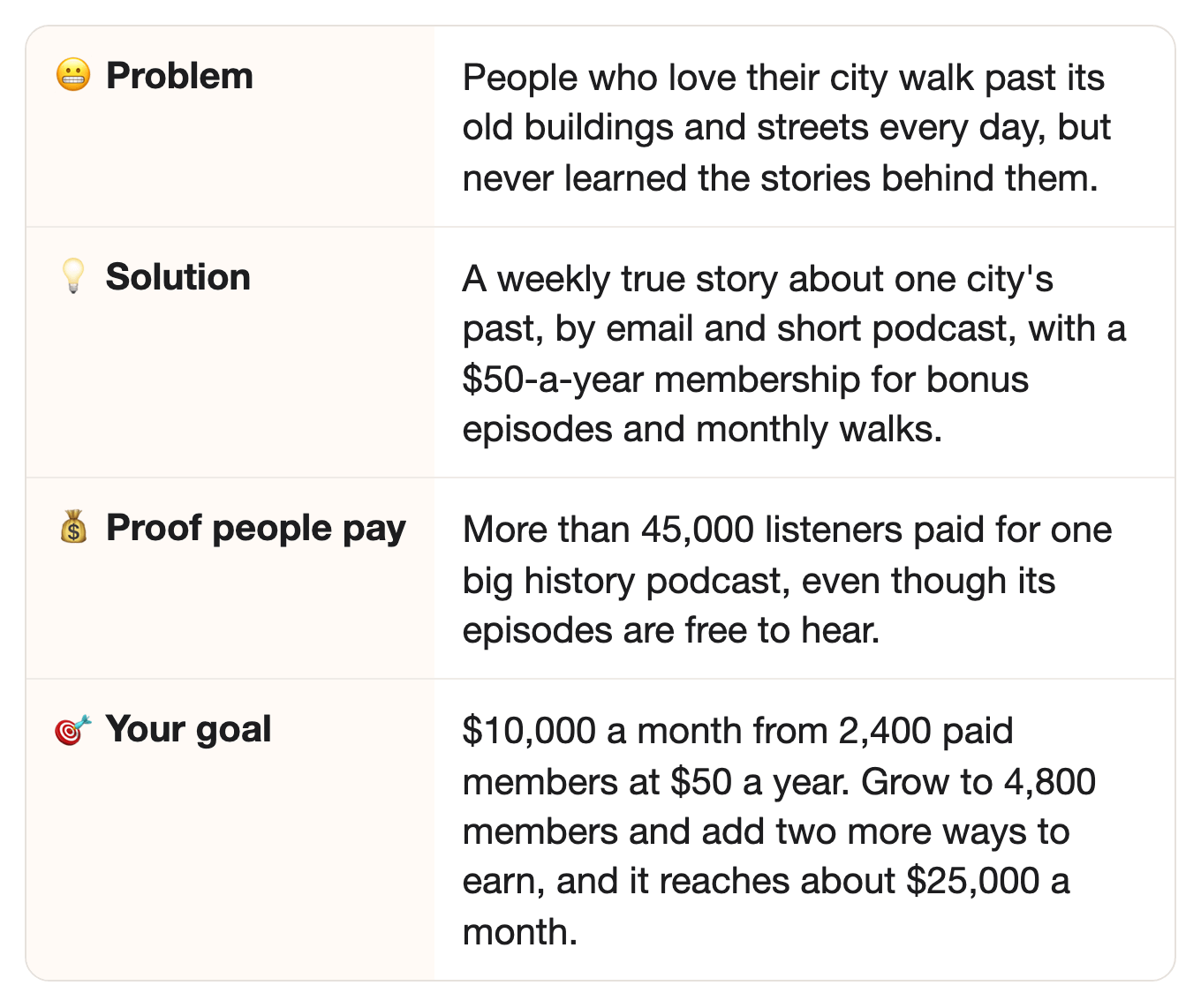
⚡ Quick facts
⠀
📖 How two historians got thousands to pay for a free show
It started with two friends who just liked telling stories.
Tom Holland and Dominic Sandbrook are British historians.
They first met nearly 20 years before the show, at a charity quiz of all places.
In November 2020, they started a podcast called The Rest Is History.
The idea was simple: two friends tell big stories from the past.
That’s the whole plan.
Dominic says listeners want history “brought to life by people who are genuine enthusiasts and love the past.”
Weird fact: the company that makes the show, Goalhanger, was co-founded by Gary Lineker.
He’s a former England soccer star, not a historian.
⠀
The episodes are free.
Paying members get early access and bonus episodes.
By October 2024, the show got 11 million downloads a month.
And more than 45,000 people paid for it, The Wall Street Journal reported.
By August 2025, it was over 15 million downloads a month.
That December, Apple named it the 2025 Show of the Year.
⠀
Then, in January 2026, Goalhanger passed 250,000 paying members across its shows.
They pay an average of £6 a month or £60 a year, about $8 and $80.
Our math: 250,000 members × £60 is about £15 million a year, or about $20 million.
That covers all its shows, including politics and soccer.
It’s an estimate, not a number they’ve shared.
Hot diggity dog. 🌭
From two friends swapping stories… to a hit inside a company making about $20 million a year, with the episodes still free to hear.
⠀
🔗 Same idea, new angle
In the story: listeners paid The Rest Is History for bonus episodes about big stories from the world’s past.
⠀In this idea: people who love one city pay for weekly stories about the streets and buildings they pass every day.
⠀Why it carries over: people pay for history told by someone who loves it, even when the main episodes are free.
⠀
💡 The opportunity
The big shows tell the world’s history. Your city’s history needs someone who lives there.
The big shows pick big topics.
The Rest Is History covers the Roman Empire, the Titanic, and Elizabeth I.
Great stuff.
But it doesn’t cover the street you live on.
⠀
But people want their own city’s stories too, a lot.
Their own words are in the proof section below.
⠀
Here’s the hook: you can stand where the story happened.
A big show can’t send its hosts to every street corner in every city.
But you can walk there, and take a photo of how it looks now.
⠀
Why one city, and not one era or one war?
Simple: every city has its own history, so every city can have its own show. 🔁
Our guess: the city stories people share most are cheerful ones: old buildings, street names, the first pizza place, a famous shop.
Locals can pass stories like these along to each other, so they have a chance to spread on their own.
⠀
👉 The idea: a weekly history story about one city, as a newsletter and a short podcast, with a paid membership at $50 a year.
⠀
🧩 What you actually need
Love for one big city or region you can get around.
You’ll go to the spots in your stories and take then-and-now photos.
So comfy shoes help. 👟
⠀
Free old sources.
Chronicling America is the Library of Congress’s free website of old US newspapers.
Your local library and historical society have more.
⠀
A source for every fact.
AI digs through the old papers for you.
You check each fact before it goes out (Step 3 of the build plan).
⠀
✅ Why this could work
Three reasons there’s real money here.
People already pay for free history shows, and not just the big one.
The Rest Is History had more than 45,000 paying subscribers (October 2024).
The Bowery Boys is a podcast about New York City history.
It has run since the summer of 2007, with 574 episodes when we checked.
That’s a long run.
And its members pay $5 to $100 a month on Patreon, a membership site.
⠀
People have bought their own town’s history for decades.
Arcadia Publishing has published local history books since 1993.
By 2009, its catalog had more than 12,000 titles.
⠀
People already look for this, a lot.
The numbers are just below. 👀
⠀
👉 Curious where these numbers come from? Every source is linked in the last section, “📎 The sources.”
⠀
📊 More proof people want this
Want more? Here you go.
People already pay for one city’s history.
Miami History is a newsletter on Substack, a newsletter website.
Substack labels it “Hundreds of paid subscribers,” at $50 a year or $5 a month.
Londonist: Time Machine, about London’s history, has the same label, at £50 a year, about $67.
Substack’s “hundreds” label is a size range, not a count, and it means at least 100.
⠀
And for one kind of history.
The Insane Archive is a newsletter about the history of everyday food.
It sent its first post in February 2026.
When we checked, Substack labeled it “Hundreds of paid subscribers,” at $70 a year.
⠀
New York’s history gets millions of views on YouTube.
When we checked, a search for “new york city history” found 50 videos with more than 70 million views.
Over 30 of those have over 100,000 views each, and over a dozen have over a million.
The most-watched, “The Reason NYC Became America’s Biggest City,” has more than 18 million.
⠀
So does Chicago’s.
The same search for “chicago history” found 50 videos with more than 23 million views.
⠀
The big picture: about 900 new history books a year, back in 2009. 💰
That’s how many Arcadia and its sister company, The History Press, said they published then.
Most of Arcadia’s books are about one town or one neighborhood.
⠀
What a Chicago local says: “Been in Chicago my entire life 47 years and never knew this.”
That’s a comment under a Chicago history video.
⠀
And someone in Berlin: “I need a series like this for my city, Berlin.”
⠀And a Londoner: “Lived in London for about 60 years and never knew any of this.”
Sixty years, and still new stories to hear.
⠀
👉 People love their city, and they want to know the stories behind its streets and buildings.
⠀
🔍 Who’s already doing it
A few players, and a clear gap next to them.
Goalhanger, the podcast company from the story above, makes big shows for the whole world.
Famous hosts, big topics, millions of listeners.
The story of one old building in your city is too small for a show that big.
⠀
The Bowery Boys is the best-known New York City history podcast, and it’s good.
It’s a podcast about New York City history, running since 2007.
But when we checked, their YouTube channel had about 2,500 subscribers.
So even New York’s best-known history podcast had a small YouTube channel.
Surprising.
And an Apple Podcasts search for “new york city history” found just 13 shows, for a city of millions.
⠀
When we checked, a few cities had a paid history newsletter.
Miami History and Londonist: Time Machine, from the proof above, are paid newsletters about Miami and London.
⠀
Here’s what we couldn’t find, when we checked, for most cities:
One story a week, as a newsletter and a 10-minute episode.
A photo of the spot then and now, and a one-minute video from the street.
A $50-a-year membership, like Miami History’s.
⠀
🔎 Check the market yourself in 2 minutes: run Part 0 of the prompt in the build plan below.
Your AI searches Substack, Apple Podcasts, YouTube, and Patreon (a membership site) for your city that day, and tells you: early, growing, or crowded.
Early? Start now.
Crowded? Good news: it means people pay. Pick one neighborhood or one theme (Step 1 of the build plan).
A crowded market is still OK. You win by serving one group better, not by being first.
⠀
👉 That gap is your chance: a weekly story about your one city, with then-and-now photos and a paid membership.
⠀
🤖 Why AI won’t replace it
AI can tell your city’s history, but you can walk people to where it happened.
Accuracy.
Every story is checked twice: by a fact-checker, then by a strict critic.
ChatGPT gets local dates right when handed the right sources, so you dig those up.
That matters, because locals spot a wrong date fast.
⠀
Judgment: you know what locals care about.
A reader doesn’t know to ask why their street has that name.
You pick the stories that make people say “I walk past that every day!”
⠀
The place itself.
You stand at the corner and take a photo of how it looks now.
AI has no new photo of your street.
It can’t walk there, but you can.
⠀
Other people.
Members join a walk once a month, and meet other people who love the same city.
⠀
Proof people pay for this: The Rest Is History is free to hear, and more than 45,000 people still paid (October 2024).
⠀
👉 People pay for the storyteller, not just the facts.
⠀
💵 How much you can make
Here’s the math.
First stop: $10,000 a month from the membership alone
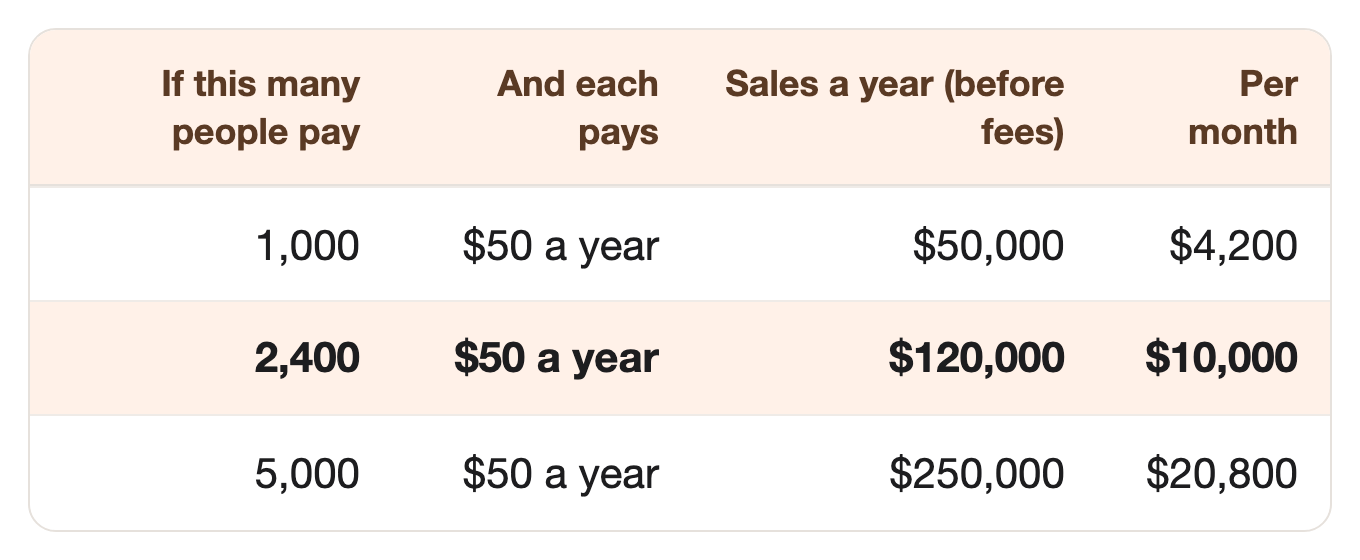
2,400 paid members is about 1% of Goalhanger’s 250,000.
⠀The $50 is Miami History’s price, so you’re not guessing what readers will pay.
Next stop: $25,000 a month, with two more ways to earn
People who love a story want to stand where it happened, or hear it told live.
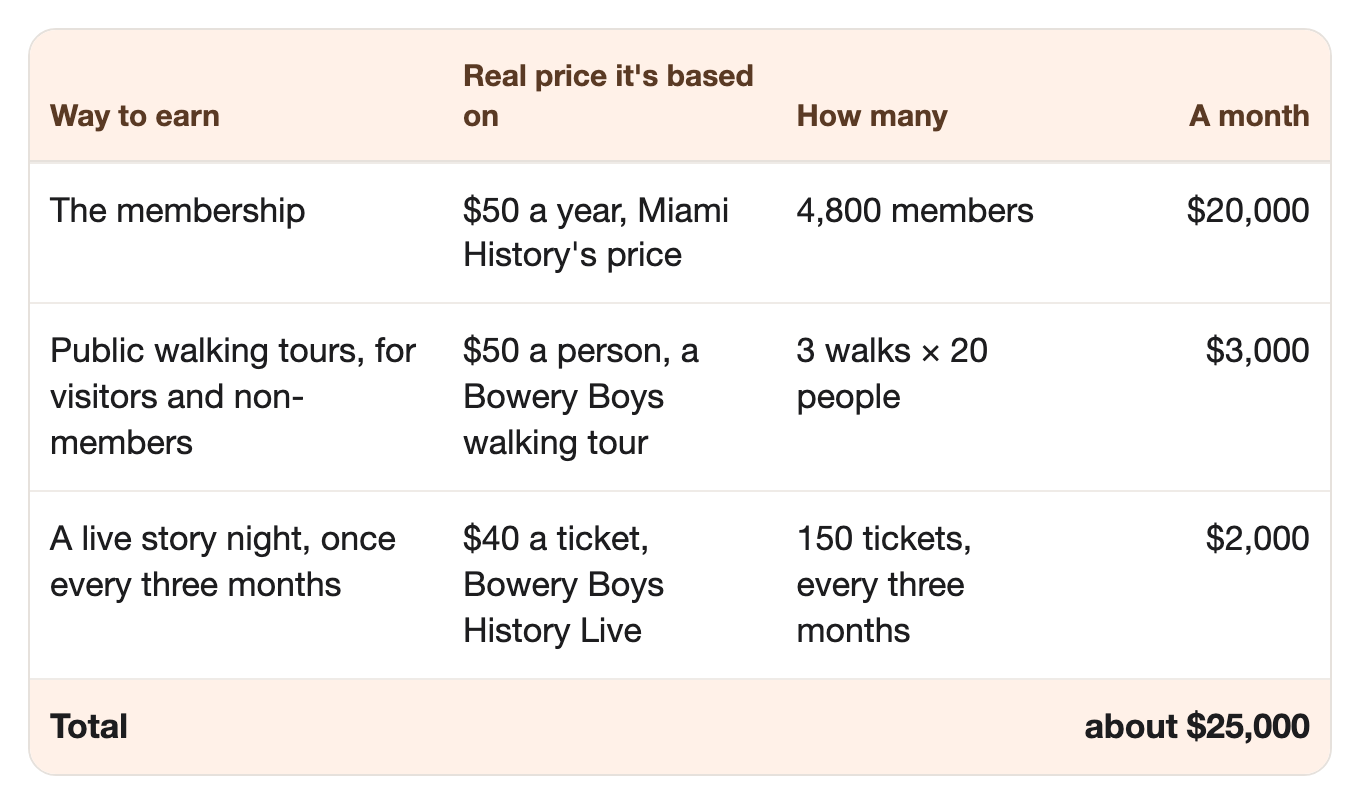
The membership still does most of the work.
Grow it from 2,400 to 4,800 members, and it brings in $20,000 a month.
Some members will pay $5 a month instead, so the real total may be a bit different.
⠀
Here’s the honest part: 4,800 members is a big club for one city.
Miami History, from the proof above, has “hundreds” of paid readers.
4,800 is about a tenth of The Rest Is History‘s 45,000, and that show covers the whole world.
So plan on years of weekly stories to get there, not months.
⠀
The walking tours sell to people outside the club.
The members’ walk stays free for members.
The public tours are for visitors, and for locals who want to try you first.
Three walks a month, 20 people each.
⠀
The live story night is a bigger version of your episode.
Tell your best stories on a stage, with old photos on a screen.
The Bowery Boys, from the proof above, run one in New York.
Four nights a year, 150 seats each.
⠀
And if it doesn’t work out? Here’s all you lose:
Substack is free to start. It keeps 10% of what readers pay, plus card fees, so it costs you only when someone pays.
One month’s subscription to an AI app, like ChatGPT or Claude.
A few evenings of walking around your own city.
One week of your time.
⠀
👉 That’s the math for $25,000 a month, all from one city’s stories.
Run two or three of these, from this newsletter or a niche close to this one. Together, they could pass a million dollars in total in two or three years.
For this club, a similar niche could be the history of one state’s small towns. And this club could be your first idea.
Itching to build this one?
The step-by-step plan is right below. 👇
Just browsing? All good. A new idea comes next week.
That’s it, my fellow contrarians! 🙌
Yours ‘handing you ideas with the proof attached’ Vijay Peduru 🦸♂️
⠀
⠀
⠀
🧰 Want to build it? Here’s everything else.
AI does the digging and the drafting. You check, walk, and tell. 🎙️
⠀
Step 1: 🗺️ Pick your city and your angle
You don’t need a history degree. You need one big city or region you love.
Pick the city you know best.
Where you live now, or where you grew up.
Pick a big one, like New York or Chicago, so enough people can join.
Live in a smaller city? Cover your whole state or region instead.
You need to be able to get to the places in your stories.
Pick an angle, so readers know what they get.
For example: “the story behind one old building, every week.”
Or “why our streets have the names they have.”
Or “the history of what we eat here.”
Pick cheerful stories first.
Buildings, shops, foods, inventions, and local characters.
Skip stories built around disasters. They’re hard to tell well, and they’re not what makes locals share.
⠀
Step 2: 📚 Dig up the stories
AI reads the old newspapers. You pick the stories worth telling.
Find the sources.
Chronicling America, from the Library of Congress, has free old US newspapers you can search.
Your local library and historical society have old photos, maps, and city records.
Let AI read them and pull out the stories.
Who, what, when, and where, with the source for each fact.
Make a list of 30 stories, and pick the first five.
⠀
Step 3: 🔍 Check every fact
Your name is on every story, and locals will notice a wrong date.
Your AI does all three passes for you: it writes in Part 2, and checks in Parts 3 and 4 of the prompt.
🖊️ The AI writer. AI drafts each story from your sources only.
🔍 The AI fact-checker. A second pass opens every source, and confirms every date, name, and address.
🧐 The AI critic. A third pass hunts for local myths, mixed-up names, and anything told as fact that’s really a legend.
Optional: ask someone at your local historical society to read your first five stories.
⠀
👉 The prompt already follows three safety rules: a source for every fact, legends labeled as legends, and photos you’re allowed to use.
⠀
Step 4: 🎙️ Make the story
One story, made twice: a newsletter to read, and a short episode to hear.
Write the newsletter, with a then-and-now photo.
Record the same story as a 10-minute episode.
Your own voice on your phone is enough to start.
Using an AI voice instead? Say so at the start of every episode: “This episode is read by an AI voice.”
Put the same line in the show notes, the text that goes with each episode.
Credit every old photo, and use only public-domain ones (free to use because the copyright has run out) or ones you have permission for.
⠀
Step 5: 🏪 Open your membership
Copy the big show’s setup: free stories, extras for members.
Start a free Substack. It can host the newsletter and the podcast.
Set your prices.
$50 a year, or $5 a month, like Miami History.
Decide what’s free and what’s paid.
Free: one story a week.
Paid: bonus episodes, early access, the full archive, and a members’ walk once a month.
⠀
Step 6: 📣 Get your first members
Locals bring locals. Give your most active readers something to host, share, and talk about.
Give your five most active members a walk route and a title, so they can host monthly neighborhood walks.
Your AI plans each route, with five stops and the story behind each, in Part 6 of the prompt.
Call each host a “Walk Leader,” and list every walk in your newsletter.
Start a 20-person group chat of locals who share old photos of one street.
Invite people you know first, like neighbors and the regulars at a corner shop.
Then invite likely members slowly, a few each week.
Put one month’s marketing budget toward repainting a faded old shop sign.
Ask the owner first, and check with the city in case the building has rules.
Then tell the sign’s story in your newsletter, with the before and after photos.
⠀
Step 7: 🏃 Eliminate competitors
Copycats will come. Here’s how you stay first.
Build a dated archive of readers’ family photos of the city.
Ask permission for each one, and note the street, the year, and who sent it.
Every month it grows, and a new show would have to start from zero.
Give members a name that belongs to your city, like “Old Town Regulars.”
Use it in every issue and every episode.
A local who calls themselves a Regular has a reason to stay when a copycat shows up.
⠀
Step 8: 🎲 Make it bigger
Every city has its own history, and your members want more of yours.
Add the two extras from “How much you can make,” one at a time.
First the public walking tours, since you already walk the routes with members.
Then a live story night every three months, once your best stories have a following.
Turn the best stories into a book, like the ones Arcadia sells.
Start a second city with a partner who lives there. You bring the system, they bring the streets.
One city club at about $25,000 a month is about $300,000 a year, before fees. 🎯
Add two or three more cities, or ideas from this newsletter, and a million dollars in total is two or three years away.
⠀
🗓️ Your first week
Phew. That was a lot. 😅
Steps 1 to 6 fit into seven days. 🚀
By day 7, you have a Substack, one checked story, one episode, and your first group chat.
The prompt below has six Parts, and they’re not the same as the Steps above.
Day 1 (Step 1): Run Part 1 of the prompt (it’s below) to pick your angle and your first 30 stories.
Days 2–3 (Steps 2 and 3): Research one story with Part 2, then check it with Parts 3 and 4.
Day 4 (Step 4): Walk to the spot, and take your then-and-now photo.
Day 5 (Steps 4 and 5): Write the issue and the episode script with Part 5, record it, and open your Substack.
Days 6–7 (Step 6): Plan your first walk and write your invite with Part 6, then start your group chat.
⠀
🏄 How to use the prompt
One prompt does all the AI work, in six parts, plus a quick market check (Part 0).
Part 1 — Pick the angle. Helps you choose your angle, and lists 30 stories to tell.
Part 2 — Research a story. Pulls the facts from your sources, with the source for each one.
Part 3 — Check every fact. Opens every source, and confirms each date, name, and address.
Part 4 — Find the mistakes. Hunts for myths, mix-ups, and legends told as fact.
Part 5 — Write the issue. Turns the story into a newsletter, an episode script, and your welcome post.
Part 6 — Plan the walk and the invite. Plans a walk a member can host, and writes your group-chat invite.
Run it your way:
Part by part (the default): it pauses after each part, and you type “next” to go on.
All at once: say “run all six parts.”
Just one part: say “only do Part 3,” or any part you need.
The full prompt is just below, under “📋 The prompt.”
🎙️ Talk to your AI sidekick, don’t type.
Turn on voice mode, or use a dictation app like Wispr Flow.
Say it messy. The AI sorts it out.
Turn it into a skill, so you never paste it again.
Paste the prompt into Claude or ChatGPT, and say: “Turn this into a skill I can save.”
Install once, use forever.
⠀
📋 The prompt
The prompt (copy it into Claude or ChatGPT, fill in the INPUTS part, and run it your way)
CONTEXT:
- You're my local-history partner. Together we'll build a weekly history newsletter and short podcast about one big city or region, with a paid membership.
- When I say "my city," I mean the city or region in INPUTS.
- This prompt has six parts, in order.
- Run it the way I ask:
    - If I say nothing, go one part at a time. After each part, show me the result, then stop and wait. Move on only when I type "next."
    - If I say "run all six parts," do them all without stopping.
    - If I say "only do Part 3" (or any part), do just that part.
- If a part needs something from me, ask for it before you start that part.
- Use only the sources I give you or real sources you can open, like old newspapers on Chronicling America (Library of Congress), library archives, and published books. Never invent a fact, a date, a name, or a quote. If you can't find a source, leave the fact out.
- Label anything that's a legend or a local story as a legend, not a fact.
- If you can't open a link I give you, ask me to attach the file instead.
- Keep web search on for the whole prompt (turn on search in ChatGPT or Claude), so you can open any page you need to check.

=============== INPUTS — edit these, or just run as is ===============

My city or region:
{e.g. Chicago, or my whole state if I live in a smaller city}

My angle:
{e.g. the story behind one old building, every week}

My sources (paste links, or attach files):
{e.g. Chronicling America search results, my library's old photo archive, a local history book I own}

How I'll make the audio:
{e.g. my own voice on my phone, or an AI voice that I'll label as AI}

My prices:
{e.g. $50 a year, or $5 a month}

======================== END OF INPUTS ========================

THE PARTS:

Part 0 — Check the market today.
This part needs web search (turn on search in ChatGPT or Claude). Search for history content about my city and, for each place, give the count, the three biggest with links, and their prices:
1. Substack newsletters about my city's history (include Substack's paid label, like "Hundreds of paid subscribers," and explain it's a minimum, not a count).
2. Podcasts about my city's history on Apple Podcasts, with episode counts.
3. YouTube channels about my city's history, with subscriber counts.
4. Patreon pages, walking tours, and local history books about my city.
Then tell me: early (few sellers), growing, or crowded, and which neighborhood or theme looks least served. Give a link for every number. If you can't open a page, say so. Never guess a number.

Part 1 — Pick the angle.
Ask me five questions about my city and what I love about it. Then suggest three angles, and say why for each. Say clearly which reasons are your guess. Help me pick one. Then list 30 story ideas for that angle, with one line each. Favor buildings, streets, shops, foods, inventions, and local characters. Leave out stories built around disasters or deaths. Mark the five best to start with, and say why.

Part 2 — Research a story.
Ask me which story to research first. Then, from my sources and real sources you can open:
1. The story in one sentence.
2. The key facts, as short bullets: who, what, when, and where. Give the source link for every fact.
3. The exact address or spot today, so I can walk there.
4. Any old photos I could use, with the link, and whether each one is public domain.
5. Anything you couldn't confirm, listed separately.

Part 3 — Check every fact.
Now act as a separate fact-checker who didn't do this research. Open every source. Mark each fact: matches the source, doesn't match, or has no source. Check every date, name, spelling, and address. For each problem, show what the source actually says. Then give a fixed version.

Part 4 — Find the mistakes.
Now act as a strict local historian reading this before anyone else sees it. Hunt for:
1. Local myths and legends told as fact.
2. Mixed-up names, dates, or buildings with similar names.
3. Anything that could upset or mislead a local reader.
4. Any photo without a clear right to use it.
Then give the final, checked story, with every fix made.

Part 5 — Write the issue.
Turn the final story into:
1. A newsletter issue, under 600 words, in a warm, plain voice. Start with the spot as it looks now, then go back in time. End with where to stand to see it.
2. A 10-minute episode script of the same story, written to be read out loud. If I'm using an AI voice, the first line must be, word for word: "This episode is read by an AI voice."
3. My welcome post: who it's for, my angle, what's free, what's paid, and my prices.
Credit every photo. Never invent a quote.

Part 6 — Plan the walk and the invite.
Write:
1. A walk route a member can host: five stops near this story's spot, the address of each, and a two-line story for each, from checked facts only.
2. A one-page guide for the member who hosts it: the route, a start time, the title "Walk Leader," and a reminder to keep everyone on the sidewalk.
3. A short invite to a local I know, asking them to join a group chat that shares old photos of one street.
Never invent a fact, a date, or a story.

When all six parts are done, ask if I want to repeat Parts 2 to 6 for the next story.
⠀
📎 The sources
Every number above, with where it came from.
The Rest Is History* start · Number: Launched November 2, 2020; produced by Goalhanger; co-founders include Gary Lineker · Source: Wikipedia: Goalhanger
Gary Lineker · Number: Former professional footballer; played for England 1984–1992 (80 caps); “In 2018, he cofounded Goalhanger” · Source: Wikipedia: Gary Lineker
Downloads and paying subscribers · Number: “11m monthly downloads, 1.2m YouTube views, and over 45,000 paying subscribers” · Source: Bojan Pancevski, “How Two Irreverent Historians Made Their Podcast a Global Sensation,” The Wall Street Journal, October 25, 2024 (paywalled; figures read in the author’s own post linking the article, October 25, 2024, and in Wikipedia)
Members’ extras · Number: Members get early access and bonus episodes · Source: Same Wikipedia page
Dominic Sandbrook’s quote · Number: History “brought to life by people who are genuine enthusiasts and love the past” · Source: The Telegraph, June 9, 2024, as quoted by the same Wikipedia page
How the hosts met · Number: First met nearly 20 years earlier, at a charity quiz; “over 15m audio downloads” a month · Source: Prospect, August 4, 2025
Show of the Year · Number: Apple Podcasts’ 2025 Show of the Year; episodes cover the Roman Empire, the Titanic, Elizabeth I · Source: Apple Newsroom, December 4, 2025
Goalhanger’s paying members · Number: “surpassed 250,000 paying members across its network of shows”; “an average of £6 per month or £60 per year”; membership on 8 of its 14 shows · Source: Televisual, January 16, 2026
Goalhanger’s yearly income from members · Number: Around £15 million a year, an estimate from 250,000 × £60 (the same math as ours) · Source: Press Gazette, January 16, 2026
Pounds to dollars · Number: $1.34 per £1 (1.3376), so £6 ≈ $8, £60 ≈ $80, £50 ≈ $67, £15 million ≈ $20 million · Source: x-rates.com
The Bowery Boys · Number: Started “during the summer of 2007” · Source: Bowery Boys: About
The Bowery Boys* episodes · Number: 574 episodes · Source: Apple Podcasts search, “new york city history”
The Bowery Boys* membership · Number: Patreon tiers of $5, $10, $25, and $100 a month · Source: Patreon: The Bowery Boys
The Bowery Boys* on YouTube · Number: About 2,520 subscribers · Source: YouTube Data API, channel @BoweryBoys
Arcadia Publishing · Number: Founded 1993; “more than 12,000 titles”; with The History Press, “900 new titles every year”; publishes “neighborhood, local, and regional history” · Source: Wikipedia: Arcadia Publishing; the 12,000 and 900 figures are cited there to Arcadia’s own “Our Story” page, archived 2009 (Arcadia’s site blocked our reader)
Miami History · Number: “Hundreds of paid subscribers” (at least 100); $50 a year or $5 a month · Source: Substack public API, History category, paid ranking; re-checked in the publication data on Miami History’s about page
Londonist: Time Machine · Number: “Hundreds of paid subscribers”; £50 a year or £7 a month · Source: Substack public API, History category, paid ranking; re-checked in the publication data on Londonist: Time Machine’s about page
The Insane Archive · Number: “Hundreds of paid subscribers”; $70 a year; first post February 3, 2026 · Source: Substack public API, History category, paid ranking; re-checked in the publication data on The Insane Archive’s about page
YouTube: New York · Number: Search “new york city history” (videos, English, top 50, no hand filtering): two runs gave 77.6 and 72.8 million views; 34 and 32 with 100,000+; 14 and 13 with 1 million+ (search results shift, so the issue prints the lower floor) · Source: YouTube Data API
Most-watched New York video · Number: “The Reason NYC Became America’s Biggest City”: about 18.3 million views · Source: YouTube
YouTube: Chicago · Number: Search “chicago history” (videos, English, top 50, no hand filtering): 23.5 and 23.7 million views in two runs · Source: YouTube Data API
Apple Podcasts: New York · Number: 13 shows for the search “new york city history” · Source: Apple Podcasts search
Comment: Chicago · Number: “Been in Chicago my entire life 47 years and never knew this.” · Source: YouTube comment, 2024
Comment: Berlin · Number: “I need a series like this for my city, Berlin.” · Source: YouTube comment, 2020
Comment: London · Number: “Lived in London for about 60 years and never knew any of this.” · Source: YouTube comment, 2020
Walking tour price · Number: “$50 per person — all-in pricing,” Historic Haunts of Lower Manhattan, a 90-minute walk (no date on the booking page) · Source: Bowery Boys Walks
Live story night price · Number: “Tickets $40,” Bowery Boys History Live at City Vineyard, called “an all-new, ongoing live event” (February 4, 2025) · Source: Bowery Boys
Substack’s cut · Number: Writers “keep 90% of their revenue minus credit card fees” · Source: Substack: Going paid
Old newspapers · Number: Free searchable US newspapers · Source: Library of Congress: Chronicling America