


Hello contrarians,
Today’s idea is called The Job-Switch Kit.
Pour yourself a tea. 🍵
First, a broke graduate’s story. Then, the business you could build from it.
⠀
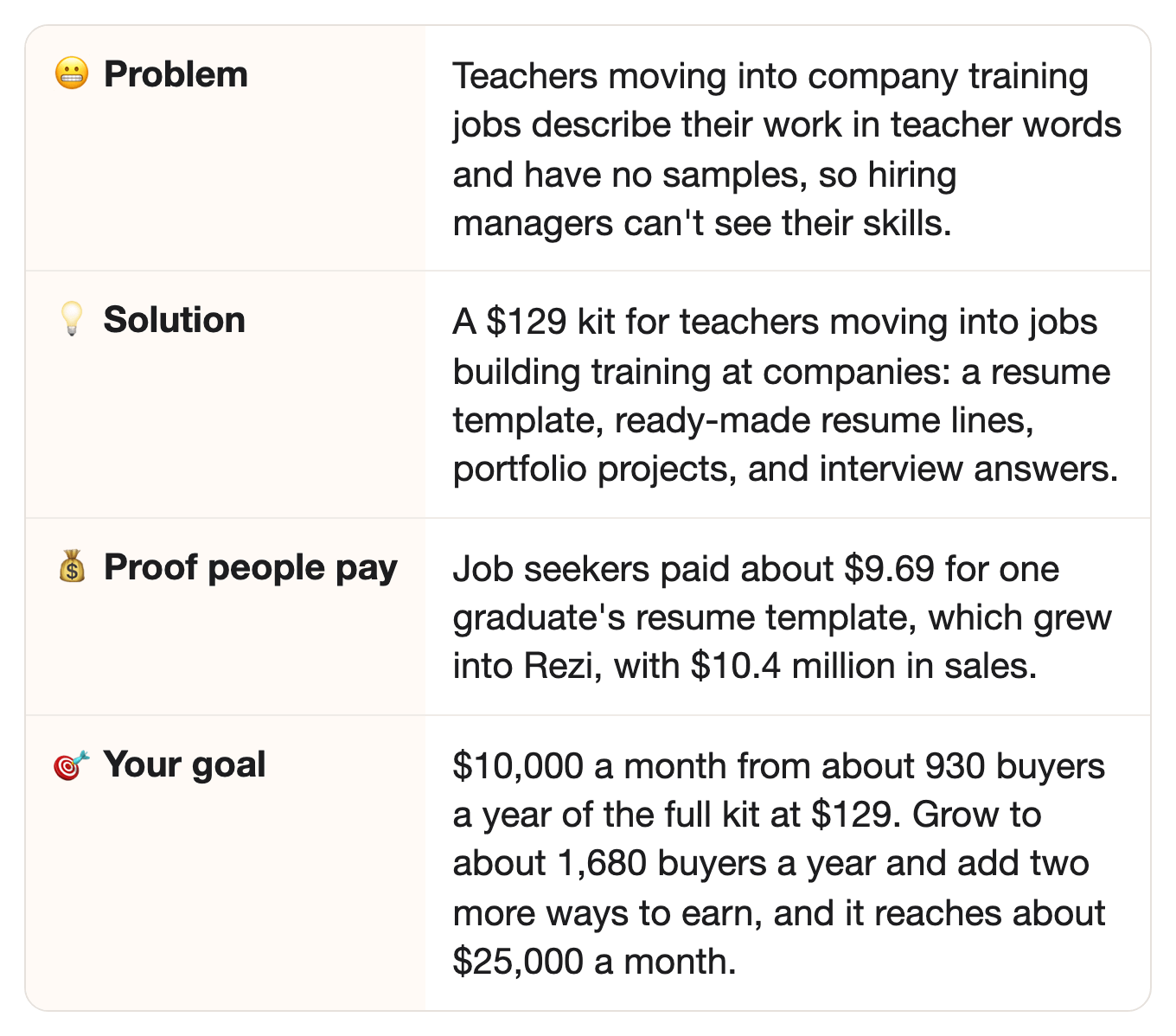
⚡ Quick facts
⠀
📖 How a $9.69 Word file grew into $10 million in sales
It started with his own resume.
In 2015, Jacob Jacquet has just finished college.
And his grades? Not great: his GPA (grade average, out of 4.0) is 2.2.
Still, he gets job interviews, and he says that’s largely thanks to his resume.
So he shares his resume online.
In his words, “the feedback was incredible.”
He turns it into a product: a Microsoft Word file, plus a short guide on how to fill it in.
No joke: his price is about $9.69.
Yep, under ten bucks.
⠀
He keeps going, and in September 2019 Rezi launches as an app.
Rezi helps anyone write a resume that gets past the software companies use to sort applications.
Later, Rezi takes money from investors, so it’s no longer a one-person shop.
When we checked, Rezi had brought in $10.4 million in sales, in total.
In 30 days (to October 22, 2026), it brought in $215,851 in sales.
TrustMRR, a site that checks revenue, pulls those numbers straight from Rezi’s payment account.
So these numbers aren’t just his word.
Mamma mia. 🤌
From a graduate with weak grades, to $10 million in sales, and it all started with the resume that got him interviews.
⠀
🔗 Same idea, new group
In the story: job seekers paid Jacob Jacquet about $9.69 for a copy of the resume that got him interviews.
⠀In this idea: teachers moving into training jobs need a resume, samples, and interview answers built for that one switch.
⠀Why it carries over: both groups need a resume that gets interviews, and would rather copy one that worked than start from a blank page.
⠀
💡 The opportunity
Rezi helps every job seeker. People switching jobs need help with one move.
First, what’s an instructional designer?
It’s the person who builds training for a company.
Think of the onboarding course for new hires, the safety lessons, or the sales training.
Yep, somebody builds those.
⠀
Teachers already do half of this job.
They plan lessons, test what works, and explain hard things simply.
Even the US government’s job guide lists teaching as useful experience for training jobs.
⠀
But their resume speaks school, not company.
It says “lesson plans” and “classroom management.”
The hiring manager is looking for “training programs” and “learner results.”
And they want a portfolio: real samples of training you’ve built.
It’s a translation problem.
⠀
Here’s what’s wild: a new group of teachers faces this every year.
8% of US public school teachers left the job in one year (2021–22).
That’s the same rate as the last time it was measured, in 2012.
So it wasn’t a one-time spike.
Not all of them switch careers, though: one of the top reasons teachers gave for choosing to leave was to retire.
👉 The idea: sell a job-switch kit for teachers moving into instructional design.
The resume template, and a bank of ready-made lines that turn teacher words into company words.
Three portfolio projects they can make in a weekend.
30 interview questions, with sample answers.
A plan for their first 90 days in the new job.
A cheap starter kit, the full kit, and an optional monthly plan that keeps it updated.
⠀
🙋 Never made this switch yourself? You can still build this.
Become the interviewer.
Talk to 10 to 20 people who made the switch, on a podcast or newsletter, with their permission.
Their stories become your kit, and every interview is also content.
Two jobs done with one chat.
⠀
Team up with one.
A working instructional designer brings the know-how.
You build the kit with AI and find the buyers.
⠀
Or use your own switch.
Engineer to product manager, or nurse to health tech.
The steps are the same.
⠀
✅ Why this could work
Three signs the money is real.
Resume products already make real money, big and small.
Rezi, from the story, went from a $9.69 template to $215,851 in sales in 30 days.
By Recruiters, one recruiter’s resume shop, said in 2023 it had sold over 8,500 resume templates and made over $40,000 a year.
Teacher Career Coach sells a $129 course to teachers leaving the classroom, and says it has helped thousands.
So people buy at the big end and the small end.
⠀
Resume templates have sold since 2015, and they still do.
Two big resume shops on Etsy, CoResume and TheStandOutResume, had been selling templates for six and eight years when we checked.
And teachers keep leaving: 8% left the job in one year (2021–22).
⠀
The searches are already there.
The numbers are in the next section.
⠀
👉 Want to check these numbers? Each one has a source link in the last section, “📎 The sources.”
⠀
📊 More proof people want this
Want more? Here you go.
People already pay for resume templates.
CoResume is a resume-template shop on Etsy, a website where small shops sell digital files.
It has 63,000 sales at $7.95, rated 4.9 from about 5,000 reviews.
That’s one shop, on one website.
⠀
Teachers pay for help leaving the classroom.
Teacher Career Coach charges $129 for its course, with resume templates and interview prep.
⠀
People pay more to learn the new job.
Peck Academy, a school for instructional designers, starts at $5,400.
Not a small check.
Design for How People Learn, a book on the craft, has 1,062 ratings on Amazon.
⠀
Lots of people watch videos about this switch (YouTube).
A YouTube search for “teacher to instructional designer” and two similar phrases finds 207 videos, with about 2.1 million views.
Devlin Peck’s channel, all about this career, has about 80,800 subscribers.
⠀
People search Google for it every month.
“teacher resume” gets 5,400 searches a month.
“jobs for former teachers” gets 4,400.
⠀
The big picture: the US had about 3.5 million public school teachers in 2020–21. 💰
8% of them left the job in one year (2021–22).
And there were about 472,500 training and development jobs in 2025, paying a median of $69,280.
The median means half earn more and half earn less.
⠀
What a teacher wished for.
“I wish there was a class I can take to get my portfolio in shape without a big investment.”
That’s a comment under a popular instructional-design video.
Hold on to that one; it comes back later.
⠀
And one who made it.
“Just landed my first job offer for a corporate Learning & Development role after being burned out from 10 years as a K-12 teacher.”
Learning & Development is a company’s training team.
K-12 means kindergarten through 12th grade.
⠀
👉 Teachers want out, and they’re already paying for help getting there.
⠀
🔍 Who’s already doing it
Who’s in the space, and what they skip.
Rezi, the resume app from the story above, serves every job seeker, in every job.
It’s a resume tool, not a guide for one switch.
Our guess: it won’t narrow to teachers, since that would shrink its market.
⠀
Teacher Career Coach sells a course that helps teachers leave for many different jobs.
It names jobs from instructional designer to project manager to account executive.
It covers the whole “leaving teaching” question, not one new job in depth.
⠀
Peck Academy teaches the whole job of instructional design.
Instructional design means building training for companies.
It’s a full program, starting at $5,400.
Some teachers want a cheaper first step, like the viewer above who asked for a class “without a big investment.”
⠀
When we checked Etsy:
There were lots of teacher resume templates, made for teachers applying to schools.
There were a few teacher career-change kits, and the ones we opened had few sales.
We didn’t find a low-priced kit for one switch, built from real job posts: resume, portfolio, interview, and first 90 days together.
So that’s the gap.
⠀
🔎 Check the market yourself in 2 minutes: run Part 0 of the prompt in the build plan below.
Your AI searches Etsy, Gumroad (a site for selling digital files), YouTube, and course sites that day, and tells you: early, growing, or crowded.
Early? Start now.
Crowded? Good news: it means people buy. Pick a narrower group, like high school teachers moving into tech companies.
A crowded market is still OK. You win by serving one switch better, not by being first.
⠀
👉 That missing part can be your business: one kit for teachers moving into instructional design, with the resume, portfolio, interview, and first 90 days together.
⠀
🤖 Why AI won’t replace it
AI writes them a resume. You show them how to get hired.
Could ChatGPT just do this?
Sort of, if a teacher first hands it 30 real job posts and a clear brief.
Few teachers do that first part.
You choose what’s right for them.
A teacher doesn’t know which of their skills a company cares about.
You know, because you made the switch, and you say what to cut.
⠀
Your kit is built from real job posts.
It’s built from 30 real job posts, and refreshed when they change.
ChatGPT tailors advice well when you paste in real job posts, but few teachers collect 30 first.
⠀
It’s ready to use: fill it in, and it’s done.
It has a template, a bank of ready-made lines, three portfolio projects, and practice answers.
ChatGPT could build all of this, given the posts and a clear brief, but a tired teacher won’t write that brief.
⠀
You’ve been there.
They trust someone who left the classroom and made it.
⠀
Proof people pay for a finished kit: free resume templates are everywhere, and CoResume still has 63,000 sales at $7.95.
Remember, that’s one Etsy shop.
⠀
👉 Free resume advice is everywhere. A kit that’s ready to use isn’t.
⠀
💵 How much you can make
Quick math time. 🧮
First stop: $10,000 a month from the full kit alone
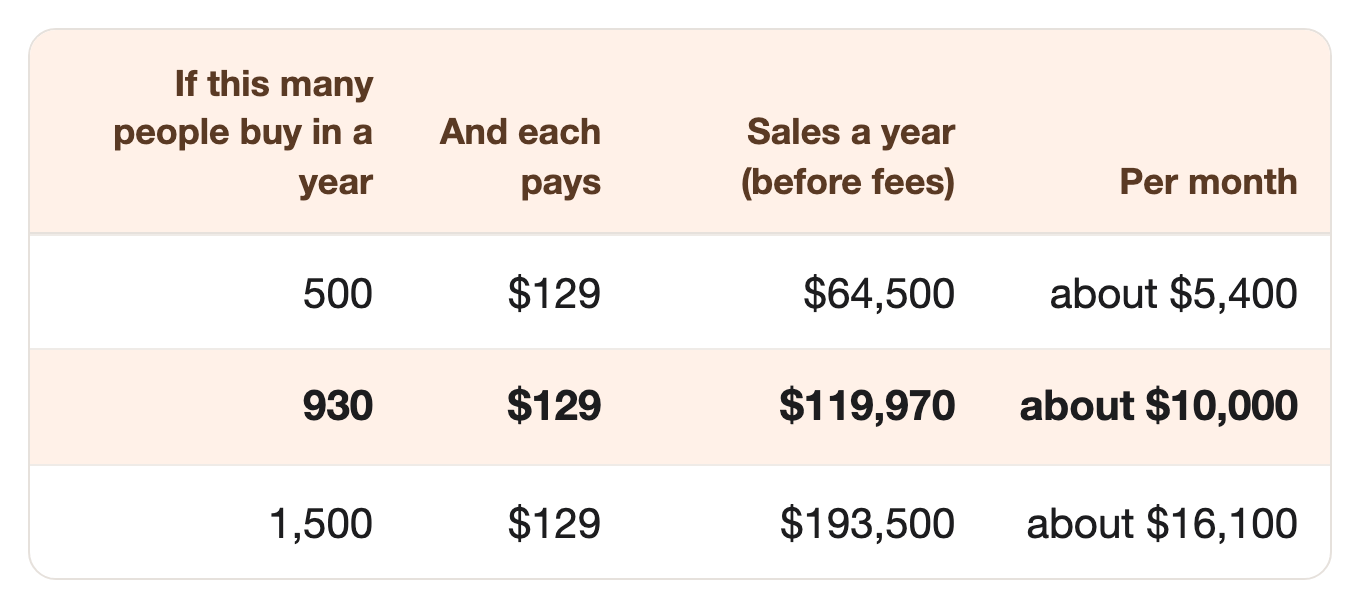
$129 is the full kit’s price, the same as Teacher Career Coach’s course.
That course also bundles resume templates and interview prep, so the full kit is priced like a course, not like a single template.
A template on its own sells for much less: $7.95 at CoResume on Etsy.
⠀
930 buyers a year is about 2% of the training jobs that open each year.
That’s about 46,000 instructional design and training jobs open each year.
Next stop: $25,000 a month, with two more ways to earn
Some teachers want less than the full kit, and some want help until they’re hired.
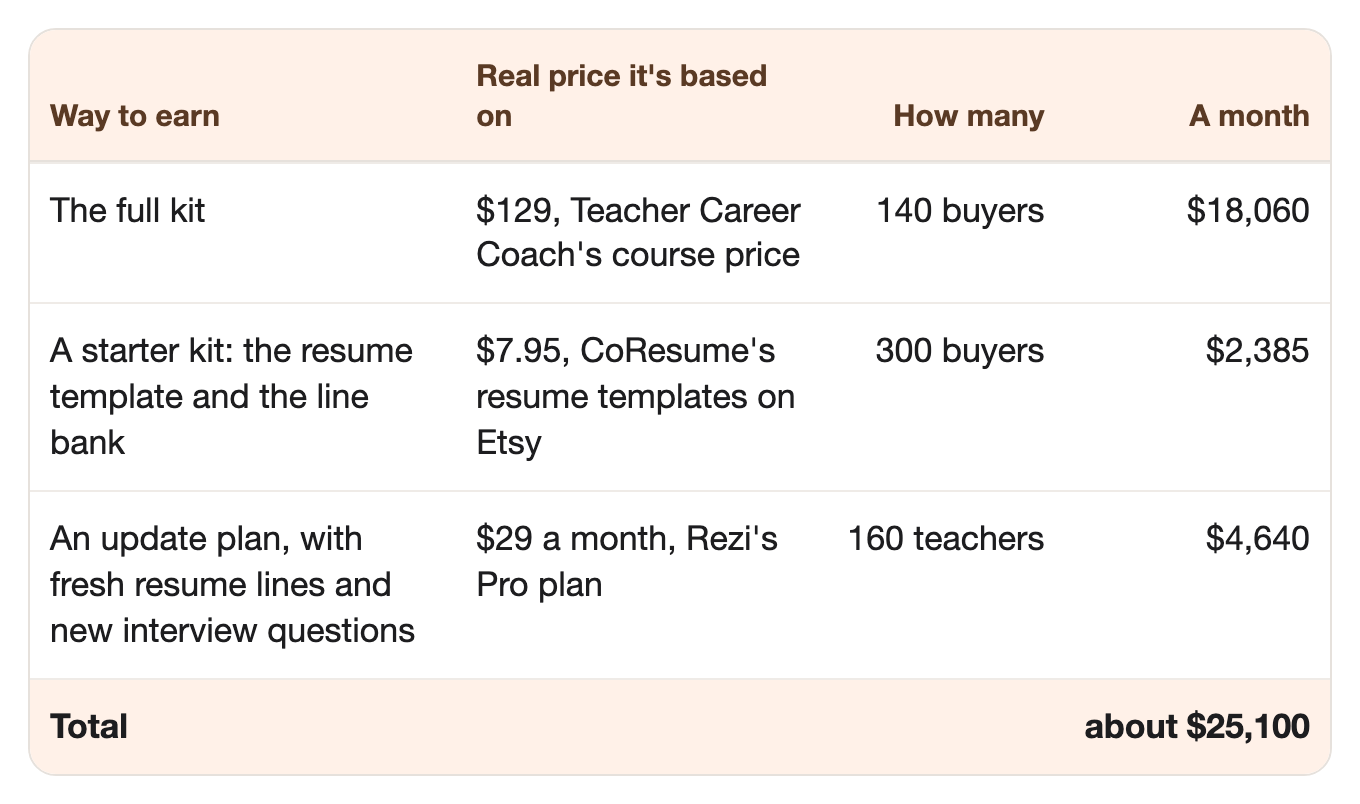
The full kit still does most of the work.
Grow it from 930 to about 1,680 buyers a year (140 a month), and it brings in $18,060 a month.
That’s about 4% of the 46,000 training jobs that open each year.
⠀
The starter kit catches teachers who aren’t sure about switching.
At $7.95, it’s an easy first buy.
Some of them come back for the full kit later.
⠀
The update plan is for teachers still looking.
Each month, they get new resume lines and interview questions from fresh job posts.
Most cancel once they’re hired, so you keep finding new ones.
160 at a time is about one in ten of your full-kit buyers in a year.
⠀
And if it doesn’t work, here’s everything you lose:
$0.20 to list the kit on Etsy.
The $29 update plan runs on a paid email tool like Substack: free to start, it takes 10% only when someone pays.
One month’s subscription to an AI app, like ChatGPT or Claude.
One week of your time.
That’s it.
⠀
👉 So one kit, done well, adds up to about $25,000 a month.
Most million-dollar totals come from a few ideas, not one. Take two or three from this newsletter, or one idea across a few niches, and give it two or three years.
For this kit, a similar niche could be nurses moving into health tech. And this kit could be your first idea.
Did this one make you think “wait, I could do that”?
Then keep scrolling. The whole build plan is below. 👇
If not, no worries. See you next week with a new idea.
That’s it, my fellow contrarians! 🙌
Yours ‘finding you small niches with real money in them’ Vijay Peduru 🦸♂️
⠀
⠀
⠀
🧰 Want to build it? Here’s everything else.
In every step, AI does most of the work. You mostly talk. 🎙️
⠀
Step 1: 🗺️ Map the switch
You don’t guess what companies want. You read what they ask for.
Good news: the job posts are free to read.
Collect 30 real job posts for entry-level instructional designers.
Copy them from LinkedIn, Indeed, or company career pages.
Let AI read all 30.
It lists the skills, tools, and words that show up most.
It splits them into “teachers already have this” and “teachers need to build this.”
Then let AI interview you about your own switch.
What you changed on your resume, what you built for your portfolio, which questions caught you off guard.
Teaming up, or interviewing others? The AI interviews them instead, with their permission.
🎙️ Talk, don’t type. Ramble like you’re helping a friend over coffee. The AI cleans it up.
⠀
Step 2: 🛠️ Build the kit
Five pieces, in the order a teacher needs them.
The resume template. A clean Word and Google Docs file, with notes on what goes where.
That’s exactly how Jacob started: one file, plus a guide.
The line bank. About 50 ready-made resume lines that turn teacher words into company words.
“Planned lessons for 120 students” becomes “Designed training for 120 learners, and measured the results.”
Three portfolio projects. Each one turns a lesson they already taught into a training sample a company would recognize.
30 interview questions, with sample answers built from real classroom stories.
A first-90-days plan, so the new job starts strong.
⠀
Step 3: 🔍 Check every piece
Your name is on the kit, so every piece gets two checks after it’s written.
Your AI does all three passes for you: it writes in Parts 2 to 5, and checks in Part 6 of the prompt.
🖊️ The AI writer. It writes each piece from your job posts and your interview only.
🔍 The AI checker. A second pass matches every skill and word back to the job posts.
🧐 The AI critic. A third pass reads the kit as a tough hiring manager, and flags anything weak or vague.
Optional: pay a working instructional designer once to review everything before you launch.
⠀
👉 The prompt already follows three safety rules: never promise a job, label every sample as made up, and never use real students’ or schools’ names.
⠀
Step 4: 🏪 Open your store
Two prices: a cheap starter, and a full kit priced like the course that already sells.
Set your prices.
A starter kit (the resume template and the line bank) at $7.95, like CoResume’s templates on Etsy.
The full kit at $129: it adds the portfolio projects, the interview answers, and the 90-day plan.
That’s the price of Teacher Career Coach’s course, which also includes resume templates and interview prep.
An optional update plan, $29 a month, like Rezi’s Pro plan, with fresh job-post lines and new questions.
Buyers cancel once they’re hired.
Pick where to sell. Etsy, Gumroad, or your own website.
Write your listings with the words teachers actually search for, like “teacher resume” and “jobs for former teachers.”
⠀
Step 5: 📣 Get your first buyers
Teachers weighing a switch are already searching and watching. Meet them there, and let happy buyers pass the kit on.
Write honest comparison pages, like “Instructional designer vs corporate trainer: which fits a teacher?”
One page for each choice teachers weigh, with the pay range, the daily work, and what each role asks for.
Say plainly where the other path wins, and link the kit for the switch it fits.
Make the kit’s last page: “Got the job? Send this to one teacher friend.”
Add a short link that opens the starter kit, so the friend gets something useful right away.
A teacher who just made the jump knows five more who want out.
Offer teacher-career-change creators a share of each kit they sell.
Find YouTubers and newsletter writers who made the same switch, and give each one their own link.
They pay nothing up front, and you pay only when a kit sells.
⠀
Step 6: 🏃 Eliminate competitors
If ten competitors copy you, here’s how yours stays ahead.
Let past buyers trade in an older kit for credit on the refreshed one.
Refresh the kit from new job posts once a year, and send every past buyer a credit code.
A rival starting out has no old buyers to bring back.
Write every line with phrases teachers actually used, like “I’m more than ‘just a teacher.’”
Save the words from buyers’ emails and reviews, with permission, and use them in your titles and pages.
A rival can copy your format, but not your buyers’ own words.
⠀
Step 7: 🎲 Make it bigger
Every common job switch has the same two things: a group that wants to leave one job, and a new job that wants a different kind of resume.
Add the two extras from “How much you can make,” one at a time.
First the starter kit, since it’s two pieces of the full kit.
Then the update plan, once you’re refreshing lines from new job posts every month.
Build kits for other switches: engineer to product manager, nurse to health tech, military to project manager.
One kit at about $25,000 a month is about $300,000 a year, before fees. 🎯
Add two or three more kits, or ideas from this newsletter, and a million dollars in total is two or three years away.
⠀
🗓️ Your first week
Phew. That was a lot. 😅
A first version of Steps 1 to 5 fits into seven days. 🚀
By day 7, you have a kit, a store listing, and one comparison page.
Quick heads-up: the prompt below has seven Parts, and they’re not the same as the Steps above.
Day 1 (Step 1): Collect 30 job posts, and map the switch with Part 1 of the prompt (it’s below).
Day 2 (Step 2): Build the line bank with Part 2.
Day 3 (Step 2): Write the resume template and its guide with Part 3.
Day 4 (Step 2): Write the three portfolio projects with Part 4.
Day 5 (Step 2): Write the interview answers and the 90-day plan with Part 5.
Day 6 (Step 3): Check the whole kit as a hiring manager with Part 6.
Day 7 (Steps 4 and 5): Write your listing and your first comparison page with Part 7, then open your store.
⠀
🏄 How to use the prompt
One prompt does all the AI work, in seven parts, plus a quick market check (Part 0).
Part 1 — Map the switch. Reads 30 job posts and interviews you, then lists what teachers have and what they need.
Part 2 — Build the line bank. Turns teacher words into about 50 ready-made company resume lines.
Part 3 — Write the resume template. Lays out the template, with a short guide on how to fill it in.
Part 4 — Plan the portfolio. Writes three portfolio projects, each built from a lesson they already taught.
Part 5 — Prep the interview. Writes 30 questions with sample answers, plus a first-90-days plan.
Part 6 — Check it as a hiring manager. Grades every piece against the job posts, and lists the fixes.
Part 7 — Write the listing and a comparison page. Writes your store listing and one honest comparison of two jobs.
Run it your way:
Part by part (the default): it pauses after each part, and you type “next” to go on.
All at once: say “run all seven parts.”
Just one part: say “only do Part 3,” or any part you need.
The full prompt is just below, under “📋 The prompt.”
🎙️ Talk to your AI sidekick, don’t type.
Turn on voice mode, or use a dictation app like Wispr Flow.
Say it messy. The AI sorts it out.
Turn it into a skill, so you never paste it again.
Paste the prompt into Claude or ChatGPT, and say: “Turn this into a skill I can save.”
Install once, use forever.
⠀
📋 The prompt
The prompt (copy it into Claude or ChatGPT, fill in the INPUTS part, and run it your way)
CONTEXT:
- You're my partner in building a job-switch kit: everything a person needs to move from one job into one new job.
- This prompt has seven parts, in order.
- Run it the way I ask:
    - If I say nothing, go one part at a time. After each part, show me the result, then stop and wait. Move on only when I type "next."
    - If I say "run all seven parts," do them all without stopping.
    - If I say "only do Part 3" (or any part), do just that part.
- If a part needs something from me, ask for it before you start that part.
- Use the job posts I give you, what I tell you, and pages you open with web search. Never invent a fact, a salary, or a result.
- Never promise a job or an interview. Label every sample as made up. Never use real students', schools', or companies' private details.
- I'll often answer by voice, so expect long, messy answers. Don't ask me to tidy them.
- Keep web search on for the whole prompt (turn on search in ChatGPT or Claude), so you can open any page you need to check.

=============== INPUTS — edit these, or just run as is ===============

The switch:
{e.g. from K-12 teacher to entry-level instructional designer at a company}

The job posts (paste them, or attach the file):
{e.g. 30 job posts for "instructional designer" copied from LinkedIn and Indeed}

My story, or my partner's:
{e.g. I taught middle school math for 8 years, and moved into instructional design at a software company}

Who the kit is for:
{e.g. high school teachers moving into tech companies}

My prices:
{e.g. $7.95 for the starter kit, $129 for the full kit, plus an optional $29 a month update plan}

======================== END OF INPUTS ========================

THE PARTS:

Part 0 — Check the market today.
This part needs web search (turn on search in ChatGPT or Claude). Search for paid help for people making my switch and, for each place, give the count, the three biggest with links, and their prices:
1. Etsy shops selling resume templates or career-change kits for this switch.
2. Gumroad and course sites selling help for it.
3. YouTube channels about it.
4. Coaches and paid programs for it.
5. Books on Amazon for it.
Then tell me: early (few sellers), growing, or crowded, and which narrower group making this switch looks least served. Give a link for every number. If you can't open a page, say so. Never guess a number.

Part 1 — Map the switch.
Read all the job posts. Give me:
1. The 20 skills, tools, and words that show up most, with how many posts mention each.
2. Which of those the old job already builds, and which the person must learn.
3. The five things hiring managers seem to care about most.
Then interview me about my own switch (or the partner or teacher I name), one question at a time, asking for a real story each time: what I changed on my resume, what I built for my portfolio, which interview questions surprised me. At the end, list what's still missing.

Part 2 — Build the line bank.
Write about 50 resume lines that turn old-job words into new-job words. For each one:
1. The old way, as the person would write it now.
2. The new way, using the words from the job posts.
3. Which job-post skill it matches.
Group them by skill. Use numbers only as blanks to fill in, like "[number] learners."

Part 3 — Write the resume template.
Lay out a one-page resume for this switch, section by section, with a fill-in note under each section. Use made-up sample content, clearly labeled as a sample. Then write a one-page guide: the five most common mistakes people make in this switch, and how to fix each one.

Part 4 — Plan the portfolio.
Write three portfolio project briefs. Each one starts from something the person already did in the old job, like a lesson they taught, and turns it into a sample the new job would recognize. For each one: the goal, the steps, the free tools to use, and what the finished sample should show. Keep each one doable in a weekend.

Part 5 — Prep the interview.
Write the 30 questions most likely to come up for this switch, based on the job posts. For each one, give a short sample answer built from an old-job story, using the situation, what I did, and the result. Then write a first-90-days plan: what to learn, who to meet, and one early win to aim for.

Part 6 — Check it as a hiring manager.
Now act as a tough hiring manager who didn't write this kit. Check every line bank entry, the resume, the portfolio briefs, and the answers against the job posts. Mark each piece: strong, weak, or doesn't match the job posts. Flag anything that promises a job, uses real private details, or sounds vague. Then give me the fixed versions.

Part 7 — Write the listing and a comparison page.
1. Write a store listing for Etsy, Gumroad, or my own site, with a title, a short description, and tags, using the words people making this switch search for. Never promise a job.
2. Ask me which two jobs teachers weigh, like instructional designer and corporate trainer. Write an honest comparison page titled the way teachers search, like "Instructional designer vs corporate trainer: which fits a teacher?":
    - What each job does day to day, and what it asks for, from the job posts in Part 1.
    - Pay ranges only from pages you opened, with links. Never guess a number.
    - Where each job wins, said plainly, and who each one fits.
    - One closing line pointing to the kit for that switch.
Then list five more job pairs teachers weigh that would make good pages.

When all seven parts are done, ask if I want to start a kit for another switch.
⠀
📎 The sources
Every number above, with where it came from.
Rezi’s start · Number: “I started Rezi in 2015, as a graduate who was job searching with outstanding success considering my GPA was 2.2 - as it turned out the interviews I was getting were largely thanks to how well I created my resume”; “the feedback was incredible” · Source: Starter Story, founder interview, August 8, 2024
Rezi’s first product · Number: “I sold this resume template for about $9.69”; “a Microsoft Word document of the resume, along with a user guide with best practices” · Source: Same interview
Rezi as an app · Number: Launched as software (”b2c saas”) in September 2019 · Source: Same interview, and Rezi: Our Journey to 1,000,000 users
Rezi’s revenue · Number: $215,851 in 30 days; $10,398,519 all-time; founded May 2015; VC-backed; Pro plan $29 a month; checked through Stripe · Source: TrustMRR
By Recruiters · Number: “over 8,500 resume templates sold altogether”; “yearly revenue has grown to over $40K” · Source: Starter Story: By Recruiters, published May 15, 2023
Teacher Career Coach course · Number: $129 one-time (or $39 a month for 4 months); “helped thousands of educators”; resume templates and interview prep; names “Instructional Designers, Project Managers, and Account Executives” and “almost everything in between” · Source: Teacher Career Coach course page
Update plan price · Number: Rezi’s “Pro $29 / month” plan (also a $149 lifetime plan) · Source: Rezi pricing
Peck Academy · Number: Programs from $5,400 upfront · Source: Peck Academy
CoResume · Number: 63k sales; 4.9 from 5k reviews; templates $7.95; 6 years on Etsy · Source: Etsy: CoResume
TheStandOutResume · Number: 28k sales; 8 years on Etsy · Source: Etsy: TheStandOutResume
Etsy career-change kits · Number: EducationByTee’s “Teacher Career Change Resume Kit,” $8.99; shop has 2 sales · Source: Etsy: EducationByTee
Design for How People Learn · Number: 1,062 ratings; $32.99 · Source: Amazon search, “instructional design book”
YouTube videos · Number: 207 videos, 2,073,996 views. Searches: “teacher to instructional designer”, “leaving teaching instructional design”, “instructional designer resume teacher”; top 100 results each, US, English; 223 unique videos, kept the 207 whose titles mention instructional, teacher, leaving, or classroom · Source: YouTube Data API
Devlin Peck’s channel · Number: About 80,800 subscribers · Source: YouTube
Google searches · Number: “teacher resume” 5,400 a month; “jobs for former teachers” 4,400 a month · Source: Ubersuggest, US
Public school teachers · Number: 3.5 million (2020–21) · Source: NCES Fast Facts
Teachers who leave · Number: 8% of public school teachers left the profession between 2020–21 and 2021–22; rate unchanged from 2012; retirement was “a top rationale” for those who left voluntarily (17% of public school leavers named it the most important reason) · Source: IES press release, December 13, 2023
Training jobs · Number: About 472,500 jobs in 2025; about 46,000 openings a year over the decade; median pay $69,280 (May 2025); teaching counts as related experience · Source: US Bureau of Labor Statistics
Comment: the portfolio · Number: “I wish there was a class I can take to get my portfolio in shape without a big investment.” · Source: YouTube comment, 2025
Comment: the offer · Number: “Just landed my first job offer for a corporate Learning & Development role after being burned out from 10 years as a K-12 teacher.” · Source: YouTube comment, 2024
Etsy listing fee · Number: $0.20 per listing; 6.5% transaction fee · Source: Checkout Page, 2026 Etsy fees guide