


Hello contrarians,
Today’s idea is called The First-Watch Guide.
Grab a pen. 🖊️
First, a banker’s story. Then, the business you could build from it.
⠀
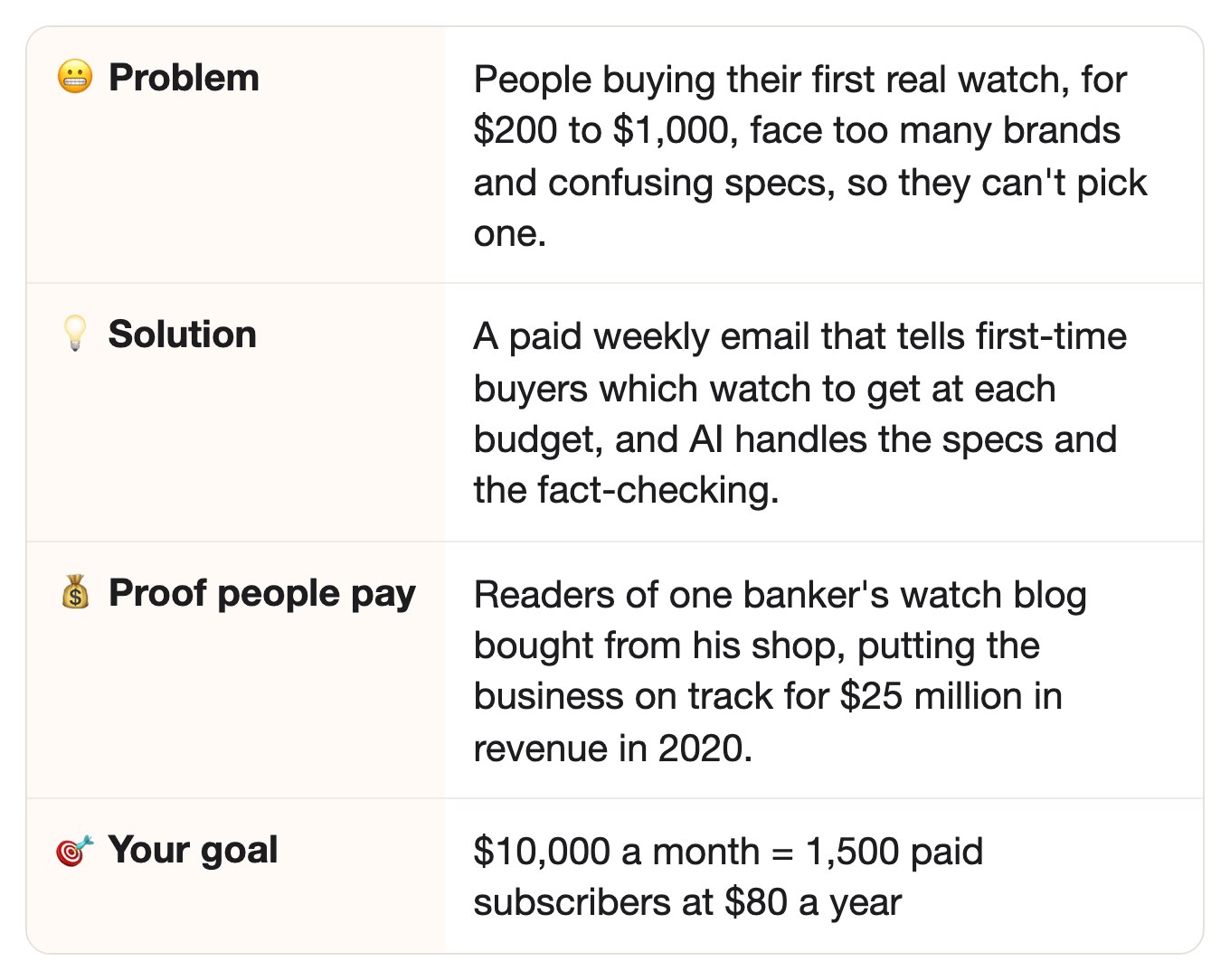
⚡ Quick facts
⠀
📖 How one banker’s watch blog and shop got on track for $25 million a year
It started with a blog about his hobby.
It’s 2008, right in the middle of the financial crisis, and Ben Clymer is a banker.
He takes a severance package, a payout for leaving the job, and heads off to journalism school.
And while he’s there, he starts a watch blog and calls it Hodinkee.
So where did his love of watches come from?
His grandfather’s Omega Speedmaster, a classic watch model.
Here’s what made him different: he writes about watches like a fan, not like a rich insider.
⠀And lots of readers show up. 📈
By October 2020, the site gets 1.3 million visitors in a single month.
Then he adds a shop that sells watches to those same readers.
Boom. That shop brings in most of the money.
By 2020, Hodinkee is on track for $25 million in revenue that year.
Holy guacamole. 🥑
From a banker leaving his job, to a business on track for $25 million a year.
He got there by writing about watches like a fan, then selling watches to his readers.
⠀
🔗 Same idea, new group
In the story: watch fans read Ben Clymer’s blog, then bought watches from his shop.
⠀In this idea: first-time buyers with $200 to $1,000 need someone to tell them which watch to get.
⠀Why it carries over: both groups want a fellow fan to tell them which watch is worth buying.
⠀
💡 The opportunity
Hodinkee is about luxury watches. People buying their first good watch need their own guide.
First, who’s the buyer?
Someone with a new job, a promotion, or a graduation.
They want one “real” watch, something between $200 and $1,000.
⠀
They go looking, and they get lost.
They open YouTube and find brand after brand.
And the specs?
They mean nothing to them.
⠀
The most popular videos jump from $100 watches to $6,000 ones.
The most-watched video for “best watches under 1000” had about 7.8 million views.
Its title: “The Best Watches From $100 To $6K.”
Fun to watch, sure, but it doesn’t tell a first-timer which one to buy.
⠀
They don’t want a hundred options.
They want one person to say: “At your budget, buy this one.”
⠀
👉 The idea: a weekly newsletter, with buying guides, that tells first-time buyers which watch to get at their budget.
⠀
🧩 What you actually need
A love of watches, or the patience to learn one price range well.
For this idea, that range is $200 to $1,000.
No need to own a drawer full of expensive watches.
⠀
The nerve to pick.
At each budget, say it plainly: “At your budget, buy this one.”
Naming one watch for your readers is the scary part, and it’s the part they want.
⠀
An AI app to do the research.
It gathers the specs and checks every fact for you.
You bring the taste.
⠀
✅ Why this could work
Why this one can work, in three points.
A watch blog already grew into a multimillion-dollar business, and others make money from “what to buy” advice too.
Hodinkee, from the story, was on track for $25 million a year in 2020, mostly from its shop.
Tony Traina, a former Hodinkee editor, runs Unpolished Watches, a paid watch newsletter, with 1,000+ paid subscribers, from $80 a year.
The New York Times bought Wirecutter, a website of buying guides, for about $30 million in 2016.
So yes, “what should I buy?” can be a real business.
⠀
Fans have followed watch blogs since 2008, and they still do.
Hodinkee ran for 16 years before a big watch retailer bought it, in October 2024.
And every year, a new group of people buys their first good watch. 🔁
⠀
Millions of people watch “what to buy” watch videos.
Want the YouTube numbers?
They’re coming up in the next section. 👀
⠀
👉 Want to check these numbers? Each one has a source link in the last section, “📎 The sources.”
⠀
📊 More proof people want this
Want more? Here you go.
People already pay for watch advice.
Unpolished Watches, the paid newsletter from a former Hodinkee editor, has 1,000+ paid subscribers.
Its price starts at $80 a year.
⠀
They buy watch books too (checked on Amazon).
The Wristwatch Handbook has 755 ratings, at $58.22.
A Man & His Watch has about 5,100 ratings, at $23.62.
Wristwatch Annual 2026, a yearly catalog of models and prices, sells for $34.26.
⠀
YouTube is full of “what to buy” watch videos.
A search for “best watches under 1000” turns up 88 videos.
Together, they have more than 55 million views and more than 32,000 comments.
Here’s the wild part: 54 of those videos have over 100,000 views each, and 15 have over 1 million.
⠀
The biggest watch channels on YouTube each have more than a million subscribers.
Nico Leonard has about 2.09 million.
Teddy Baldassarre has about 1.54 million.
Brandon Carter has about 1.27 million.
⠀
The big picture: watches are big money. 💰
Swiss watch exports were 25.6 billion francs in 2025, about $33 billion.
Exports are the watches Switzerland sold to other countries.
⠀
What first-time buyers say.
“This video was extremely helpful. I feel better about buying my first watch.”
That’s a comment under a popular beginner’s guide to watches on YouTube.
That’s the reader this idea is for.
⠀
And another viewer.
“You got me into my first automatic watch. Thanks Teddy!”
An automatic watch is one that winds itself as you wear it.
⠀
👉 Millions of people watch these videos, and they want someone to help them pick.
⠀
🔍 Who’s already doing it
Big names exist. None is built for first-time buyers.
Hodinkee, the watch site from the story above, is about luxury watches.
It’s now part of a watch retailer: Watches of Switzerland bought it in October 2024.
⠀
Unpolished Watches, a paid watch newsletter, serves collectors who already know a lot about watches.
Its monthly Watchlist is “hidden vintage watch deals from small auctions, eBay, and other corners of the internet.”
Fun for a collector, but that’s a different buyer from someone picking their first watch.
⠀
The big YouTube channels are free, and made for everyone.
One video covers $100 to $6,000, so a first-timer still has to choose alone.
⠀
Worn & Wound, a watch website, has written free reviews and guides since 2011.
It wants to make watch collecting accessible to everyone.
That’s proof the interest is real and lasts.
⠀
What nobody was selling, when we checked:
A paid weekly guide just for first-time buyers under $1,000.
A short “buy this, skip that” list at each budget: $200, $500, $1,000.
A way for readers to reply and ask, “Which one should I get?”
A beginner’s book: Luxury Watches for Beginners, the one we found on Amazon, had just 3 ratings.
Yep, three.
⠀
🔎 Check the market yourself in 2 minutes: run Part 0 of the prompt in the build plan below.
Your AI searches Substack (a site for paid newsletters), YouTube, Amazon, and watch sites that day.
Then it tells you: early, growing, or crowded.
Early? Start now.
Crowded? Good news: it means people pay. Pick one narrower group of first-time buyers, like new graduates.
A crowded market is still OK. You win by serving one group better, not by being first.
⠀
👉 That’s the part nobody else offers: a paid weekly guide that gives first-time buyers one clear pick at each budget under $1,000.
⠀
🤖 Why AI won’t replace it
AI can compare any watches. You tell readers which one to buy.
You choose what’s right for them.
A first-timer doesn’t know what to ask.
You know which watch looks better on the wrist than in photos, and which one to skip.
⠀
Your prices and deals are fresh.
Prices and sales change every week, so your list is dated and checked each week.
AI can pull current prices when asked to search, but a first-timer rarely asks.
⠀
Readers can trust you.
You never take money from a brand for a pick.
A chatbot’s answer has no face and no track record.
⠀
It’s ready to use: one short list per budget.
Sure, ChatGPT can narrow it to three picks, if someone tells it what taste to follow.
But a first-timer doesn’t know what style they like.
Your guide gives three picks, one skip, and a photo of each on a real wrist.
⠀
Remember The Wristwatch Handbook, with 755 ratings on Amazon, at $58.22?
That’s proof a finished guide sells.
People buy it, even though the same specs are free online.
⠀
👉 What a first-timer pays for: someone with taste telling them which watch to buy at their budget.
⠀
💵 How much you can make
Grab a calculator. Just kidding, here it is.
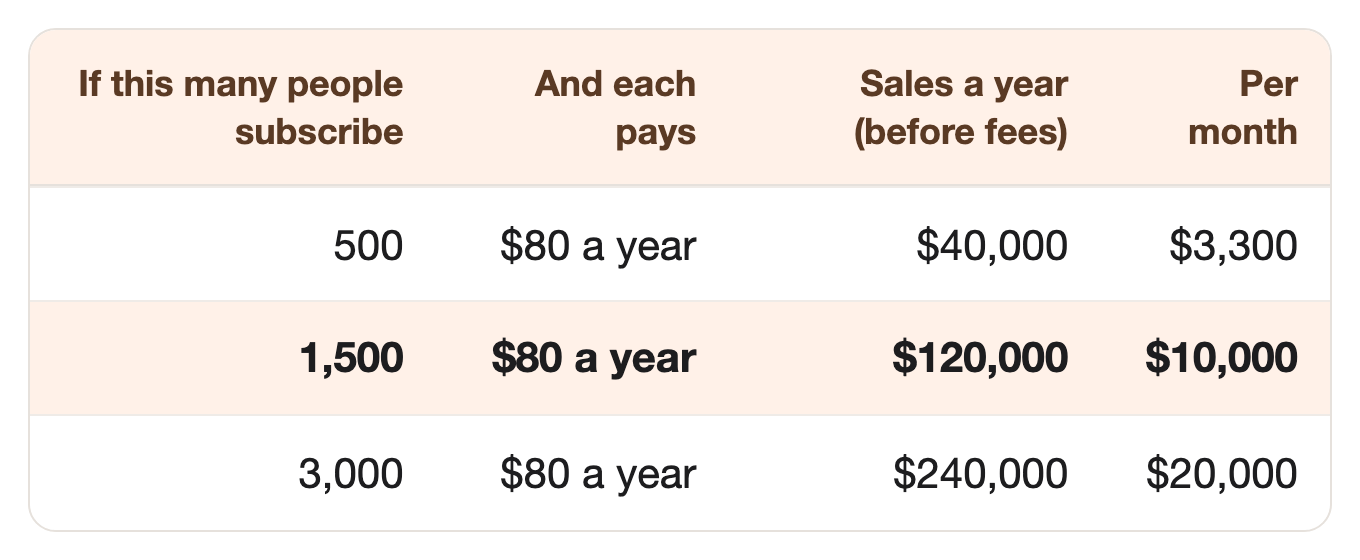
1,500 subscribers is about one and a half times what Unpolished Watches has: 1,000+ paid subscribers.
⠀Substack, the newsletter platform, keeps 10% of paid subscriptions, and card and billing fees are about 4% more.
⠀And if it doesn’t work? Here’s everything you lose:
Nothing to open a Substack. It’s free to start.
One month’s subscription to an AI app, like ChatGPT or Claude.
One week of your time.
⠀
👉 Run three of these well for three years, and the total could pass a million: no promises, just the numbers.
This guide could be your first one, and two or three more like it, for other hobbies, can grow your yearly income from there.
Already picturing your first sale?
Keep going. The how-to is just below. 👇
Not this one? Next week brings a new one.
That’s it, my fellow contrarians! 🙌
Yours ‘turning other people’s wins into your next idea’ Vijay Peduru 🦸♂️
⠀
⠀
⠀
🧰 Want to build it? Here’s everything else.
⠀
Step 1: 🛠️ Make your first buying guides
Good news: you don’t need to own fifty watches to start. You need taste, and AI to do the research.
Pick your budgets.
For example: under $200, under $500, and under $1,000.
Make one short guide for each budget.
Three watches to buy, and one to skip, with why.
Size, price, and what it’s best for, like office, gym, or every day.
Let AI do the research.
It pulls the specs and prices from each brand’s own page into one table.
You make the picks, and say why in your own words.
🎙️ Talk, don’t type.
Tell your AI why you’d pick each watch, out loud.
It turns your words into the guide.
⠀
Step 2: 🔍 Check every fact
Your name is on every pick, so every spec and price gets checked twice.
Your AI does all three passes for you: it writes in Part 2, and checks in Parts 3 and 4 of the prompt.
🖊️ The AI writer. It writes each guide from the brand’s own pages and real store listings only.
🔍 The AI fact-checker. A second pass opens every link, and confirms each size, spec, and price says exactly that.
🧐 The AI critic. A third pass reads it like a picky collector, and hunts for anything wrong or missing.
Optional: pay a watch shop or an experienced collector once to review your first guides.
⠀
👉 The prompt already follows three safety rules: every price has a date, every affiliate link is disclosed, and no brand ever pays for a pick.
An affiliate link pays you a small cut when a reader buys through it.
⠀
Step 3: 🏪 Open your newsletter
Easy one: copy Unpolished Watches’ price, and give every reader a free taste.
Open a Substack. It’s free, and it handles payments for you.
Send one free pick a week to everyone.
For example: “The one watch I’d buy under $500 this week.”
Add a paid tier.
$8 a month, or $80 a year.
Paid readers get all three budget guides, price-drop alerts, and can reply with their own question.
Let AI write your welcome page, using one of your real guides as the example.
⠀
Step 4: 📣 Get your first readers
Show people how you pick, in the places first-time buyers look, and win back readers who left.
Write honest comparison pages, like “Seiko 5 vs Orient Bambino for a first watch.”
Say where the other watch wins, so readers trust your pick.
Use the names people type into Google, and link each page to your free weekly pick.
Before a gift season, email readers who canceled: “You have an $8 credit waiting, one free month, until [date].”
Call it a credit in their account, not a percent off, so it feels like something they already own.
Time it for when they shop again, like graduation or the holidays.
Before graduation season, reply to reporter requests for gift-guide quotes.
Check reporter request sites like Qwoted each day, and reply within the hour.
Send three short sentences a reporter can quote, with no pitch, and your newsletter in your sign-off.
⠀
Step 5: 🏃 Eliminate competitors
If ten competitors copy you, here’s how yours stays ahead.
Publicly offer the big watch sites a fair test: each of you picks one first watch under $500, and a first-time buyer chooses.
Post the offer in your newsletter and on your comparison pages.
If they say yes, you get a story; if they stay quiet, readers see who stands behind their picks.
Test your headline on a stranger until they can say it’s for first-time buyers at their budget.
Ask who it’s for, what it fixes, and why it beats a general watch site.
Narrow the words until they can answer all three.
⠀
Step 6: 🎲 Make it bigger
First-time buyers in every hobby want the same thing: one person to say “buy this one.”
Add affiliate links, clearly marked, like Wirecutter does. You earn a small cut when readers buy.
Sell a yearly buying guide, updated every January.
Open the same newsletter for other obsessions: pens, headphones, knives, bikes.
Three newsletters at about $10,000 a month each is about $360,000 a year, before fees. 🎯
⠀
🗓️ Your first week
Phew. That was a lot. 😅
Steps 1 to 4 fit into seven days. 🚀
By day 7, you have a newsletter, three buying guides, and one comparison page.
Quick heads-up: the prompt below has six Parts, and they’re not the same as the Steps above.
Day 1 (Step 1): Run Part 1 of the prompt (it’s below), and pick your budgets and first picks.
Days 2–3 (Steps 1 and 2): Write three guides with Part 2, then check each one with Parts 3 and 4.
Day 4 (Step 3): Write your welcome page with Part 5, then open your Substack.
Days 5–7 (Step 4): Write one comparison page with Part 6, and write your credit email for readers who cancel.
⠀
🏄 How to use the prompt
One prompt does all the AI work, in six parts, plus a quick market check (Part 0).
Part 1 — Plan the guides. Lists ten watches worth looking at in each of your budgets, then asks for your picks.
Part 2 — Write a guide. Drafts one short guide for one budget, with a source for every spec and price.
Part 3 — Check every fact. Opens every link and confirms each spec and price matches the page.
Part 4 — Find the mistakes. Reads it like a picky collector, and flags anything wrong or unclear.
Part 5 — Write the welcome page. Writes your Substack welcome page and paid-tier description.
Part 6 — Write the comparison page and quotes. Writes an honest “X vs Y” page for one budget, plus quotes for reporter requests.
Run it your way:
Part by part (the default): it pauses after each part, and you type “next” to keep going.
All at once: say “run all six parts.”
Just one part: say “only do Part 3,” or any part you need.
The full prompt is just below, under “📋 The prompt.”
🎙️ Talk to your AI sidekick, don’t type.
Turn on voice mode, or use a dictation app like Wispr Flow.
Say it messy. The AI sorts it out.
Turn it into a skill, so you never paste it again.
Paste the prompt into Claude or ChatGPT, and say: “Turn this into a skill I can save.”
Install once, use forever.
⠀
📋 The prompt
The prompt (copy it into Claude or ChatGPT, fill in the INPUTS part, and run it your way)
CONTEXT:
- You're my buying-guide partner. Together we'll build a weekly newsletter that helps people buy their first good watch.
- This prompt has six parts, in order.
- Run it the way I ask:
    - If I say nothing, go one part at a time. After each part, show me the result, then stop and wait. Move on only when I type "next."
    - If I say "run all six parts," do them all without stopping.
    - If I say "only do Part 3" (or any part), do just that part.
- If a part needs something from me, ask for it before you start that part.
- Use only the brand's own pages and real store listings for specs and prices. Never invent a spec or a price. If you can't find a source, leave it out.
- The picks are mine. You suggest options and explain them, but I decide what goes in each guide.
- Turn on web search, so you can open brand pages and check prices. If you can't open a page, say so, and leave that spec or price out.
- I'll often answer by voice, so expect long, messy answers. Don't ask me to tidy them.

=============== INPUTS — edit these, or just run as is ===============

Who the newsletter is for:
{e.g. people buying their first good watch, under $1,000}

The narrower group I want to win:
{e.g. new graduates with their first paycheck}

My budgets:
{e.g. under $200, under $500, under $1,000}

What I love, and what I'd never buy (say it out loud, messy is fine):
{e.g. I love simple field watches and steel bracelets; I'd skip anything over 42mm for a first watch}

My prices:
{e.g. free weekly pick; $8 a month or $80 a year for the paid tier}

======================== END OF INPUTS ========================

THE PARTS:

Part 0 — Check the market today.
This part needs web search (turn on search in ChatGPT or Claude). Search for help for first-time watch buyers and, for each place, give the count, the three biggest with links, and their prices:
1. Paid newsletters about watches on Substack and elsewhere.
2. YouTube channels with "first watch" or "best watches under $1,000" videos.
3. Buying guides and books on Amazon for watch beginners.
4. Watch review websites with beginner guides.
5. Podcasts about watches.
Then tell me: early (few sellers), growing, or crowded, and which group of first-time buyers looks least served (for example: women, new graduates, people who want one watch forever). Give a link for every number. If you can't open a page, say so. Never guess a number.

Part 1 — Plan the guides.
Using my budgets and my group, list ten watches worth looking at in each budget, from the brands' own pages. For each: brand, model, size, price with the date you checked it, and the link. Then ask me which three I'd pick and which one I'd skip in each budget, and why. Keep my reasons in my words.

Part 2 — Write a guide.
Ask me which budget to write first. Then write one short guide for someone who knows nothing about watches:
1. The budget, and who this guide is for, in one sentence.
2. My three picks. For each: one line on why, the size, the price with the date, and the link.
3. The one to skip, and why, in my words.
4. One plain tip, like how to tell if a watch will fit a small wrist.
5. This line at the very bottom: "Prices checked on [date]. Some links may be affiliate links; no brand pays for a pick."

Part 3 — Check every fact.
Now act as a separate fact-checker who didn't write this guide. Open every link. Mark each spec and price: matches the source, doesn't match, or has no source. For each problem, show what the source actually says. Then give a fixed version of the guide.

Part 4 — Find the mistakes.
Now act as a picky watch collector reading the guide before any reader sees it. Flag anything wrong, anything a beginner wouldn't understand, any pick that's hard to buy at that price, and any line that sounds like a paid ad. Then give the final guide, with every fix made.

Part 5 — Write the welcome page.
Write my Substack welcome page and my paid-tier description. Use one real guide as the example. Give me:
1. A headline that names the reader, not the hobby.
2. What the free weekly pick is.
3. What paid readers get: all the budget guides, price-drop alerts, and replies to their questions.
4. The prices, shown up front, and "Cancel any time."
5. A line that says no brand ever pays for a pick.
Never use a watch brand's name or logo as my newsletter's name. Never promise a watch will hold its value.

Part 6 — Write the comparison page and quotes.
1. Ask me which two watches a first-time buyer weighs at one budget. Write an honest "X vs Y for a first watch" page, under 400 words: who each one fits, where each one wins, and my pick, in my words. Take specs and prices from the brands' own pages, with the date you checked.
2. Write three short sentences a reporter could quote about choosing a first watch as a graduation gift. No pitch, and never promise a watch will hold its value.
Then give me five more pairs from my guides that would make good comparison pages.

When all six parts are done, ask if I want to repeat Parts 2 to 6 for the next budget.
⠀
📎 The sources
Every number above, with where it came from.
Hodinkee’s revenue · Number: “on track for revenue of $25m this year” (2020); “1.3m site visitors in October”; “The majority of sales comes from its ecommerce watch business that was launched in 2012” · Source: The Hustle, December 2020, quoting WSJ Magazine
Ben Clymer’s start · Number: A banker who “took a severance package” in the 2008 financial crisis, then started a watch blog at journalism school · Source: Same article
Writing like a fan · Number: Built it “from the angle of a hobbyist rather than a 0.1%-er”; “I don’t come from a luxury world at all” · Source: The Hustle, December 2020
Hodinkee’s founding and sale · Number: Founded in 2008; bought by Watches of Switzerland in October 2024; started with his grandfather’s Omega Speedmaster · Source: Wikipedia: Hodinkee
Unpolished Watches · Number: “1,000+ paid subscribers”; standard tier $80 a year or $8 a month (a $199 founding tier too); Watchlist of “hidden vintage watch deals”; Tony Traina, a former Hodinkee editor · Source: Unpolished Watches: About
Wirecutter · Number: Bought by The New York Times in 2016 “for about $30 million”; earns mostly from affiliate links · Source: Wikipedia: Wirecutter
Swiss watch exports · Number: “25.6 billion francs (33.32 billion dollars)” in 2025 · Source: FashionUnited, January 2026
Worn & Wound · Number: “Independently owned and operated since 2011”; aims to “make watch collecting accessible to everyone” · Source: Worn & Wound: About
Watch books on Amazon · Number: The Wristwatch Handbook: 755 ratings, $58.22 · A Man & His Watch: about 5,100 ratings, $23.62 · Wristwatch Annual 2026: $34.26 · Luxury Watches for Beginners: 3 ratings · Source: Amazon search, “watch collecting book”
YouTube videos · Number: 88 videos for “best watches under 1000”; about 55.6 million views; about 32,200 comments; 54 with 100,000+ views; 15 with 1 million+ · Source: YouTube Data API
Most-watched video · Number: “The Best Watches From $100 To $6K,” about 7.76 million views (re-checked: 7,761,381) · Source: YouTube: Brandon Carter
Big channels · Number: Nico Leonard about 2.09 million subscribers; Teddy Baldassarre about 1.54 million; Brandon Carter about 1.27 million (all three re-checked) · Source: YouTube Data API
Comment: first watch · Number: “This video was extremely helpful. I feel better about buying my first watch.” · Source: YouTube comment, 2022
Comment: first automatic · Number: “You got me into my first automatic watch. Thanks Teddy!” · Source: YouTube comment, 2020
Substack fees · Number: Free to publish; keeps 10% of paid subscriptions; card fees 2.9% + $0.30, plus 0.7% for recurring billing · Source: Substack: How much does Substack cost?