

Hello contrarians,
Today’s idea is called The First-Canvas Stitch Club.
Grab a coffee. ☕
First, a blogger’s story. Then, the business you could build from it.
⠀
⚡ Quick facts
⠀
📖 How one blogger turned a college hobby into $4.4 million in sales
It started at her kitchen table.
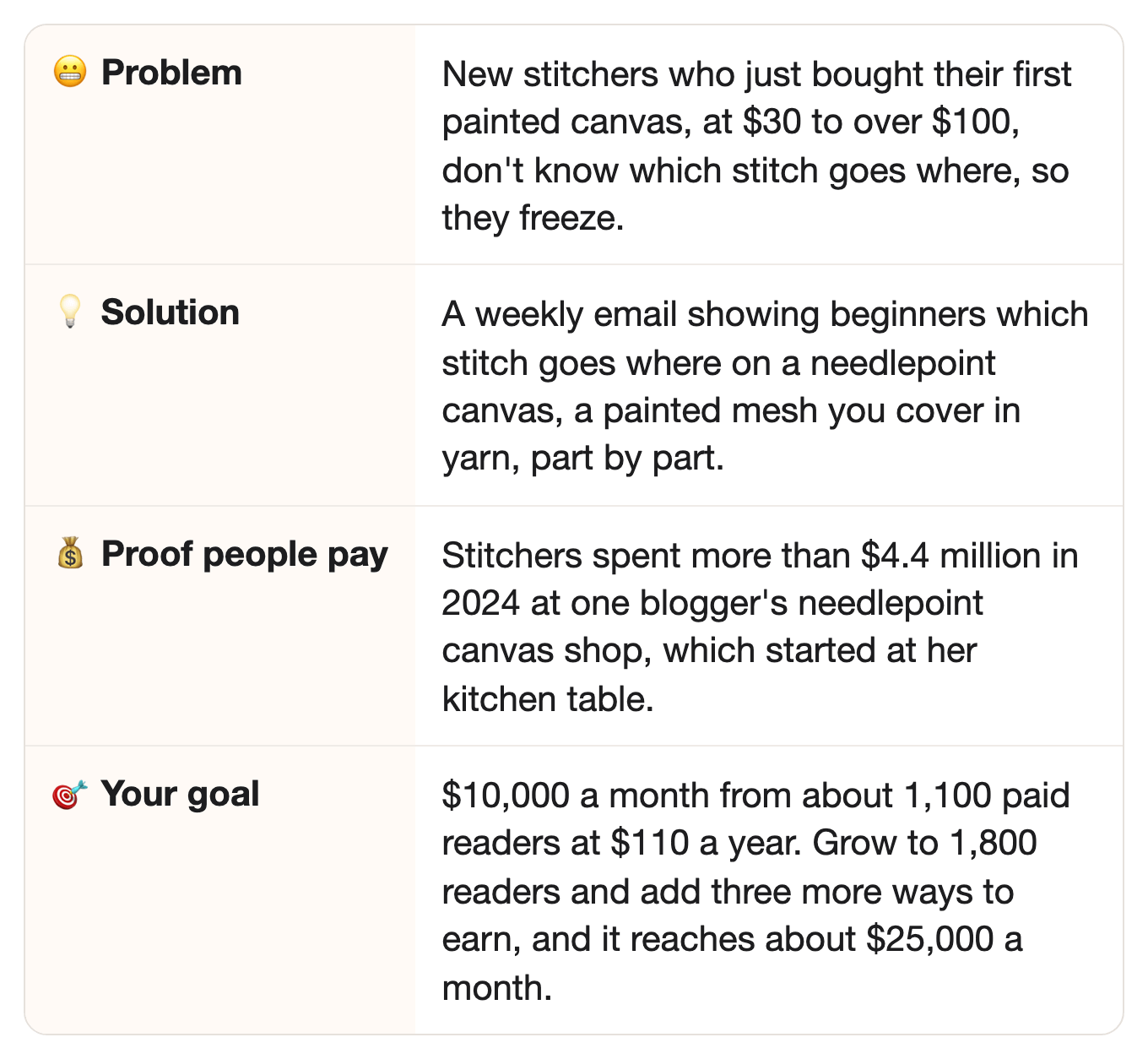
Meet Krista LeRay, a lifestyle blogger with 100,000 readers a day.
⠀Needlepoint was her hobby in college, and she picks it back up during the pandemic.
So she spends $7,000 of her blogging money on supplies.
Gulp.
⠀
Then she paints canvases by hand, at her kitchen table.
And it’s slow work: one small 4-inch canvas takes her about six hours.
⠀
In September 2020, she opens an online shop, Penny Linn Designs.
She announces it on her blog and on Instagram.
⠀
You’ll love this: her first 500 canvases sell out in two hours. 📈
Yes, two hours.
⠀
Her prices? About $30 to over $100 a canvas.
⠀Then, in 2024, needlepoint “blew up on TikTok,” she says, and her buyers get younger.
Her online buyers are mostly women aged 25 to 34.
⠀
That year, Penny Linn brings in more than $4.4 million in sales.
By then, it’s no longer a side hustle: she made it her full-time job in 2022.
And her profit margin is 36%, she says.
Jackpot! 🎰
From a $7,000 bet on supplies, to $4.4 million in sales in 2024, by selling canvases she started painting at her kitchen table.
⠀
🔗 Same idea, new format
In the story: buyers, mostly women aged 25 to 34, paid Krista $30 to over $100 for each painted canvas.
⠀In this idea: those same new stitchers need someone to show them which stitch goes where on the canvas they bought.
⠀Why it carries over: every canvas sold makes a new beginner, and a painted canvas shows what to stitch, not how to stitch it.
⠀
💡 The opportunity
Every new stitcher buys a canvas, and then has to learn how to stitch it.
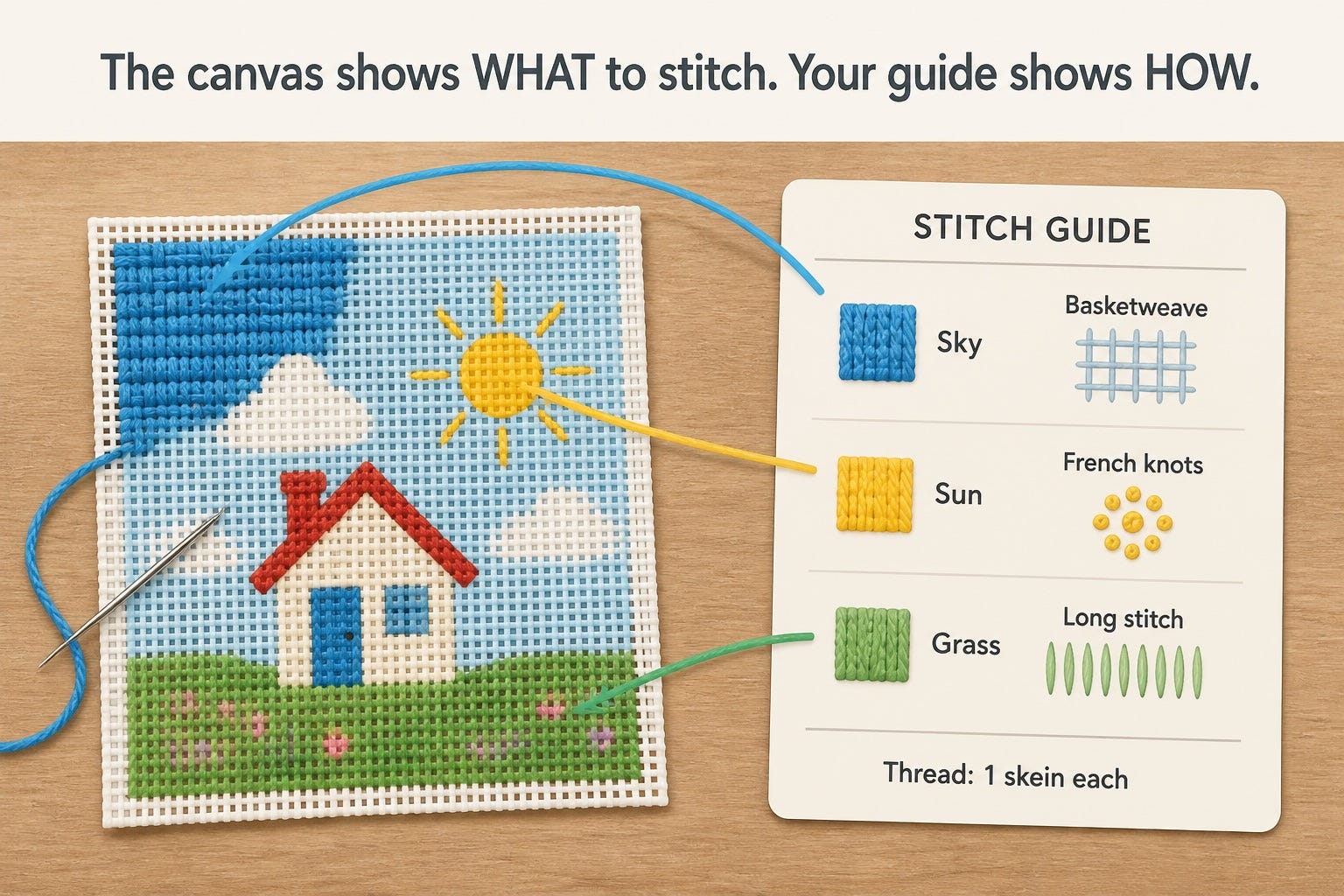
A painted canvas is a picture on mesh.
It shows the colors, but not which stitch goes where.
So it tells you what to make, not how to make it.
⠀
A beginner stares at it and asks:
Which stitch for the sky? Which for the grass?
Which thread, and how much?
What do I do when I mess up?
⠀
Here’s a secret: stitchers already pay for a plan for a canvas they own.
That plan is called a stitch guide.
One shop on Etsy, a site where small sellers sell handmade goods and digital files, sells a $22 stitch guide.
It’s for another designer’s Christmas village canvases.
One happy buyer wrote: “This thread and stitch guide is amazing!”
⠀
And the number of new stitchers is growing.
US Google searches for “needlepoint canvas” went from 6,600 a month in February 2025 to 27,100 in February 2026.
⠀
👉 The idea: a paid newsletter for first-year stitchers, with short video lessons and stitch guides.
Penny Linn sells the canvas. You teach people how to stitch it.
⠀
🧩 What you actually need
Good news: the list is short.
Love for the craft.
No expert badge needed.
Your own first canvas to stitch as you learn is enough to start.
⠀
A phone camera.
Yep, the one in your pocket.
It’s all you need for the short video lessons.
⠀
An AI app, like ChatGPT or Claude.
It writes the guides and the video scripts.
⠀
✅ Why this could work
Here’s why people will pay for this.
Someone already made millions selling to these stitchers, and others make money teaching them.
Remember Penny Linn, Krista LeRay’s shop from the story?
It brought in more than $4.4 million in sales in 2024.
And then there’s Lita, a stitching teacher, who started a Substack newsletter in January 2025.
When we checked, it had over 13,000 subscribers, and Substack showed “thousands” of them paying.
Paid readers pay $9.99 a month or $110 a year.
Bloom and Floss, a pattern shop on Etsy, sells $8.30 patterns, with more than 10,500 sales since 2022.
⠀
Every year, a new crowd of beginners starts knowing nothing.
The American Needlepoint Guild, a club for stitchers, started in 1972.
In 2016, it counted more than 10,000 members.
⠀
Beginners already search for stitch help, watch it, and buy it.
The counts are in the next section. 👀
⠀
👉 Want to check these numbers? Each one has a source link in the last section, “📎 The sources.”
⠀
📊 More proof people want this
Want more? Here you go.
Stitchers already pay for stitch help.
Needlepoint: A Modern Stitch Directory is a stitch book with 422 ratings on Amazon, at $13.60.
Its card deck version, with 50 of the stitches, has 265 ratings, at $15.83.
Yes, a whole deck of stitch cards.
⠀
Small shops on Etsy sell needlepoint charts and canvases.
DillyStitchDesign has about 1,500 sales.
Bugsneedleandthread has 795.
⠀
Beginners watch stitch lessons on YouTube.
“Learn How to Needlepoint in FIVE Minutes” has more than 638,000 views.
And a video of 20 basic hand-embroidery stitches for beginners has more than 17 million. 🤯
⠀
Beginners search Google for stitch help every month.
“Needlepoint stitches” gets 5,400 searches a month in the US.
“Needlepoint for beginners” gets 2,900.
⠀
The big picture. 💰
Half of needlework shops said sales were stronger than the year before.
That’s from a 2025 survey of 113 shops.
Patterns and charts were among their best sellers.
⠀
👉 Beginners search for stitch help, buy stitch books, and pay for guides.
⠀
🔍 Who’s already doing it
Strong sellers, and the group none of them serve.
Penny Linn, the shop from the story above, sells the canvas, not the lessons.
Her business is canvases, thread, and accessories.
Teaching beginners week by week is a different job.
⠀
Lita, the stitching teacher above, teaches finishing, and she’s good.
Wait, what’s finishing?
It means turning a stitched canvas into a pillow or an ornament.
She teaches it in a paid newsletter on Substack.
Her paid perks are finish-alongs (group sessions where everyone finishes a piece together) and virtual finishing classes.
⠀
When we checked, small shops on Etsy sold stitch guides for one canvas at a time.
TooleyStitchHouse, the shop with the $22 guide above, had 50 sales in its first 8 months.
⠀
Here’s what we couldn’t find, when we checked:
A weekly paid newsletter just for first-year stitchers in their 20s and 30s.
A one-minute video for every stitch.
A stitch guide each month for a popular beginner canvas.
⠀
🔎 Check the market yourself in 2 minutes: run Part 0 of the prompt in the build plan below.
Your AI searches Substack, YouTube, Etsy, and Amazon that day, and tells you: early, growing, or crowded.
Early? Start now.
Crowded? Good news: it means people pay. Pick one narrower group of stitchers (Step 1 of the build plan).
A crowded market is still OK. You win by serving one group better, not by being first.
⠀
👉 You can be the one to fill that gap: a weekly paid newsletter that shows first-year stitchers which stitch goes where.
⠀
🤖 Why AI won’t replace it
Could ChatGPT just do this?
Sort of.
AI can describe a stitch. You show them how, and tell them which one to use.
You show your hands on camera.
A stitch is a movement.
A paragraph from ChatGPT can’t show the needle going in and out.
⠀
You know which stitch looks best.
A beginner doesn’t know which stitch makes water shimmer or a sweater look knitted.
You pick it, and say which fancy stitch to skip on a first canvas.
⠀
Easy to use: one stitch, one card, one minute.
ChatGPT can boil a stitch down to a few steps, if you ask, and a beginner mid-canvas won’t stop to ask.
Your card gives a picture, the steps, and one common mistake, on a page they can keep next to the canvas.
⠀
You stitch with other people. 🧵
A monthly stitch-along means they finish, together.
In a stitch-along, everyone stitches the same canvas at the same pace.
⠀
Proof people pay for a ready-made version: the stitch card deck on Amazon has 265 ratings, at $15.83.
Remember it from the proof above?
And the same stitches are free on YouTube.
⠀
👉 Stitch videos are free on YouTube, and beginners still pay for a finished guide that says which stitch goes where.
⠀
💵 How much you can make
Here’s how the numbers add up.
This is a newsletter, not a canvas shop, so the math starts from Lita’s price, not Penny Linn’s sales.
First stop: $10,000 a month from the newsletter alone
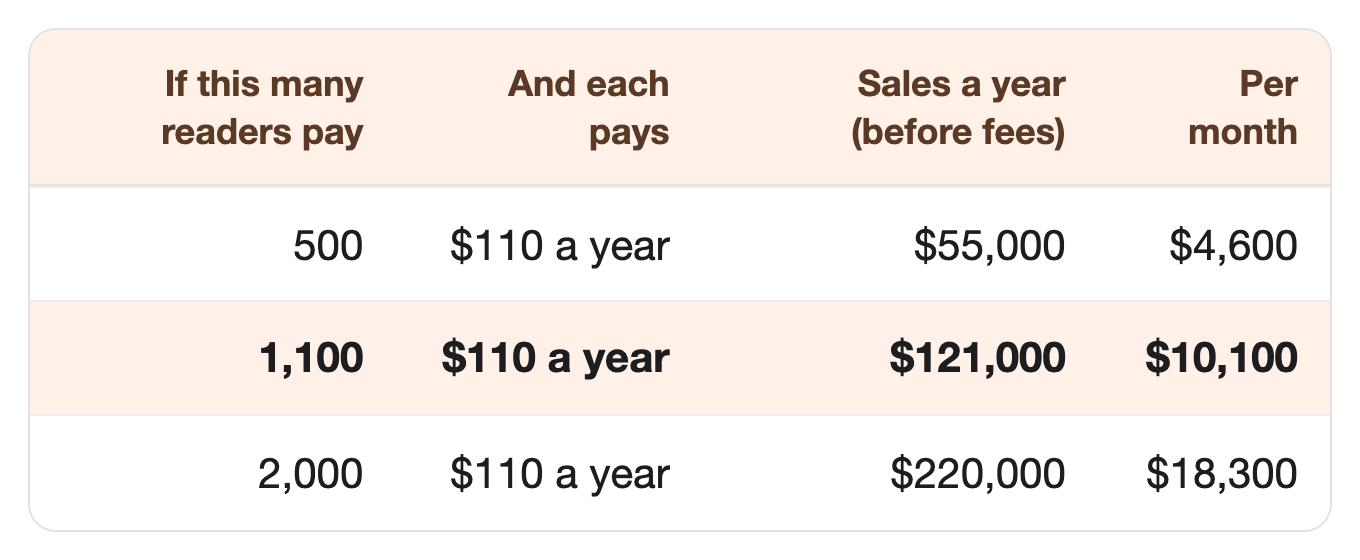
$110 a year is Lita’s yearly price.
So you’re not guessing at a price.
⠀
1,100 paid readers is just above the low end of Lita’s count.
Why only “the low end”?
Substack’s badge only gives a range, and its low end is 1,000.
It’s also well under her 13,000 total subscribers.
Next stop: $25,000 a month, with three more ways to earn
Once stitchers trust your guides, some will buy one more thing from you.
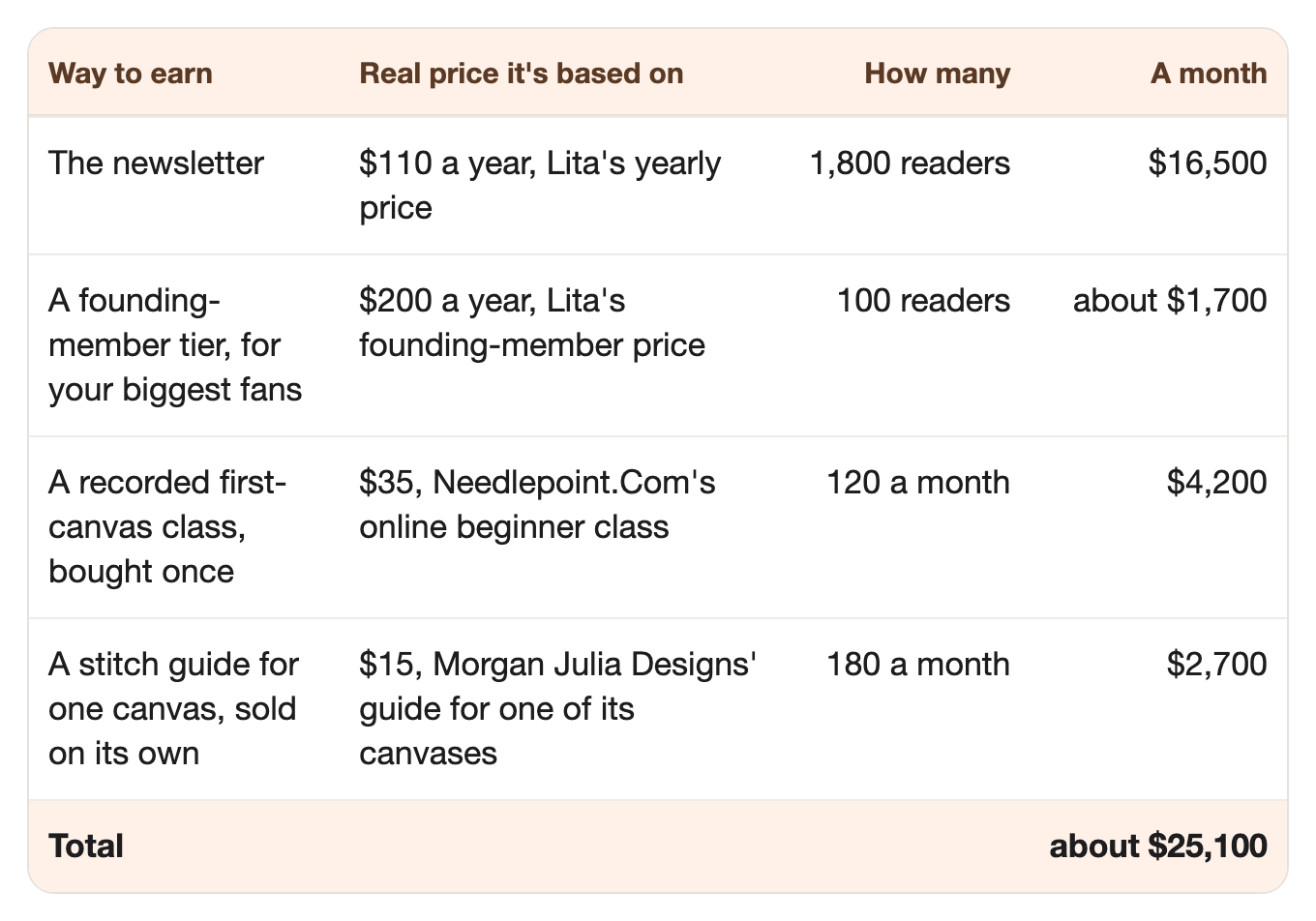
The newsletter still does most of the work.
Grow it from 1,100 to 1,800 paid readers, and it brings in $16,500 a month.
The table assumes everyone pays yearly.
Monthly readers pay $9.99 a month, so the real total shifts a little.
⠀
Here’s the honest part: 1,900 paid readers in all is a lot.
Lita’s badge says “thousands” of paid readers, and its low end is 1,000.
So you may need about her size, or a bit more.
⠀
The founding tier costs you almost nothing.
Substack lets you add a higher yearly price for readers who want to back you.
Give them a thank-you, like an early look at the next stitch guide.
⠀
The class sells to beginners who aren’t ready to subscribe.
Record your best first-canvas lessons once, and sell them every month.
⠀
The stitch guides sell one canvas at a time.
Only for canvases whose designers said yes.
180 a month is close to Bloom and Floss’s pace: about 10,500 pattern sales since 2022.
⠀
And if it doesn’t work? Here’s everything you lose:
Nothing for the newsletter: Substack is free to start.
One practice canvas, like a $15 stitch-practice canvas on Etsy.
One month’s subscription to an AI app, like ChatGPT or Claude.
One week of your time.
⠀
👉 One stitch club, four ways to earn: about $25,000 a month.
Copy this idea into a similar niche, or stack it with two ideas from this newsletter. That’s the path to a million dollars in total, in two or three years.
For this club, a similar niche could be first-time cross-stitchers. And this club could be your first idea.
Already picturing your first sale?
Keep going. The how-to is just below. 👇
Not this one? Next week brings a new one.
That’s it, my fellow contrarians! 🙌
Yours ‘showing you where the money already is’ Vijay Peduru 🦸♂️
⠀
⠀
⠀
🧰 Want to build it? Here’s everything else.
⠀
Step 1: 🧵 Pick your stitchers and your stitches
Start with one group of beginners, and one short list of stitches.
Pick one group.
For example: stitchers in their first year, in their 20s and 30s.
Or people who bought a canvas as a gift and never started it.
List the stitches a first canvas needs.
Your AI drafts a list of about 30 beginner stitches, in the order to learn them.
Start with the basics, like the basketweave and the continental stitch, two simple ways to fill an area.
Buy one practice canvas, and stitch every lesson yourself before you teach it.
⠀
Step 2: 🎬 Make the lessons
One stitch per lesson: a card and a one-minute video.
Write a stitch card for each stitch.
What it looks like, the steps, where to use it, and one common mistake.
Your AI writes the first draft.
Film your hands from above, with your phone.
One stitch, start to finish, in under a minute.
Your AI writes the script. You just stitch and talk.
Once a month, write a stitch guide for one popular beginner canvas.
Which stitch goes in each area, which thread, and in what order.
Ask the canvas designer’s permission first. Your guide can help sell their canvas, which makes a yes easier.
Never copy their design. A guide names the areas and the stitches, not the picture.
⠀
Step 3: 🔍 Check every guide
Your name is on every card, so each one gets two checks after it’s written.
Your AI does all three passes for you: it writes in Part 2, and checks in Parts 3 and 4 of the prompt.
🖊️ The AI writer. It writes each card from trusted stitch books and guild material only.
🔍 The AI checker. A second pass compares every step with the source, and flags anything it can’t back up.
🧐 The AI critic. A third pass reads it like a nervous beginner, and marks every step that could confuse them.
Then stitch it yourself. If a step doesn’t work on your canvas, fix the card.
⠀
👉 The prompt already follows three safety rules: trusted sources only, never copy a designer’s canvas, and your own shop name.
⠀
Step 4: 🏪 Open your paid newsletter
Price it like Lita does, and give a taste away free.
Set up a Substack. It’s free to start.
Send one free lesson every week, with the card and the video.
Put the rest behind the paid tier:
The full card library.
The monthly stitch guide.
A monthly stitch-along on video.
Set your prices: $9.99 a month or $110 a year, like Lita’s.
⠀
Step 5: 📣 Get your first readers
New stitchers already buy canvases, search for stitches, and read craft newsletters. Show up in all three places.
Ask a canvas shop to put your free first-stitch guide in every box, and feature the shop to your readers.
Print one card with the three easiest stitches and your newsletter’s name.
In return, show the shop’s newest beginner canvases in one issue a month.
Pin each stitch guide on Pinterest, titled like “which stitch for a sky on needlepoint canvas.”
Use one clear photo of the stitched area per pin, titled the way people search.
Link each pin to the free stitch card on your Substack.
Swap Substack recommendations with a knitting or embroidery newsletter.
Their readers already love yarn and thread, but they don’t sell needlepoint lessons.
Pick two or three, and recommend them back.
⠀
Step 6: 🏃 Eliminate competitors
If ten competitors copy you, here’s how yours stays ahead.
Email a “First Canvas Finished” certificate, with each reader’s name printed big.
Send a simple PDF the day a reader shows you a finished canvas.
Readers hang it up, share it, and stay for the next canvas.
Narrow the headline until a stranger can say it’s for people who just bought their first painted canvas.
Show it to someone who doesn’t stitch, and ask who it’s for and what it fixes.
If they can’t answer both, cut words until they can.
⠀
Step 7: 🎲 Make it bigger
Every craft has a new group of beginners every year, and stitches they need to learn.
Add the three extras from “How much you can make,” one at a time.
First the founding-member tier, since it’s one setting on Substack.
Then the recorded first-canvas class, from your best lessons.
Then stitch guides one at a time, on Etsy, like TooleyStitchHouse does, only for canvases whose designers said yes.
Partner with canvas designers. Your guide sells their canvas, and their canvas sells your guide.
Open the same newsletter for other crafts: cross-stitch, embroidery, punch needle.
One club at about $25,000 a month is about $300,000 a year, before fees. 🎯
Add two or three more clubs, or ideas from this newsletter, and a million dollars in total is two or three years away.
⠀
🗓️ Your first week
Phew. That was a lot. 😅
Steps 1 to 5 fit into seven days. 🚀
By day 7, you have a newsletter, three stitch cards, and three videos.
Quick heads-up: the prompt below has seven Parts, and they’re not the same as the Steps above.
Day 1 (Step 1): Run Part 1 of the prompt (it’s below), and pick your first ten stitches.
Days 2–3 (Steps 2 and 3): Write three stitch cards with Part 2, then check each one with Parts 3 and 4.
Day 4 (Step 3): Stitch all three on your practice canvas, and fix any step that didn’t work.
Day 5 (Step 4): Set up your Substack, and write your welcome post and paid-tier page with Part 6.
Days 6–7 (Steps 2 and 5): Script a video for each card with Part 7, film your hands, and pin each card on Pinterest.
⠀
🏄 How to use the prompt
One prompt does all the AI work, in seven parts, plus a quick market check (Part 0).
Part 1 — Plan the lessons. Lists about 30 beginner stitches in the order to learn them, and picks the first ten.
Part 2 — Write a stitch card. Drafts one card for one stitch, and names the source for every step.
Part 3 — Check every step. Compares each step with the source, and flags anything it can’t back up.
Part 4 — Find the confusing parts. Reads it like a nervous beginner, and fixes every unclear step.
Part 5 — Write a stitch guide. Plans the stitches for one canvas, area by area, from your photo.
Part 6 — Write the newsletter pages. Writes your welcome post and your paid-tier page.
Part 7 — Script the video. Turns a stitch card into a script under one minute.
Run it your way:
Part by part (the default): it pauses after each part, and you type “next” to go on.
All at once: say “run all seven parts.”
Just one part: say “only do Part 5,” or any part you need.
The full prompt is just below, under “📋 The prompt.”
🎙️ Talk to your AI sidekick, don’t type.
Turn on voice mode, or use a dictation app like Wispr Flow.
Say it messy. The AI sorts it out.
Turn it into a skill, so you never paste it again.
Paste the prompt into Claude or ChatGPT, and say: “Turn this into a skill I can save.”
Install once, use forever.
⠀
📋 The prompt
The prompt (copy it into Claude or ChatGPT, fill in the INPUTS part, and run it your way)
CONTEXT:
- You're my stitching-lesson partner. Together we'll build a paid newsletter that teaches needlepoint to beginners, one stitch at a time, with short videos and stitch guides.
- This prompt has seven parts, in order.
- Run it the way I ask:
    - If I say nothing, go one part at a time. After each part, show me the result, then stop and wait. Move on only when I type "next."
    - If I say "run all seven parts," do them all without stopping.
    - If I say "only do Part 5" (or any part), do just that part.
- If a part needs something from me, ask for it before you start that part.
- Use only trusted sources, like published stitch books, needlepoint guild material, and the sources I give you. Never invent a stitch or a step. If you can't find a source, say so.
- Never copy or describe a designer's canvas closely enough to recreate it. A stitch guide names the areas and the stitches, never the design itself.
- Use my own newsletter name from INPUTS. Never use another shop's or designer's name as if it were mine.
- If you can't open a link I give you, ask me to attach the file instead.
- Keep web search on for the whole prompt (turn on search in ChatGPT or Claude), so you can open any page you need to check.

=============== INPUTS — edit these, or just run as is ===============

Who the lessons are for:
{e.g. first-year stitchers in their 20s and 30s who just bought their first painted canvas}

My newsletter name:
{e.g. First Canvas Club}

Sources I trust (paste them, or attach the files):
{e.g. my copy of a stitch directory book, and my own notes from stitching my first canvas}

My prices:
{e.g. free weekly lesson; paid tier at $9.99 a month or $110 a year}

======================== END OF INPUTS ========================

THE PARTS:

Part 0 — Check the market today.
This part needs web search (turn on search in ChatGPT or Claude). Search for paid help for beginner stitchers in my group and, for each place, give the count, the three biggest with links, and their prices:
1. Paid newsletters on Substack about needlepoint or stitching.
2. YouTube channels teaching needlepoint to beginners.
3. Etsy shops selling stitch guides or needlepoint charts.
4. Stitch books and card decks on Amazon.
5. Online needlepoint courses.
Then tell me: early (few sellers), growing, or crowded, and which group of stitchers looks least served (for example: first-year stitchers, left-handed stitchers, people stitching a gift). Give a link for every number. If you can't open a page, say so. Never guess a number.

Part 1 — Plan the lessons.
List about 30 beginner stitches, in the order a beginner should learn them. For each, say what it's good for on a canvas (for example sky, water, grass, a sweater). Pick the first ten to teach, and say why. Say clearly which reasons are your guess.

Part 2 — Write a stitch card.
Ask me which stitch to write first. Then write one card for someone who has never stitched:
1. The stitch in one sentence: what it looks like.
2. The steps, numbered, each one short, with the source for each.
3. Where to use it on a canvas.
4. One common mistake, and how to fix it.
5. A simple picture description I can use to draw or photograph the stitch.

Part 3 — Check every step.
Now act as a separate checker who didn't write this card. Compare every step with the source. Mark each step: matches the source, doesn't match, or has no source. For each problem, show what the source actually says. Then give a fixed version of the card.

Part 4 — Find the confusing parts.
Now act as a nervous beginner holding a needle for the first time. Mark every step you couldn't follow, every word you don't know, and every place you'd get lost. Then give the final card, with every fix made, in plain words.

Part 5 — Write a stitch guide.
Ask me for a photo or a short description of one canvas, and the designer's name. Ask whether I have the designer's permission to sell a guide for it; if not, write it for my own use only. Then:
1. Split the canvas into areas (for example sky, house, border).
2. For each area, suggest one stitch from my card list, and say why it fits.
3. Suggest a thread type for each area, and the order to stitch the areas in.
4. Mark each suggestion as a beginner pick or a stretch.
Never reproduce the design itself.

Part 6 — Write the newsletter pages.
Write my welcome post and my paid-tier page for Substack:
1. A headline that names my group, not just "needlepoint."
2. What free readers get every week.
3. What paid readers get: the card library, the monthly stitch guide, and the monthly stitch-along.
4. My prices, shown up front, and "Cancel any time."
Never invent a review, a result, or a number.

Part 7 — Script the video.
Turn the final stitch card into a one-minute video script, under 150 words, for a video of my hands stitching:
1. The first line: the question a beginner would ask, like "How do I stitch a sky?"
2. The steps, in three short beats, matched to what my hands are doing.
3. The one common mistake.
4. One closing line on where to find the free stitch card.

When all seven parts are done, ask if I want to repeat Parts 2 to 7 for the next stitch.
⠀
📎 The sources
Every number above, with where it came from.
Penny Linn’s sales · Number: “more than $4.4 million in canvas, thread and accessory sales” in 2024 (”according to documents reviewed by CNBC Make It”); profitable in 2024 “with a 36% margin, says LeRay”; full-time “later that year” after her son was born in 2022 · Source: CNBC Make It, on NBC New York, February 28, 2025
Her start · Number: $7,000 on supplies; shop launched September 2020; first 500 canvases sold in two hours; about six hours to paint one 4-inch canvas; announced on her blog and Instagram; “Needlepoint was LeRay’s college hobby,” “picking it back up during the Covid-19 pandemic” · Source: Same article
Her prices · Number: Canvases “range from roughly $30 to over $100” · Source: Same article
Her blog and her buyers · Number: Blog had “100,000 daily readers”; “needlepoint just blew up on TikTok” in 2024; online buyers mostly “women aged 25 to 34”; “The age demographic has gotten a lot younger” · Source: University of Kentucky, March 3, 2025
Lita’s Substack · Number: “Thousands of paid subscribers” (Substack’s size label, a range, not a count); “Over 13,000 subscribers”; started January 15, 2025; $9.99 a month or $110 a year; paid perks include finish-alongs and virtual finishing classes · Source: Needlepoint Finishing, Painting, and Stitching with Lita
Lita’s founding-member price · Number: Founding plan “Template Archive Member,” $200 a year (Substack’s plan data: “amount”:20000, “currency”:”usd”, “interval”:”year”) · Source: Lita’s Substack, subscribe page
Recorded class price · Number: “How to Needlepoint Online Class $35.00”; “ten informative ‘how to’ videos that you can watch again and again” · Source: Needlepoint.Com
Stitch guide price · Number: “Stitch Guide for Wooden Boat,” $15.00, for Morgan Julia Designs’ own canvas · Source: Morgan Julia Designs
Bloom and Floss · Number: 10,542 sales; on Etsy since 2022; patterns at $8.30 · Source: Etsy: bloomandfloss
TooleyStitchHouse · Number: 50 shop sales, 8 months on Etsy; $22 “Le Pointe Christmas Village - Traditional Color Swap Guide & Stitch Ideas” · Source: Etsy: TooleyStitchHouse
Buyer review · Number: “This thread and stitch guide is amazing!” (August 27, 2026) · Source: Same Etsy shop’s reviews, read in a browser
Needlepoint chart shops · Number: DillyStitchDesign about 1,500 sales; bugsneedleandthread 795 sales · Source: Etsy: DillyStitchDesign and Etsy: bugsneedleandthread
Practice canvas · Number: “Decorative Stitch Practice Needlepoint Canvas,” $15 before a sale · Source: Etsy: SouthernMadeCustoms
American Needlepoint Guild · Number: Set up “in 1972”; “more than 10,000 American and non-American members” (from the Guild’s site, retrieved 2016) · Source: TRC Leiden, a textile research museum
Stitch book · Number: Needlepoint: A Modern Stitch Directory: 422 ratings, $13.60 · Source: Amazon search, read in a browser
Stitch card deck · Number: Needlepoint: A Modern Stitch Directory Card Deck: 265 ratings, $15.83 · Source: Same Amazon search, read in a browser
YouTube · Number: “Learn How to Needlepoint in FIVE Minutes”: 638,174 views · Source: YouTube: Needlepoint.Com
YouTube · Number: “20 Basic Hand Embroidery Stitches Sampler for Absolute Beginners”: 17,338,942 views · Source: YouTube: Mordern craft
Google searches · Number: “needlepoint canvas” 6,600 (February 2025) and 27,100 (February 2026); “needlepoint stitches” 5,400 a month; “needlepoint for beginners” 2,900 a month · Source: Ubersuggest, US
Needlework shops · Number: 113 shops surveyed in 2025; half “reported stronger sales than last year” (17% much stronger, 33% slightly stronger); patterns and charts close behind thread as top sellers · Source: Needlework Retailer, 2025 survey