


Hello contrarians,
Today’s idea is called The Monthly Post Kit for Insurance Agents.
Get comfy. 🛋️
First, a realtor’s story. Then, the business you could build from it.
⠀
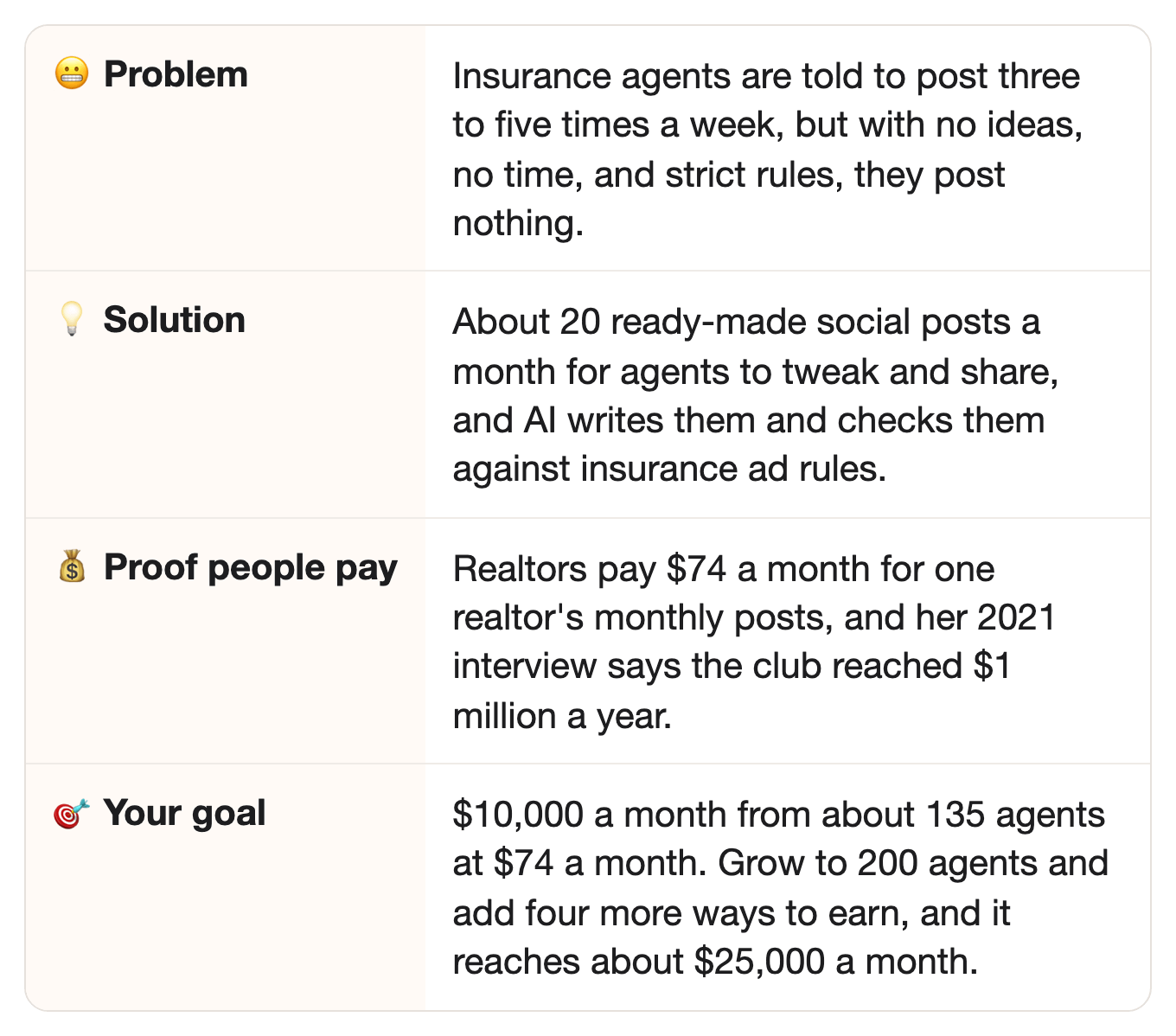
⚡ Quick facts

⠀
📖 How one realtor built a $1M-a-year club
Her first year selling houses? Not a single sale.
Haley Ingram became a real estate agent in Florida.
And her first year was rough… not one house sold.
She was in credit card debt, so she picked up a bartending job to pay the bills.
Then she tried one new thing: an Instagram account for her real estate business.
And it worked! She sold a few homes from it.
Then other agents started asking her to help with their posts too.
That’s where the business started.
⠀
First, she sold post templates on Etsy, a website where small shops sell digital files.
Then, in September 2019, she opened a membership site at $19 a month.
Turns out, what members loved most was the content calendar.
That’s a list of what to post each day, with the caption already written.
So the calendar became the main thing she sent every month.
And people signed up fast.
14 people joined by October 1, 2019.
88 more joined in October.
Then 170 more joined in November.
⠀
She raised the price to $34 a month in 2020, then to $54 in 2021.
And people kept joining anyway.
In 2021, she shared her story on Starter Story.
The interview’s title: “I Created A $1M/Year Subscription-Based Toolkit For Real Estate Professionals.”
Her club is called Coffee & Contracts, and 4,071 new members joined in 2023 alone.
Great Scott! ⚡
From bartending to pay the bills… to a million dollars a year, by telling other agents what to post.
⠀
🔗 Same idea, new group
In the story: real estate agents paid Haley Ingram every month for a calendar of ready-made posts.
⠀In this idea: insurance agents need the same monthly posts, checked against insurance ad rules.
⠀Why it carries over: both groups are told to post often, have little time, and would rather tweak a post than write one.
⠀
💡 The opportunity
Insurance agents have the same problem: they must post often but have no time to write. Theirs also comes with strict ad rules.
Wait, who are insurance agents, exactly?
They’re the people who sell you car, home, life, or health insurance.
They need a license in every state where they work.
And like realtors, they live on new clients, so they’re told to post.
⠀
There are a lot of them.
More than half a million Americans sell insurance: about 572,600 in 2025.
⠀
And new ones show up every single year. 🔁
About 43,100 job openings for insurance agents are expected each year (a government projection).
So every year, a fresh batch of new agents needs something to post.
⠀
Here’s the thing: their posts count as ads, and insurance ads have rules.
For life insurance, state regulators wrote a sample rulebook together.
Then each state decides whether to make it law.
Under it, ads must be “truthful and not misleading.”
And client reviews have to be real.
In plain words: be truthful, and no fake reviews.
⠀
So a post that’s fine for a realtor can get an insurance agent into trouble.
A realtor can post “Now’s the time to buy!”
An insurance agent who posts “Guaranteed savings!”? That can break the rules.
⠀
👉 The idea: every month, send insurance agents a kit of ready-to-post social posts, with every caption already checked against the rules.
⠀
🙋 Never sold insurance? No problem. You can still build this.
Be the curious one who asks questions.
Interview 10 to 20 agents on a podcast or a newsletter, with their permission.
Ask what they post, what their clients ask, and what their insurance company won’t let them say.
⠀
Or team up with an agent.
An experienced agent brings the know-how, and checks every post before it goes out.
You make the posts and find the buyers.
⠀
Or use your own field.
Does your job have to post on social media, with rules about what it can say?
Then it works the same way.
⠀
✅ Why this could work
Three signs the money is real.
Plot twist: this works outside real estate too.
Jasmine Star is a photographer who went on to teach business owners how to grow on Instagram.
Her club, Social Curator, sold them photos, templates, and captions to post, at $30 a month.
A 2019 article on GaryVaynerchuk.com says it hit seven figures within 12 months.
⠀
In Australia, a mortgage group already does this for its own brokers.
Brokers are the people who find home loans for buyers.
Connective sells each broker 15 approved templates a month in Canva, a free online design app.
The price: 120 Australian dollars plus tax, per broker, per month.
⠀
And the need doesn’t go away.
Every new agent needs posts from day one.
Coffee & Contracts opened in September 2019, and it was still selling when we checked.
⠀
👉 Like to check the numbers yourself? The links are all in “📎 The sources,” at the very end.
⠀
📊 More proof people want this
Want more? Here you go.
Agents already pay for ready-made posts.
Coffee & Contracts, Haley’s kit from the story, says more than 6,000 agents are members, at $74 billed monthly.
⠀
Even insurance companies pay for posts.
Erie Insurance is a big US insurance company.
BrightFire, a social-post service, says Erie pays for a year of it for new Erie agents, a $1,200 value.
BrightFire sends up to 32 posts a month.
⠀
Agent groups hand out monthly post calendars too.
Trusted Choice is a brand for independent insurance agents, who sell for several insurance companies.
It gives members a monthly post calendar with Canva templates, 30 days before each month.
⠀
And the money in this job is real. 💰
The median agent, the one right in the middle of the pay range, earned $62,280 a year (May 2025).
So $74 a month is a small cost for them.
⠀
Later on, you could sell to loan officers too.
Loan officers are the people who make home loans.
That’s about 283,000 more jobs, with about 17,100 openings a year.
⠀
Even a company that supports agents asks the same question agents ask: who has time to post?
Pinney Insurance is a firm that supports independent life insurance agents.
Its 2026 social media guide asks: “who has time to become a content creator?”
Ha. Fair question.
The same guide says 3 to 5 posts a week is “the sweet spot for most agents.”
⠀
And it says their posts must follow the rules.
It says: “Insurance social media posts are subject to the same compliance standards as any other marketing material.”
Compliance just means following the industry’s rules.
⠀
👉 So agents are told to post 3 to 5 times a week, and even their own industry asks who has time for that.
Realtors, and even insurance companies, already pay for ready-made posts.
⠀
🔍 Who’s already doing it
Yes, there are tools. But none of them is made for one kind of insurance agent.
Coffee & Contracts, Haley’s club from the story, is only for realtors.
Its brand, its reviews, its community… all real estate.
⠀
Insurance post tools exist, but none of the ones Pinney lists is made for one kind of insurance agent.
Pinney’s 2026 guide lists several, with prices, including these.
FMG Suite: pre-approved posts and tools for following the ad rules, from $99 a month.
Social Jazz: posts for you automatically, from $19 a month, with a free plan.
But the guide says Social Jazz’s posts aren’t made for life insurance.
BrightFire: a done-for-you post service, from $100 a month.
⠀
Trusted Choice and Connective only help their own members.
Trusted Choice gives its members a monthly post calendar.
Connective sells post templates only to its own brokers in Australia.
An agent outside those groups? They get nothing.
⠀
What’s missing from Pinney’s 2026 list, when we checked:
A Coffee & Contracts-style kit in Canva, made for one kind of insurance agent.
For example, Medicare agents, who help people turning 65 pick their health coverage.
A monthly calendar, with captions checked against the ad rules, that the agent edits and posts themselves.
⠀
🔎 Check the market yourself in 2 minutes: run Part 0 of the prompt in the build plan below.
Your AI searches Etsy, Gumroad (another site for selling digital files), monthly post services, and agent groups that day.
Then it tells you: early, growing, or crowded.
Early? Start now.
Crowded? Good news: agents pay. Just pick a narrower kind of agent (Step 1 of the build plan).
A crowded market is still OK. You win by serving one kind of agent better, not by being first.
⠀
👉 That missing part can be your business: a monthly kit made for one kind of insurance agent, with captions checked against the ad rules.
⠀
🤖 Why AI won’t replace it
Could ChatGPT just do this? Sort of… if someone gives it the rules first. Your kit does that work for the agent.
🔮 Honest note: AI tools can already write and schedule posts on their own.
So the words alone aren’t the product.
The product is posts that follow the insurance ad rules, on topics you picked because you studied what agents’ clients ask.
⠀
1. Staying inside the ad rules comes first.Their posts are ads, and insurance ads must be “truthful and not misleading.”
One “guaranteed savings!” in a rushed caption can break the rules.
So your kit checks every caption twice: once against a rules checklist, then with an AI playing a strict reviewer.
⠀
2. You pick the right topics for each month.A busy agent doesn’t know which topics work in March, or in hurricane season.
You pick the topics their clients actually ask about, and skip the ones that get them in trouble.
⠀
3. A whole month shows up ready to post.Sure, ChatGPT can plan a month of posts.
But only if an agent sits down and explains the season, the clients, and the rules.
How many busy agents have that hour? Not many.
Your kit shows up with designed posts in Canva, a caption for each, and a calendar.
⠀
4. Remember those 6,000+ realtors paying $74 a month for Coffee & Contracts? That’s proof people pay for a ready-made month.They pay even though Canva and ChatGPT both have free plans.
⠀
👉 What a busy agent really buys: never staring at a blank post on a Sunday night again.
⠀
💵 How much you can make
Quick math time. 🧮
First stop: $10,000 a month from the kit alone
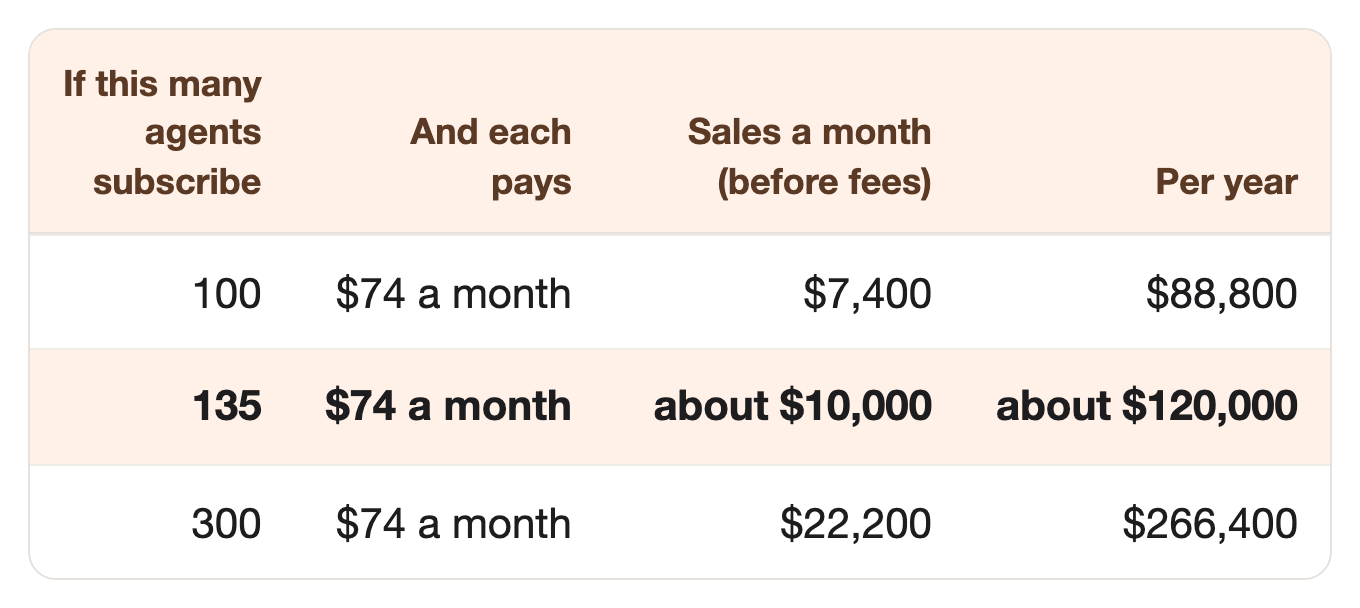
At $74 a month, Coffee & Contracts’ price, 135 agents bring in about $10,000 a month.
⠀And 135 agents is under half of 1% of the job openings for agents in a single year.
Tiny, right?
Next stop: $25,000 a month, with four more ways to earn
Once agents trust your kit, some will buy a second thing from you.
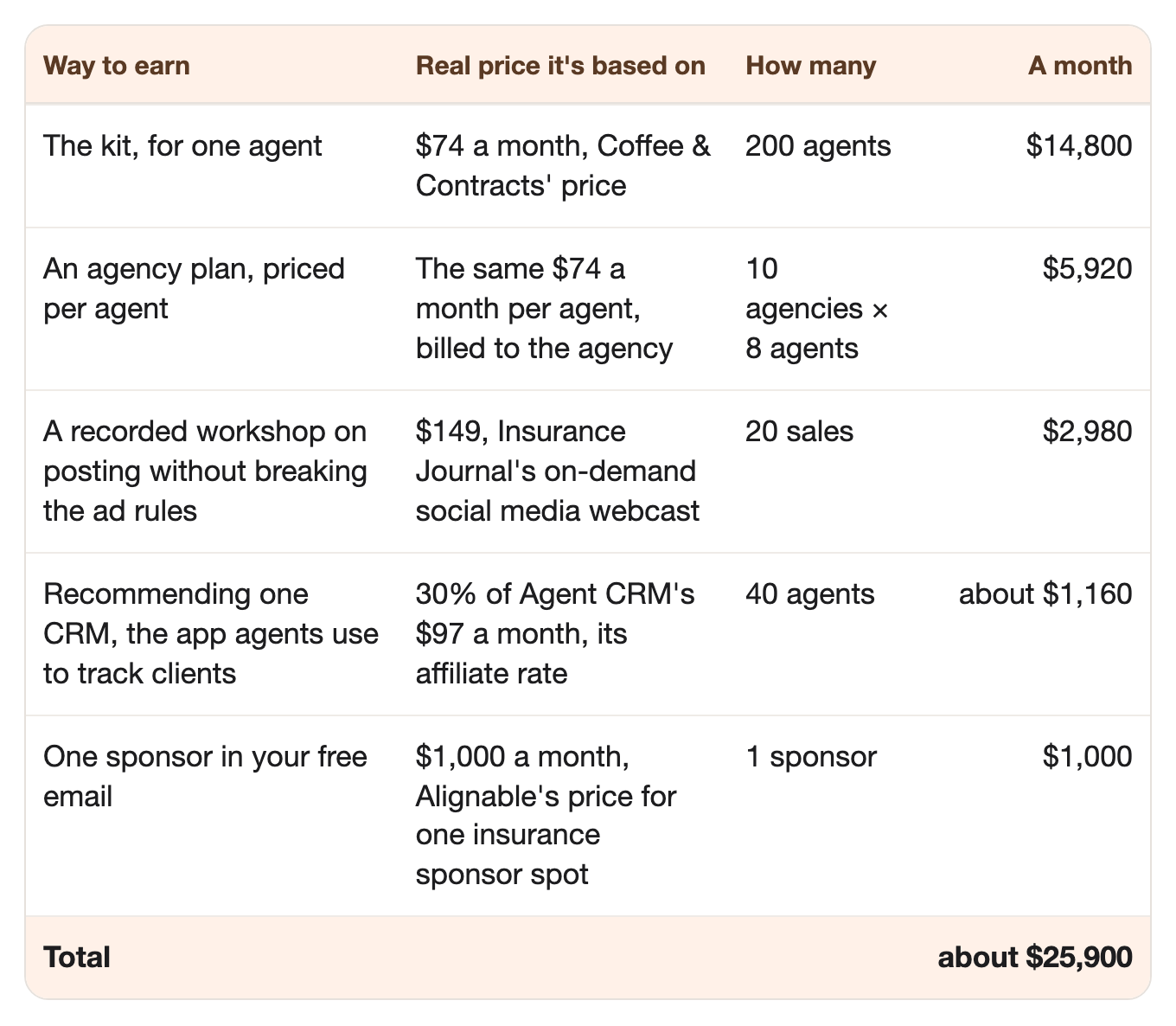
The kit still does most of the work.
Grow it from 135 to 200 agents, and it brings in $14,800 a month.
Yearly plans bring in a bit less, since they get two months free.
⠀
The agency plan is the big jump.
One agency owner signs up, and eight agents get the kit.
One sale, eight subscribers.
⠀
The workshop sells to agents who aren’t ready to subscribe.
Record it once.
If new agents keep finding it, about 20 sales a month is the goal.
⠀
The CRM link and the sponsor are small, but they take almost no time.
The sponsor only works once your free email reaches a few thousand agents.
$1,000 is Alignable’s price for a much bigger audience, so a smaller email may get less.
⠀
That’s about 280 agents in all.
Still under 1% of the job openings for agents in a single year.
⠀
And if it doesn’t work? Here’s everything you lose:
Nothing for Canva, if you start on the free plan.
One month’s subscription to an AI app, like ChatGPT or Claude.
One week to find out if agents want it.
⠀
👉 That’s the math for $25,000 a month, from one idea.
Stack two or three ideas from this newsletter, or take this one to a similar niche. Do that, and a million dollars in total is two or three years away.
For this kit, a similar niche could be loan officers. And this kit could be your first idea.
Got that “I could do this” feeling?
Good. The full plan starts right below. 👇
If not, that’s fine. See you next week.
That’s it, my fellow contrarians! 🙌
Yours ‘showing you how many ways there are to make money’ Vijay Peduru 🦸♂️
⠀
⠀
⠀
🧰 Want to build it? Here’s everything else.
⠀
Step 1: 🎯 Pick one kind of agent
Good news: you don’t need an insurance license to make posts. You just need to know who they’re for.
Pick one group, not “all agents.”
Medicare agents, who help people turning 65.
Life insurance agents, who sell to young families.
Home and car agents, in one part of the country.
Or mortgage loan officers, if you’d rather help home buyers.
Find out what their clients ask.
Interview three agents, with their permission.
Ask what they post, and what their company won’t let them say.
Your AI turns the interviews into a list of monthly topics.
⠀
Step 2: 🛠️ Make the first month
One month = about 20 posts, a caption for each, and a calendar. That’s it.
Plan the month. Your AI picks 20 topics, mixing tips, seasons, holidays, and “meet your agent” posts.
Write the captions. Plain words, no promises, and a question at the end to start a chat.
Design the posts in Canva.
Make each one a template the agent can open, add their logo and colors to, and post.
Coffee & Contracts builds all of its templates in Canva too.
Add three or four short video scripts, so agents can film a quick reel (a short vertical video).
⠀
Step 3: 🔍 Check every post
Your buyers’ licenses depend on these posts. So every caption gets two checks after it’s written (three AI passes in all, counting the writer).
Your AI does all three passes for you: it writes in Part 2, and checks in Parts 3 and 4 of the prompt.
🖊️ The AI writer. It writes each caption from a short list of safe topics, with no promises.
🔍 The AI rules checker. A second pass checks every caption against a rules checklist, and flags anything risky.
🧐 The AI critic. A third pass reads it like a strict compliance reviewer, and then like a confused client.
Optional: pay an experienced agent or a compliance pro once, to look over your checklist and your first month.
⠀👉 The prompt already follows four safety rules:
No promised savings, rates, or approvals, and no made-up reviews.
No insurance company or product names. Agents add their own.
Every kit tells agents to check with their carrier or compliance team before posting.
For loan officers, no payments or down payments. Federal rules say those also need the APR (the loan’s yearly cost, as a percentage) and the terms.
⠀
Step 4: 🏪 Open for subscribers
Easy one: copy Coffee & Contracts and keep one simple monthly price.
Set your prices.
$74 a month, like Coffee & Contracts.
$740 a year, so a yearly plan gets two months free, like theirs.
An agency plan: the same $74 a month, for each agent on the team.
Pick where to sell. Gumroad, Stan (a creator storefront app), or your own website all take monthly payments.
Send each month’s kit early, like Trusted Choice does, 30 days before the month starts.
Let AI write your sales page, using three real posts from your first month as examples.
⠀
Step 5: 📣 Get your first subscribers
Go where agents already find their tools and ask each other for help.
Put one free, rules-checked post template in Canva’s template library, with your kit’s name on it.
Check Canva’s current rules for publishing templates before you start.
Agents searching Canva for insurance posts find your free one, with your name on it.
Ask the marketing organizations that support independent agents to recommend your kit.
These groups give agents training and tools, and agents trust their picks.
Offer each one a free month to look over, so saying yes is easy.
Start a free weekly email with one rules-checked post idea.
Agents who aren’t ready to pay still hear from you every week.
Later, this is where your sponsor goes.
Answer “what should I post this month?” questions fast in insurance-agent groups.
Give a real post idea in your reply, and keep your kit’s name in your profile, not in the reply.
Never promise that a post brings sales.
⠀
Step 6: 🏃 Eliminate competitors
Here’s how to stay ahead when the competitors show up.
Write your sales page from the exact words agents use when they ask for help.
Save every phrase from their “what should I post this month?” questions in the groups, and from their emails to you.
Use their words, not yours, so your page sounds like them and a copycat’s sounds generic.
When you raise the price, say why, tied to something new, like Medicare-season posts.
For example, add a set of posts for Medicare’s yearly sign-up season, then tell members the new price and why.
Never quietly cut posts to keep the old price.
⠀
Step 7: 🎲 Make it bigger
Every licensed job that has to post has the same two things: a rulebook, and new people every year.
Add the four extras from “How much you can make,” one at a time.
First the agency plan, since you already make the kit.
Then the recorded workshop, from your best month of posts.
Then one CRM you’d recommend anyway, and one sponsor once your free email has a few thousand agents.
Open the same kit for other jobs: mortgage loan officers, other kinds of insurance agents, or any licensed job you know.
One kit at about $25,000 a month is about $300,000 a year, before fees. 🎯
Add two or three more kits, or ideas from this newsletter, and a million dollars in total is two or three years away.
⠀
🗓️ Your first week
Phew. That was a lot. 😅
Here’s a first version of Steps 1 to 5, in seven days. 🚀
By day 7, you have a sample month of posts, a sales page, and one free template.
Quick heads-up: the prompt below has seven Parts, and they’re not the same as the Steps above.
Day 1 (Step 1): Run Part 0 of the prompt (it’s below), and pick your kind of agent.
Then plan the month with Part 1.
Days 2–3 (Steps 2 and 3): Write the captions with Part 2, then check them with Parts 3 and 4.
Day 4 (Step 2): Get the design briefs and video scripts with Part 5, and build the posts in Canva.
Day 5 (Step 4): Write your sales page with Part 6, and open for subscribers.
Days 6–7 (Step 5): Make your free template and group replies with Part 7.
Then send your first note to an agent marketing organization.
⠀
🏄 How to use the prompt
One prompt does all the AI work, in seven parts, plus a quick market check (Part 0).
Part 1 — Plan the month. Picks 20 post topics for your kind of agent, with dates.
Part 2 — Write the captions. Writes one caption per post, in plain words, with no promises.
Part 3 — Check the rules. Checks every caption against a rules checklist, and flags the risky ones.
Part 4 — Find the mistakes. Reads it like a strict compliance reviewer, and then like a confused client.
Part 5 — Brief the designs and videos. Tells you what goes on each Canva post, and writes the video scripts.
Part 6 — Write the sales page. Uses your real posts as examples.
Part 7 — Write the free template and the replies. Turns one post into a free template, and writes group replies and a note to agent marketing organizations.
Run it your way:
Part by part (the default): it pauses after each part, and you type “next” to keep going.
All at once: say “run all seven parts.”
Just one part: say “only do Part 3,” or any part you need.
The full prompt is just below, under “📋 The prompt.”
🎙️ Talk to your AI sidekick, don’t type.
Turn on voice mode, or use a dictation app like Wispr Flow.
Say it messy. The AI sorts it out.
Turn it into a skill, so you never paste it again.
Paste the prompt into Claude or ChatGPT, and say: “Turn this into a skill I can save.”
Install once, use forever.
⠀
📋 The prompt
The prompt (copy it into Claude or ChatGPT, fill in the INPUTS part, and run it your way)
CONTEXT:
- You're my content partner. Together we'll build a monthly kit of ready-to-post social posts for insurance agents (or the group I name below).
- This prompt has seven parts, in order.
- Run it the way I ask:
    - If I say nothing, go one part at a time. After each part, show me the result, then stop and wait. Move on only when I type "next."
    - If I say "run all seven parts," do them all without stopping.
    - If I say "only do Part 3" (or any part), do just that part.
- If a part needs something from me, ask for it before you start that part.
- These posts are ads, and insurance and mortgage ads have rules. Follow these in every part:
    1. Never promise savings, a price, a rate, approval, or a payout.
    2. Never use "guaranteed," "cheapest," "best rates," or "free" about insurance or a loan.
    3. Never name an insurance company, a lender, or a specific policy or loan. The agent adds their own.
    4. Never write a review or testimonial. Only the agent can add a real one.
    5. Never hint that the agent is licensed in a state they didn't name.
    6. Never give personal advice. Teach general ideas, then invite people to talk to the agent.
    7. For loan officers: never name a monthly payment, a down payment, a number of payments, or an interest rate.
- End every kit with this line for the agent: "Check with your carrier or compliance team before posting. Rules differ by state and by company."
- Never invent a fact or a number. If you're not sure a fact is right, leave it out.
- Keep web search on for the whole prompt (turn on search in ChatGPT or Claude), so you can open any page you need to check.

=============== INPUTS — edit these, or just run as is ===============

Who the kit is for:
{e.g. Medicare insurance agents in Florida}

The month:
{e.g. March}

What their clients ask most (paste notes from agent interviews, or leave blank):
{e.g. "What's the difference between Medicare Advantage and Medigap?", "Do I have to sign up at 65?"}

My prices:
{e.g. $74 a month, $740 a year, a team price for agencies}

======================== END OF INPUTS ========================

THE PARTS:

Part 0 — Check the market today.
This part needs web search (turn on search in ChatGPT or Claude). Search for social-post kits and templates for my kind of agent and, for each place, give the count, the three biggest with links, and their prices:
1. Etsy and Gumroad shops selling social post templates for this kind of agent.
2. Monthly post subscriptions and done-for-you social services for them.
3. Free calendars from agent groups, associations, or insurance companies.
4. The biggest social accounts teaching these agents how to post.
Then tell me: early (few sellers), growing, or crowded, and which kind of agent looks least served (for example: Medicare agents, home-and-car agents, new agents). Give a link for every number. If you can't open a page, say so. Never guess a number.

Part 1 — Plan the month.
Plan 20 posts for the month. Base the topics on what their clients ask, from my INPUTS. Mix four kinds: tips that teach one simple idea, seasonal or holiday posts, "meet your agent" posts, and questions that start a chat. For each post give the date, the kind, the topic in one line, and why a client would care. Say clearly which reasons are your guess. Flag any topic that sits close to the rules in CONTEXT.

Part 2 — Write the captions.
Write one caption for each post in Part 1, for someone with no insurance background:
1. A first line that stops the scroll, in the client's own words.
2. Two to four short lines that teach one idea.
3. A question at the end to start a chat.
4. Three to five hashtags.
Keep each caption under 120 words, and follow every rule in CONTEXT.

Part 3 — Check the rules.
Now act as a separate rules checker who didn't write these captions. Check every caption against each rule in CONTEXT, one by one. Mark each caption: safe, needs a fix, or drop it. For each problem, quote the risky words and say which rule they break. Then give a fixed version of every caption that needs one.

Part 4 — Find the mistakes.
Now act as a strict compliance reviewer at an insurance company, then as a confused client. As the reviewer, flag anything that could read as a promise, advice, or a misleading claim. As the client, flag any word or idea that would confuse them. Then give the final captions, with every fix made, and the line from CONTEXT at the end.

Part 5 — Brief the designs and videos.
For each post, give me a Canva brief:
1. The words on the image, under 12 words.
2. The layout, for example a quote card, a tip list, or a photo with a headline.
3. Where the agent's logo, name, and colors go.
Then write four one-minute video scripts, under 150 words each, from the strongest posts. Start each with the question a client would ask.

Part 6 — Write the sales page.
Ask me for three of my best finished posts first. Use them as examples. Never invent a result, a review, or a number. Give me:
1. A headline that names the kind of agent, not "agents."
2. What they get each month: the posts, the captions, the calendar, and the video scripts.
3. How every caption is checked, and that the final check is theirs, with their carrier.
4. The prices, shown up front, and "Cancel any time."
5. A free sample week, in exchange for an email address.

Part 7 — Write the free template and the replies.
1. Ask me which post from this month to use. Turn it into one free Canva template: a title that names my kind of agent, a short description, and my kit's name on the design. It must pass the Part 3 rules check.
2. Write five short replies to "what should I post this month?" for agent groups. Each gives one real post idea for this month. Never promise sales, leads, or results, and never link to my kit in the reply.
3. Write a short note to a marketing organization that supports independent agents. Offer a free month of the kit to look over, and say how every post is checked.
⠀
📎 The sources
Every number above, with where it came from.
Coffee & Contracts’ revenue · Number: Interview title: “I Created A $1M/Year Subscription-Based Toolkit For Real Estate Professionals” · Source: Starter Story, 2021
Haley’s first year · Number: “I didn’t sell a single house in my first year”; credit card debt; a bartending job; an Instagram account for her real estate business · Source: Starter Story, 2023 update by Haley Ingram
New members in 2023 · Number: “In 2023, we welcomed 4,071 new members.” · Source: Same 2023 page
Launch and early sign-ups · Number: Live September 2019; 14 sign-ups by October 1, 88 more in October, 170 more in November · Source: Starter Story, 2021
Her prices over time · Number: $19 a month at launch; $34 from February 2020; $54 from January 2021 · Source: Same page
Homes, other agents, Etsy · Number: “I ended up selling a few homes from social media”; “other real estate agents asking me to help them with their social media”; “selling templates on Etsy” · Source: Same 2023 page; the 2021 page adds “I started an Etsy shop where I sold Canva templates for real estate agents”
Calendars with captions · Number: “members loved content calendars with captions”; templates built in Canva · Source: Same page
Free accounts for promoters · Number: Free accounts and coupon codes for agents with a strong Instagram, who earned a commission · Source: Same page
Coffee & Contracts today · Number: “Join 6,000+ top agents”; $74 billed monthly, $740 billed yearly · Source: coffeecontracts.com
Social Curator · Number: Jasmine Star, a photographer who built an Instagram education business; “$30 / month” for pictures, templates, and captions; “Within 12 months, it was doing seven figures” · Source: GaryVaynerchuk.com, March 2019
Connective Socialise · Number: 15 compliance-approved Canva templates a month; “$120 + GST per month” per broker · Source: Connective
BrightFire for Erie agents · Number: “Up To 32 Posts Per Month”; “Paid by ERIE for 1 year!”; “$1,200 total value” · Source: BrightFire: ERIE New Agent Marketing Program
Trusted Choice calendars · Number: A monthly social calendar with Canva templates; “released 30 days before start of the new month” · Source: Trusted Choice, February 2025 calendar
Insurance agent jobs · Number: About 572,600 in 2025; about 43,100 openings projected each year, on average, over the decade; median wage $62,280 (May 2025); licensed in the states where they work; new clients “often through referrals” · Source: US Bureau of Labor Statistics
Loan officer jobs · Number: About 283,000 in 2025; about 17,100 openings a year · Source: US Bureau of Labor Statistics
Life insurance ad rules · Number: “Advertisements of Life Insurance and Annuities Model Regulation”; covers ads on “the Internet”; ads “shall be truthful and not misleading”; testimonials “must be genuine” · Source: NAIC model regulation 570
States adopt NAIC models · Number: Models become law through “the states’ adoption of our model laws and regulations” · Source: NAIC, Model Laws
Mortgage ad rules · Number: Naming a down payment, number of payments, payment amount, or finance charge triggers the APR and terms · Source: CFPB, Regulation Z §1026.24
Pinney’s guide for agents · Number: “who has time to become a content creator?”; “3-5 times per week is the sweet spot for most agents”; “Insurance social media posts are subject to the same compliance standards as any other marketing material.” · Source: Pinney Insurance, 2026 guide
Workshop price · Number: “Social Media Marketing for Insurance Professionals,” an on-demand webcast, $149.00 · Source: Insurance Journal
CRM affiliate rate · Number: 30% recurring for 1–10 customers, 35% for 11–50, 40% for 51+ (March 27, 2025) · Source: Agent CRM blog
CRM price · Number: $97 a month per account · Source: Agent CRM blog
Sponsor price · Number: One exclusive insurance spot: “Then $1,000/mo” · Source: Alignable
Insurance post tools · Number: FMG Suite “From $99/month”, “pre-approved social content”; Social Jazz “Free plan available; paid from $19/month”, content “general insurance, not life-insurance-specific”; BrightFire “From $100/month” · Source: Same Pinney guide