


Hello contrarians,
Today’s idea is called Spreadsheets for Property Managers.
Pour yourself a tea. 🍵
First, a consultant’s story. Then, the business you could build from it.
⠀
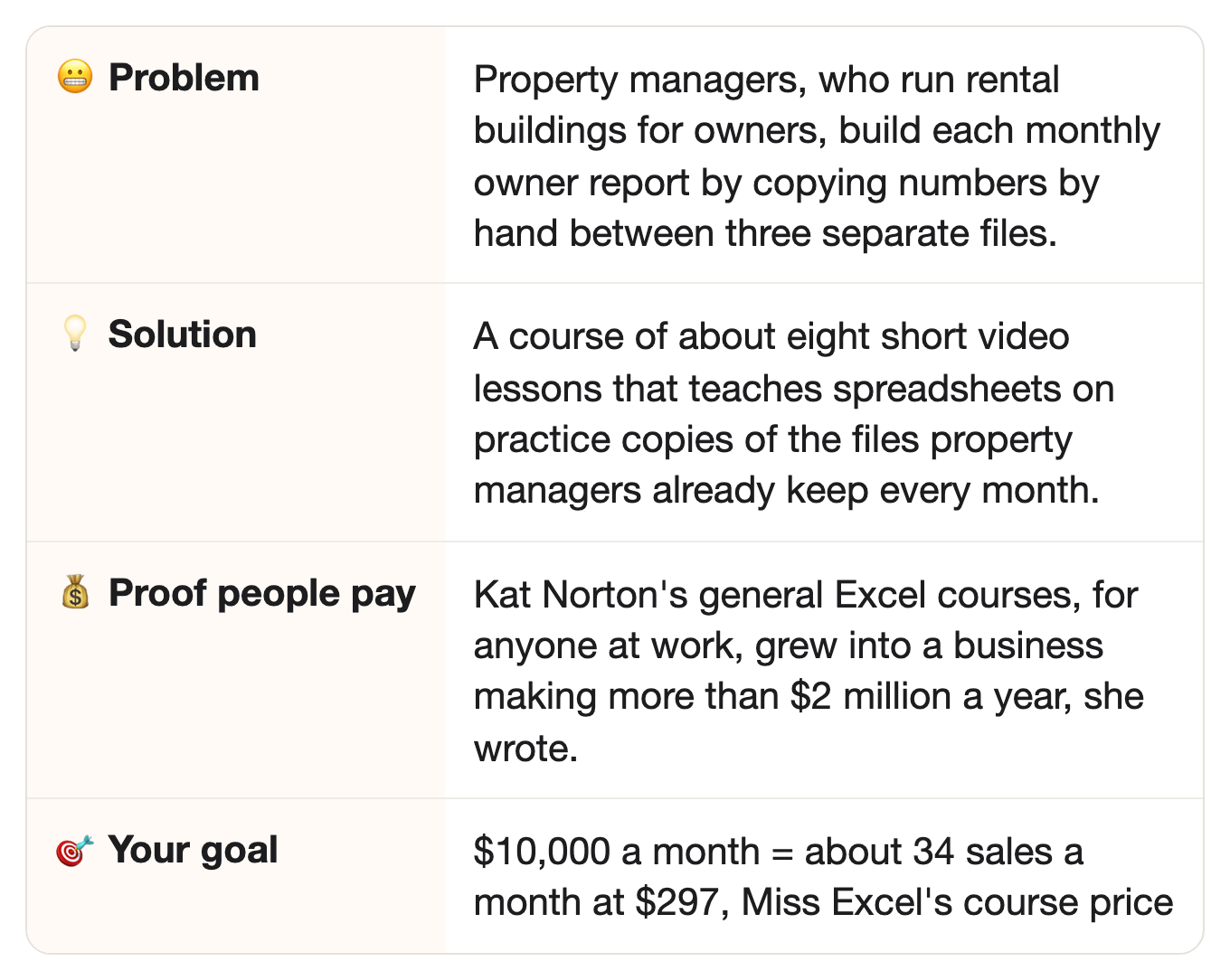
⚡ Quick facts
⠀
📖 How one consultant built a $2M-a-year Excel business
Her first Excel video? She posted it while living at her parents’ house.
Kat Norton was a full-time management consultant.
She also had a lot of student debt… and she was living back home with her parents.
Then, in June 2020, she posted her first Excel video on TikTok, on an account called Miss Excel.
Within a few weeks, the video went viral, and she had 100,000 followers.
That November, she started selling an online Excel course on her own website.
⠀Two months later, her course sales beat her monthly paycheck as a consultant.
Yes, two months.
So in January 2021, she quit her job.
Then she made nine more courses, each teaching a different work skill.
Then came her biggest day: in October 2021, she made $100,000 in sales in one day.
One day.
And companies started paying her too.
She hosted 60-minute Excel trainings for her corporate partners.
Her boyfriend quit his sales job in April 2022 to run the money side.
⠀
By the end of 2022, at 29, she wrote that Miss Excel makes more than $2 million a year.
And she wrote that she works about four hours a day.
Loopity loop. 🎢
From student debt and her parents’ house… to $2 million a year, by teaching Excel in short, fun videos.
⠀
🔗 Same idea, new group
In the story: people who wanted to get better at Excel for any job paid for Kat Norton’s general courses.
⠀In this idea: property managers need the same skills, practiced on their rent roll (the list of units and rents), budget, and monthly owner report.
⠀Why it carries over: both groups live in spreadsheets at work, and nobody ever taught them how.
⠀
💡 The opportunity
Property managers spend their days in spreadsheets, and most Excel lessons practice on files that look nothing like theirs.
Wait, who are property managers, exactly?
They run apartment buildings, condos, and rental homes, on behalf of the owners.
They collect the rent, pay the bills, and fix what breaks.
And they keep records of rental activity, and prepare budgets and financial reports.
So yes, spreadsheets.
⠀
There are a lot of them.
There were about 466,100 property, real estate, and community association manager jobs in 2024.
Community association managers work for a homeowners’ association: the group of owners that runs a condo building or a neighborhood.
⠀
And new ones arrive every year. 🔁
About 39,000 job openings are expected each year (a government projection).
And every new manager takes over the spreadsheets the last manager left behind, on day one.
⠀
Here’s the trick: their spreadsheets aren’t like anyone else’s.
A general Excel course practices on made-up sales numbers.
But a property manager needs the rent roll, the late-rent list, and the owner’s report due Friday.
Owners also want to know how many units are rented and when each lease ends, the US Bureau of Labor Statistics says.
After the course, one formula pulls each unit’s rent from the rent roll into the owner’s report, so the copying by hand stops.
Bye-bye, row-by-row copying.
⠀
Their industry already runs Excel training.
The apartment associations in Austin and Houston ran Excel classes for on-site property managers in 2023.
An apartment association is a local group for apartment owners and managers in one city.
On-site managers work in the building itself every day, and they keep its monthly files.
Then a property management company, Forty2, brought the same trainer in for its own team in 2024.
⠀
👉 The idea: a short online course that teaches property managers spreadsheets on the files they keep every month, plus an AI prompt for each task.
⠀
🙋 Never managed a property? You can still build this.
Let your AI read what managers already post.
Property managers post about the files they dread in industry forums and groups.
Your AI reads those posts and lists the files they dread most each month.
⠀
Or team up with one.
An experienced manager brings the files and checks every lesson.
You build the course, record it, and find the buyers.
⠀
Or use your own field.
Does your job live in spreadsheets too?
Then build the same course for your own field, the way school office staff or nonprofit finance staff could.
⠀
✅ Why this could work
Here’s why people will pay for this.
Others already built Excel courses from their own jobs, and the apartment industry already pays for this training in person.
Kat isn’t the only one.
Meet Purna Duggirala, known as Chandoo.
He was a business analyst in India who wrote about Excel.
He built his Excel course from whatever he used in his own job.
About 5,000 people had finished it by 2015, and his business made about $1 million in 2014.
He left his full-time job in 2010, and he was still teaching Excel when we checked.
So this isn’t a one-year fad.
⠀
People from the apartment industry already teach this, in person.
Julie Irvin Hartman had spent 21 years in the apartment industry, her 2024 class page says.
She taught the Austin, Houston, and Forty2 classes, all built for on-site managers.
⠀
👉 Don’t take my word for it. Every number is linked in “📎 The sources,” at the very end.
⠀
📊 More proof people want this
Want more? Here you go.
People pay for Excel courses, even with free videos everywhere.
Miss Excel’s site says over 30,000 students have joined her courses.
Her beginner-to-intermediate Excel course, the Excelerator, costs $297.
⠀
It isn’t only the first famous teacher.
Senna Filter is a biochemistry graduate who started teaching Excel on social media.
She launched her Excel course in July 2023, and it passed 1,000 customers, Thinkific (a course website) wrote in 2025.
⠀
And the money in this job is real. 💰
The median property manager, the one in the middle of the pay range, earned $66,700 a year (May 2024).
So a $297 course costs them less than two days’ pay.
⠀
👉 Property managers already get Excel training built for them, but in person, in one place, on one date.
A course they can take any night, built on the same files they keep every month, is what’s missing.
⠀
🔍 Who’s already doing it
Big Excel teachers sell well, but none of them build a course for apartment and rental-home managers.
Miss Excel and Chandoo teach everyone.
Their lessons fit any office worker… so the examples aren’t a rent roll or an owner’s report.
⠀
Property Metrics sells an Excel course for real estate, with a rent roll project.
Sounds close, right?
Not quite: it’s built for commercial real estate, with loan math and investment models.
Commercial real estate means buildings bought as investments, like offices and shops.
So it teaches investors, not the manager who makes a building’s monthly reports.
⠀
Apartment associations run live Excel classes.
They’re useful, but each one is in person, on one date, and the public ones last a morning.
Oh, and the trainer also posts 20+ free Excel videos for property management pros on YouTube.
⠀
Still missing when we checked:
A self-paced course for apartment and rental-home managers, built on the files they keep every month.
One practice file and one AI prompt for each task, like the owner’s report.
⠀
🔎 Check the market yourself in 2 minutes: run Part 0 of the prompt in the build plan below.
Your AI searches course sites, YouTube, Etsy, and trade associations that day, and tells you: early, growing, or crowded.
Etsy is a website where small shops sell digital files, including spreadsheet templates.
Early? Start now.
Crowded? Good news: it means managers pay. Pick one narrower kind of manager (Step 1 of the build plan).
A crowded market is still OK. You win by serving one kind of manager better, not by being first.
⠀
👉 You can be the one to fill that gap: a self-paced course on property managers’ monthly files.
⠀
🤖 Why AI won’t replace it
AI can build an owner’s report in minutes, if someone first gives it the right layout, the rules, and what the owner checks. Your course does that work.
🔮 Honest note: AI already lives inside spreadsheets, like Copilot in Excel and Gemini in Google Sheets.
Even Miss Excel sells lessons on Copilot and Claude.
So formulas alone aren’t the product.
The product is a lesson on each monthly report, with AI, on a practice file laid out like theirs.
⠀
1. You know what matters.A new manager doesn’t know which number an owner looks at first.
You do, because your AI read what managers and owners say about these reports, and you built each lesson around it.
⠀
2. Ready to use.Each lesson comes with a practice file in the right layout, and the exact prompt for that task.
The manager doesn’t have to explain their whole job to the AI first.
And on the last Thursday of the month, that matters.
⠀
3. Checked twice.A wrong rent total in an owner’s report… that’s a bad day for a manager.
So every formula in your course is tested on made-up data with known answers, then checked again.
⠀
4. They already know and trust you.Remember how Kat’s buyers found her?
Through short, fun videos.
Your videos do the same job for property managers.
⠀
5. Proof people pay for a course even when Excel help is free: over 30,000 students joined Miss Excel’s courses.
⠀
👉 They pay for a finished lesson on the exact report they owe each month.
⠀
💵 How much you can make
Here’s how the numbers add up.
The price stays at $297, and only the number of buyers changes.
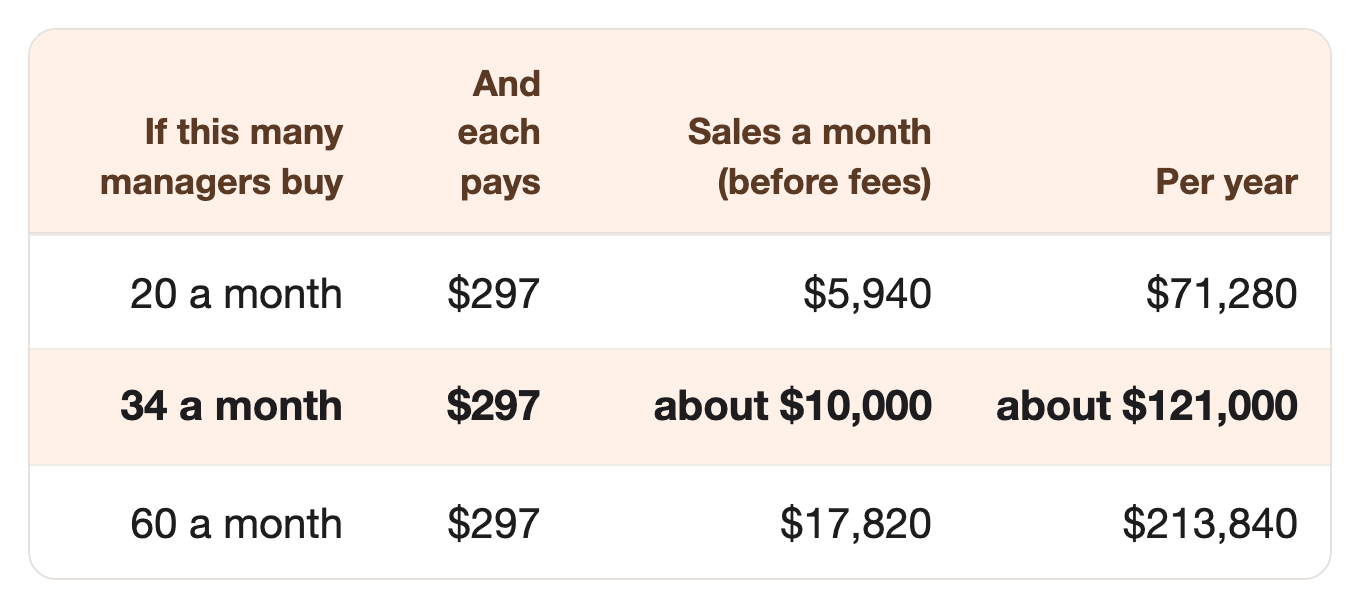
At $297, Miss Excel’s price for her Excelerator course, 34 sales a month bring in about $10,000.
⠀34 sales a month is about 400 a year, or about 1% of the property manager openings in a single year.
That’s a small slice.
⠀
If it doesn’t work out, here’s all you lose:
Nothing for the spreadsheet apps, if you use Google Sheets or the free version of Excel on the web.
One month’s subscription to an AI app, like ChatGPT or Claude.
One week of your time.
⠀
👉 With AI doing most of the work, three or four ideas like this could add up to a million in 2 to 3 years.
Did this one make you think “wait, I could do that”?
Then keep scrolling. The whole build plan is below. 👇
If not, no worries. See you next week with a new idea.
That’s it, my fellow contrarians! 🙌
Yours ‘showing you how many ways there are to make money’ Vijay Peduru 🦸♂️
⠀
⠀
⠀
🧰 Want to build it? Here’s everything else.
⠀
Step 1: 🎯 Pick one kind of property manager
You don’t need to have managed a building. You need to know whose files you’re teaching.
Pick one group, not all managers.
On-site apartment managers, who run one building every day.
Managers of rental homes, who look after many houses for many owners.
Community association managers, who work for a homeowners’ association board.
Let your AI find the real files.
Ask it to read what property managers post in industry forums and groups about the reports they dread each month.
Ask it to find free sample rent rolls and owner reports online, so you see real layouts.
⠀
Step 2: 🛠️ Build the course
Eight short lessons, one file each.
Plan the lessons. Your AI turns that research into eight lessons, from the easiest file to the hardest.
For example: the rent roll, the late-rent list, lease end dates, the budget, and the owner’s monthly report.
Make a practice file for each lesson, with made-up units, tenants, and rents.
Write each lesson. A short video script, the steps by hand, and the AI prompt that does the same task.
Record the videos. Five to ten minutes each, with your screen and your voice.
⠀
Step 3: 🔍 Check every formula
Managers will use these files with real rent money, so every formula gets two checks after it’s written.
Your AI does the three jobs below: it builds in Parts 2 and 3 of the prompt, and checks in Parts 4 and 5.
🖊️ The AI writer. It builds the practice files and the lessons, with a version for Excel and one for Google Sheets.
🔍 The AI tester. A second pass works out each answer by hand on small, made-up data, and compares it with the formula.
🧐 The AI critic. A third pass reads each lesson like a strict trainer, and like a confused first-week manager.
Optional: pay an experienced property manager once, to review the first two lessons.
⠀👉 The prompt already follows four safety rules:
Made-up data only. It tells you to remove real names before you paste any real file.
No legal, tax, or accounting advice. Each lesson teaches the spreadsheet, and says to follow the company’s and the owner’s rules.
No promised raises, jobs, or saved hours.
Every formula comes in Excel and Google Sheets versions, and is tested before it goes into a lesson.
⠀
Step 4: 🏪 Open for sales
Copy Miss Excel: one clear price, and a refund promise.
Set your prices.
$297, like Miss Excel’s Excelerator course.
A team price for management companies that buy for several managers.
Offer a 14-day refund, like Miss Excel does, so buying feels safe.
Pick where to sell. A course website like Thinkific or Teachable, or Gumroad, all take payments.
Let AI write your sales page, using one finished lesson as the example.
⠀
Step 5: 📣 Get your first buyers
Go where property managers already learn.
Co-host a free live session with an apartment association.
Pitch one hour: “Build next month’s owner report with AI, from your rent roll.”
You both keep the sign-up list, and the association gets a free class to offer its members.
Make longer YouTube lessons titled with what managers search.
One problem per video, titled like “rent roll in Excel” or “late rent tracker in Google Sheets.”
Put the course link in the description, not in the middle of the lesson.
Ask regional managers and training directors at management companies.
They choose the classes their on-site managers take.
Offer each one a free look at two lessons, and your team price.
⠀
Step 6: 🏃 Eliminate competitors
When others copy you, here’s how you stay the one people pick.
Make one claim only you can make: “Built on the files property managers keep every month.”
Put it on your sales page, in every video, and in your profile.
A general Excel teacher can’t honestly say that about their course.
Give finishers a certificate, with their name printed big.
Miss Excel gives one at the end of each course, and students can add it to LinkedIn.
For a property manager, it’s proof for their next review, or their next job.
⠀
Step 7: 🎲 Make it bigger
Every job that lives in spreadsheets has the same two things: its own files, and new people every year.
Open the same course for other jobs: school office staff, nonprofit finance staff, or any job you know.
Sell team licenses to management companies, so every new hire takes the course in week one.
Three courses at about $10,000 a month each is about $360,000 a year, before fees. 🎯
⠀
🗓️ Your first week
Phew. That was a lot. 😅
A first version of Steps 1 to 5 fits into seven days. 🚀
By day 7, you have a course plan, practice files and scripts for all eight lessons, two recorded lessons, and a sales page.
Quick heads-up: the prompt below has a market check (Part 0) plus seven Parts, and they’re not the same as the Steps above.
Day 1 (Step 1): Run Part 0 of the prompt (it’s below), and pick your kind of manager.
Then plan the lessons with Part 1.
Days 2–3 (Step 2): Build the practice files with Part 2, and write the lessons with Part 3.
Day 4 (Step 3): Test every formula with Part 4, and find the mistakes with Part 5.
Then record two lessons.
Day 5 (Step 4): Write your sales page with Part 6, and open for sales.
Days 6–7 (Step 5): Write your live-session pitch, video titles, and notes with Part 7, and send your first pitch to an apartment association.
⠀
🏄 How to use the prompt
One prompt does all the AI work, in seven parts, plus a quick market check (Part 0).
Part 1 — Plan the lessons. Turns your research notes into eight lessons, one file each, from easiest to hardest.
Part 2 — Build the practice files. Lays out each file with made-up data, with formulas for Excel and Google Sheets.
Part 3 — Write the lessons. Writes each video script, the steps by hand, and the AI prompt a manager uses for that task.
Part 4 — Test the formulas. Works out each answer by hand on the made-up data, and flags any formula that disagrees.
Part 5 — Find the mistakes. Reads each lesson like a strict trainer, and like a confused first-week manager.
Part 6 — Write the sales page. Uses one finished lesson as the example.
Part 7 — Write the first-buyer notes. Writes the live-session pitch, the YouTube titles, and a note to a training director.
Run it your way:
Part by part (the default): it pauses after each part, and you type “next” to go on.
All at once: say “run all seven parts.”
Just one part: say “only do Part 3,” or any part you need.
The full prompt is just below, under “📋 The prompt.”
🎙️ Talk to your AI sidekick, don’t type.
Turn on voice mode, or use a dictation app like Wispr Flow.
Say it messy. The AI sorts it out.
Turn it into a skill, so you never paste it again.
Paste the prompt into Claude or ChatGPT, and say: “Turn this into a skill I can save.”
Install once, use forever.
⠀
📋 The prompt
The prompt (copy it into Claude or ChatGPT, fill in the INPUTS part, and run it your way)
CONTEXT:
- You're my course partner. Together we'll build a short online course that teaches spreadsheets to property managers (or the job I name below), using the files they keep every month.
- This prompt has seven parts, in order.
- Run it the way I ask:
    - If I say nothing, go one part at a time. After each part, show me the result, then stop and wait. Move on only when I type "next."
    - If I say "run all seven parts," do Parts 1 to 7 without stopping (Part 0 runs only if I ask for it).
    - If I say "only do Part 3" (or any part), do just that part.
- If a part needs something from me, ask for it before you start that part.
- Follow these rules in every part:
    1. Use made-up data only: made-up units, tenants, rents, and owners. If I paste a real file, tell me to remove every name, phone number, and account number first, and don't use any you see.
    2. Never give legal, tax, or accounting advice. Teach the spreadsheet, and tell learners to follow their company's and the owner's rules.
    3. Never promise a raise, a job, or a number of hours saved.
    4. Give every formula in two versions, one for Excel and one for Google Sheets.
- Never invent a fact or a number. If you're not sure a fact is right, leave it out.
- Keep web search on for the whole prompt (turn on search in ChatGPT or Claude), so you can open any page you need to check.

=============== INPUTS — edit these, or just run as is ===============

Who the course is for:
{e.g. on-site apartment managers in buildings with 100 to 300 units}

The files they dread each month (paste your research notes, or leave blank):
{e.g. the rent roll, the late-rent list, lease end dates, the monthly budget, the owner's monthly report}

The spreadsheet app they use:
{e.g. Excel at work, some use Google Sheets}

My price and refund promise:
{e.g. $297, a team price for management companies, and a full refund in the first 14 days}

======================== END OF INPUTS ========================

THE PARTS:

Part 0 — Check the market today.
This part needs web search (turn on search in ChatGPT or Claude). Search for spreadsheet courses and templates for my kind of manager and, for each place, give the count, the three biggest with links, and their prices:
1. Online courses that teach Excel or Google Sheets to this job (course sites, Udemy, association classes).
2. Etsy and Gumroad shops selling spreadsheet templates for this job.
3. YouTube channels teaching spreadsheets to this job.
4. Free classes or videos from trade associations or software companies for this job.
Then tell me: early (few sellers), growing, or crowded, and which kind of manager looks least served (for example: on-site apartment managers, rental-home managers, community association managers). Give a link for every number. If you can't open a page, say so. Never guess a number.

Part 1 — Plan the lessons.
Plan eight lessons from my INPUTS, one file per lesson, from the easiest to the hardest. For each lesson give: the file, the one task the learner finishes, the two or three spreadsheet skills it teaches (for example sorting, a lookup, a date formula, a pivot table), and why a manager would care. Say clearly which reasons are your guess.

Part 2 — Build the practice files.
For each lesson, build a practice file with made-up data:
1. The column names, in order, with one line on what goes in each.
2. 15 to 25 rows of made-up data, as a table I can paste into a spreadsheet.
3. Every formula the lesson uses, in an Excel version and a Google Sheets version, and which cell it goes in.
If you can make spreadsheet files, also give me each one as a file. If not, the table is enough.

Part 3 — Write the lessons.
For each lesson, write:
1. A video script of five to ten minutes, in plain words, for someone who has never used a formula. Start with the moment the manager needs this file.
2. The steps by hand, numbered, matching the practice file.
3. The AI prompt a manager can paste into Copilot, Gemini, or ChatGPT to do the same task on their own file. It must tell the AI the file's layout and what the result should look like, and remind them to check the answer.

Part 4 — Test the formulas.
Now act as a separate tester who didn't write these files. For each formula in Part 2, work out the right answer by hand from the made-up data, then compare it with what the formula gives. Mark each formula: correct, wrong, or unclear. For each wrong one, say why, and give a fixed version in both Excel and Google Sheets.

Part 5 — Find the mistakes.
Now act as a strict spreadsheet trainer, then as a confused first-week property manager. As the trainer, flag any step that's wrong, missing, or in the wrong order. As the new manager, flag any word or step that would confuse them. Then give the final lessons, with every fix from Part 4 and this part made.

Part 6 — Write the sales page.
Ask me for one finished lesson first. Use it as the example. Never invent a result, a review, or a number. Give me:
1. A headline that names the kind of manager, not "everyone."
2. The eight lessons, each with the file and the task it finishes.
3. How every formula is tested, and that each lesson comes with an AI prompt.
4. The price, shown up front, and the refund promise I give you.
5. A free sample lesson, in exchange for an email address.

Part 7 — Write the first-buyer notes.
1. Write a short pitch to an apartment association for a free one-hour live session: "Build next month's owner report with AI, from your rent roll." Say what members leave with, and that we both keep the sign-up list.
2. Write ten YouTube titles, each one problem in the words a manager would search, like "rent roll in Excel."
3. Write a short note to a regional manager or training director at a management company. Offer a free look at two lessons and my team price. Never promise results.
⠀
📎 The sources
Every number above, with where it came from.
Kat Norton’s story · Number: First video June 2020; “living at my parents house and buried in student debt”; 100,000 followers within a few weeks; course on her website “That November”; course earnings beat her monthly paycheck as a management consultant two months later; quit January 2021; nine more courses; $100,000 in sales in one day, October 2021; 60-minute Excel trainings for corporate partners; boyfriend joined April 2022 · Source: CNBC Make It, December 26, 2022
Miss Excel’s revenue · Number: “at 29, I’ve built Miss Excel into a business that generates more than $2 million a year”; “I work just four hours a day” · Source: Same CNBC article
Miss Excel’s students and prices · Number: “Join over 30,000 students learning with Kat!”; The Excelerator Course $297, for “beginner to intermediate level Excel users”; lessons on “Claude, and Microsoft 365 Copilot” in a bundle; refund “in the first 14 days”; “a Completion Certificate at the end of each course” · Source: Miss Excel homepage, Wayback copy of May 12, 2026
Chandoo’s course and revenue · Number: “I was working as a business analyst”; “Straight from India”; revenue in 2014 “About $1 million”; course topics were “whatever I thought relevant for my job because I’m working as an analyst”; “we’ve had 5,000 people graduate from this course”; basic version $97 · Source: Mixergy interview with Purna Duggirala, August 26, 2015
Chandoo’s history · Number: “I launched Chandoo.org in year 2004”; Excel focus after three years; “I left my full-time job in 2010” · Source: Chandoo.org about page, Wayback copy of May 1, 2026
Easily Excel · Number: Senna Filter, biochemistry graduate; Excel course launched July 2023; “well over 1,000 customers”; she started by posting daily Excel tips on social media · Source: Thinkific case study, May 23, 2025 (a Wayback copy of May 14, 2026 says the same)
Property manager jobs · Number: About 466,100 in 2024; about 39,000 openings projected each year, on average, over the decade (2024–34); median pay $66,700 a year (May 2024); duties include “Keep records of rental activity and owner requests” and “Prepare budgets and financial reports”; they report to owners on “occupancy rates, expiration dates of leases” · Source: US Bureau of Labor Statistics, Wayback copy of May 16, 2026
Austin apartment association class · Number: Excel 103, May 16, 2023, for “On-Site Property Managers, Supervisors, Corporate Team Members, and Vendors”; 9:00 to 11:00 am; “20+ Excel Videos for property management professionals” on YouTube; speaker Julie Irvin Hartman · Source: B2G Victory event page (a Wayback copy of April 11, 2026 says the same)
Houston apartment association class · Number: Excel 102 with the Houston Apartment Association, May 9, 2023, “Course for On-Site Property Managers” with “relevant property management examples”; 9:00 to 11:00 am; trainer Julie Irvin Hartman · Source: B2G Victory event page (a Wayback copy of February 14, 2026 says the same)
Forty2 Property Management class · Number: Excel 102, November 26, 2024, “designed for On-Site Property Managers”; formulas, dates, pivot tables, charts; trainer Julie Irvin Hartman, “in the multi-family industry for twenty-one years”; in person, private event · Source: B2G Victory event page (a Wayback copy of June 5, 2026 says the same)
Property Metrics course · Number: “Excel Basics for Real Estate”; “practical commercial real estate projects”; a rent roll project; loan analysis and a multifamily proforma; 7 modules · Source: Property Metrics, Wayback copy of December 15, 2025