


Hello contrarians,
Today’s idea is called The AI Mentor for New Product Managers.
Grab a snack. 🍪
First, a consultant’s story. Then, the business you could build from it.
⠀
⚡ Quick facts
⠀
📖 How one consultant turned himself into an AI
It started with years of his own advice.
James Kemp is a consultant.
He helps coaches and consultants sell their services.
In January 2026, he launches VirtualJK.
He calls it “a Replicant of James Kemp trained on $25 million of consulting sales.”
In plain words: an AI that thinks like him, built from years of his own work.
Coaches ask it to build offers, sales pages, and posts, the way he would.
His prices:
$97 a week.
$5,000 a year.
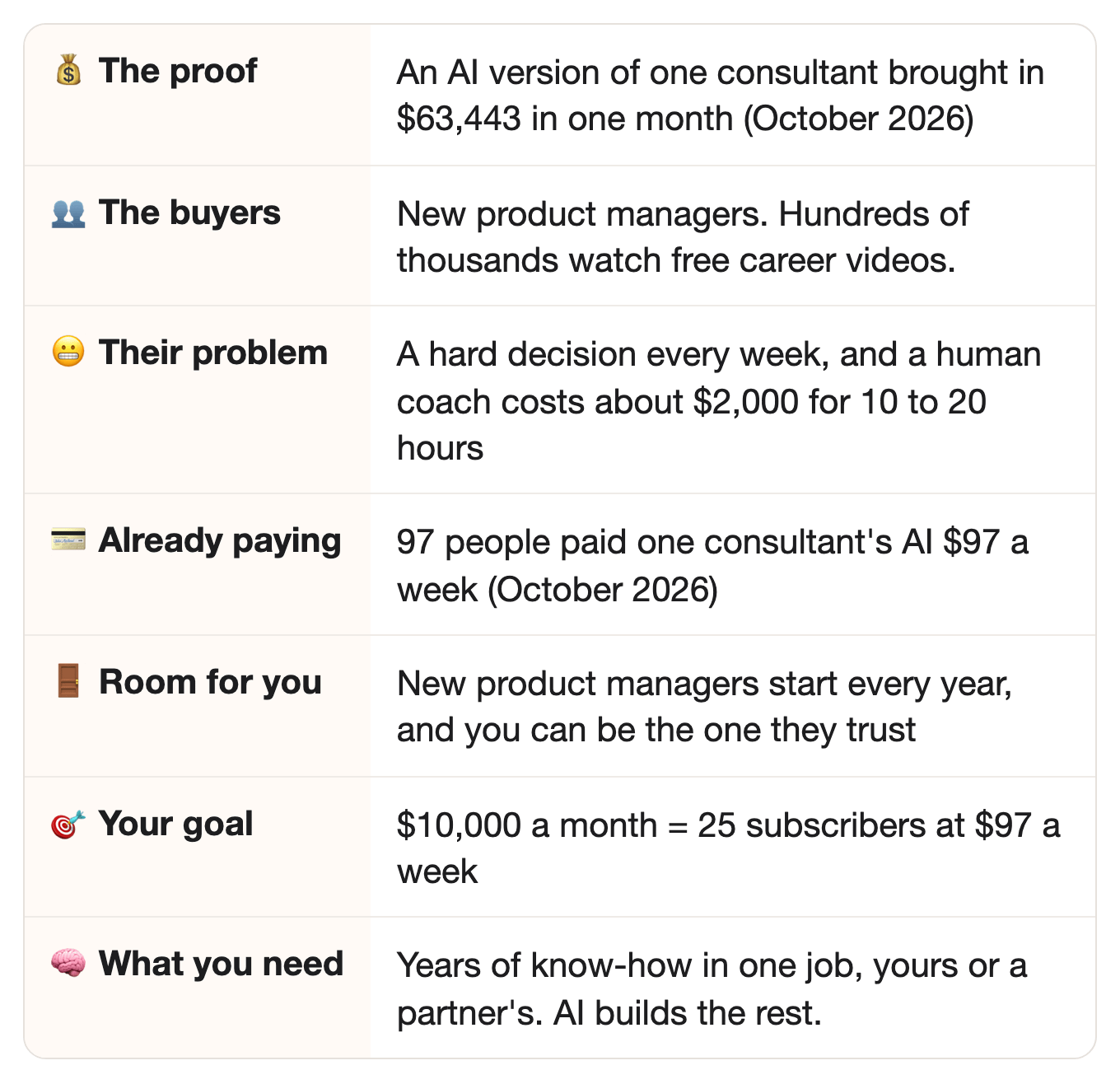
By October 2026, nine months in, it brought in $63,443 in a single month.
TrustMRR, a site that checks revenue, pulls that number straight from his payment account.
Bingo bango. 🎯 $63,000 in a month, from an AI version of one person.
⠀
💡 The opportunity
New product managers need advice every week, and an AI version of an experienced one can answer any day.
First, what’s a product manager?
It’s the person who decides what a software team builds next, and why.
They sit between the customers, the engineers who build it, and the bosses who pay for it.
Every app on your phone has product managers behind it.
In their first year, they hit a decision nobody taught them, every week.
A big customer wants a feature that doesn’t fit the plan. How do you say no?
Engineering says a two-week feature will take six weeks. Do you push back?
The first big plan for a new feature is due Friday. What goes in it?
Their manager is busy.
Here’s the kicker: a human coach costs real money.
On Leland, a coaching site, one product-manager coaching package is listed at about $2,000 for 10 to 20 hours.
So they watch YouTube, and guess.
⠀
👉 The idea: sell an AI mentor for new product managers, built from your own experience.
Not a product manager yourself? You can still build this.
Become the interviewer.
Interview 20 to 30 experienced product managers on a podcast or newsletter, with their permission.
Their answers become your AI’s knowledge, and every interview is also content.
Team up with one.
An experienced product manager brings the know-how.
You build the AI and find the buyers.
Or swap in your own job. The steps are the same.
⠀
🗣️ What it looks like
Here’s a made-up example of one question and one answer.
A new product manager types:
“Our biggest customer wants a feature that’s not on our plan. My boss says it’s my call. What do I do?”
Your AI answers, the way you would:
“First, ask the customer what problem the feature solves. Half the time, something already on the plan solves it.”
“If not, say ‘not this quarter,’ and tell them when you’ll look again.”
“That’s what I did in 2021 with our largest account, and we kept them.”
It answers from your notes and your stories, not from the whole internet.
⠀
👉 A course teaches everyone the same thing. This answers their own problem, this week.
⠀
✅ Why this could work
Three reasons this can pay.
Someone already makes tens of thousands a month with this exact model.
In October 2026, $44,202 of that month came from 97 monthly subscribers.
The rest is other payments, such as yearly plans.
Plot twist: he’s not the only one. Delphi, a company that builds these AIs, says dating coach Matthew Hussey’s AI has made over $1 million, at $39 a month.
People have paid to ask experts questions online for more than 20 years.
JustAnswer started in 2003, letting people pay to ask lawyers, doctors, and other experts.
What’s new is that the answers can now come from an AI version of the expert, any time of day.
People already look for this advice, a lot.
One product-manager career channel on YouTube has about 431,000 subscribers. 👀
More proof just below.
⠀
👉 Curious where these numbers come from? Every source is linked in the last section, “📎 The sources.”
⠀
📊 More proof people want this
Specific proof first, then the big picture, then their own words.
YouTube: that channel is Chloe Shih’s, with about 431,000 subscribers, all about product-manager careers.
Newsletters: Lenny’s Newsletter, for product managers and founders, says it has more than 1,000,000 subscribers. 🤯
Its podcast has about 645,000 more subscribers on YouTube.
The big picture: coaching is a $5.34 billion-a-year business worldwide. 💰
About 123,000 coaches share it.
US companies spent $102.8 billion on training their people in 2025.
$16 billion of that went to outside products and services.
That’s the budget your expense receipt in Step 4 asks for.
What they say: “You’re my only source for this type of advice. Thank you so much!!”
A comment under a YouTube career-advice video.
And another: “I followed all your advice and just landed a dream promotion.”
⠀
👉 People don’t want every piece of advice online. They want one person they trust.
⠀
🔍 Who’s already doing it
A few big names, and a clear gap next to them.
VirtualJK serves only coaches and consultants.
James Kemp’s know-how is about selling coaching offers.
Building software products is a different job.
Delphi builds these AIs, but it’s a company, not a person.
Its best-known AIs belong to experts with huge audiences, like Matthew Hussey.
A big product-manager career channel sells almost nothing to its viewers.
That’s Chloe Shih’s YouTube channel, from the proof above, with about 431,000 subscribers.
It earns from sponsors and shopping links.
But its only product-manager product is a $25 résumé kit.
There’s no product-manager course, coaching, or mentor to buy.
Here’s what we couldn’t find, when we checked in October 2026:
An AI version of one experienced product manager.
They can ask it any day, about their own situation.
A weekly price, like VirtualJK’s.
🔎 Check the market yourself in 2 minutes: run Part 0 of the prompt below.
Your AI searches for AI mentors and coaches for your moment that day, and tells you: early, growing, or crowded.
Early? Start now.
Crowded? Good news: it means people pay. Pick a narrower moment and be the face (Step 6).
A crowd isn’t a deal-breaker. You win by being the one person they trust for one moment, not by being first.
⠀
👉 That’s your opening.
⠀
🤖 Why AI won’t replace it
ChatGPT gives the average answer. Yours gives an answer from someone they trust.
A person they trust. They’ve watched your videos and believe you.
ChatGPT is a stranger with no track record.
Judgment: you know what matters.
A new product manager doesn’t know which advice to follow.
You pick the advice that worked for you, and say what to skip.
The format: their problem, this week.
A course teaches everyone the same thing, and a two-hour video makes them dig.
Your AI answers their own situation in a few lines.
Ready when they’re stuck. The night before a big meeting, they get your answer in two minutes, without writing a careful prompt.
The real you, once a month. A live call adds what no AI can: you, in person.
Proof people pay for this: in October 2026, 97 people paid VirtualJK $97 a week.
ChatGPT is free, and they still pay.
⠀
👉 Bottom line: they pay for the person, not just the answers.
⠀
🧩 Already making something?
This fits on top of whatever you build.
📰 A newsletter: your old issues become your AI’s notes, and the AI becomes your paid tier.
🎙️ A podcast: your episode transcripts feed the AI.
End each episode with “Ask my AI about this.”
🎬 YouTube: your videos bring the subscribers, and the AI is your channel’s first product.
🎓 A course: add an “ask the teacher” AI, and your one-time course becomes a subscription.
📱 An app: this already is the app, and tools like Delphi mean no code.
⠀
👉 Starting from zero? Step 5 shows how to find your first subscribers.
⠀
💵 How much you can make
Let’s run the numbers.
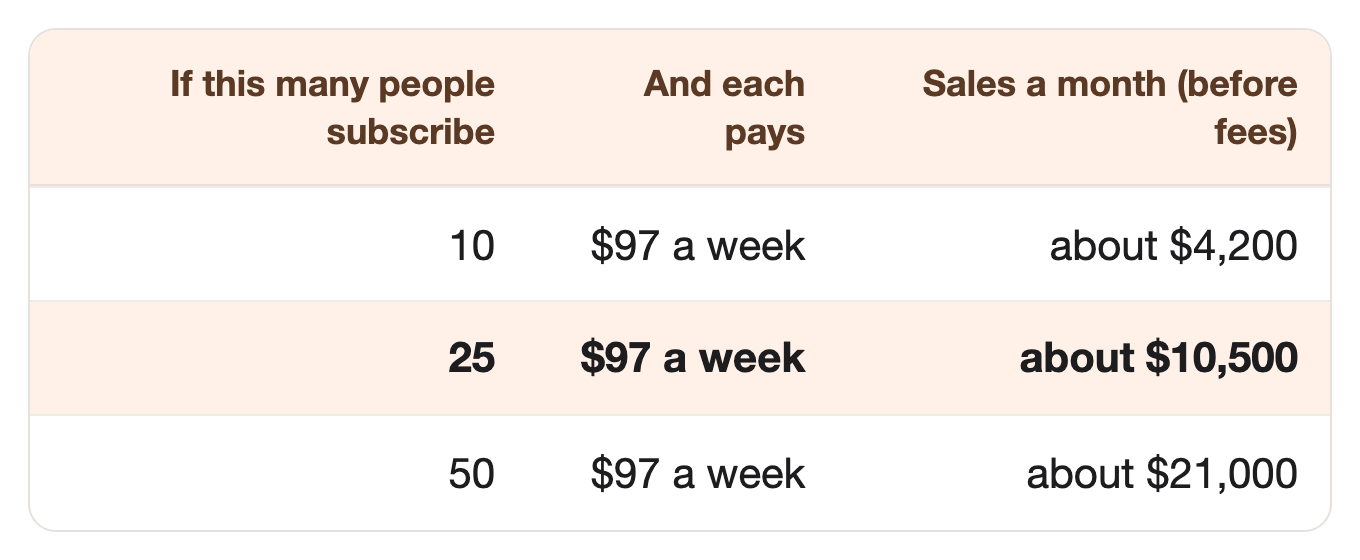
25 subscribers is a small number. VirtualJK had 97 in October 2026.
Yearly plans mean you’re not winning people back every week.
120 people at $1,000 a year is $120,000 a year, or $10,000 a month.
Itching to build this one?
The step-by-step plan is right below. 👇
Just browsing? All good. A new idea lands next week.
That’s it, my fellow contrarians! 🙌
Yours ‘digging up proven ideas so you never have to guess’ Vijay Peduru 🦸♂️
⠀
⠀
⠀
🧰 Want to build it? Here’s everything else.
In every step, AI does most of the work. You mostly talk. 🎙️
⠀
Step 1: 🧠 Get your thinking out of your head
You don’t need to write a book. AI reads what you have, then interviews you.
Pick one moment you know well, not a whole job.
For example: “your first year as a product manager,” not “product management.”
Or “your first time managing engineers.”
Gather what you’ve already made.
Your own notes, posts, talks, slides, and newsletter issues.
Use only your own work, never your company’s private files or names.
Let AI read all of it first.
It pulls out your frameworks, the steps you follow for common problems.
It also pulls out the decisions you made, and why.
Then let AI interview you about what’s missing.
Teaming up with a product manager, or interviewing several? The AI interviews them instead, and only with their permission.
Your past decisions it didn’t find, and why you made them.
Your mistakes, and what you’d do now.
🎙️ Talk, don’t type.
Use voice mode in the ChatGPT or Claude app, or a dictation app like Wispr Flow.
Ramble like you’re talking to a new hire over coffee. The AI cleans it up.
An hour of talking gives you more than a week of typing.
AI turns all of it into one knowledge file, organized by situation.
Keep adding to it every week. Talk through each new decision you make.
⠀
Step 2: 🤖 Build your AI
The tools already exist. You don’t need to write code.
Pick a tool.
Delphi builds these AIs for experts, and can charge the subscription for you.
Or try it first as a ChatGPT plugin or a Claude project, using your knowledge file.
To sell it without Delphi, you also need a payment tool and a login page.
Let AI write its own instructions.
It answers only from your knowledge file.
When your file doesn’t cover a question, it says “I don’t know.”
⠀
Step 3: 🔍 Check every answer
Your name is on every answer, so it gets checked three times.
🖊️ The answerer. Your AI answers only from your notes.
🔍 The checker. A second pass flags any answer your notes don’t back up.
🧐 You. Each week, you read a sample of real answers and fix the weak ones.
Before launch, test it with 50 real questions.
Ask colleagues, or copy questions from comments under product-manager videos.
AI asks all 50, compares each answer with your file, and lists the weak ones.
Fix a weak answer by talking through it again. 🎙️
⠀
👉 The prompt already follows three safety rules: it says it’s an AI, gives no legal, medical, or money advice, and cancels in one click.
⠀
Step 4: 🏪 Open for subscribers
Copy his weekly price, and make yearly much cheaper than he does.
Set your prices.
$97 a week, for someone with one hard week ahead.
$1,000 a year, much cheaper than paying weekly all year.
That’s on purpose, so most people pick it and stay.
Add one live call a month for subscribers.
Let AI write your sales page, using real answers your AI gave as examples.
Make it easy to expense. Send a proper receipt, so buyers can ask their company to pay.
⠀
Step 5: 📣 Get your first subscribers
Short videos bring the subscribers. Show people how you think.
Post your real decisions as short videos.
“What I’d do when engineering says six weeks.”
“How I said no to our biggest customer.”
Let AI find the topics. Your knowledge file is already full of decisions to talk about.
Let AI write each script. You just read it, or talk it through in your own words.
End every video the same way:
“Ask my AI your version of this question. First three questions are free.”
Turn every comment into the next video. Your subscribers write your topic list for you.
Share real answers your AI gave, with permission, so people can judge it.
⠀
Step 6: 🏃 Eliminate competitors
Copycats will come. Here’s how you stay first.
Stay with the one moment you picked in Step 1.
A new product manager picks the AI made for their first year over a general one.
Be the face. Your AI is only worth paying for because people know you.
Show your best answers. Post real questions and the answers your AI gave.
Keep feeding it. Talk through every new decision you make, so it gets better every month.
⠀
Step 7: 🎲 Make it bigger
Every moment you know well can be its own AI.
Build one for other moments you know:
Your first year as an engineering manager.
Your first data team.
Your first job search after five years at one company.
Or build them for other experts, for a fixed fee.
One fixed price and one fixed scope, so it never turns into endless client work.
Three AIs at about 25 weekly subscribers each is about $360,000 a year, before fees.
Over three years, that’s about a million dollars. 🎯
⠀
🗓️ Your first week
A first version of Steps 1 to 5 fits into seven days. 🚀
By day 7, you have a working AI mentor, a sales page, and one video.
The prompt below has seven Parts, and they’re not the same as the Steps above.
Day 1 (Step 1): Gather your old notes and posts, and let AI read them with Part 1 of the prompt (it’s below).
Day 2 (Step 1): Talk through the interview with Part 2, then build your knowledge file with Part 3.
Day 3 (Step 2): Set up your AI with Part 4.
Days 4–5 (Step 3): Test it with 50 real questions using Part 5, then fix the weak answers.
Day 6 (Step 4): Write your sales page with Part 6.
Day 7 (Step 5): Script your first video with Part 7, and post it.
⠀
🏄 How to use the prompt
One prompt does all the AI work, in seven parts, plus a quick market check (Part 0).
Part 1 — Read what I have. Reads your own notes, posts, and talks, and pulls out your frameworks and decisions.
Part 2 — Interview me. Asks only about what’s missing, one question at a time.
Part 3 — Build the knowledge file. Turns everything into one clean document, organized by situation.
Part 4 — Set up the AI. Writes the instructions so it answers only from your file, and says “I don’t know” when it should.
Part 5 — Test it. Asks 50 real questions, compares each answer with your file, and lists the weak ones.
Part 6 — Write the sales page. Uses your real answers as examples.
Part 7 — Script the video. Turns one real decision into a one-minute script.
Run it your way:
Part by part (the default): it pauses after each part, and you type “next” to go on.
All at once: say “run all seven parts.”
Just one part: say “only do Part 4,” or any part you need.
The full prompt is just below, under “📋 The prompt.”
🎙️ Talk to your AI sidekick, don’t type.
Turn on voice mode, or use a dictation app like Wispr Flow.
Say it messy. The AI sorts it out.
Turn it into a skill, so you never paste it again.
Paste the prompt into Claude or ChatGPT, and say: “Turn this into a skill I can save.”
Install once, use forever.
⠀
📋 The prompt
The prompt (copy it into Claude or ChatGPT, fill in the INPUTS part, and run it your way)
CONTEXT:
- You're my partner in building an AI version of my work know-how, for people one step behind me.
- This prompt has seven parts, in order.
- Run it the way I ask:
    - If I say nothing, go one part at a time. After each part, show me the result, then stop and wait. Move on only when I type "next."
    - If I say "run all seven parts," do them all without stopping.
    - If I say "only do Part 4" (or any part), do just that part.
- If a part needs something from me, ask for it before you start that part.
- Use only the material I give you and what I tell you. Don't add advice from anywhere else.
- Skip anything that looks like my company's private information, and tell me what you skipped.
- I'll often answer by voice, so expect long, messy answers. Don't ask me to tidy them.

=============== INPUTS — edit these, or just run as is ===============

The moment I want to help people with:
{e.g. your first year as a product manager}

My material (paste it, or attach the files):
{e.g. my old talk slides, 20 LinkedIn posts, and my notes from mentoring two new hires}

My name, and who it's for:
{e.g. Priya, for product managers in their first year}

My prices:
{e.g. $97 a week, or $1,000 a year}

======================== END OF INPUTS ========================

THE PARTS:

Part 0 — Check the market today.
This part needs web search (turn on search in ChatGPT or Claude). Search for paid help for people in my moment and, for each place, give the count, the three biggest with links, and their prices:
1. AI versions of experts and AI mentors for this moment (for example on Delphi, in ChatGPT plugins, on Product Hunt).
2. Human coaches and coaching sites for it.
3. Courses and cohorts for it.
4. The biggest free YouTube channels, newsletters, and podcasts for it.
Then tell me: early (few sellers), growing, or crowded, and which narrower moment looks least served. Give a link for every number. If you can't open a page, say so. Never guess a number.

Part 1 — Read what I have.
Read my material and give me:
1. My frameworks — the steps I follow for common problems, in my own words.
2. My decisions — each real decision you found, what I chose, and why.
3. My mistakes — anything I say I'd do differently now.
4. The gaps — the ten most common situations in this moment that my material doesn't cover yet.

Part 2 — Interview me.
Interview me to fill the gaps from Part 1. Ask one question at a time, and ask for a real story each time, not general advice. When an answer is vague, ask "What did you actually do?" After each answer, give a two-line summary of what you learned, then the next question. At the end, list the gaps still open.

Part 3 — Build the knowledge file.
Turn everything from Parts 1 and 2 into one document, organized by situation. Keep my words and my stories. For each situation:
1. The situation — in the words a new person would use to ask about it.
2. What I'd do — my answer, step by step.
3. Why — the reason, and the story behind it.
4. When I'd do something else — the exceptions.
Then list the situations that still need more from me.

Part 4 — Set up the AI.
Write the instructions for an AI that answers as me, using only my knowledge file. I'll paste them into my tool, for example Delphi, a ChatGPT plugin, or a Claude project. The instructions must say:
1. Answer only from the knowledge file. If it doesn't cover the question, say "I don't know," and suggest bringing it to the monthly call.
2. When a question is too vague to answer well, ask one question back.
3. Say clearly that it's an AI version of me, not me live.
4. Never give legal, medical, or money advice.
5. Never name or guess at any company's private details.
6. Answer the way I talk: plain, short, with a real example when the file has one.

Part 5 — Test it.
Use my knowledge file as the answer key.
1. Give me fifty test questions. Use any real questions I paste first, then add the kinds of questions new people in this moment ask.
2. Wait while I ask my AI all fifty and paste its answers back.
3. Grade each answer: backed by my file, partly backed, or not backed.
4. List the ten weakest answers, with what's missing from my file for each.
5. Tell me which questions to talk through again, by voice, to fix them.

Part 6 — Write the sales page.
Ask me for three of my AI's best answers first. Use my real answers as examples. Never invent a result, a review, or a number. Give me:
1. A headline that names the moment, not the job.
2. Three real questions and my AI's answers, shown as examples.
3. What they get: the AI, any time, plus one live call a month.
4. The prices, shown up front, and "Cancel in one click."
5. A line that says it's an AI version of me.
6. A short note they can send their manager to get it expensed.

Part 7 — Script the video.
Ask me which real decision from my knowledge file to use. Turn it into a one-minute video script, under 150 words, in my words:
1. The first line — the moment, in the viewer's words, as a question.
2. What I did, in three short beats.
3. Why it worked.
4. The closing line, word for word: "Ask my AI your version of this question. First three questions are free."
Then give me five more decisions from my file that would make good videos.
⠀
📎 The sources
Every number above, with where it came from.
VirtualJK’s revenue for 30 days · Number: $63,443, checked through Stripe · Source: TrustMRR, October 15, 2026
VirtualJK’s monthly subscriptions · Number: $44,202 a month, from 97 active subscribers · Source: TrustMRR, October 15, 2026
VirtualJK’s description and prices · Number: “a Replicant of James Kemp trained on $25 million of consulting sales”; $97 a week or $5,000 a year · Source: TrustMRR, October 15, 2026
Matthew Hussey’s AI · Number: Over $1 million, at $39 a month · Source: Delphi’s own claim
Coaching worldwide · Number: $5.34 billion a year; 122,974 coaches · Source: ICF Global Coaching Study 2025, by PwC
US company training · Number: $102.8 billion in 2025; $16 billion on outside products and services (companies with 100+ employees) · Source: Training magazine, 2025 Training Industry Report
JustAnswer · Number: Started in 2003 · Source: Wikipedia (listed under its newer name, Pearl.com)
Human coaching for product managers · Number: About $2,000 for 10 to 20 hours · Source: Leland, October 2026
Chloe Shih’s channel · Number: About 431,000 subscribers; one product-manager product, a $25 résumé kit; also sponsors and shopping links · Source: YouTube and her kit, October 2026
Lenny’s Newsletter · Number: “1,000,000+ subscribers” (its own claim) · Source: Lenny’s Newsletter, October 2026
Lenny’s Podcast on YouTube · Number: About 645,000 subscribers · Source: YouTube, October 2026
Comment: only source · Number: “You’re my only source for this type of advice.” · Source: YouTube comment, 2023
Comment: the promotion · Number: “I followed all your advice and just landed a dream promotion.” · Source: YouTube comment, 2020