


Hello contrarians,
Today’s idea is called The Back-Row Dance Club.
Grab a coffee. ☕
First, a dancer’s story. Then, the business you could build from it.
⠀
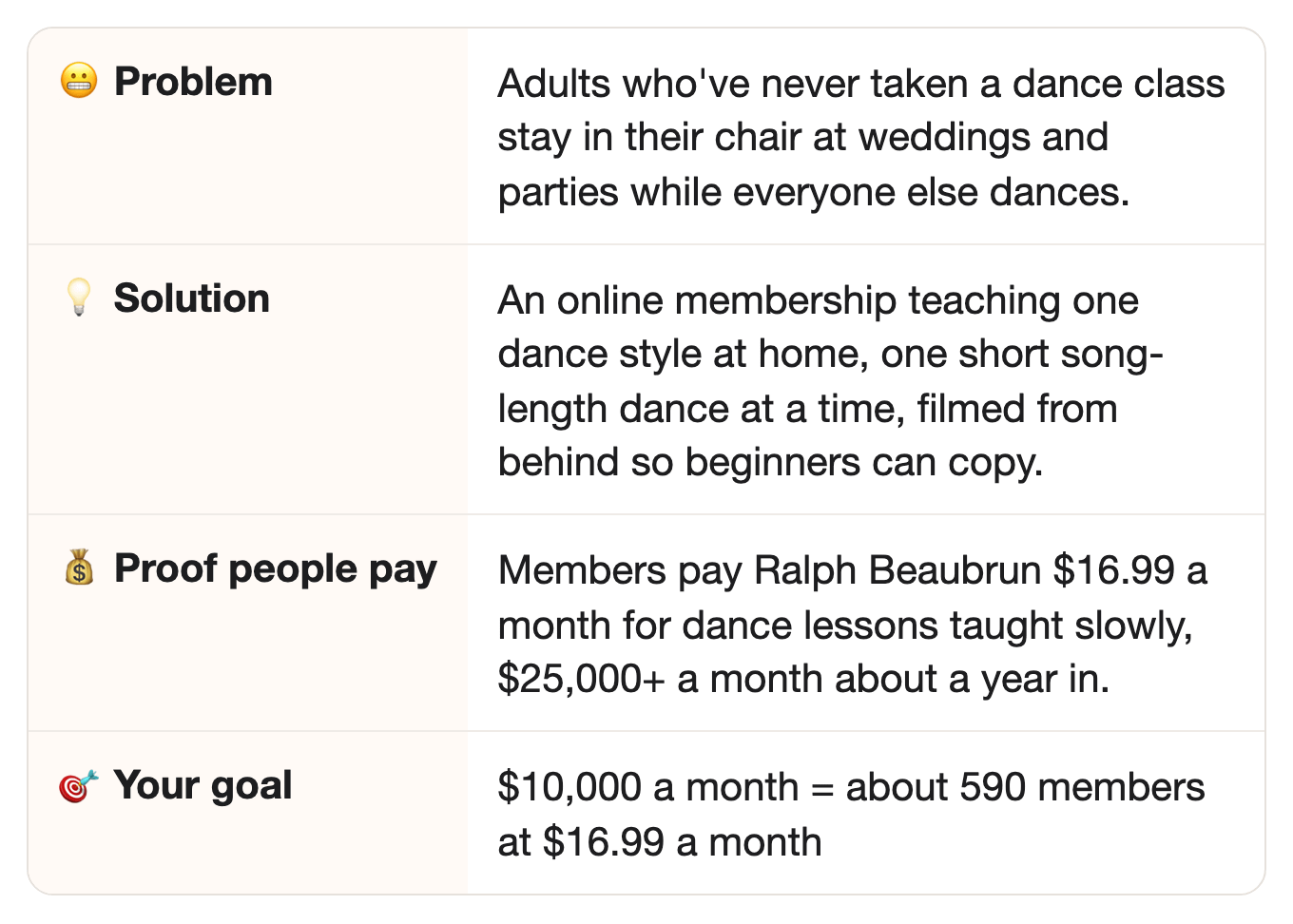
⚡ Quick facts
⠀
📖 How the dancer at the back built a $25,000-a-month club
He was never the one at the front of the room.
Ralph Beaubrun grew up in Haiti, in a family of artists.
Five!
But in class, he was never the strongest dancer, and he always ended up at the back.
Why does the back matter?
In many dance classes, the strongest dancers stand at the front, near the teacher and the mirror.
Everyone else stands behind them, where it’s harder to see the teacher’s feet.
His mother wanted him to get an education.
So he earned a master’s in mathematical engineering, in France.
Then he worked as an engineer, and took dance classes and went to auditions without telling his mother.
Sneaky.
Then he quit his job, and heard “no” for a long time.
Ouch.
⠀
His first real chance: a job dancing for a French singer few people had heard of.
He stayed seven years.
In 2015, he started teaching, with five students.
And he built his class for the dancer he used to be.
In his class, nobody gets put at the back.
It’s a beginners class in Paris, and people arrive with the same worries: too old, too heavy, too shy.
For years, he didn’t film his dances, because he didn’t believe in himself.
Then his students pushed him to post one video.
And it spread much further than he expected.
His classes grew to about 90 people each.
⠀
His style is called TYAKA, a mix of Afro, Caribbean, and modern dance.
He built up 1.6 million followers on Instagram, and 200,000 subscribers on YouTube.
In November 2024, he and his business partner, Nicholas, opened an online membership on Uscreen, a site for selling video lessons.
It costs $16.99 a month, with two new routines every month.
He teaches each one slowly, “just as if I was teaching in the classroom.”
And here’s the clever bit: every video is filmed with his back to the camera.
So learners can copy him, facing the same way.
50 members joined in the first two weeks, with no ads.
Nice start.
About a year in, Uscreen reported more than 5,000 members in over 20 countries.
And more than $25,000 a month in recurring revenue.
Recurring means it comes in again each month, for as long as members stay.
Holy guacamole. 🥑
He went from the back row of a dance class, to a $25,000-a-month membership, by teaching beginners slowly, with his back to the camera.
⠀
🔗 Same idea, new group
In the story: people who follow Ralph Beaubrun’s dancing paid $16.99 a month to learn his routines slowly, filmed from behind.
⠀In this idea: adults who’ve never taken a dance class need one style taught the same slow way, starting from zero.
⠀Why it carries over: both groups learn best by copying a teacher at home, slowly, with nobody watching.
⠀
💡 The opportunity
Lots of adults dance at weddings. Few of them ever take a class.
First, who are the buyers?
Adults who’ve never taken a dance class, and want to learn one style.
Think salsa, swing, line dancing, or Afrobeats.
And many of them would rather start at home than in a room full of mirrors.
⠀
Lots of adults dance.
In 2022, about 22% of US adults danced at weddings, clubs, or other social settings.
That’s more than one adult in five.
It’s from a government arts survey, run by the National Endowment for the Arts.
⠀
Here’s the nice part: most adults who learn to dance skip the class.
In 2022, 2.1% of US adults took dance classes or lessons, the same survey says.
And 6.7% learned dance some other way, like from friends or on their own (some did both).
So lessons they can follow at home fit how most adults already learn.
⠀
Beginners stay out of dance classes for the same few reasons.
Ralph hears the same worries from beginners: too old, too heavy, too self-conscious.
At home?
Nobody is watching them get it wrong.
⠀
And some of them have a deadline.
A couple getting married needs to learn one dance, for one day.
At many weddings, the couple dances alone to one song while every guest watches.
It’s called the first dance.
No pressure, right?
⠀
👉 The idea: an online membership that teaches one dance style to adults who’ve never danced, slowly, filmed from behind, one short routine every two weeks.
The first 12 weeks take a total beginner from zero to six finished routines.
After week 12, two new routines arrive every month, like Ralph’s, so members who finish the path have the next dance waiting.
⠀
🙋 Never danced? You can still build this.
Team up with a dance teacher.
Many teach at a local studio, and few have time to build an online membership.
They dance on camera.
You plan the lessons, build the site, and find members.
Ralph runs his membership with a business partner, too.
⠀
Be the beginner on camera.
Learn each routine next to the teacher, and keep your slips in the video.
Yep, the wobbles stay in.
Members see someone just like them getting it right, step by step.
⠀
Or use your own skill.
Do you dance one style yourself, even as an amateur?
Then film it slowly, and from behind.
⠀
✅ Why this could work
Three reasons this can pay.
Others already earn from teaching dance online.
Leon Turetsky started Passion4dancing, a site with ballroom lessons on video, in 2009.
In 2021, he said it was at the “6-figures/year revenue level and growing.”
That’s 12 years after he started.
Monika, who runs a YouTube channel called Get Dance, filmed a program for adults at home, with no website.
It brought in over $60,000 in seven months, she says in a 2021 case study on a YouTube coach’s site.
⠀
Adults have paid for dance lessons for 100 years, and they still do.
Arthur Murray had begun a chain of dance studios by about 1920.
In 2020, about 275 Arthur Murray studios were still open.
⠀
People pay for slow lessons, even when the dances are free to watch.
Remember Ralph?
He posts his routines on Instagram, to 1.6 million followers.
But more than 5,000 people have joined his paid membership to learn them slowly.
⠀
👉 Want to check these numbers? Each one has a source link in the last section, “📎 The sources.”
⠀
📊 More proof people want this
Want more? Here you go.
A home-made program beat a fancy one.
Monika’s first course had a rented studio, a camera crew, and a paid dance partner.
It made two sales in eight months, for $640.
Yikes.
Her next program was the one filmed at home, the one from the section above that brought in over $60,000.
⠀
Learners find dance teachers on YouTube.
Monika’s Get Dance channel had 220,000 subscribers in 2021.
Passion4dancing’s channel had 70,000, and its founder called YouTube his most important marketing channel.
⠀
What a teacher hears from adult beginners.
Monika says that before her lessons, her students avoided the dance floor.
They were “sitting in the corner and just not having fun.”
Sounds a lot like the wedding guest who stays in their chair while everyone else dances.
⠀
👉 Adults want to dance, most of them learn outside a class, and thousands pay for slow lessons at home.
⠀
🔍 Who’s already doing it
Big names exist. None of them takes a total beginner through one style, one step at a time, over 12 weeks.
Ralph, from the story above, teaches his own style, TYAKA.
He adds two new routines a month, usually from what he teaches in his Paris classes.
His members learn his routines, not a path from zero in salsa or swing.
⠀
Passion4dancing teaches many ballroom dances, like salsa and swing, from basic to advanced.
Its founder said he adds one or two new dances a year.
That’s a big library, and a lot to pick from for someone who’s never danced.
⠀
Free tutorials on YouTube are endless.
But they come in no set order, from many teachers, at many levels.
So a beginner has to piece the path together on their own.
⠀
What’s missing, when we checked:
A step-by-step path in one style, for adults who’ve never danced, from week 1 to week 12.
A first-dance track for couples, with a date on the calendar.
A monthly check-in where members send a clip and get one tip back.
⠀
🔎 Check the market yourself in 2 minutes: run Part 0 of the prompt, under “📋 The prompt” below.
Your AI searches YouTube, Udemy, membership sites, and app stores that day, and tells you: early, growing, or crowded.
Udemy is a big site that sells video courses.
Early? Start now.
Crowded? Good news: it means people pay. Pick one narrower style or kind of beginner (Step 1 of the build plan).
A crowded market is still OK. You win by serving one group better, not by being first.
⠀
👉 That’s the gap you can fill: a slow, step-by-step membership in one dance style, made for adults who’ve never danced.
⠀
🤖 Why AI won’t replace it
AI can plan a dance lesson. It can’t dance it for them.
🔮 Honest note: a personal AI agent can already find free dance tutorials and line them up into a plan.
So finding videos isn’t the product.
The product is a real dancer to copy, slowed down and counted, in the right order.
Dancers split a song into groups of 8 beats and say them out loud: “5, 6, 7, 8.”
The counting tells a beginner which step goes on which beat, so they never get lost in the music.
⠀
1. A body to copy.Dance is movement, and beginners learn by copying.
Your videos show every step from behind, at half speed, then at full speed.
⠀
2. You choose the steps, and the order.Sure, ChatGPT can write a 12-week salsa plan in a minute.
But a beginner can’t tell if the order is right, or which move is too big a jump in week 1.
You dance every step first, and fix the order before they ever see it.
⠀
3. They already know and trust you.They dance with you every week.
Over time, they stay for you, not just for the lessons.
⠀
4. Others dancing along. 🕺Ralph’s members tell him what they want next, and he plans to add a community where they help each other.
A monthly day when members send in a short video of themselves dancing gives them a reason to learn the whole routine.
⠀
👉 Lessons in the right order, slowed down, with every step counted: a nervous beginner won’t build that for themselves, even with AI.
⠀
💵 How much you can make
Let’s run the numbers.
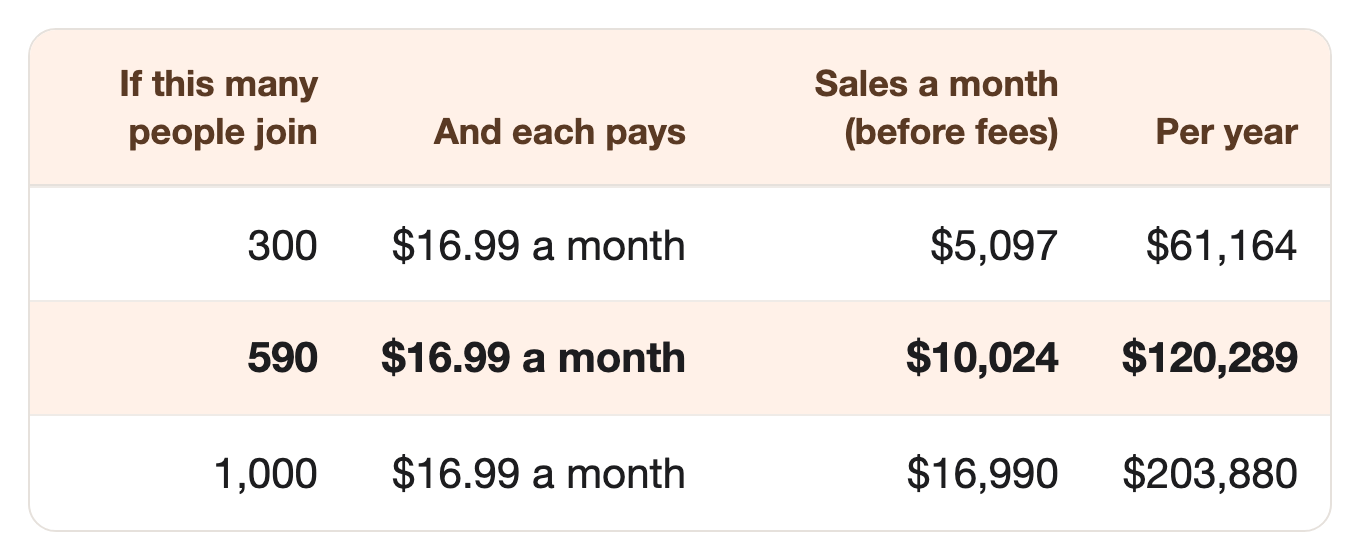
$16.99 a month is Ralph’s price.
⠀$10,000 a month is less than half of Ralph’s $25,000+.
⠀If it doesn’t work out, here’s all you lose:
Nothing to post your first free lessons: a YouTube channel costs nothing to start.
The phone you already own, on a stand.
One month’s subscription to an AI app, like ChatGPT or Claude.
One week of your time.
⠀
👉 This is idea one, and with ideas two, three, and four, you could reach a million in 2 to 3 years.
A dance club like this could be your first idea, and each idea you add after it grows your yearly income.
Can you picture yourself running this?
Scroll down. Everything you need to start is waiting. 👇
Not for you? No problem. Next week’s idea might be.
That’s it, my fellow contrarians! 🙌
Yours ‘helping you spot the gaps the big players ignore’ Vijay Peduru 🦸♂️
⠀
⠀
⠀
🧰 Want to build it? Here’s everything else.
⠀
Step 1: 🎯 Pick one style and one kind of beginner
One style, one kind of beginner, and one first song.
Pick one style.
Salsa, swing, line dancing, Afrobeats, or any style you or your partner teaches well.
Pick one kind of beginner.
Adults who’ve never taken a class.
Or adults over 40 coming back after years off.
Or couples with a wedding date and a first dance to learn.
Write it in one line, like “salsa for adults who’ve never danced, at home.”
⠀
Step 2: 🗺️ Map the first 12 weeks
Six short routines, one every two weeks, from easiest to hardest.
Good news: your AI drafts the first version.
Let your AI draft the path, using Part 1 of the prompt.
The basic steps first, then harder moves, with each routine set to one kind of song.
Break each routine into chunks of 8 counts.
A count of 8 is how dancers split music into short pieces they can learn one at a time.
Dance the whole path yourself, or with your partner, and fix any step that feels too big a jump.
⠀
Step 3: 🎬 Film each routine four ways
Copy Ralph: slow, and with your back to the camera.
Your phone on a stand is enough to start.
From behind, slowly, with counts. One chunk of 8 at a time.
From behind, at full speed, with music. The whole routine.
From the front. So they can see your arms and your face.
The common mistakes. Show the slip, then the fix.
Music: use only songs you have the rights to use, or teach on counts and name the song, so members play it themselves.
⠀
Step 4: 🔍 Check every lesson
Real bodies follow these lessons, so the AI checks every lesson twice after writing it, and then you dance it.
Your AI does all three passes for you: it writes in Part 2, and checks in Parts 3 and 4 of the prompt.
🖊️ The AI writer. It writes the counts, the cues (the short words you say as you dance), and the practice plan.
🔍 The AI checker. A second pass checks every lesson against the safety rules, and makes sure the counts add up.
🧐 The AI critic. A third pass reads it like a nervous beginner, and like a strict dance teacher.
Then dance it yourself. If a step doesn’t work at real speed, fix the lesson.
⠀👉 The prompt already follows four safety rules:
Every lesson starts with a warm-up, and offers a low-impact option.
A low-impact option is an easier version of a step, with no jumping or deep bending.
It lets someone with sore knees or a bad back keep dancing along.
No promises about weight loss, health, or results.
Every lesson says: “Check with your doctor first if you have a health condition or an injury.”
Only music you have the rights to use; otherwise, teach on counts and name the song.
⠀
Step 5: 🏪 Open the membership
Copy Ralph: one simple monthly price, plus single routines.
Set your prices.
$16.99 a month, like Ralph.
Single routines for a one-time price, for people who want just one, like Ralph offers too.
Pick where to sell. Uscreen, Ralph’s platform, or any membership site that takes monthly payments and streams video.
Let AI write your sales page with Part 6 of the prompt, using clips from your first routine.
⠀
Step 6: 📣 Get your first members
Start with a question, then let your most active members bring their friends.
Post one free short lesson a week on YouTube and Instagram, and link the club under each one.
That’s how learners find dance teachers: Passion4dancing’s founder called YouTube his most important marketing channel.
Ralph already had 1.6 million Instagram followers watching his free videos when he opened his club.
Part 5 of the prompt plans the filming, so each free lesson is one chunk of a routine you’ve already made.
Ask one question at signup: “What song do you want to dance to first?”
Offer three answers to pick from, plus a “skip” option that says what they’ll miss.
Then send the starter lesson that fits their answer.
Give your five most active members a plan to host a practice night where they live.
A room, a music speaker, one routine from the club, and your club’s name on the event.
Once you have real numbers, send them to your platform and offer to be a customer story.
Uscreen published a story about Ralph’s dance membership on its own site.
⠀
Step 7: 🏃 Eliminate competitors
If ten competitors copy you, here’s how yours stays ahead.
Sign every reply “Real person here,” with your name and face, and answer each member’s clip or question yourself within a day.
Give your members a name they’d put in their bio, like “the Back Row,” for everyone who started where Ralph did.
⠀
Step 8: 🎲 Make it bigger
Add a wedding pack, a second style, then live classes.
Add a wedding first-dance pack for couples, with one routine to their own song.
Open a second style, with the same slow, from-behind lessons.
Add live classes later, the next step Ralph and Nicholas planned for their second year.
⠀
🗓️ Your first week
Phew. That was a lot. 😅
A first version of Steps 1 to 6 fits into seven days. 🚀
By day 7, you have a 12-week path, your first routine on video, a sales page, and a signup question.
The prompt below has seven Parts, and they’re not the same as the Steps above.
Day 1 (Steps 1 and 2): Run Part 0 of the prompt (it’s below), and pick your style and kind of beginner.
Then map the 12 weeks with Part 1.
Days 2–3 (Step 4): Write the first routine’s lesson with Part 2, then check it with Parts 3 and 4.
Day 4 (Step 3): Get your filming plan with Part 5, and film the first routine four ways.
Day 5 (Step 5): Write your sales page with Part 6, and open the membership.
Days 6–7 (Step 6): Write your signup question, welcome emails, and practice-night plan with Part 7.
⠀
🏄 How to use the prompt
One prompt does all the AI work, in seven parts, plus a quick market check (Part 0).
Part 1 — Map the path. Plans six routines over 12 weeks, from easiest to hardest, with the moves for each.
Part 2 — Write the lesson. Breaks one routine into chunks of 8 counts, with cues, a warm-up, and a practice plan.
Part 3 — Check the lesson. Checks it against the safety rules, and checks that the counts add up.
Part 4 — Find the mistakes. Reads it like a nervous beginner, and like a strict dance teacher.
Part 5 — Plan the filming. Writes the shot list and the script for the four videos of each routine.
Part 6 — Write the sales page. Uses your real routine as the example.
Part 7 — Write the first-member kit. Writes the signup question, the welcome emails, the practice-night plan, and your “real person here” reply line.
Run it your way:
Part by part (the default): it pauses after each part, and you type “next” to go on.
All at once: say “run all seven parts.”
Just one part: say “only do Part 3,” or any part you need.
The full prompt is just below, under “📋 The prompt.”
🎙️ Talk to your AI sidekick, don’t type.
Turn on voice mode, or use a dictation app like Wispr Flow.
Say it messy. The AI sorts it out.
Turn it into a skill, so you never paste it again.
Paste the prompt into Claude or ChatGPT, and say: “Turn this into a skill I can save.”
Install once, use forever.
⠀
📋 The prompt
The prompt (copy it into Claude or ChatGPT, fill in the INPUTS part, and run it your way)
CONTEXT:
- You're my dance-lesson partner. Together we'll build an online membership that teaches one dance style to adults who've never danced.
- This prompt has a market check (Part 0), then seven parts (Part 1 to Part 7), in order.
- If I say "run all seven parts," do Part 1 to Part 7. Run Part 0 only when I ask for it.
- Run it the way I ask:
    - If I say nothing, go one part at a time. After each part, show me the result, then stop and wait. Move on only when I type "next."
    - If I say "run all seven parts," do them all without stopping.
    - If I say "only do Part 3" (or any part), do just that part.
- If a part needs something from me, ask for it before you start that part.
- Real people will follow these lessons with their bodies. Follow these rules in every part:
    1. Start every lesson with a short warm-up.
    2. Give a low-impact option for any jump, deep bend, fast spin, or move done on the floor.
    3. Never promise weight loss, health benefits, or results.
    4. End every lesson with this line: "Check with your doctor first if you have a health condition or an injury."
    5. Use only songs I say I have the rights to use. Otherwise, teach on counts and just name the song, so members play it themselves.
    6. Never copy another teacher's routine. Build routines from basic steps of the style.
- Never invent a fact or a number. If you're not sure a fact is right, leave it out.
- Keep web search on for the whole prompt (turn on search in ChatGPT or Claude), so you can open any page you need to check.

=============== INPUTS — edit these, or just run as is ===============

The style:
{e.g. salsa, on1 (the most common way to count salsa)}

The kind of beginner:
{e.g. adults over 35 who've never taken a dance class}

Songs I have the rights to use (or leave blank, and we'll teach on counts):
{e.g. none, teach on counts}

My price:
{e.g. $16.99 a month, plus single routines at $9 each}

======================== END OF INPUTS ========================

THE PARTS:

Part 0 — Check the market today.
This part needs web search (turn on search in ChatGPT or Claude). Search for online lessons in my style for adult beginners and, for each place, give the count, the three biggest with links, and their prices:
1. YouTube channels teaching this style to beginners, with subscriber counts.
2. Courses on Udemy and similar course sites, with student counts and prices.
3. Monthly memberships and dance apps that teach this style.
4. Local studios near me that sell online classes too.
Then tell me: early (few sellers), growing, or crowded, and which kind of beginner looks least served (for example: adults over 50, couples before a wedding, men who've never danced). Give a link for every number. If you can't open a page, say so. Never guess a number.

Part 1 — Map the path.
Plan 12 weeks for my kind of beginner: six short routines, one every two weeks, from easiest to hardest. For each routine, give the moves it teaches, the new skill it adds, the tempo (slow, medium, or fast), and one kind of song it fits. Start with basic steps. Leave flashy moves out of the first four weeks, and say why.

Part 2 — Write the lesson.
Ask me which routine from Part 1 to write. Then write the full lesson:
1. A two-minute warm-up.
2. The routine broken into chunks of 8 counts. For each chunk, give the steps count by count, and the cue words to say out loud.
3. The low-impact option for any step that needs one.
4. The three most common beginner mistakes, and the fix for each.
5. A 10-minute practice plan for each day of the two weeks.
6. The line from rule 4 in CONTEXT, at the end.

Part 3 — Check the lesson.
Now act as a separate checker who didn't write this lesson. Check it against each rule in CONTEXT, one by one. Then check the counts: every chunk must add up to 8, and the chunks must join up with no missing step. Mark each problem, quote the words, and give the fixed version.

Part 4 — Find the mistakes.
Now act as a nervous adult beginner, then as a strict dance teacher of this style. As the beginner, flag every word, step, or jump in difficulty that would confuse or scare you. As the teacher, flag anything that's wrong for the style, or unsafe for a beginner. Then give the final lesson, with every fix made.

Part 5 — Plan the filming.
For the routine in Part 4, write a shot list and a short script for four videos:
1. From behind, slowly, one chunk of 8 at a time, with counts out loud.
2. From behind, at full speed, the whole routine.
3. From the front, at full speed.
4. The three common mistakes, each shown wrong, then right.
For each video, give the camera spot, the length (under 10 minutes), and what to say at the start and the end.

Part 6 — Write the sales page.
Ask me for one finished routine and a short clip description first. Use them as the example. Never invent a result, a review, or a number. Give me:
1. A headline that names my style and my kind of beginner.
2. What members get: the 12-week path, two routines a month, the four videos for each, and the monthly clip check-in.
3. Who it's for, and who it's not for.
4. The price, shown up front, and "Cancel any time."
5. A free first lesson, in exchange for an email address.

Part 7 — Write the first-member kit.
1. A signup question, "What song do you want to dance to first?", with three answer choices that match my first routines, and a "skip" option that says what they'll miss.
2. Three welcome emails, one for each answer, each pointing to the matching starter lesson.
3. A one-page plan for a member who wants to host a practice night where they live: the room, the speaker, the warm-up, one routine, and how to end. Never promise results.
4. A short "Real person here" line for the end of my replies and welcome emails, with my name, saying I answer every clip and question myself within a day.
⠀
📎 The sources
Every number above, with where it came from.
Ralph’s membership · Number: Headline “1 year with Uscreen”; “5,000+ members”; “$25,000+ monthly recurring revenue”; “Global audience across 20+ countries”; launched on Uscreen in November 2024 with his business partner, Nicholas; “50 members in the first two weeks without ads”; TYAKA, “a high-energy fusion of Afro, Caribbean, and contemporary influences”; “1.6 million followers on Instagram and 200K subs on YouTube”; members “tell us what they want next”; plans for “live classes and a premium community” in “year two” · Source: Uscreen case study, archived February 15 and June 11, 2026
Ralph’s price and format · Number: “$16.99/month”; “2 new choreographies per month”; single choreographies for sale; “just as if I was teaching in the classroom”; “All videos are filmed with my back to the camera” · Source: Ralph Beaubrun Dance Classes, About page, archived June 16, 2026
Ralph’s early life and class · Number: Grew up in Haiti in a family of artists; a master’s in mathematical engineering; worked as an engineer while auditioning without telling his mother; a long run of no’s; seven years dancing for a then-unknown French singer; started teaching in 2015 with five students; a beginners class in Paris where nobody is put at the back; always at the back himself; didn’t film for years; the first video took off; “90 people a class”; too old, too heavy, too self-conscious · Source: Been There Got Out Podcast, episode 236 show notes, February 10, 2025
Dancing from age five · Number: “starting dance at five” · Source: Qobuz artist bio, 2025
Adults who dance and learn dance · Number: 21.8% did social dancing “at weddings, clubs, or other social settings” in 2022; learned dance in 2022: 2.1% through classes or lessons, 6.7% by other means, 8.0% either way · Source: National Endowment for the Arts, 2022 Survey of Public Participation in the Arts, October 2023
Arthur Murray studios · Number: Had “begun his chain of dance studios” by 1920; “more than 100 years of teaching dance at over 270 Arthur Murray Dance Studios in 22 countries” (2012); “In 2020, about 275 Arthur Murray Studios remained in operation” · Source: Wikipedia, Arthur Murray (March 2026 version)
Passion4dancing · Number: Started in 2009; “6-figures/year revenue level and growing”; “70K YouTube subscribers”; YouTube is “the most important marketing channel”; adds “1-2 new dances, or levels” a year; styles “like Cha Cha, Waltz, Tango, Salsa, Swing and more”; lessons “from the most basic to advanced levels” · Source: Course Method interview with Leon Turetsky, 2021
Monika’s Get Dance · Number: First course: “two sales in eight months,” “640 dollars,” with a rented studio, a camera crew, and a paid dance partner; the next program, shot at home with no website, “generated over $60,000” in seven months; “220,000 subscribers”; students were “sitting in the corner and just not having fun” · Source: Sunny Lenarduzzi case study, February 2021
The money math · Number: 590 × $16.99 = $10,024 a month · Source: Ralph’s price, above