


Hello contrarians,
Today’s idea is called The Advisor Video Subscription.
Find a comfy chair. 🪑
First, a video service’s story. Then, the business you could build from it.
⠀
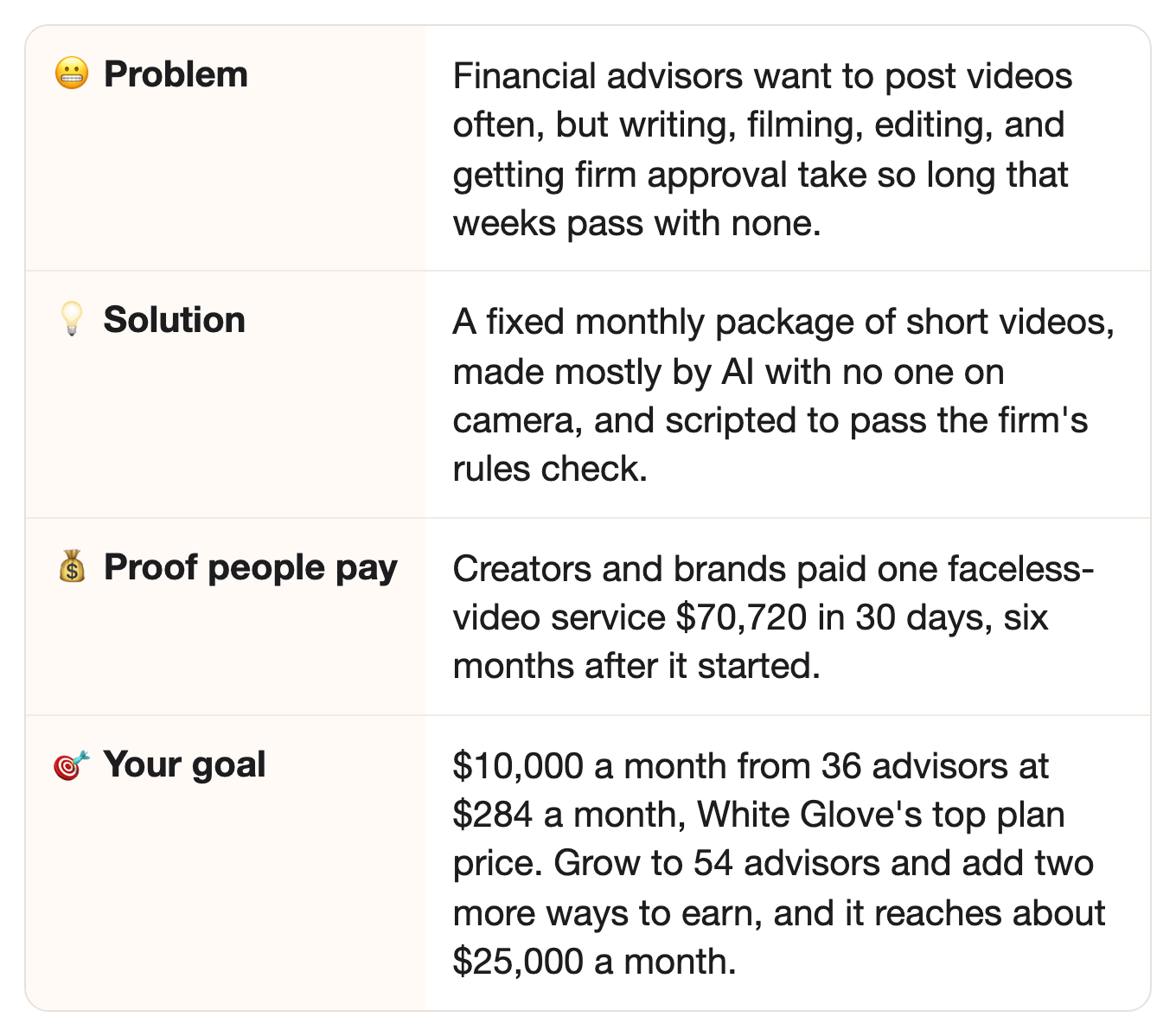
⚡ Quick facts
⠀
📖 How one video service hit $70,000 in a month
It started with videos nobody has to appear in.
In April 2026, a founder named Dylan N. starts White Glove Content.
The whole idea? “Faceless” videos.
No one appears on camera.
It’s just visuals, captions, and an AI voice.
Creators and brands subscribe, and finished videos show up in their dashboard.
The script, the voice, the editing, the thumbnail… all done for them.
⠀
And the prices are simple.
$54 a month.
$124 a month.
$284 a month.
No setup fee, and they can cancel any month.
Plot twist: people pay so they never have to film, edit, or upload a video themselves.
That’s what they’re really buying.
⠀
When we checked, it had 563 active subscriptions.
That number comes from TrustMRR, a site that checks a company’s revenue at the source.
It shows the numbers straight from the company’s payment account.
And in the 30 days to October 22, 2026, it brings in $70,720.
That’s six months after it started.
Boom! 💥
From a brand-new service in April… to $70,000 in 30 days by October, by making videos so its customers never have to.
⠀
🔗 Same idea, new group
In the story: creators and brands paid White Glove Content so they never had to film, edit, or upload a video.
⠀In this idea: financial advisors need weekly videos too, with scripts their firm will approve.
⠀Why it carries over: both groups want to post videos without spending their own hours making them.
⠀
💡 The opportunity
Financial advisors should post short videos every week, and strict rules make every video slow to approve.
Wait, who are financial advisors, exactly?
They help families plan for retirement, savings, and taxes.
Many also manage their clients’ money for a fee.
The US has about 299,400 of these jobs, and the median (middle) pay is about $105,000 a year.
That’s a lot of advisors.
⠀
People look for money advice on YouTube.
Our guess: short videos, week after week, help advisors get found there.
⠀
Here’s the catch: every video must pass review first.
Advisors at brokerage firms, which buy and sell investments for clients, follow FINRA’s rules.
FINRA? That’s the brokerage industry’s watchdog.
Under those rules, a supervisor approves each piece of marketing before it goes out.
Yep, each piece.
⠀
Advisors registered with the government follow a rule too.
They’re registered with the SEC, the US government’s investment watchdog.
Its marketing rule says every fact in an ad must be backed up.
In practice, their firm’s compliance team usually approves marketing first.
⠀
And the rules are strict.
No promises of returns, meaning investment gains.
No guesses about future performance.
No claim without proof.
That leaves very little room to write.
⠀
So posting a video every week is hard.
Kitces is a research firm for advisors.
Its survey calls social media “the least efficient of all marketing tactics” for advisors, because it eats their time.
Ouch.
The advisor has no time to write, film, edit, and send each video for review.
⠀
👉 The idea: sell advisors a fixed monthly package of short videos, made mostly by AI, with scripts written to pass compliance review.
It’s an AI service: one price, one package, the same for every advisor.
One fixed price, one fixed scope: for example, 8 short videos a month for $284, the price of White Glove’s top plan.
AI does most of the work: the scripts, the visuals, the captions, the voice.
No custom client work: every advisor gets the same process, on the same delivery day.
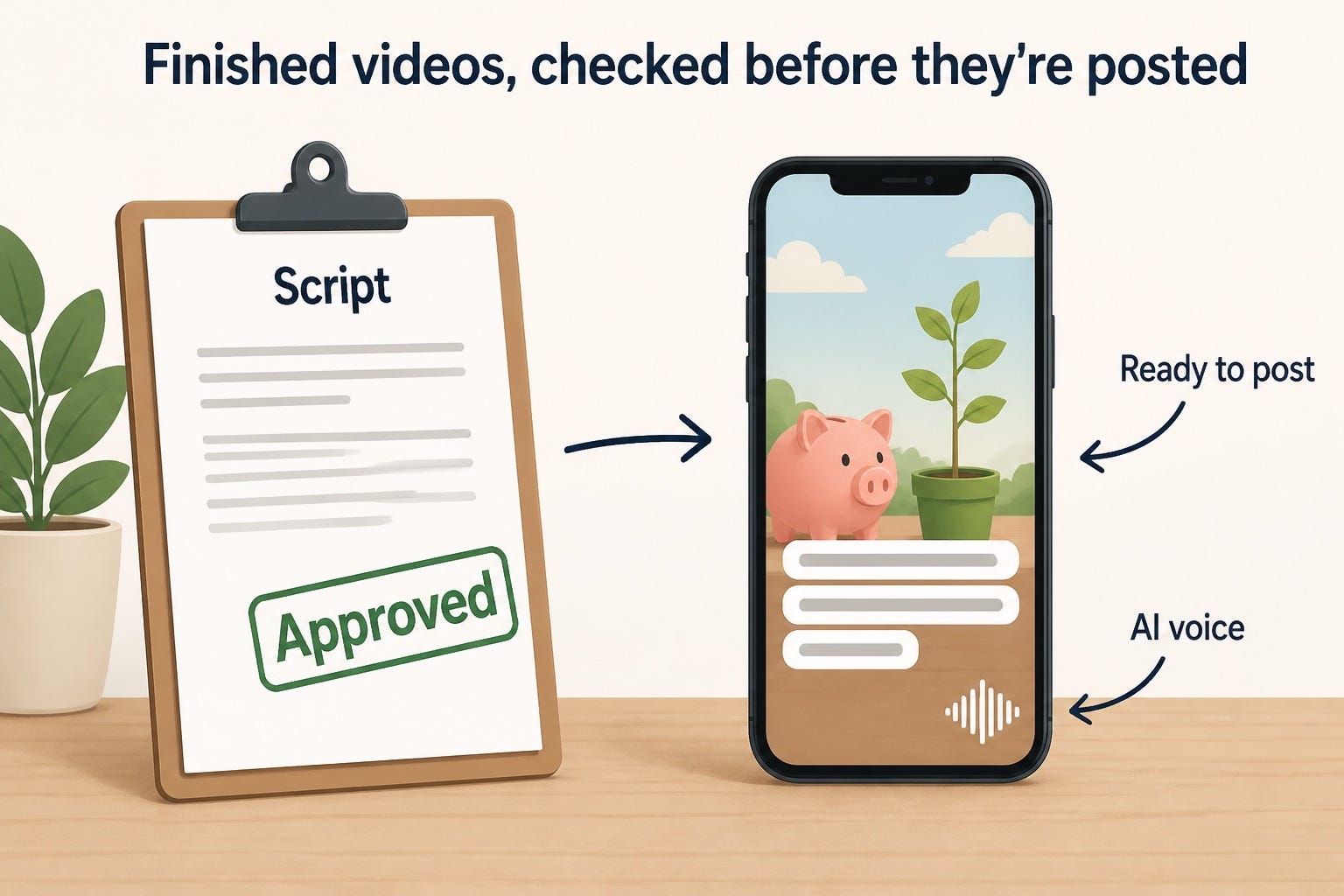
The advisor’s compliance team approves every script and every video before anything is posted.
⠀
🙋 Never worked in finance? You can still build this.
Sign one advisor as your pilot, a first test client.
Give them their first month at a low price.
Use it to learn how their firm’s review works.
So you get paid while you learn.
⠀
Or team up with one.
A former advisor or a finance marketer brings the know-how.
You run the AI and find the clients.
⠀
Or use another job you know that has strict rules.
The steps are the same.
You just swap in that job’s rulebook.
⠀
✅ Why this could work
Three reasons there’s real money here.
People already pay well for done-for-you content, and advisors pay for it too.
Remember White Glove, from the story?
It makes about $66,000 a month in subscriptions, from 563 active subscriptions.
Wait, didn’t the story say $70,720?
It did, and both are right: the 30-day total counts every payment that came in; the $66,000 monthly figure counts subscriptions only.
FMG, a company that sells marketing content to advisors, says it has more than 40,000 active customers.
Snappy Kraken, another advisor-marketing company, sells done-for-you marketing at $899 a month, plus a $499 setup fee.
⠀
The buyers aren’t going anywhere.
About 17,100 advisor jobs open up every year, on average, so new advisors keep arriving.
And the review rules keep every video slow for an advisor to make alone.
⠀
Handing the work to someone else costs less than doing it yourself.
A Kitces survey of 506 advisors looked at what each tactic costs to bring in new business.
Advisors who handed social media off completely spent 45 cents for each new dollar of client revenue.
And advisors who did it themselves?
They spent $1.77.
⠀
👉 Curious where these numbers come from? Every source is linked in the last section, “📎 The sources.”
⠀
📊 More proof people want this
Want more? Here you go.
Advisors already pay for marketing help.
Snappy Kraken’s plans run from $99 to $999 a month.
FMG says it publishes more than 200 new pieces of content a month for its customers.
⠀
Some pay a lot for a single video.
Vidiance is a video company started by a compliance consultant.
It charges about $2,500 for one client-testimonial video, a client praising the advisor on camera (January 2024).
Yep, for one video.
⠀
Advisory firms already budget for marketing.
The average firm puts 7% of its yearly revenue into marketing, the Kitces survey found.
⠀
The big picture: about 1 in 5 US adults has used social media for financial advice. 💰
That’s from a survey of more than 5,000 adults by the Philadelphia Fed, part of the US central bank.
And where did they go for it?
YouTube was the top platform, used by 65.6% of them.
⠀
People trust qualified advisors more than influencers.
About 4 in 10 people in that survey said an influencer’s know-how or wealth doesn’t replace professional qualifications.
Only about 1 in 4 said it does.
That’s an advisor’s edge on video, if they show up.
⠀
In a viewer’s own words.
“Consistency is my toughest thing to nail down.”
It’s a comment under a YouTube video called “Digital Marketing For Financial Advisors” (2022).
⠀
👉 Advisors want to show up every week. They just can’t do it alone.
⠀
🔍 Who’s already doing it
A few big players, and a clear gap next to them.
White Glove, the video service from the story above, serves creators and brands in every topic.
Its founder says it has managed more than 1,000 pages across more than 100 topics.
But its plans list no compliance review step (the firm’s rules check), when we checked.
⠀
FMG and Snappy Kraken sell marketing platforms and content libraries to financial advisors.
Their content is ready-made, and many advisors use the same pieces.
⠀
AI video tools sell the software, not the finished videos.
So the advisor still has to write, make, and send each one for review.
⠀
Custom video makers charge per video.
Vidiance, the video company started by a compliance consultant, charges about $2,500 for one client-testimonial video.
⠀
Here’s what we couldn’t find, when we checked:
A fixed monthly price for a set number of short advisor videos.
Scripts written to pass compliance review the first time.
Prices closer to White Glove’s than to a custom video maker’s.
⠀
🔎 Check the market yourself in 2 minutes: run Part 0 of the prompt in the build plan below.
Your AI searches for video services and tools for advisors that day, and tells you: early, growing, or crowded.
Early? Start now.
Crowded? Good news: it means advisors pay. Pick one kind of advisor (Step 1 of the build plan).
A crowded market is still OK. You win by serving one kind of advisor better, not by being first.
⠀
👉 That gap is your chance: a fixed monthly set of short advisor videos, with scripts written to pass compliance review the first time.
⠀
🤖 Why AI won’t replace it
AI gives advisors a tool. You give them videos that are done.
Could an advisor just open an AI app and do this? Sort of.
The AI is smart.
The hard part is everything around the AI: the right sources, the rules, the checks, and the hours.
It saves their time.
An advisor can open an AI video app, but then the hours are theirs again.
The Kitces survey above shows doing it themselves costs more than handing it off.
⠀
You know what compliance rejects.
A busy advisor doesn’t know which words get a script sent back.
Your scripts avoid promises, guesses about returns, and facts with no source.
⠀
Every video arrives finished and ready to post.
It comes with captions, the right size for each platform, and a thumbnail.
It also has the firm’s disclosure line, the legal note the firm requires.
⠀
It comes every week, without fail.
The same delivery day, every month, so they never post once and stop.
⠀
You handle the fixes.
When compliance sends a script back, you rewrite it, not the advisor.
⠀
Proof people pay for “done”: Snappy Kraken charges $899 a month for done-for-you marketing.
The AI tools are right there, and advisors still pay.
⠀
👉 Real talk: advisors pay for videos that are done, not for another tool.
⠀
💵 How much you can make
Here’s the math.
First stop: $10,000 a month from the video package alone
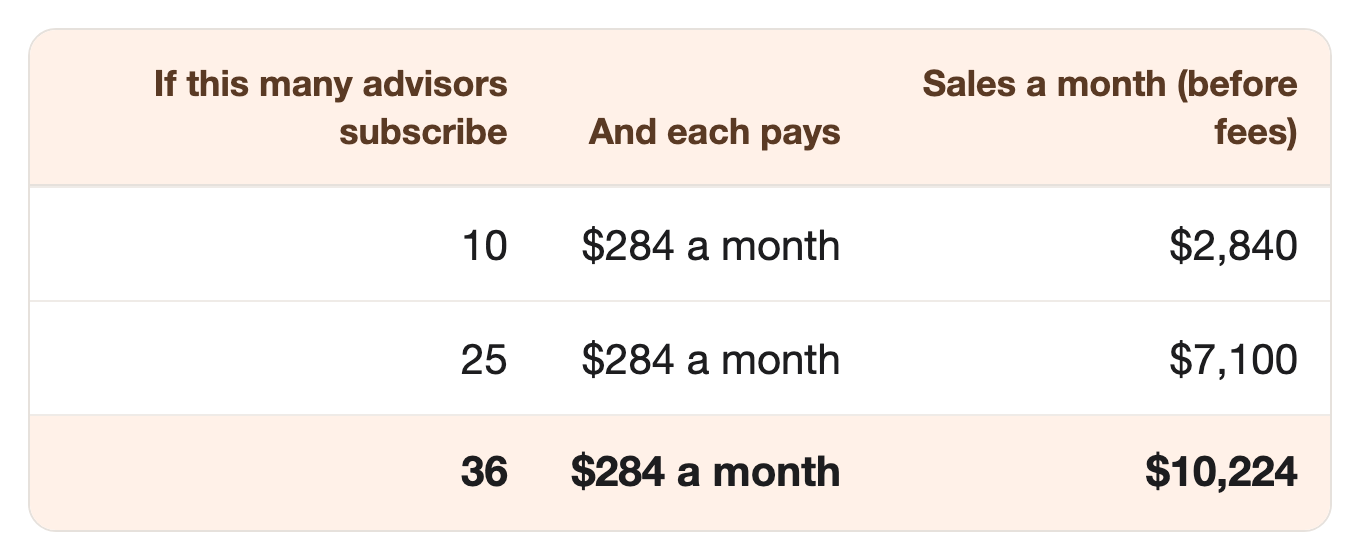
If you charge $284 a month, like White Glove’s top plan, 36 advisors get you past $10,000 a month.
That’s about 0.01% of the 299,400 advisor jobs in the US.
⠀
White Glove’s $284 buys 16 long videos and 30 shorts, with no compliance step.
Yours is fewer videos, each one written to pass review.
And it’s well below the $899 a month Snappy Kraken charges for done-for-you marketing.
Next stop: $25,000 a month, with two more ways to earn
Once advisors trust your videos, their firms and new clients add more.
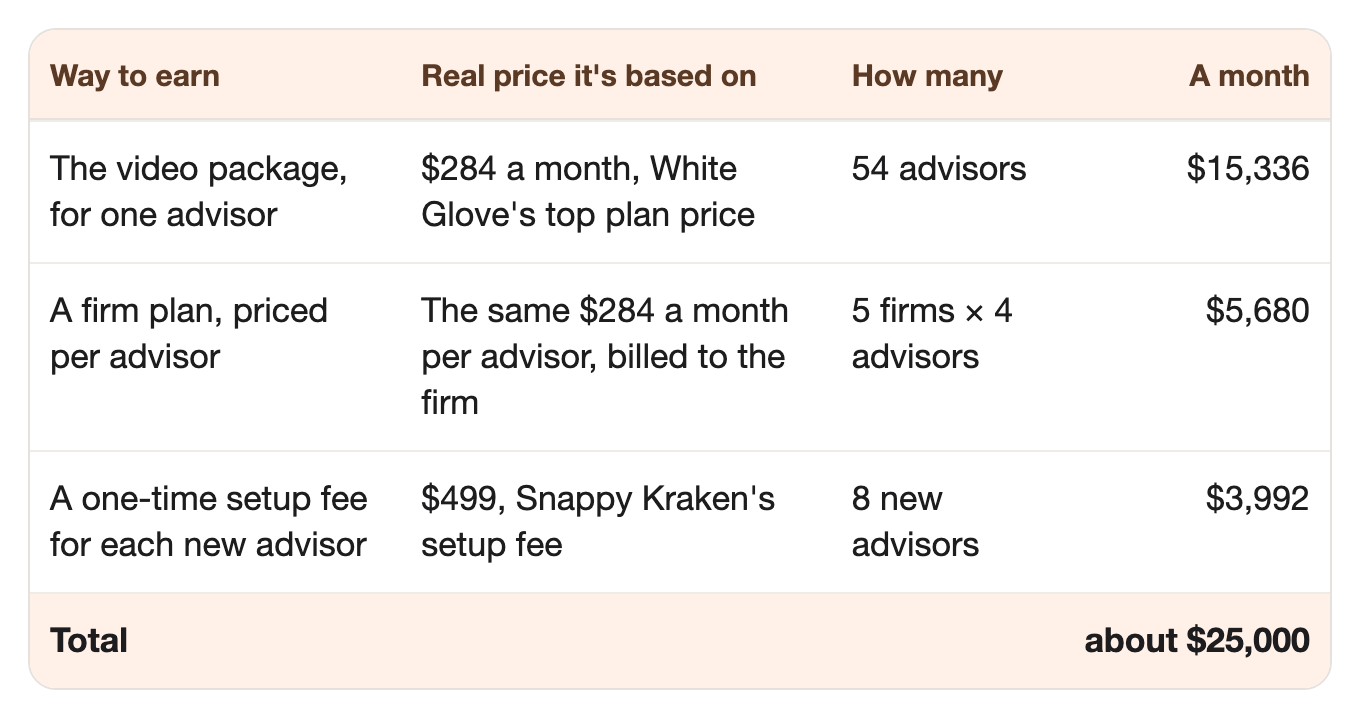
The video package still does most of the work.
Grow it from 36 to 54 advisors, and it brings in $15,336 a month.
That’s still a tiny slice of the 299,400 advisor jobs in the US.
⠀
The firm plan is the big jump.
A firm is a company with several advisors under one roof.
One firm signs up, and four advisors get videos.
⠀
The setup fee pays for the first week of work.
Each new advisor needs a style, a voice, and their firm’s disclosure line set up once.
Snappy Kraken charges $499 for setup on its bigger plans, on top of the monthly price.
It only adds up while new advisors keep joining, about eight a month.
Once growth slows, this line shrinks.
⠀
That’s 74 advisors in all.
Still under 1% of the advisor jobs that open up in a single year.
⠀
And if it doesn’t work? Here’s everything you lose:
One month of an AI app, like ChatGPT or Claude.
One month of an AI video tool.
One week of your time.
⠀
👉 That’s about $25,000 a month, all from one group of financial advisors.
One idea is the start. Add a second and a third, from this newsletter or a niche next door, and a million in total is two or three years out.
For this service, a similar niche could be mortgage loan officers. And this service could be your first idea.
Want to try this one?
The whole plan, the prompt included, is below. 👇
If it’s not your thing, see you next week with a fresh idea.
That’s it, my fellow contrarians! 🙌
Yours ‘handing you ideas with the proof attached’ Vijay Peduru 🦸♂️
⠀
⠀
⠀
🧰 Want to build it? Here’s everything else.
In every step, AI does most of the work. You run the process. 🎙️
⠀
Step 1: 🎯 Pick one kind of advisor
One kind of advisor, one package, one price.
Pick who you serve.
For example: advisors who work with teachers, with doctors, or with small-business owners.
Their clients ask the same questions, so your topic list writes itself.
Fix the package.
For example: 8 short videos a month, delivered on the first Monday.
The same steps for every advisor, with no custom requests.
Fix the price. For example: $284 a month, like White Glove’s top plan, cancel any month.
⠀
Step 2: ✍️ Write the scripts
Education only. Never investment advice.
Plan the month’s topics from official sources.
For example: how IRS contribution limits (the most you can put into a retirement account each year) work, or when to claim Social Security.
Use the IRS and Social Security websites, not blogs.
AI writes each script, under one minute.
One question a client would ask, a plain answer, and one example.
Every fact names its source.
Never in a script:
A stock, fund, or product to buy.
A promise of returns, or a guess about the market.
A client story or review, unless the advisor’s firm signs off in writing.
⠀
Step 3: 🔍 Check every script
Three AI checks, then the advisor’s compliance team.
Your AI does all three passes for you: it writes in Part 3, and checks in Part 4 of the prompt.
🖊️ The AI writer. It writes from official sources only.
🔍 The AI fact-checker. A second pass opens every link, and confirms each fact says exactly that.
🧐 The AI compliance critic. A third pass reads it like a strict reviewer at the advisor’s firm.
It flags promises, guesses about returns, and anything that sounds like advice.
✅ The advisor’s compliance team. They approve every script before you make the video.
Then they approve the finished video before it’s posted.
⠀
👉 The prompt already follows three safety rules: education only, the firm’s own disclosure line on every video, and nothing posted without the firm’s approval.
⠀
Step 4: 🎬 Make the videos
Faceless videos, like White Glove’s. AI does most of the work.
Use an AI video tool to turn each approved script into a short video.
Simple visuals, big captions, and an AI voice.
Or the advisor’s own voice, recorded on a phone, if they prefer.
Size each one for every platform: YouTube Shorts, Instagram, LinkedIn, and Facebook.
Add the firm’s disclosure line at the end of every video.
Send the finished videos for final approval, then deliver them on your fixed day.
⠀
Step 5: 📣 Get your first advisors
Reach advisors through the people and podcasts they already trust for marketing advice.
Ask compliance consultants who review advisor marketing to recommend you to their clients.
These are outside experts who check advisors’ posts and videos against the rules.
Send each one two sample scripts, so they can judge your work before they recommend it.
Pitch advisor-marketing podcasts one episode: “How to write a video script that passes review the first time.”
Put three talking points in the pitch, so saying yes is easy.
Teach the method in general terms, with no client names and no performance claims.
Publish “20 advisors who explain money well on video,” and tag each one.
Pick advisors whose videos teach plainly, and say what each one does well.
Make no claims about anyone’s returns or results.
⠀
Step 6: 🏃 Eliminate competitors
Copycats will come. Here’s how you stay first.
Own one claim: “Scripts written to pass your firm’s review.”
Put it on your offer page, in every message, and on every review packet.
Never promise a script will pass, because their firm’s compliance team always decides.
Sign a year-long deal with your best compliance-consultant partner, and promote them to your clients.
Put it in writing, and name them in your monthly email to advisors.
The longer it runs, the more it’s worth to them, so a rival can’t easily win them away.
⠀
Step 7: 🎲 Make it bigger
Every job with strict marketing rules needs the same kind of service.
Add the two extras from “How much you can make,” one at a time.
First the setup fee, from your very next advisor.
Then the firm plan, once a few advisors from one firm are happy.
Open the same service for other jobs: mortgage loan officers, accountants, estate-planning lawyers.
One service at about $25,000 a month is about $300,000 a year, before fees. 🎯
Add two or three more services, or ideas from this newsletter, and a million dollars in total is two or three years away.
⠀
🗓️ Your first week
Phew. That was a lot. 😅
A first version of Steps 1 to 5 fits into seven days. 🚀
By day 7, you have a package, a month of scripts, two sample videos, and a list of consultants and podcasts to contact.
Quick heads-up: the prompt below has six Parts, and they’re not the same as the Steps above.
Day 1 (Step 1): Pick your kind of advisor and your package with Parts 0 and 1 of the prompt (it’s below).
Day 2 (Step 2): Plan a month of topics with Part 2.
Day 3 (Step 2): Write the scripts with Part 3.
Day 4 (Step 3): Check every script with Part 4.
Day 5 (Step 4): Make two sample videos with Part 5.
Days 6–7 (Step 5): Write your offer, consultant note, and podcast pitch with Part 6, and send them to three consultants and two podcasts.
⠀
🏄 How to use the prompt
One prompt does all the AI work, in six parts, plus a quick market check (Part 0).
Part 1 — Pick the advisor and the package. Suggests three kinds of advisor, then helps you fix one package and price.
Part 2 — Plan the topics. Plans a month of topics from official sources only.
Part 3 — Write the scripts. Writes each script under one minute, with a source for every fact.
Part 4 — Check every script. Checks every fact, then reads each script like a strict compliance reviewer.
Part 5 — Plan the videos. Turns each script into a shot list (the visuals, in order), captions, and a thumbnail line for your AI video tool.
Part 6 — Win the first advisors. Writes your offer page, a note to compliance consultants, and a podcast pitch.
Run it your way:
Part by part (the default): it pauses after each part, and you type “next” to go on.
All at once: say “run all six parts.”
Just one part: say “only do Part 4,” or any part you need.
The full prompt is just below, under “📋 The prompt.”
🎙️ Talk to your AI sidekick, don’t type.
Turn on voice mode, or use a dictation app like Wispr Flow.
Say it messy. The AI sorts it out.
Turn it into a skill, so you never paste it again.
Paste the prompt into Claude or ChatGPT, and say: “Turn this into a skill I can save.”
Install once, use forever.
⠀
📋 The prompt
The prompt (copy it into Claude or ChatGPT, fill in the INPUTS part, and run it your way)
CONTEXT:
- You're my partner in running a done-for-you short-video service for financial advisors.
- It's a productized service: one fixed price, one fixed number of videos a month, the same process for every advisor, no custom work.
- This prompt has six parts, in order.
- Run it the way I ask:
    - If I say nothing, go one part at a time. After each part, show me the result, then stop and wait. Move on only when I type "next."
    - If I say "run all six parts," do them all without stopping.
    - If I say "only do Part 4" (or any part), do just that part.
- If a part needs something from me, ask for it before you start that part.
- Education only. Never give investment advice. Never name a stock, fund, or product to buy. Never promise returns or predict markets.
- Use only official sources, like IRS.gov and SSA.gov. Never invent a fact or a number. If you can't find a source, leave the fact out.
- The advisor's compliance team approves every script and every finished video before anything is posted. You help me prepare for that review. You never replace it.
- If you can't open a link I give you, ask me to attach the file instead.
- Keep web search on for the whole prompt (turn on search in ChatGPT or Claude), so you can open any page you need to check.

=============== INPUTS — edit these, or just run as is ===============

The kind of advisor I serve:
{e.g. financial advisors whose clients are public-school teachers}

My package and price:
{e.g. 8 short videos a month, delivered on the first Monday, $284 a month, cancel any month}

The advisor's disclosure line (from their firm):
{e.g. the exact line their compliance team gives you, pasted word for word. No advisor yet? Write [DISCLOSURE LINE] and paste theirs in later.}

My AI video tool:
{e.g. the AI video app I use, with an AI voice and auto captions}

======================== END OF INPUTS ========================

THE PARTS:

Part 0 — Check the market today.
This part needs web search (turn on search in ChatGPT or Claude). Search for video help for my kind of advisor and, for each place, give the count, the three biggest with links, and their prices:
1. Done-for-you video services for financial advisors.
2. Marketing platforms and content libraries for advisors.
3. AI video tools that pitch advisors.
4. Agencies that make custom videos for advisors.
Then tell me: early (few sellers), growing, or crowded, and which kind of advisor looks least served (for example: advisors for teachers, for doctors, for small-business owners). Give a link for every number. If you can't open a page, say so. Never guess a number.

Part 1 — Pick the advisor and the package.
Using Part 0, suggest three kinds of advisor I could serve, and say why for each. Say clearly which reasons are your guess. Then help me fix one package: the number of videos, the delivery day, the price, and what's never included (custom requests, extra edits beyond one round, posting for them unless I offer it).

Part 2 — Plan the topics.
Plan one month of topics for my kind of advisor's clients. Each topic is one question a client would ask. Use only official sources, and give the link for each. Skip any topic that would need investment advice to answer. Mark any topic that depends on a number that changes every year, like contribution limits, and say which year the number is for.

Part 3 — Write the scripts.
Ask me which topics to write. For each, write a script under 150 words:
1. The first line: the client's question, in their words.
2. A plain answer, in three short beats.
3. One simple example, with made-up round numbers that are clearly an example.
4. The source for every fact, listed under the script (not read aloud).
5. The advisor's disclosure line, word for word, at the end.
Never include a product to buy, a promise of returns, a guess about the market, or a client story.

Part 4 — Check every script.
First, act as a separate fact-checker who didn't write these scripts. Open every link. Mark each fact: matches the source, doesn't match, or has no source. Fix or remove each problem.
Then act as a strict compliance reviewer at the advisor's firm. Flag anything that is a promise, predicts or implies returns, could read as advice to one person, or isn't backed by a source. For each flag, say why and give a safer rewrite.
Then give me a review packet for the advisor's compliance team: each final script, its sources, and a short list of what you changed and why. Say clearly that their team gives the final approval.

Part 5 — Plan the videos.
For each approved script, give me what my AI video tool needs:
1. A shot list, one simple visual per line (no people's faces, no logos I don't own).
2. On-screen captions, short and large.
3. One thumbnail line, under six words.
4. The sizes to export for YouTube Shorts, Instagram, LinkedIn, and Facebook.
5. A reminder to add the disclosure line at the end and send the finished video for final approval.

Part 6 — Win the first advisors.
Write:
1. A one-page offer: who it's for, the package, the price up front, "cancel any month," and how compliance review fits in.
2. A short note to a compliance consultant who reviews advisor marketing, with two sample scripts attached, asking if they'd recommend the service to their clients.
3. A podcast pitch for one episode, "How to write a video script that passes review the first time," with three talking points in general terms.
Never promise more clients, more money, or faster approval. Never invent a result, a review, or a number.

When all six parts are done, ask if I want to repeat Parts 2 to 5 for next month.
⠀
📎 The sources
Every number above, with where it came from.
White Glove Content’s revenue for 30 days · Number: $70,720 “last 30 days,” verified through Stripe (page updated October 22, 2026, so about September 22 to October 22) · Source: TrustMRR
White Glove’s subscriptions · Number: $66,166 a month, from 563 active subscriptions · Source: TrustMRR
White Glove’s start, founder, and prices · Number: Founded April 2026 (the page’s data says April 17, 2026, so six months before the 30-day window ended) by Dylan N.; $54, $124, and $284 a month; $0 setup; month-to-month · Source: TrustMRR
What White Glove’s $284 plan includes · Number: Pro (mixed) $284/mo: 16 long-form (10 min) + 30 shorts (45s); no compliance review listed · Source: White Glove Content pricing
Why customers pay · Number: Publish “without filming, editing, managing freelancers, or manually uploading every video” · Source: TrustMRR
White Glove’s reach · Number: “1,000+ pages across 100+ niches” (the founder’s own claim) · Source: TrustMRR
Financial advisor jobs · Number: About 299,400 in 2025; about 17,100 openings a year, on average, over the decade; median pay $105,070 (May 2025) · Source: US Bureau of Labor Statistics
FINRA’s rule for advisor marketing · Number: Applies to FINRA member firms (brokerages): a qualified registered principal must approve each retail communication before use; no promissory claims; no predicting performance · Source: FINRA Rule 2210
The SEC’s marketing rule · Number: No untrue statement of a material fact; every material fact must be backed up on demand · Source: 17 CFR 275.206(4)-1, Cornell LII
FMG · Number: “40K+ active FMG customers”; “200+ new content pieces monthly” (its own claims, printed with “says”) · Source: FMG
Snappy Kraken · Number: Plans from $99 (website) to $999 (bundle) a month; Freedom360, “Complete done-for-you system,” $899 a month (annual term) plus $499 setup · Source: Snappy Kraken pricing
Setup fee · Number: Grow and Freedom360 plans: “Setup Fee $499” · Source: Snappy Kraken pricing
Vidiance · Number: “about $2,500 for a single video” (a two-minute client-testimonial video); started by compliance consultant Sander Ressler · Source: WealthManagement.com, January 9, 2024
Kitces survey · Number: 506 advisors; average firm puts 7% of yearly revenue into marketing; social media “the least efficient of all marketing tactics”; fully outsourced social media $0.45 per dollar of new revenue, done in-house $1.77 · Source: Financial Planning, September 15, 2026
Social media for financial advice · Number: 19.5% of more than 5,000 US adults (surveyed April 2024); YouTube used by 65.6% of them; 41% disagreed that an influencer’s knowledge, and 44% that their apparent success, can substitute for professional qualifications, while 23–24% agreed · Source: Federal Reserve Bank of Philadelphia, LIFE Survey, March 2025
Comment: consistency · Number: “Consistency is my toughest thing to nail down.” (under “Digital Marketing For Financial Advisors - What Actually Works,” Advisor Growth with Dave Zoller; posted in 2022) · Source: YouTube comment, 2022