


Hello contrarians,
Today’s idea is called The Dental Tax Letter.
Grab a pen. 🖊️
First, an accountant’s story. Then, the business you could build from it.
⠀
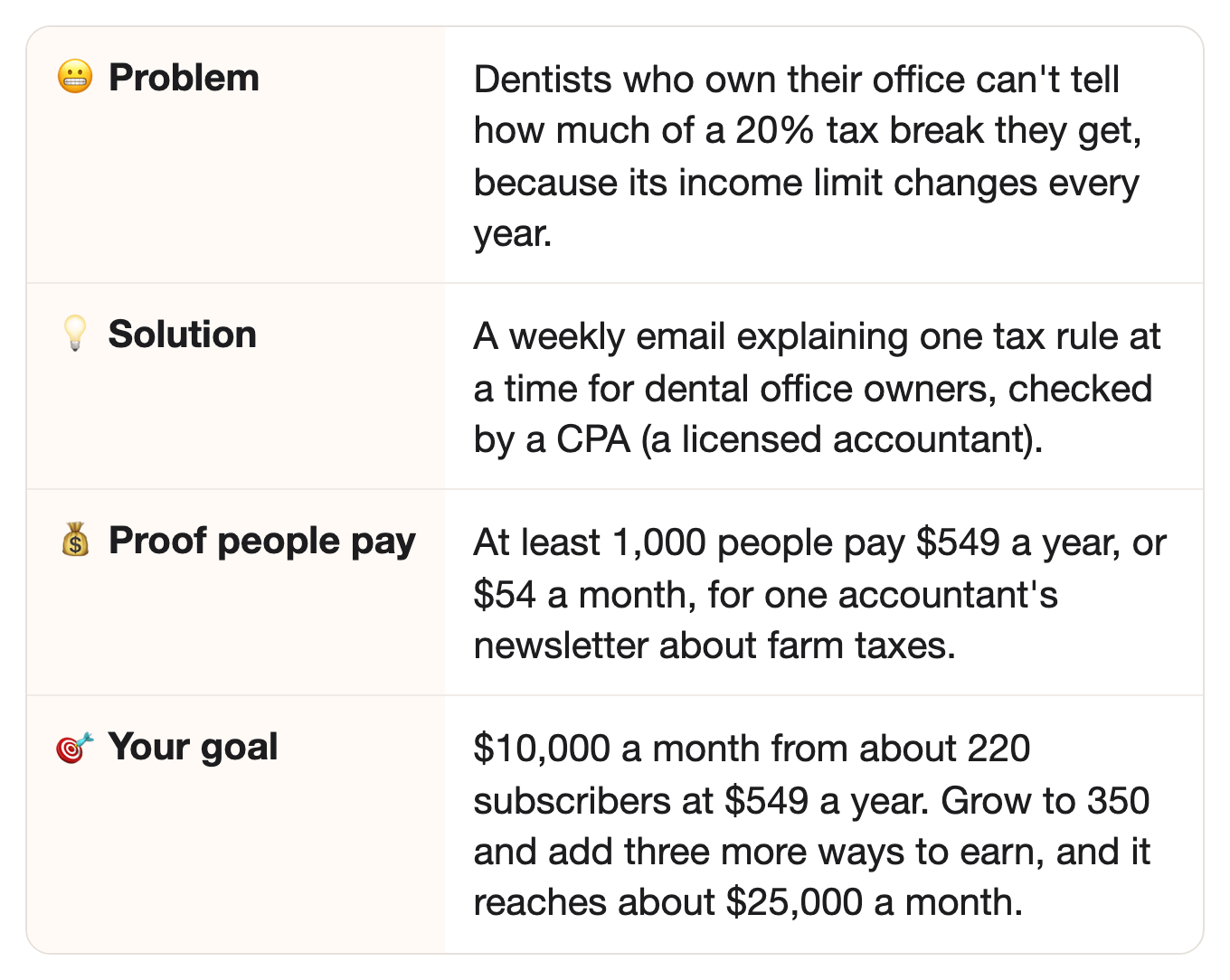
⚡ Quick facts
⠀
📖 How one farm accountant got 1,000+ people to pay for his tax emails
It started with one tax rule per post.
Paul Neiffer grew up on a farm in Walla Walla County, Washington.
⠀He became a CPA in 1984.
That’s a certified public accountant, licensed to do taxes and audits.
⠀
He was a principal (a senior partner) in the farm group at CliftonLarsonAllen, a big accounting firm.
His job? Taxes for farmers.
He also writes a monthly column called “The Farm CPA” for Top Producer, a farm magazine.
⠀
Then, on December 7, 2022, he sent the first post of a new newsletter, Farm CPA Report.
Its title: “Related Parties Don’t Count.”
⠀
Heads up: farmers play by some of their own tax rules.
If two-thirds of their income comes from farming, they can skip quarterly tax payments by filing by March 1.
The IRS even publishes a whole tax guide just for farmers.
⠀
So most of his posts explain one rule, just for farmers.
“Hedging vs. Speculating: The Tax Line Every Farmer Needs to Know.”
“Crop Quality Losses: What Farmers Need to Know Before the Grain Leaves the Farm.”
⠀
For about ten months, every post was free.
⠀Then, on October 2, 2023, he opened a paid tier at $49 a month or $499 a year.
⠀When we checked, he had sent more than 900 posts, and the price was $54 a month or $549 a year.
⠀And here’s the fun part.
Substack, the site it runs on, shows a badge: “Thousands of paid subscribers.”
The badge only gives a range, and its low end is 1,000.
Monthly payers pay more over a year ($648), so each reader pays at least $549 a year.
So 1,000 readers bring in at least $549,000 a year.
That’s the least it could be, worked out from the badge and the price. He hasn’t shared his revenue.
Wowza. 🤩
By our math, at least $549,000 a year, from emails about farm taxes.
He went from doing farmers’ taxes at a big firm, to 1,000+ paying readers, by explaining one farm tax rule per post.
⠀
🔗 Same idea, new group
In the story: farmers paid Paul Neiffer’s Farm CPA Report for posts that explain one farm tax rule at a time.
⠀In this idea: dentists who own their office get the same thing, one dental tax rule at a time.
⠀Why it carries over: both groups run real businesses with tax rules aimed right at them, which a general tax newsletter skips.
⠀
💡 The opportunity
Dentists who own a practice run a real business, with tax rules of their own.
First, who are dental practice owners?
They’re dentists who own their office: they hire the staff, buy the equipment, and pay the bills.
About 7 in 10 US dentists own their practice (72.5%, 2023).
⠀
Their office is a big business.
In 2025, owners’ practices billed about $1,016,790 per dentist, on average.
The average owner’s net income was $258,770.
Quick note: net income is what the owner earns from the practice.
It isn’t the same as taxable income, which is what the income limit below uses.
⠀
Here’s the key point: the tax rules name dentists.
Many small-business owners get a tax break of up to 20% of their business income.
But federal tax rules put dentists in the “field of health,” where that break shrinks above an income limit, and ends at a higher one.
Yep, the rules list dentists by name.
In 2026, that line is $201,750 of taxable income for a single filer, and $403,500 for a married couple filing together.
Taxable income here means before the break itself.
And the line moves every year.
In 2025, it was $197,300 for a single filer.
⠀
Why dentists, and not another industry?
Owners earn enough that tax planning matters a lot.
They have rules aimed at them, like the one above.
And a group of accounting firms that specialize in dentists has existed since 2001.
⠀
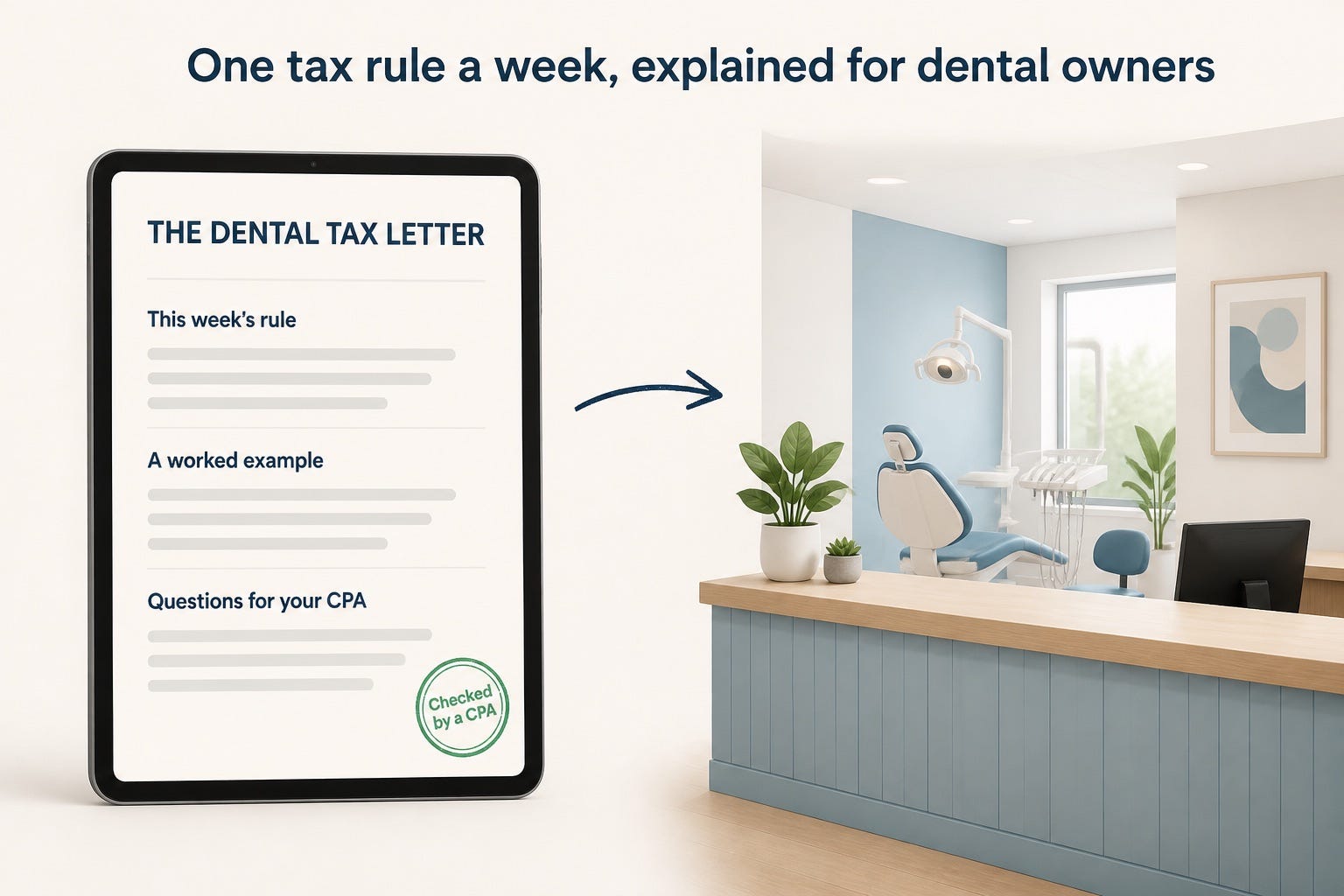
👉 The idea: a paid weekly newsletter that explains one tax rule or planning idea at a time, for dental practice owners.
One rule before you start: explain, never advise.
This part matters.
The newsletter explains rules and planning ideas.
It never tells one reader what to do on their own tax return.
The writer should be a CPA or an enrolled agent, or partner with one who reviews every issue before it goes out.
An enrolled agent is a tax pro licensed by the IRS.
The IRS calls it “the highest credential the IRS awards.”
⠀
🙋 Not a CPA yourself? You can still build this.
Become the interviewer.
Each issue, interview one CPA or enrolled agent who serves dentists, with their permission.
You ask the questions, and their answers become the issue.
A CPA or enrolled agent still reviews every issue before it goes out.
⠀
Team up with a CPA or enrolled agent.
They bring the license and the judgment, and sign off on every issue.
You do the research, the writing, and the growth.
⠀
✅ Why this could work
Here’s why people will pay for this.
Others make money the same way, so it’s a pattern, not luck.
Roger McEowen, a professor of agricultural law and taxation, runs a farm tax and law newsletter.
Yep, another farm tax letter.
It had hundreds of paid subscribers, and its yearly plan was $300.
Capitol Account explains financial rules to people who work in finance.
Its yearly plan was $2,000, and it also had hundreds of paid subscribers.
By our math, at least 100 readers at $2,000 is at least $200,000 a year.
That’s our estimate, not a number they’ve shared.
⠀
Dentists have read about the business side for decades.
A dental magazine was renamed Dental Economics in 1967, “to reflect a growing focus on the business of dentistry.”
It has more than 90,000 print subscribers.
About 4,800 dentist jobs open every year in the US, and most dentists end up owning a practice. 🔁
⠀
Dentists already pay for tax help.
You can see the demand in plain numbers, coming up next.
⠀
👉 Don’t take my word for it. Every number is linked in “📎 The sources,” at the very end.
⠀
📊 More proof people want this
Want more? Here you go.
Dentists already pay for tax help.
The Academy of Dental CPAs is a group of accounting firms that serve dentists.
The headline on its own site says: “What Do 9,000 Other Dentists Know That You Don’t?”
That’s their own claim about how many dentists use them.
⠀
They pay for money classes too.
The National Dental Association is a US group for dentists.
It lists a six-week money class for dentists at $597, or $400 for members.
⠀
Advertisers pay about $30 for each Google click on “dental cpa.”
That’s what an ad costs each time someone clicks it.
⠀
People search for it every month.
“Dental cpa” gets about 720 Google searches a month in the US.
⠀
The big picture: about 161,400 dentist jobs in the US in 2025. 💰
Their median pay was $176,110 a year (May 2025).
Half of dentists earn more than this, and half earn less.
⠀
What they say.
That’s a YouTube comment from someone who worked at a dental clinic.
The same comment says: “We always used a CPA.”
⠀
👉 Dental owners want tax help they can trust, from someone who knows their world.
⠀
🔍 Who’s already doing it
Lots of free tax tips, and the reader none of them serve.
Farm CPA Report, the tax newsletter from the story above, serves farmers only.
Its posts cover crop insurance, farm payments, and farm deadlines.
Its posts are written for farmers, not dentists.
Makes sense, it’s in the name.
⠀
Dental accounting firms write free tips to win clients.
For example, a blog post called “What Every Dentist Should Know About Tax Deductions.”
On YouTube, the most-watched tax video made for dentists had about 36,000 views, when we checked.
⠀
A few books exist.
When we checked, the top Amazon book for “dentist taxes” with reviews had 15 ratings, at $19.99.
⠀
Still missing when we checked:
A paid weekly email that explains each new tax rule for dental practice owners.
Signed by a named CPA or enrolled agent (a tax pro licensed by the IRS) they can follow.
At a price like Farm CPA Report’s.
⠀
🔎 Check the market yourself in 2 minutes: run Part 0 of the prompt in the build plan below.
Your AI searches for paid tax newsletters, courses, and books for dental owners that day.
Then it tells you: early, growing, or crowded.
Early? Start now.
Crowded? Good news: it means people pay. Pick one narrower group of owners (Step 8 of the build plan).
A crowded market is still OK. You win by serving one group better, not by being first.
⠀
👉 You can be the one to fill that gap: a paid weekly tax email for dental owners, signed by a named tax pro.
⠀
🤖 Why AI won’t replace it
AI gives them a tax answer. You give them one a licensed pro has checked.
Could ChatGPT just do this?
Sort of, once someone hands it the exact rule and the new limits.
Accuracy, with a name on it.
A CPA or enrolled agent reviews every issue.
A ChatGPT answer has no license behind it.
⠀
You pick the tax news that matters to a dental office.
Most tax news has nothing to do with a dental office.
You pick the few changes that do, and say which ones to skip.
⠀
New rules, every year.
The income limit and the limit on writing off new equipment change every year.
AI gets the math right once the new limits are in front of it, but a busy dentist won’t go dig them up.
Your issue links the new ones.
⠀
Ready to use: one rule, one example.
The rule in plain words, a worked example with made-up numbers, and three questions to bring to their own CPA.
AI explains a rule well once it’s handed the exact rule and a sample office, and you’ve done that gathering.
⠀
Proof people pay for this.
Remember the IRS’s free tax guide just for farmers?
It’s free, and at least 1,000 readers still pay for Paul’s $549-a-year letter.
⠀
👉 The rules are free. People pay for the finished, checked issue.
⠀
💵 How much you can make
Here’s how the numbers add up.
Quick math time. 🧮
First stop: $10,000 a month from the newsletter alone
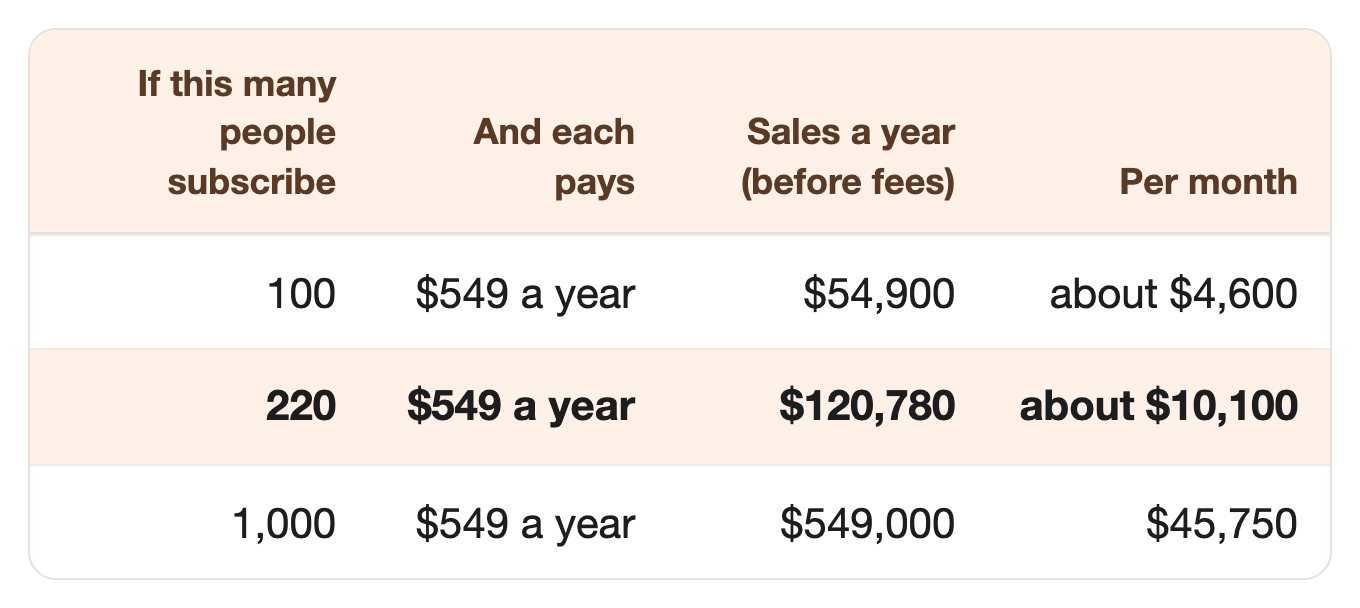
$549 a year is Farm CPA Report’s price.
⠀220 subscribers is fewer than 2 in every 1,000 US dental offices.
Next stop: $25,000 a month, with three more ways to earn
Once dental owners trust your letter, some will buy a second thing from you.
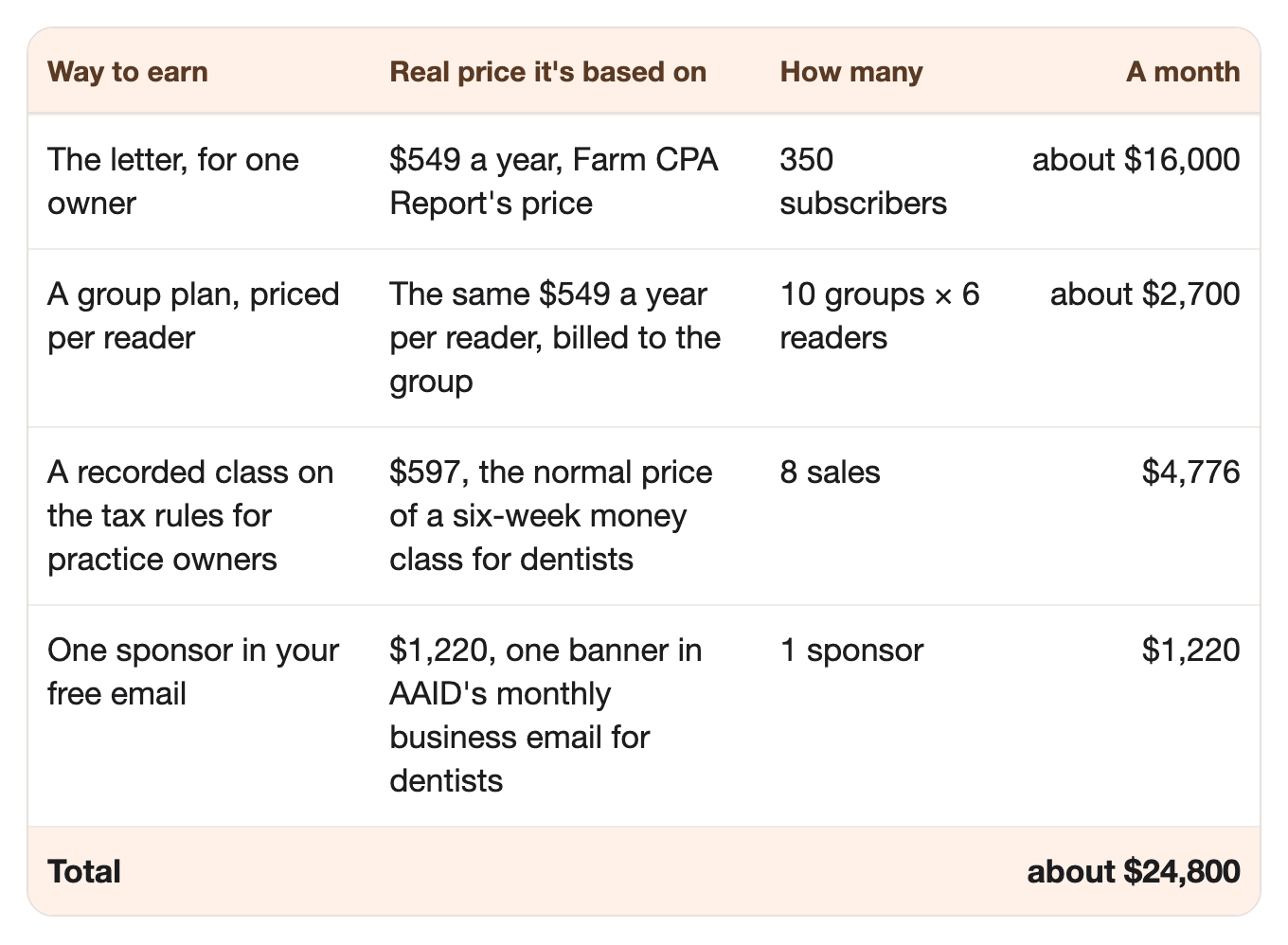
The letter still does most of the work.
Grow it from 220 to 350 subscribers, and it brings in about $16,000 a month.
That’s about 2.6 in every 1,000 US dental offices.
⠀
The group plan is the big jump.
The buyer is a dental group with several offices, or a CPA firm with many dental clients.
One sale, six readers.
⠀
The class sells to owners who want it all in one place.
Record it once, and have your CPA or enrolled agent check it, like every issue.
It explains how the rules work, never what one owner should do.
The $597 is for a live six-week class, so a recorded one may sell for less.
⠀
The sponsor only works once your free email has a few thousand readers.
AAID, a group for dentists who place implants, charges $1,220 for one banner to over 14,000 readers.
A smaller email may get less.
⠀
That’s about 410 readers in all.
Still about 3 in every 1,000 US dental offices.
⠀
If it doesn’t work out, here’s all you lose:
Substack’s cut, which comes only from what readers pay: 10%, plus card fees.
One month’s subscription to an AI app, like ChatGPT or Claude.
One week of your time, and your partner’s review time, if you have one.
⠀
👉 That’s about $25,000 a month, all from one group of dental office owners.
Most million-dollar totals come from a few ideas, not one. Take two or three from this newsletter, or one idea across a few niches, and give it two or three years.
For this letter, a similar niche could be vet clinic owners. And this letter could be your first idea.
Is your brain already buzzing? 🐝
Then scroll on. The build plan is below. 👇
Not feeling it? All good. Another idea comes next week.
That’s it, my fellow contrarians! 🙌
Yours ‘showing you where the money already is’ Vijay Peduru 🦸♂️
⠀
⠀
⠀
🧰 Want to build it? Here’s everything else.
AI does the research and the drafts. A CPA or enrolled agent signs off. 🎙️
⠀
Step 1: 🤝 Line up your reviewer
No issue goes out without a licensed tax pro’s review.
If you’re a CPA or enrolled agent, you’re the reviewer.
Easy one.
If you’re not, find one who serves dentists.
Offer a share of the revenue, or a fixed fee per issue.
Their name goes on every issue, next to yours.
Write down the house rule together:
We explain rules and planning ideas.
We never tell one reader what to do on their own return.
Every issue ends with: “General information, not tax advice for your situation. Talk to your own CPA or enrolled agent.”
⠀
Step 2: 🗂️ List the rules that touch a dental office
Your topic list for the first year, built in one sitting.
List 30 tax rules a dental owner runs into.
For example: the 20% business break and its income limit, writing off new equipment, hiring an associate dentist, and buying or selling a practice.
Your AI builds the list in Part 1 of the prompt.
Link each rule to its official source, like an IRS page or the tax code.
Mark the dates. Which rules change every year, and which deadlines come up when.
⠀
Step 3: 📰 Track what changes
The news writes your next issue.
Each week, your AI checks the official sources for anything new that touches dental owners.
IRS news and guidance, and the yearly update to tax limits each fall.
Pick the one change that matters most.
No news that week? Explain one rule from your Step 2 list instead.
Your topic list has you covered.
⠀
Step 4: 🛠️ Write one rule a week
Every issue has the same shape, so readers know what they get.
The rule in one sentence.
Who it touches: for example, solo owners, or owners about to sell.
A worked example with made-up numbers, labeled as made up.
Three questions to bring to their own CPA.
The source link for every fact, and the house line at the bottom.
🎙️ Talk, don’t type. Explain the rule out loud, like you would to a client, and let AI turn it into a draft.
⠀
Step 5: 🔍 Check every issue
Tax mistakes cost real money. So every issue gets checked four times.
Your AI does all three passes for you: it writes in Part 3, and checks in Parts 4 and 5 of the prompt.
🖊️ The AI writer. Your AI drafts from official sources only.
🔍 The AI checker. A second pass opens every link, and confirms each fact and number says exactly that.
🧐 The AI critic. A third pass hunts for anything that sounds like advice for one person, like “you should.”
👩💼 The CPA or enrolled agent. They read the final version and sign off.
This step is never optional.
⠀
👉 The prompt already follows three safety rules: official sources only, no personal advice, and a CPA or enrolled agent reviews every issue.
⠀
Step 6: 🏪 Open your newsletter
Copy Farm CPA Report’s setup: free first, then paid.
Start on Substack. It takes its 10% cut only from what readers pay.
Send free issues first.
Farm CPA Report was free for about ten months before it opened a paid tier.
Then set your prices.
$54 a month, or $549 a year, like Farm CPA Report.
A group plan: the same $549 a year, for each reader at a dental group or a CPA firm.
Send a proper receipt, so the practice’s books can track it.
⠀
Step 7: 📣 Get your first subscribers
Dentists learn the business side from podcasts, Google, and the news. Show up there, and explain how the rules work.
Pitch dental-business podcasts one episode: “Three tax rules new practice owners ask about.”
Send the three talking points with the pitch, so saying yes is easy.
Keep it to how each rule works, never what one listener should do.
Write one short page for each tax question dentists type into Google.
Use their exact words as the title, like “Can a dentist deduct continuing-education travel?”
Each page explains how the rule works in general, and ends with “Ask your own CPA about your situation.”
The week a tax rule changes, post what it means for practice owners in general.
Your AI drafts the post in Part 6 of the prompt, and your reviewer checks it before it goes up.
Link to the full issue, which has the worked example.
⠀
Step 8: 🏃 Eliminate competitors
When others copy you, here’s how you stay the one people pick.
Narrow your headline until a stranger can say who it’s for.
Show it to someone outside dentistry, and ask who it’s for, what it explains, and why it beats a general tax blog.
Keep narrowing until they answer “dentists in their first three years of owning a practice.”
Serve solo practice owners, the ones big accounting firms rarely explain things to.
Write every example for the owner of one office, not a group of ten.
Answer reader emails yourself, with how the rule works in general and a nudge to ask their own CPA.
⠀
Step 9: 🎲 Make it bigger
The same tax rules also name vets, physical therapists, and pharmacists.
Add the three extras from “How much you can make,” one at a time.
First the group plan, since you already write the letter.
Then the recorded class, built from your best issues and checked by your reviewer.
Then one sponsor, once your free email has a few thousand readers.
Start the same letter for vet clinic owners, or another health practice.
One letter at about $25,000 a month is about $300,000 a year, before fees. 🎯
Add two or three more letters, or ideas from this newsletter, and a million dollars in total is two or three years away.
⠀
🗓️ Your first week
Phew. That was a lot. 😅
Steps 1 to 7 fit into seven days. 🚀
By day 7, you have a reviewer, a topic list, two checked issues, a Substack, and your first post.
Quick heads-up: the prompt below has six Parts, and they’re not the same as the Steps above.
Day 1 (Step 1): Line up your reviewer, and agree on the house rule.
Day 2 (Step 2): Run Part 1 of the prompt (it’s below), and build your list of 30 rules.
Day 3 (Step 3): Find the newest change with Part 2.
Days 4–5 (Steps 4 and 5): Write two issues with Part 3, and check each with Parts 4 and 5.
Then send both to your reviewer.
Day 6 (Step 6): Set up your Substack, and send issue 1 free.
Day 7 (Step 7): Write your LinkedIn post with Part 6, and post it.
⠀
🏄 How to use the prompt
One prompt does all the AI work, in six parts, plus a quick market check (Part 0).
Part 1 — List the rules. Lists 30 tax rules that touch a dental office, each with its official source.
Part 2 — Find the newest change. Searches official sources for anything new, and picks the one that matters most.
Part 3 — Write the issue. Explains one rule in plain words, with a worked example and questions for their own CPA.
Part 4 — Check every fact. Opens every link and confirms each fact and number matches the page.
Part 5 — Find the advice traps. Flags anything that sounds like advice for one person, and makes a review sheet for your CPA.
Part 6 — Write the LinkedIn post. Turns the issue into a short post that points to your newsletter.
Run it your way:
Part by part (the default): it pauses after each part, and you type “next” to go on.
All at once: say “run all six parts.”
Just one part: say “only do Part 3,” or any part you need.
The full prompt is just below, under “📋 The prompt.”
🎙️ Talk to your AI sidekick, don’t type.
Turn on voice mode, or use a dictation app like Wispr Flow.
Say it messy. The AI sorts it out.
Turn it into a skill, so you never paste it again.
Paste the prompt into Claude or ChatGPT, and say: “Turn this into a skill I can save.”
Install once, use forever.
⠀
📋 The prompt
The prompt (copy it into Claude or ChatGPT, fill in the INPUTS part, and run it your way)
CONTEXT:
- You're my newsletter partner. Together we'll build a paid weekly newsletter that explains one tax rule or planning idea at a time to dental practice owners.
- This prompt has six parts, in order.
- Run it the way I ask:
    - If I say nothing, go one part at a time. After each part, show me the result, then stop and wait. Move on only when I type "next."
    - If I say "run all six parts," do them all without stopping.
    - If I say "only do Part 3" (or any part), do just that part.
- If a part needs something from me, ask for it before you start that part.
- We explain rules and planning ideas. We never give personal tax advice. Never tell a reader what to do on their own return. Never write "you should" about a reader's own taxes.
- A CPA or enrolled agent reviews every issue before it goes out. If I'm not one, remind me to send each issue to my reviewer.
- Use only official sources, like IRS pages, IRS publications, and the tax code. Never invent a fact, a number, or a rule. If you can't find a source, leave it out. If you can't open a link, say so, and ask me to paste the page instead.
- Tax limits change every year. Always say which tax year a number is for.
- Keep web search on for the whole prompt (turn on search in ChatGPT or Claude), so you can open any page you need to check.

=============== INPUTS — edit these, or just run as is ===============

The industry I write for:
{e.g. dentists who own their practice in the US}

The group of owners I focus on:
{e.g. owners in their first three years after buying a practice}

My reviewer:
{e.g. me, a CPA who has served dental practices for 12 years; or my partner, an enrolled agent}

My prices:
{e.g. $54 a month, or $549 a year}

======================== END OF INPUTS ========================

THE PARTS:

Part 0 — Check the market today.
This part needs web search (turn on search in ChatGPT or Claude). Search for paid tax help for my industry and, for each place, give the count, the three biggest with links, and their prices:
1. Paid newsletters about taxes for this industry (for example on Substack's leaderboards).
2. Courses, classes, and webinars about taxes for this industry.
3. Books about taxes for this industry on Amazon.
4. The biggest free blogs, YouTube channels, and podcasts about it, and who runs them.
Then tell me: early (few sellers), growing, or crowded, and which group of owners looks least served (for example: new owners, owners selling their practice, specialists). Give a link for every number. If you can't open a page, say so. Never guess a number.

Part 1 — List the rules.
List 30 tax rules that a dental practice owner runs into. For each rule, give:
1. The rule, in plain words.
2. Who it touches (for example: every owner, solo owners, owners about to sell).
3. Its official source, with a link.
4. Whether it changes every year, and when the new numbers come out.
5. Any deadline, with the date.
Then pick the first five to write about, and say why. Say clearly which reasons are your guess.

Part 2 — Find the newest change.
Ask me for the date of my last issue. Search official sources for anything new since then that touches dental practice owners: IRS news, new guidance, new yearly limits, or new laws. For each one, give the link, the date, and one line on who it touches. Pick the one that matters most, and say why. If nothing is new, say so, and suggest a rule from Part 1 instead.

Part 3 — Write the issue.
Ask me which rule or change to write about, and ask me how I'd explain it to a client, in my own words. Then write one issue:
1. A subject line that names the rule, not a promise.
2. The rule in one sentence, with the tax year.
3. Who it touches.
4. A worked example with made-up numbers, labeled as made up.
5. Three questions the reader can bring to their own CPA or enrolled agent.
6. A source link for every fact.
7. This line at the very bottom: "General information, not tax advice for your situation. Talk to your own CPA or enrolled agent."

Part 4 — Check every fact.
Now act as a separate fact-checker who didn't write this issue. Open every link. Mark each fact and number: matches the source, doesn't match, or has no source. Check that each number is for the right tax year. For each problem, show what the source actually says. Then give a fixed version of the issue.

Part 5 — Find the advice traps.
Now act as a cautious CPA reading this before any reader sees it. Flag:
1. Anything that tells one reader what to do on their own return, or sounds like "you should."
2. Any promise of a tax saving or a result.
3. Any number without a tax year or a source.
4. Any step a dentist with no tax background would find confusing.
Then give the final issue with every fix made, plus a one-page review sheet for my CPA or enrolled agent: every rule, number, and source in the issue, with a box to tick for each.

Part 6 — Write the LinkedIn post.
Turn the final issue into a LinkedIn post under 150 words, for the week a rule changes:
1. The first line: the rule that changed, in a dentist's words.
2. Who it touches, and one line from the worked example, in three short lines.
3. No advice for one person, and no promised savings.
4. A last line that links to the full issue in my newsletter.
5. Remind me to send the post to my reviewer before it goes up.

When all six parts are done, ask if I want to repeat Parts 2 to 6 for next week's issue.
⠀
📎 The sources
Every number above, with where it came from.
Farm CPA Report’s paid subscribers · Number: “Thousands of paid subscribers” (Substack’s badge; at least 1,000); plans $54 a month and $549 a year; first post December 7, 2022 · Source: Substack Finance leaderboard
Farm CPA Report’s prices · Number: “$54/month or $549/year”; Paul Neiffer, CPA, writes “The Farm CPA” column for Top Producer · Source: Farm CPA Report: about
First paid tier · Number: October 2, 2023: “$49/month, $499/year” · Source: Farm CPA Report, “Introducing Farm CPA Report Premium”
Posts and titles · Number: 925 posts since December 7, 2022; first post “Related Parties Don’t Count”; first paid-only post October 2, 2023; post titles quoted above · Source: Farm CPA Report archive
Paul Neiffer’s background · Number: CPA certificate in 1984; grew up on a farm in Walla Walla County, Washington · Source: Colorado Society of CPAs
Paul Neiffer’s firm · Number: “former principal in the Agribusiness Group at Clifton Larson Allen,” specializing in taxes for farmers and processors · Source: Washburn Law seminar page
Farmers’ own deadline · Number: Farmers can skip estimated payments if they file by March 1 (when at least two-thirds of gross income is from farming or fishing) · Source: IRS: farmers and fishermen FAQ
The IRS farm tax guide · Number: Publication 225, “Farmer’s Tax Guide,” free · Source: IRS Publication 225
Accountant comment · Number: “This makes me really thankful for the farm clients I take care of.” · Source: Farm CPA Report comment, February 27, 2026
Dentists named in the tax rules · Number: “the provision of medical services by individuals such as physicians, pharmacists, nurses, dentists, veterinarians, physical therapists…” · Source: Treasury Regulation 1.199A-5 (eCFR)
The 20% break and the 2025 line · Number: Up to 20% of business income; health is a “specified service” field; 2025 line $197,300 ($394,600 married filing jointly) · Source: IRS Form 8995 instructions
The 2026 line and equipment limit · Number: 2026 threshold $201,750 for all other returns ($403,500 married filing jointly), phase-in range to $276,750 ($553,500); Section 179 equipment limit $2,560,000 · Source: IRS Revenue Procedure 2025-32
Enrolled agents · Number: “the highest credential the IRS awards” · Source: IRS: enrolled agents
Dentists who own their practice · Number: 72.5% in 2023, down from 84.7% in 2005 · Source: ADA Health Policy Institute
Dental offices in the US · Number: 135,665 (US Census Bureau, County Business Patterns, 2023) · Source: ADA Health Policy Institute
Owner dentists’ billings and income · Number: Average gross billings per dentist, owner dentists, $1,016,790 (Table 5); average annual net income, all owners, $258,770 (Table 1) (2025) · Source: ADA Health Policy Institute, Survey of Dental Practice 2025 (spreadsheet, Tables 1 and 5), linked here
Most dentists end up owners · Number: “In a nutshell, most roads still, eventually, lead to practice ownership.” · Source: ADA News, June 17, 2025
Dentists in the US · Number: About 161,400 jobs in 2025; about 4,800 openings a year, on average, over the decade; median pay $176,110 (May 2025) · Source: US Bureau of Labor Statistics
Dental Economics · Number: First published as Oral Hygiene; “renamed in 1967… to reflect a growing focus on the business of dentistry”; “more than 90,000-plus subscribers” in print · Source: Dental Economics: about
Academy of Dental CPAs · Number: “What Do 9,000 Other Dentists Know That You Don’t?” (its own headline); founded October 17, 2001; blog post “What Every Dentist Should Know About Tax Deductions” · Source: ADCPA home and ADCPA: about
“dental cpa” on Google · Number: 720 searches a month; $30.19 cost per click · Source: Ubersuggest, US, search words “dental cpa”
Money class for dentists · Number: Six weeks; “$400 flat per enrollee” for members, “normally $597” · Source: National Dental Association partner page
Dental tax webinar · Number: “Flipping the Script: How to Put Tax Dollars Back into Your Pocket,” March 5, 2025 · Source: New York State Dental Association
Most-watched dental tax video · Number: About 36,000 views (36,359), “Tax Season Without the Panic: What Dentists Need to Know Before April 15th” · Source: YouTube Data API search “dental practice tax,” US, top 100 by relevance, hand-filtered to tax videos made for dentists; the video
Dentist tax books · Number: Top result with ratings: “Taxes for Dentists,” 15 ratings, $19.99 · Source: Amazon Books search “dentist taxes,” read in a browser
Comment: the dental clinic · Number: “We always used a CPA. We didn’t think we could figure out our taxes on our own.” · Source: YouTube comment, October 21, 2025
Roger McEowen’s newsletter · Number: “Hundreds of paid subscribers”; plans $30 a month and $300 a year; first post March 12, 2024; he is “Professor of Agricultural Law and Taxation at Washburn University School of Law” · Source: Substack Business leaderboard and Washburn Law
Capitol Account · Number: “Hundreds of paid subscribers” (at least 100); plans $200 a month and $2,000 a year; $200,000 floor is our math (100 × $2,000); financial regulation news, by two veteran financial reporters · Source: Substack Finance leaderboard and Capitol Account: about
Substack’s fee · Number: “Writers keep 90% of their revenue minus credit card fees” · Source: Substack: going paid
Sponsor price · Number: AAID Business Bite, a monthly email on business topics for dentists; “Circulation: +14,000”; Middle Banner 650 × 150 pixels, $1,220 for one send ($1,040 each for 12) (2026 media kit) · Source: AAID: advertise and AAID 2026 media kit