


Hello contrarians,
Today’s idea is called The Procurement Peer Club.
Find a comfy chair. 🪑
First, a man’s story. Then, the business you could build from it.
⠀
⚡ Quick facts
⠀
📖 How one group chat grew courses from $0 to $3 million
He couldn’t find a place made just for his job, so he built one in 2019.
Let’s go behind the scenes.
Quick one first: product marketers are the people who explain a tech product to customers, and to their company’s own sales team.
⠀Richard King looked around and saw that “there was very little out there” made just for them.
Product marketers had to go to five different places to find what the job needed.
Five!
⠀
So in March 2019, he started a free Slack group for them.
Slack is a group chat app that many companies use at work.
He called it Product Marketing Alliance, or PMA.
⠀
In August 2019, he set the group up as a company, at first just so he could sell t-shirts at an event.
Then his card reader didn’t arrive in time.
So he gave the shirts away for free.
Ha.
⠀
The missing card reader didn’t matter.
The group kept growing anyway.
⠀
Facebook ads didn’t grow it.
LinkedIn ads didn’t either.
So what did?
An ambassador program: members who brought in other members, at every stage.
⠀
By September 2020, the Slack group had more than 10,000 members.
⠀Then came the money part: he sold paid extras to the free members, a membership and certification courses.
A certification course teaches one part of the job and ends with a certificate.
⠀
And in 2020, its courses went from $0 to $3 million.
Its membership plans went from $0 to $1 million a year, too.
⠀
By October 2021, it had more than 40,000 members and nine courses, 32 months in.
Holy moly. 😳
He started with a free group chat in 2019, and a year later his courses made $3 million.
⠀
🔗 Same idea, new group
In the story: product marketers paid Product Marketing Alliance for a membership and courses made just for their job.
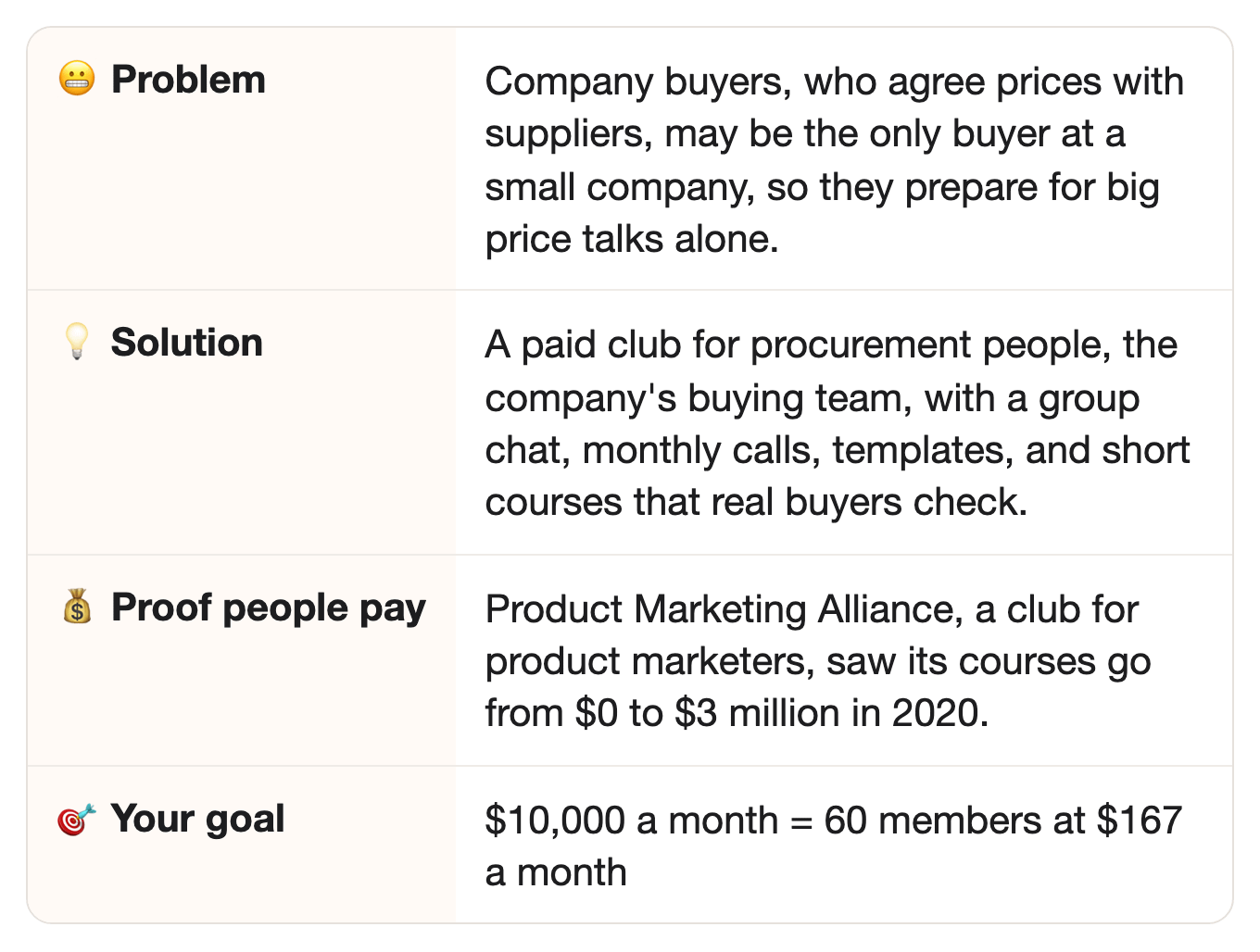
⠀In this idea: procurement people need a club made just for their job too, where they can learn to bargain with suppliers.
⠀Why it carries over: both jobs are learned mostly at work, so people pay to learn from others who do the same work.
⠀
💡 The opportunity
Procurement people need a club made just for their job, too, and they learn the hardest part of it in a few months.
First, who are procurement people?
They’re the buyers inside a company.
They pick suppliers, negotiate contracts, and check the quality of what the company buys.
Their job titles? Buyer, purchasing agent, and purchasing manager.
⠀
There are a lot of them.
There were about 605,600 of these jobs in the US in 2024.
That’s more than half a million.
⠀
And new ones start every year. 🔁
About 58,700 job openings are expected each year, on average, over the decade (a government projection).
⠀
Here’s the gap: most of the job is learned at work.
The government’s job guide says buyers typically get on-the-job training for a few months.
That’s where they learn the basics, including how to negotiate with suppliers.
Yep, a few months, bargaining included.
⠀
So a new buyer can face a big price talk after just a few months of training.
Meanwhile, the supplier’s salesperson may have done it for years.
And at a small company?
The buyer may be the only person who does this job.
Yikes.
⠀
👉 The idea: a paid club for one kind of procurement person, with a group chat, monthly calls, templates, and short skill courses.
⠀
🙋 Never worked in procurement? You can still build this.
Let buyers teach you.
Good news: buyers already write about their hardest supplier talks in LinkedIn posts and comments.
Your AI reads those posts and tells you what they wish someone had told them.
⠀
Team up with one.
An experienced buyer brings the know-how, leads the monthly calls, and checks every course.
You build the club, write with AI, and find the members.
⠀
Or use your own field.
Is your job learned at work, and often done alone at a company?
Then it works the same way.
⠀
✅ Why this could work
Three reasons there’s real money here.
The same model now runs for other jobs.
PMA’s own site links to its sister “Alliance” groups, for jobs like finance and revenue (the teams that bring in a company’s sales).
Together they hold job communities for sales enablement, customer success, and more, and none is for procurement.
Sales enablement people train a company’s salespeople, and customer success people help customers after they buy.
Notice who’s missing?
Buyers.
⠀
Sales leaders pay for a club like this too.
Pavilion, first called Revenue Collective, is a paid club for sales and marketing leaders.
In January 2021, it was “quickly approaching 4,000” members.
Then in June 2021, it took the new name Pavilion.
⠀
Product marketers have paid for this since 2020, and PMA still sells it.
Yep, PMA was still selling its memberships and courses in November 2025.
⠀
👉 Curious where these numbers come from? Every source is linked in the last section, “📎 The sources.”
⠀
📊 More proof people want this
Want more? Here you go.
Members pay real money for one job’s club.
PMA’s Pro+ membership, at its top price, costs $167 a month, billed yearly.
And one of its courses, on its own?
$1,299.
⠀
Procurement people already gather online.
Procurement Foundry is a private community for procurement and supply chain people.
Supply chain people handle what happens after the buying, like stock and shipping.
It sells “courses, and memberships,” next to its chat forum.
⠀
Some buyers work alone, and they look for each other.
Procurement Foundry has a group called “Lone Wolf,” for people who are the only procurement person at their company.
Love that name.
But it’s a side group inside a community for all of procurement and supply chain.
⠀
The money in this job is real. 💰
The median buyer, the one right in the middle of the pay range, earned $79,830 a year (May 2024).
So a club at $167 a month costs less than 3% of that pay.
And it’s training for work, so a buyer can ask their company to pay for it.
⠀
Some already study for a certificate.
The government’s job guide says some buyers choose to earn an optional certificate in procurement.
Nice, but a certificate proves you know the field, and it doesn’t give you people to ask.
⠀
👉 Buyers learn the hardest part of their job in a few months, often alone.
Other jobs already pay for a club that fixes that.
⠀
🔍 Who’s already doing it
Big names exist. None is built for one kind of buyer.
Procurement Foundry is for all of procurement and supply chain at once.
It has smaller groups inside, like “Lone Wolf” and “Women in Procurement.”
But its home page, when we checked, spoke to all procurement and supply chain people, not one kind of buyer.
⠀
PMA’s Alliances don’t cover buyers.
Its six sister groups are for other office jobs, like finance and revenue.
⠀
Certificates teach procurement in general, not how to handle their next price talk with a supplier.
A certificate ends with a test.
And then?
It doesn’t come with a group of buyers who buy the same things you do.
⠀
Still missing when we checked:
A whole club built for one kind of buyer, not a side group inside a community for everyone.
Short courses on one skill at a time, like a first price talk with a supplier, with AI prep sheets members can reuse.
A prep sheet is a fill-in form a buyer pastes into their AI before a price talk.
⠀
🔎 Check the market yourself in 2 minutes: run Part 0 of the prompt at the bottom of this issue.
Your AI searches for procurement communities, courses, and groups that day, and tells you: early, growing, or crowded.
Early? Start now.
Crowded? Good news: it means buyers pay. Pick one narrower kind of buyer (Step 1, further down).
A crowded market is still OK. You win by serving one kind of buyer better, not by being first.
⠀
👉 That gap is your chance.
When we checked, nobody had built a whole club for one kind of buyer, with courses on the skill they need next.
⠀
🤖 Why AI won’t replace it
Could ChatGPT just do this? Sort of… AI can plan a supplier talk well, if the buyer feeds it the right facts.
🔮 Honest note: AI can already draft a request for quotes and a negotiation plan.
A request for quotes is the note a buyer sends to several suppliers, asking each one for a price.
So a template on its own isn’t the product.
The product is the club: the other buyers, the courses, and the prep sheets that tell the AI what to look at.
⠀
1. Real buyers to ask.A buyer can ask, “Has anyone bought this before? What did you argue against?”
Other members answer from their own work, without sharing anything secret.
⠀
2. You choose what’s right for them.A new buyer doesn’t know which skill to learn first.
So your courses go in order: first the request for quotes, then the price talk, then the contract check.
⠀
3. Ready to use.Sure, ChatGPT can prep a price talk, if a buyer sits down and explains the part, the supplier, and the goal.
That takes time a busy buyer often doesn’t have.
A prep sheet from your club asks those questions in the right order, so the buyer fills it in and runs it.
⠀
4. Proof people pay for a ready-made club for their job: PMA’s courses went from $0 to $3 million in 2020.Members paid even though free tips about their job were everywhere online.
And remember, it all started as a free Slack group.
⠀
👉 Busy buyers won’t stop to find each other or write a prep sheet, so your club has both ready.
⠀
💵 How much you can make
Here’s the math. 🧮
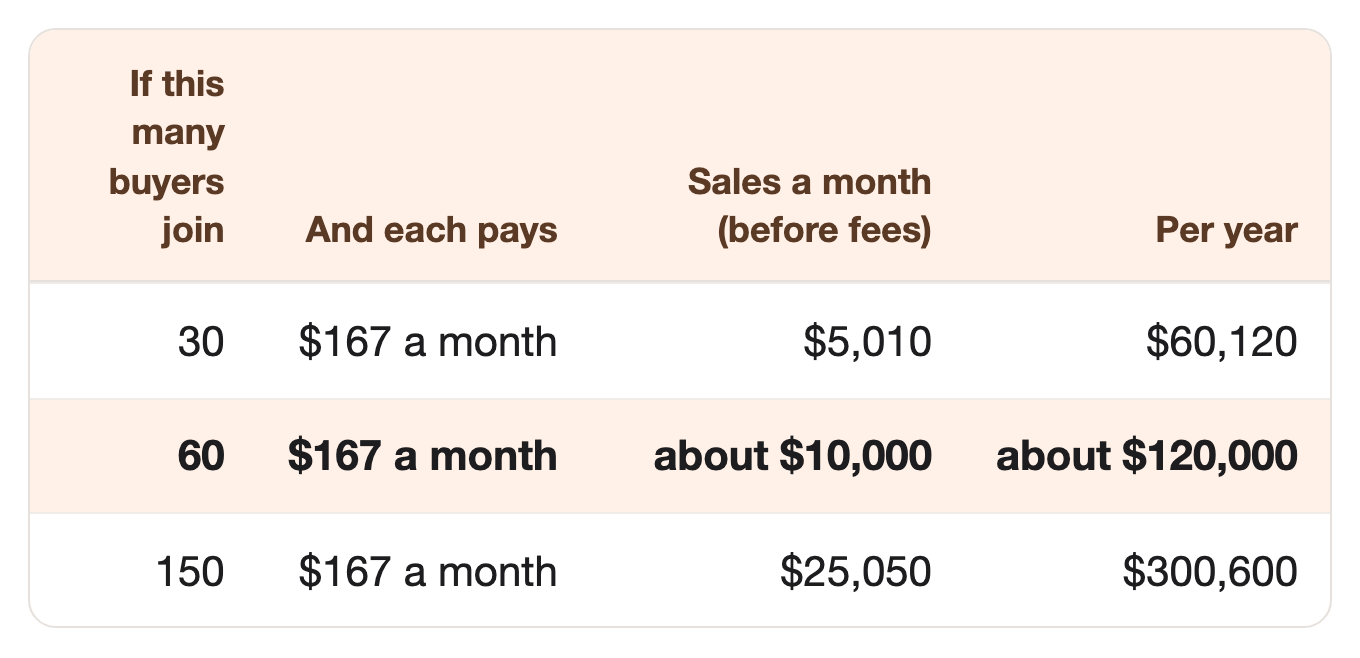
At $167 a month, PMA’s top Pro+ price, 60 members bring in about $10,000 a month.
⠀60 members is about 0.1% of the job openings for buyers in a single year.
That’s about one member for every thousand openings.
⠀
If it doesn’t work out, here’s all you lose:
Nothing for the group chat, if you start on a free plan.
One month’s subscription to an AI app, like ChatGPT or Claude.
One week of your time.
⠀
👉 Earning a million dollars usually takes a few good ideas, not one lucky one.
This club could be your first idea, and a second club for another kind of buyer could be your next.
Got that “I could do this” feeling?
Good. The full plan starts right below. 👇
If not, that’s fine. See you next week.
That’s it, my fellow contrarians! 🙌
Yours ‘handing you ideas with the proof attached’ Vijay Peduru 🦸♂️
⠀
⠀
⠀
🧰 Want to build it? Here’s everything else.
⠀
Step 1: 🎯 Pick one kind of buyer
“Procurement people” is too wide. Pick one group that buys the same kinds of things.
Pick one group, not all of procurement.
The only buyer at a small factory.
Buyers at restaurants or hotel groups, who buy food and supplies every week.
Purchasing staff at cities, schools, or other public offices, who follow strict bidding rules: they must let several suppliers compete, because they spend public money.
New buyers in their first year, in any industry.
One group is plenty to start.
Learn their hard moments, the parts of the job they dread most.
Buyers already write about their hardest supplier talks in LinkedIn posts and comments.
Your AI reads them and turns them into a list of hard moments (Part 1 of the prompt).
⠀
Step 2: 🛠️ Build the club
A club is a group chat, a monthly call, and a set of templates.
Open the group chat. Use a free plan to start.
Remember, Richard started PMA as a free Slack group.
Make 10 templates. Part 3 of the prompt writes all ten.
A request for quotes (the note you send suppliers to ask for prices).
A supplier scorecard, to compare offers side by side.
A prep sheet for a price talk, which a buyer fills in and pastes into their AI.
Plan three months of monthly calls. Each call takes one hard moment from Step 1.
Set the house rules. No secret prices, no supplier names, and no contract terms a member signed to keep private.
⠀
Step 3: 🎓 Make the first short course
One skill, five short lessons, one finished prep sheet at the end.
Pick the skill members dread most, like “your first price talk with a supplier.”
Your AI plans and writes it in Parts 4 and 5 of the prompt, then checks it in Part 6.
The AI rules check looks for promised savings, legal advice, and anything that asks for secret information.
The AI reviewer reads it like a veteran buyer, then like a confused new buyer.
Then a real buyer reads it. Your partner from the 🙋 section, or one buyer you pay once.
AI drafts, a human checks. That’s the deal.
⠀
Step 4: 🏪 Open for members
Copy PMA: one membership, with courses inside it.
Set your prices.
$167 a month, billed yearly, like PMA’s top plan, Pro+.
A team price, for companies that pay for every buyer on their team at once.
Later, sell each course on its own too, once you have three.
Pick where to run it. A community app that takes payments, or a group chat plus a simple checkout page.
Let AI write your sales page, using one real template and one lesson as examples.
⠀
Step 5: 📣 Get your first members
Go where buyers already read about their job.
Leave one useful comment early under the biggest procurement posts on LinkedIn.
Turn on alerts for the five biggest procurement accounts, and comment within ten minutes of each post.
Answer the way a good buyer would, like how to say no to a price rise.
Start a 20-person founding group before launch.
Invite the buyers who replied to your LinkedIn comments into a free group chat, until you have 20.
Then invite likely members in slowly, a few each week.
Write honest comparison pages.
For example: “A procurement certificate or a peer club: which helps a new buyer more?”
Say plainly when the certificate is the better pick.
Honesty is the whole point of the page.
⠀
Step 6: 🏃 Eliminate competitors
Copycats will come. Here’s how you stay first.
Compete on getting each member ready for their next supplier talk, not on having the most courses.
Big communities win by having the most members. You win by getting each member ready for their next hard moment, like a first price talk.
Every course ends with a prep sheet a member can use that week.
Name every course and call with words members sent you.
For example: “My first price talk is Thursday.”
A copycat can copy your topics, but not your members’ own words.
⠀
Step 7: 🎲 Make it bigger
Every kind of buyer learns the job the same way: a few months of training at work, with new buyers starting every year.
Open a second club for another kind of buyer from Step 1.
Sell your courses on their own, to buyers who don’t want a membership.
Three clubs at about $10,000 a month each is about $360,000 a year, before fees. 🎯
⠀
🗓️ Your first week
Phew. That was a lot. 😅
A first version of Steps 1 to 5 fits into seven days. 🚀
By day 7, you have a club plan, 10 templates, a first course, a sales page, and a founding group.
Quick heads-up: the prompt below has eight Parts, and they’re not the same as the Steps above.
Day 1 (Step 1): Run Part 0 of the prompt (it’s below), and pick your kind of buyer.
Then have Part 1 turn buyers’ own posts into a list of hard moments.
Day 2 (Step 2): Plan the club with Part 2, and write your templates with Part 3.
Days 3–4 (Step 3): Plan the course with Part 4, write the lessons with Part 5, and check them with Part 6.
Day 5 (Step 4): Write your sales page with Part 7.
Days 6–7 (Step 5): Write your LinkedIn comments, founding-group invite, and comparison page with Part 8, and open the founding group.
⠀
🏄 How to use the prompt
One prompt does all the AI work, in eight parts, plus a quick market check (Part 0).
Part 1 — Map the hard moments. Turns buyers’ own posts into a list of moments new buyers dread.
Part 2 — Plan the club. Plans the chat channels, three months of calls, the house rules, and a welcome message.
Part 3 — Write the templates. Writes 10 fill-in-the-blank templates, including the prep sheet.
Part 4 — Plan the course. Plans one short course of five lessons, on one skill.
Part 5 — Write the lessons. Writes each lesson, with one exercise at the end.
Part 6 — Check it. Checks the course and templates against the rules, then reads them like a veteran buyer and a confused new one.
Part 7 — Write the sales page. Uses your real templates and lessons as examples.
Part 8 — Write the first-member posts. Writes LinkedIn comments for posts you paste, the founding-group invite, and a comparison page.
Run it your way:
Part by part (the default): it pauses after each part, and you type “next” to go on.
All at once: say “run all eight parts.”
Just one part: say “only do Part 3,” or any part you need.
The full prompt is just below, under “📋 The prompt.”
🎙️ Talk to your AI sidekick, don’t type.
Turn on voice mode, or use a dictation app like Wispr Flow.
Say it messy. The AI sorts it out.
Turn it into a skill, so you never paste it again.
Paste the prompt into Claude or ChatGPT, and say: “Turn this into a skill I can save.”
Install once, use forever.
⠀
📋 The prompt
The prompt (copy it into Claude or ChatGPT, fill in the INPUTS part, and run it your way)
CONTEXT:
- You're my business partner. Together we'll build a paid online club, with templates and short courses, for one kind of procurement person (the group I name below).
- This prompt has eight parts, plus Part 0, in order.
- Run it the way I ask:
    - If I say nothing, go one part at a time. After each part, show me the result, then stop and wait. Move on only when I type "next."
    - If I say "run all eight parts," do them all without stopping.
    - If I say "only do Part 3" (or any part), do just that part.
- If a part needs something from me, ask for it before you start that part.
- Follow these rules in every part:
    1. Never promise savings, a lower price, or a better deal. Teach how to prepare, not what will happen.
    2. Never ask members to share secret prices, supplier names, or contract terms they agreed to keep private. Examples use made-up suppliers, marked "example."
    3. Never give legal advice about contracts. Say: "Check contract terms with your company's legal team."
    4. For public-sector buyers: never tell them to skip a bidding rule. Say: "Follow your own purchasing rules."
    5. Never write a review or testimonial. Only real members can give one.
- Never invent a fact or a number. If you're not sure a fact is right, leave it out.
- Keep web search on for the whole prompt (turn on search in ChatGPT or Claude), so you can open any page you need to check.

=============== INPUTS — edit these, or just run as is ===============

Who the club is for:
{e.g. the only buyer at a small factory, in the US}

What they buy most:
{e.g. metal parts, packaging, and shipping}

Their hard moments (paste buyers' LinkedIn posts about their hardest supplier talks, or leave blank):
{e.g. "My first price talk with a big supplier," "A supplier raised prices with almost no notice"}

The first course's skill:
{e.g. your first price talk with a supplier}

My prices:
{e.g. $167 a month billed yearly, plus a team price}

======================== END OF INPUTS ========================

THE PARTS:

Part 0 — Check the market today.
This part needs web search (turn on search in ChatGPT or Claude). Search for clubs, courses, and groups for my kind of buyer and, for each kind, give the count, the three biggest with links, and their prices:
1. Paid online communities and memberships for procurement and purchasing people.
2. Online procurement courses and certificates.
3. Free LinkedIn groups, Slack groups, and associations for buyers.
4. The biggest newsletters, podcasts, and LinkedIn accounts for buyers.
Then tell me: early (few sellers), growing, or crowded, and which kind of buyer looks least served (for example: the only buyer at a small company, public-sector buyers, new buyers). Give a link for every number. If you can't open a page, say so. Never guess a number.

Part 1 — Map the hard moments.
Use any buyers' posts I pasted in INPUTS, and search the web for posts and articles where buyers describe their hardest moments. List the 15 moments my kind of buyer dreads most, in the order they usually happen in a buyer's first year. For each, give one line on what goes wrong, and one line on what a prepared buyer does. Say clearly which moments come from real posts and which are your guess.

Part 2 — Plan the club.
Plan the club from the moments in Part 1:
1. Five to seven chat channels, each with a one-line purpose.
2. Three monthly calls, each built on one hard moment, with a title and three questions to discuss.
3. House rules, written in plain words, that follow rules 1 to 3 in CONTEXT.
4. A welcome message for new members, under 120 words.

Part 3 — Write the templates.
Write 10 fill-in-the-blank templates for my kind of buyer. Include:
1. A request for quotes (the note a buyer sends suppliers to ask for prices).
2. A supplier scorecard to compare offers side by side.
3. A prep sheet for a price talk. It asks the buyer, in order: what they're buying, how much, the supplier's offer, their goal, their walk-away point, and what they can give in return. It ends with a short prompt the buyer pastes into their own AI with the filled-in sheet.
Then seven more, picked from the moments in Part 1. Use made-up suppliers and numbers, marked "example."

Part 4 — Plan the course.
Plan one short course on the skill in my INPUTS: five lessons, each under 15 minutes to read. For each lesson give the title, the one thing the buyer will be able to do after it, and which template from Part 3 it uses.

Part 5 — Write the lessons.
Write each lesson from Part 4, for a buyer in their first year:
1. A short story of the moment, with made-up names.
2. The steps, in plain words, as a numbered list.
3. One exercise that uses a template from Part 3.
Keep each lesson under 800 words, and follow every rule in CONTEXT.

Part 6 — Check it.
Now act as a separate checker who didn't write the course. First, check every lesson and template against each rule in CONTEXT, one by one. Quote any risky words and say which rule they break. Then read it as a veteran buyer with many years in the job, and flag anything wrong or naive. Then read it as a confused new buyer, and flag any word or step that would lose them. Give the fixed versions.

Part 7 — Write the sales page.
Ask me for one finished template and one finished lesson first. Use them as examples. Never invent a result, a review, or a number. Give me:
1. A headline that names my kind of buyer, not "procurement professionals."
2. What members get: the chat, the monthly calls, the templates, and the courses.
3. The house rules, so buyers know nothing secret is shared.
4. The prices, shown up front, and how to cancel.
5. A free template in exchange for an email address.

Part 8 — Write the first-member posts.
1. Ask me to paste up to five recent posts from big procurement accounts on LinkedIn. Write one useful comment for each, under 80 words, that teaches one thing a buyer can use this week. No links and no pitch.
2. Write a short invite to my 20-person founding group: a free group chat for my kind of buyer before the club opens, with the house rules from Part 2.
3. Draft an honest comparison page: "A procurement certificate or a peer club: which helps a new buyer more?" Say plainly when a certificate is the better pick. Never invent a price or a fact about a certificate; search for it and link it, or leave it out.
⠀
📎 The sources
Every number above, with where it came from.
PMA’s growth · Number: “Our courses went from $0 to $3million. Our membership plans went from $0 to $1M ARR” (”Last year,” in a release dated October 21, 2021); “40,000+ members”; “in just 32 months, we’ve unleashed nine accredited courses”; founded February 2019 · Source: Product Marketing Alliance press release, October 21, 2021
How PMA started · Number: “there was very little out there dedicated to the PMM”; “five different places”; Slack community started March 2019; business from August 2019; the t-shirts given away free when the checkout device didn’t arrive; ambassador program worked, Facebook and LinkedIn ads didn’t; “10,000+ members” · Source: PMA Q&A with Richard King, September 16, 2020
PMA prices · Number: Pro+ Membership “$167 /month (billed annually)” (Exec+ shows the same price; Insider and Pro sit below); individual certification “$1,299 One off payment” · Source: PMA course page, Wayback copy, November 9, 2025
PMA’s sister groups · Number: Site menu, under “The Alliance”: Marketing, Revenue, Product, Customer, Finance, and Technology Alliance · Source: PMA site, Wayback copy, March 19, 2025
The Alliance’s communities · Number: “The Alliance is the meeting place for thirty functional executive communities”; listed: Product Marketing Alliance, Sales Enablement Collective, Customer Success Collective, Finance Alliance, and others; none for procurement · Source: The Alliance home page, Wayback copy, June 12, 2025
Pavilion in 2021 · Number: “As we quickly approach 4,000 Revenue Collective members”; a private membership for sales, marketing, and revenue leaders · Source: PR Newswire, January 19, 2021
Pavilion’s new name · Number: “Introducing...Pavilion! Here’s what’s next for Revenue Collective”; “Revenue Collective’s rebrand to Pavilion” · Source: Pavilion blog, June 21, 2021
Procurement Foundry · Number: “a private community”; “Our community, courses, and memberships”; “Lone Wolf” group for solo procurement professionals; “Women in Procurement” group · Source: Procurement Foundry home page, Wayback copy, May 18, 2026
Procurement jobs · Number: 605,600 jobs in 2024; about 58,700 openings projected each year, on average, over the decade; median pay $79,830 (May 2024); “on-the-job training for a few months,” including “negotiating with suppliers”; “optional certification”; they “evaluate suppliers, negotiate contracts, and review the quality of products” · Source: US Bureau of Labor Statistics, Wayback copy, July 4, 2026