

Hello contrarians,
Today’s idea is called The Step-by-Step Drawing Club.
Grab a coffee. ☕
First, a programmer’s story. Then, the business you could build from it.
⠀
⚡ Quick facts
⠀
📖 How a programmer who “had no chance” built a drawing school
It started with a programmer who couldn’t picture things in his head.
Irshad Karim was a game programmer.
And he has aphantasia.
That means he can’t see pictures in his mind’s eye.
So he assumed he had no chance at art.
⠀
He quit his programming job anyway, which was a big leap.
Then he moved across North America to study drawing and design at an art school in Pasadena, California.
⠀
And what he learned there changed how he saw drawing.
He decided drawing, design, and even creativity are skills anyone can build.
⠀
In August 2014, he started sharing what he learned online.
In 2015, he turned his messy handwritten notes into proper lessons.
And that’s how Drawabox.com was born.
⠀
Here’s the twist: the lessons were free, and they stayed free.
So what do students pay for?
One thing: feedback on their homework, from him and his trained teaching assistants.
The most popular plans are $5 and $9.50 a month, at US prices.
⠀
Guess what: by August 2020, he was working on Drawabox full time.
And when we checked, 2,908 people were paying Drawabox every month on Patreon.
Patreon is a fan-funding site, where fans pay creators every month.
We added up the public member count on each plan, at its price in Canadian dollars, the campaign’s currency.
That’s about $14,000 a month in US dollars, before fees.
Great Scott! ⚡
He went from thinking he had no chance at art… to about $14,000 a month, by giving lessons away and charging for homework feedback.
⠀
🔗 Same idea, new group
In the story: people learning to draw paid Irshad every month for feedback on their homework, while the lessons stayed free.
⠀In this idea: engineers and analysts who “can’t draw” want drawing taught as rules and steps, one lesson a week.
⠀Why it carries over: both groups learn from clear steps and practice, and Irshad, a programmer himself, decided drawing is a skill anyone can build.
⠀
💡 The opportunity
Lots of adults want to draw. The analytical ones want a system, not “just loosen up.”
First, who are the buyers?
Engineers, data analysts, accountants, and product managers.
People who work with numbers, rules, and steps.
And many of them decided as kids that they “can’t draw.”
Like an engineer who draws a wobbly box at a whiteboard, laughs, and says, “I can’t draw.”
⠀
But drawing has rules they’d love.
Take perspective: it’s geometry, where parallel lines meet at one point.
Proko is a drawing-lesson channel on YouTube.
Guess what its most-watched video is about?
Drawing a box in perspective.
Yes, a box.
It has more than 17 million views.
Another Proko video teaches Andrew Loomis’s method for drawing a head from any angle.
⠀
Here’s the best part: they need it at work too.
Think whiteboard diagrams in meetings.
Or sketchnotes: notes with simple drawings, so ideas are easier to remember.
And The Back of the Napkin, a book about solving business problems with simple pictures, has 735 ratings on Amazon.
⠀
Every January, a new crowd shows up.
“Learn to draw” got about 40,500 Google searches in January 2026, against 4,400 in June 2026 (Ubersuggest estimates, US).
Same search, very different month.
Ubersuggest is a tool that estimates Google searches.
⠀
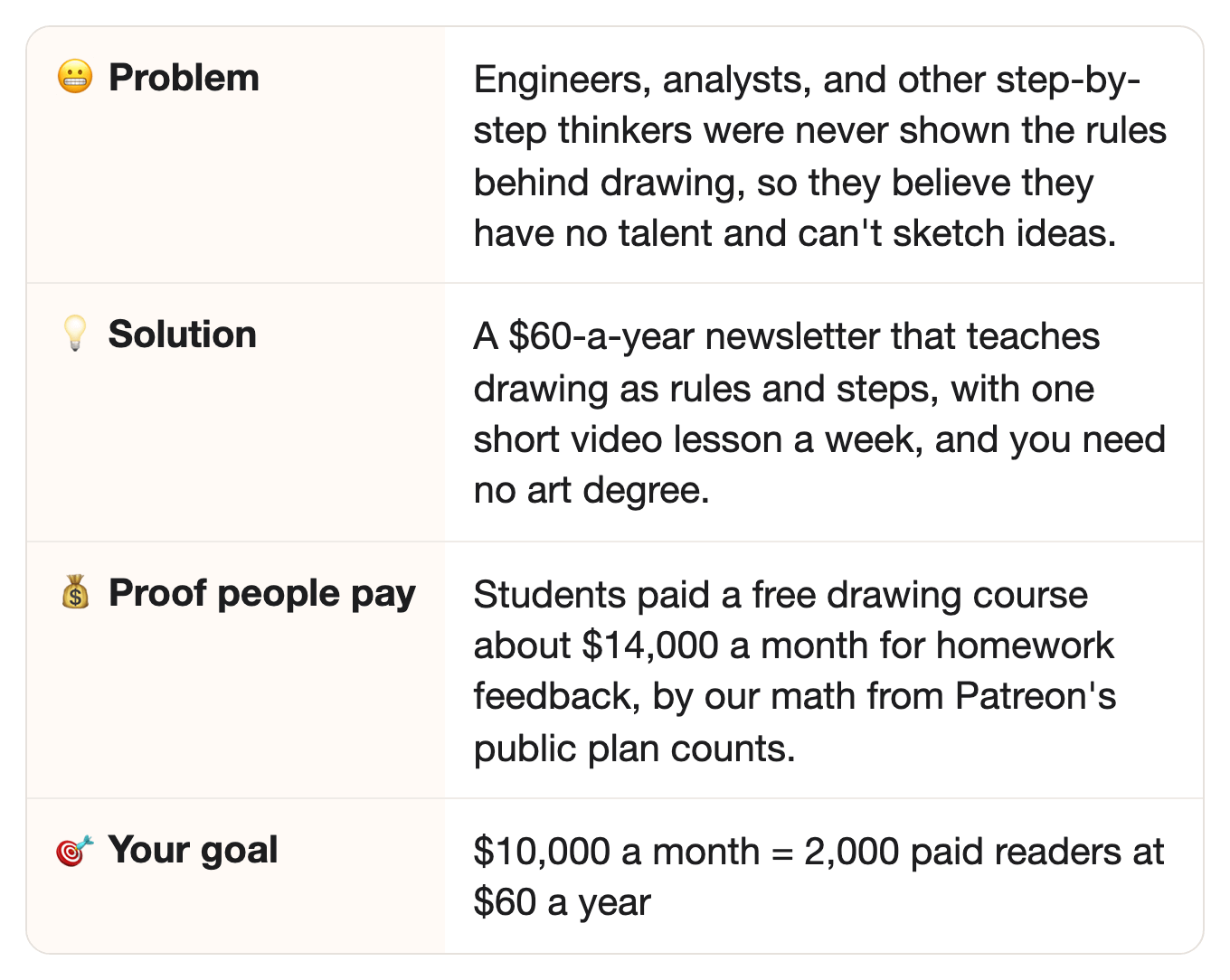
👉 The idea: a paid weekly drawing newsletter for analytical adults, with one short video lesson and one assignment each week.
⠀
🧩 What you actually need
Spoiler: no art degree on this list.
The will to learn in public.
Irshad started as a beginner too.
So share each week’s drawings, wobbly lines included.
⠀
A step-by-step plan.
Put the lessons in a simple order: lines, then boxes, then whole objects.
⠀
AI to plan the lessons.
It turns each lesson into short, clear steps.
That’s the whole list.
⠀
✅ Why this could work
Three signs the money is real.
Others already earn from step-by-step drawing lessons.
Drawabox, from the story above, also earns from ads, pens, and course links.
Then there’s DrawTogether with WendyMac, an illustrator’s drawing newsletter.
It shows “thousands of paid subscribers” at $10 a month or $60 a year.
Wait, what does “thousands” mean here?
Substack, the newsletter platform, shows a badge that says “thousands,” so at least 1,000 paying, or at least $60,000 a year.
Introvert Drawing Club, $5 a month, shows “hundreds of paid subscribers” (at least 100).
And Sketch Away with Suhita Shirodkar, sketching lessons at $60 a year, also shows “hundreds of paid subscribers.”
⠀
People have bought drawing books since at least 1979, and they still do.
Drawing on the Right Side of the Brain came out in 1979, and is in its 4th edition.
Its publisher says it has sold over 4 million copies worldwide.
Not bad for a book from 1979.
Urban Sketchers, a worldwide drawing community, began on Flickr in 2007, and became a nonprofit in 2009.
⠀
The searches are already there.
The numbers come next, right below.
⠀
👉 Don’t take my word for it. Every number is linked in “📎 The sources,” at the very end.
⠀
📊 More proof people want this
Want more? Here you go.
People already pay for drawing books (Amazon, when we checked).
You Can Draw in 30 Days has 7,654 ratings, at $10.48.
Drawing on the Right Side of the Brain has 4,428 ratings, at $12.58.
And its workbook has 1,437 ratings, at $19.56.
The Sketchnote Handbook, a book on drawing your notes, has 773 ratings.
⠀
Millions follow drawing lessons on YouTube.
Proko, the drawing-lesson channel, has about 4.42 million subscribers.
Cartooning Club How to Draw, another drawing-lesson channel, has about 5.24 million.
⠀
People search Google for it.
“learn to draw” gets about 14,800 searches a month in the US (Ubersuggest estimates).
And “sketchnotes” gets about 2,900.
⠀
The big picture. 🎨
10.7% of US adults made visual art in 2022, in the government’s arts survey.
That means things like paintings, graphic design, or digital art.
And 2.6% of US adults took classes or lessons in visual arts in 2022.
⠀
What an engineering student says.
“I’m an engineering student and very much not artistic.”
The comment goes on: “Learning how to do basic 2 point perspective drawing is a lifesaver.”
It sits under Proko’s box video.
That’s your reader, right there.
⠀
What a stick-figure beginner says.
“i’ve only ever drawn stick figures and in 5 minutes I have instantly drawn the best thing ive ever made”
It sits under Proko’s video on drawing heads.
Love that one.
⠀
👉 Analytical people don’t lack talent. They lack lessons that fit how they think.
⠀
🔍 Who’s already doing it
Who’s in the space, and what they skip.
DrawTogether is a paid drawing newsletter, built around a bestselling illustrator.
It’s playful and loose: its Sunday lessons mix art history, visiting artists, and field trips.
So it’s more about joy and attention than rules.
⠀
Drawabox, the drawing school from the story above, is step by step.
Its free lessons come with homework and critiques, which are comments on your drawings.
It teaches the basics Irshad learned at art school.
But its paid part is feedback, not a weekly newsletter.
⠀
Proko, a big drawing-lesson channel on YouTube, teaches serious artists.
Its courses cover anatomy, figure drawing, and perspective, some more than 70 hours long.
That’s a lot of hours for someone who “can’t draw.”
⠀
What nobody was selling, when we checked:
A weekly paid lesson built for engineers and analysts.
Drawing taught as a system: one rule a week, measured practice, and progress you can track.
Drawing for work too: whiteboard diagrams and sketchnotes (notes made of quick drawings).
⠀
🔎 Check the market yourself in 2 minutes: run Part 0 of the prompt in the build plan below.
Your AI searches Substack, Patreon (where fans pay creators monthly), YouTube, and Amazon that day.
Then it tells you: early, growing, or crowded.
Early? Start now.
Crowded? Good news: it means people pay. Pick one narrower group of learners (Step 1 of the build plan).
A crowded market is still OK. You win by serving one group better, not by being first.
⠀
👉 That missing part can be your business: a weekly paid drawing lesson for engineers and analysts, taught one rule at a time.
⠀
🤖 Why AI won’t replace it
AI can make a picture. It can’t do the drawing practice for your reader.
🔮 Honest note: AI image tools can already make a drawing in seconds, and AI can comment on a photo of a sketch.
So pictures and tips aren’t the product.
The product is the practice: a weekly assignment, other members, and a teacher who shows their own learning.
⠀
1. The skill lives in their hand.Watching AI draw is like watching someone else lift weights.
Their hand gets better only by drawing, week after week.
⠀
2. A path in the right order.Sure, ChatGPT can plan lessons in order if someone asks.
But most people ask for tips… and get tips.
You give lesson 1 before lesson 2, so each week builds on the last.
⠀
3. A teacher one step ahead.You post your own drawings, wobbly lines included.
That shows them it’s possible, in a way a perfect AI picture can’t.
⠀
4. Other people, and a deadline.Members share their assignments with each other, like DrawTogether’s members do in a group chat.
And a new assignment every week keeps them drawing.
⠀
5. Proof people pay for the practice: Drawabox’s lessons are free online.But 2,908 people still paid Drawabox every month on Patreon, mostly for homework feedback.
⠀
👉 Free tips are everywhere, but a weekly practice that keeps them drawing is hard to find.
⠀
💵 How much you can make
Quick math time. 🧮
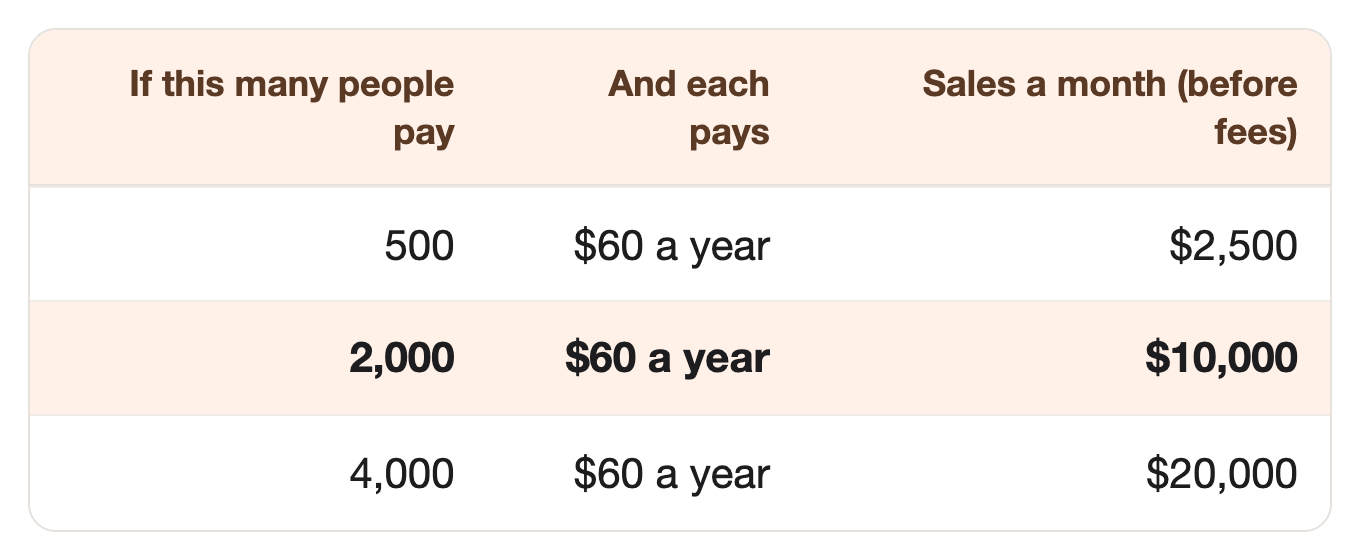
$60 a year is DrawTogether’s yearly price.
So it’s a real price, not a guess.
⠀
2,000 paid readers sits between DrawTogether (at least 1,000) and Drawabox (2,908 paying on Patreon).
⠀If it doesn’t work out, here’s all you lose:
Nothing for the newsletter: Substack is free to start.
A sketchbook and a pen.
One month’s subscription to an AI app, like ChatGPT or Claude.
One week of your time.
⠀
👉 This is idea one, and with ideas two, three, and four, you could reach a million in 2 to 3 years.
This drawing club could be that first idea, and the ones after it can add to your yearly income.
Can you picture yourself running this?
Scroll down. Everything you need to start is waiting. 👇
Not for you? No problem. Next week’s idea might be.
That’s it, my fellow contrarians! 🙌
Yours ‘hoping one of these sparks an idea of your own’ Vijay Peduru 🦸♂️
⠀
⠀
⠀
🧰 Want to build it? Here’s everything else.
AI plans the lessons. You draw them, wobbly lines included. ✏️
⠀
Step 1: 🧭 Pick your learner and your path
Start with one kind of learner, and one 12-week path.
Good news: you don’t need an art degree for this step.
You just need to know who you’re teaching.
Pick one group.
For example: engineers who want to sketch on their trips.
Or analysts who want to draw clear diagrams in meetings.
Plan 12 weeks, from easiest to hardest.
For example: lines, then boxes, then perspective, then shading, then everyday objects.
One rule a week, and one assignment that practices it.
Let AI draft the path. You change the order until it feels right to you.
⠀
Step 2: ✏️ Make each lesson
One rule, one short video, one assignment.
Your AI writes the lesson.
The rule, in plain words.
A step-by-step exercise.
The week’s assignment, with a way to check your own work.
Film yourself drawing it.
A phone above the paper is enough.
Keep it under five minutes.
Show your own attempt, mistakes included. That’s what makes it believable.
⠀
Step 3: 🔍 Check every lesson
A wrong rule teaches a bad habit, so every lesson goes through three passes.
Your AI does all three passes for you: it writes in Part 2, and checks in Parts 3 and 4 of the prompt.
🖊️ The AI writer. Your AI writes the lesson from well-known drawing methods, and names each one.
🔍 The AI checker. A second pass checks every rule, like where the lines should meet in perspective.
🧐 The AI beginner. A third pass reads it like someone who “can’t draw,” and marks every confusing step.
Optional: pay an art teacher once to review your first 12 lessons.
⠀
👉 The prompt already follows three safety rules: your own lessons, no promises of talent, and members’ drawings shared only with permission.
⠀
Step 4: 🏪 Open your newsletter
Start free, then add a paid tier like DrawTogether’s.
Easy one: copy DrawTogether’s prices.
Start a free Substack newsletter.
Free readers get one lesson a month.
Add a paid tier at $10 a month or $60 a year, like DrawTogether.
Paid readers get every weekly lesson and assignment.
Plus a group chat where members share their drawings.
Let AI write your welcome post and your paid-tier page.
⠀
Step 5: 📣 Get your first readers
Let people watch you learn, and let them bring their friends.
Post a 90-day goal for your own drawing, and share the failed drawings, not just the good ones.
Keep a simple count, like “day 23 of 90,” and post one weekly note on what didn’t work.
Readers who think in steps trust an honest log of misses more than a highlight reel.
Open a waitlist before the paid tier launches, where people move up the line for each friend who joins.
Give each person a link to share, and show them their place in line.
The first 100 in line get the first paid lesson a week early.
At signup, ask “What do you want to draw first?” and send the matching starter lesson.
Offer a few choices, like boxes and buildings, faces, or animals.
Add a skip button that says what they’d miss: “Skip, and get the general lesson instead.”
⠀
Step 6: 🏃 Eliminate competitors
When others copy you, here’s how you stay the one people pick.
Build a ritual: one rule, one drawing, Sunday morning.
Same steps each week: coffee, read the rule, draw for 20 minutes, post it in the group chat.
Once Sunday morning means drawing, readers would have to give up that habit to switch to a new newsletter.
Show “Drawing since [month]” next to each member’s name in the group chat.
Staying starts to feel like a streak worth keeping.
Leaving means starting that count over somewhere else.
⠀
Step 7: 🎲 Make it bigger
Every lesson you make keeps working, and it can grow into more.
Sell a short course, like “Sketchnotes for work” or “Drawing on your trips.”
Add a feedback tier, like Drawabox: members pay more to get comments on their homework.
Run workshops for teams, for a fixed fee. Drawing helps with clear thinking and better meetings.
Each one adds to what the newsletter makes, from the same readers. 🎯
⠀
🗓️ Your first week
Phew. That was a lot. 😅
Steps 1 to 5 fit into seven days. 🚀
By day 7, you have a 12-week path, two lessons, a newsletter, and a waitlist.
The prompt below has six Parts, and they’re not the same as the Steps above.
Day 1 (Step 1): Run Part 1 of the prompt (it’s below), and plan your 12 weeks.
Day 2 (Step 2): Write your first lesson with Part 2.
Day 3 (Step 3): Check it with Parts 3 and 4, then film yourself drawing it.
Day 4 (Steps 2 and 3): Write, check, and film your second lesson.
Day 5 (Step 4): Write your welcome post and paid-tier page with Part 5, and open your newsletter.
Days 6–7 (Step 5): Write your 90-day goal post, waitlist page, and signup question with Part 6, and open the waitlist.
⠀
🏄 How to use the prompt
One prompt does all the AI work, in six parts, plus a quick market check (Part 0).
Part 1 — Plan the path. Names your learner, and plans 12 weeks of lessons, from easiest to hardest.
Part 2 — Write a lesson. One rule, a step-by-step exercise, and the week’s assignment.
Part 3 — Check the rules. Checks every drawing rule and every step, from scratch.
Part 4 — Read it as a beginner. Marks every step someone who “can’t draw” couldn’t follow.
Part 5 — Write the pages. Your welcome post, your paid-tier page, and your About page.
Part 6 — Write the launch pieces. Your 90-day goal post, your waitlist page, and your signup question.
Run it your way:
Part by part (the default): it pauses after each part, and you type “next” to go on.
All at once: say “run all six parts.”
Just one part: say “only do Part 3,” or any part you need.
The full prompt is just below, under “📋 The prompt.”
🎙️ Talk to your AI sidekick, don’t type.
Turn on voice mode, or use a dictation app like Wispr Flow.
Say it messy. The AI sorts it out.
Turn it into a skill, so you never paste it again.
Paste the prompt into Claude or ChatGPT, and say: “Turn this into a skill I can save.”
Install once, use forever.
⠀
📋 The prompt
The prompt (copy it into Claude or ChatGPT, fill in the INPUTS part, and run it your way)
CONTEXT:
- You're my drawing-teacher partner. Together we'll build a paid weekly drawing newsletter that teaches analytical adults to draw, one rule and one assignment a week.
- This prompt has six parts, in order.
- Run it the way I ask:
    - If I say nothing, go one part at a time. After each part, show me the result, then stop and wait. Move on only when I type "next."
    - If I say "run all six parts," do them all without stopping.
    - If I say "only do Part 3" (or any part), do just that part.
- If a part needs something from me, ask for it before you start that part.
- Teach from well-known drawing methods, and name each one (for example, two-point perspective, or the Loomis method for heads). Never copy another teacher's lesson, words, or exercises.
- Never promise talent, results, or a timeline. Never invent a review, a result, or a number.
- Never share or post a member's drawing without their permission.
- If you can't open a link I give you, ask me to attach the file instead.
- Keep web search on for the whole prompt (turn on search in ChatGPT or Claude), so you can open any page you need to check.

=============== INPUTS — edit these, or just run as is ===============

Who the lessons are for:
{e.g. engineers and data analysts who haven't drawn since school, and want to sketch on their trips}

My level, honestly:
{e.g. a beginner, about three months ahead of my readers}

My newsletter name:
{e.g. Drawing by the Rules}

My prices:
{e.g. free newsletter with one lesson a month; paid tier at $10 a month or $60 a year, with every weekly lesson and assignment}

======================== END OF INPUTS ========================

THE PARTS:

Part 0 — Check the market today.
This part needs web search (turn on search in ChatGPT or Claude). Search for paid drawing lessons for adult beginners and, for each place, give the count, the three biggest with links, and their prices:
1. Drawing newsletters on Substack, and which ones have paid tiers.
2. Drawing courses and memberships on Patreon, and their paid member counts if shown.
3. YouTube channels teaching adult beginners to draw.
4. Drawing books for beginners on Amazon, with rating counts.
Then tell me: early (few sellers), growing, or crowded, and which group of learners looks least served (for example: engineers, analysts, adults over 40, people who want to draw for work). Give a link for every number. If you can't open a page, say so. Never guess a number.

Part 1 — Plan the path.
Describe my learner in one clear sentence. Then plan 12 weekly lessons, from easiest to hardest. For each week: the one rule it teaches, the drawing method it comes from, and the assignment. Say which week is likely to be hardest, and why. Say clearly which reasons are your guess.

Part 2 — Write a lesson.
Ask me which week to write first. Then write the lesson, for someone who believes they can't draw:
1. The rule, in one or two plain sentences, and why it works.
2. A warm-up, under five minutes.
3. The exercise, step by step, with numbered steps.
4. The week's assignment, and a short checklist so they can check their own drawing.
5. A note on where I show my own attempt, mistakes included.

Part 3 — Check the rules.
Now act as a separate art teacher who didn't write this lesson. Check every drawing rule and every step, from scratch. Mark each one: correct, wrong, or unclear. For each problem, explain what's actually true, in plain words. Then give a fixed version of the lesson.

Part 4 — Read it as a beginner.
Now act as an engineer who hasn't drawn since school, and is nervous about it. Mark every step you couldn't follow, every word you don't know, and every place you'd give up. Then give the final lesson, with every fix made, in plain words.

Part 5 — Write the pages.
Write:
1. My welcome post: who it's for, what free readers get, and my own story as a learner.
2. My paid-tier page: a weekly lesson and assignment, the group chat, my prices shown up front, and "Cancel any time."
3. My About page, in under 150 words.
Never promise talent or results. Never use another teacher's name to sell mine.

Part 6 — Write the launch pieces.
Write:
1. My 90-day goal post, under 120 words: the goal for my own drawing, how I'll count the days, and a promise to post what didn't work each week.
2. A waitlist page for my paid tier, where people move up the line for each friend who joins. Include a short line they can send a friend.
3. One signup question, "What do you want to draw first?", with three or four choices and the starter lesson I send for each. Add a skip line that says what they'd miss.
Never promise talent or results.

When all six parts are done, ask if I want to repeat Parts 2 to 4 for the next week's lesson.
⠀
📎 The sources
Every number above, with where it came from.
Irshad Karim’s story · Number: Full name from his Proko course page; quit his job as a game programmer; moved to study drawing and design in Pasadena; a person with aphantasia who assumed he’d have no chance in an art-focused field; started sharing lessons in August 2014; Drawabox.com born in 2015; lessons “completely for free”; paid tiers buy homework critiques from him and his teaching assistants; full time on Drawabox since August 2020; also earns from ads, pens, and affiliate and course links · Source: Drawabox on Patreon, About section
Irshad’s move and belief · Number: “quitting my job as a game programmer and moving across North America to study drawing and entertainment design at Concept Design Academy in Pasadena, California”; “drawing, design, and even creativity are all skills that can be developed” · Source: Drawabox on Patreon, About section
Drawabox’s paying members · Number: 2,908 paid members; on Patreon since March 2015 · Source: Patreon, via Patreon’s public campaign data
Drawabox’s monthly total (our math) · Number: The issue uses the CA$ total below, converted to US$ (about US$14,100). Members per plan, at Patreon’s US prices: 205 at $1, 36 at $3, 1,979 at $5, 513 at $9.50, 33 at $14.50, 42 at $19.50 = about $16,379 a month, before fees. These 2,808 are the members we could see by plan, out of 2,908 paid. (The campaign is priced in Canadian dollars: CA$1, 3.50, 6, 12, 18.50, 25; at CA$ prices the total is about CA$20,022, roughly US$14,100 at the July 3, 2026 rate, this issue’s date: CA$1 = US$0.70415, Frankfurter.) · Source: Patreon, public plan counts
DrawTogether with WendyMac · Number: “Thousands of paid subscribers” and “Hundreds of thousands of subscribers” (Substack’s size labels, ranges, not counts); $10 a month or $60 a year; on Substack since February 2021 · Source: DrawTogether and Substack’s public API
WendyMac, DrawTogether’s host · Number: “#1 NYT-Bestelling illustrator” (sic, on the page) · Source: DrawTogether About page
Loomis head method (Proko video) · Number: “In this tutorial I’ll attempt to summarize Andrew Loomis’s approach to drawing the head. It’s a great method for drawing the head from various angles.” · Source: YouTube: Proko, “How to Draw the Head from Any Angle”
DrawTogether’s Sunday lessons · Number: Every Sunday a lesson and an assignment, “integrating art history, visiting artists, skill development, field trips”; members share work in a group chat; 30 Days of Drawing every January · Source: DrawTogether About page
Introvert Drawing Club · Number: “Hundreds of paid subscribers”; “Paid membership is $5 a month” · Source: Introvert Drawing Club and Substack’s public API
Sketch Away with Suhita Shirodkar · Number: “Hundreds of paid subscribers”; $10 a month or $60 a year; “Sketching Tips and Online Sketching Sessions” · Source: Sketch Away and Substack’s public API
Drawing on the Right Side of the Brain · Number: Published in 1979; “4th edition” · Source: Wikipedia: Drawing on the Right Side of the Brain
Its sales · Number: “OVER 4 MILLION COPIES SOLD WORLDWIDE” (the publisher’s claim) · Source: Publisher’s listing on OverDrive
Urban Sketchers · Number: “began on Flickr in 2007”; a nonprofit since December 2009 · Source: Wikipedia: Urban Sketchers
Drawing books · Number: You Can Draw in 30 Days: 7,654 ratings, $10.48 · Source: Amazon search “you can draw in 30 days”
Drawing books · Number: Drawing on the Right Side of the Brain, 4th edition: 4,428 ratings, $12.58; its workbook: 1,437 ratings, $19.56 · Source: Amazon search “drawing on the right side of the brain”
Sketchnotes book · Number: The Sketchnote Handbook: 773 ratings · Source: Amazon search “sketchnote handbook”
Business pictures book · Number: The Back of the Napkin (Expanded Edition): 735 ratings · Source: Amazon search “back of the napkin dan roam”
Proko · Number: About 4.42 million subscribers; most-watched upload “The Impossible Box Perspective,” 17,305,702 views · Source: YouTube Data API, channel @ProkoTV, all uploads sorted by views
Proko’s courses · Number: Anatomy, figure drawing, perspective; “Anatomy of the Human Body” runs 76h 59m, “Drawing Basics” 82h 2m · Source: Proko
Cartooning Club How to Draw · Number: About 5.24 million subscribers · Source: YouTube Data API, channel @cartooningclub
Google searches · Number: “learn to draw” about 14,800 a month (US), 40,500 in January 2026, 4,400 in June 2026; “sketchnotes” about 2,900 a month · Source: Ubersuggest estimates, US
Adults making visual art · Number: 10.7% in 2022 (”other visual art such as paintings, sculpture, graphic designs, or digital art”; the report prints 8.1% for 2020, but the 2020 question did not include digital art, so the rise isn’t printed); 2.6% took classes or lessons in “other visual arts” in 2022 · Source: National Endowment for the Arts, Arts Participation Patterns in 2022, October 2023
Comment: the engineering student · Number: “I’m an engineering student and very much not artistic. Learning how to do basic 2 point perspective drawing is a lifesaver.” · Source: YouTube comment, 2023
Comment: the stick figures (under Proko’s “How to Draw the Head from Any Angle”) · Number: “i’ve only ever drawn stick figures and in 5 minutes I have instantly drawn the best thing ive ever made” · Source: YouTube comment, 2022