


Hello contrarians,
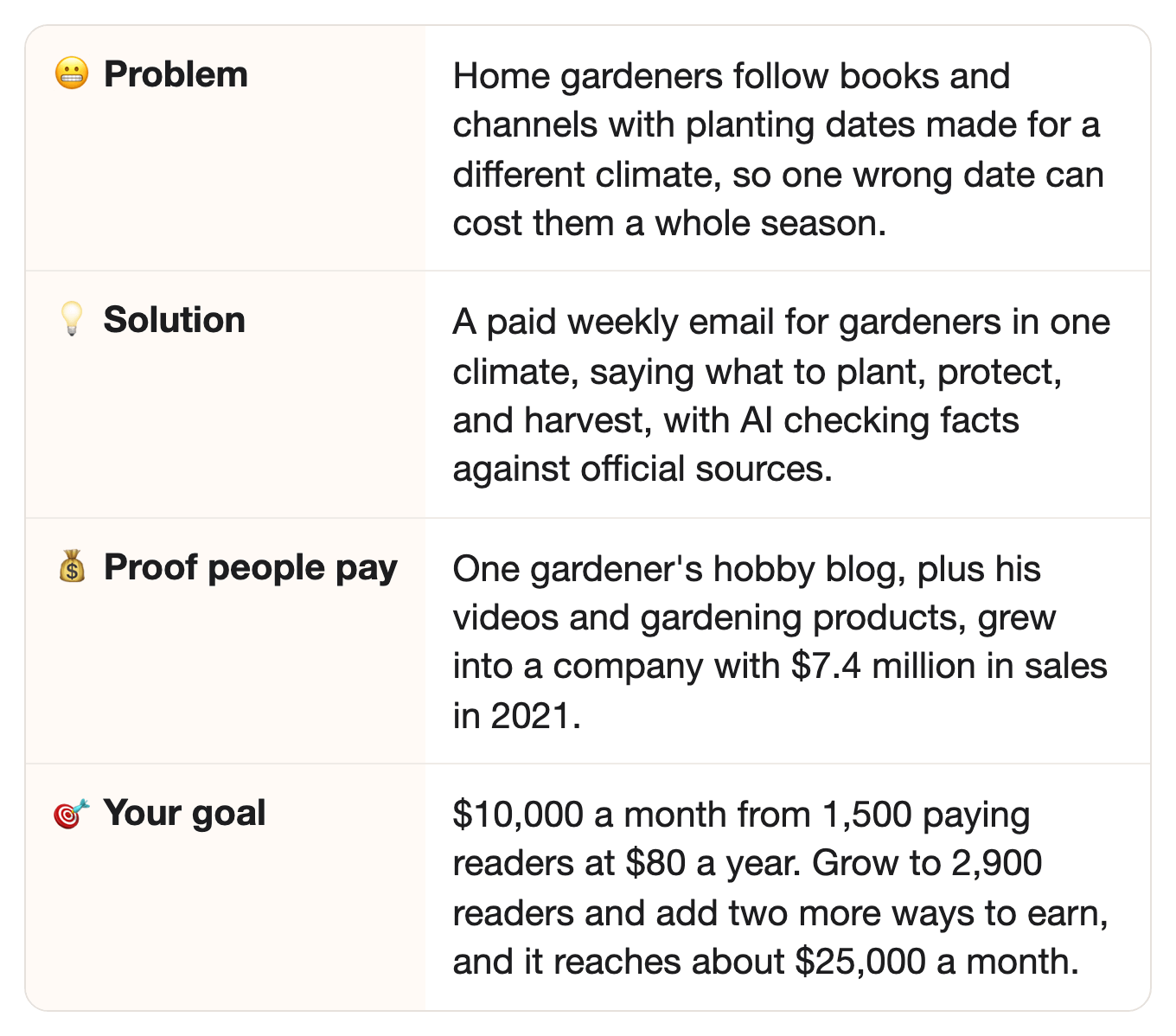
Today’s idea is called The One-Climate Garden Letter.
Pour yourself a tea. 🍵
First, a gardener’s story. Then, the business you could build from it.
⠀
⚡ Quick facts
⠀
📖 How one gardener grew a hobby blog into millions
He didn’t even have a place to grow outdoors.
Kevin Espiritu grew up in San Diego, a skater kid who went on to study accounting.
He and his brother started gardening together.
Partly to get outside, and partly to stop playing video games.
One problem: he had no space to grow outdoors.
So he grew plants in water, with no soil at all.
Around 2013, he started a hobby blog, to share what the two of them learned.
In 2016, he quit his job to run it full time.
That year, the blog made about $17,000.
A nice start, but not millions.
⠀
Then he added videos on YouTube and Instagram, and started selling gardening products.
Here’s the big number: in 2021, the company did $7.4 million in sales.
He’s clear that it’s “not profit.”
A year later, his YouTube channel, Epic Gardening, was just short of two million subscribers. 📈
Loopity loop. 🎢
He went from growing plants in water with no outdoor space, to $7.4 million in sales, by sharing what he learned.
⠀
🔗 Same idea, new angle
In the story: home gardeners followed Kevin Espiritu’s blog and videos, and bought his gardening products.
⠀In this idea: gardeners in one climate get a weekly email made only for their own planting dates.
⠀Why it carries over: gardeners already pay for advice they trust, and advice for their own climate saves them a lost season.
⠀
💡 The opportunity
Kevin teaches everyone. A gardener in one climate needs advice made for their own climate.
Plants live or die by the local climate.
Think the last frost, the summer heat, the rain.
⠀
In the US, gardeners use a map with 13 zones, made by the government (USDA).
Your zone tells you which plants can survive your winter.
You type in your zip code, and it shows your zone.
⠀
Quick reality check: the map changed in November 2023.
About half the country moved up half a zone, to a slightly warmer one.
Garden books printed before then use the old map.
Oops.
⠀
And the biggest channels talk to everyone, everywhere.
⠀So a gardener in the Arizona desert, or on a tenth-floor balcony, gets advice made for someone else.
👉 The idea: a weekly newsletter, with printable guides and a monthly live garden walk, for gardeners in one climate or one kind of space.
For example: Arizona’s high desert, food growing in a cold zone, or apartment balconies.
Every week, it says what to plant, what to protect, and what to harvest, where they live.
⠀
🧩 What you actually need
Good news: the list is short.
A garden you’re obsessed with, even a balcony.
That way, you grow along with your readers.
⠀
Your area’s free planting calendar from a university.
Free, in many areas.
You turn it into a plain weekly to-do list.
⠀
An AI app to check the facts against official sources.
⠀
✅ Why this could work
Here’s why people will pay for this.
Someone already built a multi-million-dollar gardening business, and others make money from one small, focused topic.
Remember Kevin from the story?
His company had $7.4 million in sales in 2021.
Now a small, focused example: The Well-Dressed Garden is a paid newsletter by a UK garden designer, started in July 2025.
When we checked, Substack showed “thousands of paid subscribers,” at £80 a year (about $106).
That’s a lot of people paying for garden emails.
If 1,000 of them pay yearly, that’s about $106,000 a year.
And it’s not the only one.
The Gardening Mind, by another UK designer, also shows “thousands of paid subscribers,” at £38.50 a year (about $51).
⠀
A small-space gardening method from 1981 made it all the way to TV.
Square foot gardening is a method for small spaces, devised by a retired engineer.
His 1981 book led to a TV series on PBS.
Not bad for a retired engineer.
⠀
Gardening isn’t a passing trend.
The Royal Horticultural Society, the UK’s national gardening charity, started in 1804.
Yes, 1804.
It had more than 609,000 members in 2024.
And a yearly US survey of gardeners has run every year since 1973.
⠀
👉 Don’t take my word for it. Every number is linked in “📎 The sources,” at the very end.
⠀
📊 More proof people want this
Want more? Here you go.
People already pay for advice made for their place.
One publisher sells a Month-by-Month Gardening series: 19 books, one per region.
Its Arizona desert book has 483 Amazon ratings, at a list price of $29.99.
Its Pacific Northwest book has 390 ratings, at a list price of $26.99.
Growing Vegetables West of the Cascades, a book for one region, is on its 35th anniversary edition, with 208 ratings.
⠀
Small spaces sell too.
The third edition of All New Square Foot Gardening has about 6,200 Amazon ratings.
That’s the square foot method from above, in book form.
⠀
Big YouTube audiences for local advice.
Angela Judd teaches gardening in Arizona’s low desert, and her channel has about 377,000 subscribers.
Her video on growing vegetables in a hot, dry climate has more than 246,000 views.
Epic Gardening, Kevin’s channel, has a video on the 2023 zone map change with more than 185,000 views.
⠀
Google searches.
“planting zones” got about 40,500 US searches a month.
“Balcony garden” got about 1,600.
⠀
The big picture: US households spent $79.0 billion on their lawns and gardens in 2025. 💰
That’s $740 per gardening household, a record.
The same survey says renters bought more vegetable and herb seed than homeowners. 🪴
⠀
What one gardener says:
“too bad they never tell you what zone is ‘apartment.’”
Ha, fair point.
That’s a comment under Epic Gardening’s video on the zone map change.
⠀
And another, from someone moving to Prescott, Arizona:
“I hope someone can guide me to learn HIGH desert like you teach low.”
It’s a comment under Angela’s desert video.
⠀
👉 Gardeners already hunt for, and pay for, advice made for their own climate.
⠀
🔍 Who’s already doing it
Here’s who already teaches gardening, and the gardeners none of them serve.
Epic Gardening, Kevin’s channel from the story above, teaches everyone, everywhere.
It had about 4.1 million YouTube subscribers when we checked.
A channel that big has to talk to every climate at once.
⠀
When we checked, the two paid gardening newsletters we found with thousands of paying readers were by British garden designers.
They’re about British gardens and garden design, not what to plant in Phoenix in March.
⠀
Some climates already have a great teacher.
Angela Judd, a YouTube gardening teacher, is a big name for Arizona’s low desert.
But her own commenters ask for the high desert, a different climate in the same state.
The map has many more climates than it has teachers.
⠀
What’s missing, when we checked:
A paid weekly newsletter for one US climate zone, with a short video from a real garden there.
The same for balcony and container growers.
⠀
🔎 Check the market yourself in 2 minutes: run Part 0 of the prompt in the build plan below.
Your AI searches Substack (a site for paid newsletters), YouTube, Amazon, and the app stores that day.
Then it tells you: early, growing, or crowded.
Early? Start now.
Crowded? Good news: it means people pay. Pick a narrower climate or space (Step 1 of the build plan).
A crowded market is still OK. You win by serving one place better, not by being first.
⠀
👉 You can be the one to fill that gap: a paid weekly newsletter for one climate, or for balcony growers.
⠀
🤖 Why AI won’t replace it
Could ChatGPT just do this?
Sort of… if someone gives it the local calendar first.
AI knows gardening in general. You know what’s happening in your own climate, week by week.
Accuracy, for their place.
Every planting date is checked against the official calendar for that area.
AI gets the dates right once it has the local calendar, but a new gardener just asks, and one wrong date can cost a season.
⠀
You’ve grown it here.
You know which tomatoes survived the heat wave, and which ones quit in July.
A new gardener doesn’t know what to ask.
⠀
Fresh, local information.
You know this week’s weather, what the local nursery (plant shop) has in stock, and what your own beds did.
Their AI doesn’t have your photos, or your garden.
⠀
Ready when they need it.
Every Sunday morning, the email says what to do that week.
No prompt to write.
⠀
Someone they know.
They’ve watched your garden grow for a year, and they believe you.
⠀
Remember the Arizona desert book, with 483 Amazon ratings at a list price of $29.99?
That’s proof gardeners pay for advice made for their place.
They buy it even though the university’s planting calendar for Phoenix is free.
⠀
👉 The planting facts are free.
What gardeners pay for is a weekly plan for their own garden, from someone who grows in the same climate.
⠀
💵 How much you can make
Here’s how the numbers add up.
First stop: $10,000 a month from the paid newsletter alone
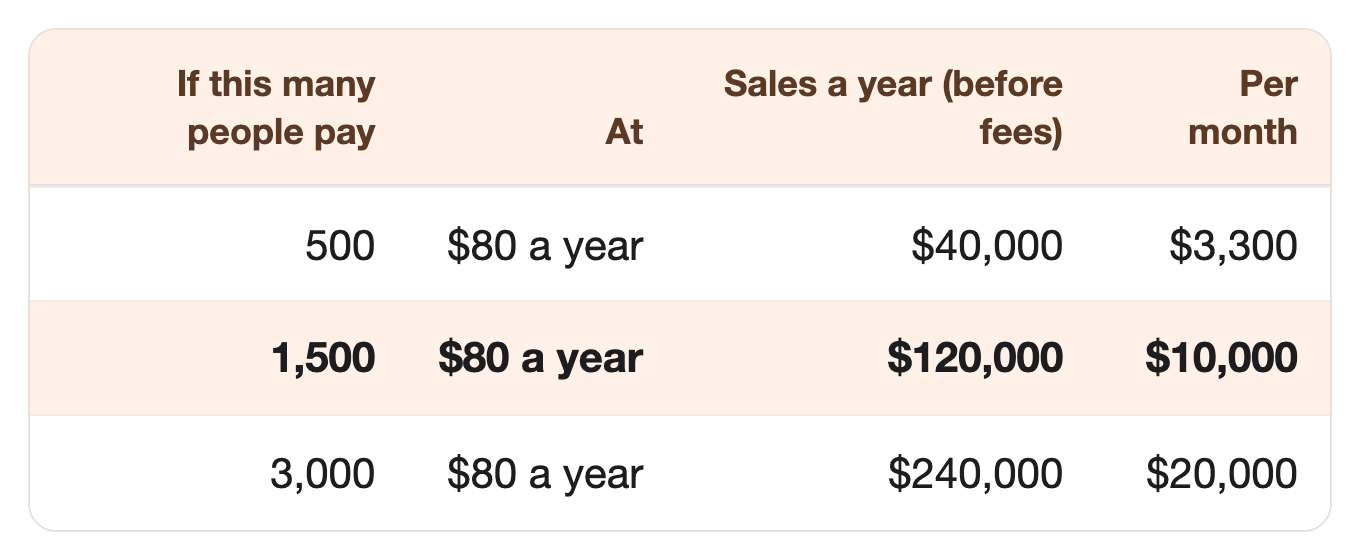
1,500 readers is about 0.4% of Angela Judd’s 377,000 YouTube subscribers, in one desert.
⠀$80 a year is less than The Well-Dressed Garden charges (£80 a year, about $106).
⠀A planting calendar for your climate adds more.
Angela Judd sells a printed one for Arizona’s low desert at $30.
Next stop: $25,000 a month, with two more ways to earn
Gardeners who trust your dates will buy a planner, and a local garden business will want to reach them.
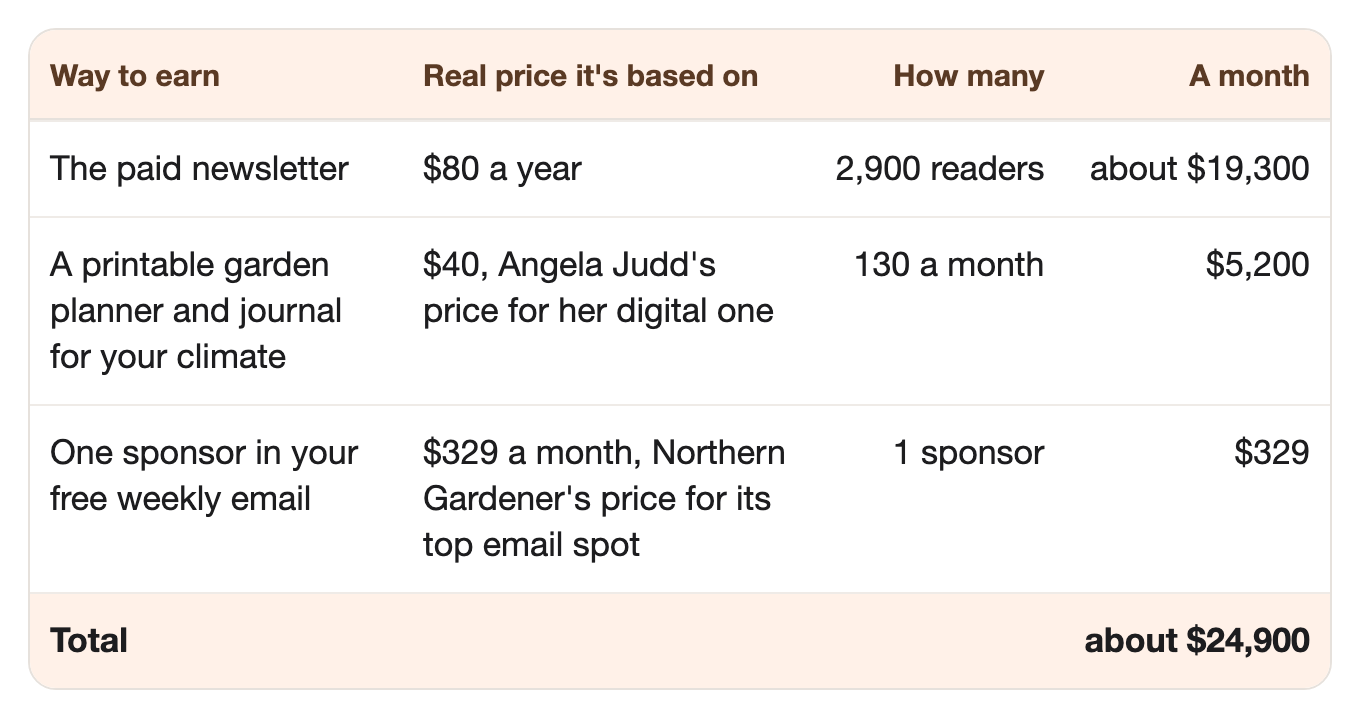
The newsletter still does most of the work.
Grow from 1,500 to 2,900 paying readers, and it brings in about $19,300 a month.
That’s still under 1% of Angela Judd’s 377,000 YouTube subscribers.
⠀
The planner is a file you make once.
A page for each month: what you planted, when, and how it did.
Free readers can buy it too, not just paid ones.
It’s a printable PDF, so there’s nothing to ship.
⠀
The sponsor is small, but it takes almost no time.
Your free weekly email is the free version of your newsletter.
A local nursery or seed shop pays for one spot in it.
Northern Gardener sends its email to about 24,500 gardeners.
A smaller list may get less.
⠀
Here’s the honest part: the two extras in this table add only about $5,500 a month.
So most of the growth comes from more paying readers.
⠀
Worst case, here’s all you lose:
Nothing for the newsletter itself, because Substack is free to start.
One month’s subscription to an AI app, like ChatGPT or Claude.
One week to find out if gardeners in your climate want it.
⠀
👉 One idea, three ways to earn: about $25,000 a month.
Stack two or three ideas from this newsletter, or take this one to a similar niche. Do that, and a million dollars in total is two or three years away.
For this letter, a similar niche could be balcony growers in hot cities. And this letter could be your first idea.
Can you picture yourself running this?
Scroll down. Everything you need to start is waiting. 👇
Not for you? No problem. Next week’s idea might be.
That’s it, my fellow contrarians! 🙌
Yours ‘showing you where the money already is’ Vijay Peduru 🦸♂️
⠀
⠀
⠀
🧰 Want to build it? Here’s everything else.
In every step, AI does most of the work. You garden, and you talk. 🎙️
⠀
Step 1: 🌵 Pick your climate, or your space
Pick something narrow: “Gardening” is too big a topic, but “Arizona’s high desert” is small enough to become a business.
Pick one place, or one kind of space.
One climate: “the high desert of Arizona,” or “food growing in zone 5.”
One space: “balconies in hot cities,” or “a small yard with clay soil.”
Find your zone on the official USDA map. Type in your zip code.
Find your local planting calendar.
Many areas have one, free, from a university’s extension service, a public advice office for farmers and gardeners.
For example: the University of Arizona’s planting calendar for Maricopa County, which covers Phoenix.
Write down your own garden: what grew, what died, and when.
Yes, the dead ones too.
⠀
Step 2: 🗓️ Build your year
One calendar runs the whole business.
AI turns the official calendar into a 52-week to-do list.
What to plant, what to protect, and what to harvest, every week.
You add what you’ve seen in your own garden. That’s the part no one else has.
Each week’s to-do list becomes that week’s issue. You never run out of topics.
⠀
Step 3: 🔍 Check every fact
A wrong date costs a reader a whole season. So every issue is checked three times.
Your AI does all three passes for you: it writes in Part 3, and checks in Parts 4 and 5 of the prompt.
🖊️ The AI writer. Writes each issue from official sources only, like your local extension calendar.
🔍 The AI fact-checker. A second pass opens every link, and confirms each date says exactly that.
🧐 The AI critic. A third pass reads it like a local expert gardener, and checks every date against your frost dates.
Optional: pay a local master gardener (a trained garden volunteer) once to review your calendar before you launch.
⠀
👉 The prompt already follows three safety rules: official sources only, every issue names its area, and no wild plant is called safe to eat.
⠀
Step 4: 📰 Launch the newsletter
Free every week, with a paid tier for the people who want more.
Start on Substack. It’s free to start, and it handles payments.
Send one free issue a week: “This week in your garden.”
Set a paid tier at $8 a month, or $80 a year.
The printable planting calendar for the year.
Answers to readers’ garden questions.
A live video walk through your garden, once a month.
Let AI write your welcome email and your paid page.
⠀
Step 5: 📣 Get your first readers
Meet local gardeners where they already shop and read, and let them bring their neighbors.
Ask one local nursery to keep your free planting calendar by the register.
Put your newsletter’s signup link on the calendar.
In return, send the nursery’s sale dates to your readers, so it gets customers too.
Swap Substack recommendations with a cooking or homesteading newsletter in your region.
Their readers already care about food and land, but those newsletters don’t cover planting.
You recommend them back, so both lists grow.
Before your first issue goes out, open a waitlist where people move up the line for each gardening neighbor who joins.
Give the front of the line the free printable planting calendar for the year, the one paid readers get.
Gardeners talk over the fence, so one excited neighbor can bring in the whole street.
⠀
Step 6: 🏃 Eliminate competitors
When others copy you, here’s how you stay the one people pick.
Compete on timing: tell readers what to do this week in their own area, not who knows the most plants.
Open every issue with the one job in your climate that can’t wait.
A big gardening site writes for the whole country, so it can’t name the job due in your area.
Make the issue a Sunday ritual: coffee, the list, a ten-minute garden walk.
Send it early every Sunday, and put the ritual at the top of each issue.
Once it’s part of their Sunday, switching means giving up a habit they like.
⠀
Step 7: 🎲 Make it bigger
Every climate has an official calendar, and a new group of gardeners every spring.
Add the two extras from “How much you can make,” one at a time.
First the printable planner, built from your 52-week list.
Then one sponsor, once your free weekly email has a few thousand gardeners.
Open the same newsletter for a nearby climate, with a local gardener as your partner.
Sell a printable planting calendar for each climate.
One newsletter at about $25,000 a month is about $300,000 a year, before fees. 🎯
Add two or three more climates, or ideas from this newsletter, and a million dollars in total is two or three years away.
⠀
🗓️ Your first week
Phew.
That was a lot. 😅
Steps 1 to 5 fit into seven days. 🚀
By day 7, you have a calendar for your year, two issues, a newsletter, a waitlist invite, and a calendar card for a local nursery.
Quick heads-up: the prompt below has seven Parts, and they’re not the same as the Steps above.
Day 1 (Step 1): Run Part 1 of the prompt (it’s below). Pin down your climate.
Day 2 (Step 2): Build your 52-week calendar with Part 2.
Days 3–4 (Step 3): Write two issues with Part 3, then check each one with Parts 4 and 5.
Day 5 (Step 4): Set up Substack, and write your welcome email and paid page with Part 7.
Days 6–7 (Step 5): Write your waitlist invite and nursery card with Part 6, and take the card to one local nursery.
⠀
🏄 How to use the prompt
One prompt does all the AI work, in seven parts, plus a quick market check (Part 0).
Part 1 — Pin down my climate. Finds your zone, frost dates, and local planting calendar, from official sources.
Part 2 — Build my year. Turns the calendar into a 52-week to-do list.
Part 3 — Write the weekly issue. Drafts the issue from the calendar and your own garden notes.
Part 4 — Check every fact. Opens every link and confirms each date matches the page.
Part 5 — Find the mistakes. Reads it like a strict local gardener, and checks every date against your frost dates.
Part 6 — Write the waitlist invite and the nursery card. Writes a waitlist invite that moves people up for each neighbor they bring, and a free calendar card for a local nursery.
Part 7 — Write the welcome and paid page. Writes your welcome email and your paid tier page.
Run it your way:
Part by part (the default): it pauses after each part, and you type “next” to go on.
All at once: say “run all seven parts.”
Just one part: say “only do Part 3,” or any part you need.
The full prompt is just below, under “📋 The prompt.”
🎙️ Talk to your AI sidekick, don’t type.
Turn on voice mode, or use a dictation app like Wispr Flow.
Walk around your garden and say it messy. The AI sorts it out.
Turn it into a skill, so you never paste it again.
Paste the prompt into Claude or ChatGPT, and say: “Turn this into a skill I can save.”
Install once, use forever.
⠀
📋 The prompt
The prompt (copy it into Claude or ChatGPT, fill in the INPUTS part, and run it your way)
CONTEXT:
- You're my garden-newsletter partner. Together we'll build a weekly newsletter for gardeners in one climate, or one kind of space.
- This prompt has seven parts, in order.
- Run it the way I ask:
    - If I say nothing, go one part at a time. After each part, show me the result, then stop and wait. Move on only when I type "next."
    - If I say "run all seven parts," do them all without stopping.
    - If I say "only do Part 3" (or any part), do just that part.
- If a part needs something from me, ask for it before you start that part.
- Use only official sources, like the USDA hardiness zone map and my local university extension service. Never invent a date or a fact. If you can't find a source, leave it out.
- If you can't open a link I give you, ask me to attach the file instead.
- I'll often answer by voice, so expect long, messy answers. Don't ask me to tidy them.
- Keep web search on for the whole prompt (turn on search in ChatGPT or Claude), so you can open any page you need to check.

=============== INPUTS — edit these, or just run as is ===============

My climate or space:
{e.g. the high desert of Arizona, around Prescott}

My zip code:
{e.g. 86301}

My local planting calendar (paste it, attach it, or give a link):
{e.g. the University of Arizona extension's vegetable planting calendar for my county}

My own garden notes (paste them, or talk them through):
{e.g. tomatoes died in the July heat; garlic planted in October did great; I have four raised beds}

My prices:
{e.g. free weekly issue; $8 a month or $80 a year for the paid tier}

======================== END OF INPUTS ========================

THE PARTS:

Part 0 — Check the market today.
This part needs web search (turn on search in ChatGPT or Claude). Search for gardening help made for my climate or space and, for each place, give the count, the three biggest with links, and their prices:
1. Newsletters on Substack and elsewhere, free and paid.
2. YouTube channels.
3. Books on Amazon, and when each was last updated.
4. Gardening apps on the App Store and Google Play.
5. Podcasts.
Then tell me: early (few sellers), growing, or crowded, and which narrower group looks least served (for example: beginners, balcony growers, retirees, people who just moved here). Give a link for every number. If you can't open a page, say so. Never guess a number.

Part 1 — Pin down my climate.
Using my zip code and official sources only, give me:
1. My USDA hardiness zone, from the current map.
2. My average last spring frost date and first fall frost date, with the source.
3. My local planting calendar, from the nearest university extension service, with a link.
4. Anything special about my climate (extreme heat, short season, monsoon rains, wind), each with a source.
Say clearly which items you couldn't confirm.

Part 2 — Build my year.
Turn my planting calendar and my frost dates into a 52-week to-do list. For each week: what to plant, what to protect, and what to harvest. Mark which line comes from which source. Then add my own garden notes where they fit, marked "from my garden." List any weeks with almost nothing to do, so I can plan those issues around my garden instead.

Part 3 — Write the weekly issue.
Ask me which week it is, and what's happening in my garden. Then write the issue, for someone new to gardening here:
1. A short opening, from my own garden this week.
2. "This week": three to five jobs, each one line, with the source link.
3. One plant up close: how to grow it here, step by step.
4. One mistake to avoid this week, and why.
5. One reader question, if I give you one.
6. This line at the bottom: "Written for [my area]. Check your own frost dates before you plant."

Part 4 — Check every fact.
Now act as a separate fact-checker who didn't write this issue. Open every link. Mark each fact: matches the source, doesn't match, or has no source. For each problem, show what the source actually says. Then give a fixed version of the issue.

Part 5 — Find the mistakes.
Now act as a strict local master gardener reading the issue before any reader sees it. Check every planting date against my frost dates. Flag any plant that wouldn't survive my climate in that week. Flag any line about sprays, fertilizer, or eating wild plants, and replace it with "follow the label" or remove it. Then give the final issue, with every fix made.

Part 6 — Write the waitlist invite and the nursery card.
1. Write a short waitlist invite from the final issue: who it's for, the week's five jobs as a taste, and how each neighbor who joins moves them up the line. Say the front of the line gets the free printable planting calendar for the year.
2. Write a one-page free planting calendar for my area that a nursery can keep by its register, with my signup link at the bottom.
3. Write a two-line note to a local nursery owner offering the calendar, and offering to share their sale dates with my readers.

Part 7 — Write the welcome and paid page.
Write:
1. A welcome email for new readers: who it's for, what they'll get each week, and the first job to do this week.
2. A paid page: what paid readers get (the printable planting calendar, answers to their questions, a monthly live garden walk), the prices, shown up front, and "Cancel any time."
Never promise a harvest or a result. Never invent a review or a number.

When all seven parts are done, ask if I want to repeat Parts 3 to 5 for next week's issue. Part 6 is for the first week only.
⠀
📎 The sources
Every number above, with where it came from.
Kevin Espiritu’s company sales · Number: “Last year in 2021, Epic Gardening as a company did $7.4 million in revenue”; “that’s not profit”; they “sell products” · Source: NBC 7 San Diego, September 2022
His blog’s first year as a business · Number: About $17,000 in 2016; left his job in 2016; hobby blog from around 2013; no space to grow outdoors · Source: Same article
Kevin’s early life · Number: “I grew up as like a suburban skater kid”; “graduated with a degree in accounting”; “Espiritu and his brother started gardening together as a way to get outside (and as a way to stop playing video games)”; “I was growing hydroponically, which is without soil”; content “for a variety of platforms, like YouTube and Instagram” · Source: NBC 7 San Diego, September 2022
Epic Gardening on YouTube in 2022 · Number: “just short of two-million subscribers” · Source: Same article
Epic Gardening on YouTube · Number: About 4,120,000 subscribers · Source: YouTube Data API
The Well-Dressed Garden · Number: “Thousands of paid subscribers”; started July 2, 2025; £80 a year (about $106) · Source: Substack
The Gardening Mind · Number: “Thousands of paid subscribers”; £38.50 a year (about $51) · Source: Substack
Pounds to dollars · Number: £1 = $1.3225 on October 5, 2026 (this issue’s date) · Source: Frankfurter (European Central Bank rates)
Square foot gardening · Number: Devised by a retired engineer; 1981 book; PBS series · Source: Wikipedia
Royal Horticultural Society · Number: Founded in 1804; 609,000+ members (2024) · Source: Wikipedia
US gardening spending · Number: $79.0 billion in 2025; $740 per household, a record; survey run every year since 1973; renters out-buy homeowners on vegetable and herb seed · Source: National Gardening Survey, 2026 edition, read in a browser (the page blocks scripts)
The zone map change · Number: Released November 15, 2023; 13 zones; “about half of the country shifted to the next warmer half zone” · Source: Ohio State University BYGL, reprinting USDA’s release
Month-by-Month Gardening books · Number: 19 books in the series; Arizona deserts: 483 ratings, list $29.99; Pacific Northwest: 390 ratings, list $26.99 · Source: Amazon search, “month-by-month gardening”
Growing Vegetables West of the Cascades · Number: 35th anniversary edition; 208 ratings · Source: Amazon
All New Square Foot Gardening, 3rd edition · Number: About 6,200 ratings; list $24.99 · Source: Amazon
Angela Judd’s channel · Number: About 377,000 subscribers; low desert gardening in Mesa, Arizona · Source: YouTube and her About page
Her desert vegetables video · Number: More than 246,000 views · Source: YouTube
Epic’s zone map video · Number: More than 185,000 views · Source: YouTube
Google searches · Number: “planting zones” 40,500 a month; “balcony garden” 1,600 a month · Source: Ubersuggest, US
Comment: the apartment · Number: “This is great and all, but too bad they never tell you what zone is “apartment.”“ · Source: YouTube comment, 2023
Comment: the high desert · Number: “I hope someone can guide me to learn HIGH desert like you teach low.” · Source: YouTube comment, 2025
Angela Judd’s planting calendar · Number: Printed Vegetable, Herb & Fruit Planting Calendar for the low desert of Arizona, $30 · Source: Growing in the Garden shop
Angela Judd’s planner · Number: “DIGITAL Low Desert AZ Garden Planner & Journal \ · Source: Printable PDF,” $40.00
Sponsor price · Number: Northern Gardener E-news, circulation 24,500; “TOP OF E-NEWS (EXCLUSIVE PLACEMENT, 1 PER ISSUE)”: “1x - $329/mo.” (2025 rate card) · Source: Minnesota State Horticultural Society
Free county planting calendar · Number: Vegetable Planting Calendar for Maricopa County · Source: University of Arizona Cooperative Extension