


Hello contrarians,
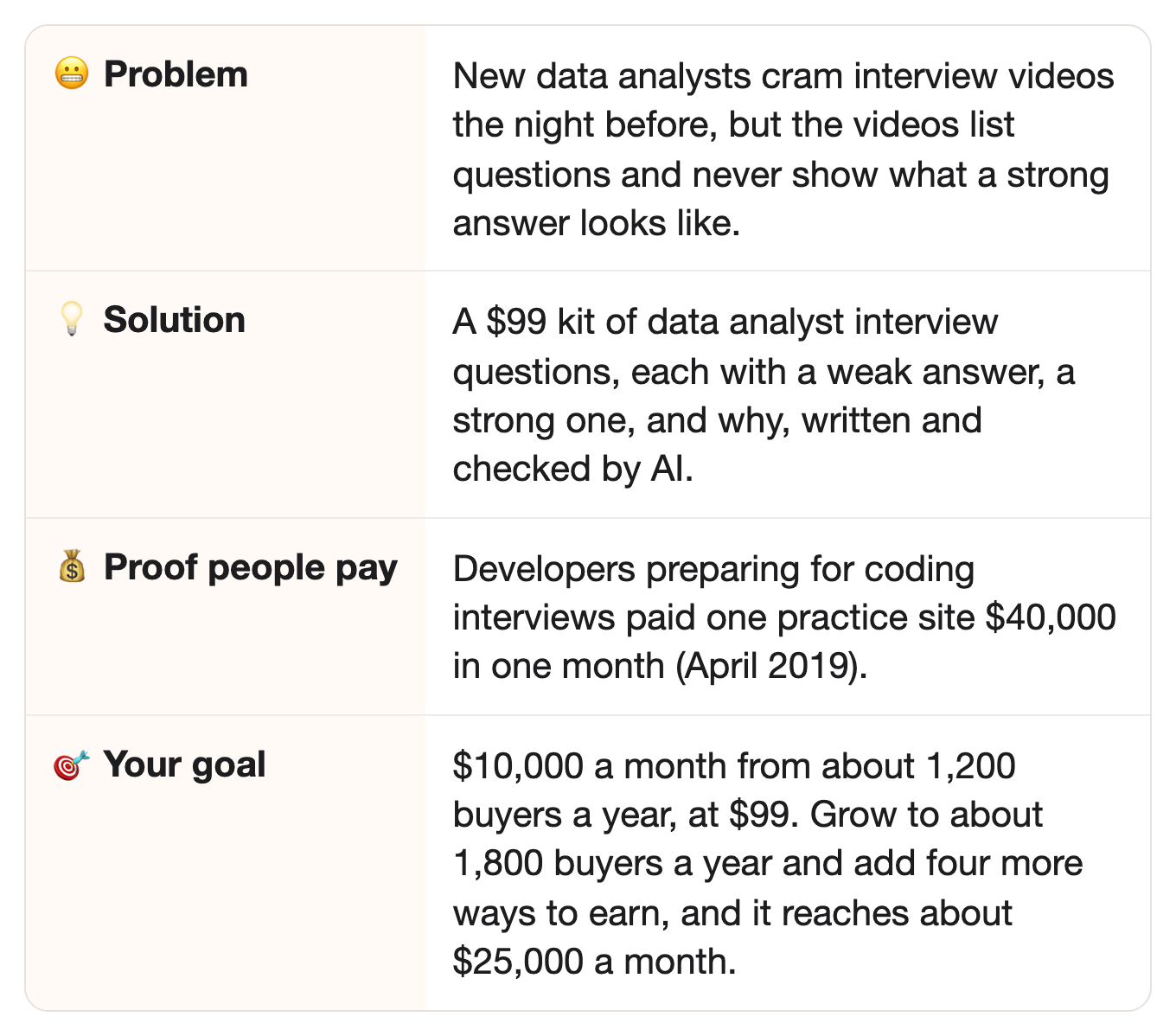
Today’s idea is called The Data Analyst Interview Kit.
Grab a snack. 🍪
First, an engineer’s story. Then, the business you could build from it.
⠀
⚡ Quick facts
⠀
📖 How one engineer turned his own interview panic into a $40K month
It started with his own job hunt.
In February 2017, Clément Mihailescu has just finished a coding bootcamp (a short, intense coding school).
⠀He’s getting ready for tech interviews, and he feels underprepared.
Coding interviews ask tricky puzzle questions, called algorithm problems.
So he reads dense prep books, and hunts YouTube for videos that explain the answers.
⠀
Here’s what he saw: the books weren’t the problem. Nothing put it all in one place.
He wants one place with a question, a spot to write the code, hints, and a video that explains it.
He can’t find one… so he decides to build it.
⠀
He pitches it to his best friend, Antoine Pourchet, an engineer at Uber.
They put in $2,500 each.
⠀
Two months later, Clément starts a full-time job at Google.
So he builds on his train rides, his evenings, and his weekends.
Busy guy.
⠀
They call it AlgoExpert, and start selling in September 2017.
First month? Just three sales.
Yep, three.
⠀
Their prices:
$70, paid once.
Or $25 a month.
⠀
By April 2019, it brings in $40,000 in a single month, from 809 customers.
Holy cow. 🐄
He went from three sales in his first month, to $40,000 in one month, by putting questions, hints, and video answers in one place.
⠀
🔗 Same idea, new group
In the story: people getting ready for coding interviews paid AlgoExpert for questions, hints, and video answers in one place.
⠀In this idea: new data analysts face SQL, Excel, and business tests, and need to see what a strong answer looks like.
⠀Why it carries over: both groups face a tough test with a job on the line, and a new wave reaches interviews every year.
⠀
💡 The opportunity
Data analysts face hard interviews too, and every year’s new applicants need what Clément gave coders.
Wait, what’s a data analyst, exactly?
It’s the person who digs through a company’s numbers and explains what’s going on.
“Why did sales drop in March?” They find out, and make the chart that shows it.
⠀
Millions of people are training for this job.
About 3.9 million have enrolled in Google’s data analytics certificate on Coursera, an online course site.
Yep, millions.
⠀
After the certificate comes the interview, and it’s several tough tests in a row. 😬
A SQL test: write a query to pull the right numbers from a database.
An Excel test, often timed.
A business case: “Sign-ups fell 10% last week. What would you check first?”
Sometimes a take-home project, and then they present it.
⠀
And the free help? It’s scattered.
A short Excel video here, a SQL video there.
And no one shows them what a strong answer looks like.
⠀
👉 The idea: sell a practice kit for data analyst interviews, with a weak answer, a strong answer, and why, for every question.
⠀
🙋 Not a data analyst yourself? You can still build this.
Become the interviewer.
Fun twist: this time, you ask the questions.
Interview 20 to 30 working analysts and hiring managers on a podcast or newsletter, with their permission.
Ask what they ask candidates, and what a great answer sounds like.
Their answers shape your kit, and every interview is also content.
⠀
Team up with one.
A data analyst or analytics manager brings the know-how.
You build the kit and find the buyers.
⠀
Or swap in your own job.
Product analyst, analytics engineer, product designer, product manager.
The steps are the same.
⠀
🗣️ What it looks like
Here’s a made-up example of one question from the kit.
The question: “Our app’s sign-ups fell 10% last week. What would you check first?”
⠀A weak answer: “I’d look at the data and find the problem.”
Hmm. Not wrong, but it doesn’t say how.
⠀
A strong answer, step by step:
“First, is it real? I’d check if the tracking broke.”
“Then, where did it fall? I’d split it by country, device, and where people came from.”
“Then, what changed? A new app version, a price change, a holiday.”
“Finally, I’d write one query to test my best guess, and show the chart.”
⠀
The rubric (a short scoring guide): why the strong answer wins, in three lines, so they can grade their own.
⠀
👉 A free video gives them a question, and your kit shows them what a strong answer looks like.
⠀
✅ Why this could work
Three signs the money is real.
Someone already made $40,000 in one month with this model, and others make money the same way.
Case in point: Exponent, an interview-prep site, started in 2017 with product manager interviews.
By 2020, it had more than 3,000 paying customers, with courses from $99.
Product Alliance sells product manager interview courses at $529 each, and says it has 12,000+ members.
DataLemur, from author Nick Singh, sells SQL and data interview practice by subscription.
⠀
People have paid for interview prep since 2017, and they still do.
Our guess: almost every new job starts with an interview.
The US government expects about 24,800 openings a year for data scientists, the closest group it counts.
And it expects that job to grow 35% from 2025 to 2035. 🔁
⠀
Candidates already look for interview help on YouTube.
How many?
A search for “data analyst interview questions” finds 198 videos, with more than 28 million views.
More in the next section.
⠀
👉 Curious where these numbers come from? Every source is linked in the last section, “📎 The sources.”
⠀
📊 More proof people want this
Want more? Here you go.
People already pay to train and practice for this job.
Google’s data analytics certificate costs $49 a month on Coursera in the US, and about 3.9 million have enrolled.
DataLemur charges $15 a month for data interview practice, or $300 for lifetime access plus a coaching call.
⠀
Data analyst interview videos pull big crowds on YouTube.
A YouTube search for “data analyst interview questions” finds 198 videos, with more than 28 million views and more than 14,000 comments.
60 of those videos have over 100,000 views each.
⠀
Single practice videos get over a million views.
One data analytics mock interview (a practice interview, filmed) has more than 1.2 million views.
“Can You Pass This Excel Interview Test?” from Kenji Explains, a YouTube channel, has more than 1.6 million views.
⠀
The big picture. 💰
The US government doesn’t count data analysts on their own.
Its closest group, data scientists, held about 275,600 jobs in 2025.
Data scientists’ median pay was $120,230 a year, in May 2025.
So $99 of practice is small next to a new salary.
⠀
What a candidate wrote the night before.
“Have a data analyst interview tomorrow and I have never really gotten into data science things, so watching this last minute.”
That’s a comment under a popular YouTube video of data analyst interview questions.
That’s the night before a real interview.
⠀
And another, 20 seconds into Kenji’s Excel test.
Ouch.
⠀
👉 Every new analyst has to pass the interview, and they’re already looking for help.
⠀
🔍 Who’s already doing it
Big names exist. None is built for entry-level data analysts.
AlgoExpert, the site from the story above, is only for software engineers.
It preps them for coding interviews, where you solve a puzzle by writing code while an interviewer watches.
A data analyst’s interview is a different test: SQL, Excel, and a business question.
⠀
Exponent, now called Aced, is an interview-prep site for many tech jobs at once.
It sells interview courses, and started with product manager interviews in 2017.
When we checked, it listed more than a dozen kinds of interviews, from product manager to data scientist.
So data analysts are one small corner of a big library.
⠀
DataLemur is a practice site for SQL questions, sold by monthly subscription.
It grew out of Nick Singh’s book on data science interviews.
Its page speaks to data scientists, data analysts, and data engineers all at once.
⠀
What’s missing, when we checked:
One kit just for entry-level data analyst interviews.
Every round in one place: SQL, Excel, the business case, the take-home, and the “tell me about yourself.”
Worked answers with a rubric, and a mock interviewer that scores you.
Built for people coming out of a certificate, not people already at big tech.
⠀
🔎 Check the market yourself in 2 minutes: run Part 0 of the prompt in the build plan below.
Your AI searches courses, kits, YouTube, and books that day, and tells you: early, growing, or crowded.
Early? Start now.
Crowded? Good news: it means people pay. Pick one narrower group of candidates (Step 1 of the build plan).
A crowded market is still OK. You win by serving one group better, not by being first.
⠀
👉 That missing part can be your business: one practice kit just for entry-level data analyst interviews, with a worked answer for every round.
⠀
🤖 Why AI won’t replace it
AI can ask them questions. You show them what a strong answer looks like.
Could ChatGPT just do this?
Sort of, if someone hands it a rubric and a strong example first.
You pick what matters.
A nervous candidate doesn’t know which practice questions matter.
You pick the ones real interviews use, and point out the traps.
⠀
Worked answers, with a rubric.
ChatGPT grades an answer well when you give it a rubric and a strong example to compare against.
A nervous candidate won’t build those first, so your kit hands them a weak answer, a strong one, and why.
⠀
Practice data that really works.
Every SQL question comes with a practice dataset.
Its answer key has been run, not just written.
⠀
A timed mock interview, like the real thing. ⏱️
A timed mock interview, with a scorecard at the end.
⠀
Proof people pay for the finished kit: Product Alliance charges $529 a course, and says it has 12,000+ members.
Free interview videos on YouTube have more than 28 million views, and people still pay for a finished kit.
⠀
👉 AI can grade an answer well, but a nervous candidate won’t build the rubric first, so your kit hands it to them.
⠀
💵 How much you can make
Quick math time. 🧮
First stop: $10,000 a month from the kit alone
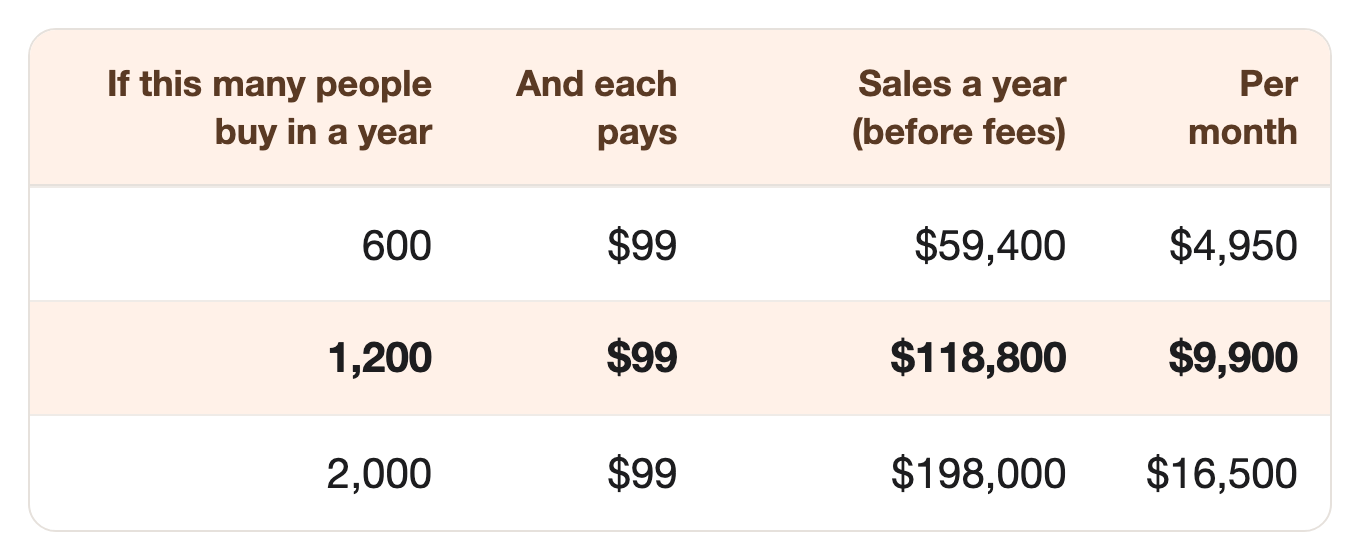
$99 is what Exponent charged for its online course (its price in 2020).
So it’s an old price, and Exponent may charge more now.
⠀
1,200 buyers a year is about 3 in every 10,000 of the 3.9 million people who have ever enrolled in Google’s certificate.
That 3.9 million is a total over the years, not one year’s count.
⠀
AlgoExpert had 809 customers in April 2019 alone.
Remember, that’s the month it brought in $40,000.
Next stop: $25,000 a month, with four more ways to earn
Once candidates trust your kit, schools and sponsors start to pay too.
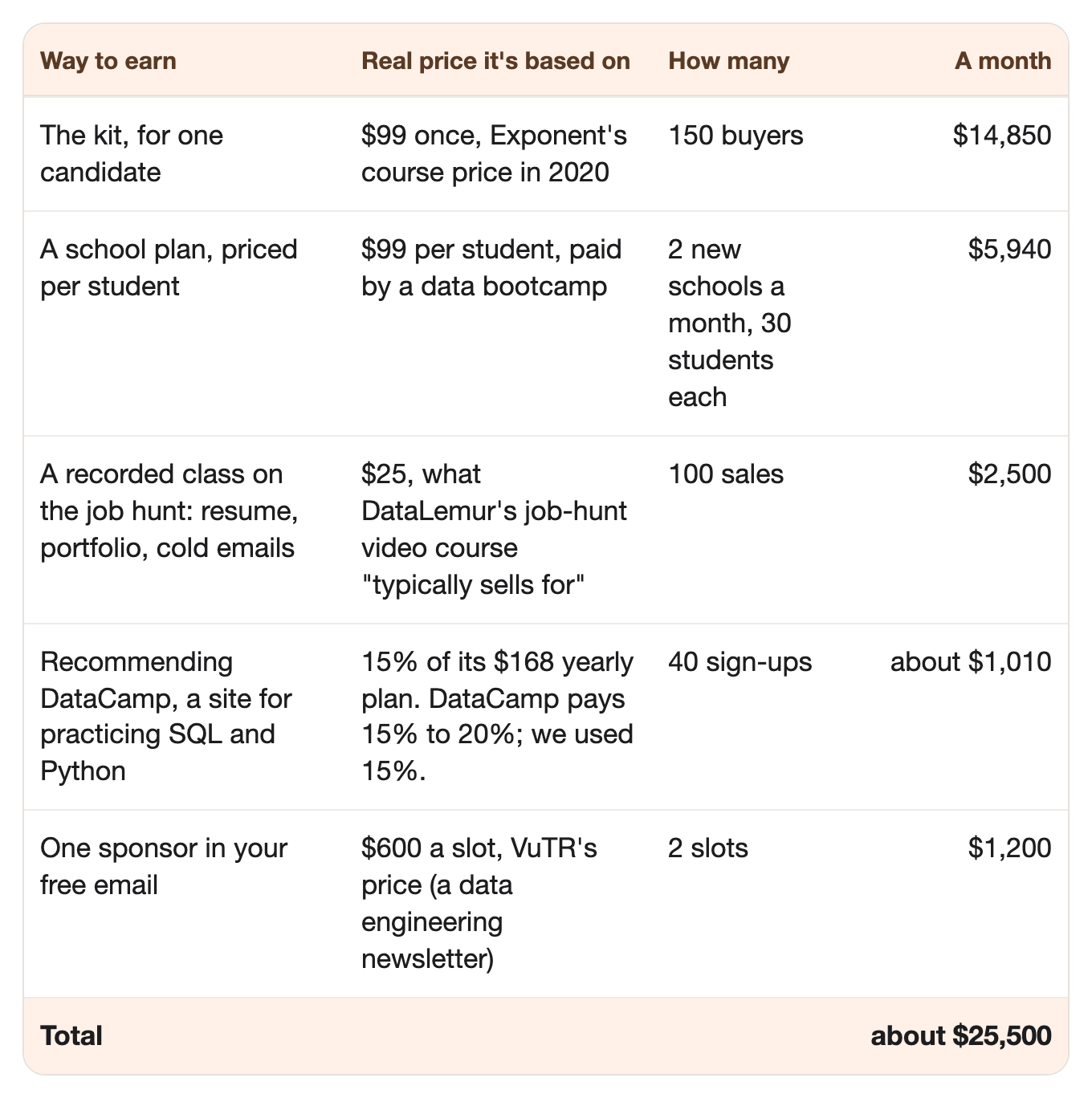
The kit still does most of the work.
Grow it from 1,200 to about 1,800 buyers a year (150 a month), and it brings in $14,850 a month.
That’s still far below AlgoExpert’s 809 customers in April 2019.
⠀
The school plan is the big jump.
AlgoExpert did this: a bootcamp bought a copy for every student.
One school says yes, and 30 students get the kit at once.
⠀
The job-hunt class sells to people who already bought the kit.
Record it once, from what your buyers ask you most.
At $25, it’s an easy second buy.
⠀
The DataCamp link and the sponsor are small, but they take almost no time.
Many candidates still need SQL practice before the interview.
The sponsor only works once your free email reaches a few thousand candidates.
VuTR has about 20,000 readers, so a smaller email may get less.
⠀
That’s about 210 buyers a month, plus the class.
2,500 a year is still only about 6 or 7 in every 10,000 people who have enrolled in Google’s certificate.
⠀
If it doesn’t work out, here’s all you lose:
Nothing to open a Gumroad store. It has no monthly fee, and takes a cut only when you sell.
One month’s subscription to an AI app, like ChatGPT or Claude.
One week of your time.
⠀
👉 That’s the math for about $25,000 a month, all from one kit.
Stack two or three ideas from this newsletter, or take this one to a similar niche. Do that, and a million dollars in total is two or three years away.
A similar niche for this kit could be product analysts, who face the same SQL tests. This could be your first idea.
So, want to try this one?
The whole plan, the prompt included, is below. 👇
If it’s not your thing, see you next week with a fresh idea.
That’s it, my fellow contrarians! 🙌
Yours ‘helping you skip the guesswork and start with proof’ Vijay Peduru 🦸♂️
⠀
⠀
⠀
🧰 Want to build it? Here’s everything else.
⠀
Step 1: 🎯 Pick one job and one group
One job, one kind of candidate. That’s what makes your kit the one they pick.
Pick the job. This plan uses entry-level data analyst.
Pick the group. For example:
People finishing a data analytics certificate.
People moving from an Excel-heavy job, like finance or operations.
Analysts aiming at one industry, like healthcare.
Map the interview.
Collect 20 real job posts for that job and group.
Your AI lists the rounds, the skills each round tests, and the tools named most.
⠀
Step 2: 🛠️ Build the question bank
Your kit is the questions, the worked answers, and the practice data.
Write the questions, round by round.
SQL, Excel, the business case, the take-home, and the “tell me about yourself” questions.
Start with 30 questions. Add more every week.
Write a worked answer for each.
A weak answer, a strong answer, and a three-line rubric that says why.
Make the practice data.
A small made-up database for the SQL questions, and a spreadsheet for the Excel ones.
Make every question your own.
Never copy another company’s or course’s questions, and never claim a “leaked” question.
⠀
Step 3: 🔍 Check every answer
A wrong answer key costs a candidate the job, so every answer gets two checks after it’s written.
Your AI does all three passes for you: it writes in Parts 2 and 3, and checks in Part 4 of the prompt.
🖊️ The AI writer. It writes each question and worked answer, using your interview map.
🔍 The AI checker. A second pass runs every SQL answer on the practice data, and checks every Excel formula.
🧐 The AI critic. A third pass reads it like a tough hiring manager, and like a confused beginner.
Optional: pay a working data analyst or analytics manager once to review the first pack.
⠀
👉 The prompt already follows three safety rules: no “leaked” company questions, no company logos, and no promise of a job offer.
⠀
Step 4: 🏪 Open your store
Keep it like AlgoExpert: one simple product, priced up front.
Set your price.
$99, paid once, like Exponent’s online course in 2020.
A school plan: the same $99, for each student a bootcamp signs up.
Pick where to sell.
Gumroad is the simplest. It has no monthly fee.
Or your own website.
Package the kit:
The question bank, by round.
The worked answers and rubrics.
The practice data, with answer keys.
The mock-interview prompt (Part 5 below), so they can practice with their own AI.
Let AI write your store page, using one real question and its worked answer as the sample.
⠀
Step 5: 📣 Get your first buyers
YouTubers brought AlgoExpert its most buyers. Pay yours only when a kit sells.
Offer data-career YouTubers a share of each kit they sell, instead of a paid sponsorship.
Give each one their own link and a free copy, so they can show a real question on camera.
They pay nothing up front, and you pay only when a kit sells.
Leave one useful answer early under the biggest data-career LinkedIn posts each day.
Turn on alerts for five big accounts, and add a strong answer to the question in the post.
Keep the kit’s link in your profile, not in the reply.
Start a free weekly email with one interview question and its strong answer.
Candidates who aren’t ready to pay still hear from you every week.
Later, this is where your sponsor goes.
Ask ChatGPT “how do I prep for a data analyst interview?” and publish pages where your kit is missing from its answers.
Ask Claude and Gemini the same, plus two more questions your buyers ask, and note which kits and pages get named.
Where yours is missing, write one free page that answers the question, with one sample question and its strong answer.
⠀
Step 6: 🏃 Eliminate competitors
Copycats will come. Here’s how you stay first.
Give past buyers trade-in credit when you release the new edition, for new Excel and SQL features.
Send every past buyer a credit code the day the new edition is out.
A new rival has no old buyers to bring back.
When you add a new round, like a take-home case study, raise the price openly and say what’s new.
Post the new price a week ahead, with one line for each thing you added.
Never quietly cut questions or answers to keep the old price.
⠀
Step 7: 🎲 Make it bigger
Every job has an interview, and a new group of people trying to pass it every year.
Add the four extras from “How much you can make,” one at a time.
First the school plan, since you already make the kit.
Then the job-hunt class, built from what your buyers ask most.
Then the DataCamp link, and one sponsor once your free email has a few thousand candidates.
Build the same kit for other non-coding jobs: product analyst, analytics engineer, product designer, product manager.
One kit at about $25,000 a month is about $300,000 a year, before fees. 🎯
Add two or three more kits, or ideas from this newsletter, and a million dollars in total is two or three years away.
⠀
🗓️ Your first week
Phew. That was a lot. 😅
A first version of Steps 1 to 5 fits into seven days. 🚀
By day 7, you have an interview map, a 30-question first pack, a store, and a pitch for YouTubers.
Quick heads-up: the prompt below has seven Parts, and they’re not the same as the Steps above.
Day 1 (Step 1): Collect 20 job posts, and map the interview with Part 1 of the prompt (it’s below).
Days 2–3 (Step 2): Write 30 questions with Part 2, then the worked answers with Part 3.
Day 4 (Step 3): Check every answer with Part 4.
Day 5 (Step 4): Test the mock interviewer with Part 5, then write your store page with Part 6.
Days 6–7 (Step 5): Write your YouTuber pitch with Part 7, and send it to three data-career YouTubers.
⠀
🏄 How to use the prompt
One prompt does all the AI work, in seven parts, plus a quick market check (Part 0).
Part 1 — Map the interview. Reads real job posts, and lists the rounds and the skills each one tests.
Part 2 — Write the questions. Writes the question bank, round by round, with practice data.
Part 3 — Write the worked answers. A weak answer, a strong one, and a rubric for each question.
Part 4 — Check every answer. Runs every SQL answer on the practice data, then reads it like a tough hiring manager.
Part 5 — Run a mock interview. Plays the interviewer, one question at a time, and gives a scorecard.
Part 6 — Write the store page. Uses one real question and its worked answer as the sample.
Part 7 — Write the YouTuber pitch. Writes a short note offering a data-career YouTuber a share of each sale.
Run it your way:
Part by part (the default): it pauses after each part, and you type “next” to go on.
All at once: say “run all seven parts.”
Just one part: say “only do Part 5,” or any part you need.
The full prompt is just below, under “📋 The prompt.”
🎙️ Talk to your AI sidekick, don’t type.
Turn on voice mode, or use a dictation app like Wispr Flow.
Say it messy. The AI sorts it out.
Turn it into a skill, so you never paste it again.
Paste the prompt into Claude or ChatGPT, and say: “Turn this into a skill I can save.”
Install once, use forever.
⠀
📋 The prompt
The prompt (copy it into Claude or ChatGPT, fill in the INPUTS part, and run it your way)
CONTEXT:
- You're my interview-prep partner. Together we'll build an interview-prep kit for one job: a question bank, worked answers, practice data, and a mock interviewer.
- This prompt has seven parts, in order.
- Run it the way I ask:
    - If I say nothing, go one part at a time. After each part, show me the result, then stop and wait. Move on only when I type "next."
    - If I say "run all seven parts," do them all without stopping.
    - If I say "only do Part 5" (or any part), do just that part.
- If a part needs something from me, ask for it before you start that part.
- Write every question yourself. Never copy questions from another course, book, or website, and never call a question "leaked" or "asked at" a named company.
- Never invent a fact or a number. If you're not sure, say so.
- If you can't open a link I give you, ask me to attach the file instead.
- Keep web search on for the whole prompt (turn on search in ChatGPT or Claude), so you can open any page you need to check.

=============== INPUTS — edit these, or just run as is ===============

The job:
{e.g. entry-level data analyst}

Who the kit is for:
{e.g. people finishing a data analytics certificate, with no data job yet}

Real job posts (paste them, or attach the file):
{e.g. 20 data analyst job posts from LinkedIn and Indeed}

My own notes (optional):
{e.g. notes from interviews I've given or taken, or from analysts I interviewed with their permission}

My price:
{e.g. $99, paid once}

======================== END OF INPUTS ========================

THE PARTS:

Part 0 — Check the market today.
This part needs web search (turn on search in ChatGPT or Claude). Search for interview prep for my job and, for each place, give the count, the three biggest with links, and their prices:
1. Interview-prep courses and kits (for example on Gumroad, Udemy, Maven, and standalone sites).
2. Interview-prep sites that cover many jobs, and whether they cover mine.
3. YouTube channels and videos about interviews for this job.
4. Books about interviews for this job.
Then tell me: early (few sellers), growing, or crowded, and which group of candidates looks least served (for example: certificate grads, people switching from finance, one industry). Give a link for every number. If you can't open a page, say so. Never guess a number.

Part 1 — Map the interview.
Read the job posts I gave you. Then give me:
1. The interview rounds this job usually has (for example: SQL test, Excel test, business case, take-home, behavioral). Mark which rounds the posts mention, and which are your guess.
2. The skills and tools each round tests, ranked by how often the posts name them.
3. The ten things a candidate in my group is most likely to get wrong. Say clearly which are your guess.

Part 2 — Write the questions.
Ask me which round to start with. Then write ten questions for that round, from easy to hard, for someone in my group:
1. For SQL: build a small made-up practice database first (tables and sample rows), then write the questions against it.
2. For Excel: describe a small made-up spreadsheet, then write the tasks.
3. For the business case: a short, realistic situation with one clear question.
4. For behavioral: the question, and what the interviewer is really checking.

Part 3 — Write the worked answers.
For each question from Part 2, write:
1. A weak answer, the kind a nervous beginner gives.
2. A strong answer, step by step, in plain words.
3. A three-line rubric: what makes the strong answer strong.
4. One common trap, and how to avoid it.

Part 4 — Check every answer.
Now act as a separate checker who didn't write these answers.
1. Run every SQL answer against the practice database from Part 2, row by row, and show the result. Flag any answer that gives the wrong rows.
2. Check every Excel formula against the sample spreadsheet.
3. Then act as a tough hiring manager. Flag anything vague, wrong, or out of date, and anything a beginner would find confusing.
Then give the fixed version of every question and answer.

Part 5 — Run a mock interview.
Act as the interviewer for my job. Ask me one question at a time from the bank, and wait for my answer. If the question bank and rubric aren't in this chat, ask me to paste them first. Don't help me during the interview. After five questions, give me a scorecard:
1. A score out of 5 for each answer, using the rubric from Part 3.
2. What I did well, in one line each.
3. The one thing to fix first, with a better version of my weakest answer.
Then ask if I want five more questions.

Part 6 — Write the store page.
Ask me for one question and its worked answer to use as the sample. Never invent a review, a result, or a number. Give me:
1. A headline that names the job and the group, not "everyone."
2. What's in the kit: the rounds, the number of questions, the worked answers, the practice data, and the mock interviewer.
3. The sample question, with its weak and strong answer.
4. The price, shown up front.
5. This line, word for word: "This kit helps you practice. It can't promise a job offer."
Never use a company's name or logo as if it endorsed the kit.

Part 7 — Write the YouTuber pitch.
Ask me for one data-career YouTuber's channel and one of their recent videos. Then give me:
1. A short note, under 120 words, that names something real from that video, with no template phrases.
2. The offer: their own link, a free copy of the kit, and a share of each kit sold through it. Leave the share as [X%] for me to fill in.
3. One sample question with its weak and strong answer, so they can see the kit before they say yes.
4. The line: "This kit helps people practice. It can't promise a job offer."
Never invent a number or a result. Then list five more data-career YouTubers to pitch, with links (this needs web search), and say if you can't open a page.
⠀
📎 The sources
Every number above, with where it came from.
AlgoExpert’s revenue · Number: “breaking $2,000/month in April 2018 and 40,000/month in April 2019”; April 2019 gross revenue $40,052, “our best month to date”; Clément: “I’m a Software Engineer at Google” · Source: Indie Hackers interview with Clément Mihailescu, April 2019 (read via the Web Archive copy)
The start · Number: Idea in February 2017, after a coding bootcamp; co-founder Antoine Pourchet, an engineer at Uber; $2,500 each; Clément started at Google two months later; “realized I was underprepared in the domain of algorithms”; “reading through page after page of dense interview prep books, and scouting the web for YouTube videos”; “My 40-minute morning and evening train rides are typically spent developing new features… My weekday evenings and nights… my weekends” · Source: Same interview
Sales · Number: Selling from September 2017; 3 sales the first month; 809 customers in April 2019 · Source: Same interview
Prices · Number: “$70 one-time fee or $25 a month”; “65 curated practice interview questions” · Source: Same interview
First buyers · Number: Free for Fullstack Academy students; an interview-prep talk there every six weeks; a deal in August 2018 to buy one for every student; YouTuber sponsorships from November 2018 “generated the best results thus far” · Source: Same interview
Exponent · Number: Started in 2017, “starting with product management”; “more than 3,000 paying customers”; courses from $99 · Source: Poets&Quants, April 2020
Exponent today · Number: Now named Aced, “formerly Exponent”; its menu lists interview questions for more than a dozen jobs, including PM, Data Science, Software Engineering, TPM, and Investment Banking (a re-check found no single clean count) · Source: Aced course library
Product Alliance · Number: “$529 / course”; “12,000+ Satisfied Members Who Landed Dream Jobs” (its own claim) · Source: productalliance.com
DataLemur · Number: $15 a month; $300 for “1:1 Coaching + Signed Book + Lifetime Access”; Nick Singh’s book “has successfully helped 16,000+ readers” (its own claim) · Source: DataLemur pricing
Google’s data analytics certificate · Number: 3,889,101 enrolled; $49 a month in the US and Canada · Source: Coursera
Data scientists in the US · Number: About 275,600 jobs in 2025; about 24,800 openings a year; median pay $120,230 (May 2025); 35% growth from 2025 to 2035 · Source: US Bureau of Labor Statistics
YouTube videos · Number: 198 videos found by YouTube search for “data analyst interview questions”; 23,264,454 views and 12,134 comments on a first run; a re-run found 28,709,929 views, 14,032 comments, 60 with 100,000+ views · Source: YouTube Data API
Mock interview views · Number: 1,207,520 · Source: YouTube: Data Analytics Mock Interview
Excel interview test views · Number: 1,610,140 · Source: YouTube: Kenji Explains, “Can You Pass This Excel Interview Test?”
Comment: the night before · Number: “Have a data analyst interview tomorrow and I have never really gotten into data science things, so watching this last minute.” · Source: YouTube comment, 2021
Comment: the Excel test · Number: “00:20 I already failed.” · Source: YouTube comment, 2023
Gumroad fees · Number: No monthly fee; “10% + $0.50” per sale · Source: Gumroad pricing
Job-hunt class price · Number: “Ace the Data Job Hunt”: “The course has 25+ videos & downloadable resources to aid you in your data job hunt, and typically sells for $25” · Source: DataLemur pricing
DataCamp affiliate rate · Number: “15-20% Of Yearly Subscriptions”; “50-80% Of the first month for monthly subscriptions” · Source: DataCamp affiliates
DataCamp price · Number: Premium: “$14/month billed annually” ($168 a year) · Source: DataCamp pricing
Sponsor price · Number: “Banner ad slot in a free article: $600 per slot”; about 19,900 Substack subscribers (January 29, 2025) · Source: VuTR media kit