


Hello contrarians,
Today’s idea is called The Founder Grant Club.
Pour yourself a tea. 🍵
First, a grant writer’s story. Then, the business you could build from it.
⠀
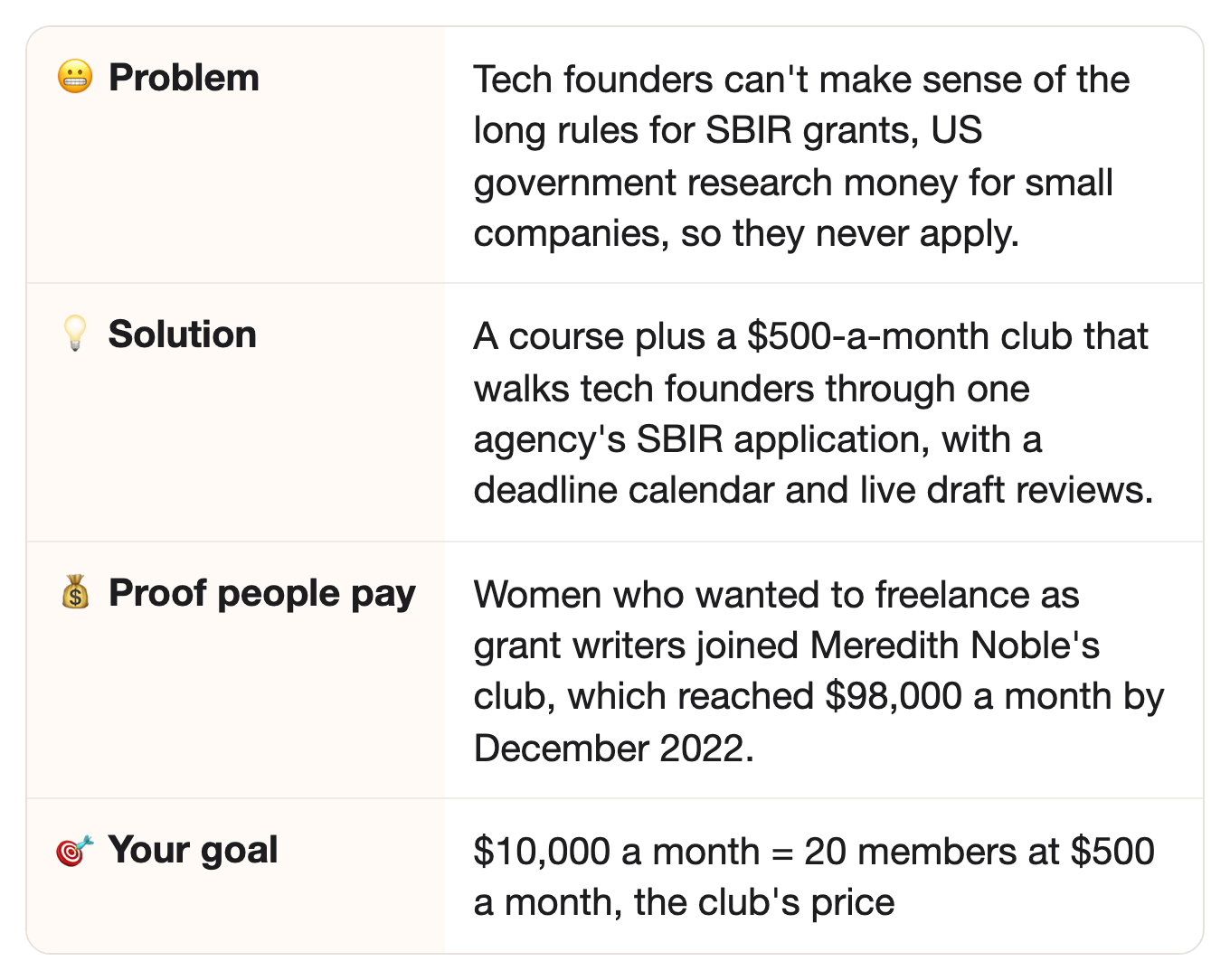
⚡ Quick facts
⠀
📖 How one grant writer built a $1M-a-year club
Her first course? $2,000 in a whole year.
Meredith Noble grew up on a cattle ranch in Wyoming.
Later, she quit her corporate job and started a software company.
And it failed… within three months.
So, to pay the bills, she went back to grant writing: “the exact job I’d pledged to never do again!”
A grant writer writes the applications charities and other nonprofits send to win money from foundations and governments.
Then people kept inviting her to coffee for grant-writing advice, or asking her to teach workshops.
So she had an idea: put her grant-writing advice in an online course.
⠀And it didn’t sell.
Only $2,000 in sales in the first year.
So she ran live grant-writing workshops.
She borrowed $7,000 from her dad to run them.
The workshops made about $20,000.
And about one in five people there then bought her course.
Then she stopped writing grants for clients, to work on the course full-time.
Surprise, surprise: it kept losing money.
Why?
She charged about $350 per student, once, and kept helping each one for life.
Every new customer cost her more than they paid.
Then came December 2020: the business lost $20,000 in that month alone.
She had six weeks of money left.
Yikes.
⠀
So she and her co-founder, Alex Lustig, rebuilt everything in three weeks.
They did 20 interviews with people who fit their ideal customer.
They picked one narrow buyer: a woman who wanted to freelance as a grant writer.
And they tripled their prices and moved to monthly payments.
In January 2021, they made $7,000 in monthly recurring revenue.
That’s money that comes in every month.
Then it grew by about $4,000 a month, month after month.
By December 2022? $98,000 a month, over $1 million a year.
Her club is the Global Grant Writers Collective: a course, a community, and coaching, priced at $500 a month in 2023.
Mamma mia. 🤌
She went from losing $20,000 in one month, to a million dollars a year, by teaching one narrow group of people to write grants.
⠀
🔗 Same idea, new group
In the story: women who wanted to freelance as grant writers paid Meredith Noble’s club to learn to write grants.
⠀In this idea: tech founders need the same help writing SBIR proposals for their own companies.
⠀Why it carries over: both groups must follow long, strict rules to win grant money, and live draft reviews help them get it right.
⠀
💡 The opportunity
Tech founders need the same help writing grants, and the awards they can win are large.
First, who are the buyers?
Founders of small tech and science companies: software, AI, medical devices, robotics, and more.
To apply, a company must have fewer than 500 employees.
Our guess: most are engineers or scientists, and few have ever written a grant.
⠀
The money is big, and it takes no shares.
SBIR and its sister program, STTR, invest about $4 billion each year, and fund about 4,000 companies a year.
And in return?
The government takes 0% of the company’s shares, and no ownership of its inventions.
The money comes through 11 government agencies, like the National Science Foundation (NSF).
⠀
The awards are large.
A first-stage award (Phase I) pays to test whether the idea can work at all.
As of April 2026, it can reach $323,090 without special approval.
A second-stage award (Phase II) pays to build it, and usually goes to companies that won Phase I.
That one can reach $2,153,927.
⠀
But most proposals lose.
A Maryland proposal program puts the national Phase I win rate at 16%.
In other words, about 5 in 6 Phase I proposals get a “no.”
⠀
Here’s why now: the rules changed in 2026.
The programs’ legal authority lapsed on September 30, 2025.
Then, in April 2026, a new law brought them back, through 2031.
And it came with changes: wider security screening, caps on how many proposals a company can send, and a new kind of larger award.
NSF began taking new Project Pitches on June 2, 2026, under new calls for proposals.
Wait, what’s a Project Pitch?
It’s a short summary of the idea that NSF asks for first.
NSF reads it and says whether the founder may send a full proposal.
And a call for proposals?
That’s the agency’s official rules for one funding round.
It says what to send, the page limits, the deadline, and how reviewers score it.
So every founder, first-timer or not, has new rules to learn.
⠀
👉 The idea: a course plus a monthly club that walks tech founders through one agency’s SBIR application.
Here’s how it works: members get a deadline calendar and live reviews of their drafts.
And a founder’s grant work doesn’t end with one proposal: first a Project Pitch, then Phase I, then Phase II for the winners.
⠀
🙋 Never written a grant? You can still build this.
Team up with someone who has won one.
A founder who won an SBIR award, or who has reviewed proposals, brings the know-how.
You build the course, the calendar, and the club, and find the members.
⠀
Or use your own story.
Has your startup applied, win or lose?
Then you already know where first-timers get stuck.
⠀
✅ Why this could work
Three reasons there’s real money here.
The model already works, for nonprofit grants.
Meredith’s club teaches people to write grants for nonprofits, and charged $500 a month in 2023.
Its site said it had 600+ active members, in its July 2026 copy.
⠀
Founders already pay to learn SBIR.
A course by an experienced SBIR reviewer was priced at $999 in 2021, as a discount off $1,299.
And a video series on NSF’s version sells for $150.31 per person.
⠀
SBIR has funded small companies since 1982, and a new law keeps it going.
SBIR has funded small companies since 1982.
And the April 2026 law keeps it going through 2031.
⠀
👉 Want to check these numbers? Each one has a source link in the last section, “📎 The sources.”
⠀
📊 More proof people want this
Want more? Here you go.
Help seems to change the odds.
OST Global Solutions, a proposal-training company, runs a program for Maryland founders.
It says its founders won 39% of their Phase I tries, against the 16% national average.
Big caveat: that’s their own number, from one state.
And no course can promise a win.
⠀
The government itself points founders to outside help.
The SBIR site says accelerators and support groups “help startups identify and apply for awards.”
⠀
Grant writers win big money too.
Meredith’s club says its members have won $1.6 billion in grants since 2020.
That’s for nonprofits, but it shows people pay to learn grant writing, and use it.
⠀
Founders who won become teachers.
Remember that $999 course?
The reviewer behind it, Nicole Toomey Davis, says she raised over $1.2 million from NSF’s SBIR program.
And she turned what she learned into a course for other founders.
⠀
👉 Founders already pay to learn SBIR, and the biggest grant-writing club serves nonprofits instead.
⠀
🔍 Who’s already doing it
Plenty of SBIR help exists, but none of it is a monthly club for tech founders.
Meredith’s club is built for nonprofit grant writers.
Its site speaks to people becoming grant writers, freelancers, and in-house grant staff.
A founder with one research proposal?
Not who it’s for.
⠀
Universities and state programs run SBIR workshops.
The University of Tennessee’s research foundation lists an online SBIR course.
OST’s program, run with Maryland, serves Maryland companies.
Most are one-time classes, or tied to one state.
⠀
Recorded courses teach the basics.
The $150.31 video series covers NSF’s process, from the Project Pitch to the budget.
But a video can’t read a founder’s draft.
⠀
AI grant tools search and draft for everyone.
Granted AI, for one, says it lists 140,000+ grants, drafts proposals section by section, and has a page for SBIR applicants.
But it’s software for every kind of applicant, not a club with live reviews of drafts by a past winner.
⠀
Still missing when we checked:
A monthly club for tech founders, built around one agency’s SBIR deadlines.
Live group reviews of members’ drafts, led by someone who has won an award.
⠀
🔎 Check the market yourself in 2 minutes: run Part 0 of the prompt, in “📋 The prompt” below.
Your AI searches courses, memberships, consultants, and free university workshops that day, and tells you: early, growing, or crowded.
Early? Start now.
Crowded? Good news: it means founders pay. Pick one narrower agency or kind of founder (Step 1 below).
A crowded market is still OK. You win by serving one group better, not by being first.
⠀
👉 That gap is your chance.
A monthly club for first-time tech founders, around one agency’s SBIR deadlines, with drafts reviewed by someone who has won.
⠀
🤖 Why AI won’t replace it
Could ChatGPT just do this? Sort of, once someone gives it the rules. Your club does that work for the founder.
🔮 Honest note: AI grant tools can already find grants and draft proposals.
So a first draft isn’t the product.
The product is a draft checked against the real rules, before the deadline, by people who’ve been through it.
⠀
1. You pick what matters.Each agency’s call for proposals is long, and it changes.
You tell founders which parts reviewers care about, and which deadline is theirs.
⠀
2. Every draft is checked twice.Your club feeds the agency’s own rules and review criteria into the AI, along with the founder’s draft.
Then a person who has won reads the flagged parts.
⠀
3. A real person who has won.Founders trust a past winner more than a chatbot.
Live group reviews put that person in the room every month.
⠀
4. The rules, already pasted in.A founder can ask ChatGPT for feedback at midnight before a deadline.
But how many busy founders have first pasted in the rules, the review criteria, and a winning outline?
Not many.
⠀
👉 Any founder can get free AI feedback, but few get a draft checked against the real rules before the deadline.
⠀
💵 How much you can make
Here’s the math.
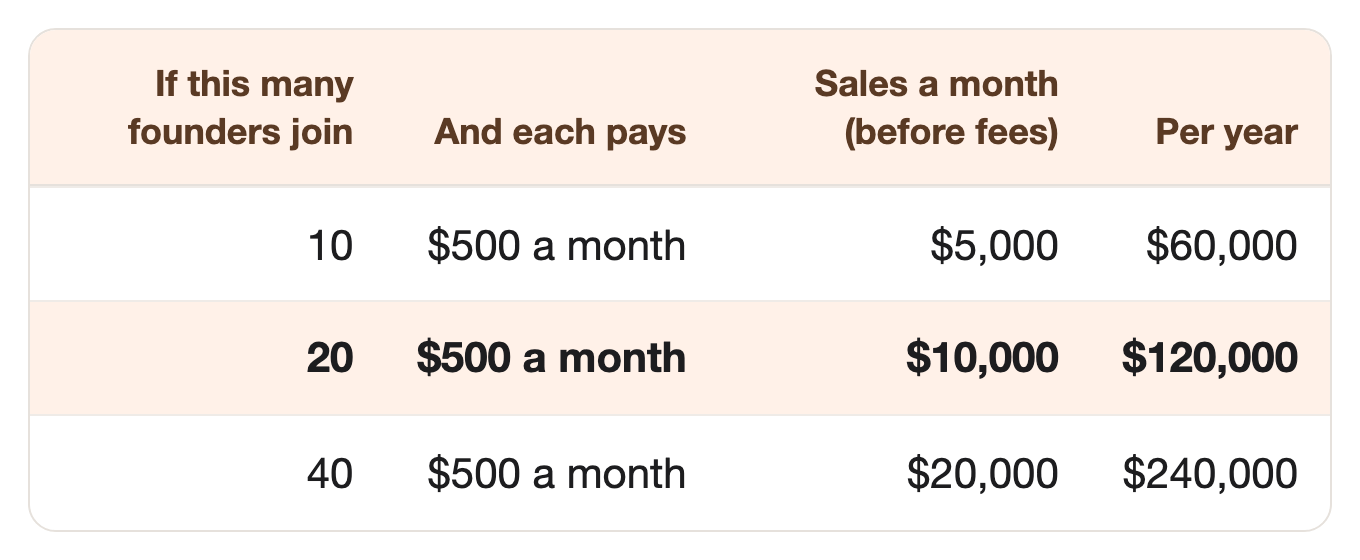
$500 a month is the price of Meredith’s club.
⠀20 members is half of 1% of the 4,000 companies funded each year.
And only about 1 in 6 Phase I proposals wins, so many more founders apply than win.
⠀
If it doesn’t work out, here’s all you lose:
$0 for the community space, if you start on a free plan.
One month’s subscription to an AI app, like ChatGPT or Claude.
One week of your time.
⠀
👉 Three ideas like this at $10,000 a month each make $360,000 a year, and pass a million in three years.
This club could be the first of those three.
Already picturing your first sale?
Keep going. The how-to is just below. 👇
Not this one? Next week brings a new one.
That’s it, my fellow contrarians! 🙌
Yours ‘helping you find ideas that already make money’ Vijay Peduru 🦸♂️
⠀
⠀
⠀
🧰 Want to build it? Here’s everything else.
⠀
Step 1: 🎯 Pick one agency and one kind of founder
Each agency runs SBIR its own way, so start with one.
Good news: you don’t need to cover every agency, just one.
Pick one agency.
NSF, for software, AI, and other startups built on new science or engineering.
Or the National Institutes of Health (NIH), for health and medical startups.
Or the Department of Defense, for hardware and defense tech.
Pick one kind of founder.
First-time founders applying for Phase I.
Or Phase I winners getting ready for Phase II.
Write it in one line, like “NSF Phase I for first-time AI founders.”
⠀
Step 2: 🛠️ Build the course
One short lesson for each part of the application, in the order founders write it.
Read the agency’s current call for proposals with Part 1 of the prompt.
Paste in the official text. The AI lists the parts, the page limits, the dates, and what reviewers judge.
Plan the lessons and the deadline calendar with Part 2.
One lesson per part of the application, with a worksheet for each.
Write the lessons with Part 3, in plain words, for an engineer who’s never seen a grant.
Record each lesson as a short screen-share video, with the worksheet beside it.
⠀
Step 3: 🔍 Check every lesson
Founders bet months of work on these lessons, so the AI checks every one twice after writing it.
Your AI does all three passes for you: it writes in Part 3, and checks in Parts 4 and 5 of the prompt.
🖊️ The AI writer. It writes each lesson from the agency’s official text that you pasted in.
🔍 The AI rules checker. A second pass checks every lesson against that text and the safety rules, and flags anything that doesn’t match.
🧐 The AI critic. A third pass reads it like a strict proposal reviewer, and like a confused first-time founder.
Then your partner who has won reads it, and fixes anything that doesn’t match real experience.
👉 The prompt already follows four safety rules:
Never promise an award, a score, or a win rate.
Never state a date, limit, or dollar amount that isn’t in the official text you pasted in.
Every lesson says: “Rules and dates change. Check the agency’s current call for proposals before you apply.”
Every lesson tells founders to check the agency’s rules on using AI in a proposal.
⠀
Step 4: 🏪 Open the club
Copy Meredith: one offer, one monthly price.
Set your price.
$500 a month, like the Global Grant Writers Collective.
Let members cancel any time.
What members get.
The course, the deadline calendar, and the worksheets.
Live group reviews of drafts, twice a month, like Meredith’s twice-monthly live coaching calls.
A draft checklist built from the agency’s review criteria, from Part 6 of the prompt.
Pick where to run it. Any community app with paid memberships and video calls works.
Let AI write your sales page with Part 7 of the prompt.
⠀
Step 5: 📣 Get your first members
Go where founders already learn about SBIR, and start with one deadline.
Co-host a free live session with a university’s startup office or a local small-business center.
Title it like “Read an NSF call for proposals in 30 minutes.”
You both keep the signup list.
Start a 20-person founding group for one deadline.
Invite the founders who signed up for your free session, all aiming at the same agency deadline, into one group chat.
Share one worksheet a week, and invite them to the club when it opens.
Pitch podcasts for science and hardware founders with one episode idea.
For example: “Three mistakes in first SBIR proposals, and how to fix them.”
Send the three talking points already written, so saying yes is easy.
Part 8 of the prompt writes the session pitch, the group invite, and the podcast pitch.
⠀
Step 6: 🏃 Eliminate competitors
If ten competitors copy you, here’s how yours stays ahead.
Have a real person answer every question.
“A founder who has won an SBIR award reads every question,” with their name and photo.
Meredith’s club promises answers from 6+ coaches within 36 hours.
Keep your best partner with you.
Sign the past winner who leads your reviews to a one-year deal, and introduce them to every member.
⠀
Step 7: 🎲 Make it bigger
Every agency, and every phase, is another club.
Add a Phase II track for members who win Phase I.
Open a second club for another agency, like NIH for health founders.
Each new club reuses the same prompt: change the agency in the INPUTS and run it again. 🎯
⠀
🗓️ Your first week
Phew. That was a lot. 😅
A first version of Steps 1 to 5 fits into seven days. 🚀
By day 7, you have your first lessons, a deadline calendar, a sales page, and your first invites out.
Quick heads-up: the prompt below has eight Parts, and they’re not the same as the Steps above.
Day 1 (Steps 1 and 2): Run Part 0 of the prompt (it’s below), and pick your agency and kind of founder.
Then read the official call for proposals with Part 1.
Day 2 (Step 2): Plan the lessons and the deadline calendar with Part 2.
Days 3–4 (Steps 2 and 3): Write the first lessons with Part 3, then check them with Parts 4 and 5.
Day 5 (Step 4): Build the draft checklist with Part 6, and write your sales page with Part 7.
Days 6–7 (Step 5): Write your session pitch, group invite, and podcast pitch with Part 8, and send them.
⠀
🏄 How to use the prompt
One prompt does all the AI work, in eight parts, plus a quick market check (Part 0).
Part 1 — Read the rules. Sums up the call for proposals you paste in: the parts, the limits, the dates, and what reviewers judge.
Part 2 — Plan the course. Plans one lesson per part of the application, plus a deadline calendar.
Part 3 — Write the lessons. Writes each lesson and its worksheet, in plain words.
Part 4 — Check the rules. Checks every lesson against the official text and the safety rules, and flags what doesn’t match.
Part 5 — Find the mistakes. Reads each lesson like a strict reviewer, and like a confused first-time founder.
Part 6 — Build the draft checklist. Turns the review criteria into a checklist for members’ drafts.
Part 7 — Write the sales page. Uses your real lessons as examples.
Part 8 — Write the first-member notes. Writes a live-session pitch, a founding-group invite, and a podcast pitch.
Run it your way:
Part by part (the default): it pauses after each part, and you type “next” to go on.
All at once: say “run all eight parts.”
Just one part: say “only do Part 3,” or any part you need.
The full prompt is just below, under “📋 The prompt.”
🎙️ Talk to your AI sidekick, don’t type.
Turn on voice mode, or use a dictation app like Wispr Flow.
Say it messy. The AI sorts it out.
Turn it into a skill, so you never paste it again.
Paste the prompt into Claude or ChatGPT, and say: “Turn this into a skill I can save.”
Install once, use forever.
⠀
📋 The prompt
The prompt (copy it into Claude or ChatGPT, fill in the INPUTS part, and run it your way)
CONTEXT:
- You're my course partner. Together we'll build a course plus a monthly club that helps tech founders apply for SBIR or STTR grants from one US government agency.
- This prompt has nine parts, Part 0 to Part 8, in order. "Run all eight parts" means Parts 1 to 8.
- Run it the way I ask:
    - If I say nothing, go one part at a time. After each part, show me the result, then stop and wait. Move on only when I type "next."
    - If I say "run all eight parts," do them all without stopping.
    - If I say "only do Part 3" (or any part), do just that part.
- If a part needs something from me, ask for it before you start that part.
- Follow these rules in every part:
    1. Never promise an award, a score, a win rate, or funding.
    2. Never state a date, deadline, page limit, or dollar amount that isn't in the official text I pasted in. If it's missing, say "check the agency's current call for proposals."
    3. End every lesson with: "Rules and dates change. Check the agency's current call for proposals before you apply."
    4. Tell founders to check the agency's rules on using AI in a proposal, and never to submit AI text they haven't checked and rewritten themselves.
    5. Never give legal, tax, or accounting advice. Point founders to the agency, or to a professional.
    6. Never invent a quote, a review, or a success story.
- Never invent a fact or a number. If you're not sure a fact is right, leave it out.
- Keep web search on for the whole prompt (turn on search in ChatGPT or Claude), so you can open any page you need to check.

=============== INPUTS — edit these, or just run as is ===============

The agency and program:
{e.g. NSF SBIR Phase I}

Who the club is for:
{e.g. first-time founders of AI software startups}

The official call for proposals (paste the full text, or the parts you have):
{e.g. the solicitation text from the agency's website}

Notes from founders who applied (paste what you found, or leave blank):
{e.g. founders' public posts about what went wrong, like "We didn't know what 'broader impacts' meant", "Our budget got sent back"}

My price:
{e.g. $500 a month, cancel any time}

======================== END OF INPUTS ========================

THE PARTS:

Part 0 — Check the market today.
This part needs web search (turn on search in ChatGPT or Claude). Search for help aimed at founders applying to SBIR or STTR (if I named an agency in INPUTS, focus on that one) and, for each place, give the count, the three biggest with links, and their prices:
1. Online courses on SBIR or STTR proposals.
2. Paid memberships, communities, or group coaching for SBIR applicants.
3. SBIR consultants and proposal-writing firms.
4. Free workshops from universities, state programs, and small-business centers.
5. AI tools that help write grant proposals.
Then tell me: early (few sellers), growing, or crowded, and which kind of founder looks least served (for example: first-time founders, a certain agency, Phase II applicants). Give a link for every number. If you can't open a page, say so. Never guess a number.

Part 1 — Read the rules.
Read the official call for proposals in my INPUTS. Using only that text, list:
1. Every part of the application, in order, with its page or word limit.
2. Every date and deadline.
3. What reviewers judge, in the agency's own words.
4. Who can apply, and the rules that knock an application out.
Quote the line each item comes from. Mark anything the text doesn't say as "not in the text."

Part 2 — Plan the course.
Plan one short lesson for each part of the application from Part 1, in the order a founder writes them. For each lesson give a title, the one thing it teaches, a worksheet idea, and the common mistakes from my founder notes. Then make a deadline calendar that works back from the deadline in Part 1, week by week. Mark any week that's your guess.

Part 3 — Write the lessons.
Write each lesson from Part 2 for an engineer who has never written a grant: a short script for a 5-minute screen-share video, then a one-page worksheet with questions the founder answers about their own project. Use only facts from the official text. Follow every rule in CONTEXT.

Part 4 — Check the rules.
Now act as a separate rules checker who didn't write these lessons. Check every lesson against the official text and each rule in CONTEXT, one by one. Mark each lesson: correct, needs a fix, or drop it. For each problem, quote the words and say which rule or which line of the official text they break. Then give a fixed version of every lesson that needs one.

Part 5 — Find the mistakes.
Now act as a strict proposal reviewer at the agency, then as a confused first-time founder. As the reviewer, flag anything that would teach a founder to write a weak or off-topic proposal. As the founder, flag any word or step that would confuse them. Then give the final lessons, with every fix made, and the line from rule 3 at the end.

Part 6 — Build the draft checklist.
Turn what reviewers judge, from Part 1, into a checklist for members' drafts. For each item: the question to ask of the draft, what a strong answer shows, and a common miss. Then write instructions for using it: the member pastes their draft, the official text, and this checklist into an AI app, gets a list of gaps, then brings the gaps to the live group review. The checklist flags gaps; it never scores the draft or predicts a win.

Part 7 — Write the sales page.
Ask me for two of my finished lessons first. Use them as examples. Never invent a result, a review, or a number. Give me:
1. A headline that names the agency and the kind of founder, not just "founders."
2. What members get: the course, the calendar, the worksheets, the draft checklist, and the live group reviews.
3. Who leads the reviews, with a blank for my partner's real background.
4. The price, shown up front, and "Cancel any time."
5. A plain line that says no one can promise an award.

Part 8 — Write the first-member notes.
1. A short note to a university startup office or a small-business center, offering a free co-hosted live session called "Read an [agency] call for proposals in 30 minutes." Both of us keep the signup list.
2. An invite to a 20-person founding group for one deadline: who it's for, the deadline, and one free worksheet a week.
3. A pitch to a deep-tech founder podcast for one episode, with three talking points already written.
Never promise funding or results in any of them.
⠀
📎 The sources
Every number above, with where it came from.
Learn Grant Writing’s revenue · Number: “$20,000 loss in December of 2020 alone”; “$1 million in annual recurring revenue (ARR) just two years later” · Source: Buffer, Open Books, Oct 2, 2023
Her club and price · Number: The Global Grant Writers Collective: “An online course, community, and coaching program priced at $500 per month” · Source: Same Buffer page
Early prices and turnaround · Number: “around $350 per student”, served “for a lifetime”; $7,000 loan from her dad; workshops made “about $20,000”, about 20% bought the course; tripled prices; “$7,000 in monthly recurring revenue in January 2021 and grew $4,000 in MRR every month”; “only six weeks of runway” · Source: Same Buffer page
Her start · Number: Grew up on a cattle ranch in Wyoming; software startup failed within three months; grant writing, “the exact job I’d pledged to never do again!”; “Within one year, I’d only made $2,000 in sales”; interviewed their ideal customer “20x over” in three weeks · Source: Canvas Rebel interview, July 10, 2023
$98,000 a month · Number: “$98K monthly recurring revenue in December 2022” · Source: Same Canvas Rebel page
The club in 2026 · Number: “600+ active members”; “$1.6 Billion In Grant Funding Won By Members Since 2020”; “twice-monthly live coaching calls”; “6+ coaches to answer your questions within 36 hours”; training for new, freelance, and in-house grant writers · Source: Learn Grant Writing, Wayback copy, July 6, 2026
SBIR in numbers · Number: “$4 Billion” funds invested each year; “4,000” average companies funded per year; “0%” equity or IP taken; “fewer than 500 employees” · Source: SBIR.gov, Wayback copy, July 24, 2026
Agencies, history, award sizes · Number: “11 participating federal agencies”; “Since 1982”; “As of April 2026”, Phase I up to $323,090 and Phase II up to $2,153,927 without SBA approval; support organizations “help startups identify and apply for awards” · Source: SBIR.gov About, Wayback copy, July 4, 2026
The lapse and the new law · Number: Authorization “had lapsed as of September 30”; signed the day before April 14, 2026; reauthorized “through 2031”; “significant security screening expansion, proposal submission caps,” and a “strategic breakthrough” award “allowing for larger award amounts” · Source: University of Washington Federal Relations, April 14, 2026
The law’s date · Number: S. 3971 “Signed by President” and “Became Public Law No: 119-83” on “04/13/2026” · Source: Congress.gov, all actions, Wayback copy, April 15, 2026
NSF pitches reopened · Number: New Project Pitches accepted under the new solicitations “beginning on Tuesday, June 2, 2026” · Source: NSF America’s Seed Fund, Wayback copy, June 2, 2026
Win rates · Number: National Phase I average “16%”; Proposal Lab participants “39%”; over 120 Maryland companies in 5 years; run with Maryland’s TEDCO and SBDC · Source: OST Global Solutions, Oct 9, 2023
SBIR reviewer’s course · Number: “Insights from an Experienced Reviewer”; “Buy $999.00”; “a Pandemic Recovery Discount off the regular price of $1299”; Nicole Toomey Davis, “over $1.2 million in funding from the NSF SBIR program” · Source: VentureWrench course page, Wayback copy, Oct 15, 2021
NSF video series · Number: “Independent Learner Price: $150.31 per person”; covers the project pitch through the budget · Source: CITI Program, Wayback copy, May 18, 2026
University SBIR course · Number: An online SBIR/STTR course for entrepreneurs and researchers · Source: University of Tennessee Research Foundation, Wayback copy, July 12, 2026
AI grant tool · Number: “140,000+ grants from 144 sources”; “Section-by-section AI drafting”; “Small Businesses & SBIR Applicants”; “Personalized letters of inquiry” · Source: Granted AI, Wayback copy, July 12, 2026