


Hello contrarians,
Today’s idea is called The Personal Trainer Contract Kit.
Grab a coffee. ☕
First, a lawyer’s story. Then, the business you could build from it.
⠀
⚡ Quick facts
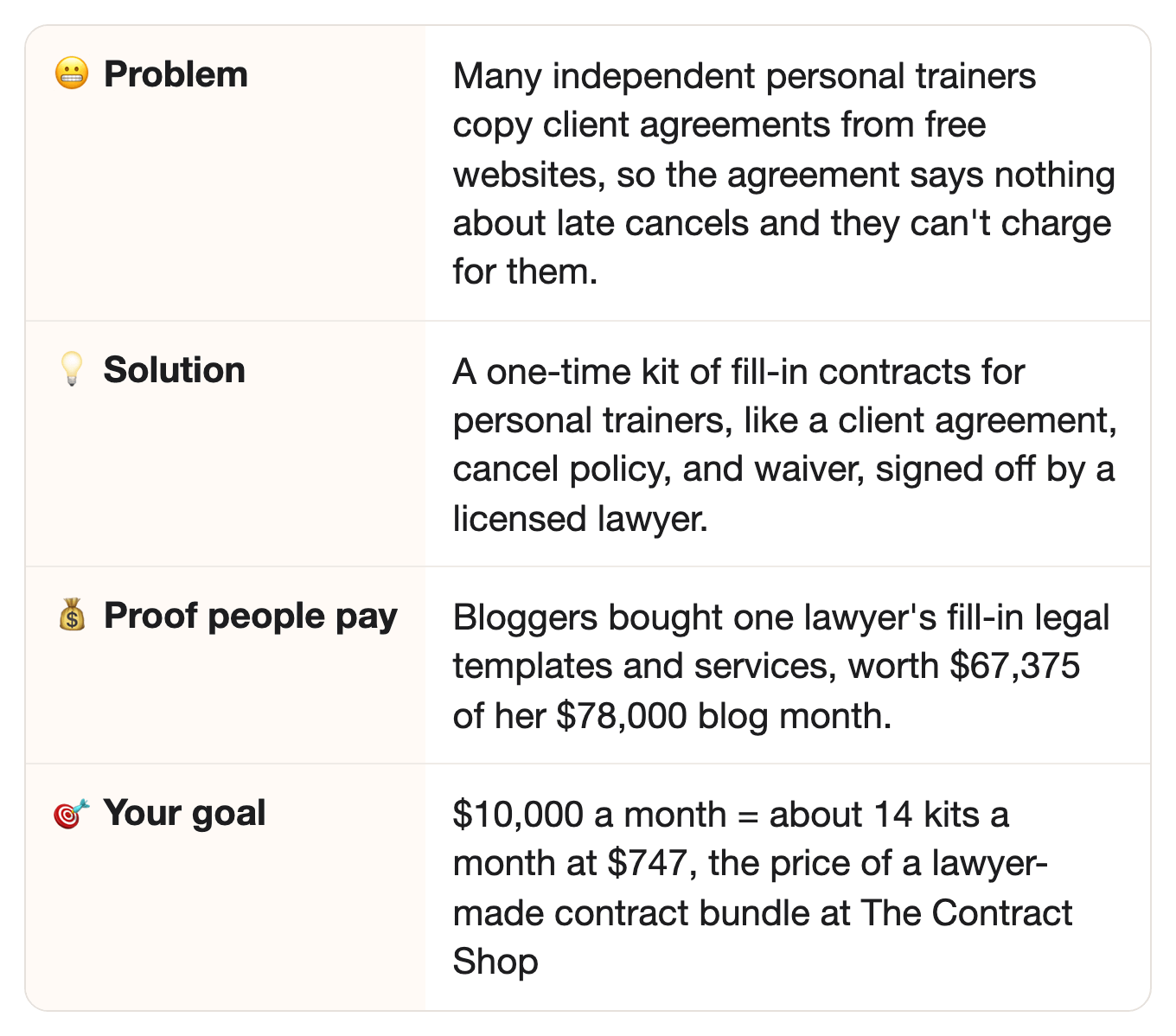
⠀
📖 How one lawyer turned her contracts into a $78,000 blog month
She started because her dad got sued.
Amira Irfan watched her dad’s business get sued for $90,000 over a legal mistake.
So she became a lawyer, to help business owners avoid mistakes like his.
Oh, and she also owed $150,000 in law school loans.
She said each month it felt like paying a second mortgage.
Ouch.
⠀
On the side, she started a blog for online business owners.
Then bloggers started hiring her, one by one, to write the legal pages for their websites.
Things like a privacy policy and a disclaimer.
The catch? She could only help a few people a day.
So she turned her work into fill-in templates that anyone could download and use.
⠀She launched them to her email list, which had 500 people on it.
And on day one, she made $2,000 from that list and her Facebook group.
Then came the hard part: 14-hour days, on top of her full-time job as a lawyer.
She says she wanted to give up and go back to just the day job.
⠀
In 2022, she published an income report: $78,000 in a single month.
An income report is a blog post where she shows readers what she earned that month, and where it came from.
Fine print: that $78,000 was her whole blog.
$67,375 of it came from her legal templates and legal services.
The rest came from things like affiliate links and sponsored posts.
One day alone brought in over $11,000, she wrote, about what she made in a month as a lawyer.
So she quit her 9-to-5 job.
Yahtzee! 🎲
She went from $150,000 in law school loans, to a $78,000 blog month, by turning her one-on-one legal work into templates.
⠀
🔗 Same idea, new group
In the story: bloggers and online business owners paid Amira for fill-in legal pages, like a privacy policy and a disclaimer.
⠀In this idea: independent personal trainers need fill-in contracts and policies for signing up their own clients.
⠀Why it carries over: both need the same few papers, and one lawyer’s template can serve many buyers without a one-on-one meeting.
⠀
💡 The opportunity
Personal trainers sign up clients every week, and many use contracts they copied from somewhere.
First, who are independent personal trainers?
They’re the people who coach you one-on-one, in a gym, at your home, or online.
Many work for themselves, so nobody hands them a contract.
They set their own prices, packages, and cancel rules.
⠀
There are a lot of them.
Fitness trainers and instructors held about 370,100 jobs in 2024.
14% of them were self-employed: about 51,800 people, by our math.
⠀
And new ones start every year. 🔁
About 74,200 fitness trainer and instructor job openings are expected each year (a government projection).
A job opening is a trainer job someone needs to fill, either a new job or one someone left.
⠀
Every one of them needs the same few papers.
A client agreement: what’s included, what it costs, and how to pay.
A cancellation and package policy: what happens to a missed session or an unused package.
A package is a set of sessions a client pays for up front, like 10 sessions for one price.
A health form and a waiver, before the first workout.
The health form asks about injuries and health problems, so the trainer knows what to avoid.
The waiver is a form where the client agrees that exercise carries a risk of getting hurt.
So why does this matter?
Once a client signs a cancel policy, the trainer has it in writing that late cancels get charged.
Without the paper, she just loses the hour.
⠀
Here’s the safe part: a licensed lawyer writes or reviews and signs off on every template.
Why a lawyer?
Because a contract only helps if it holds up when a client argues against it, and knowing what holds up is a lawyer’s job.
Signing off means the lawyer reads the final version and approves it, with their name on it.
That name is why a trainer trusts the kit enough to pay for it.
Every page says plainly that it’s a template, not legal advice.
That means the lawyer wrote a solid version for trainers in general, but hasn’t looked at one trainer’s own business.
Rules for lawyers who sell templates aren’t the same everywhere, so your lawyer checks their own state’s rules first.
⠀
👉 The idea: sell independent personal trainers one kit of lawyer-signed, fill-in contracts and policies, made just for how trainers work.
⠀
🙋 Not a lawyer? You can still build this, with one.
Team up with a licensed lawyer.
The lawyer writes or reviews every template, and signs off before anything is sold.
You build the shop, write the guides, and find the buyers.
⠀
Already a lawyer? Pick a business you know.
Maybe you train clients yourself, or your family runs a gym.
Then you already know what they argue with clients about.
⠀
Or use your own field.
Know photographers, dog groomers, or yoga teachers well?
Then it’s the same kit, with the same rule: a lawyer signs off on every template.
⠀
✅ Why this could work
Why this one can work, in three points.
Amira isn’t the only lawyer selling templates.
Christina Scalera was a trademark lawyer who wrote a contract for a photographer friend.
And the friend told her to sell it.
So in 2015, The Contract Shop opened.
Its 2021 revenue was over $500,000, and it was sold in 2022.
⠀
Lawyers already make kits for one kind of business.
Amira, from the story, made an Interior Design Contract Bundle “just for interior designers,” with five templates.
The Contract Shop sells a Commercial Photography Foundations Bundle for $747.
⠀
Do-it-yourself legal papers aren’t going anywhere.
Nolo, a publisher of self-help legal guides, was founded in 1971.
People have bought fill-in legal papers for more than 50 years, and they still do.
⠀
👉 Want to check these numbers? Each one has a source link in the last section, “📎 The sources.”
⠀
📊 More proof people want this
Want more? Here you go.
People already pay for lawyer-written templates.
The Contract Shop sells one coaching contract template for $495.
Yep, $495 for a single contract.
And the shop made over $500,000 in 2021.
⠀
Partners can bring a big share of sales.
Affiliates are partners who earn a share of each sale they send.
At The Contract Shop, affiliates brought in one-third of sales.
⠀
Amira says she sells to a big crowd.
She has 25 legal templates in her store.
She says they’re “trusted by more than 50,000 entrepreneurs.”
⠀
Big legal sites already offer a trainer contract.
Rocket Lawyer is a large online legal-documents site.
It has had a personal training agreement page since at least 2020.
⠀
The number of trainers is big, and it’s growing. 💰
Trainer jobs are projected to grow 12% from 2024 to 2034.
That’s much faster than the average job, the same government page says.
⠀
👉 Trainers need these papers from their first client.
And there are more of them every year.
⠀
🔍 Who’s already doing it
A few big names, and a clear gap next to them.
The Contract Shop sells to creative businesses.
Its menu lists coaches, photographers, designers, consultants, and weddings.
When we checked, it had no section for personal trainers.
⠀
Amira sells to online business owners.
That means bloggers, coaches, freelancers, and interior designers.
⠀
Rocket Lawyer has one general training agreement.
It’s just one document, though, not a full kit with a fill-in guide made for trainers.
⠀
Free template sites are everywhere.
But they give a blank form, with no lawyer’s name on it and no yearly updates.
⠀
Missing from all four, when we checked:
A full kit for independent trainers: the agreement, the cancel and package policy, the health form, the waiver, and online coaching terms.
Signed off by a named, licensed lawyer, and updated every year.
⠀
🔎 Check the market yourself in 2 minutes: run Part 0 of the prompt in the build plan below.
Etsy is a website where small shops sell digital files.
Your AI searches Etsy, legal template stores, and big legal sites that day, and tells you: early, growing, or crowded.
Early? Start now.
Crowded? Good news: it means people pay. Pick one narrower kind of trainer (Step 1 of the build plan).
A crowded market is still OK. You win by serving one kind of business better, not by being first.
⠀
👉 That’s the part nobody else offers.
A lawyer-signed kit made just for independent personal trainers, updated every year.
⠀
🤖 Why AI won’t replace it
Could ChatGPT just write a trainer contract? Sure, in seconds. But it can’t put a lawyer’s name on it, or know which clauses trainers argue with clients about. Your kit has both.
🔮 Honest note: a trainer can ask ChatGPT for a client agreement.
So the words alone aren’t the product.
The product is a lawyer’s name on it, and clauses picked for how trainers really work.
A clause is one rule inside a contract, like “cancel less than 24 hours ahead and you pay for the session.”
⠀
1. Trust.A licensed lawyer wrote or reviewed every template, and signed off on it.
A trainer can’t tell which clause is missing from a draft. A lawyer can.
⠀
2. You know what matters.You know what trainers argue with clients about: late cancels, no-shows, unused packages, refunds.
But how many busy trainers have an hour to explain it to an AI?
Not many.
⠀
3. A finished kit.A whole kit, with a fill-in guide that says what to change and where.
Amira says her templates take about 15 minutes to fill in.
⠀
4. Kept up to date.Rules and business habits change, so the kit gets a yearly update.
⠀
5. Proof people pay for this, even with free templates around: The Contract Shop sells one lawyer-written contract for $495.And free ones are easy to find: Rocket Lawyer’s training agreement page title starts with “Free Personal Training Agreement.”
⠀
👉 They pay for a lawyer’s signature, not just the words.
⠀
💵 How much you can make
Grab a calculator. Just kidding, here it is.
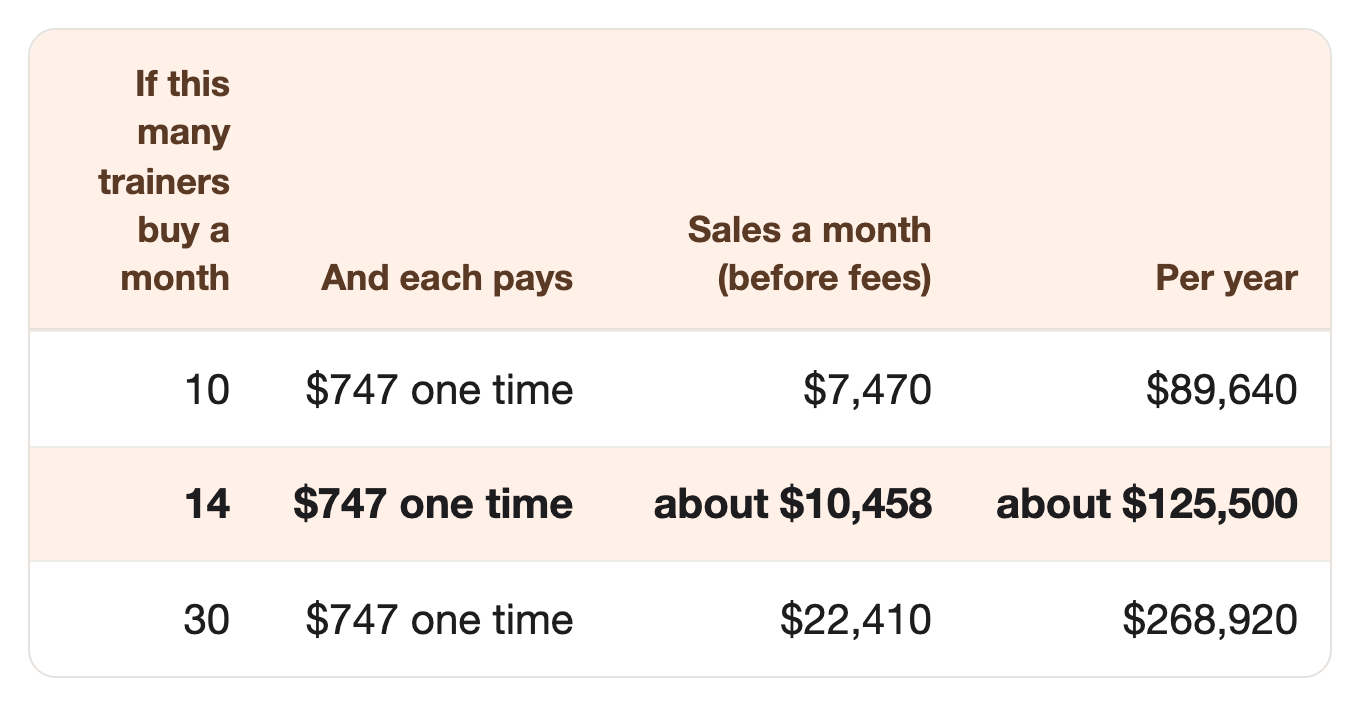
At $747, The Contract Shop’s photography bundle price, 14 kits a month bring in about $10,000.
⠀14 kits a month is 168 a year, under 1% of a single year’s trainer job openings.
⠀Your lawyer gets paid from this too. So agree on a split or a fee before you start.
⠀And if it doesn’t work, here’s everything you lose:
The lawyer’s time, if you agreed to pay for it up front.
One month’s subscription to an AI app, like ChatGPT or Claude.
A few weeks of your evenings.
⠀
👉 Three ideas like this at $10,000 a month each make $360,000 a year, and pass a million in three years.
Already picturing your first sale?
Keep going. The how-to is just below. 👇
Not this one? Next week brings a new one.
That’s it, my fellow contrarians! 🙌
Yours ‘finding you small niches with real money in them’ Vijay Peduru 🦸♂️
⠀
⠀
⠀
🧰 Want to build it? Here’s everything else.
⠀
Step 1: 🎯 Pick one kind of business, and your lawyer
Find your lawyer first, then pick one kind of trainer and learn what goes wrong with their clients.
Good news: you don’t have to be the lawyer.
You just need to find one, and know who the kit is for.
Find your lawyer first.
A licensed lawyer who writes or reviews every template and signs off before you sell.
Agree in writing on who owns the templates, and how the money is split.
Ask them to check their own state’s rules on selling templates.
Pick one group, not all small businesses.
In-person trainers who sell session packages.
Online coaches who train clients by app or video.
Trainers who work in clients’ homes.
Learn what goes wrong.
Trainers already post online about clients who cancel late, skip payments, or want a refund.
Part 1 of the prompt reads those posts on trainer forums for you, and lists what clients argue about most.
⠀
Step 2: 🛠️ Draft the kit
Your AI writes the first drafts. Your lawyer checks them, fixes them, and signs off.
Think of the AI as the fast typist, and the lawyer as the boss.
List the papers. Part 1 of the prompt lists every document the business needs, and what each one covers.
Draft each template. Part 2 writes first drafts with fill-in blanks, marked “DRAFT, for lawyer review.”
Keep the words plain. A trainer should understand every line without a dictionary.
⠀
Step 3: 🔍 Check it, then the lawyer signs off
No template is sold until a licensed lawyer has signed off on it.
Your AI does the first check in Part 3 of the prompt.
It reads each draft like a careful reviewer, then like a confused trainer.
It flags anything that may depend on the state, and builds a question list for your lawyer.
🧑⚖️ Your lawyer reviews and signs off. They rewrite whatever needs it. AI never has the last word.
👉 The prompt already follows four safety rules:
Every template says it’s not legal advice.
It never states a state’s law as a fact.
It never promises a template will hold up in court.
Every draft stays marked “for lawyer review” until your lawyer signs off.
⠀
Step 4: 🏪 Open the shop
Copy The Contract Shop: one bundle, one clear price.
Easy one: you already know the price to start with.
Set your prices.
$747 for the full kit, like The Contract Shop’s photography bundle.
Single templates for less, for trainers who need just one.
Pick where to sell. Etsy, Gumroad, or your own website all sell downloads.
Add the fill-in guide from Part 4, so a trainer can finish the kit in one sitting.
Let AI write your sales page with Part 5, using your lawyer’s name and your real template list.
⠀
Step 5: 📣 Get your first buyers
Go where trainers already shop and read.
On Etsy, name each listing the way trainers search.
For example: “Personal trainer client agreement template, lawyer-written.”
Put the job’s words first, then what’s inside.
Write one free guest post for a fitness-business blog or newsletter that trainers read.
For example: “The five papers a new independent trainer needs,” in general terms.
End with one line about your kit.
Let fitness-business coaches and trainer educators earn a share of every kit they sell.
They pay nothing up front, and neither do you.
At The Contract Shop, partners like these brought in a third of sales.
⠀
Step 6: 🏃 Eliminate competitors
If ten competitors copy you, here’s how yours stays ahead.
When the yearly edition adds templates, raise the price openly and say what’s new.
List what you added, and why the price went up.
Never take pages out of a kit someone already bought.
When the yearly edition comes out, give past buyers a discount on it.
They come back every year, and a copycat starts with nothing.
⠀
Step 7: 🎲 Make it bigger
Every small business that signs up clients needs the same kind of kit.
Open the same kit for other businesses: yoga teachers, dog trainers, or swim coaches.
Three kits at about $10,000 a month each is about $360,000 a year, before fees and the lawyer’s share. 🎯
⠀
🗓️ Your first week
A first version of Steps 1, 2, 4, and 5 fits into seven days. 🚀
Step 3, the lawyer’s sign-off, takes as long as your lawyer needs.
By day 7, you have drafts on your lawyer’s desk, a fill-in guide, a sales page, and your first listings ready.
The prompt below has six Parts, and they’re not the same as the Steps above.
⠀
1. Day 1 (Step 1): Start looking for your lawyer, run Part 0 of the prompt (it’s below), and pick your kind of trainer.Then list the papers with Part 1.
2. Days 2–3 (Step 2): Draft the templates with Part 2.
3. Day 4 (Step 3): Check the drafts with Part 3, and send them with the question list to your lawyer.
4. Day 5 (Step 4): Write the fill-in guide with Part 4.
5. Day 6 (Step 4): Write your sales page with Part 5.
6. Day 7 (Step 5): Write your listings, guest post, and partner note with Part 6.
⠀
🏄 How to use the prompt
One prompt does all the AI work, in six parts, plus a quick market check (Part 0).
Part 1 — List the papers. Lists every document your kind of trainer needs, and what each one covers.
Part 2 — Draft the templates. Writes first drafts with fill-in blanks, marked for lawyer review.
Part 3 — Check the drafts. Reads them like a careful reviewer and a confused trainer, flags state-dependent clauses, and builds a question list for your lawyer.
Part 4 — Write the fill-in guide. Explains, in plain words, what the trainer changes and where.
Part 5 — Write the sales page. Uses your lawyer’s name and your real template list.
Part 6 — Write the growth pieces. Writes Etsy listing titles, a guest post outline, and a note to partners.
Run it your way:
Part by part (the default): it pauses after each part, and you type “next” to go on.
All at once: say “run all six parts.”
Just one part: say “only do Part 3,” or any part you need.
The full prompt is just below, under “📋 The prompt.”
🎙️ Talk to your AI sidekick, don’t type.
Turn on voice mode, or use a dictation app like Wispr Flow.
Say it messy. The AI sorts it out.
Turn it into a skill, so you never paste it again.
Paste the prompt into Claude or ChatGPT, and say: “Turn this into a skill I can save.”
Install once, use forever.
⠀
📋 The prompt
The prompt (copy it into Claude or ChatGPT, fill in the INPUTS part, and run it your way)
CONTEXT:
- You're my drafting partner. Together we'll build a kit of fill-in contracts and policies for one kind of small business (independent personal trainers, or the group I name below).
- A licensed lawyer on my team will review, rewrite, and sign off on every template before anything is sold. Your drafts are first drafts for that lawyer, never the final product.
- This prompt has a quick market check (Part 0), then six parts, in order. "Run all six parts" means Parts 1 to 6.
- Run it the way I ask:
    - If I say nothing, go one part at a time. After each part, show me the result, then stop and wait. Move on only when I type "next."
    - If I say "run all six parts," do them all without stopping.
    - If I say "only do Part 3" (or any part), do just that part.
- If a part needs something from me, ask for it before you start that part.
- Follow these rules in every part:
    1. Never call anything legal advice, and never write as if you are the buyer's lawyer.
    2. Never state what a state's or country's law says as a fact. Write "[CHECK WITH LAWYER: state rule]" instead.
    3. Never promise that a template will hold up in court or protect anyone from every claim.
    4. Never invent a law, a court case, a fee, or a number.
    5. Mark every template "DRAFT, for lawyer review" at the top.
    6. Use plain words a busy trainer understands. Explain any legal term in a few words.
- End every template and guide with this line: "This template is not legal advice. Have a licensed lawyer in your state review it for your business."
- Never invent a fact or a number. If you're not sure a fact is right, leave it out.
- Keep web search on for the whole prompt (turn on search in ChatGPT or Claude), so you can open any page you need to check.

=============== INPUTS — edit these, or just run as is ===============

Who the kit is for:
{e.g. independent personal trainers who sell session packages, in-person and online}

Where my buyers work (states or countries):
{e.g. the United States, starting with California and Texas}

What clients argue about (leave blank, and Part 1 will look it up):
{e.g. late cancels, unused packages, refunds after an injury}

My lawyer's name and state of license:
{e.g. Jane Doe, licensed in Texas}

My prices:
{e.g. $747 for the full kit, single templates for less}

======================== END OF INPUTS ========================

THE PARTS:

Part 0 — Check the market today.
This part needs web search (turn on search in ChatGPT or Claude). Search for legal templates and contract kits for my kind of business and, for each place, give the count, the three biggest with links, and their prices:
1. Etsy and Gumroad shops selling contract or waiver templates for this business.
2. Lawyer-run template stores, and whether they have a section for this business.
3. Big legal-document sites with a template for this business.
4. Free template pages for this business.
Then tell me: early (few sellers), growing, or crowded, and which kind of buyer in this business looks least served (for example: online coaches, in-home trainers, trainers who sell packages). Give a link for every number. If you can't open a page, say so. Never guess a number.

Part 1 — List the papers.
First, if the "What clients argue about" input is blank, search trainer forums and fitness-business sites for what trainers say clients argue about (late cancels, no-shows, unused packages, refunds), and list the top problems with a link for each. Then list every document my kind of business needs to sign up and work with clients. For each one, give its name, what it covers in two lines, when the buyer uses it, and which parts may depend on the state. Base the list on my INPUTS. Say clearly which items are your suggestion. Then give me a short list of questions to ask my lawyer before drafting.

Part 2 — Draft the templates.
Draft each document from Part 1 as a fill-in template:
1. "DRAFT, for lawyer review" at the top.
2. Blanks in [BRACKETS] for everything the buyer fills in, like [BUSINESS NAME] and [SESSION PRICE].
3. Short sections with plain headings.
4. A plain-words note under each section saying what it does.
5. "[CHECK WITH LAWYER: …]" wherever a rule may depend on the state.
Follow every rule in CONTEXT.

Part 3 — Check the drafts.
Now act as a careful reviewer who didn't write these drafts, then as a confused trainer. As the reviewer, flag missing topics, unclear words, blanks that are missing, and anything that sounds like a promise or advice. As the trainer, flag any word or step you wouldn't understand. Then give me:
1. A fixed version of each draft, still marked "DRAFT, for lawyer review."
2. A numbered question list for my lawyer, one question per state-dependent clause or open issue.

Part 4 — Write the fill-in guide.
Write a plain guide the buyer reads before filling in the kit:
1. Which document to use when.
2. Every blank, what to put in it, and one example.
3. What never to change without a lawyer.
4. The line from CONTEXT at the end.

Part 5 — Write the sales page.
Ask me for my lawyer's name, state of license, and the final template list first. Never invent a result, a review, or a number. Give me:
1. A headline that names my kind of business.
2. What's in the kit, one line per document.
3. Who wrote and signed off on it: my lawyer, by name.
4. The prices, shown up front.
5. A plain "This is not legal advice" box near the top.

Part 6 — Write the growth pieces.
1. Five Etsy listing titles that start with the words my buyers search, like "personal trainer client agreement template."
2. An outline for a free guest post, "The papers a new [business] needs," in general terms, with one line about my kit at the end. No legal advice, no state rules stated as facts.
3. A short note to fitness-business coaches and trainer educators, inviting them to earn a share of each kit they send. Never promise them sales.
⠀
📎 The sources
Every number above, with where it came from.
Amira’s start · Number: Dad’s business “sued for $90,000”; “$150,000 in law school student loans”; drafted legal pages one-on-one and “could only help a few people per day”; 500 people on her email list; “$2000” on launch day; 14-hour days on top of her full-time job; “I wanted to give up and return to my regular 9-to-5 lawyer job”; “allowing me to quit my 9-to-5 job as a lawyer” · Source: Course Method interview, August 11, 2022
Her $78,000 month · Number: “$78,000 in one month”; “$67,375 from my legal templates and services”; “another $11,000” from affiliate marketing, sponsored posts, paid gigs, coaching, and audits; “over $11,000 in ONE day (which I was making as a lawyer in ONE month)”; “25 legal templates”; “trusted by more than 50,000 entrepreneurs”; “15 minutes to complete” · Source: A Self Made Lawyer, blog income report, published July 6, 2022, updated February 28, 2025, archived January 28, 2026
Interior design bundle · Number: “made just for interior designers”; “5 different legal templates” · Source: A Self Made Lawyer, legal templates page, archived December 24, 2025
The Contract Shop’s story · Number: Founded 2015; sold 2022; “2021 annual revenue was over $500,000”; a contract template for a photographer friend; affiliates “accounting for one-third of their sales” · Source: They Got Acquired, May 25, 2023
The Contract Shop’s prices and menu · Number: Commercial Photography Foundations Bundle $747; Coaching Contract Template $495; “Since 2015”; menu: coaches, consultants, designers, photographers, weddings; “is not a law firm. Nothing on this website is legal advice” · Source: The Contract Shop, archived August 9, 2026
Trainer jobs · Number: About 370,100 jobs in 2024; 14% self-employed; about 74,200 openings (fitness trainers and instructors) projected each year; 12% growth projected 2024–2034, “much faster than the average” · Source: US Bureau of Labor Statistics, 2024 edition, archived July 30, 2026
Self-employed trainers · Number: 14% of 370,100 = about 51,800 · Source: Same BLS page (our math)
Rocket Lawyer · Number: A personal training agreement page; its title starts “Free Personal Training Agreement”; archived September 30, 2020 · Source: Rocket Lawyer
Nolo · Number: Self-help legal publisher, founded 1971 · Source: Wikipedia, Nolo (publisher), archived July 29, 2026