


Hello contrarians,
Today’s idea is called The Working Designer’s Newsletter.
Get comfy. 🛋️
First, a marketer’s story. Then, the business you could build from it.
⠀
⚡ Quick facts
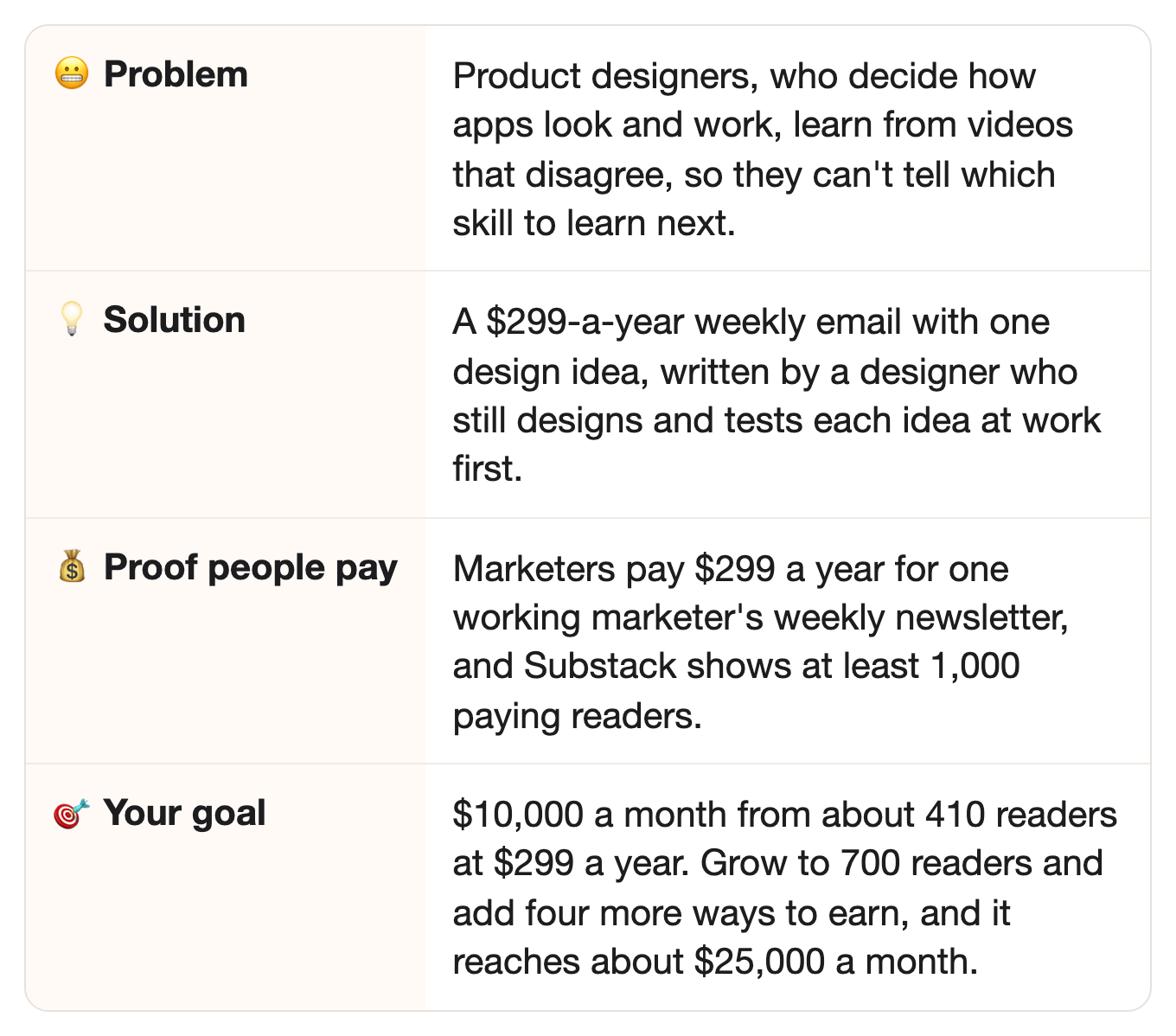
⠀
📖 How one marketer turned his Saturdays into a $299 newsletter
It started with a joke tool and a waitlist.
Tom Orbach works full-time in marketing, at tech companies.
Back in 2022, he built a joke tool called the Viral Post Generator.
It wrote cringey LinkedIn posts… and over 2 million people used it.
Then a company called Taplio bought it, about a week after launch.
A joke that paid off.
So what did he do with that money?
He bought a domain (a website name): MarketingIdeas.com.
Every time he spoke at a conference, he told people to join the waitlist on MarketingIdeas.com.
Funny part: he didn’t even know what it would become.
In August 2023, his first email went out to about 1,000 people.
⠀Spot the pattern: every idea he sends, he tests at his day job first.
He writes on Saturdays only, one day a week.
In his words: “Without my full-time job, I would have never succeeded in my newsletter.”
After one year, he had 52 issues and more than 17,800 subscribers.
Now here’s the surprising part.
For almost two years, he sold nothing: no ads, no products.
⠀
Then, in mid-2025, he opened a paid tier, a paid version with extra issues for paying readers.
More than 500 people paid in the first few days.
And he made over $50,000 in the first month.
When we checked, Substack showed “Thousands of paid subscribers,” at $299 a year or $29 a month.
Substack’s badge says “thousands,” so at least 1,000.
Oh, and that day job?
He says he leads a growth marketing team at Google.
Jackpot! 🎰
1,000 readers at $299 is about $299,000 a year, from one day a week, without quitting his job.
He went from a joke tool and a waitlist, to thousands of paying readers, by testing each idea at work before he wrote it up.
⠀
🔗 Same idea, new group
In the story: marketers paid Tom Orbach $299 a year for marketing ideas he tests at his day job first.
⠀In this idea: product designers get one design idea a week, tested at a real design job.
⠀Why it carries over: people pay for ideas from someone who still does their job and has tested each idea at work.
⠀
💡 The opportunity
Tom’s pattern is simple: a paid weekly letter about the job you still do. Product designers need their own.
First, what’s a product designer?
It’s the person who decides how an app or website looks and works.
Where the buttons go, what happens when you tap, and why the sign-up has three steps, not seven.
They work next to product managers and engineers.
⠀
Why this job? The other jobs already have their big newsletter.
Product managers have Lenny’s Newsletter.
Engineers have The Pragmatic Engineer.
Marketers? They have Tom.
Each of those has thousands or tens of thousands of paying readers.
And the product-design newsletters we checked on Substack?
They showed hundreds.
⠀
Their tools keep changing.
New AI design tools keep coming out.
And a designer two years in doesn’t know which skill to learn next.
⠀
Here’s the easy part: if you’re a designer, you already have the material.
Every week at work, you try things that other designers wonder about.
What worked becomes your issue.
👉 The idea: a paid weekly newsletter for product designers, written by a designer who still designs.
Each issue: one idea you tested at work, in a 3-minute read, with a made-up example.
Free readers get one idea a week. Paid readers also get a premium idea every week, plus the archive.
Check your employment contract first. Some contracts limit side work, or writing about your job.
Never share confidential work. No company names, real screens, numbers, or unreleased products.
Tom’s own page says his opinions are his own. Say the same.
⠀
🙋 Not a product designer yourself? You can still build this.
Become the interviewer.
Interview one working designer a week about one thing they tested, with their permission.
Each interview becomes an issue, and they share it with their own followers.
⠀
Team up with one.
A working designer brings the tests and the know-how.
You write, build the newsletter, and find the readers.
⠀
Or use your own job.
Are you a UX researcher (who studies how people use apps), a content designer, or a technical writer?
Then write this kind of newsletter about your own job.
The steps don’t change.
⠀
✅ Why this could work
Here’s why people will pay for this.
Newsletters about one job already make serious money.
Marketing Ideas, Tom’s newsletter for marketers, has thousands of paid subscribers at $299 a year.
Lenny’s Newsletter, for product managers and founders, has “tens of thousands of paid subscribers,” at $200 a year.
The Pragmatic Engineer, for software engineers, has tens of thousands too, at $150 a year.
And MKT1, by Emily Kramer, for startup marketers, has thousands, at $144 a year.
⠀
The need has been there since at least 2013, and it still is.
Lenny’s Newsletter has run since June 2019.
Don’t Make Me Think, a classic design book, had its 3rd edition in 2013.
And when we checked, Amazon listed a 4th edition, dated December 2026.
So designers keep buying the basics.
Plus, the US government projects about 13,600 openings a year for web developers and digital designers together.
⠀
Companies often pay for it.
The Pragmatic Engineer’s page says: “Many subscribers expense this newsletter.”
So the reader isn’t always the one paying.
More proof comes next.
⠀
👉 Like to check the numbers yourself? The links are all in “📎 The sources,” at the very end.
⠀
📊 More proof people want this
Want more? Here you go.
Designers already pay for design newsletters.
UX Mentor Diaries is a design career newsletter on Substack.
It shows “hundreds of paid subscribers,” at $250 a year.
UX Movement Newsletter, another design newsletter there, shows hundreds too, at $188 a year.
⠀
And they buy the classic design books.
Don’t Make Me Think, Revisited has about 4,600 Amazon ratings, at $21.46.
⠀
They search Google for the job every month.
“product designer” gets 6,600 searches a month in the US.
“ux design portfolio” gets 2,400.
⠀
And they sign up to learn it.
1,568,271 people worldwide have signed up for Google’s UX design certificate on Coursera, an online course site, all-time.
It costs $49 a month in the US, after a free week.
That’s a lot of sign-ups.
⠀
The big picture: the US has about 132,700 web and digital interface designers. 💰
That’s the government’s closest count of the people who design how apps and websites look and work.
Their median pay, the one in the middle of the pay range, is $104,000 a year.
So $299 is a small cost next to a $104,000 salary.
⠀
What one designer says: “I’m so lost, I don’t know where to evolve”
That’s a UI designer, who designs app screens, commenting under a YouTube video about AI and design jobs.
Oof.
⠀
What another says about new designers: “freshers (0–2 yrs) are stuck between building fundamentals, learning AI tool, or mastering a niche.”
⠀And one more: “There are so many videos on YouTube that it gets a bit confusing about what to follow in 2026.”
⠀
👉 They don’t need more videos.
They need one designer they trust, who tells them what to learn, every week.
⠀
🔍 Who’s already doing it
Who’s in the space, and what they skip.
Tom Orbach, from the story above, writes for marketers, and he’ll likely stay there.
His know-how is all about marketing.
And design is a different job.
⠀
Lenny’s Newsletter and The Pragmatic Engineer serve product managers and engineers.
Both are big paid newsletters on Substack.
Designers read them, sure, but the issues are written for other jobs.
⠀
Product-design newsletters exist, and people pay for them.
Design Better has run since 2017, at $72 a year.
UX Movement charges $188 a year, and UX Mentor Diaries $250.
When we checked, each showed “hundreds of paid subscribers” on Substack.
⠀
What’s missing, when we checked:
A product-design newsletter in Substack’s Design category with thousands of paying readers.
Written by a designer still doing the job, every week.
One idea a week, tested at work first, like Tom’s.
⠀
🔎 Check the market yourself in 2 minutes: run Part 0 of the prompt in the build plan below.
Your AI searches Substack, Medium (a blogging site), YouTube, and LinkedIn that day, and tells you: early, growing, or crowded.
Early? Start now.
Crowded? Good news: it means people pay. Pick one narrower group of designers (Step 1 of the build plan).
A crowded market is still OK. You win by serving one group better, not by being first.
⠀
👉 You can be the one to fill that gap: a design newsletter with thousands of paying readers, by a designer still doing the job.
⠀
🤖 Why AI won’t replace it
AI knows what’s already been written. You know what worked in your own job.
You run real tests.
Each issue is something you tried in a real job, with what happened.
AI is great with what’s already been written, but it can’t run a test inside your job.
⠀
You pick what matters.
A designer two years in doesn’t know which new tool matters.
You tell them what you use, what you dropped, and why.
⠀
They already know and trust you.
They’ve read you for months, and you’re still in the job.
ChatGPT has never shipped a design.
⠀
Ready to use: one idea, three minutes.
A made-up before and after, and the steps to try on Monday.
ChatGPT can pick the best option once told what worked in practice.
You’re the one who tried them.
⠀
Other people.
Paid readers get a group chat with you and other designers.
⠀
Proof people pay for this: marketing advice is free everywhere.
And still, thousands pay for Tom’s $299-a-year newsletter.
One reader quoted on Tom’s own about page calls it “Best money ever spent.”
⠀
👉 Free advice is everywhere. A tested idea from someone still in the job isn’t.
⠀
💵 How much you can make
Here’s how the numbers add up.
First stop: $10,000 a month from the newsletter alone
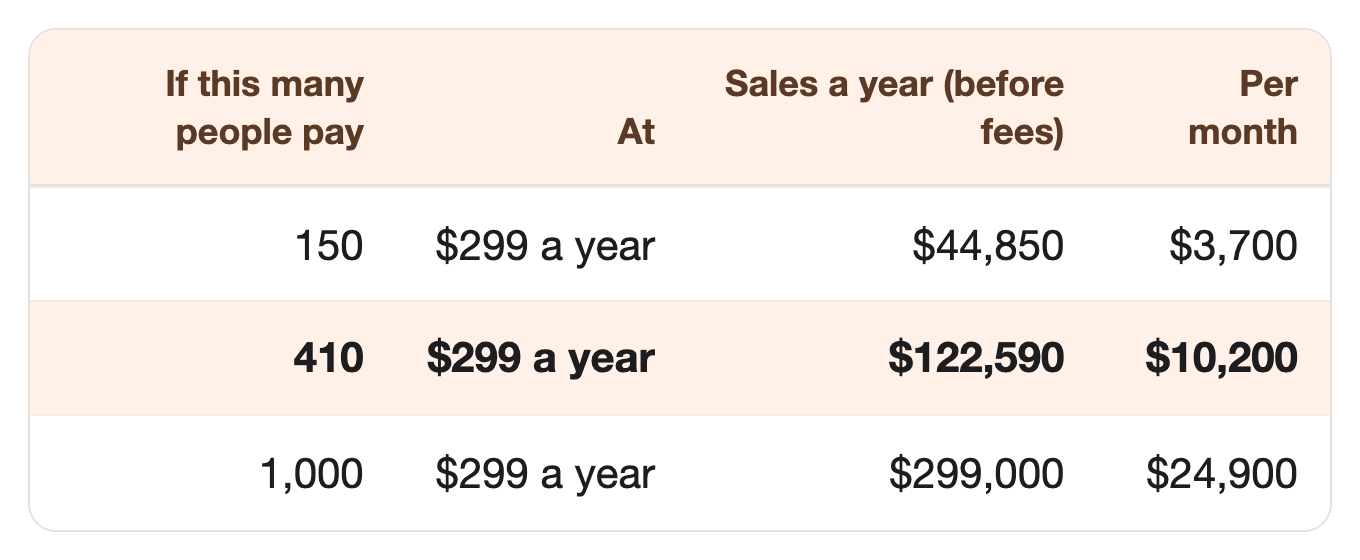
410 readers is about 1 in 320 of the 132,700 US web and digital interface designers.
⠀$299 a year is Tom’s yearly price. 1,000 readers is his minimum, from Substack’s “Thousands of paid subscribers” badge.
Next stop: $25,000 a month, with four more ways to earn
Once designers trust your weekly idea, some will buy a second thing from you.
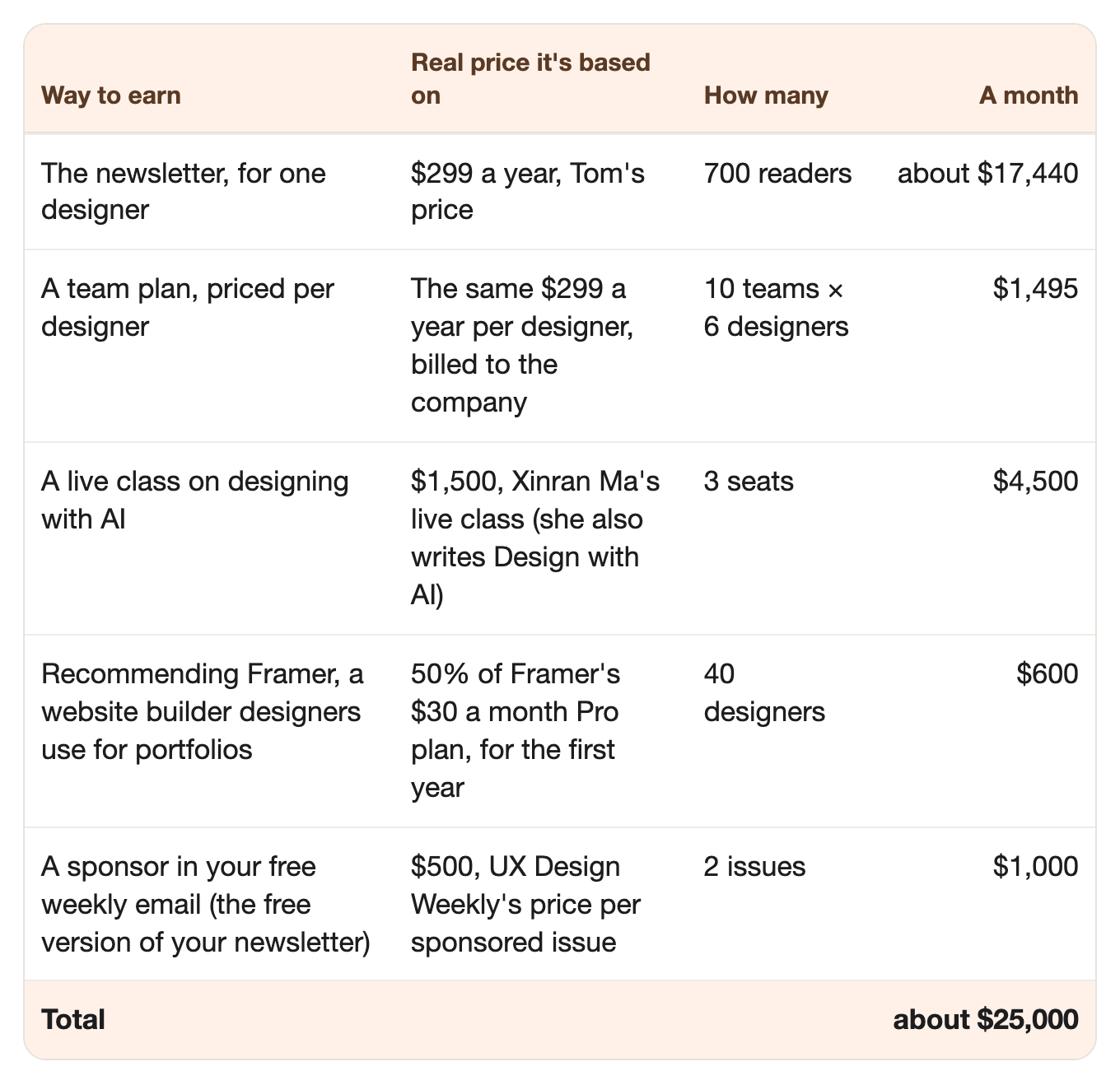
The newsletter still does most of the work.
Grow it from 410 to 700 readers, and it brings in about $17,440 a month.
That’s still about 1 in 190 US web and digital interface designers.
⠀
The team plan is the easiest sale.
One design manager signs up, and six designers get it.
The Pragmatic Engineer, a newsletter for engineers, says many of its readers expense it.
⠀
The live class is the big jump.
Teach one AI design test, start to finish, over a few weeks.
That’s trying one AI tool on a real design task and showing what worked.
Xinran Ma sells hers on Maven, a site for live online classes.
Run it three times a year, 12 seats each: about 3 seats a month on average.
⠀
The Framer link and the sponsor are small, but they take almost no time.
Framer pays half of what your designers pay, for their first year.
The sponsor only works once your free email reaches a few thousand designers.
UX Design Weekly charges $500 for 35,000+ readers, so a smaller email may get less.
⠀
That’s about 800 buyers in all.
Fewer than Tom’s 1,000+ paying readers.
⠀
Worst case, here’s all you lose:
Nothing for the newsletter itself. Substack is free to start.
One month’s subscription to an AI app, like ChatGPT or Claude.
A few Saturdays.
⠀
👉 One idea, five ways to earn: about $25,000 a month.
The next step is a second idea: another one from this newsletter, or this one for a new group. Three of them could pass a million dollars in total in two or three years.
For this one, a new group could be UX researchers. And it could be your first idea.
Got that “I could do this” feeling?
Good. The full plan starts right below. 👇
If not, that’s fine. See you next week.
That’s it, my fellow contrarians! 🙌
Yours ‘proving you don’t need an original idea, just a proven one’ Vijay Peduru 🦸♂️
⠀
⠀
⠀
🧰 Want to build it? Here’s everything else.
Your job is the lab. AI does most of the writing. You read last. 🎙️
⠀
Step 1: 🎯 Pick your group and your rules
Narrow wins. “Design” is too big. “Designers two to five years in, at startups” is a business.
Pick one group of designers.
Designers two to five years in.
Or the only designer at a small startup.
Or designers moving into AI products.
Check your employment contract.
Boring, but it matters.
Look for rules on side work, outside writing, and using what you learn at work.
If it’s unclear, ask HR or a lawyer before you launch.
Write down your rules, and keep them on every issue.
No company names, real screens, real numbers, or unreleased products.
Every example is made up, or redrawn from scratch.
This line at the bottom: “Opinions are my own, not my employer’s.”
⠀
Step 2: 🧪 Turn your work week into ideas
Tom tests at work, then writes on Saturday. You can too.
Keep a work log. Each day, one line: what you tried, and what happened.
Only your own methods and lessons, never your company’s private details.
On Saturday, let AI interview you about the best one.
🎙️ Talk, don’t type. Use voice mode, or a dictation app like Wispr Flow.
Ramble like you’re telling a friend. The AI cleans it up.
AI turns your log into a list of topics. Start with twelve.
⠀
Step 3: 🔍 Check every issue
Your name and your job are on every issue, so it gets checked three times.
Your AI does all three passes for you: it writes in Part 3, and checks in Parts 4 and 5 of the prompt.
🖊️ The AI writer. AI drafts the issue from your interview, in your words.
🔍 The AI fact-checker. A second pass opens every link, checks every tool name and number, and flags anything confidential.
🧐 The AI critic. A third pass hunts for anything vague or generic.
You read it last, as if your manager were reading over your shoulder.
⠀
👉 The prompt already follows three safety rules: no confidential work, made-up examples only, and the “opinions are my own” line.
⠀
Step 4: 📰 Launch the newsletter
Free first, like Tom. Paid when people trust you.
Start on Substack. It’s free to start, and it handles payments.
Send one free idea a week while you build trust.
Then open a paid tier at $299 a year, or $29 a month, like Tom.
One premium idea every week.
The full archive.
A monthly career note, like how to ask for a promotion.
A group chat with you and other designers.
Make it easy to expense. Substack sends a receipt, so readers can ask their company to pay.
Add a team plan too: the same $299 a year, for each designer on the team.
Let AI write your welcome email and your paid page.
⠀
Step 5: 📣 Get your first readers
Share real design work by real designers, as soon as it happens.
Publish “20 designers shipping real work with AI,” and tag each one.
Pick people whose work you’ve actually looked at, and say in one line what each one shipped.
People like to share a list they’re on.
Co-host a free live session with a design-tool community: “One AI design test, start to finish.”
Run one test live, with a made-up project, never your company’s screens.
You and the community both keep the signup list.
When a new AI design tool launches, post the next day what happened when you tried it at work.
Only try tools your company allows, and show a made-up example.
Your AI writes the LinkedIn post and the Substack Note (a short post inside Substack) in Part 6 of the prompt.
⠀
Step 6: 🏃 Eliminate competitors
Here’s how to stay ahead when the competitors show up.
Let your first 50 paid readers pick which design task you test next.
Each month, list five tasks from your work log and let them vote for one.
A rival can copy your tests, but not the readers who chose them.
Keep a dated log of every tool you’ve tested.
One line per tool: the date, the task, and what happened.
Every week it grows, and a new rival would start from zero.
⠀
Step 7: 🎲 Make it bigger
Every knowledge job has the same two things: people one step behind, and tools that keep changing.
Add the four extras from “How much you can make,” one at a time.
First the team plan, since you already write the newsletter.
Then the live class, built from your best AI design test.
Then the Framer link, and one sponsor once your free email has a few thousand designers.
Turn your best issues into a PDF book for yearly readers.
Start the same newsletter for a nearby job, with a partner who does it: UX researchers, content designers, design managers.
One newsletter at about $25,000 a month is about $300,000 a year, before fees. 🎯
Add two or three more newsletters, or ideas from this newsletter, and a million dollars in total is two or three years away.
⠀
🗓️ Your first week
Phew. That was a lot. 😅
Steps 1 to 5 fit into seven days. 🚀
By day 7, you have a group, a work log, twelve topics, one checked issue, a newsletter, and one post.
Quick heads-up: the prompt below has seven Parts, and they’re not the same as the Steps above.
Day 1 (Step 1): Pick your group, check your contract, and write your rules.
Day 2 (Step 2): Plan twelve issues from your work log with Part 1 of the prompt (it’s below).
Day 3 (Step 2): Talk through your best test with Part 2.
Days 4–5 (Step 3): Write the first issue with Part 3, then check it with Parts 4 and 5.
Day 6 (Step 4): Set up Substack, and write your welcome email and paid page with Part 7.
Day 7 (Step 5): Write your LinkedIn post and Substack Note with Part 6, and post them.
⠀
🏄 How to use the prompt
One prompt does all the AI work, in seven parts, plus a quick market check (Part 0).
Part 1 — Plan twelve issues. Turns your work log into twelve topics for your group.
Part 2 — Interview me. Asks about one test, one question at a time.
Part 3 — Write one issue. One idea, a 3-minute read, with a made-up example.
Part 4 — Check facts and secrets. Opens every link, and flags anything that could be confidential.
Part 5 — Find the weak spots. Hunts for anything vague, too long, or generic.
Part 6 — Write the post and the note. A LinkedIn post and a Substack Note from the issue.
Part 7 — Write the welcome and paid page. Your welcome email, and your paid tier page.
Run it your way:
Part by part (the default): it pauses after each part, and you type “next” to go on.
All at once: say “run all seven parts.”
Just one part: say “only do Part 3,” or any part you need.
The full prompt is just below, under “📋 The prompt.”
🎙️ Talk to your AI sidekick, don’t type.
Turn on voice mode, or use a dictation app like Wispr Flow.
Say it messy. The AI sorts it out.
Turn it into a skill, so you never paste it again.
Paste the prompt into Claude or ChatGPT, and say: “Turn this into a skill I can save.”
Install once, use forever.
⠀
📋 The prompt
The prompt (copy it into Claude or ChatGPT, fill in the INPUTS part, and run it your way)
CONTEXT:
- You're my newsletter partner. Together we'll build a weekly paid newsletter about one job, written by me while I still do that job.
- This prompt has seven parts, in order.
- Run it the way I ask:
    - If I say nothing, go one part at a time. After each part, show me the result, then stop and wait. Move on only when I type "next."
    - If I say "run all seven parts," do them all without stopping.
    - If I say "only do Part 3" (or any part), do just that part.
- If a part needs something from me, ask for it before you start that part.
- Never include anything confidential from my job: no company or client names, real screens, real numbers, internal tools, or unreleased products. If something I say looks confidential, leave it out and tell me what you left out.
- Every example must be made up, and labeled as an example.
- Never invent a fact, a number, a result, or a quote. If you can't find a source, leave it out and tell me.
- Remind me to check my employment contract before I launch. Never tell me I'm allowed to publish something.
- I'll often answer by voice, so expect long, messy answers. Don't ask me to tidy them.
- Keep web search on for the whole prompt (turn on search in ChatGPT or Claude), so you can open any page you need to check.

=============== INPUTS — edit these, or just run as is ===============

My job, and how long I've done it:
{e.g. product designer, 8 years, now at a mid-size software company}

The group I write for:
{e.g. product designers two to five years in, at startups}

My work log (paste it):
{e.g. Mon: tried a new AI tool for first drafts of screens, saved two hours. Wed: ran a 5-person test on the sign-up flow, found one big problem.}

My prices:
{e.g. one free idea a week while I build trust; $299 a year or $29 a month for a weekly idea, the archive, and a group chat}

======================== END OF INPUTS ========================

THE PARTS:

Part 0 — Check the market today.
This part needs web search (turn on search in ChatGPT or Claude). Search for newsletters and paid help for my job and group and, for each place, give the count, the three biggest with links, and their prices:
1. Paid newsletters on Substack (check the paid lists in the matching categories) and elsewhere, with their paid-subscriber bands.
2. Free newsletters and blogs, like Medium publications.
3. YouTube channels and LinkedIn creators for this job.
4. Courses and communities for this job.
Then tell me: early (few sellers), growing, or crowded, and which narrower group looks least served (for example: people a few years in, people at startups, people moving into AI work). Give a link for every number. If you can't open a page, say so. Never guess a number.

Part 1 — Plan twelve issues.
Read my work log. Turn it into twelve issue topics for my group, one idea each. For each topic, give a working title, the one thing a reader will try on Monday, and which log line it comes from. Mark any topic that might touch confidential work, and suggest a safe made-up version. Pick the first three to write, and say why. Say clearly which reasons are your guess.

Part 2 — Interview me.
Ask me which topic to start with. Then interview me about it, one question at a time. Ask for what I actually did, what happened, and what I'd do differently. When an answer is vague, ask "What did you actually do?" When an answer sounds confidential, stop and help me turn it into a made-up example. At the end, give a short summary of what you learned.

Part 3 — Write one issue.
Write one issue from the interview, in my words, as a 3-minute read:
1. A title that names the idea, not a promise.
2. The problem, in two or three short lines.
3. What I tried, and what happened, in short bullets.
4. A made-up example, with a before and an after, labeled as an example.
5. The steps to try on Monday, numbered.
6. What I'd skip, and why.
7. This line at the very bottom: "Opinions are my own, not my employer's."

Part 4 — Check facts and secrets.
Now act as a separate fact-checker who didn't write this issue. Open every link. Check every tool name, feature, and number. Mark each one: matches the source, doesn't match, or has no source. Then act as a strict confidentiality reader: flag anything that could identify my employer, a client, a coworker, a real screen, a real number, or an unreleased product. Then give a fixed version of the issue.

Part 5 — Find the weak spots.
Now act as a tough reader from my group who pays for this. Flag every line that is vague, too long, or that any AI could have written without my experience. Ask me for one more real detail for each weak spot. Then give the final issue, with every fix made.

Part 6 — Write the post and the note.
Turn the final issue into:
1. A LinkedIn post under 150 words: the first line names the problem, then the one idea, then three short steps.
2. A Substack Note under 60 words.
If a new AI design tool just launched, write both about what happened when I tried it at work, with a made-up example.
End both with one plain line and a link to the newsletter.

Part 7 — Write the welcome and paid page.
Write:
1. A welcome email: who it's for, what they'll get, the first issue to read, and the "opinions are my own" line.
2. A paid page: what paid readers get, the prices shown up front, "Cancel any time," and a short note readers can send their manager to get it expensed.
Never promise a result, a promotion, or a raise. Never invent a review, a number, or a reader story.

When all seven parts are done, ask if I want to repeat Parts 2 to 6 for the next topic.
⠀
📎 The sources
Every number above, with where it came from.
Tom’s start · Number: Viral Post Generator in 2022, over 2 million users, “acquired by Taplio just one week after its launch”; bought MarketingIdeas.com with the money; waitlist plugged at talks; about 1,000 people on the first email, August 2023 · Source: Growth In Reverse, July 2025
Tom’s Saturdays · Number: Writes “on Saturdays”; “Without my full-time job, I would have never succeeded in my newsletter” · Source: Same article
Tom’s paid launch · Number: Almost two years with no monetizing; mid-2025 launch; “500+ paid subscribers in the first few days”; “$50,000+ in the first month” · Source: Same article
Tom’s first year · Number: 52 articles; “over 17,800 subscribers” · Source: Marketing Ideas, August 2, 2024
Marketing Ideas on Substack · Number: “Thousands of paid subscribers” (Substack’s band: at least 1,000); $299 a year or $29 a month; first post August 4, 2023 · Source: Substack Business paid list
The $299,000 math · Number: 1,000 × $299 a year, at the list price; monthly readers pay more, launch-discount readers paid less, so it’s an estimate, not his revenue · Source: Our math, from the row above
Tom’s job and his line · Number: “currently leading a Growth Marketing team at Google” (his own words; Growth In Reverse, July 2025, also says he built the newsletter “while working full-time”); “Opinions and views are my own” · Source: Marketing Ideas: about
A reader’s quote · Number: “Best money ever spent” (Itai Handler) · Source: Tom’s own about page, under “Praise for this newsletter”
Lenny’s Newsletter · Number: “Tens of thousands of paid subscribers” (at least 10,000); $200 a year; first post June 14, 2019 · Source: Substack Business paid list
The Pragmatic Engineer · Number: “Tens of thousands of paid subscribers”; $150 a year; first post August 30, 2021; “Many subscribers expense this newsletter” · Source: Substack Technology paid list and its about page
MKT1 · Number: “Thousands of paid subscribers”; $144 a year; by Emily Kramer · Source: Substack Business paid list and MKT1: about
Design newsletters · Number: UX Mentor Diaries: “Hundreds of paid subscribers,” $250 a year · UX Movement Newsletter: hundreds, $188 a year · Design Better: hundreds, $72 a year, first post April 2017 · Design with AI: hundreds, $90 a year · Source: Substack Design paid list, pages 0–2
Live class price · Number: “AI for Product Designers,” Xinran Ma, “Founder of Design with AI”; “Live Cohort $1,500 USD”; Dec 1–17, 2026 · Source: Maven
Framer affiliate rate · Number: “fifty percent (50%) of subscription payments for the first twelve (12) months” (Version 1.0, effective March 24, 2025) · Source: Framer affiliate terms
Framer price · Number: Pro, “Growing professional sites,” “$30 per month,” yearly billing · Source: Framer pricing
Sponsor price · Number: “Sponsored links cost $500 per sponsorship”; “Reach 35,000+ subscribers” · Source: UX Design Weekly
Don’t Make Me Think · Number: Don’t Make Me Think, Revisited (3rd edition, December 2013): 4.6K ratings, $21.46; a 4th edition listed, dated December 2026 · Source: Amazon books search “don’t make me think steve krug”
Designers in the US · Number: “Web and digital interface designers held about 132,700 jobs in 2025”; median pay $104,000 (May 2025); “About 13,600 openings for web developers and digital designers are projected each year” (the two jobs together) · Source: US Bureau of Labor Statistics
Google searches · Number: “product designer” 6,600 a month; “ux design portfolio” 2,400 · Source: Ubersuggest, US
Google UX certificate · Number: 1,568,271 “Enrolled learners” (all-time sign-ups, worldwide, not completions); $49 a month in the US after a 7-day free trial · Source: Coursera
Comment: lost · Number: “I’m so lost, I don’t know where to evolve” (a UI designer) · Source: YouTube comment, 2026
Comment: stuck · Number: “freshers (0–2 yrs) are stuck between building fundamentals, learning AI tool, or mastering a niche.” · Source: YouTube comment, 2026
Comment: too many videos · Number: “There are so many videos on YouTube that it gets a bit confusing about what to follow in 2026.” · Source: YouTube comment, 2026
Tom’s Product Hunt launch · Number: “more than 7,000 new subscribers” · Source: Growth In Reverse, July 2025