


Hello contrarians,
Today’s idea is called The First-Year Money Letter.
Grab a pen. 🖊️
First, a marketer’s story. Then, the business you could build from it.
⠀
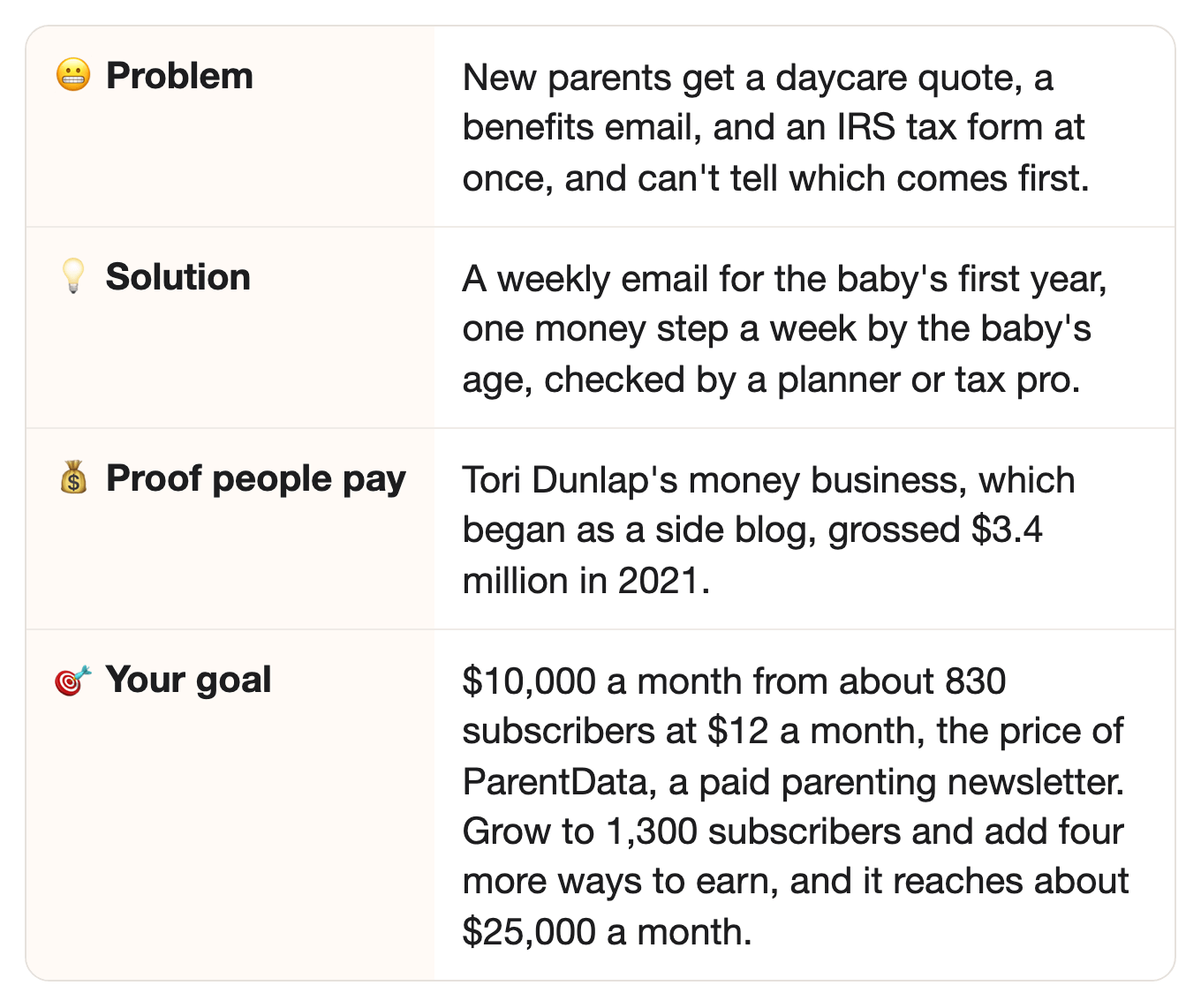
⚡ Quick facts
⠀
📖 How one marketer’s side blog grew into a $3.4M-a-year business
She wrote about money on the side, while working a day job, for people who were never taught it.
Tori Dunlap learned money early.
At 9, her parents taught her to run a vending machine business, to help pay for college.
Yes, a vending machine, at 9.
She graduated from the University of Portland in 2016, with no student loans.
She took marketing jobs at companies, and set herself a big goal.
Save $100,000 before she turned 26.
How? She put 22% of every paycheck straight into savings.
And friends and coworkers kept coming to her with money questions.
She had assumed “everybody knows how to negotiate on salary.” Many of them didn’t.
⠀
Mini story: she started a blog about her savings goal while still at her corporate job.
She called it Her First $100K.
She hit $100,000 within three years of graduating, a few months ahead of her goal.
Then she went on Good Morning America, a big morning TV show.
Three weeks later, she quit her nine-to-five to run the business full-time.
She taught money workshops and gave private coaching, like how to negotiate a salary.
In 2020, she started posting short money videos on TikTok.
⠀By June 2021, her solo project had a team of eight, in just over a year and a half.
She had 1.5 million TikTok followers.
Entrepreneur reported her business “has already hit $1 million in revenue for 2021.”
And in 2022, she told Fortune the business grossed $3.4 million in revenue in 2021.
Her paid tools cost about $50 on average, some as little as $15.
Great Scott! ⚡
She went from a side blog at a desk job, to $3.4 million in a year, by explaining money in plain words.
⠀
🔗 Same idea, new group
In the story: people who were never taught about money paid Tori for plain-words money tools, about $50 each on average.
⠀In this idea: new parents need money steps in the order their baby’s first year brings them.
⠀Why it carries over: both groups were never taught this, and they want one clear next step instead of a pile of rules.
⠀
💡 The opportunity
A new baby’s first year is full of money deadlines, and they come in a set order.
Here’s the warm part: you’d be the one who tells tired parents what’s next.
First, who are the buyers?
New and expecting parents, from late pregnancy to the baby’s first birthday.
Many still work, so they’re juggling leave, a job, and very little sleep.
⠀
Every year, a new crowd starts knowing nothing. 🔁
The US had 3,606,400 births in 2025, the CDC says.
Every first baby comes with parents who’ve never done this paperwork before.
⠀
The money questions arrive on a schedule, by the baby’s age.
Before the birth: how much leave is paid, and how much isn’t.
In the first weeks: adding the baby to health insurance.
Before going back to work: childcare, and how to pay for it.
At the next benefits sign-up at work: a dependent care account.
Wait, what’s a benefits sign-up, and a dependent care account?
The benefits sign-up is the short window each year when workers can change their job’s health insurance and accounts.
A dependent care account lets a parent pay for childcare with money that isn’t taxed, up to a yearly limit.
⠀
Many parents need a plan for unpaid weeks.
In March 2023, 27% of US workers had access to paid family leave through their job, the Bureau of Labor Statistics says.
So about 3 in 4 workers had no paid family leave through their job.
Ouch.
⠀
The deadlines come fast.
On a HealthCare.gov plan, a family that just had a baby has up to 60 days to enroll.
HealthCare.gov is the US government’s site where people without insurance from a job buy a health plan.
A birth opens a short extra window to sign up there.
Coverage can start the day the baby was born.
⠀
Childcare is a big new bill.
The national average price of child care was $13,128 in 2024, Child Care Aware of America found.
That’s 10% of a married couple’s middle income, and 35% of a single parent’s.
For a single parent, that’s more than a third.
⠀
And the rules change, so older advice can be wrong.
For 2026, the yearly limit on a dependent care account went from $5,000 to $7,500, the IRS says.
A new federal account for children, the Trump Account, opened to deposits on July 4, 2026.
Babies born from 2025 through 2028, who are US citizens with a Social Security number, can get a one-time $1,000 government deposit into it.
A parent can sign them up on IRS Form 4547.
That’s a lot for a tired parent to keep up with.
⠀
👉 The idea: a weekly money newsletter for the baby’s first year, with one step a week, matched to the baby’s age.
It explains what’s due and how it works, and comes with a checklist of deadlines.
It never tells a family what to buy or invest in.
⠀
🙋 Never worked in finance? You can still build this.
Team up with a pro who checks every issue.
A fee-only financial planner (paid by the client, not by selling products), or an enrolled agent (a tax pro licensed by the IRS).
They check the facts and the limits. You write the letter and find the readers.
Here’s the line to remember.
Explaining how a rule works, in general, is teaching, and anyone can do it.
Telling one family what to do with its money is personal advice, and that’s a licensed pro’s job.
⠀
Let your AI read what parents already posted.
Parents who just finished year one write on parenting forums and blogs about what was due, and what they missed.
Your AI reads those posts and turns them into a week-by-week list.
⠀
Or use your own year one.
Just did all this paperwork yourself?
Then your own story of what you did, and when, makes the letter feel personal.
Your pro still checks the facts.
⠀
✅ Why this could work
Three reasons there’s real money here.
Parents already pay for a weekly email matched to their child’s stage.
Emily Oster, an economist at Brown University, started ParentData as a weekly newsletter in 2020.
By January 2025, it had over 250,000 subscribers.
Its paid PregnantData series sends weekly emails matched to the week of pregnancy.
⠀
Plain money teaching sells, even next to free videos.
Remember Tori’s free TikTok videos?
She posted those, and still sold paid tools for about $50.
Fortune says she reached four million people through social media and her podcast.
⠀
People have paid for plain money teaching since 1947, and they still do.
Kiplinger’s Personal Finance is a money magazine that teaches saving, paying for college, and big purchases.
It started in January 1947, and had a total circulation of 315,757 in December 2025.
That’s a long run.
⠀
👉 Don’t take my word for it. Every number is linked in “📎 The sources,” at the very end.
⠀
📊 More proof people want this
Want more? Here you go.
Parents pay every month for help matched to their child’s stage.
ParentData charged $12 a month, or $10 a month billed yearly, in August 2026.
It also sold a lifetime plan for $500, paid once.
Its sign-up page promised weekly emails matched to “your family’s stage.”
⠀
Families signed up millions of kids for a new money account.
By March 31, 2026, families had signed up more than 4 million children for Trump Accounts, the IRS says.
More than 1 million of them had claimed the $1,000 government deposit.
That’s a lot of kids.
⠀
Childcare prices keep climbing.
Child Care Aware says the price of child care rose 29% from 2020 to 2024.
⠀
The rules a family needs change from year to year.
The dependent care limit had been $5,000, and rose to $7,500 for 2026, IRS Publication 15-B says.
A family reading a 2025 article would plan with the wrong number.
⠀
👉 Parents already pay $12 a month for weekly help matched to their child’s stage.
The baby’s first year also has money deadlines, and numbers that change every year. A weekly letter can cover those the same way.
⠀
🔍 Who’s already doing it
Who’s in the space, and what they skip.
ParentData covers parenting research, by stage.
Its topic menu, in April 2026, covered sleep, food, health, screens, potty training, and school.
Money wasn’t one of the topics on that menu, though some of its articles touch on leave and child care.
⠀
Her First $100K, Tori’s business from the story, is for women in general, not new parents in particular.
Entrepreneur said it helps “women all over the world” take control of their money.
⠀
Kiplinger’s Personal Finance is for everyone with money questions.
Retirement, college, cars, and homes, not one family’s first year.
⠀
The rules themselves are spread out.
Health insurance rules live on HealthCare.gov, tax limits in IRS publications, and the benefits dates in each parent’s work email.
A tired parent has to check three different places.
⠀
Still missing when we checked:
A weekly money letter that walks one family through year one, in order, by the baby’s age.
One that checks every limit against the official page each year, and gives the family a one-page form to write in their own dates.
⠀
🔎 Check the market yourself in 2 minutes: run Part 0 of the prompt in the build plan below.
Your AI searches newsletters, Substack, Etsy, and parenting sites that day, and tells you: early, growing, or crowded.
Substack is a website where writers run free and paid newsletters. Etsy is one where small shops sell printable files.
Early? Start now.
Crowded? Good news: it means parents pay. Pick one narrower kind of parent (Step 1 of the build plan).
A crowded market is still OK. You win by serving one kind of parent better, not by being first.
⠀
👉 That gap is your chance.
A weekly money letter for one family’s first year, in order, with every limit checked.
⠀
🤖 Why AI won’t replace it
AI knows the money rules. But it only answers the questions a parent thinks to ask. A tired parent often doesn’t know what to ask until the deadline has passed. Your letter brings the right step in the right week, with the current numbers checked.
Could ChatGPT just do this?
Sort of… if the parent knows what to ask, and when.
🔮 Honest note: AI can already explain what a dependent care account is, and how it works.
So the explanation alone isn’t the product.
The product is the right step in the right week, checked against the rules for that year.
⠀
1. You choose what’s right for them.Out of every money topic, you pick the one that matters at this baby’s age.
A tired parent may not think to ask about the benefits sign-up until it has passed.
⠀
2. Checked twice.Limits change: the dependent care limit went from $5,000 to $7,500 for 2026.
Your AI checks every number against the official page, then your planner or tax pro reads it.
⠀
3. Ready to use.ChatGPT can build a first-year money plan, if a parent types in their benefits dates, leave, childcare quotes, and state.
How many new parents have that hour?
Few.
Your letter shows up each week with the step, the deadline, and the question to ask HR.
⠀
4. Proof people pay for the finished thing: ParentData charged $12 a month in August 2026.
⠀
👉 Free answers are everywhere, but a first-year money plan that’s ready to use is hard to find.
⠀
💵 How much you can make
Here’s the math.
First stop: $10,000 a month from the weekly letter alone
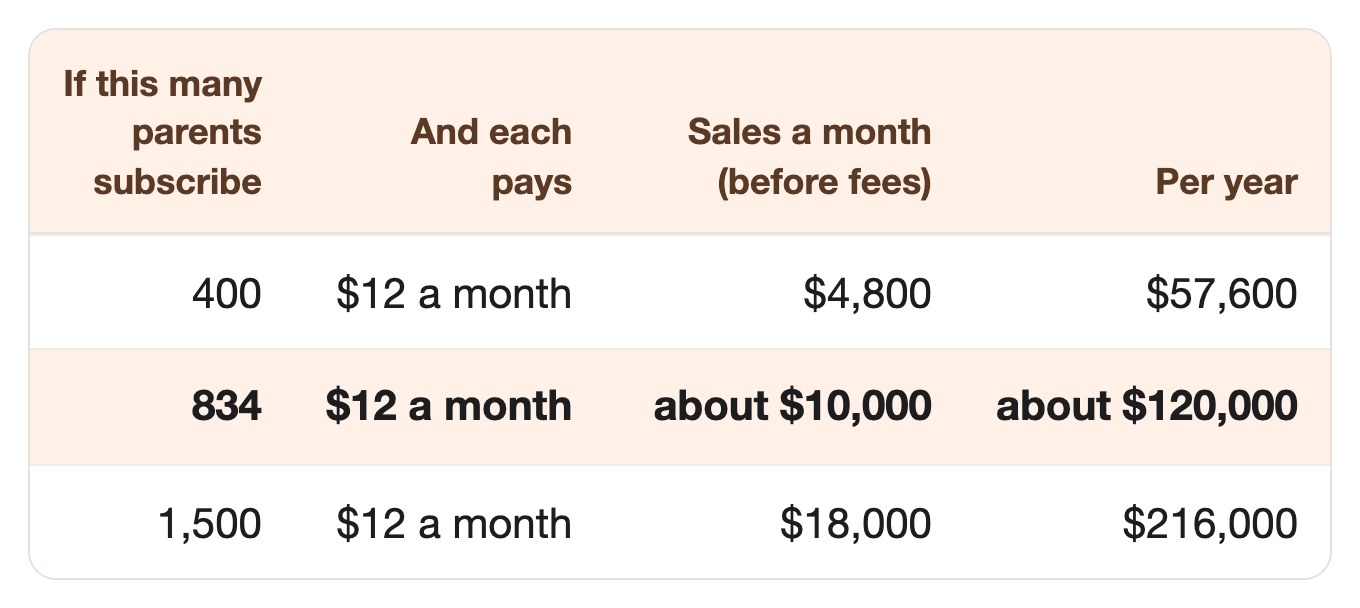
At $12 a month, ParentData’s price, 834 subscribers bring in about $10,000 a month.
⠀Our guess: each family stays about a year, so you’d need about 830 new families each year.
That’s about 1 for every 4,300 US births in 2025.
Next stop: $25,000 a month, with four more ways to earn
New parents aren’t the only ones who pay. Grandparents and employers want to help them too.
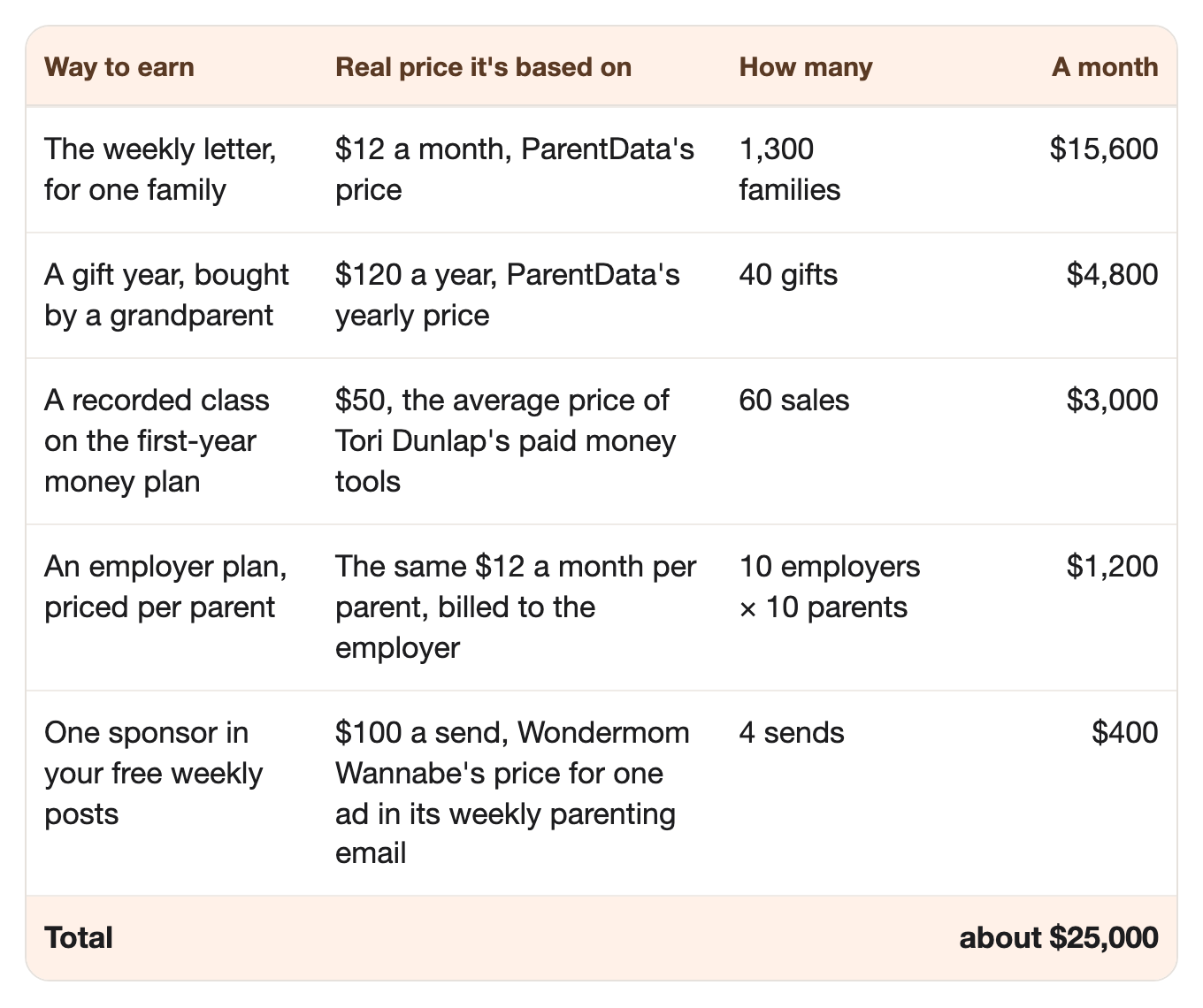
The weekly letter still does most of the work.
Grow it from 834 to 1,300 families, and it brings in $15,600 a month.
That’s about 1 family for every 2,800 US births in 2025.
⠀
The gift year is the big jump.
A grandparent pays $120 once, and the new parents get the whole first year.
A baby shower is a good time to sell it.
⠀
The recorded class sells to parents who want it all at once.
Record it once with your planner or tax pro: every deadline of the first year, in order.
Tori’s paid money tools cost about $50 on average, Fortune reported.
⠀
The employer plan sells to the company, not the parent.
A company pays for the letter for each worker who’s expecting a baby.
One sale, ten subscribers.
⠀
The sponsor is small, but it takes almost no time.
Your free weekly posts are the free version of your letter, on Substack.
Pick a baby-gear brand, never a bank, insurer, or investment company (that’s your pledge in Step 6).
Wondermom Wannabe charges $100 a send, with more than 33,000 parents on that list, so a smaller list may get less.
⠀
If it doesn’t work out, here’s all you lose:
Nothing for Substack, which is free to start.
Kit, an email tool (more in Step 4), prices by how many readers you have, so check it before you start.
One month’s subscription to an AI app, like ChatGPT or Claude.
One week of your time.
⠀
👉 That’s the math for about $25,000 a month, from one weekly letter.
Run two or three of these, from this newsletter or a niche close to this one. Together, they could pass a million dollars in total in two or three years.
For this letter, a niche close by could be parents adopting a child. And this letter could be your first idea.
Did this one make you think “wait, I could do that”?
Then keep scrolling. The whole build plan is below. 👇
If not, no worries. See you next week with a new idea.
That’s it, my fellow contrarians! 🙌
Yours ‘helping you find ideas that already make money’ Vijay Peduru 🦸♂️
⠀
⠀
⠀
🧰 Want to build it? Here’s everything else.
⠀
Step 1: 🎯 Pick one kind of parent, and a pro to check your facts
Narrow your readers first, then line up your planner or tax pro.
Good news: this letter teaches, it doesn’t advise, so you don’t need to be the expert.
You need a pro who checks it.
Pick one kind of parent, not all of them.
First-time parents who both work full-time.
Single parents going back to work.
Parents with salaried jobs at big companies, where benefits come with sign-up dates.
Parents who are self-employed, with no HR team at all.
Team up with a fee-only planner or an enrolled agent.
They read every issue before it goes out.
Share the subscription money with them, so nothing is paid up front.
Have your AI read what parents who just finished year one already posted on parenting forums and blogs.
It pulls out what was due, when, and what they wish they’d known.
⠀
Step 2: 🛠️ Plan the year and write the first month
One step a week, for 52 weeks, in the order the baby’s age brings them.
Plan the year with your AI.
Late pregnancy: leave pay, the budget for unpaid weeks.
The first weeks: adding the baby to health insurance, a Social Security number, the IRS forms.
Months 2 to 4: childcare quotes, the dependent care account, the next benefits sign-up.
The rest of year one: the new budget, accounts for the baby, the first tax return as parents.
Write the first four issues.
Each one: the step, why it matters now, how it works, and the question to ask HR or the health insurance company.
Make the checklist pack.
A one-page list of first-year money deadlines, by the baby’s age.
A fill-in page for the family’s own dates: due date, leave dates, the benefits sign-up, the childcare start.
⠀
Step 3: 🔍 Check every issue
Families make real money choices from this letter, so every issue gets checked after it’s written.
Your AI does the first three rounds for you.
Parts 2 and 3 of the prompt write the issues and the checklist.
Parts 4 and 5 check them.
🖊️ The AI writer. It writes each issue as general teaching, with no personal advice.
🔍 The AI rules checker. A second pass checks every line against the safety rules, and every number against the official page.
🧐 The AI critic. A third pass reads it like a strict financial planner, and like a tired new parent.
Then your planner or tax pro reads every issue before it goes out.
⠀👉 The prompt already follows six safety rules:
Teaching only, never personal advice.
Never name an investment, fund, bank, or insurer as the one to pick.
Every limit and date comes from an official page, with its year.
Every issue tells readers to check with HR, their plan, or a tax pro.
No promised savings or tax refunds.
No affiliate links.
⠀
Step 4: 🏪 Open for subscribers
Copy ParentData: one simple monthly price, and a cheaper yearly one.
Easy one: their prices are already public.
Set your prices.
$12 a month, like ParentData.
$120 a year, so a yearly plan gets two months free, like theirs.
A gift version at $120, so a grandparent can buy the year for the new parents.
Later, an employer plan: the same $12 a month, for each parent at the company.
Send the weekly steps with an email tool that times each email to the parent’s own due date, like Kit (formerly ConvertKit).
Each parent types in their due date when they sign up.
The tool sends week 1, week 2, and so on, timed to their baby, not to everyone at once.
A plain Substack post goes to every reader on the same day, so it can’t do this on its own.
Keep Substack for free weekly posts and Notes, where new parents find you.
Give the checklist away free, in exchange for an email address, so parents see your style first.
Let AI write your sales page, using one real issue and the checklist as examples.
⠀
Step 5: 📣 Get your first readers
Go where expecting parents already shop, talk, and read.
Ask a local baby-gear resale shop, or a prenatal yoga studio, to keep your free checklist card by the register.
In return, feature the shop to your readers in an issue.
Open a waitlist before your first issue.
Expecting parents move up the list for each friend who joins from their online group of parents due the same month.
The first 100 get the checklist pack free.
Keep your free weekly posts on Substack going.
Parents who aren’t ready to pay still hear from you every week.
Later, this is where your sponsor goes.
For two days after each issue, post on Substack Notes, Substack’s feed of short posts.
Post one short Note with one deadline from the issue, and the link.
Reply to every comment, and comment on other parenting Notes.
Post a second Note on Friday.
⠀
Step 6: 🏃 Eliminate competitors
When others copy you, here’s how you stay the one people pick.
Sign your planner or tax pro to a year-long deal, and feature them to your readers in every issue.
As your list grows, so does their reach, so they have a reason to stay with you, not with a copycat.
Make a public pledge: no commissions and no affiliate links from any bank, insurer, or investment company.
An affiliate link pays a site each time a reader signs up for the product it points to.
Then invite the big money sites to say the same.
A site that earns money from those links can’t make that pledge, so parents see the difference.
⠀
Step 7: 🎲 Make it bigger
Every family moves on to the next stage, and each stage can be its own letter.
Add the four extras from “How much you can make,” one at a time.
First the gift year, since Step 4 already sets it up.
Then the recorded class, made with your planner or tax pro.
Then the employer plan, and one sponsor once your free posts reach a few thousand parents.
Add letters for the next stages: the toddler years (ages 1 to 3), or the year before a baby arrives.
One letter at about $25,000 a month is about $300,000 a year, before fees. 🎯
Add two or three more letters, or ideas from this newsletter, and a million dollars in total is two or three years away.
⠀
🗓️ Your first week
Phew. That was a lot. 😅
A first version of Steps 1 to 5 fits into seven days. 🚀
By day 7, you have a year plan, four issues, a checklist pack, a sales page, and a waitlist.
The prompt below has seven Parts, and they’re not the same as the Steps above.
Day 1 (Step 1): Run Part 0 of the prompt (it’s below), pick your kind of parent, and message a planner or enrolled agent.
Then plan the year with Part 1.
Days 2–3 (Step 2): Write the first four issues with Part 2, and make the checklist pack with Part 3.
Day 4 (Step 3): Check everything with Parts 4 and 5, then send it to your planner or tax pro.
Day 5 (Step 4): Write your sales page with Part 6, and set up your timed emails in Kit.
Days 6–7 (Step 5): Write your shop card, waitlist page, and first Notes with Part 7, and visit one shop.
⠀
🏄 How to use the prompt
One prompt does all the AI work, in seven parts, plus a quick market check (Part 0).
Part 1 — Plan the year. Plans 52 weekly money steps for your kind of parent, by the baby’s age, and lists the official page for each.
Part 2 — Write the issues. Writes the issues you ask for, each with the step, why now, how it works, and the question to ask.
Part 3 — Make the checklist pack. Makes the one-page deadline list and the fill-in page for the family’s own dates.
Part 4 — Check the rules and the numbers. Checks every line against the safety rules, and every number against its official page.
Part 5 — Find the mistakes. Reads it like a strict financial planner, and like a tired new parent.
Part 6 — Write the sales page. Uses one real issue and the checklist as examples.
Part 7 — Write the first-reader kit. Writes the shop card, the waitlist page, and your first Notes, and checks them against the rules.
Run it your way:
Part by part (the default): it pauses after each part, and you type “next” to go on.
All at once: say “run all seven parts.”
Just one part: say “only do Part 3,” or any part you need.
The full prompt is just below, under “📋 The prompt.”
🎙️ Talk to your AI sidekick, don’t type.
Turn on voice mode, or use a dictation app like Wispr Flow.
Say it messy. The AI sorts it out.
Turn it into a skill, so you never paste it again.
Paste the prompt into Claude or ChatGPT, and say: “Turn this into a skill I can save.”
Install once, use forever.
⠀
📋 The prompt
The prompt (copy it into Claude or ChatGPT, fill in the INPUTS part, and run it your way)
CONTEXT:
- You're my writing partner. Together we'll build a paid weekly money newsletter for parents in their baby's first year: one money step a week, matched to the baby's age, plus a checklist pack.
- This prompt has a market check (Part 0), then seven parts (Part 1 to Part 7), in order.
- Run it the way I ask:
    - If I say nothing, go one part at a time. After each part, show me the result, then stop and wait. Move on only when I type "next."
    - If I say "run all seven parts," do Part 1 to Part 7 without stopping. Run Part 0 only when I ask for it.
    - If I say "only do Part 3" (or any part), do just that part.
- If a part needs something from me, ask for it before you start that part.
- This newsletter teaches. It never advises. Follow these rules in every part:
    1. Never give personal advice. Explain how a rule or an account works in general, then tell the reader to check with HR, their plan, or a tax pro.
    2. Never name an investment, a fund, a bank, an insurer, or an account provider as the one to pick. Never say which account a family should open.
    3. Every limit, amount, and date must come from an official page (IRS.gov, HealthCare.gov, a state agency, or the reader's own plan), with the year it applies to. If you can't open the official page, leave the number out and say so.
    4. Never promise savings, a refund, or a tax result.
    5. No affiliate links, and no links to sign up for any financial product.
    6. Say plainly when a rule differs by state or by employer.
- End every issue with this line: "This is general education, not financial or tax advice. Check with your HR team, your plan, or a tax pro before you decide."
- Never invent a fact or a number. If you're not sure a fact is right, leave it out.
- Keep web search on for the whole prompt (turn on search in ChatGPT or Claude), so you can open any page you need to check.

=============== INPUTS — edit these, or just run as is ===============

Who the newsletter is for:
{e.g. first-time parents who both work full-time at companies with HR benefits}

Where they live (country and state):
{e.g. the US, California}

What parents have posted (paste notes from forum posts you've read, or leave blank):
{e.g. "We missed the benefits sign-up by two weeks," "Nobody told us daycare waitlists start in pregnancy"}

My pro who checks every issue:
{e.g. a fee-only financial planner}

My prices:
{e.g. $12 a month, $120 a year, a gift version}

======================== END OF INPUTS ========================

THE PARTS:

Part 0 — Check the market today.
This part needs web search (turn on search in ChatGPT or Claude). Search for money help made for new and expecting parents, and for each place give the count, the three biggest with links, and their prices:
1. Paid newsletters on Substack and elsewhere about money for new parents.
2. Free and paid parenting newsletters and apps that send emails by the baby's age.
3. Etsy shops selling baby budget planners or first-year money checklists.
4. The biggest social accounts teaching money to new parents.
Then tell me: early (few sellers), growing, or crowded, and which kind of parent looks least served (for example: single parents, self-employed parents, parents of twins). Give a link for every number. If you can't open a page, say so. Never guess a number.

Part 1 — Plan the year.
Plan 52 weekly money steps for the parents in my INPUTS, from late pregnancy to the baby's first birthday. Use what parents told me, if I pasted any. Cover: leave pay and a budget for unpaid weeks; adding the baby to health insurance; the baby's Social Security number; childcare costs and how to pay for them; the dependent care account and the benefits sign-up at work; tax credits and forms for a new child; accounts for the baby, explained in general; and the first tax return as parents. For each week give the baby's age, the step in one line, why it matters at that age, and the official page that has the rule. Say clearly which timings are your guess. Flag any step that differs by state or by employer.

Part 2 — Write the issues.
Ask me which weeks to write. Write one issue for each, for a tired parent with no finance background:
1. A first line with the baby's age and the one step ("Your baby is 6 weeks old. This week: the benefits sign-up").
2. Why it matters now, in two or three short lines.
3. How it works, in plain words, with every number from the official page and its year.
4. The exact question to ask HR, the plan, or a tax pro.
5. The closing line from CONTEXT.
Keep each issue under 500 words, and follow every rule in CONTEXT.

Part 3 — Make the checklist pack.
1. Make a one-page list of first-year money deadlines, by the baby's age, from Part 1. Each line names the step and the official page.
2. Make a one-page fill-in page for the family's own dates: due date, leave start and end, the benefits sign-up window at work, the health insurance deadline, the childcare start date, and who to call for each.
3. Put the closing line from CONTEXT at the bottom of both pages.

Part 4 — Check the rules and the numbers.
Now act as a separate rules checker who didn't write any of this. Check every line of Parts 2 and 3 against each rule in CONTEXT, one by one. Open the official page for every number, and confirm the number and its year. Mark each issue: safe, needs a fix, or drop it. For each problem, quote the risky words and say which rule they break or which number is wrong. Then give a fixed version of everything that needs one.

Part 5 — Find the mistakes.
Now act as a strict fee-only financial planner, then as a tired new parent. As the planner, flag anything that reads as personal advice, a product pick, a promise, or an out-of-date rule. As the parent, flag any word or step that would confuse you. Then give the final issues and pages, with every fix made, and the closing line from CONTEXT on each. Remind me that my pro must read every issue before it goes out.

Part 6 — Write the sales page.
Ask me for one finished issue and the checklist first. Use them as examples. Never invent a result, a review, or a number. Give me:
1. A headline that names the kind of parent, not "parents."
2. What they get: one step a week by the baby's age, and the checklist pack.
3. Who checks it: my pro, and that it teaches, never advises.
4. The prices, shown up front, the gift version, and "Cancel any time."
5. The free checklist, in exchange for an email address.

Part 7 — Write the first-reader kit.
1. Write a short card for a baby-gear resale shop or a prenatal yoga studio counter: one line on what the free checklist is, and where to get it.
2. Write a waitlist page: who it's for, what the first issue covers, and that parents move up the list for each friend from their due-date group who joins. The first 100 get the checklist pack free.
3. Write five short Substack Notes, each with one deadline from an issue and one plain line on why it matters.
4. Check all of it against the rules in CONTEXT before you show me.
⠀
📎 The sources
Every number above, with where it came from.
Tori’s revenue in 2021 · Number: “And last year, she said, the business grossed $3.4 million in revenue” (last year = 2021; self-reported; fits Entrepreneur’s $1 million by June 2021) · Source: Fortune, October 8, 2022
Her start and her tools · Number: Started a blog to document her goal while at her corporate job; reached $100,000 a few months early; started on TikTok in 2020; paid tools “around $50, but some are as low as $15”; “reached four million people via social media and her podcast” · Source: Same page
Her savings goal · Number: 2016 graduate; “saved $100,000 within three years of graduating”; “as long as I do it before I turn 26”; 22% of her paycheck to savings; friends and coworkers came to her for guidance; workshops and private coaching; a vending machine business at 9; no student loan debt · Source: The Beacon, University of Portland, March 2020
Good Morning America, team, revenue · Number: “three weeks after an appearance on Good Morning America, she quit her nine-to-five”; a team of eight in just over a year and a half; 1.5 million on TikTok; “has already hit $1 million in revenue for 2021”; helps “women all over the world take control of their financial futures” · Source: Entrepreneur, June 9, 2021
US births · Number: “3,606,400 births recorded in 2025” · Source: CDC National Center for Health Statistics, April 9, 2026
Paid family leave · Number: “In March 2023, 27 percent of civilian workers had access to paid family leave” · Source: US Bureau of Labor Statistics, family leave fact sheet (also on a June 13, 2026 Wayback copy)
Health insurance after a birth · Number: “Had a baby”; “Your coverage can start the day of the event — even if you enroll in the plan up to 60 days afterward.” · Source: HealthCare.gov, Wayback copy of August 3, 2026
Child care prices · Number: National average $13,128 in 2024; 10% of a married couple’s median income, 35% of a single parent’s; up 29% from 2020 to 2024 · Source: Child Care Aware of America, published May 2025
Dependent care limit · Number: “For the 2026 tax year, the annual dependent care FSA limit was raised from $5,000 to $7,500” · Source: IRS Publication 15-B (2026), Wayback copy of June 5, 2026
Trump Accounts · Number: Children born from January 1, 2025, through December 31, 2028; a $1,000 pilot contribution; IRS Form 4547; contributions from July 4, 2026; more than 4 million children signed up, more than 1 million covered for the $1,000 · Source: IRS news release IR-2026-42, March 31, 2026
ParentData’s start and size · Number: “ParentData started as a weekly newsletter in 2020”; “over 250,000 subscribers”; PregnantData’s weekly emails “tailored to their specific stage of pregnancy,” through a paid subscription; its 1,100+ articles cover “everything from prenatal vitamins to preparing for maternity leave and child care”; Emily Oster is a professor of economics at Brown University · Source: PR Newswire, January 22, 2025
ParentData’s prices · Number: Plus Monthly $12 a month; Plus Annual $10 a month, billed yearly; Lifetime $500, one-time · Source: ParentData plans, Wayback copy of August 25, 2026
ParentData’s topics · Number: Weekly emails “tailored to your family’s stage”; topics: breastfeeding and formula, food and nutrition, health and wellness, potty training, school, screens, sleep; Emily Oster, “NYT Bestselling Author” · Source: ParentData sign-up page, Wayback copy of April 18, 2026
Kiplinger’s Personal Finance · Number: First published January 1947; total circulation 315,757 (December 2025); offers advice on saving, investing, retirement, paying for college, and big purchases like cars and homes · Source: Wikipedia, revision of July 26, 2026
The money math · Number: $12 × 834 = $10,008 a month; 3,606,400 births divided by 834 is about 4,300 · Source: Our math, from ParentData’s price and the CDC count
Gift and yearly price · Number: “Plus Annual ... $10 /mo ... Billed annually”; the page links a gift subscription (no date) · Source: ParentData plans
Recorded class price · Number: “She said the average cost for those tools is around $50, but some are as low as $15” · Source: Fortune, October 8, 2022
Sponsor price · Number: “Weekly Parenting 33,493 subscribers”; targeted weekly send “From $100 per send” (no date) · Source: Wondermom Wannabe sponsor page
The $25K math · Number: 1,300 × $12 = $15,600; 3,606,400 births divided by 1,300 is about 2,800 · Source: Our math, from ParentData’s price and the CDC count