


Hello contrarians,
Today’s idea is called The Birth Partner Class.
Grab a pen. 🖊️
First, a mom’s story. Then, the business you could build from it.
⠀
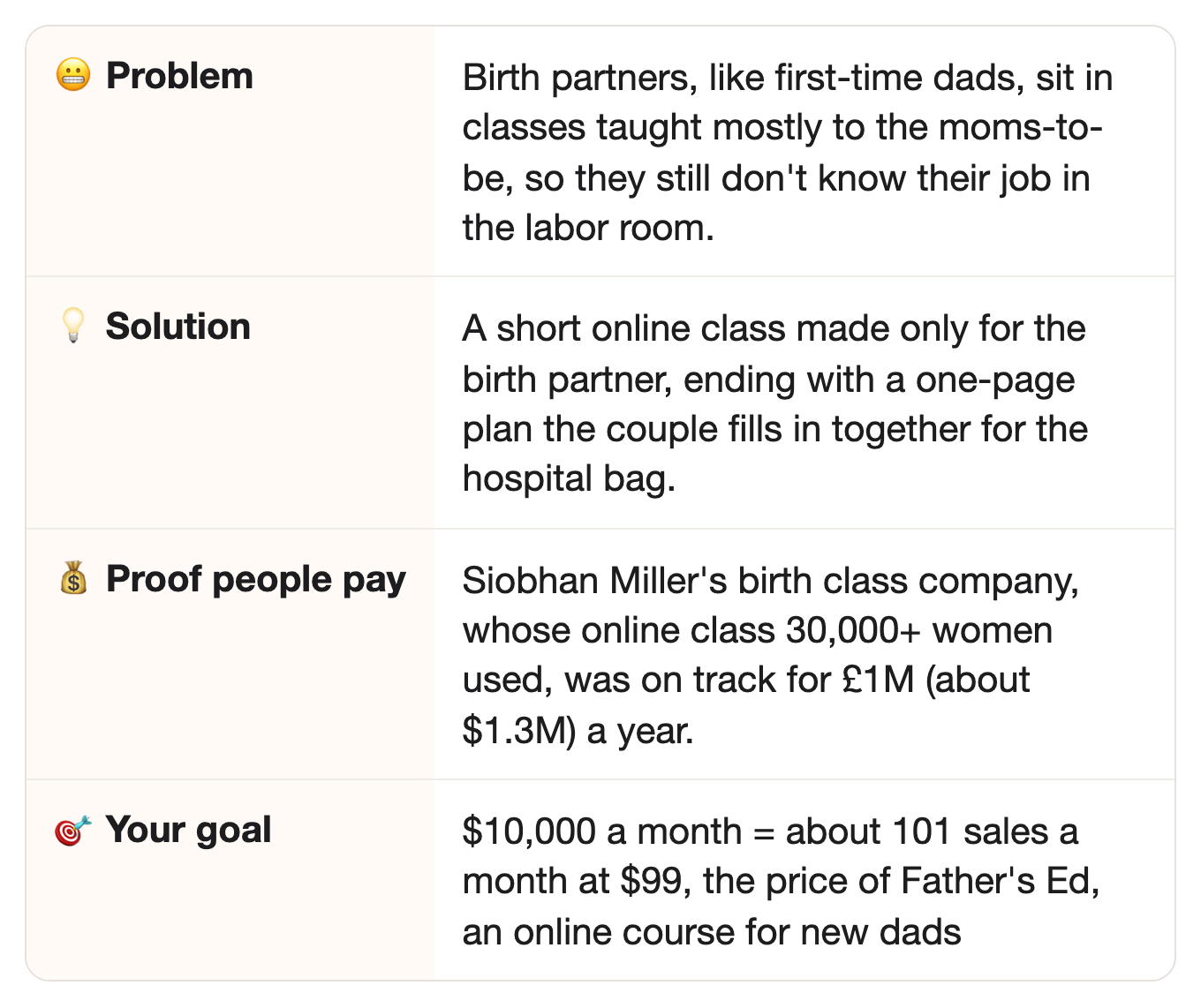
⚡ Quick facts
⠀
📖 How one mom’s birth class got on track for $1.3M a year
She started with no money, so she did every job herself.
Siobhan Miller was studying for a master’s degree in psychology in England.
While expecting her second child, she took a hypnobirthing course.
Wait, hypnobirthing?
It’s a way to stay calm during birth: breathing, relaxation, and knowing what happens at each stage.
And no, there’s no hypnosis in it.
She had an amazing home birth, and she knew what she wanted to do next.
So she trained to teach it, and started The Positive Birth Company in 2015, she says.
Here’s the hard part: she had no investors and no savings, so she did every job herself.
She took the bookings, answered customers, built the website, and taught the classes.
She said it ran “24/7, for all 365 days of the year, for many years.”
Oof.
⠀
She taught classes in person, in London, Brighton, Birmingham, and Devon.
Then she put the class online as a “Digital Pack,” for £39 (about $52).
By early 2020, more than 30,000 women had used the online course.
She also built Freya, an app that times contractions and talks you through each one.
Contractions are the waves of tightening that push the baby out, and how close together they come shows how far along labor is.
Sweet fact: she calls it a “virtual birth partner.”
And Apple named it one of its Top Apps of 2019.
In February 2020, she said: “We’re on track to surpass 1 million pounds in turnover this year.”
Turnover is the British word for sales.
£1 million is about $1.3 million, at the exchange rate on this issue’s date.
⠀
In 2021, she pitched on Dragons’ Den, a British TV show where founders ask investors for money.
Three of the five investors made offers.
Two of them shared the £136,000 she asked for (about $183,000), for 10% of her company.
Her old university said she’d turned “an idea from her kitchen table into a global business.”
By 2026, her home page said over 1 million people had trusted The Positive Birth Company.
Jackpot! 🎰
From doing every job herself… to a business on track for $1.3 million a year, after she put her birth class online.
⠀
🔗 Same idea, new group
In the story: women getting ready to give birth paid Siobhan £39 (about $52) for her birth class online.
⠀In this idea: birth partners, like first-time dads, need a class made for their own job in the labor room.
⠀Why it carries over: both face one big day they’ve never done before, and a short online class gets them ready at home.
⠀
💡 The opportunity
Most birth classes are made for the one giving birth. The partner gets a section.
First, who’s the birth partner?
It’s the person who stays with someone while they give birth, and helps.
Often it’s the dad, but it can be a wife, a mom, a sister, or a close friend.
⠀
Every year, a new crowd starts knowing nothing. 🔁
The US had 3,606,400 births in 2025, the CDC says.
And every first baby comes with someone who has never been a birth partner before.
⠀
Partners want to help, and even one short section can make a big difference.
Mommy Labor Nurse is run by Liesel, a registered nurse, and sells a $39 online birth class.
Here’s the kind part.
One mom wrote to her: “My husband read the partner section before our induction and he was absolutely amazing!”
An induction is when the hospital starts labor on purpose.
If one section helped him that much, a whole class for the partner can cover more, like the long hours and the bag.
⠀
But in the big classes, the partner gets one part.
The Positive Birth Company’s course lists “the role of the birth partner” as one topic among dozens.
Mommy Labor Nurse calls hers a “birth class for every mom,” with a partner section inside.
The class many couples take at their hospital works the same way.
The partner sits in, but the lessons are about her body, not his job in the room.
⠀
The partner’s job is support, not medical care.
Comfort, kind words, food and water, the bag, and calling the midwife or doctor when they were told to.
Every medical question goes to the midwife or doctor, never to the class.
⠀
👉 The idea: a short online class made only for the birth partner.
It ends with a one-page plan the couple fills in together: what she wants, what helps, what to pack, and who to call.
⠀
🙋 Never been a birth partner? You can still build this.
Team up with a labor nurse, a midwife, or a doula.
Wait, what’s a doula?
A doula is a trained helper who supports a family through birth, but isn’t a medical worker.
The nurse, midwife, or doula checks every lesson. You make the class and find the buyers.
⠀
Let your AI read what partners already wrote.
Dads and other partners post their birth stories in parenting forums.
Your AI reads them and lists what they wish they’d known, and what helped most in the labor room.
⠀
Or use your own story.
Been a birth partner yourself?
Then your “here’s what I did” is the warm part of the class.
A nurse or doula still checks the facts.
⠀
✅ Why this could work
Here’s why people will pay for this.
Dads already pay for a class made for them.
Two dads, Paul Zalewski and John Doht, started a site for new dads called Fathercraft in 2016.
“I literally never held a baby until my daughter was born,” Paul told Google in 2022.
Ha. That’s honest.
They launched video courses in 2018, and by 2022 the courses were their biggest money maker.
They did it part-time, and about 600 parents had taken a course by then.
⠀
Half a million dads have gone to a class to get ready.
Boot Camp for New Dads is a nonprofit, father-to-father workshop for dads-to-be.
Founded in 1990, it says it has graduated more than 500,000 men, in 44 states.
⠀
The same class keeps selling, year after year, at the same price.
Boot Camp started in 1990, and it was still running in 2026.
The Positive Birth Company charged £39 for its main course in 2020, and still did in 2026.
⠀
👉 Want to check these numbers? Each one has a source link in the last section, “📎 The sources.”
⠀
📊 More proof people want this
Want more? Here you go.
Moms pay $39 for an online birth class.
Mommy Labor Nurse’s home page says her class is “trusted by 100,000+ moms,” at $39.
She also has 650,000+ Instagram followers.
⠀
Dads pay $99 for a whole course.
Fathercraft’s course, Father’s Ed, cost $99 in 2025.
It covers pregnancy through the first weeks of being a dad, with birth as one part.
⠀
A dad says the class helped him in the labor room.
One Father’s Ed buyer wrote that it “gave me confidence helping and supporting my wife through labor and afterwards.”
Confidence: that’s what it gave him.
⠀
The UK leader is huge, and its course is made for the one giving birth.
The Positive Birth Company says over 1 million people have trusted it.
Its Freya app made Apple’s Top Paid Apps six years in a row, its home page says.
⠀
A new dad found most baby advice was aimed at moms.
Remember Paul from Fathercraft?
When he went looking for help as a new dad, much of what he found was geared toward moms, Google’s article says.
⠀
👉 Moms pay $39 and dads pay $99 to get ready for a birth.
And one mom says a single partner section helped her husband on the day she gave birth.
⠀
🔍 Who’s already doing it
These sell well, and none of them builds a whole class around the partner’s job in the labor room.
The Positive Birth Company, Siobhan’s company from the story, is for the person giving birth.
Its courses cover pregnancy, birth, the weeks after, and the early years.
The partner’s role is one topic inside the birth course.
⠀
Mommy Labor Nurse is a birth class for moms, with a partner section.
Its home page calls it a “birth class for every mom.”
Right there in the name: it’s for mom.
⠀
Fathercraft’s Father’s Ed is for dads, and covers much more than the birth.
Pregnancy, the hospital, gear, and the first weeks at home are all in it.
Its hospital part has short lessons on the birth plan and what to pack.
A birth plan is the mom’s written list of what she wants during labor, made before the day.
It’s made for dads only, not for a wife, a mom, a sister, or a friend.
⠀
Boot Camp for New Dads runs live workshops on becoming a dad.
It’s a nonprofit, taught in local programs and live online.
⠀
What’s missing, when we checked:
A short class only about the labor room, made for any birth partner, not just dads.
One that ends with a one-page plan built from the couple’s own wishes and what their hospital told them.
⠀
🔎 Check the market yourself in 2 minutes: run Part 0 of the prompt in the build plan below.
Your AI searches course sites, YouTube, Etsy, and dad-focused programs that day, and tells you: early, growing, or crowded.
Etsy is a website where small shops sell printable files, like birth plan templates.
Early? Start now.
Crowded? Good news: it means partners pay. Pick one narrower kind of partner (Step 1 of the build plan).
A crowded market is still OK. You win by serving one kind of partner better, not by being first.
⠀
👉 You can be the one to fill that gap.
A short class made only for the birth partner, ending with a one-page plan for the hospital bag.
⠀
🤖 Why AI won’t replace it
AI can explain every stage of labor. It doesn’t know her wishes, or what her hospital told the couple. Your class teaches the partner their own job, and gets those wishes onto one page.
So could ChatGPT just do this?
Sort of… it knows the facts about labor, but not this couple’s wishes.
🔮 Honest note: AI tools can already explain the stages of labor and list what to pack.
So the general facts aren’t the product.
The product is a short, checked class on the partner’s own job, plus their own plan.
⠀
1. You choose what’s right for them.Out of all the facts about birth, you teach only what the partner does.
Comfort, words that help, food and breaks, the bag, and when to call, as the midwife or doctor told them.
⠀
2. Checked twice.An AI checker reads every lesson against the safety rules, then a labor nurse, midwife, or doula reads it.
Nothing medical, and every medical question points to the midwife or doctor.
⠀
3. Ready to use.A chatbot doesn’t know her birth wishes, what the hospital said at the tour, or what she does and doesn’t want said.
Many hospitals invite expecting couples to visit the birth ward before the due date, and explain how they do things.
Your plan turns those into one page for the bag.
⠀
4. Proof people pay for a finished class: The Positive Birth Company sold a £39 course while giving away free videos on YouTube.Free videos, and people still bought the course.
⠀
👉 The facts are free. People pay for the finished plan for the bag.
⠀
💵 How much you can make
Here’s how the numbers add up.
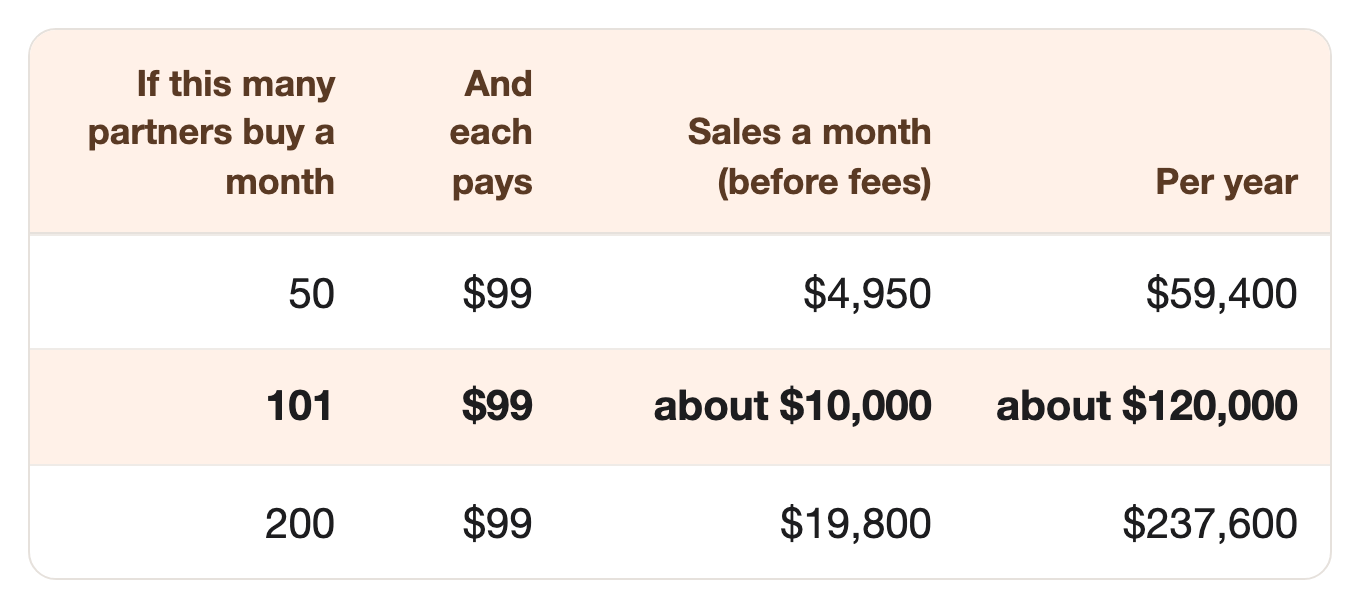
At $99, Father’s Ed’s price, 101 sales a month bring in about $10,000.
Why $99 and not $39? The $39 classes teach her. Yours teaches the partner’s whole job in the room, checked by a nurse or doula, plus a plan made from the couple’s own wishes.
⠀
101 a month is 1,212 a year, about 1 for every 3,000 US births in 2025.
⠀If it doesn’t work out, here’s all you lose:
One month’s subscription to an AI app, like ChatGPT or Claude.
A phone to film on, which you already have.
One week of your time.
⠀
👉 This is idea one, and with ideas two, three, and four, you could reach a million in 2 to 3 years.
Can you picture yourself running this?
Scroll down. Everything you need to start is waiting. 👇
Not for you? No problem. Next week’s idea might be.
That’s it, my fellow contrarians! 🙌
Yours ‘turning other people’s wins into your next idea’ Vijay Peduru 🦸♂️
⠀
⠀
⠀
🧰 Want to build it? Here’s everything else.
⠀
Step 1: 🎯 Pick one kind of birth partner, and a nurse or doula to work with
You don’t need a medical license to teach support. You need a nurse or doula on your side.
Pick one kind of birth partner, not everyone.
First-time dads.
A mom who’ll be with her daughter.
Wives and partners in two-mom families.
Partners at a birth center, or partners for a planned C-section (a birth by surgery).
A birth center is a small, home-like place for births, run by midwives, with its own routine.
Team up with a labor nurse, a midwife, or a doula.
They check every lesson before it goes out.
Share each sale with them, so nothing is paid up front.
Let your AI read what recent partners already posted.
Parenting forums are full of partners describing the day.
Your AI turns what they wish they’d known, and what helped most, into a list of lessons.
⠀
Step 2: 🛠️ Make the class
Keep it short: 8 to 10 videos, each under 10 minutes, plus one page.
Good news: your AI drafts the scripts.
Plan the lessons.
What each stage looks like from the partner’s chair, in general terms.
Comfort moves (like a back rub or a cool cloth), words that help, and when to stay quiet.
Food, water, and breaks for the partner too.
The bag, and the phone list: who to call, and when, once labor starts.
When to call the midwife or doctor, exactly as they told the couple.
The first hour after the baby arrives.
Write the scripts with your AI. Plain words, short, and calm.
Film on your phone. A quiet room and good light are enough.
Make the one-page partner plan.
A fill-in page the couple completes together.
Her wishes, what helps her, what she doesn’t want said, the bag, and who to call.
⠀
Step 3: 🔍 Check every lesson
Families will use this on the day their baby is born, so every lesson gets checked after it’s written.
Your AI does the first passes for you: it writes in Parts 2 and 3, and checks in Parts 4 and 5 of the prompt.
🖊️ The AI writer. It writes each lesson as support only, with no medical advice.
🔍 The AI rules checker. A second pass checks every line against the safety rules, and flags anything risky.
🧐 The AI critic. A third pass reads it like a strict labor nurse, and like a nervous first-time partner.
Then your nurse, midwife, or doula reads every lesson before anyone buys it.
⠀👉 The prompt already follows six safety rules:
Support only: no medical advice, no medicines, and no doses.
Every medical question goes to the midwife or doctor.
No promises about how a birth will go.
No frightening stories, and a calm, kind tone.
The person giving birth decides. The partner supports.
Follow the hospital’s or birth center’s own rules.
⠀
Step 4: 🏪 Open for sales
Copy Father’s Ed: one simple price, paid once.
Easy one.
Set your price.
$99, paid once, like Father’s Ed.
A gift version, so a friend or a grandparent-to-be can buy it for the couple.
Pick where to sell. Gumroad, Stan (a creator storefront app), or your own website all sell courses.
Give the first lesson away free, so partners can see your style before they buy.
Let AI write your sales page, using one real lesson and the blank partner plan as examples.
⠀
Step 5: 📣 Get your first buyers
Go where expecting couples already get help and ideas.
Answer partner questions in the big pregnancy groups on Facebook.
Look in due-date groups, where people due the same month talk, for posts like “What should my husband actually do during labor?”
Give support tips only, and send every medical question to the midwife or doctor.
Name your class in your profile, not in the reply.
Make the last line of the partner plan one clear ask.
“Know someone whose partner is due? Send them the free first lesson.”
Every couple who fills in the plan sees this ask, and many know someone else who’s expecting.
Pin one image per question on Pinterest, titled the way couples search.
Like “what a birth partner packs in the hospital bag.”
Link each pin to your free first lesson.
⠀
Step 6: 🏃 Eliminate competitors
If ten competitors copy you, here’s how yours stays ahead.
Serve the partners the dad courses skip.
A mom with her daughter, a wife, a sister, a close friend.
Make a version of the class for each, in their own words.
Sign a plain pledge, with your name and photo.
“A labor nurse or doula checks every lesson, and every medical question goes to your midwife or doctor.”
Put it on your sales page and at the start of every lesson.
⠀
Step 7: 🎲 Make it bigger
Every new family needs a few more short classes, and each one sells on its own.
Add classes for the next stages: the first six weeks at home for partners, or a class for grandparents who’ll help.
Three classes at about $10,000 a month each is about $360,000 a year, before fees. 🎯
⠀
🗓️ Your first week
Phew. That was a lot. 😅
A first version of Steps 1 to 5 fits into seven days. 🚀
By day 7, you have a sample class, a partner plan, a sales page, and your first answers in pregnancy groups.
The prompt below has seven Parts, and they’re not the same as the Steps above.
Day 1 (Step 1): Run Part 0 of the prompt (it’s below), pick your kind of partner, and message a nurse, midwife, or doula.
Then plan the class with Part 1.
Days 2–3 (Step 2): Write the lesson scripts with Part 2, make the partner plan with Part 3, and film.
Day 4 (Step 3): Check everything with Parts 4 and 5, then send it to your nurse, midwife, or doula.
Day 5 (Step 4): Write your sales page with Part 6, and open for sales.
Days 6–7 (Step 5): Write your group answers and your pins with Part 7, and post your first answers.
The last-line ask is already on the partner plan, from Part 3.
⠀
🏄 How to use the prompt
One prompt does all the AI work, in seven parts, plus a quick market check (Part 0).
Part 1 — Plan the class. Plans 8 to 10 short lessons for your kind of partner, and flags anything that belongs to the midwife or doctor.
Part 2 — Write the lesson scripts. Writes each lesson as a short video script, in plain, calm words.
Part 3 — Make the partner plan. Makes the fill-in, one-page plan the couple completes together.
Part 4 — Check the safety rules. Checks every line against the safety rules, and flags the risky ones.
Part 5 — Find the mistakes. Reads it like a strict labor nurse, and like a nervous first-time partner.
Part 6 — Write the sales page. Uses one real lesson and the blank plan as examples.
Part 7 — Write the first-buyer kit. Writes answers for pregnancy groups and your Pinterest pins, and checks them against the rules.
Run it your way:
Part by part (the default): it pauses after each part, and you type “next” to go on.
All at once: say “run all seven parts.”
Just one part: say “only do Part 3,” or any part you need.
The full prompt is just below, under “📋 The prompt.”
🎙️ Talk to your AI sidekick, don’t type.
Turn on voice mode, or use a dictation app like Wispr Flow.
Say it messy. The AI sorts it out.
Turn it into a skill, so you never paste it again.
Paste the prompt into Claude or ChatGPT, and say: “Turn this into a skill I can save.”
Install once, use forever.
⠀
📋 The prompt
The prompt (copy it into Claude or ChatGPT, fill in the INPUTS part, and run it your way)
CONTEXT:
- You're my course partner. Together we'll build a short online class for birth partners: the person who stays with someone while they give birth, and helps.
- This prompt has a market check (Part 0), then seven parts (Part 1 to Part 7), in order.
- Run it the way I ask:
    - If I say nothing, go one part at a time. After each part, show me the result, then stop and wait. Move on only when I type "next."
    - If I say "run all seven parts," do Part 1 to Part 7 without stopping. Run Part 0 only when I ask for it.
    - If I say "only do Part 3" (or any part), do just that part.
- If a part needs something from me, ask for it before you start that part.
- This class teaches support, not medical care. Follow these rules in every part:
    1. Never give medical advice. Never name a medicine, a dose, or a treatment to choose.
    2. Every medical question goes to the midwife or doctor. Say so plainly whenever one comes up.
    3. Never promise how a birth will go, how long it takes, or how much it hurts.
    4. No frightening stories, and no stories about loss. Keep the tone calm and kind.
    5. The person giving birth decides. The partner supports and speaks up only as she asked.
    6. Tell partners to follow their hospital's or birth center's own rules, and the plan their midwife or doctor gave them.
- End every lesson with this line: "This class teaches support. Ask your midwife or doctor any medical question."
- Never invent a fact or a number. If you're not sure a fact is right, leave it out.
- Keep web search on for the whole prompt (turn on search in ChatGPT or Claude), so you can open any page you need to check.

=============== INPUTS — edit these, or just run as is ===============

Who the class is for:
{e.g. first-time dads, at a hospital birth}

What partners have posted (paste posts from parenting forums, or leave blank):
{e.g. "I didn't know whether to talk or stay quiet," "I forgot to eat for 12 hours"}

My nurse, midwife, or doula partner:
{e.g. a labor nurse with 10 years in a hospital birth unit}

My price:
{e.g. $99, paid once, plus a gift version}

======================== END OF INPUTS ========================

THE PARTS:

Part 0 — Check the market today.
This part needs web search (turn on search in ChatGPT or Claude). Search for classes and products made for birth partners, and for each place give the count, the three biggest with links, and their prices:
1. Online birth classes, and whether they have a partner section or a partner-only class.
2. Courses made for dads-to-be or birth partners, on course sites and their own websites.
3. YouTube channels and videos teaching partners what to do during birth.
4. Etsy shops selling birth partner guides or birth plan templates.
Then tell me: early (few sellers), growing, or crowded, and which kind of partner looks least served (for example: a mom with her daughter, two-mom families, partners for a planned C-section). Give a link for every number. If you can't open a page, say so. Never guess a number.

Part 1 — Plan the class.
Plan 8 to 10 short lessons for the partner in my INPUTS. Use what partners have posted, if I pasted any. Cover: what each stage of labor looks like from the partner's side, in general terms; comfort moves and words that help; food, water, and breaks for the partner; the bag and the phone list; when to call the midwife or doctor, as they told the couple; and the first hour after the baby arrives. For each lesson give the title, three things it teaches, and why a partner would care. Say clearly which reasons are your guess. Flag anything that belongs to the midwife or doctor instead.

Part 2 — Write the lesson scripts.
Write one video script for each lesson in Part 1, for someone who has never been at a birth:
1. One opening line that names the moment ("You're in the room, and she's breathing through a contraction").
2. Three to five short points, each something the partner can do or say.
3. One line on what to leave to the midwife or doctor, if it applies.
4. The closing line from CONTEXT.
Keep each script under 600 words, and follow every rule in CONTEXT.

Part 3 — Make the partner plan.
Make a one-page, fill-in plan the couple completes together, to pack in the hospital bag. Include blanks for: her wishes for the birth, in her words; what helps her relax; what she does and doesn't want said; who to call, and when, as their midwife or doctor told them; what the hospital or birth center told them at the tour; and the partner's own bag (snacks, charger, a change of clothes). Keep it to one page, with plain labels. Add the closing line from CONTEXT at the bottom. Ask me what goes on the last line; if I say nothing, use: "Know someone whose partner is due? Send them the free first lesson."

Part 4 — Check the safety rules.
Now act as a separate rules checker who didn't write the lessons or the plan. Check every line of Parts 2 and 3 against each rule in CONTEXT, one by one. Mark each lesson: safe, needs a fix, or drop it. For each problem, quote the risky words and say which rule they break. Then give a fixed version of everything that needs one.

Part 5 — Find the mistakes.
Now act as a strict labor nurse, then as a nervous first-time partner. As the nurse, flag anything that sounds like medical advice, anything wrong, and anything that could worry a family. As the partner, flag any word or step that would confuse you. Then give the final lessons and plan, with every fix made, and the closing line from CONTEXT on each. Remind me that my nurse, midwife, or doula partner must read every lesson before it goes on sale.

Part 6 — Write the sales page.
Ask me for one finished lesson and the blank partner plan first. Use them as examples. Never invent a result, a review, or a number. Give me:
1. A headline that names the kind of partner, not "everyone."
2. What they get: the lessons, how long each is, and the one-page plan.
3. Who checked it: my nurse, midwife, or doula partner, and that it teaches support, not medical care.
4. The price, shown up front, and the gift version.
5. The free first lesson, in exchange for an email address.

Part 7 — Write the first-buyer kit.
1. Write five short, helpful answers to questions birth partners post in Facebook pregnancy and due-date groups (for example, "What should my husband actually do during labor?"). Support tips only, no link and no sales pitch in the answer, and every medical question goes to the midwife or doctor. No promises.
2. Write five Pinterest pin titles and short descriptions, each titled the way a couple would search (for example, "what a birth partner packs in the hospital bag"), each pointing to the free first lesson.
3. Check all of it against the rules in CONTEXT before you show me.
⠀
📎 The sources
Every number above, with where it came from.
Siobhan’s start · Number: Started in 2015, after a psychology master’s and training as a hypnobirthing teacher; took a course while expecting her second child; a home birth · Source: TechRound, February 18, 2020
Doing every job · Number: “with no investment or savings upon set up, I had to do EVERYTHING myself”; bookings, customer service, website, classes; “24/7, for all 365 days of the year, for many years” · Source: Same page
Classes and the online course · Number: In-person classes in London, Brighton, Birmingham and Devon; the Digital Pack “priced at just £39”; “used by more than 30,000 women”; free videos on YouTube · Source: Same page
Freya app · Number: “virtual birth partner”; “named as one of the Top Apps of 2019 by the App Store”; it will “coach you through each surge” and “keep track of how frequently your surges are coming” (home page, Wayback copy of May 19, 2026, below) · Source: Same page
Her sales forecast · Number: “We’re on track to surpass 1 million pounds in turnover this year.” · Source: Same page
Dragons’ Den · Number: Studied “on the Psychology MSc course at the University of Westminster” (in London); offers from three of five Dragons; £136,000 shared by two, for a combined 10%; “an idea from her kitchen table into a global business” · Source: University of Westminster, July 26, 2021
The Positive Birth Company in 2026 · Number: “Over 1 million people have trusted in The Positive Birth Company”; Freya “Included in Apple’s Top Paid Apps for 6 years in a row”; “our courses are for you,” for anyone · Source: Home page, Wayback copy of May 19, 2026
Its main course · Number: £39; “The role of the birth partner” listed as one topic · Source: Hypnobirthing Pack, Wayback copy of April 23, 2026
Pounds to dollars · Number: £1 = $1.345 on August 7, 2026 (this issue’s date); £39 ≈ $52; £1 million ≈ $1.3 million; £136,000 ≈ $183,000 · Source: Frankfurter (European Central Bank rates)
US births · Number: “3,606,400 births recorded in 2025” · Source: CDC National Center for Health Statistics, April 9, 2026
Mommy Labor Nurse · Number: Run by “Liesel Heinzelmann, BSN-RN”; “$39 online birth class”; “trusted by 100,000+ moms”; “birth class for every mom”; “650k+ Instagram Followers”; review: “My husband read the partner section before our induction and he was absolutely amazing!” · Source: Home page, Wayback copy of July 12, 2026
Fathercraft’s story · Number: Paul Zalewski: “I literally never held a baby until my daughter was born”; site launched 2016; courses launched 2018, “currently their biggest money maker”; about 600 parents had taken the courses; still part-time; much of the advice he found was aimed at moms · Source: Google for Creators, February 22, 2022 (Wayback copy)
Father’s Ed · Number: $99; “from pre-birth preparation through the first few weeks of fatherhood”; a birth and delivery module; “The hospital & when your baby is born” module includes “Touring hospitals and the birth plan” and “What to pack”; review: “gave me confidence helping and supporting my wife through labor and afterwards” · Source: Fathercraft, Wayback copy of August 11, 2025
Boot Camp for New Dads · Number: “Founded in 1990”; “graduated more than 500,000 men”; “offered in 44 states”; “father-to-father, community-based workshop”; “live, online, interactive Boot Camp” · Source: Boot Camp for New Dads, Wayback copy of June 28, 2026
The money math · Number: $99 × 101 = $9,999 a month; 1,212 a year out of 3,606,400 births is about 1 in 3,000 · Source: Our math, from the Father’s Ed price and the CDC count