


Hello contrarians,
Today’s idea is called The Rental Staging Pack.
Grab a coffee. ☕
First, a photo business’s story. Then, the business you could build from it.
⠀
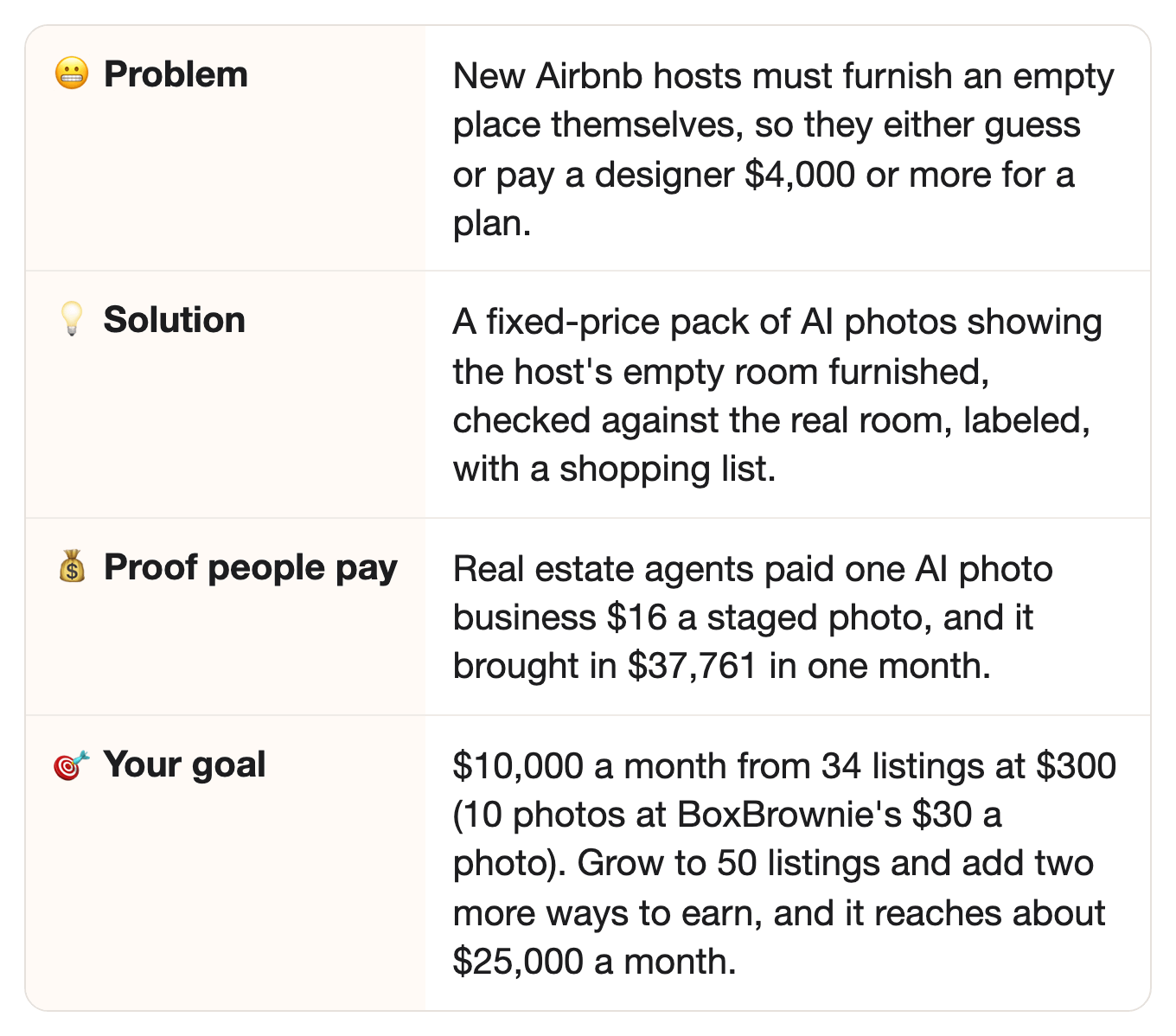
⚡ Quick facts
⠀
📖 How one photo business hit $37,000 in a month
It started as a done-for-you service.
Meet Refined Listings, a business that makes “virtually staged” photos.
In plain words: a photo of an empty room, with furniture added by AI.
Its buyers are real estate agents selling homes.
Our guess at why: a furnished room helps a buyer picture living there.
It started in September 2024 as a done-for-you service, its founders say.
Then, in October 2025, it turned into an app the agents run themselves.
An agent uploads a photo, and AI adds the furniture.
And the price: $16 a photo, less on bigger packs.
Agents pay only for the photos they download.
⠀
Small win: in November 2025, its first full month as an app, it brought in $18,205.
A nice start.
Then, in September 2026, it brought in $37,761.
TrustMRR, a site that checks revenue at the source, shows these numbers.
⠀
It didn’t stay at that peak, though.
In the 30 days to October 23, 2026, it brought in about $24,000.
Holy moly. 😳
$37,000 in one month, from $16 photos.
From a done-for-you service… to an app that more than doubled its monthly sales, by letting agents stage their own photos.
⠀
🔗 Same idea, new group
In the story: real estate agents paid Refined Listings $16 a photo to show empty homes with furniture added by AI.
⠀In this idea: short-term rental hosts get the same AI photos as a design preview, plus a shopping list to furnish the real room.
⠀Why it carries over: both need to see an empty room furnished, and AI does it for far less than a designer charges.
⠀
💡 The opportunity
Refined Listings sells to real estate agents. This idea takes the same model to rental hosts.
Rental hosts need furnished photos too, but theirs must match what guests find.
First, who are short-term rental hosts?
They’re people who rent out a home or an apartment by the night, on sites like Airbnb and Vrbo.
And there are lots of them: Airbnb says it has more than 5.5 million hosts.
⠀
A new host often starts with an empty place.
Before the first guest, they pick a style, buy the furniture, and take photos.
And a designer costs real money: one rental designer charges $4,000 and up for a design-only plan.
⠀
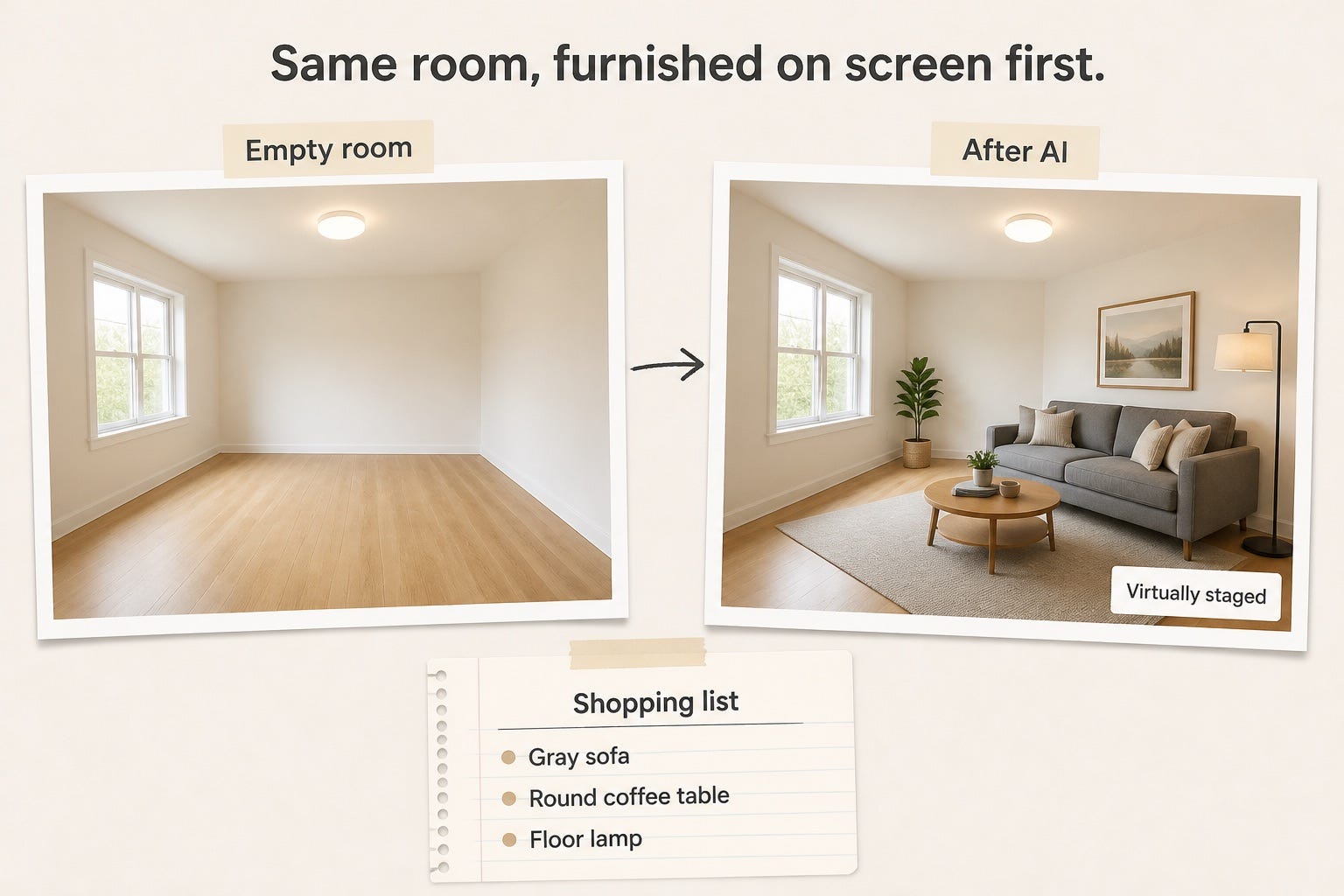
Here’s the clever bit: a staged photo shows the room furnished before you buy a single chair.
The host sees the look, picks it, and shops from a list.
Pretty handy, right?
⠀
But the rules are strict.
Airbnb says listing photos should “accurately represent the space provided.”
It also asks hosts to remove photos where AI was used to “add amenities or attributes that are not part of a listing.”
In plain words: no fake hot tubs.
So you sell the pack as a design preview first.
A staged photo goes in a listing only once the room is furnished to match.
And every staged photo is labeled “Virtually staged.”
⠀
👉 The idea: sell rental hosts a fixed-price AI staging pack, as a design preview first: checked against the real room, labeled, with a shopping list.
It’s an AI service: a form in, photos out.
One fixed price, one fixed scope.
For example, 10 staged photos for $300, at BoxBrownie’s $30 a photo.
⠀
AI does most of the work.
It adds the furniture, picks the styling, and writes the shopping list.
⠀
No custom client work, and no calls.
The host fills in a form and uploads photos.
Then the finished photos land in their inbox.
⠀
Every photo is checked against the original, and labeled “Virtually staged.”
⠀
🧩 What you actually need
No design background.
Good news: AI stages the photos, and you check each one against the real room.
⠀
An AI app that edits photos, like ChatGPT.
⠀A simple online form with a checkout.
Stripe or Gumroad, two sites that take payments online, both work.
⠀
✅ Why this could work
Three reasons there’s real money here.
People already pay for staged photos, and others make money the same way.
Refined Listings, from the story, brought in $37,761 in September 2026, from agents.
BoxBrownie, a photo-editing company, charges $30 for a staged photo, and says 250,000+ professionals trust it.
And Zillow, the big home-listing site, bought a startup called Virtual Staging AI in October 2024.
That startup was founded the year before.
⠀
New hosts have kept joining since at least 2024, and they still do.
Airbnb had over 5 million hosts in February 2024, and over 5.5 million by May 2026.
Many new hosts start with rooms to furnish and photograph.
⠀
Hosts already spend thousands on the setup.
One rental designer charges $4,000 and up for design only.
The same designer charges $8,700 and up to do it all, plus the furniture itself.
Next to that, a $300 pack is small.
⠀
👉 Don’t take my word for it. Every number is linked in “📎 The sources,” at the very end.
⠀
📊 More proof people want this
Want more? Here you go.
People already pay freelancers to stage photos.
Fiverr is a website where freelancers sell small jobs.
On Fiverr, a search for “airbnb virtual staging” shows 529 results.
Two top sellers there have more than 1,000 reviews each, with prices starting at $9 and $20.
⠀
Companies charge for staged photos, too.
BoxBrownie charges $30 a photo, and $10 to remove things from a photo.
Refined Listings charges $16 a photo, less on bigger packs.
⠀
Hosts watch videos on how to furnish a rental.
We looked at the top 100 YouTube videos for “how to furnish an airbnb.”
About a third of them have more than 100,000 views each.
⠀
The big picture: Airbnb counts more than 9 million active listings. 💰
The typical US host earned $15,600 in 2025.
⠀
What hosts say, under a host’s video about AI listing photos:
“Just paid to have this done and almost all the photos were unusable, added a toilet to the closet of the bathroom…”
A toilet in the closet, yikes.
“I would be highly afraid my guests would show up after seeing these flawless AI generated images and immediately think ‘this doesn’t look like the photos!’”
These two comments show the problem.
They don’t prove how many hosts would pay.
⠀
👉 Hosts want great photos.
But they’re scared of photos that don’t match the real room.
⠀
🔍 Who’s already doing it
Who’s in the space, and the hosts they skip.
Refined Listings, BoxBrownie, and Zillow’s staging tool are built mainly for agents selling homes.
Refined Listings is the staging app from the story above.
BoxBrownie sells photo edits, like virtual staging at $30 a photo.
Zillow, the big home-listing site, bought a staging startup called Virtual Staging AI in 2024.
Here’s the difference: a home buyer tours the house before buying.
A guest sees the room for the first time at check-in, so the photo has to match.
⠀
Sellers on Fiverr, a freelancer site, work one photo at a time.
The host has to write the instructions for each photo.
⠀
Rental designers, interior designers who set up rentals, do the whole job.
They charge thousands of dollars.
⠀
AI photo tools for hosts exist.
One host says the AI photos they paid for added things that weren’t in the room.
That’s the toilet-in-the-closet comment from above.
⠀
What nobody was selling, when we checked:
A fixed-price staging pack made for rental hosts.
Every photo checked against the real room, and labeled.
A shopping list that matches what’s in the photo.
⠀
🔎 Check the market yourself in 2 minutes: run Part 0 of the prompt in the build plan below.
Your AI searches for staging services and apps for hosts that day, and tells you: early, growing, or crowded.
Early? Start now.
Crowded? Good news: it means hosts pay. Pick one kind of host (Step 1 of the build plan).
A crowded market is still OK. You win by serving one kind of host better, not by being first.
⠀
👉 That gap is your chance: a fixed-price staging pack for rental hosts, checked against the real room.
⠀
🤖 Why AI won’t replace it
AI gives hosts a pretty picture. You give them one they can trust.
Could ChatGPT just do this?
Sort of, if the host tells it exactly what to leave alone.
Honest photos.
AI leaves the windows, fireplace, and room size alone when told to.
But a busy host may not think to say it.
You check every photo against the original, and redo any that changed the room itself.
One wrong photo can mean an upset guest, and a photo the listing site asks them to remove.
⠀
Taste: one look for the whole place.
A busy host doesn’t know which style fits their place and their guests.
You pick a look that fits, and keep it in every room.
⠀
The same pieces in every photo.
One host said the AI photos they paid for “changed the fixtures from picture to picture.”
Fixtures are the built-in parts, like lights, taps, and sinks.
In your pack, the sofa in photo 1 is the same sofa in photo 4.
⠀
Ready to use: a finished pack.
It’s labeled, sized for the listing, and comes with a shopping list for the pieces shown.
⠀
Their time.
A form in, photos out.
No prompts to write, no photos to fix.
⠀
Proof people pay for finished work: two top Fiverr stagers have more than 1,000 reviews each.
The AI apps are right there, and people still pay someone.
⠀
👉 AI photos are everywhere, but a checked pack that’s ready to list is hard to find.
⠀
💵 How much you can make
Here’s the math.
First stop: $10,000 a month from the pack alone
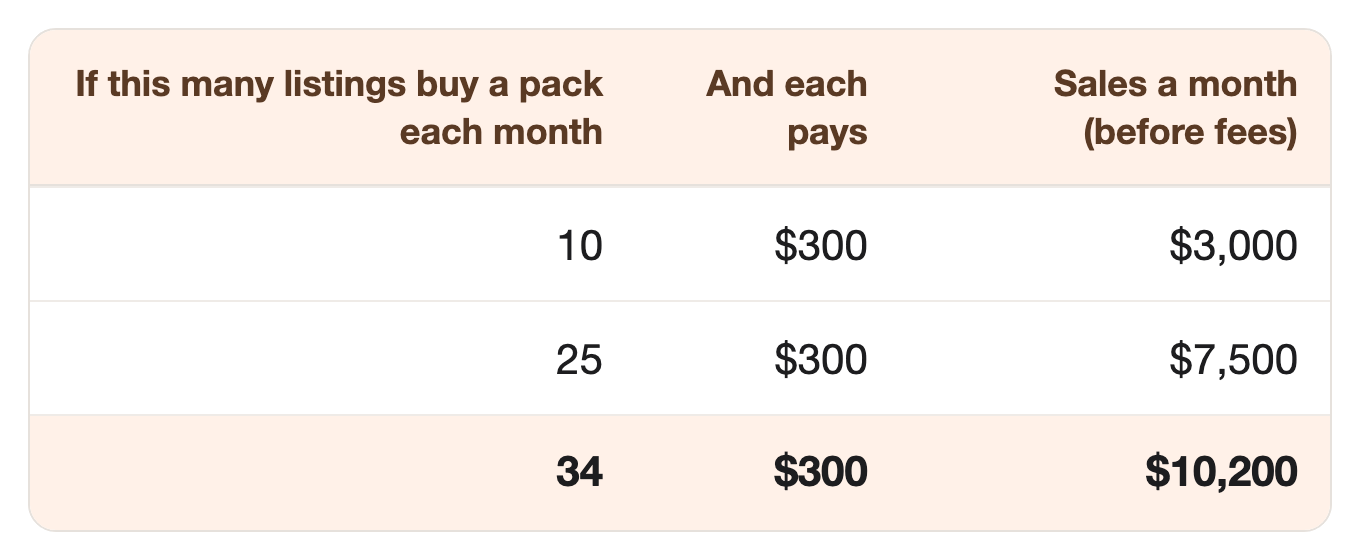
If you charge $300 for 10 photos, at BoxBrownie’s $30 a photo, 34 listings a month get you past $10,000.
That’s about 400 listings a year, less than 0.01% of Airbnb’s 5.5 million hosts.
⠀
Many hosts will likely buy once, so plan on finding new hosts every month.
A monthly plan for people who run many listings gives you steady income (Step 7).
Next stop: $25,000 a month, with two more ways to earn
Once hosts trust your photos, some will buy a second thing from you.
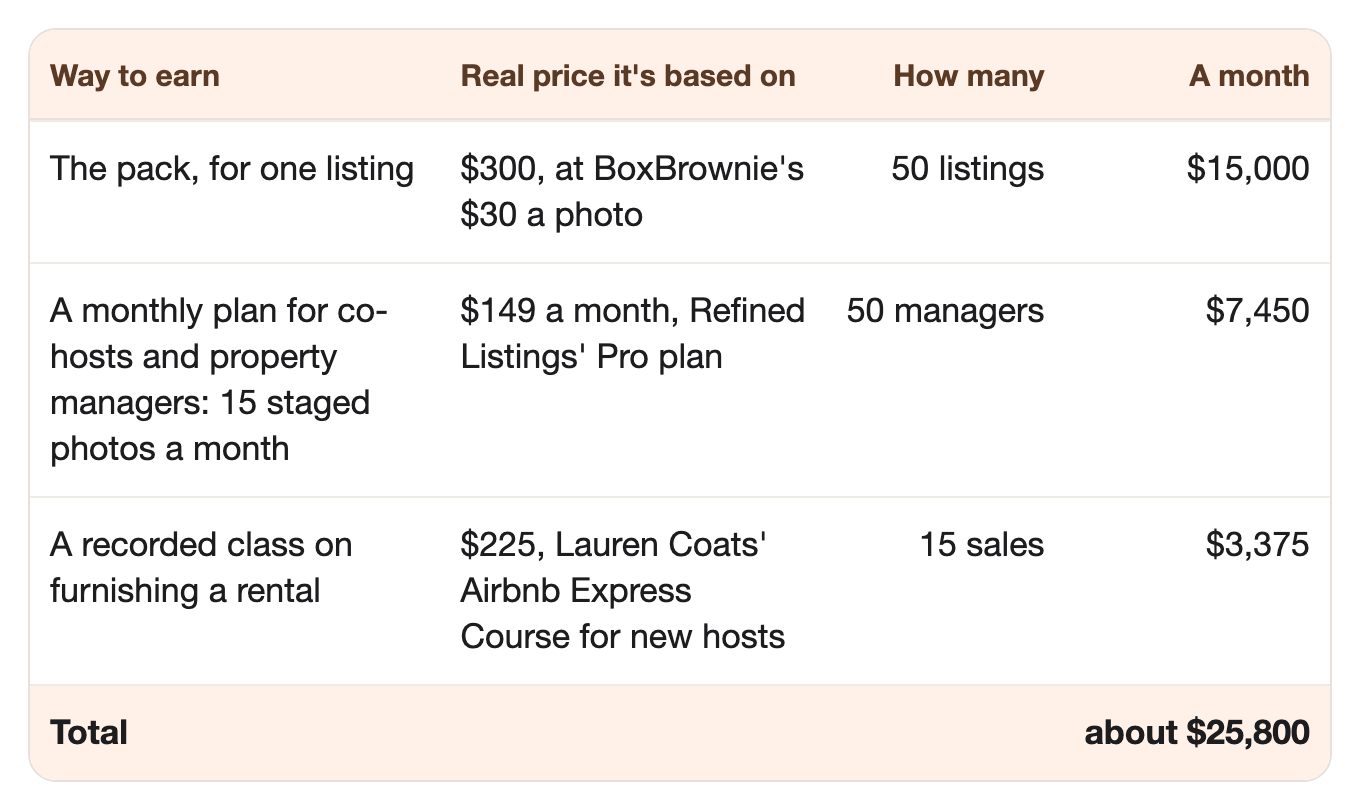
The pack still does most of the work.
Grow it from 34 to 50 listings a month, and it brings in $15,000.
Most hosts buy once, so that means about 50 new hosts every month.
⠀
The monthly plan is the steady part.
A co-host runs a listing for its owner, and a property manager runs many.
They add new listings all the time, so they need photos every month.
Same rules as the pack: 15 photos, checked, labeled, with no custom requests.
⠀
The class sells to hosts who aren’t ready to buy a pack.
Record it once, from your shopping lists and your best before-and-after photos.
About 15 sales a month is the goal.
⠀
That’s about 115 buyers a month in all.
Still a tiny slice of Airbnb’s 5.5 million hosts.
⠀
If it doesn’t work out, here’s all you lose:
One month of an AI app that edits photos, like ChatGPT.
One week of your time.
⠀
👉 One idea, three ways to earn: about $25,000 a month.
Add two more ideas, from this newsletter or a niche close to this one. Run all three for two or three years, and the total could pass a million dollars.
For this pack, a niche close by could be landlords of long-term rentals. And this pack could be your first idea.
Is your brain already buzzing? 🐝
Then scroll on. The build plan is below. 👇
Not feeling it? All good. Another idea comes next week.
That’s it, my fellow contrarians! 🙌
Yours ‘hoping one of these sparks an idea of your own’ Vijay Peduru 🦸♂️
⠀
⠀
⠀
🧰 Want to build it? Here’s everything else.
In every step, AI does most of the work. You run the process. 🎙️
⠀
Step 1: 🎯 Pick one kind of host and one pack
One kind of host, one pack, one price.
Pick who you serve.
For example: first-time hosts setting up an empty apartment, or cabin owners.
Their rooms and guests look alike, so your styles repeat.
Fix the pack.
For example: 10 staged photos, one style picked from three samples, one round of fixes.
The same steps for every host, with no custom requests.
Fix the price. For example: $300 a pack, at BoxBrownie’s $30 a photo.
Say what’s never included: new walls, windows, views, a pool, a hot tub, or anything else that isn’t there.
Remember Airbnb’s rule? No amenities that aren’t really there.
⠀
Step 2: 📥 Set up the form
A form in, photos out. No calls.
The host fills in one form.
A photo of each room, taken straight on, in daylight.
The style they like, from your three samples.
What the photos are for: a design preview, or a listing.
For a listing, one box to tick: “The room will be furnished to match before any guest sees these photos.”
They pay on the form, with a simple checkout tool like Stripe or Gumroad.
⠀
Step 3: 🎨 Stage the photos
AI adds the furniture. The room itself never changes.
Use an AI app that edits photos, like ChatGPT.
Give it a staging brief for each photo (Part 3 of the prompt writes it).
Keep the walls, windows, floors, doors, fixtures, views, and room size exactly as they are.
Add only furniture and decor someone could carry in.
Use the same pieces in every photo of the same room.
⠀
Step 4: 🔍 Check every photo
Three checks, then the label.
Your AI does all three passes: Part 3 of the prompt tells your photo app what to add, and Part 4 runs both checks.
🖊️ The AI stager. It adds only movable furniture and decor.
🔍 The AI checker. It compares each staged photo to the original, and lists everything that changed.
A changed window, floor, fixture, or view? Redo the photo.
🧐 The AI critic. It reads the photo against the listing site’s current photo rules, like Airbnb’s.
🏷️ The label. Every photo says “Virtually staged” in a corner.
Once the room is furnished, the host swaps in real photos.
⠀
👉 The prompt already follows three safety rules: change only movable furniture and decor, label every photo “Virtually staged,” and follow each listing site’s photo rules.
⠀
Step 5: 📣 Get your first hosts
Show hosts their own room, staged. Hosts buy what they can see.
Send one host two lines, plus their own empty room, staged and labeled, at no charge.
Pick a host whose listing shows a bare room, and say one thing you noticed in it.
Write each note for one host at a time, with Part 6 of the prompt, and never post their photo without their OK.
Write one short page for each question hosts type into Google, like “can I use virtual staging on Airbnb.”
Use their exact words as the title, and answer in plain words, with one staged and labeled room as the example.
Your AI drafts the pages in Part 6 of the prompt.
Make a free tool that turns one room photo into a furniture shopping list.
Build it with an AI app builder, using the shopping-list step from Part 5.
Put a link to your pack at the bottom of every list.
⠀
Step 6: 🏃 Eliminate competitors
When others copy you, here’s how you stay the one people pick.
Sign every pack: “A real person checked this against your room.”
Add your name and the date, and answer every host’s reply yourself within a day.
An app can stage a photo, but it can’t put a person’s name on the check.
That signature is what rivals can’t copy.
Publicly offer any rival a side-by-side: labeled staged photos next to the real room.
Post your own side-by-sides first, with each host’s permission.
A rival who changes windows or views can’t take that test without looking bad.
⠀
Step 7: 🎲 Make it bigger
Every group with empty rooms to furnish has the same need.
Add the two extras from “How much you can make,” one at a time.
First the monthly plan for co-hosts and property managers, since you already make the pack.
Then the recorded class, built from your shopping lists and your best before-and-after photos.
Open the same service for other groups: landlords of long-term rentals, or people selling a home themselves.
Then turn the form into an app hosts run themselves, like Refined Listings did in October 2025.
One service at about $25,000 a month is about $300,000 a year, before fees. 🎯
Add two or three more services, or ideas from this newsletter, and a million dollars in total is two or three years away.
⠀
🗓️ Your first week
Phew. That was a lot. 😅
A first version of Steps 1 to 5 fits into seven days. 🚀
By day 7, you have a pack, a form, three sample styles, two staged rooms, and your first notes sent to five hosts.
The prompt below has six Parts, and they’re not the same as the Steps above.
Day 1 (Step 1): Pick your host and your pack with Parts 0 and 1 of the prompt (it’s below).
Day 2 (Step 2): Write your form with Part 2.
Days 3–4 (Step 3): Stage two rooms with Part 3.
Day 5 (Step 4): Check every photo and its label with Part 4, then write the shopping lists with Part 5.
Days 6–7 (Step 5): Write your offer and your notes with Part 6, and send a note to five hosts, one at a time.
⠀
🏄 How to use the prompt
One prompt does all the AI work, in six parts, plus a quick market check (Part 0).
Part 1 — Pick the host and the pack. Picks one kind of host, and sets a fixed pack and price.
Part 2 — Write the form. Writes the questions hosts answer, with the listing checkbox.
Part 3 — Write the staging brief. Writes what your AI photo app should add, and what it must never change.
Part 4 — Check every photo. Compares each staged photo to the original, and flags every change to the room.
Part 5 — Label it and list it. Writes the shopping list, the “virtually staged” note for the listing, and a reminder to swap in real photos.
Part 6 — Win the first hosts. Writes your offer page, a note to one host, and three question pages.
Run it your way:
Part by part (the default): it pauses after each part, and you type “next” to go on.
All at once: say “run all six parts.”
Just one part: say “only do Part 4,” or any part you need.
The full prompt is just below, under “📋 The prompt.”
🎙️ Talk to your AI sidekick, don’t type.
Turn on voice mode, or use a dictation app like Wispr Flow.
Say it messy. The AI sorts it out.
Turn it into a skill, so you never paste it again.
Paste the prompt into Claude or ChatGPT, and say: “Turn this into a skill I can save.”
Install once, use forever.
⠀
📋 The prompt
The prompt (copy it into Claude or ChatGPT, fill in the INPUTS part, and run it your way)
CONTEXT:
- You're my partner in running an AI staging service for short-term rental hosts.
- It's a fixed-price AI service: one price, one fixed pack of photos, the same process for every host, no custom work, and no calls. A form comes in, finished photos go out.
- This prompt has six parts, in order.
- Run it the way I ask:
    - If I say nothing, go one part at a time. After each part, show me the result, then stop and wait. Move on only when I type "next."
    - If I say "run all six parts," do them all without stopping.
    - If I say "only do Part 4" (or any part), do just that part.
- If a part needs something from me, ask for it before you start that part.
- Honesty rules, always:
    - Change only furniture and decor someone could carry in. Never change walls, windows, floors, doors, fixtures, counters, views, room size, or the outside.
    - Never add an amenity that isn't there, like a fireplace, a pool, a hot tub, or a balcony.
    - Every staged photo carries the label "Virtually staged."
    - A staged photo goes in a listing only if the host says guests will find the room furnished to match. Otherwise it's a design preview only.
    - Follow each listing site's current photo rules. Read them before you answer; never guess them.
- Never invent a fact, a price, or a number. If you can't find a source, say so.
- If you can't open a link or a photo I give you, ask me to attach the file instead.
- Keep web search on for the whole prompt (turn on search in ChatGPT or Claude), so you can open any page you need to check.

=============== INPUTS — edit these, or just run as is ===============

The kind of host I serve:
{e.g. first-time hosts setting up an empty one-bedroom apartment}

My pack and price:
{e.g. 10 staged photos, one style picked from three samples, one round of fixes, $300}

The listing sites my hosts use:
{e.g. Airbnb and Vrbo}

My three sample styles:
{e.g. warm modern, coastal, cozy cabin}

======================== END OF INPUTS ========================

THE PARTS:

Part 0 — Check the market today.
This part needs web search (turn on search in ChatGPT or Claude). Search for staging help for my kind of host and, for each place, give the count, the three biggest with links, and their prices:
1. Virtual staging services and apps that sell to rental hosts.
2. Virtual staging services and apps for real estate agents.
3. Freelancers on Fiverr and Upwork offering "airbnb virtual staging."
4. Interior designers who set up short-term rentals.
Also find and link the current photo rules for each listing site in my INPUTS. Then tell me: early (few sellers), growing, or crowded, and which kind of host looks least served (for example: cabin owners, first-time hosts, hosts of small city apartments). Give a link for every number. If you can't open a page, say so. Never guess a number.

Part 1 — Pick the host and the pack.
Using Part 0, suggest three kinds of host I could serve, and say why for each. Say clearly which reasons are your guess. Then help me fix one pack: the number of photos, the styles, the rounds of fixes, the price, and what's never included (custom requests, calls, any change to the room itself, any amenity that isn't there).

Part 2 — Write the form.
Write the form a host fills in. Include:
1. Upload one photo per room, taken straight on, in daylight, with the room's name.
2. Pick one of my three sample styles.
3. What the photos are for: "design preview" or "listing."
4. For "listing," a required checkbox: "The room will be furnished to match before any guest sees these photos. I'll replace them with real photos once it is."
5. A checkbox that they own the photos or have the right to use them.
6. A short line that every photo will carry the label "Virtually staged."
Keep it under ten questions. No call, no meeting.

Part 3 — Write the staging brief.
Ask me for the original photos and the host's form answers. For each photo, write a brief I can paste into my AI photo app:
1. What to add: the furniture and decor for the chosen style, sized to fit the room.
2. What must stay exactly the same: list the walls, windows, floors, doors, fixtures, counters, and view you can see in this photo.
3. For rooms with more than one photo, the same pieces, in the same places, in every photo.
4. Add the label "Virtually staged" in a bottom corner.

Part 4 — Check every photo.
Act as a separate checker who didn't write the briefs. Ask me for each original photo and its staged version, side by side. For each pair:
1. List everything that changed.
2. Mark each change: OK (movable furniture or decor) or REDO (anything else, like a window, a floor, a fixture, a counter, the view, or the room's size).
3. Check that the same room looks the same across all its photos.
4. Check the label is there.
Then act as a strict reviewer for the listing site's current photo rules. Flag anything that could mislead a guest. Give me a list: approved, or redo with the exact fix.

Part 5 — Label it and list it.
For the approved photos, write:
1. A shopping list of the pieces shown, by type, color, and size (no brand names or links unless I give them to you).
2. For "listing" packs only, a short note for the listing description, for example: "Some photos are virtually staged. The furniture you'll find matches them." Use it only if that's true.
3. A reminder for the host to replace the staged photos with real ones once the room is furnished.

Part 6 — Win the first hosts.
Write:
1. A one-page offer: who it's for, the pack, the price up front, how the form works, and the honesty rules.
2. A two-line note to one host I name, written only for them: one thing I noticed in their listing, and their own room, staged and labeled, free. No template.
3. Three short pages, each titled with a question hosts type into Google, like "can I use virtual staging on Airbnb." Use the host's exact words as the title, answer in plain words, and link the listing site's current photo rules.
Never promise more bookings, more money, or higher prices. Never invent a result, a review, or a number.

When all six parts are done, ask if I want to repeat Parts 3 to 5 for the next host.
⠀
📎 The sources
Every number above, with where it came from.
Refined Listings’ revenue by month · Number: $18,205 in November 2025 (the first full month after the October 2025 switch to an app; the page also shows earlier months, back to August 2024); $36,624 in August 2026; $37,761 in September 2026; verified through Stripe · Source: TrustMRR
Refined Listings’ other figures · Number: $23,969 in the 30 days to October 23, 2026, down 36% from the 30 days before (the page title showed $25,192 on the same visit, so the issue prints “about $24,000”); $274,906 all time; founded September 23, 2024; buyers: real estate agents and property managers · Source: TrustMRR
Refined Listings’ start as a service · Number: “transitioned from a productized-service … model into a DIY SaaS platform in October 2025” (the founders’ own words; the “…” leaves out one word, and the meaning is unchanged) · Source: TrustMRR
Refined Listings’ price · Number: “From $16 / photo, less on larger packs” ($16 per download on the 8-credit pack, $11 on the 20-credit pack); pay per downloaded photo · Source: Refined Listings pricing
BoxBrownie’s prices · Number: Virtual Staging “US$30”; Item Removal & Virtual Cleaning “Standard – US$10” (checked October 31, 2026) · Source: BoxBrownie pricing
BoxBrownie’s reach · Number: “Trusted by 250,000+ professionals worldwide” (its own claim) · Source: BoxBrownie
Zillow buys Virtual Staging AI · Number: Acquisition announced October 8, 2024; the startup was “founded last year”; nine employees · Source: GeekWire, October 8, 2024
Airbnb hosts in 2024 · Number: “over 5 million Hosts on Airbnb” (February 15, 2024) · Source: Airbnb Newsroom
Airbnb hosts, listings, and host earnings · Number: 5.5M+ hosts; 9M+ active listings worldwide; “$15.6K earned by the typical US host in 2025” (page last updated May 2026) · Source: Airbnb Newsroom: About us
Airbnb’s photo rules · Number: Photos “should accurately represent the space provided”; Airbnb will ask hosts to remove content “if AI or other digital technology has been used to edit flaws, hide damage, add amenities or attributes that are not part of a listing” · Source: Airbnb Help: Ground rules for home hosts
A rental designer’s prices · Number: Design only “$4,000 and up”; turnkey “$8,700 and up” · Source: Michael Intérieurs
Fiverr staging sellers · Number: 529 results for the search “airbnb virtual staging”; Zac Brown, 4.9 with 1k+ reviews, from $9; Thanh, 4.8 with 1k+ reviews, from $20 (prices are each gig’s starting price) · Source: Fiverr search
YouTube videos on furnishing · Number: YouTube search “how to furnish an airbnb,” top 100 results (US, English, by relevance): 29 with 100,000+ views each in one run, 35 in a re-run the same day, so the issue says “about a third” · Source: YouTube Data API
Comment: unusable photos · Number: “Just paid to have this done and almost all the photos were unusable, added a toilet to the closet of the bathroom” (January 31, 2026) · Source: YouTube comment, under “Why I am only using AI for my Airbnb Photos in 2026”
Comment: the fear · Number: “I would be highly afraid my guests would show up after seeing these flawless AI generated images and immediately think ‘this doesn’t look like the photos!’” (March 1, 2026) · Source: YouTube comment, same video
Comment: fixtures changed · Number: “changed the fixtures from picture to picture” (same comment as “unusable photos”) · Source: YouTube comment, same video
Monthly plan price · Number: “Pro,” “$149/month,” “15 credits included monthly” (a credit is one staged photo; its “Enterprise” plan, $249 a month, is the one “For teams and brokerages”) · Source: Refined Listings pricing
Class price · Number: “Airbnb Express Course,” “$225,” “Course Only”; Lauren Coats ran seven rentals in Hollywood, California, from 2016 to 2019 · Source: Lauren Coats’ course page