

Hello contrarians,
Today’s idea is called The Comeback Jazz Piano Course.
Get comfy. 🛋️
First, an engineer’s story. Then, the business you could build from it.
⠀
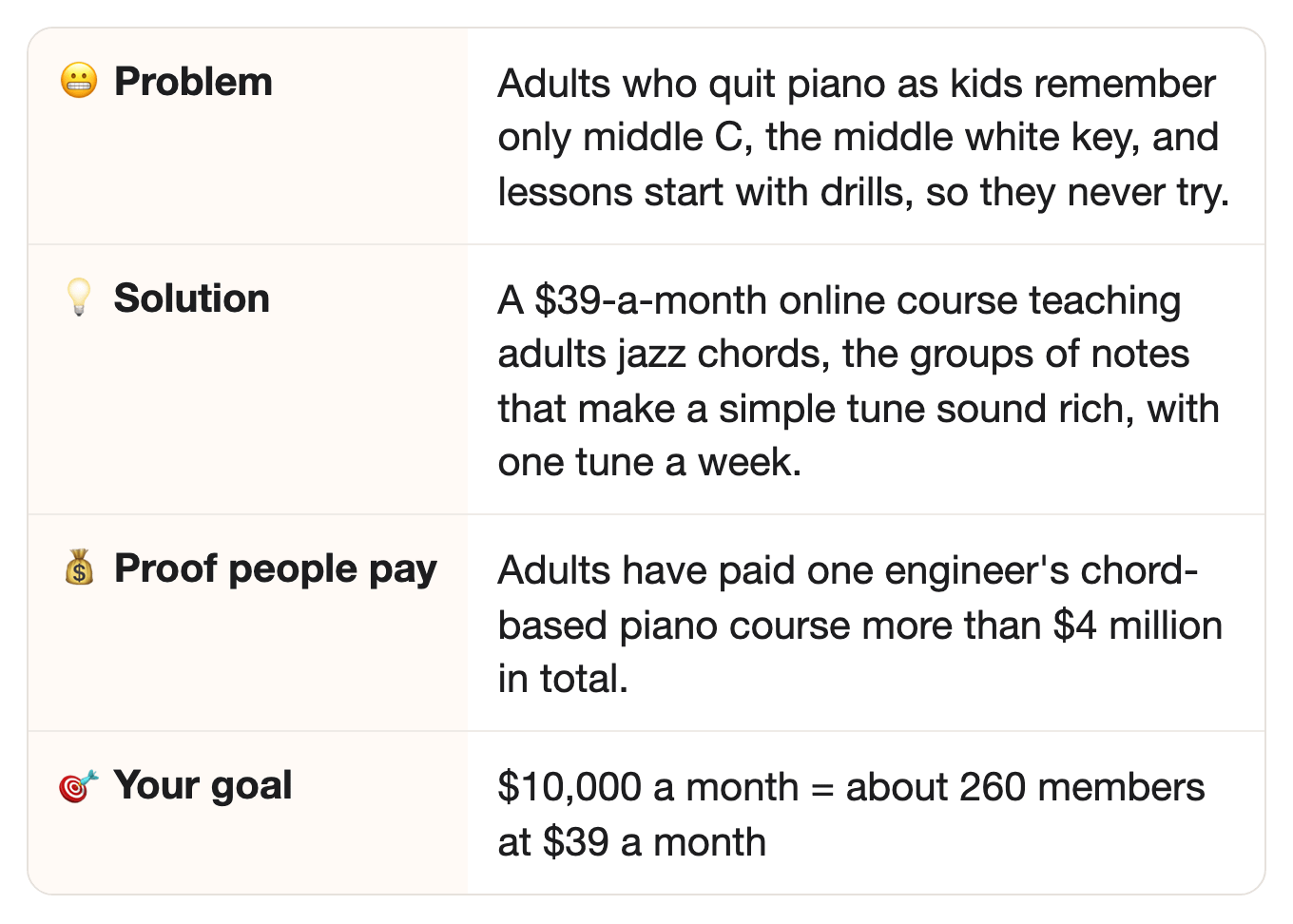
⚡ Quick facts
⠀
📖 How 12 years of lessons and two songs became a $4 million course
It started with a kid who practiced for years and could barely play.
A boy takes traditional piano lessons for 12 years.
And at the end, he can play… two songs.
Twelve years of practice, and two songs to show for it.
Ouch.
That boy is Jacques Hopkins, and he grows up to be an engineer.
And he keeps thinking there must be a faster way.
His answer: skip the drills, and learn the chords behind the songs you love.
⠀In March 2013, he starts Piano In 21 Days, an online course for adults.
He spends about eight months and about $100 building it.
Yep, about a hundred bucks.
⠀
But it doesn’t sell itself.
In his words: “My first sales were very hard-won.”
⠀
So he posts short lessons on YouTube, and builds an email list.
And YouTube becomes “one of the main sources of traffic” for the course.
⠀
He quits his engineering job, and the course goes on to support his family.
⠀By October 2024, Starter Story (a site that interviews founders) reports more than 10,000 students.
It also reports “more than $4 million” in total sales.
And he says it “brings in $10k-$30k per month,” for about one hour of work a month.
Yep, about one hour.
Holy cannoli. 🍰
He went from two songs after 12 years of lessons, to a course that made more than $4 million, by teaching chords, not drills.
⠀
🔗 Same idea, new angle
In the story: adults paid Jacques Hopkins to learn piano through chords instead of years of drills.
⠀In this idea: adults who quit lessons as kids get a jazz course that starts from the little they remember.
⠀Why it carries over: both skip the drills and teach the chords behind real songs, so adults play something fun quickly.
⠀
💡 The opportunity
Lots of adults quit piano as kids. Many of them never stopped wanting to play.
Wait, who are the buyers, exactly?
Adults who had piano lessons as kids, and quit.
They may remember where middle C (the white key in the middle of the keyboard) is, and not much else.
⠀
True story: one comment under a beginner piano video reads “I gave up piano at around 11 years old.”
The next line: “Today I am 67!”
That’s 56 years later, and the wish to play is still there.
⠀
They don’t want more scales. They want songs that sound good.
Jazz is a great fit: a few chord shapes make a simple tune sound rich.
“Jazz piano chords” gets about 2,900 Google searches a month in the US.
That’s an estimate from Ubersuggest, a keyword tool.
⠀
Most adults teach themselves.
In 2022, just under 4% of US adults learned music through classes or lessons.
About 12% learned another way, like from friends or on their own.
So lessons they can follow at home fit the way most adults already learn.
No teacher’s living room needed.
⠀
👉 The idea: an online jazz-chords course for adults who quit piano as kids, plus a short weekly email with one tune and one chord trick.
⠀
🧩 What you actually need
Enough piano to show chords on camera.
Don’t play? Team up with someone who does.
They play, and you build the course and the email.
⠀
A phone above the keys.
Seriously, that’s the whole studio.
⠀
A weekly habit.
One lesson and one email, every week.
⠀
You can start while you still have a day job.
Remember Hopkins, the engineer from the story?
He started building his course while he still had that engineering job.
⠀
✅ Why this could work
Why this one can work, in three points.
Others already earn from teaching adults piano by chords.
Pianoforall, a chord-first video course, has 427,306 learners on Udemy, listed at $159.99.
Open Studio, a jazz lesson site, charges $39 a month.
Its YouTube channel has about 744,000 subscribers.
The Jazz Piano Book came out in 1989, and it still sells, with about 1,000 ratings on Amazon at $39.
⠀
New learners start every January.
“Learn piano” got about 6,600 Google searches in January 2026, against 3,600 in June 2026 (Ubersuggest estimates, US).
Each January, more adults sit down at the keys.
⠀
Adults are openly asking for easier lessons.
They write it in the comments under beginner piano videos.
You’ll see their words at the end of the next section.
⠀
👉 Curious where these numbers come from? Every source is linked in the last section, “📎 The sources.”
⠀
📊 More proof people want this
Want more? Here you go.
Adults already pay to learn piano.
Alfred’s Basic Adult All-in-One Piano Course is a piano book for adults, with about 11,100 ratings on Amazon, at $22.91.
Pianoforall, the chord-first video course, has 53,184 ratings on Udemy.
Open Studio, the jazz lesson site, has a yearly plan that works out to $33 a month.
⠀
Jazz chords for beginners pull big crowds on YouTube.
A YouTube search for “jazz piano chords for beginners” finds about 180 videos with more than 110 million views.
About 120 of them have over 100,000 views each.
⠀
Adult beginners watch piano videos by the millions.
A YouTube search for “piano for adult beginners” finds about 165 videos with more than 270 million views.
⠀
Adults look for lessons on Google every month.
“Piano lessons for adults” gets about 8,100 searches a month in the US.
That’s an estimate from Ubersuggest, a keyword tool.
⠀
The big picture. 🎹
That’s from a government arts survey, run by the National Endowment for the Arts.
⠀
What adults write under beginner piano videos.
One comment: “Anybody else used to play piano but quit and wanna restart again“
Another, with 27,993 likes: “I need a beginner version of this beginner version”
Ha. Fair enough.
⠀
👉 They already tried piano once, as kids, and now they want lessons that start where they really are.
⠀
🔍 Who’s already doing it
Who’s already doing it, and what they miss.
Piano In 21 Days, the course from the story above, teaches pop songs to every adult.
One general method, for anyone who wants to play their favorite songs.
⠀
Open Studio is an online jazz school for every level, from beginners to pros.
It sells a monthly membership.
It says it has more than 2,500 lessons, plus courses for bass and guitar.
That’s a huge library, and a lot to pick from for someone who quit at 11.
⠀
Pianoforall is one video course that covers pop, blues, jazz, ballads, and classical.
It runs about 24 hours on Udemy, a big site that sells video courses.
⠀
Still missing when we checked:
A short jazz-chords course built for the adult who quit as a kid.
One that starts from what they half-remember, not from zero.
One tune a week, sent by email, from one teacher.
⠀
🔎 Check the market yourself in 2 minutes: run Part 0 of the prompt in the build plan below.
Your AI searches Udemy, YouTube, Substack, and Amazon that day, and tells you: early, growing, or crowded.
Early? Start now.
Crowded? Good news: it means people pay. Pick one narrower style or learner (Step 1 of the build plan).
A crowded market is still OK. You win by serving one group better, not by being first.
⠀
👉 That’s the part nobody else offers: a short jazz-chords course, one tune a week, for adults who quit piano as kids.
⠀
🤖 Why AI won’t replace it
Could ChatGPT just teach them piano? Sort of. AI can explain a chord. It can’t put their fingers on the keys.
🔮 Honest note: AI can already write chord charts (sheets that show which chords to play), explain music theory, and even comment on a recording.
So information isn’t the product.
The product is a teacher who shows their own hands, and a weekly habit that keeps people playing.
⠀
1. What people really pay for is practice.Only their own ten minutes at the keys, most days, makes the chords stick.
An email every Monday with one new tune gives them a reason to sit down.
⠀
2. Hands they can copy.A camera above your keys shows the shape, the timing, and your slips.
A chord chart from ChatGPT shows letters on a screen.
⠀
3. You choose what’s right for them.Jazz has hundreds of chords.
You pick the five that make each tune sound right, and say what to skip.
⠀
4. A teacher they feel they know.They hear your voice every week.
Over time, they stay for you, not just for the lessons.
⠀
5. Proof people pay for the lessons: chord charts are free online.Remember Pianoforall, the chord-first video course?
427,306 people still signed up for it on Udemy.
⠀
👉 Free chord charts are everywhere, but a weekly lesson that’s ready to play is hard to find.
⠀
💵 How much you can make
Grab a calculator. Just kidding, here it is.
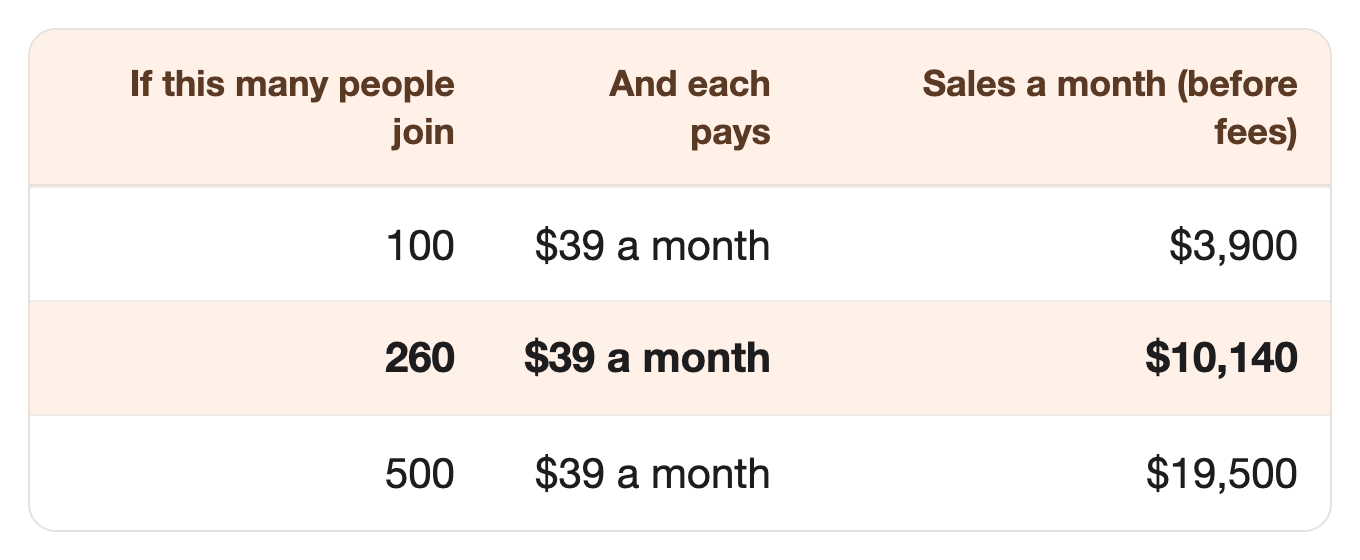
$39 a month is Open Studio’s monthly price.
⠀260 members is small next to Hopkins, who had more than 10,000 students by October 2024.
⠀And if it doesn’t work? Here’s all you lose:
Nothing for the weekly email: Substack is free to start.
One month’s subscription to an AI app, like ChatGPT or Claude.
One week of your time.
⠀
👉 Add three more ideas at $10,000 a month each, and the yearly total gets close to half a million.
This course could be your first idea, and a few more like it can stack on top of it, year after year.
Itching to build this one?
The step-by-step plan is right below. 👇
Just browsing? All good. A new idea comes next week.
That’s it, my fellow contrarians! 🙌
Yours ‘helping you build on what already works’ Vijay Peduru 🦸♂️
⠀
⠀
⠀
🧰 Want to build it? Here’s everything else.
AI plans the lessons and writes the emails. You play. 🎹
⠀
Step 1: 🎯 Pick your style and your learner
One style of music, and one kind of learner.
Pick one style.
Jazz chords, like in this issue.
Or film and game themes, or the blues.
Pick one learner.
For example: adults who had lessons until about age 12, and quit.
Or adults who play a little pop, and want their songs to sound jazzy.
Write it in one line, like “jazz chords for people who quit piano as kids.”
⠀
Step 2: 🗺️ Plan the course
Eight weeks, one chord idea and one tune a week.
Let AI draft the eight weeks, from easiest to hardest.
For example: three-note chord shapes, then a walking left hand (a steady bass line), then a full tune.
Pick one tune for each week.
Use tunes that are out of copyright, or teach only the chords.
Change the order until it feels right, at your own piano.
⠀
Step 3: 🎬 Make each lesson
One short video, one chord chart, one practice plan.
Your AI writes the lesson.
The chord idea, in plain words.
A chord chart, with every note spelled out.
A ten-minute daily practice plan.
Film your hands from above. A phone on a stand is enough.
Keep each video under ten minutes. Show your slips too.
⠀
Step 4: 🔍 Check every lesson
A wrong chord teaches a wrong habit, so every lesson gets three passes.
Your AI does all three passes for you: it writes in Part 2, and checks in Parts 3 and 4 of the prompt.
🖊️ The AI writer. Your AI writes the lesson, and names every chord.
🔍 The AI checker. A second pass spells every chord note by note, and checks it against the chart.
🧐 The AI returner. A third pass reads it like someone who quit at 11, and marks every confusing step.
Optional: pay a piano teacher once to review your first eight lessons.
⠀
👉 The prompt already follows three safety rules: your own exercises, no copyrighted melodies or lyrics, and no promised timeline.
⠀
Step 5: 🏪 Open your course
A free weekly email up front, and a paid membership behind it.
Start a free Substack newsletter.
Every week: one chord trick, in a short email with a short video.
Add a paid tier at $39 a month, like Open Studio’s monthly price.
Members get the full eight-week course.
Plus each week’s new tune, with its chord chart.
Let AI write your welcome email and your paid-tier page.
⠀
Step 6: 📣 Get your first students
YouTube built Hopkins’s course. Be the lesson people find when they search, then bring back the ones who drifted.
Make one longer YouTube lesson per search, like “jazz chords for beginners who quit piano.”
Use the exact words people type as the title, and teach one chord idea per video.
Point to the newest free tune in your newsletter at the end.
Email lapsed members: “You’re still the kid who wanted to play by ear,” with a “That’s still me” button.
Send it to people who signed up and stopped opening, about who they wanted to be at the keys.
Put any offer, like the newest tune, at the bottom, never at the top.
Give each member one free month to pass to a friend who also quit lessons.
Send the pass after a member’s fourth week, as a reward for showing up.
Most adults who quit piano know someone else who quit too.
⠀
Step 7: 🏃 Eliminate competitors
Copycats will come. Here’s how you stay first.
Make Monday’s tune a ritual: coffee, one chord, one song.
Send the tune at the same time every Monday, with the same three steps at the top.
A habit tied to Monday coffee is hard for a new course to break.
Show “Playing since [month]” on each member’s page.
Put the month they joined next to their name, so each member sees a streak worth keeping.
A rival can copy your lessons, but not the year each member has already spent learning with you.
⠀
Step 8: 🎲 Make it bigger
Every style you can play can become its own course.
Add a second style for the same members, like film and game themes.
Or build the same course for another instrument, like guitar or ukulele, with a partner who plays it.
Each new style is a new course, built with the same prompt. 🎯
⠀
🗓️ Your first week
Phew. That was a lot. 😅
Steps 1 to 6 fit into seven days. 🚀
By day 7, you have an eight-week plan, two lessons, a newsletter, and one longer YouTube lesson.
Quick heads-up: the prompt below has six Parts, and they’re not the same as the Steps above.
Day 1 (Steps 1 and 2): Run Part 1 of the prompt (it’s below), and plan your eight weeks.
Day 2 (Step 3): Write your first lesson with Part 2.
Day 3 (Steps 3 and 4): Check it with Parts 3 and 4, then film it.
Day 4 (Steps 3 and 4): Write, check, and film your second lesson.
Day 5 (Step 5): Write your welcome email and paid-tier page with Part 5, and open your newsletter.
Days 6–7 (Step 6): Plan one longer YouTube lesson with Part 6, then film it and post it.
⠀
🏄 How to use the prompt
One prompt does all the AI work, in six parts, plus a quick market check (Part 0).
Part 1 — Plan the course. Names your learner, and plans eight weeks, one chord idea and one tune a week.
Part 2 — Write a lesson. The chord idea, a chord chart, and a ten-minute practice plan.
Part 3 — Check the music. Spells every chord note by note, and flags any tune that may be under copyright.
Part 4 — Read it as a returner. Marks every step someone who quit at 11 couldn’t follow.
Part 5 — Write the pages. Your welcome email, your paid-tier page, and your About page.
Part 6 — Write the weekly email and the YouTube lesson. One chord trick as a short email, and a longer lesson titled the way people search.
Run it your way:
Part by part (the default): it pauses after each part, and you type “next” to go on.
All at once: say “run all six parts.”
Just one part: say “only do Part 3,” or any part you need.
The full prompt is just below, under “📋 The prompt.”
🎙️ Talk to your AI sidekick, don’t type.
Turn on voice mode, or use a dictation app like Wispr Flow.
Say it messy. The AI sorts it out.
Turn it into a skill, so you never paste it again.
Paste the prompt into Claude or ChatGPT, and say: “Turn this into a skill I can save.”
Install once, use forever.
⠀
📋 The prompt
The prompt (copy it into Claude or ChatGPT, fill in the INPUTS part, and run it your way)
CONTEXT:
- You're my piano-teaching partner. Together we'll build an online course, plus a short weekly email, that teaches one style of piano to adults who quit lessons as kids.
- This prompt has six parts, in order.
- Run it the way I ask:
    - If I say nothing, go one part at a time. After each part, show me the result, then stop and wait. Move on only when I type "next."
    - If I say "run all six parts," do them all without stopping.
    - If I say "only do Part 3" (or any part), do just that part.
- If a part needs something from me, ask for it before you start that part.
- Spell every chord note by note, and name it the standard way (for example, Cmaj7 = C E G B).
- Use my own exercises, and tunes that are out of copyright. For any other song, teach only the chords. Never print a copyrighted melody or lyrics.
- Never promise results or a timeline. Never invent a review, a result, or a number.
- If you can't open a link I give you, ask me to attach the file instead.
- Keep web search on for the whole prompt (turn on search in ChatGPT or Claude), so you can open any page you need to check.

=============== INPUTS — edit these, or just run as is ===============

My style of music:
{e.g. jazz chords}

Who the course is for:
{e.g. adults who had piano lessons until about age 12, quit, and want to play songs that sound good}

My level, honestly:
{e.g. I play pop songs from chord charts, and I'm learning jazz voicings}

My newsletter name:
{e.g. The Comeback Keys}

My prices:
{e.g. free weekly email with one chord trick; paid tier at $39 a month with the full course and each week's tune}

======================== END OF INPUTS ========================

THE PARTS:

Part 0 — Check the market today.
This part needs web search (turn on search in ChatGPT or Claude). Search for paid piano lessons in my style for adult learners and, for each place, give the count, the three biggest with links, and their prices:
1. Courses on Udemy, with student counts and rating counts.
2. Lesson sites and memberships, with their monthly prices.
3. YouTube channels teaching this style to adults, with subscriber counts.
4. Piano newsletters on Substack, and which ones have paid tiers.
5. Books on Amazon for this style, with rating counts.
Then tell me: early (few sellers), growing, or crowded, and which group of learners looks least served (for example: people who quit as kids, adults over 50, people who only play by ear). Give a link for every number. If you can't open a page, say so. Never guess a number.

Part 1 — Plan the course.
Describe my learner in one clear sentence. Then plan eight weekly lessons, from easiest to hardest. For each week: the one chord idea it teaches, one tune that uses it (out of copyright, or chords only), and a ten-minute daily practice goal. Say which week is likely to be hardest, and why. Say clearly which reasons are your guess.

Part 2 — Write a lesson.
Ask me which week to write first. Then write the lesson, for someone who quit piano as a kid:
1. The chord idea, in one or two plain sentences, and why it sounds good.
2. A chord chart, with every chord spelled out note by note, and which hand plays what.
3. The steps, numbered, from the first chord to playing the whole tune slowly.
4. A ten-minute daily practice plan for the week.
5. A short checklist, so they know when they're ready for next week.
6. A note on where I show my own hands, slips included.

Part 3 — Check the music.
Now act as a separate checker who didn't write this lesson. Spell every chord again from scratch, note by note, and compare it with the chart. Mark each chord: correct, wrong, or unclear. Check the hand positions make sense for a beginner. Flag any tune that may still be under copyright, and any line that prints a copyrighted melody or lyrics. Then give a fixed version of the lesson.

Part 4 — Read it as a returner.
Now read the lesson as an adult who quit piano at 11 and remembers only where middle C is. Mark every word, symbol, or step they couldn't follow, and every step that moves too fast. Then give the final lesson, with every fix made.

Part 5 — Write the pages.
Ask me for my story first: when I started, when I stopped, and why I came back. Then write:
1. A welcome email for new free readers.
2. A paid-tier page: who it's for, what they get each week, the price up front, and "Cancel anytime."
3. A short About page in my voice.
Never promise a result or a timeline. Never invent a review or a number.

Part 6 — Write the weekly email and the YouTube lesson.
Turn one chord idea from the course into:
1. A weekly email under 200 words: one chord trick, the chord spelled out, and one thing to try at the keys tonight.
2. A longer YouTube lesson plan, 8 to 10 minutes:
    - Five title ideas in the exact words a returner would search, like "jazz chords for beginners who quit piano."
    - The outline: the question, the chord spelled out, a slow demo, a practice plan, and one common slip.
    - One closing line pointing to this week's free tune in my newsletter.
Never use a copyrighted melody or lyric.

When all six parts are done, ask if I want to repeat Parts 2 to 6 for the next week.
⠀
📎 The sources
Every number above, with where it came from.
Piano In 21 Days, totals · Number: “more than $4 million”; “over 10,000 students”; “brings in $10k-$30k per month, and I work on it about one hour a month”; started March 2013 · Source: Starter Story, October 2024
Hopkins’s start · Number: Started building while still an engineer, then quit to finish it; about eight months and about $100 to build; “My first sales were very hard-won”; “YouTube has been one of the main sources of traffic”; “I quit my engineering job and have been supporting my family this way for over eight years now” · Source: Starter Story, June 2022
Hopkins’s childhood lessons · Number: 12 years of traditional lessons, then “he only knew how to play two songs”; thought about a faster way “during his career in engineering”; teaches chords and pop songs without “long, frustrating piano drills” · Source: Piano In 21 Days
Piano In 21 Days on YouTube · Number: About 102,000 subscribers · Source: YouTube
Pianoforall · Number: 427,306 learners; 53,184 ratings; listed at $159.99; about 24 hours of video; pop, blues, jazz, ballads, classical · Source: Udemy
Open Studio · Number: $39 a month, or $33 a month on the yearly plan; “2,500+ Lessons”; courses for jazz piano, bass, and guitar · Source: Open Studio
Open Studio on YouTube · Number: About 744,000 subscribers · Source: YouTube
The Jazz Piano Book · Number: Published 1989; about 1,000 ratings; $39 · Source: Amazon search “mark levine the jazz piano book”
Alfred’s Basic Adult All-in-One Piano Course · Number: About 11,100 ratings (spiral-bound edition); $22.91 · Source: Amazon search “alfred’s adult all-in-one course level 1”
Google searches · Number: “piano lessons for adults” 8,100 a month; “jazz piano chords” 2,900 a month; “learn piano” 6,600 in January 2026 and 3,600 in June 2026 · Source: Ubersuggest, US
YouTube: jazz chords · Number: YouTube search “jazz piano chords for beginners,” top 200 results, duplicates removed, run three times; results shift between runs, so the lowest figures are used: 179–191 videos, 113–139 million views, 120–135 with 100,000+ views · Source: YouTube Data API
YouTube: adult beginners · Number: YouTube search “piano for adult beginners,” top 200 results, duplicates removed, run three times; lowest figures used: 165–200 videos, 276–402 million views · Source: YouTube Data API
Adults who play an instrument · Number: 11.4% of US adults in 2022; just under 4% learned music through classes or lessons, 12% through other means · Source: National Endowment for the Arts, 2022 SPPA
Comment: gave up at 11 · Number: “I gave up piano at around 11 years old. Today I am 67!” … “Now I think I will start again with your help.” · Source: YouTube comment, 2024
Comment: restart · Number: “Anybody else used to play piano but quit and wanna restart again” · Source: YouTube comment, 2021
Comment: beginner version · Number: “I need a beginner version of this beginner version”; 27,993 likes · Source: YouTube comment, 2020