


Hello contrarians,
Today’s idea is called The Stock Pay Explainer.
Pour yourself a tea. 🍵
First, an investor’s story. Then, the business you could build from it.
⠀
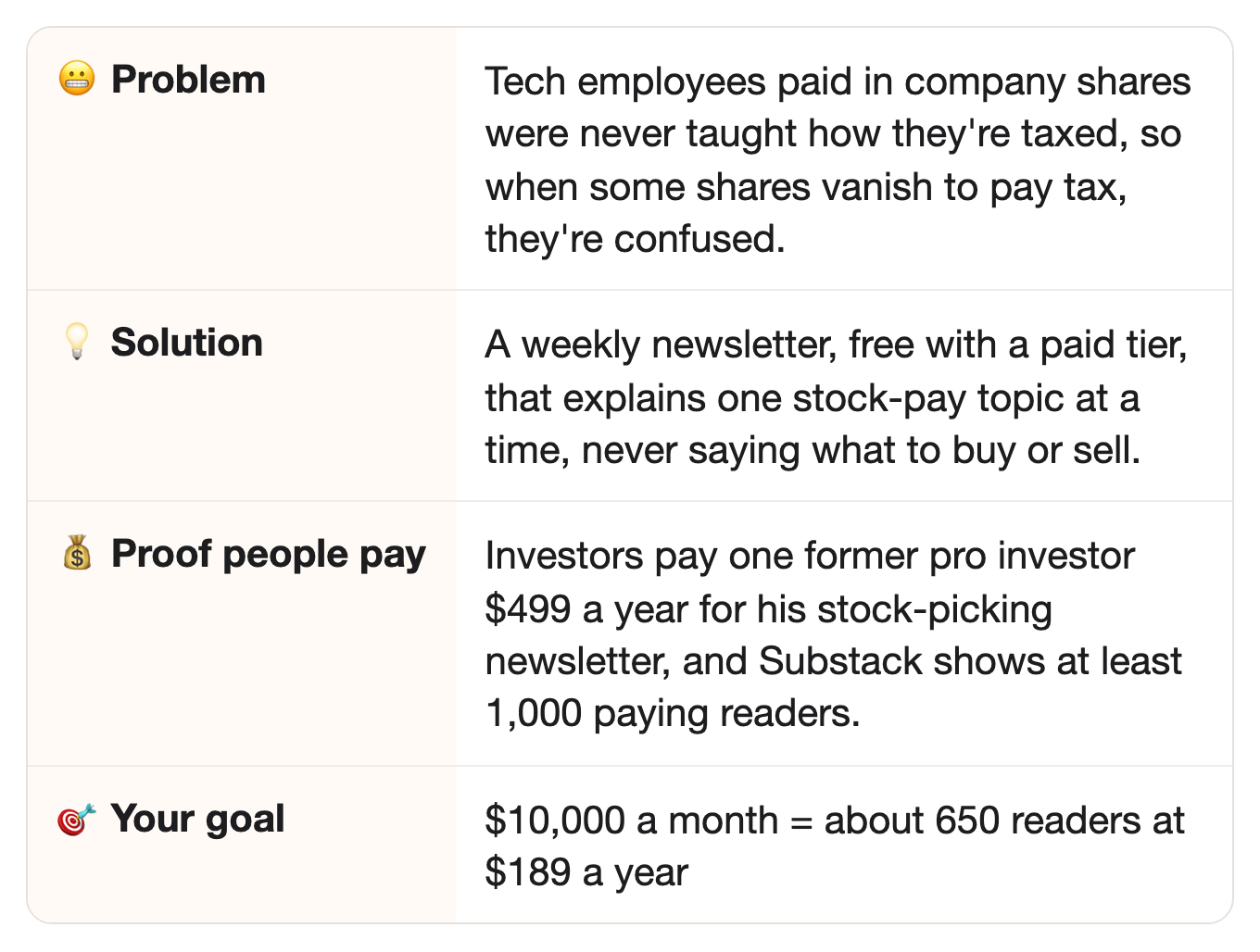
⚡ Quick facts
⠀
📖 How one investor’s free posts became a $499-a-year newsletter
It started on a Friday evening, out of boredom.
It’s 2022, and Pieter Slegers works as a professional investor in Belgium.
He’s the right hand of a senior fund manager, working about 60 hours a week.
So, not exactly a guy with spare time.
Then, in June 2022, he opens an anonymous account on X, called Compounding Quality.
After two weeks? Maybe 20 to 30 followers.
Then a well-known investing author shares his posts… and the account grows fast. 📈
⠀In the first year, he writes about 150 free articles for his Substack newsletter, while still at his job.
All of them are general lessons about investing.
Psst: before he quits, he earns nothing from it.
Zero.
Then, in the summer of 2023, he quits his job.
He picks paid subscriptions over ads, so the ads won’t push readers away.
⠀
So how did it go?
When we checked, his newsletter showed “Thousands of paid subscribers” on Substack, a newsletter website.
Substack only shows a range, so “thousands” means at least 1,000.
The price? $499 a year, or $57 a month.
Paid readers get three articles a week: Tuesdays, Thursdays, and Sundays.
Holy smokes. 🔥
Quick math.
Just 1,000 readers at $499 a year would be $499,000 a year.
That’s a rough minimum by our math, not his reported revenue.
He went from 20 to 30 followers and zero dollars, to thousands of paying readers, by writing free investing lessons for a year first.
⠀
🔗 Same idea, new group
In the story: investors paid Pieter Slegers $499 a year for a newsletter about picking stocks.
⠀In this idea: tech employees paid in company shares get plain-words help with how that stock pay works and how it’s taxed.
⠀Why it carries over: people pay well, every year, for a money newsletter they trust.
⠀
💡 The opportunity
Millions of people get paid in company stock, and many were never taught how it works.
First, what’s stock pay?
Many tech companies pay part of your salary in company shares.
RSUs are shares you get over time, usually every few months, if you’re still there.
An ESPP lets you buy company shares at a discount, out of your paycheck.
Options give you the right to buy shares later, at a set price, and startups use them a lot.
That’s a lot of letters, right?
And it gets trickier.
⠀
Each one has its own tax rules, dates, and forms.
Take a new engineer on her first vest day, the day her shares become fully hers.
She sees the shares arrive, then some disappear to pay tax.
Then a W-2, the yearly US tax form, arrives and looks wrong.
⠀
Here’s the smart part: the questions repeat every year.
Every new hire hits the same first vest and the same tax season.
They also hit the same ESPP window, the dates to sign up.
Same questions, new people, every year. 🔁
⠀
What Pieter proves: people pay well, every year, for a money newsletter they trust.
But his newsletter picks stocks, for any investor.
Yours never picks a stock.
Instead, it explains the company stock your readers already have, and which questions to ask.
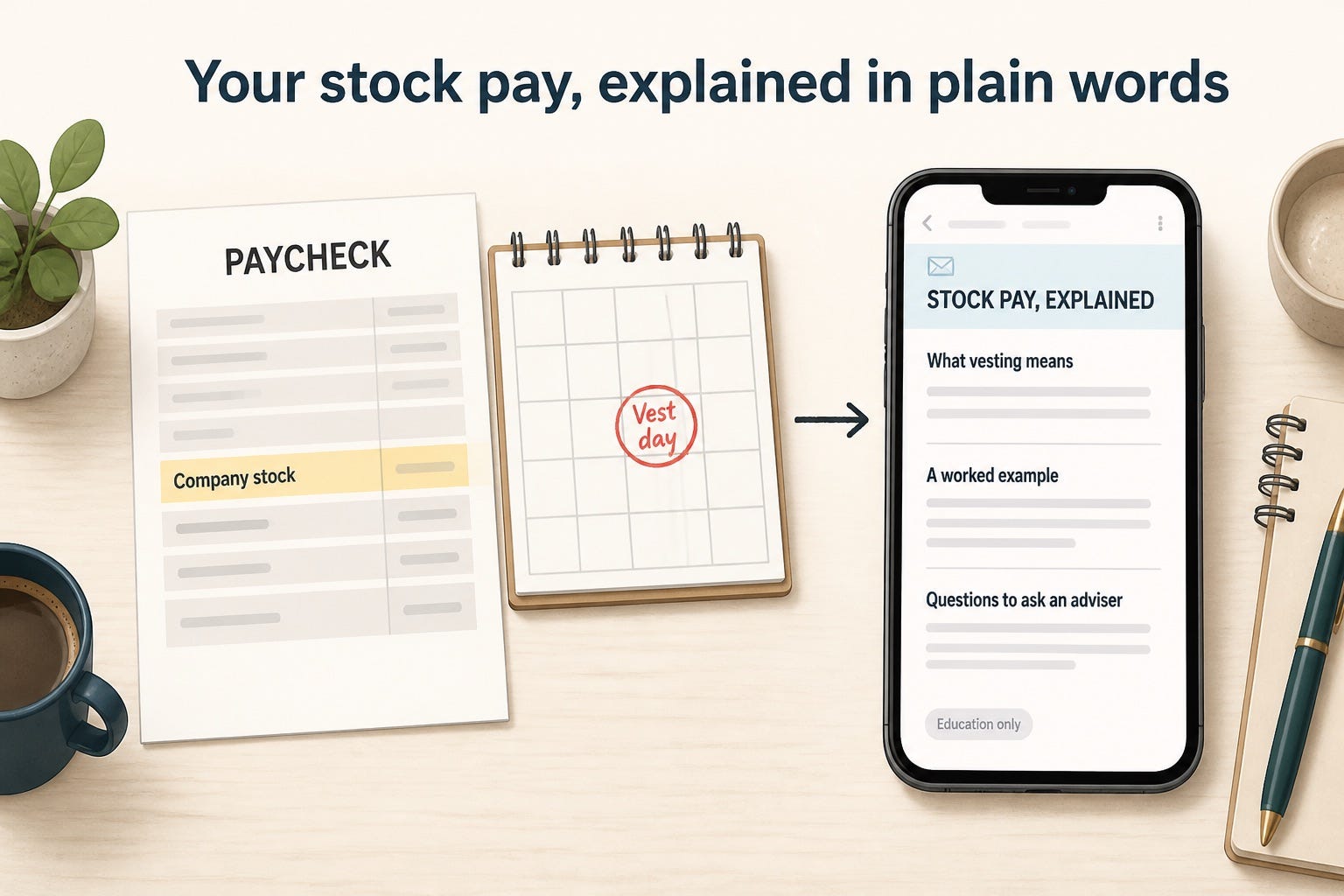
👉 The idea: a weekly newsletter, free with a paid tier, that explains stock pay to tech employees, in plain words.
Each week: one topic, one worked example with round numbers, and the questions to ask.
Paid readers get the deep dives, a yearly calendar of key dates, and a monthly live Q&A.
It’s education, never advice. It never tells anyone to buy, sell, hold, or exercise (use options to buy shares), and never gives personal tax advice.
Advice on someone’s own situation needs a licensed adviser, like a CFP or a CPA. Say so in every issue.
Rules for publishing about money differ by country. Check yours before you launch.
⠀
🙋 Not a money expert? You can still build this, carefully.
Good news: there are two ways in.
Become the interviewer.
Interview CFPs, CPAs, and tax preparers about one topic each, with their permission.
Every interview is also an issue: you explain, and they bring the expertise.
You ask the questions a new hire would ask.
⠀
Team up with one.
A CFP or CPA reviews every issue before it goes out.
You write, build the newsletter, and find the readers.
They bring the license, and you bring the rest.
⠀
👉 Whichever path you pick, the rule is the same: explain how stock pay works, and never tell anyone what to do with theirs.
⠀
✅ Why this could work
Three reasons this can pay.
People already pay for money newsletters, and for stock-pay help.
Remember Pieter’s newsletter, Compounding Quality?
It has “thousands of paid subscribers” at $499 a year, and over 531,000 subscribers in all.
Then there’s FAANG FIRE, a newsletter by Andre Nader, who writes for tech workers after a decade at Meta.
It shows “hundreds of paid subscribers” on Substack, at $100 a year.
Here’s the fun part: he keeps his posts free.
So those readers pay to support him.
And myStockOptions.com, a website only about stock pay, charges $189 a year for full access.
⠀
Stock pay isn’t going away.
Consider Your Options, a book that explains stock pay, first came out in 2000.
Its publisher calls the 2023 edition its tenth.
Ten editions of one stock-pay book.
And The Stock Options Book? It’s in its 26th edition.
Every year, a new group of hires gets their first grant of shares. 🔁
⠀
People already look for this help, a lot.
The numbers are in the next section.
⠀
👉 Don’t take my word for it. Every number is linked in “📎 The sources,” at the very end.
⠀
📊 More proof people want this
Want more? Here you go.
People already pay to understand stock pay.
myStockOptions.com charges $189 a year, or $289 for two years.
Consider Your Options, the stock-pay book from above, costs $23.95.
⠀
Stock-pay books get read.
Founder’s Pocket Guide: Stock Options and Equity Compensation has 135 ratings on Amazon.
⠀
People search Google for it every month.
“espp” gets 12,100 searches a month in the US.
“what is rsu” gets 2,400, and “rsu tax” gets 1,600.
⠀
And they watch explainer videos on YouTube.
The top 100 videos for “RSU explained” have about 1.4 million views.
One RSU explainer by Humphrey Yang, a YouTube creator, has about 292,000 views.
The top 100 for “ESPP explained” have over 1.2 million views.
⠀
The big picture: about 11.8 million US employees take part in stock pay plans. 💰
That counts RSUs, options, and stock purchase plans.
The number comes from a Rutgers University study, cited by the NCEO (National Center for Employee Ownership).
⠀
What one confused employee says: “I am afraid that my shares are being withheld but the withholding doesn’t appear on my w-2 and I am paying taxes twice on them.”
That’s a comment under a YouTube video about RSUs.
Oof.
⠀
What another found helpful: “After several videos I was so confused on the tax implications but the graphic made complete sense.”
Several videos in, and one picture did it.
⠀
And what a beginner asks: “What books do you suggest for the absolute and extremely lost newbie?”
“Extremely lost newbie.” That’s your reader.
⠀
👉 They don’t need more stock tips.
They need someone to explain the company stock in their paycheck.
⠀
🔍 Who’s already doing it
A few big names, and a clear gap next to them.
Compounding Quality, the newsletter from the story above, picks stocks for any investor.
Stock pay at your own company is a different topic, and it’s not his.
⠀
FAANG FIRE, a newsletter for tech workers, covers a whole money journey.
Wait, what do those letters mean?
FAANG is a nickname for big tech firms like Meta and Google.
FIRE means saving hard to retire early.
It covers early retirement, investing, and personal finance for tech workers.
So stock pay is one topic among many.
⠀
Financial planners write free explainers to win clients.
Java Wealth is a YouTube channel by Mike Zung, a software engineer turned CFP (certified financial planner).
It has about 3,300 subscribers.
The Vesting Schedule is a free stock-pay newsletter from Vested Tax, a firm of CPAs (licensed accountants), started in January 2026.
Makes sense: their goal is to win clients, not to sell a paid newsletter.
⠀
myStockOptions.com, a paid website about stock pay, is a deep library.
It has 800+ questions and answers, and a version for advisors.
Great for looking things up.
Not built to read in five minutes a week.
⠀
Still missing when we checked:
A paid weekly newsletter only about stock pay.
In plain words, one topic a week, timed to the year’s key dates.
Written for one group, like first-year RSU holders, who get company shares over time.
⠀
🔎 Check the market yourself in 2 minutes: run Part 0 of the prompt in the build plan below.
Your AI searches Substack, YouTube, Amazon, and the web that day, and tells you: early, growing, or crowded.
Early? Start now.
Crowded? Good news: it means people pay. Pick one narrower group (Step 1 of the build plan).
A crowded market is still OK. You win by serving one group better, not by being first.
⠀
👉 That’s the gap you can fill: a plain-words weekly newsletter only about stock pay, for one group of employees.
⠀
🤖 Why AI won’t replace it
AI can define an RSU. It can’t be the explainer they trust on vest day.
Could ChatGPT just explain stock pay?
Sort of, if someone points it at the right official pages first.
Checked twice.
Every fact is checked against official pages, like the IRS’s own guide.
ChatGPT explains this well when pointed at the IRS pages.
But a new hire on vest day just types the question, without the pages.
⠀
You know what matters.
A new hire doesn’t know which questions matter.
You point out the common mistakes, and the questions to bring to a licensed adviser.
⠀
A finished issue: one topic, one example.
A worked example with round numbers, and a short checklist.
Sure, AI can build a clean example too, if someone sets it up.
Your issue arrives with it already done.
⠀
Ready when they need it.
Vest day, the ESPP window, and tax season arrive on a calendar.
Your issue about each one arrives before the date.
⠀
Proof people pay for the explaining: the IRS guide is free.
But myStockOptions still charges $189 a year to explain it.
⠀
👉 People pay for clear explanations, not just the facts.
⠀
💵 How much you can make
Let’s run the numbers.
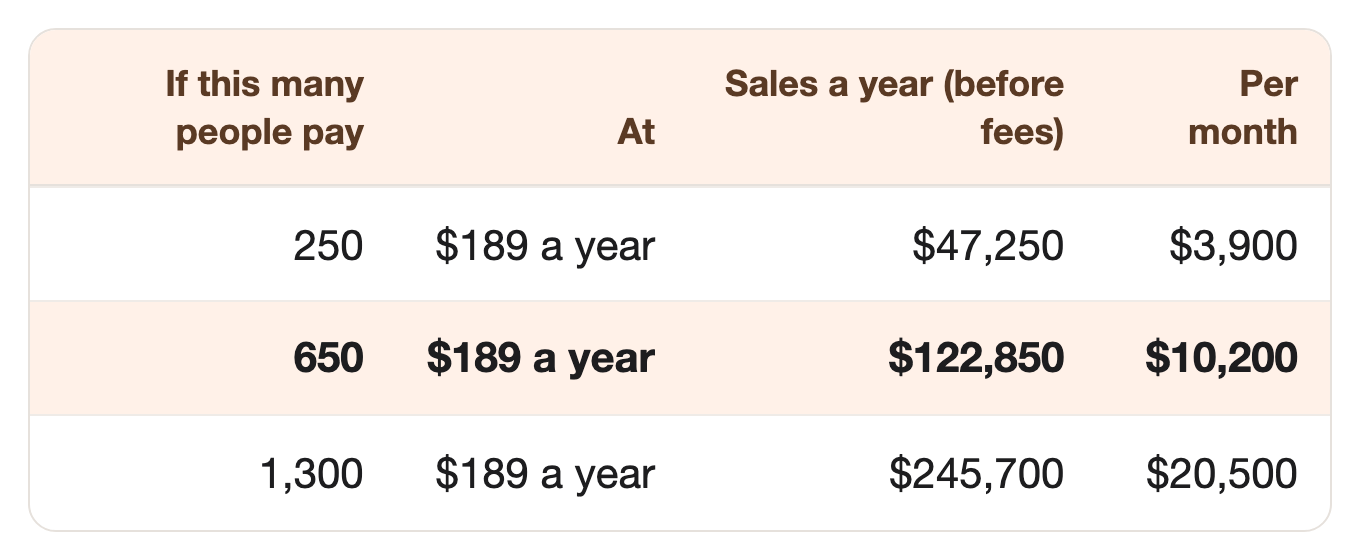
650 readers is fewer than 1 in 18,000 of the 11.8 million with stock pay.
⠀$189 a year is what myStockOptions.com charges for full access.
So the price has a real example behind it.
⠀
Worst case, here’s all you lose:
Nothing for the newsletter itself. Substack is free to start.
One month’s subscription to an AI app, like ChatGPT or Claude.
Your reviewer’s fee, if you team up (agree it up front).
One week of your time.
⠀
👉 This is idea one, and with ideas two, three, and four, you could reach a million in 2 to 3 years.
This newsletter could be that first idea, and each one you add after it can grow your yearly income.
Can you picture yourself running this?
Scroll down. Everything you need to start is waiting. 👇
Not for you? No problem. Next week’s idea might be.
That’s it, my fellow contrarians! 🙌
Yours ‘helping you spot the gaps the big players ignore’ Vijay Peduru 🦸♂️
⠀
⠀
⠀
🧰 Want to build it? Here’s everything else.
AI does most of the research and writing. Your reviewer has the final say. 🎙️
⠀
Step 1: 🎯 Pick your group, your reviewer, and your rules
Pick a narrow group: “Money” is too big, but “RSUs for your first year at a public tech company” (one whose shares trade on the stock market) is big enough to build a business on.
Pick one group.
First-year RSU holders at public tech companies.
Or startup employees with options, or people buying through an ESPP.
Line up a reviewer.
A CFP or CPA reads every issue before it goes out.
If you hold one of those credentials yourself, you’re the reviewer.
That part’s easy.
Write down your rules, and keep them on every issue.
Explain how it works, and which questions to ask.
Never say buy, sell, hold, or exercise. Never pick a stock. No personal tax advice.
This line at the bottom: “Education only. Not investment, tax, or legal advice. For your own situation, talk to a licensed adviser.”
Check the rules in your country for publishing about money, before you launch.
⠀
Step 2: 🗓️ Plan the year
Stock pay runs on a calendar, so your topics can too.
Map the year’s key dates for your group.
Tax season, ESPP enrollment windows, typical vest dates, year-end.
AI turns them into a year of weekly topics.
Each topic from official sources only, like IRS Publication 525, which covers stock options, ESPPs, and restricted stock.
Start with ten topics, and add more as readers ask.
⠀
Step 3: 🔍 Check every issue
This is money, so every issue is checked three times, and a person checks last.
Your AI does all three passes for you: it writes in Part 2, and checks in Parts 3 and 4 of the prompt.
🖊️ The AI writer. AI writes each issue from official sources only.
🔍 The AI fact-checker. A second pass opens every link, and confirms each fact and each number.
🧐 The AI critic. A third pass hunts for any line that sounds like advice, and rewrites it as a question to ask.
Your reviewer reads it last. Again before launch, and whenever tax rules change.
⠀
👉 The prompt already follows three safety rules: education only, no stock picks, and the licensed-adviser line on every issue.
⠀
Step 4: 📰 Launch the newsletter
Free every week, with a paid tier for the people who want more.
Start on Substack. It’s free to start, and it handles payments.
Send one free issue a week: one topic, one worked example, and the questions to ask.
Set a paid tier at $189 a year, like myStockOptions.com.
A monthly deep dive.
A yearly calendar of key dates for your group.
A monthly live Q&A, explaining general rules only.
Let AI write your welcome email and your paid page.
⠀
Step 5: 📣 Get your first readers
Give it away first, like Pieter did: about 150 free articles before he charged anything.
When a big tech company’s lockup ends, or a stock-pay rule changes, post the next day on what the terms mean.
A lockup is the months after a company goes public when its employees aren’t allowed to sell their shares.
Your AI drafts it in general terms in Part 6 of the prompt, and your reviewer checks it first.
Write a free explainer for a bigger tech-career newsletter on one term, like “sell to cover.”
That’s when some of your new shares are sold to pay the tax due on them.
Explain how it works with round numbers, and add one line about your newsletter at the end.
Write one short page for each term people search, like “why did my RSUs disappear on vest day.”
Use their exact words as the title, and explain how it works, never what to do.
Link each page to the matching issue.
⠀
Step 6: 🏃 Eliminate competitors
When others copy you, here’s how you stay the one people pick.
Pledge in public that you take no commissions from any financial product.
Put it on your About page and at the bottom of every issue.
Invite other stock-pay newsletters to make the same pledge, a promise sellers of financial products can’t match.
Narrow the headline until a stranger can say it’s for tech workers in their first year of stock pay.
Show it to someone outside tech, and ask who it’s for, what it explains, and why it beats a general money blog.
Keep narrowing until they can answer all three.
⠀
Step 7: 🎲 Make it bigger
Every group with stock pay has the same two things: confusing rules, and new people every year.
Open the same newsletter for another group, like startup employees, people leaving a company, or stock pay in another country.
Sell a printable yearly guide on its own.
Three newsletters at about $10,000 a month each is about $360,000 a year, before fees. 🎯
⠀
🗓️ Your first week
Phew. That was a lot. 😅
Steps 1 to 5 fit into seven days. 🚀
By day 7, you have a group, a reviewer, a year of topics, one checked issue, a newsletter, and your first search page.
Quick heads-up: the prompt below has seven Parts, and they’re not the same as the Steps above.
Day 1 (Step 1): Pick your group, line up your reviewer, and write your rules.
Day 2 (Step 2): Plan the year with Part 1 of the prompt (it’s below).
Days 3–4 (Step 3): Write the first issue with Part 2, and check it with Parts 3 and 4.
Then send it to your reviewer with Part 5.
Day 5 (Step 4): Set up Substack, and write your welcome email and paid page with Part 7.
Days 6–7 (Step 5): Pick one searched term, like “sell to cover,” write its page with Part 2, and send it to your reviewer.
⠀
🏄 How to use the prompt
One prompt does all the AI work, in seven parts, plus a quick market check (Part 0).
Part 1 — Plan the year. Turns your group’s key dates into a year of weekly topics.
Part 2 — Write one issue. Explains one topic, with a worked example and the questions to ask.
Part 3 — Check every fact. Opens every link, and works every number again.
Part 4 — Find any advice. Hunts for lines that tell someone what to do, and rewrites them.
Part 5 — Prepare the reviewer note. Lists what your CFP or CPA needs to check.
Part 6 — Write the news post. Turns a lockup ending or a rule change into a short post, in general terms.
Part 7 — Write the welcome and paid page. Writes your welcome email and your paid tier page.
Run it your way:
Part by part (the default): it pauses after each part, and you type “next” to go on.
All at once: say “run all seven parts.”
Just one part: say “only do Part 3,” or any part you need.
The full prompt is just below, under “📋 The prompt.”
🎙️ Talk to your AI sidekick, don’t type.
Turn on voice mode, or use a dictation app like Wispr Flow.
Say it messy. The AI sorts it out.
Turn it into a skill, so you never paste it again.
Paste the prompt into Claude or ChatGPT, and say: “Turn this into a skill I can save.”
Install once, use forever.
⠀
📋 The prompt
The prompt (copy it into Claude or ChatGPT, fill in the INPUTS part, and run it your way)
CONTEXT:
- You're my newsletter partner. Together we'll build a weekly newsletter that explains stock pay (RSUs, ESPPs, stock options) to one group of employees.
- This prompt has seven parts, in order.
- Run it the way I ask:
    - If I say nothing, go one part at a time. After each part, show me the result, then stop and wait. Move on only when I type "next."
    - If I say "run all seven parts," do them all without stopping.
    - If I say "only do Part 3" (or any part), do just that part.
- If a part needs something from me, ask for it before you start that part.
- This is education only. Explain how stock pay works and which questions to ask. Never tell anyone to buy, sell, hold, or exercise. Never pick or recommend a stock. Never give personal investment, tax, or legal advice. When a question needs advice on someone's own situation, say: "Ask a licensed adviser, like a CFP or a CPA."
- Use only official sources, like IRS pages (for example IRS Publication 525) and the plan documents I give you. Never invent a fact, a number, or a tax rule. If you can't find a source, leave it out and tell me.
- Rules for publishing about money differ by country. Remind me to check mine before I launch, and never tell me I'm allowed to publish something.
- Never ask for, or use, any reader's real name, company, or grant details.
- I'll often answer by voice, so expect long, messy answers. Don't ask me to tidy them.
- Keep web search on for the whole prompt (turn on search in ChatGPT or Claude), so you can open any page you need to check.

=============== INPUTS — edit these, or just run as is ===============

My group:
{e.g. engineers in their first year of RSUs at a US public tech company}

My country:
{e.g. the United States}

My reviewer:
{e.g. Dana, a CFP who works with tech employees}

My prices:
{e.g. free weekly issue; $189 a year for deep dives, a yearly calendar, and a monthly live Q&A}

======================== END OF INPUTS ========================

THE PARTS:

Part 0 — Check the market today.
This part needs web search (turn on search in ChatGPT or Claude). Search for paid and free help that explains stock pay to my group and, for each place, give the count, the three biggest with links, and their prices:
1. Newsletters on Substack and elsewhere, free and paid.
2. YouTube channels.
3. Books on Amazon.
4. Websites, courses, and tools.
Then tell me: early (few sellers), growing, or crowded, and which narrower group looks least served (for example: first-year RSU holders, startup employees with options, ESPP buyers, one country). Give a link for every number. If you can't open a page, say so. Never guess a number.

Part 1 — Plan the year.
List the key dates in a year for my group (tax season, ESPP enrollment windows, typical vest dates, year-end). Turn them into 52 weekly topics, each tied to a date where it fits. For each topic, name the official source you'd use. Pick the first ten to write, and say why. Say clearly which reasons are your guess.

Part 2 — Write one issue.
Ask me which topic to write. Then write one issue for someone in my group who knows nothing about it:
1. The topic in one plain sentence.
2. How it works, in short bullets, each with its source link.
3. One worked example, step by step, with round made-up numbers, labeled as an example.
4. Common mistakes people make, stated as facts, not as instructions.
5. Five questions to ask a licensed adviser or the company's stock plan team.
6. This line at the very bottom: "Education only. Not investment, tax, or legal advice. For your own situation, talk to a licensed adviser."

Part 3 — Check every fact.
Now act as a separate fact-checker who didn't write this issue. Open every link. Mark each fact: matches the source, doesn't match, or has no source. Work every number in the example again from scratch. For each problem, show what the source actually says. Then give a fixed version of the issue.

Part 4 — Find any advice.
Now act as a strict compliance reader. Flag every line that tells a reader what to do with their own shares or taxes, names or hints at a stock to buy or sell, or promises a result. Rewrite each one as a general explanation or as a question to ask a licensed adviser. Check that the education-only line is there. Then give the final issue.

Part 5 — Prepare the reviewer note.
Write a short note to my reviewer, with the issue attached. List every fact and number they need to confirm, anything that may differ by state or country, and any line you're still unsure about. Leave a space for the reviewer to write "approved" and their name. Remind me: nothing goes out until the reviewer approves it.

Part 6 — Write the news post.
Ask me for this week's news, like a big tech company's lockup ending or a stock-pay rule change, with its link. Turn it into a LinkedIn or X post, under 150 words:
1. The first line: the news, in plain words, with its date.
2. What the terms mean, in three short lines, in general terms only.
3. One question a reader can bring to a licensed adviser.
4. The line: "Education only, not advice."
5. A last line that links to the full explainer in my newsletter.
Never say buy, sell, hold, or exercise, and never name a stock as a pick. Remind me to send the post to my reviewer first.

Part 7 — Write the welcome and paid page.
Write:
1. A welcome email: who it's for, what they'll get each week, the first topic to read, and the education-only line.
2. A paid page: what paid readers get, the prices shown up front, the reviewer's name and credential, "Cancel any time," and the education-only line.
Never promise a result, a saving, or a return. Never invent a review, a number, or a reader story.

When all seven parts are done, ask if I want to repeat Parts 2 to 6 for the next topic.
⠀
📎 The sources
Every number above, with where it came from.
Pieter’s start · Number: Works in “the finance industry”; based near Antwerp, Belgium; right hand of “a senior fund manager”; about 60 hours a week; account started June 2022 on “a Friday evening”; “maybe 20-30 followers” after two weeks; about 150 free articles in year one; all content “100% general and educational” before quitting; a retweet by Gautam Baid, “author of The Joys of Compounding”; earnings “0.0” before quitting; quit summer 2023; chose paid subscriptions over ads · Source: Good Investing Talks interview, February 2025
Compounding Quality on Substack · Number: “Thousands of paid subscribers” (Substack’s band: at least 1,000); “531K+” subscribers; $499 a year or $57 a month; “Three articles per week (Tuesdays, Thursdays & Sundays)”; “Ex-professional investor”; first post July 4, 2022 · Source: Compounding Quality
The $499,000 floor · Number: 1,000 × $499 a year: a rough floor from the badge and the yearly price, not reported revenue (some pay $57 a month; discounts and free passes are unknown) · Source: Our math, from the row above
FAANG FIRE · Number: Andre Nader, “After a decade at Meta”; “Hundreds of paid subscribers” (at least 100); “27K+” subscribers; $10 a month or $100 a year; “I prefer to keep everything free”; first post July 2, 2021 · Source: FAANG FIRE
myStockOptions.com · Number: Premium: “1 year for $189,” “2 years for $289”; “800+ exclusive FAQs”; MSO Pro for advisors; copyright 2000–2026 · Source: Membership types and Premium sign-up page
Consider Your Options · Number: 2023 edition “published December 2022,” “the tenth edition of this perennial best-seller”; $23.95 · Source: Fairmark Press
Consider Your Options editions · Number: Amazon lists editions from January 14, 2000 (a February 2026 listing isn’t used: the publisher’s page still shows the 2023 edition) · Source: Amazon search “consider your options kaye thomas”
The Stock Options Book · Number: 26th edition · Source: NCEO; Amazon books search “equity compensation stock options RSU”
Founder’s Pocket Guide · Number: 135 ratings · Source: Amazon books search “equity compensation stock options RSU”
Stock pay in the US · Number: “an estimated 11.8 million employees participate in different combinations of equity compensation plans” (June 2023 Rutgers analysis, Blasi and Kruse) · Source: NCEO, Employee Ownership by the Numbers, January 2026 update
Google searches · Number: “espp” 12,100 a month; “what is rsu” 2,400; “rsu tax” 1,600 · Source: Ubersuggest, US
YouTube: RSU · Number: YouTube search “RSU explained,” top 100 by relevance (US, English), no hand-filtering: 1,424,568 to 1,458,090 views across three runs (results shift a little each run), 1,112 comments, 3 videos with 100,000+ views · Source: YouTube Data API
YouTube: ESPP · Number: YouTube search “ESPP explained,” top 100 by relevance (US, English), no hand-filtering: 1,196,508 to 1,446,472 views across three runs (results shift each run), 1,687 to 1,745 comments (overlaps with the RSU list, so not added) · Source: YouTube Data API
Humphrey Yang’s RSU video · Number: “What are RSUs? Explained in simple terms.” (June 2026): 291,877 views · Source: YouTube, YouTube Data API
Java Wealth · Number: Mike Zung, “software engineer turned CERTIFIED FINANCIAL PLANNER™”; about 3,300 subscribers · Source: YouTube, YouTube Data API
The Vesting Schedule · Number: “Taxes and equity compensation for tech workers”; “a newsletter from Vested Tax”; first post January 12, 2026; paid subscriptions off; Vested Tax: “handled by CPAs” · Source: Substack and Vested Tax
IRS Publication 525 · Number: Covers stock options, employee stock purchase plans, and restricted property · Source: IRS
Comment: taxed twice · Number: “I am afraid that my shares are being withheld but the withholding doesn’t appear on my w-2 and I am paying taxes twice on them.” · Source: YouTube comment, 2024
Comment: the graphic · Number: “After several videos I was so confused on the tax implications but the graphic made complete sense.” · Source: YouTube comment, 2024
Comment: lost newbie · Number: “What books do you suggest for the absolute and extremely lost newbie?” · Source: YouTube comment, 2026