


Hello contrarians,
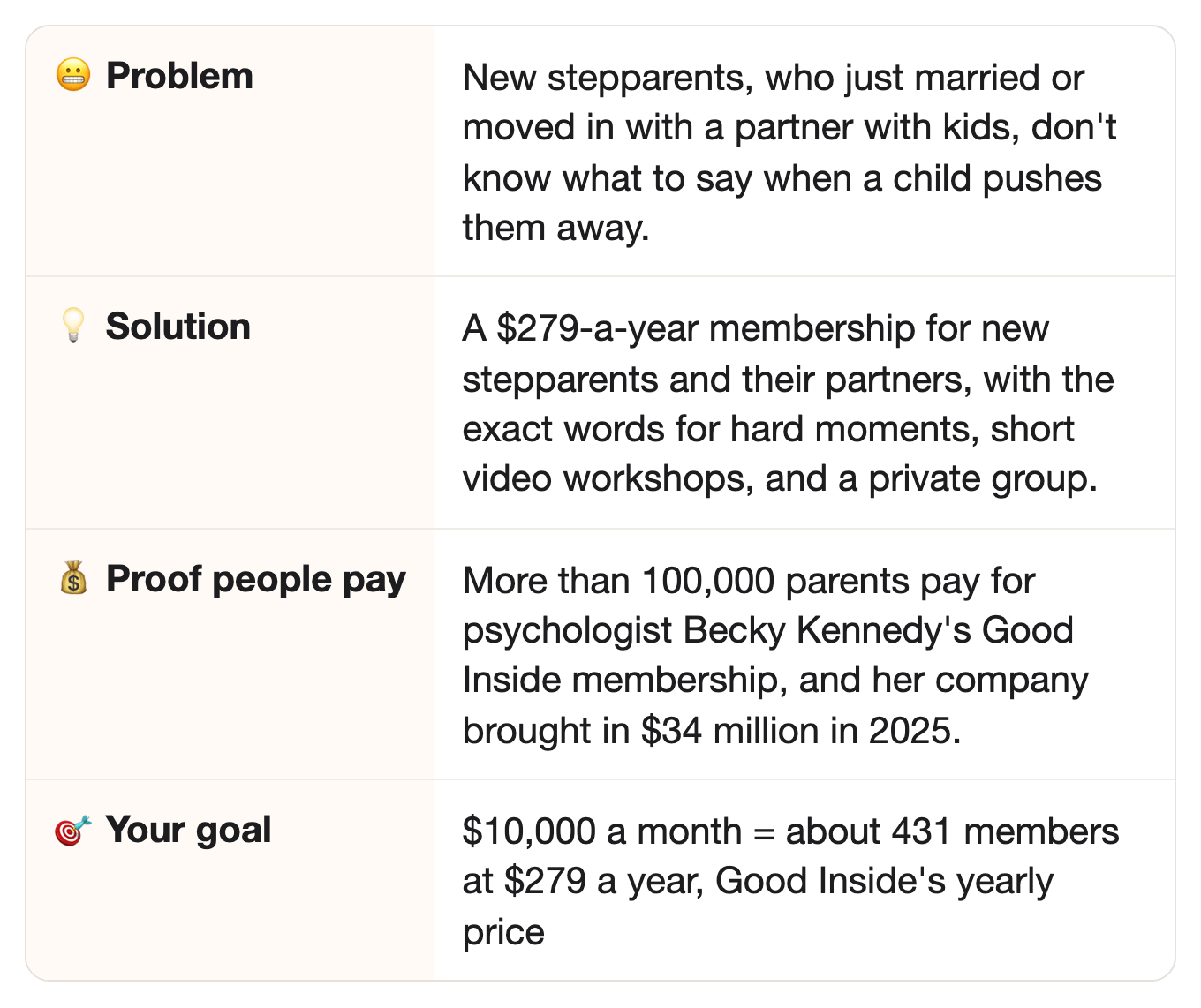
Today’s idea is called The First-Years Stepparent Club.
Grab a snack. 🍪
First, a psychologist’s story. Then, the business you could build from it.
⠀
⚡ Quick facts
⠀
📖 How a psychologist with 200 followers built a $34 million club
Her practice was already full before she ever posted.
Becky Kennedy is a clinical psychologist with a PhD from Columbia University.
She had a private practice in Manhattan, and ran parenting groups.
She’s a mother of three, and her practice was full.
And Instagram? She had no account until February 2020.
Not gonna lie, the account started almost by accident.
She and a friend were working on a “sleep button” product, and her sister told her to start an account for it.
The button never launched.
But the account stayed.
⠀
Then, on March 11, 2020, two weeks after she opened the account, she wrote a post for her roughly 200 followers.
The pandemic had just sent families home, and parents were stuck inside with their kids all day.
And that post spread fast.
By that summer, she had thousands of followers.
A few months after she started posting, she started Good Inside, her parenting company.
By June 2021, she had more than 600,000 followers.
She had sold more than 35,000 online workshops, at $54 each.
Time magazine figured that was over $1.8 million in a year, from workshops alone.
⠀
Then came a membership app, with workshops, short videos, and a private community.
It costs $84 for three months, or $279 a year.
Fast forward to the third quarter of 2025: the membership passed 100,000 subscribers.
In 2025, Good Inside brought in $34 million, nearly 50% more than the year before, Fortune reports.
And it’s profitable, with more than 60 people on the team.
Boom! 💥
She went from a post to 200 followers, to a $34 million parenting company, by selling parents help with one hard moment at a time.
⠀
🔗 Same idea, new group
In the story: parents paid Becky Kennedy’s Good Inside for help with one hard parenting moment at a time.
⠀In this idea: new stepparents need the same help, for the moments regular parenting advice skips, like “you’re not my mom.”
⠀Why it carries over: both groups face hard moments with kids that nobody trained them for, and they want the exact words to say.
⠀
💡 The opportunity
Stepparents have all the usual parenting problems, plus a few more that nobody trained them how to handle.
First, who are stepparents?
Adults who marry or move in with a partner who already has kids.
Some see the kids every day.
Some see them every other weekend.
Either way, they join a family that already has its own habits.
⠀
There are a lot of them.
In a Pew Research survey, 13% of US adults said they have at least one stepchild.
And 16% of US kids live in a blended family, with a stepparent, a stepsibling, or a half-sibling.
⠀
A stepparent starts with no authority in the house.
A parent’s rules come with years of trust.
A stepparent’s rules come with “you’re not my mom.”
And there’s an ex in the picture, with their own rules in their own home.
So what works? The fix runs through the kids’ own parent.
When that parent says “we agreed on this together,” the rule sticks.
When the stepparent says it alone, it doesn’t.
That’s why this club is for the couple, not just the stepparent.
⠀
Even trained counselors can miss this.
Wait, the pros too?
Yep.
The Stepfamily Foundation, a nonprofit that’s helped stepfamilies since 1975, says family counselors are trained to help a mom, a dad, and their own kids.
A home with a new adult in it, and an ex in another home, is a different job.
In its words, they “are not trained in the complexities of the stepfamily.”
⠀
And the hard moments follow a calendar.
The first holiday split between two homes.
The handover day, when the kids switch from one parent’s home to the other’s.
The first time the stepparent has to say no.
⠀
👉 The idea: a yearly membership for new stepparents and their partners, built around one hard moment a month.
Here’s how it works: each month brings a short workshop, the words to say, and a 10-minute talk guide for the couple.
The talk guide is three questions the two partners go through together.
That way, they agree on what to say before the kids are in the room.
A private group comes with it, so they never go through it alone.
⠀
🙋 Never been a stepparent? You can still build this.
Team up with someone who has lived it.
An experienced stepparent, or a family therapist who works with stepfamilies.
They bring the know-how and check every script.
You build the club and find members.
⠀
Let your AI do the listening.
Stepparents already post about their first year in stepmom groups, on Facebook, and in podcast comments.
Your AI reads a few hundred of those posts and lists what they wish someone had told them.
⠀
Or use your own life.
Grew up with a stepparent?
Then you’ve seen the hard moments from the kids’ side.
And that view is something new stepparents rarely get to hear.
⠀
✅ Why this could work
Three signs the money is real.
A stepmom already built a business just for stepmoms.
Jamie Scrimgeour remembers crying on the bathroom floor, “wondering what the heck I was thinking marrying a man with three kids.”
When she couldn’t find the stepmom support she wanted, she built it herself: coaching, a podcast, and a community.
Her site says she’s supported over 4,500 stepmoms around the world.
She grew her stepmom coaching business to $1 million, says a 2026 case study by Kajabi, the course site she uses.
⠀
Stepfamily help has been around since 1975.
Jeannette Lofas, a stepmother and a stepchild herself, founded the Stepfamily Foundation in 1975.
And it’s still going: it offers counseling, plus training seminars for coaches who want to work with stepfamilies.
⠀
Parents pay every month for help, even with free advice everywhere.
Good Inside posts free tips to 3.4 million Instagram followers.
And 100,000+ parents still pay for the membership.
⠀
👉 Curious where these numbers come from? Every source is linked in the last section, “📎 The sources.”
⠀
📊 More proof people want this
Want more? Here you go.
New stepfamilies keep forming.
Almost 42 million Americans had been married more than once in 2013, up from 22 million in 1980, Pew found.
Not every second marriage brings kids into the home, but each one that does makes a new stepparent.
⠀
About 8% of US kids live with a stepparent.
That’s from the same Pew report that counted blended families.
⠀
Parents buy workshops one hard moment at a time.
Becky sold more than 35,000 workshops at $54 each by mid-2021, Time reported.
Topics ran from potty training to kids with big feelings.
So parents could buy just the one they needed.
⠀
Members come from all over the world.
Good Inside has members from over a hundred countries, Becky told Marie Claire in 2026.
⠀
👉 Lots of people become stepparents, few get trained for it, and parents already pay monthly for help with the hard moments.
⠀
🔍 Who’s already doing it
Big names exist. None is built for the stepparent and their partner together.
Good Inside is made for all parents.
Its membership page says “most of our content is designed for parenting kids ages 0-18.”
When we checked, that page didn’t mention stepparents or blended families.
⠀
Jamie Scrimgeour serves stepmoms.
Her coaching, podcast, and community are made for women in the stepmom role.
Makes sense: she’s a stepmom herself.
But stepdads, and the kids’ own parent, aren’t who it’s made for.
⠀
The Stepfamily Foundation offers counseling.
It’s one-on-one help, in person or by phone, plus training for coaches.
That’s help for a family in trouble, not a monthly club for the first years.
⠀
Still missing when we checked:
A membership for the couple together, the stepparent and the kids’ parent, in their first two years.
Scripts built around the custody schedule, the calendar of which days the kids spend in which home.
A separate set of lessons made for stepdads.
⠀
🔎 Check the market yourself in 2 minutes: run Part 0 of the prompt, under “📋 The prompt” below.
Your AI searches membership sites, Substack, podcasts, and coaching programs that day, and tells you: early, growing, or crowded.
Early? Start now.
Crowded? Good news: it means people pay. Pick one narrower kind of stepfamily (Step 1, further down).
A crowded market is still OK. You win by serving one kind of stepfamily better, not by being first.
⠀
👉 That missing part can be your business: a club for both partners in a new stepfamily, built around the days the kids come and go.
⠀
🤖 Why AI won’t replace it
AI can write a kind, careful script. But first it needs the family’s details, like the kids’ ages, the custody schedule, and the ex. A stressed stepparent rarely stops to type them out.
🔮 Honest note: a personal AI agent can already find stepparent articles and draft what to say.
So the words alone aren’t the product.
The product is the right script in the month they need it, plus a group of stepparents going through the same thing.
⠀
1. The inputs.Good advice depends on the kids’ ages, the custody schedule, and how things stand with the ex.
Your club asks for those once, at signup, and sorts members by them: kids under 10 or teens, every day or every other weekend.
Each month’s scripts come in a version for each of those groups, so members read the one that fits their family.
⠀
2. You choose the order.A new stepparent doesn’t know which moment comes first: the bedtime routine, or the first holiday split.
You plan the year, so the right workshop arrives in the month they need it.
⠀
3. Other stepparents going through the same thing. 🫂Becky says nothing she could tell a parent is as powerful as knowing you’re not the only one.
In her words: “AI cannot give that.”
⠀
4. A person they know.They hear from the same person every month, someone who knows what the first years of a stepfamily feel like.
⠀
5. Proof people pay for more than answers: Good Inside has its own chatbot, Gigi, inside the app.Remember those 100,000+ parents paying for Good Inside?
They still pay for the whole membership, chatbot and all.
⠀
👉 They pay for a plan that fits their family, not just advice.
⠀
💵 How much you can make
Quick math time. 🧮
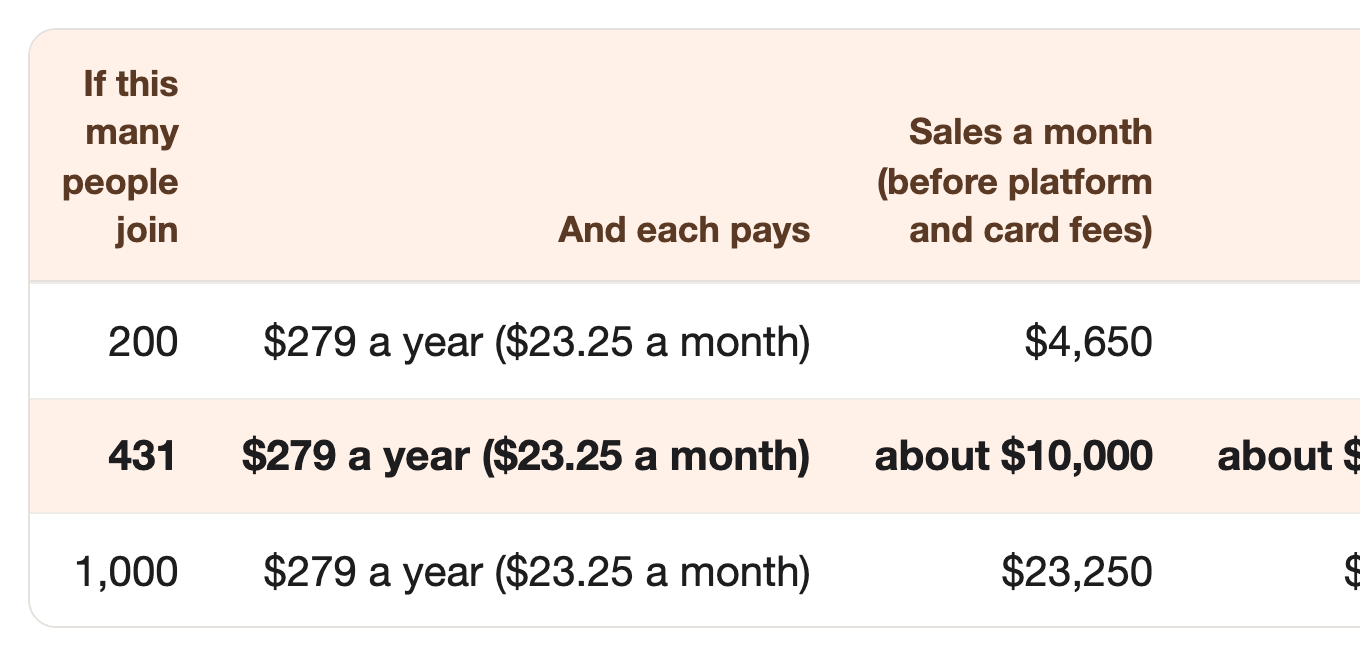
$279 a year is Good Inside’s yearly price.
⠀431 members is under half of 1% of Good Inside’s 100,000+ subscribers.
⠀If it doesn’t work out, here’s all you lose:
Nothing to start: a Substack newsletter, with a paid tier and a private chat, costs nothing to open.
One month’s subscription to an AI app, like ChatGPT or Claude.
One week of your time.
⠀
👉 Earning a million dollars usually takes a few good ideas, not one lucky one.
This club could be your first idea, and each idea you add after it grows your yearly income.
Got that “I could do this” feeling?
Good. The full plan starts right below. 👇
If not, that’s fine. See you next week.
That’s it, my fellow contrarians! 🙌
Yours ‘proving you don’t need an original idea, just a proven one’ Vijay Peduru 🦸♂️
⠀
⠀
⠀
🧰 Want to build it? Here’s everything else.
⠀
Step 1: 🎯 Pick one kind of stepfamily
One kind of stepparent, at one stage, with one kind of schedule.
Good news: you don’t need to serve every stepfamily, just one.
Pick one group.
Stepmoms of kids under 10.
Stepdads of teenagers.
Couples in their first year living together.
Part-time stepparents, who see the kids every other weekend.
Write it in one line, like “for stepdads in their first two years with teenagers.”
Let your AI read what that group already posts, in stepmom groups, on Facebook, and in podcast comments.
It pulls out their hardest weeks, and the words they wish they’d had.
⠀
Step 2: 🗺️ Map the first year
Twelve hard moments, one a month, in the order they usually come.
Let your AI draft the list, using Part 1 of the prompt and the posts it found in Step 1.
The first dinner, the first “no,” the first holiday split, the first school event with the ex there.
Fix the order yourself, or with your expert partner.
Give each month a plain name, like “The first holiday in two homes.”
⠀
Step 3: ✍️ Make the first month
One month is one short workshop, a page of scripts, and a 10-minute couple talk.
Write it with Part 2 of the prompt.
A 15-minute workshop script you record on video.
5 to 8 scripts: what to say, and what to skip.
A 10-minute talk guide for the couple, for the night before.
Check it with Parts 3 and 4.
Part 3 checks every line against the safety rules.
Part 4 reads it as a stepparent, as the kids’ parent, and as a family therapist.
Optional: pay a family therapist once to review your first three months.
⠀👉 The prompt already follows these safety rules:
It isn’t therapy or legal advice, and every month says so.
Custody and legal questions go to a family lawyer or mediator.
If anyone’s safety is at risk, it says to contact local emergency services.
Never a bad word about the ex, and no kids’ names or photos.
⠀
Step 4: 🏪 Open the doors
Copy Good Inside’s simple pricing.
Easy one.
Set your prices.
$279 a year, like Good Inside.
Or $84 for three months, also like Good Inside.
Pick where to run it.
Substack works for a start: a paid newsletter plus a private chat.
Or a course site with a community built in.
Write the group rules first, with Part 5 of the prompt: no kids’ names, no photos, no bad-mouthing the ex.
Let AI write your sales page, with Part 6, using one real script from your first month.
⠀
Step 5: 📣 Get your first members
Go to the people new stepfamilies already trust.
Ask family therapists and divorce mediators to pass your club on.
They meet new stepfamilies every week, and they’re often asked “what should we read?”
Send each one a free month to look over, and a one-page summary they can hand out.
Offer stepfamily and divorce podcasts an idea for one episode.
Like “Three things to say on the first handover day,” with the talking points already written.
Give every member one free month to pass on.
Stepparents know other stepparents, so each member can give that free month to a stepparent friend.
⠀
Step 6: 🏃 Eliminate competitors
Copycats will come. Here’s how you stay first.
Make the night before handover day a ritual.
Every week, members get one short script and one question for the couple, the night before the kids arrive.
Ten minutes, the same time each week, tied to their own calendar.
Let your first 50 members pick the hard moment for the month after.
A quick vote in the group each month.
They tell you what’s hard for them that month, so the club keeps fitting their lives.
⠀
Step 7: 🎲 Make it bigger
Every stepfamily stage has its own hard moments.
Add a new set of lessons for each new group: stepdads, stepparents of teens, or a short “moving in together” starter course.
Three groups at about $10,000 a month each is about $360,000 a year, before fees. 🎯
⠀
🗓️ Your first week
Phew. That was a lot. 😅
A first version of Steps 1 to 5 fits into seven days. 🚀
By day 7, you have a mapped year, one finished month, group rules, a sales page, and your first notes to therapists.
Quick heads-up: the prompt below has eight Parts, Part 0 to Part 7, and they’re not the same as the Steps above.
Day 1 (Step 1): Run Part 0 of the prompt (it’s below), and pick your kind of stepfamily.
Day 2 (Step 2): Map the first year with Part 1.
Days 3–4 (Step 3): Write the first month with Part 2, then check it with Parts 3 and 4.
Day 5 (Step 4): Set up the group with Part 5, and write your sales page with Part 6.
Days 6–7 (Step 5): Write your notes to therapists and mediators, your podcast idea, and the free-month pass with Part 7.
⠀
🏄 How to use the prompt
One prompt does all the AI work, in seven parts, plus a quick market check (Part 0).
Part 1 — Map the first year. Lists 12 hard moments, one a month, in order.
Part 2 — Write one month. Writes the workshop script, the scripts for what to say, and the couple talk.
Part 3 — Check the safety rules. Checks every line against the rules, and fixes or drops what breaks them.
Part 4 — Read it three ways. Reads it as a stepparent, as the kids’ parent, and as a family therapist.
Part 5 — Set up the group. Writes the welcome post, the group rules, and the weekly handover-day check-in.
Part 6 — Write the sales page. Uses your real first month as the example.
Part 7 — Write the first-member kit. Writes the note to therapists and mediators, a podcast pitch, and the free-month pass.
Run it your way:
Part by part (the default): it pauses after each part, and you type “next” to go on.
All at once: say “run all the parts.”
Just one part: say “only do Part 3,” or any part you need.
The full prompt is just below, under “📋 The prompt.”
🎙️ Talk to your AI sidekick, don’t type.
Turn on voice mode, or use a dictation app like Wispr Flow.
Say it messy. The AI sorts it out.
Turn it into a skill, so you never paste it again.
Paste the prompt into Claude or ChatGPT, and say: “Turn this into a skill I can save.”
Install once, use forever.
⠀
📋 The prompt
The prompt (copy it into Claude or ChatGPT, fill in the INPUTS part, and run it your way)
CONTEXT:
- You're my content partner. Together we'll build a yearly membership for new stepparents and their partners, with one hard moment a month.
- This prompt has eight parts, Part 0 to Part 7, in order.
- Run it the way I ask:
    - If I say nothing, go one part at a time. After each part, show me the result, then stop and wait. Move on only when I type "next."
    - If I say "run all the parts," do them all without stopping.
    - If I say "only do Part 3" (or any part), do just that part.
- If a part needs something from me, ask for it before you start that part.
- Follow these safety rules in every part:
    1. This is not therapy and not legal advice. Every month's material ends with: "This is general support, not therapy or legal advice. For your family's situation, talk to a licensed family therapist."
    2. Never give advice on custody, child support, or court. Say: "Ask a family lawyer or mediator."
    3. If a member mentions abuse, violence, or anyone being unsafe, tell them to contact local emergency services or a local crisis line right away. Never coach them through it.
    4. Never say a bad word about the ex, and never suggest turning the kids against a parent.
    5. Never use a real child's name, photo, or story. Use made-up names and say they're made up.
    6. Never promise results, like "your stepkids will accept you."
- Never invent a fact, a study, or a number. If you're not sure a fact is right, leave it out.
- Keep web search on for the whole prompt (turn on search in ChatGPT or Claude), so you can open any page you need to check.

=============== INPUTS — edit these, or just run as is ===============

Who the club is for:
{e.g. stepdads in their first two years with teenagers}

The custody schedule most members have:
{e.g. kids every other weekend, plus one weeknight}

What members told me is hardest (paste your notes, or leave blank):
{e.g. "She won't talk to me at dinner", "His ex texts him about everything I do"}

The month to write first:
{e.g. Month 1: the first weekend the kids stay over}

My prices:
{e.g. $279 a year, or $84 for three months}

======================== END OF INPUTS ========================

THE PARTS:

Part 0 — Check the market today.
This part needs web search (turn on search in ChatGPT or Claude). Search for paid help for my kind of stepparent and, for each place, give the count, the three biggest with links, and their prices:
1. Memberships and paid communities for stepparents or blended families.
2. Paid newsletters on Substack and similar sites about stepfamily life.
3. Coaching programs and courses for stepparents.
4. The biggest podcasts and social accounts for stepparents.
Then tell me: early (few sellers), growing, or crowded, and which kind of stepparent looks least served (for example: stepdads, stepparents of teens, couples where both have kids). Give a link for every number. If you can't open a page, say so. Never guess a number.

Part 1 — Map the first year.
List 12 hard moments for my kind of stepfamily, one a month, in the order they usually come. Use my INPUTS first. For each, give a plain name, one line on why it's hard, and which month it fits. Say clearly which ones come from my notes and which are your guess.

Part 2 — Write one month.
Ask me which month to write first, or use my INPUTS. For that month, write:
1. A workshop script I can record in about 15 minutes, in plain words, with one main idea.
2. Five to eight scripts: what the stepparent or the parent can say in the moment, and what to skip saying.
3. A 10-minute talk guide for the couple, with three questions, for the night before the moment.
Fit everything to the custody schedule in my INPUTS. Follow every rule in CONTEXT.

Part 3 — Check the safety rules.
Now act as a separate checker who didn't write Part 2. Check every line against each rule in CONTEXT, one by one. Mark each line: safe, needs a fix, or drop it. For each problem, quote the words and name the rule. Then give the fixed version, with the line from rule 1 at the end.

Part 4 — Read it three ways.
Read the fixed month three times: as a nervous new stepparent, as the kids' parent, and as a family therapist. As the stepparent, flag anything that sounds like blame. As the parent, flag anything that takes sides against their kids or their ex. As the therapist, flag anything that sounds like therapy or a promise. Then give the final month, with every fix made.

Part 5 — Set up the group.
Write:
1. A short welcome post for new members.
2. Group rules: no kids' names or photos, no bad-mouthing the ex, no legal advice, and where to go if someone is unsafe.
3. A weekly "night before handover day" check-in: one short script and one question for the couple, based on this month's moment.

Part 6 — Write the sales page.
Ask me for one finished script from my first month first. Use it as the example. Never invent a result, a review, or a number. Give me:
1. A headline that names my kind of stepparent, not "parents."
2. What members get each month: the workshop, the scripts, the couple talk, the weekly check-in, and the group.
3. That it's general support, not therapy or legal advice.
4. The prices, shown up front, and "Cancel any time."

Part 7 — Write the first-member kit.
1. A short note to a family therapist or divorce mediator. Offer a free month to look over, and a one-page summary they can hand to families. Say plainly it isn't therapy.
2. A pitch to a stepfamily or divorce podcast for one episode, like "Three things to say on the first handover day," with three talking points written out.
3. The text for a free-month pass a member can give to another stepparent.
⠀
📎 The sources
Every number above, with where it came from.
Good Inside’s revenue and members · Number: “$34 million in revenue last year” (2025), “a nearly 50% increase year over year”; profitable; “passed 100,000 subscribers in the third quarter of last year”; $23.25 to $28 a month; more than 60 employees; 3.4 million Instagram followers · Source: Fortune, February 27, 2026
How it started · Number: Psychologist in Manhattan; mother of three; no Instagram until the pandemic; started Good Inside a few months later; app with workshops, videos, a community, and the chatbot Gigi · Source: Same Fortune article
Becky’s early years · Number: PhD in clinical psychology from Columbia; private practice and parenting groups; practice full; no Instagram until February 2020; “sleep button” product; March 11, 2020 post (two weeks after the account opened) went viral beyond “her then 200 followers”; sleep button “scrapped”; workshop topics “ranging from potty training to how to deal with ‘deeply feeling kids’”; thousands by summer; 600,000+ followers; 35,000+ workshops at $54; “over $1.8 million in a year” from workshops · Source: Time, June 26, 2021
Good Inside’s price and focus · Number: $84 for 3 months ($28 a month) or $279 a year ($23.25 a month); “most of our content is designed for parenting kids ages 0-18” · Source: Good Inside, September 16, 2025 (copy from May 15, 2026)
Members worldwide; the AI quote · Number: Members “from over a hundred countries”; “There’s nothing I could ever say to a parent that is as powerful as the actual visceral experience of knowing you’re not the only one, and AI cannot give that” · Source: Marie Claire, April 30, 2026
Jamie Scrimgeour · Number: “Crying on the bathroom floor, wondering what the heck I was thinking marrying a man with three kids”; “supported over 4,500 stepmoms around the world” · Source: jamiescrimgeour.com, copy from May 12, 2026
Jamie’s business · Number: “built a coaching business specifically for stepmoms and grew it to $1M”; built on Kajabi · Source: Kajabi, March 18, 2026
Stepfamily Foundation · Number: Founded 1975 by Jeannette Lofas, “a stepchild and stepmother herself”; counseling in person and by phone; certification seminars for coaches; counselors “are not trained in the complexities of the stepfamily” · Source: Stepfamily Foundation, About (copy from April 22, 2026)
Adults with a stepchild · Number: 13% of US adults have at least one stepchild (survey of October 2010) · Source: Pew Research Center, January 13, 2011
Kids in blended families · Number: 16% of children live in blended families; about 8% live with a stepparent · Source: Pew Research Center, December 17, 2015
Remarriage · Number: Almost 42 million Americans married more than once in 2013, up from 22 million in 1980 · Source: Pew Research Center, November 14, 2014