


Hello contrarians,
Today’s idea is called The Cooking-for-One Newsletter.
Grab a snack. 🍪
First, a recipe writer’s story. Then, the business you could build from it.
⠀
⚡ Quick facts
⠀
📖 How a rejected cookbook became a $50-a-year newsletter
It started with a book nobody would publish.
Back in 2019, Caroline Chambers wrote recipes for brands and magazines.
She pitched her own cookbook, called What to Cook When You Don’t Feel Like Cooking.
Pretty great name, honestly.
And publishers turned it down.
Every one gave the same reason, she says: she didn’t have enough followers online.
Ouch.
Then in March 2020, COVID hit, and her recipe clients stopped all their projects.
So now she had no book deal… and no clients either.
So she started a free weekly recipe email, and grew her Instagram.
⠀In early December 2020, she had an idea.
“What if I turned that book proposal that got rejected last year into a paid newsletter?”
A couple of weeks later, she launched it on Substack, a newsletter platform.
Her price: $35 a year, “the average price of a cookbook.”
So a whole year of recipes cost about the same as one book.
By September 2021, about 3,000 people were paying.
Funny thing: she already had one cookbook out with a big publisher, Just Married (2018).
By September 2021, the newsletter had earned her as much as that whole book.
⠀
When we checked, she charged $50 a year.
Substack labels her newsletter “Tens of thousands of paid subscribers.”
That label gives a range, and its low end is 10,000.
Our math: at least 10,000 readers × $50 is at least $500,000 a year, if everyone paid the full yearly price.
It’s our estimate; she hasn’t shared her numbers.
Holy guacamole. 🥑
By that math, half a million dollars a year, from a cookbook publishers said no to.
She went from a rejected book and no clients, to at least 10,000 paying readers, by sending that book out as a weekly email.
⠀
🔗 Same idea, new group
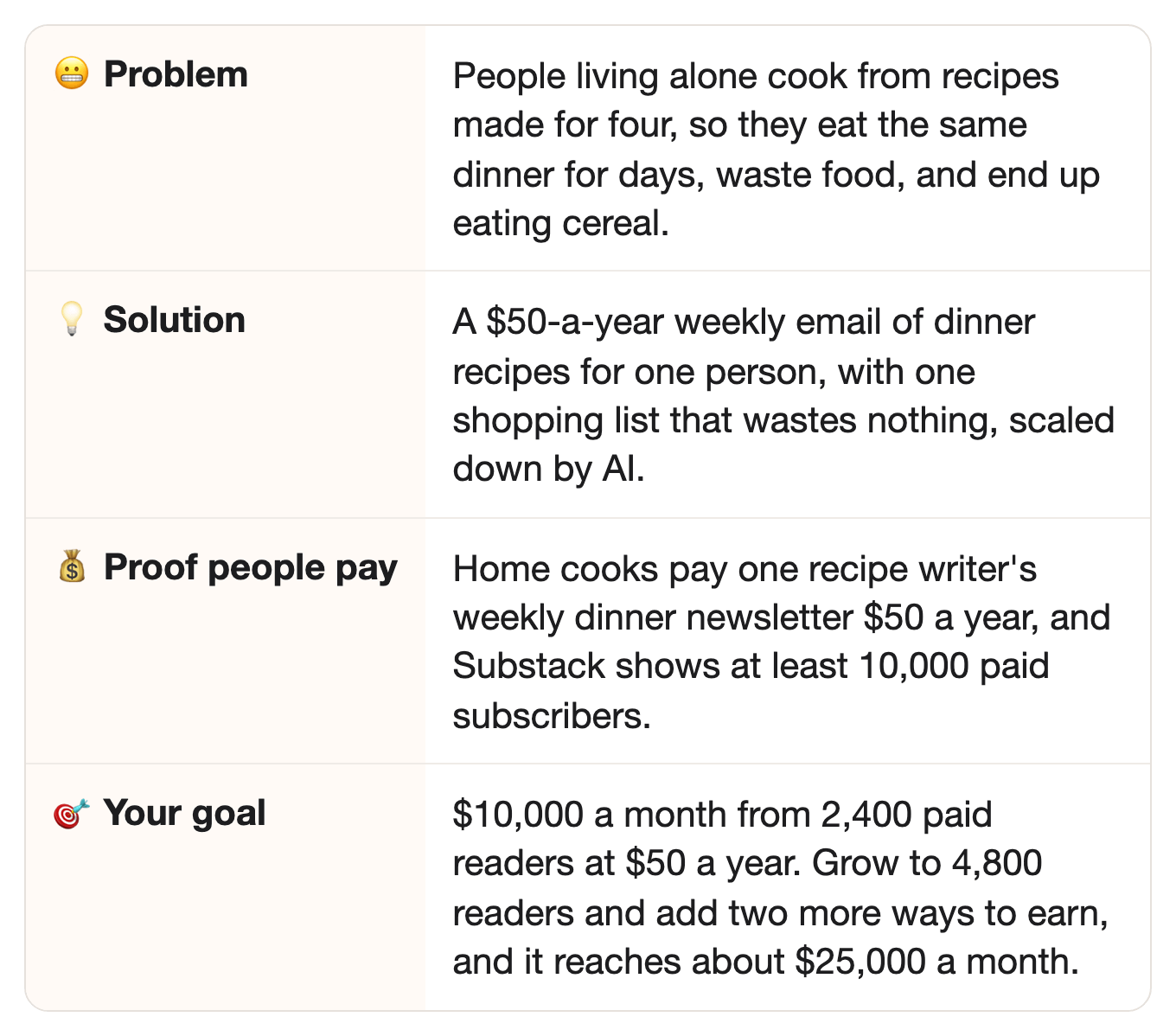
In the story: at least 10,000 readers pay Caroline $50 a year for a weekly dinner email made for families.
⠀In this idea: people who live alone need the same weekly email, with recipes and a shopping list sized for one.
⠀Why it carries over: both groups have to make dinner every night, and a weekly plan tells them what to cook and buy.
⠀
💡 The opportunity
Millions of people cook for one, and most cooking newsletters are written for families.
Almost 3 in 10 US homes have just one person living in them.
That’s 38.5 million homes in 2024, says the US Census Bureau.
In 1974, it was only 19%.
That’s a lot of dinners for one.
⠀
Who are they?
New grads in their first apartment.
People who moved to a new city for work.
People who simply like their own space.
Parents whose kids have grown up and moved out.
⠀
Their week looks like this.
A recipe feeds four, so they eat the same dinner four nights in a row.
Half a bunch of herbs goes bad in the fridge.
Or they give up and have cereal.
⠀
Here’s the beauty of it: Caroline’s newsletter is for family dinners, not for one.
Her recipes are “family-friendly,” Substack wrote in 2021.
So she proves people will pay $50 a year for a weekly dinner email.
A version made for people who live alone is the gap you’d fill.
⠀
👉 The idea: a weekly newsletter for people who live alone: dinners for one, plus one shopping list that wastes nothing, for $50 a year.
⠀
🧩 What you actually need
Good news: the list is short.
A home kitchen you already use.
You cook each recipe yourself before it goes out (Step 3 of the build plan).
No chef’s hat needed.
⠀
One group and one promise.
For example: new grads in their first apartment.
⠀
An AI app, like ChatGPT or Claude.
It cuts each recipe to one serving, and writes the shopping list that wastes nothing.
⠀
✅ Why this could work
Why this one can work, in three points.
Paid cooking newsletters already make real money, more than once.
Caroline: at least 10,000 paid readers at $50 a year.
Over 598,000 people subscribe to her in all, free and paid.
Jenn Lueke started the eat goood newsletter in January 2024.
When we checked, Substack also labeled it “Tens of thousands of paid subscribers,” at $60 a year.
Jenny Rosenstrach’s Dinner: A Love Story is labeled “Thousands of paid subscribers” (at least 1,000), at $70 a year.
So that’s three paid cooking newsletters, not one lucky one.
⠀
The group keeps growing, and they need a new dinner every night.
One-person homes went from 19% of US homes in 1974 to 29% in 2024.
Every night brings the same question again: “what do I make for just me?” 🔁
⠀
They’re openly asking for this.
The cookbook ratings, video views, and comments are in the next section.
⠀
👉 Like to check the numbers yourself? The links are all in “📎 The sources,” at the very end.
⠀
📊 More proof people want this
Want more? Here you go.
People already pay for cooking-for-one cookbooks.
Cooking for One, from the cooking brand America’s Test Kitchen, has about 1,600 ratings on Amazon, at a $29.99 list price.
The list price is the price printed by the publisher.
The Ultimate Cooking for One Cookbook has about 2,500 ratings, at a $19.99 list price.
One Pot One Portion has 428 ratings, at a $28 list price.
⠀
A video of dinners for one passed 2 million views.
Andy Cooks is a YouTube cooking channel.
When we checked, its video “5 Easy Dinners for One” had more than 2 million views.
⠀
Seniors living alone are a group of their own.
A video called “10 Dump and Bake Dinners for Seniors Living Alone” went up in September 2026.
It passed 500,000 views within a month.
⠀
People search Google for this every month.
“Meals for one” gets about 3,600 US searches a month.
“Cooking for one” and “recipes for one” get about 2,400 each.
⠀
The big picture: 38.5 million US homes had one person in 2024. 💰
That’s 29% of all US homes.
⠀
What people who live alone say.
That’s a comment under Andy Cooks’ video, with more than 1,500 likes.
⠀
Another YouTube comment: “shopping for one is even more difficult than cooking for one.”
Yep, the shopping list is half the problem.
⠀
And one more: “AT LAST!!!! Recipes for us singles, living alone, kids grown!!”
Four exclamation marks after “AT LAST.”
That’s someone who’s been waiting.
⠀
👉 People who live alone want recipes that fit their week, not a family’s.
⠀
🔍 Who’s already doing it
Who’s already doing it, and what they miss.
Caroline, from the story above, writes for families.
Her paid recipe newsletter is built for family dinners, and she’s a mom of boys.
⠀
Jenn Lueke’s paid newsletter sends healthy recipes, meal plans, and grocery lists.
She writes for anyone who wants to eat healthy, not for people who live alone.
⠀
YouTube teaches one dinner at a time.
A video shows you one recipe.
It doesn’t plan your whole week around one shopping list.
⠀
When we checked, we found one paid Substack made just for cooking for one.
Serves You Right started in April 2026, at $70 a year.
So yes, someone else spotted this too.
That shows the idea is real, with plenty of room left.
⠀
What’s missing, when we checked:
A weekly plan for one person, where one shopping list covers every dinner.
A plan for one group, like new grads or seniors living alone.
Short videos that show each dinner, at $50 a year.
⠀
🔎 Check the market yourself in 2 minutes: run Part 0 of the prompt in the build plan below.
Your AI searches Substack, YouTube, Amazon, and Instagram that day, and tells you: early, growing, or crowded.
Early? Start now.
Crowded? Good news: it means people pay. Pick one narrower group (Step 1 of the build plan).
A crowded market is still OK. You win by serving one group better, not by being first.
⠀
👉 That’s the part nobody else offers: a weekly dinner plan for one group of people who live alone, with one shopping list.
⠀
🤖 Why AI won’t replace it
AI can shrink a recipe. You make it work in a real kitchen.
So could ChatGPT just do this?
Part of it, yes.
Here’s the part it can’t do on its own.
Tested for real.
Cutting a recipe to one serving isn’t just dividing by four.
The pan size changes, the cooking time changes, and nobody can use half an egg.
Half an egg? Good luck with that.
You cook every recipe before it goes out.
A quick ChatGPT recipe has never been cooked.
⠀
Taste: what’s worth making for one.
Someone tired at 7 p.m. doesn’t know which dish reheats well on night two.
You pick the dinners that are good twice, and skip the ones that aren’t.
⠀
A finished plan: one week, one shopping list.
ChatGPT can plan a week around one bunch of herbs, if someone lists what’s in the fridge first.
Your plan uses the whole bunch of herbs across three dinners, so nothing goes bad.
Bye-bye, slimy herbs.
⠀
They already know and trust you.
They’ve watched you cook, and they like your taste.
⠀
Proof they pay for the plan.
Remember Caroline?
Her recipes are free all over Instagram, and 10,000+ readers still pay $50 a year.
⠀
👉 Free recipes are everywhere, but a week of dinners for one, ready to cook, is hard to find.
⠀
💵 How much you can make
Grab a calculator. Just kidding, here it is.
First stop: $10,000 a month from the newsletter alone
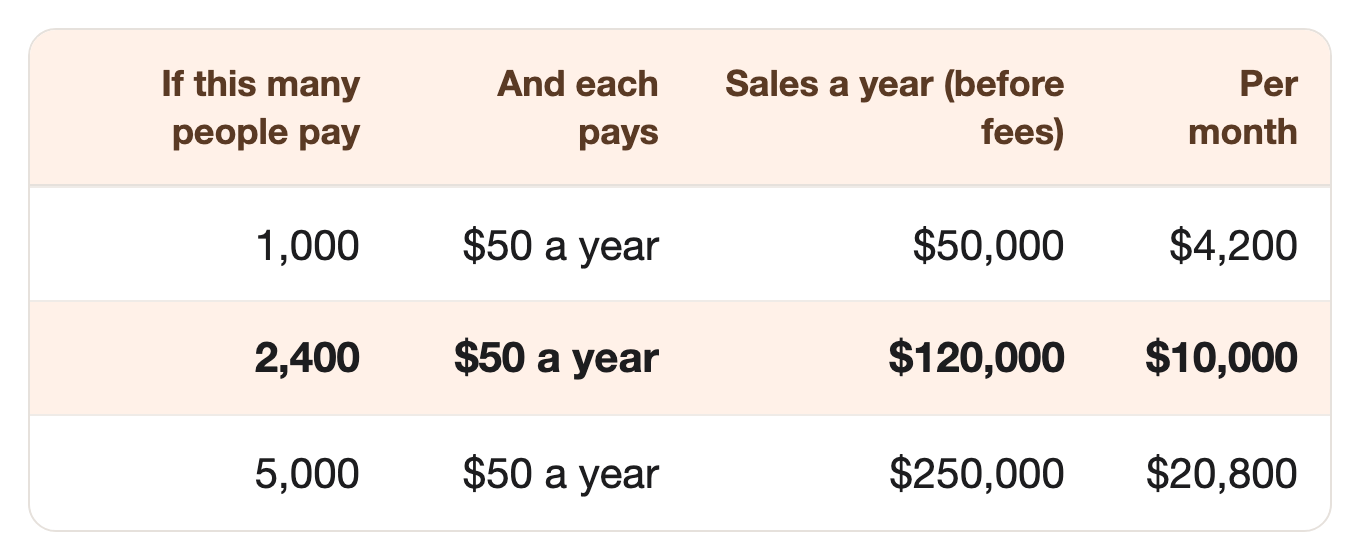
2,400 paid readers is under a quarter of Caroline’s 10,000-plus.
She had about 3,000 within about nine months of going paid.
⠀
The $50 is her price, so you’re not guessing what readers will pay.
Next stop: $25,000 a month, with two more ways to earn
Some readers will pay more for extra help, and many already shop for groceries online.
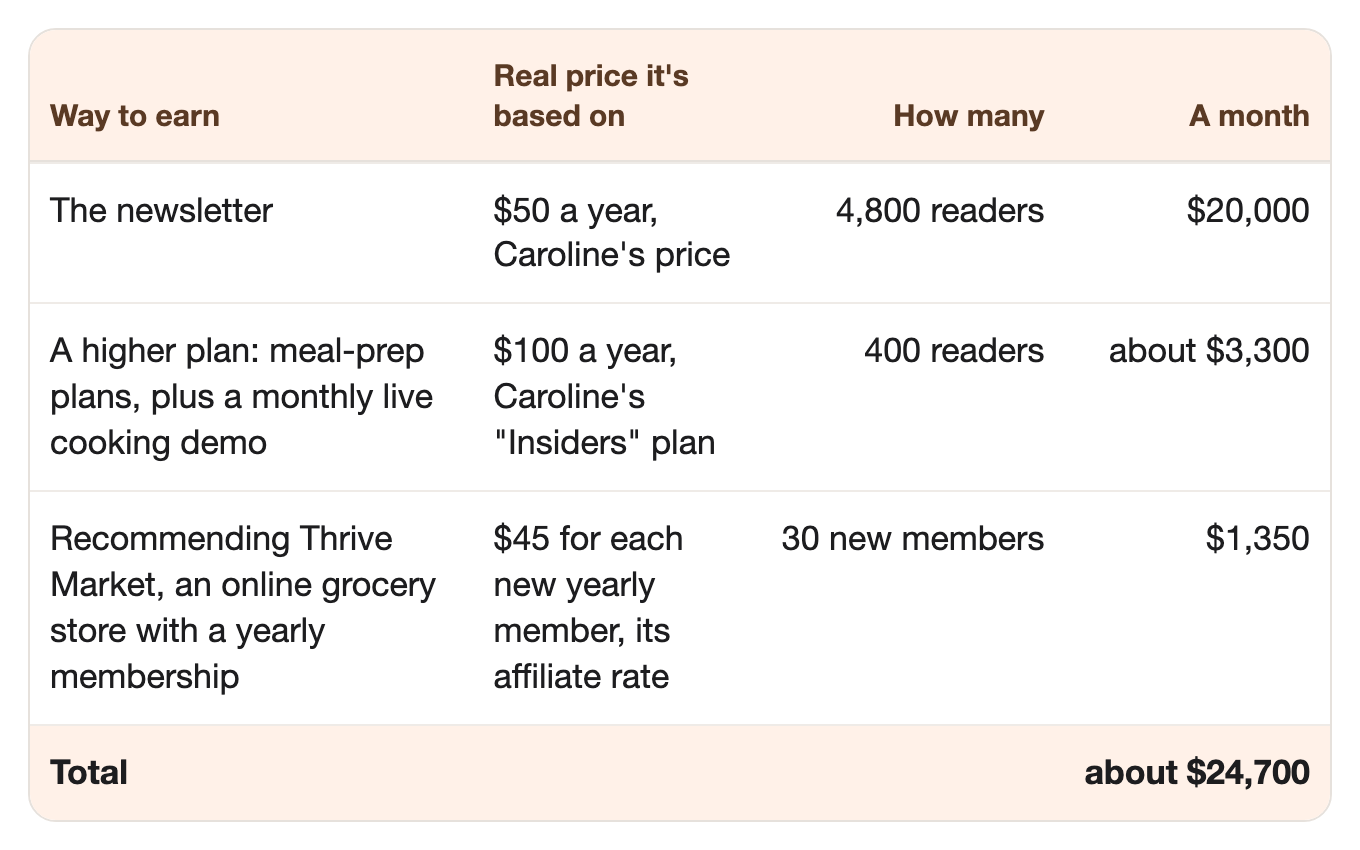
The newsletter still does most of the work.
Grow it from 2,400 to 4,800 readers, and it brings in $20,000 a month.
Add the 400 on the higher plan, and that’s 5,200 paid readers.
That’s about half of Caroline’s 10,000-plus.
⠀
The higher plan is for readers who want more than dinner.
Caroline’s version includes six meal-prep plans and monthly live cooking demos.
Yours could be one cooking demo a month, made for one person.
⠀
The Thrive Market link is small, but it takes almost no time.
Caroline’s top plan already comes with a Thrive Market gift.
So her readers are the kind of people who shop there.
Thirty new members a month is the goal.
⠀
If it doesn’t work out, here’s all you lose:
Substack’s cut: it keeps 10% of what readers pay, plus card fees, so it costs you only when someone pays.
One month’s subscription to an AI app, like ChatGPT or Claude.
Groceries you’d buy for dinner anyway.
(You were gonna eat anyway.)
Two weeks of evenings.
⠀
👉 One idea, three ways to earn: about $25,000 a month.
Stack two or three ideas from this newsletter, or take this one to a similar niche. Do that, and a million dollars in total is two or three years away.
For this newsletter, a similar niche could be couples cooking for two. And this newsletter could be your first idea.
Got that “I could do this” feeling?
Good. The full plan starts right below. 👇
If not, that’s fine. See you next week.
That’s it, my fellow contrarians! 🙌
Yours ‘helping you build on what already works’ Vijay Peduru 🦸♂️
⠀
⠀
⠀
🧰 Want to build it? Here’s everything else.
AI does the planning and writing. You do the cooking. 🍳
⠀
Step 1: 🎯 Pick your group and your promise
You don’t need to be a chef. You need one group and one clear promise.
Good news: this step is mostly thinking.
Pick one group of people who live alone.
For example: new grads in a small kitchen.
Or people in their 60s and 70s whose kids have moved out.
Or people who live alone and eat vegetarian.
Write your promise in one line.
For example: “Three dinners for one, one shopping list, nothing goes bad.”
Caroline’s promise is her newsletter’s name: What to Cook When You Don’t Feel Like Cooking.
Make yours just as plain.
⠀
Step 2: 🛒 Plan the week
AI drafts the plan. You make sure it works in a real kitchen.
Let AI draft three dinners that share ingredients.
One bunch of herbs, one pack of chicken, one bag of spinach, used across the week.
Let AI write one shopping list for all three, in the sizes stores actually sell.
Cook every dinner yourself before it goes out, and take a photo on your phone.
Yes, this is the fun part.
Add a “night two” note to each recipe: how to reheat it, or turn it into lunch.
⠀
Step 3: 🔍 Check every recipe
Your name is on every recipe, so each one goes through three passes.
Your AI does all three passes for you: it writes in Part 2, and checks in Parts 3 and 4 of the prompt.
🖊️ The AI writer. AI writes each recipe for one serving, from your own cooking notes.
🔍 The AI checker. A second pass redoes every amount, and checks safe cooking temperatures against the government’s official chart.
🧐 The AI critic. A third pass reads it like a beginner, and flags anything confusing, like “half an egg.”
Then you cook it, and fix what didn’t work.
⠀
👉 The prompt already follows three safety rules: official safe temperatures, every allergen (like nuts) named, and recipes in your own words, never copied.
⠀
Step 4: 🏪 Open your newsletter
Copy Caroline’s setup: one free recipe to bring people in, the full plan for paid readers.
Easy one: she already showed how it’s done.
Start a free Substack.
Set your prices.
$50 a year, or $7 a month, like Caroline.
Decide what’s free and what’s paid.
Free: one dinner a month.
Paid: the full weekly plan, the shopping list, and the archive.
Run a sale now and then. Caroline says she gets “tons of new subscribers every time.”
⠀
Step 5: 📣 Get your first readers
Get found where people plan dinners, and win back readers who drifted off.
Pin each dinner on Pinterest, titled like “one-pan dinner for one, no leftovers.”
One pin per dinner, titled the way people search, with a link to your free signup.
Your AI writes the titles from each week’s plan.
Swap mentions with a shop that sells single-serving food containers.
It tells its buyers about your newsletter, and you tell your readers about its containers.
Pick a shop whose buyers cook for one, but that doesn’t sell recipes.
Send readers who drifted off a free month, with a deadline.
On Substack, set it up as a free month that ends on a set date.
A gift with a deadline gives them a reason to come back before it runs out.
⠀
Step 6: 🏃 Eliminate competitors
Here’s how to stay ahead when the competitors show up.
Let your first 30 paid readers vote on the dinners in your next plans.
Put them in one Substack chat, and each month ask which dinner they most want made for one.
Their picks decide the plan, so it fits them better than any big recipe site can.
Have a “switching from meal kits” page ready now.
When a big meal kit raises its prices, your page is already live.
It shows one week’s plan and its shopping list, so people can compare for themselves.
⠀
Step 7: 🎲 Make it bigger
Every group that cooks for one can have its own plan.
Add the two extras from “How much you can make,” one at a time.
First the $100-a-year higher plan, with one live cooking demo a month.
Then a Thrive Market link, in the posts where you shop for the week.
Start a second newsletter for another group: seniors living alone, one diet, or cooking for two.
Turn the best plans into a cookbook.
Caroline’s rejected cookbook came out in 2024, and it became a New York Times bestseller.
Yep, the same one publishers turned down in 2019.
One newsletter at about $25,000 a month is about $300,000 a year, before fees. 🎯
Add two or three more newsletters, or ideas from this newsletter, and a million dollars in total is two or three years away.
⠀
🗓️ Your first week
Phew. That was a lot. 😅
Steps 1 to 5 fit into seven days. 🚀
By day 7, you have a newsletter, one tested weekly plan, and your first pins.
Quick heads-up: the prompt below has six Parts, and they’re not the same as the Steps above.
Day 1 (Step 1): Run Part 1 of the prompt (it’s below). Pick your group and your promise.
Days 2–3 (Steps 2 and 3): Draft your first week with Part 2, then check it with Parts 3 and 4.
Day 4 (Step 3): Cook all three dinners, and fix what didn’t work.
Day 5 (Step 4): Write your welcome post and first issue with Part 5, and open your Substack.
Days 6–7 (Step 5): Write your pins and your swap note with Part 6, and post the pins.
⠀
🏄 How to use the prompt
One prompt does all the AI work, in six parts, plus a quick market check (Part 0).
Part 1 — Pick the group. Helps you choose one group of people who live alone, and write your promise.
Part 2 — Plan the week. Drafts three dinners for one that share one shopping list.
Part 3 — Check every amount. Redoes the math for one serving, and checks safe temperatures.
Part 4 — Find the problems. Reads it like a beginner cook, and flags anything that won’t work.
Part 5 — Write the issue. Turns the plan into a newsletter issue, plus your welcome post.
Part 6 — Find your first readers. Writes your Pinterest pins, a swap note to a container shop, and a win-back email.
Run it your way:
Part by part (the default): it pauses after each part, and you type “next” to go on.
All at once: say “run all six parts.”
Just one part: say “only do Part 3,” or any part you need.
The full prompt is just below, under “📋 The prompt.”
🎙️ Talk to your AI sidekick, don’t type.
Turn on voice mode, or use a dictation app like Wispr Flow.
Say it messy. The AI sorts it out.
Turn it into a skill, so you never paste it again.
Paste the prompt into Claude or ChatGPT, and say: “Turn this into a skill I can save.”
Install once, use forever.
⠀
📋 The prompt
The prompt (copy it into Claude or ChatGPT, fill in the INPUTS part, and run it your way)
CONTEXT:
- You're my recipe-planning partner. Together we'll build a weekly cooking newsletter for people who live alone: dinners for one, plus one shopping list that wastes nothing.
- This prompt has six parts, in order.
- Run it the way I ask:
    - If I say nothing, go one part at a time. After each part, show me the result, then stop and wait. Move on only when I type "next."
    - If I say "run all six parts," do them all without stopping.
    - If I say "only do Part 3" (or any part), do just that part.
- If a part needs something from me, ask for it before you start that part.
- Write every recipe in my own words, from my notes and what I tell you. Never copy a recipe from a book, a site, or another newsletter.
- For safe cooking temperatures, use only the US government's safe minimum temperature chart, on FoodSafety.gov. Never guess a temperature.
- Name every common allergen in each recipe. Never give medical or diet advice.
- Never invent a fact or a number. If you're not sure, leave it out. If you can't open a page, say so.
- Keep web search on for the whole prompt (turn on search in ChatGPT or Claude), so you can open any page you need to check.

=============== INPUTS — edit these, or just run as is ===============

Who it's for:
{e.g. new grads living alone in a small apartment kitchen}

My promise:
{e.g. three dinners for one, one shopping list, nothing goes bad}

What I like to cook (paste notes, or just talk):
{e.g. quick stir-fries, sheet-pan dinners, pasta, lots of vegetables}

My kitchen:
{e.g. two burners, one oven, one big pan, one small pot, a rice cooker}

My prices:
{e.g. $50 a year, or $7 a month}

======================== END OF INPUTS ========================

THE PARTS:

Part 0 — Check the market today.
This part needs web search (turn on search in ChatGPT or Claude). Search for paid help with cooking for one and, for each place, give the count, the three biggest with links, and their prices:
1. Substack newsletters about cooking for one (include Substack's paid label, like "Thousands of paid subscribers," and explain it's a minimum, not a count).
2. YouTube channels about cooking for one, with subscriber counts.
3. Cooking-for-one cookbooks on Amazon, with rating counts.
4. Meal-plan apps or sites made for one person.
Then tell me: early (few sellers), growing, or crowded, and which group of people who live alone looks least served (for example: new grads, seniors, one diet). Give a link for every number. If you can't open a page, say so. Never guess a number.

Part 1 — Pick the group.
Ask me five questions about who I know and how I cook. Then suggest three groups of people who live alone that I could serve, and say why for each. Say clearly which reasons are your guess. Help me pick one, and write my promise in one plain line.

Part 2 — Plan the week.
Plan three dinners for one person, for my group and my kitchen:
1. The three dinners must share ingredients, so one shopping list covers all three and nothing goes to waste.
2. Each recipe makes one serving, or one serving plus a planned "night two" lunch.
3. Use amounts people can actually buy (one can, one bunch, one pack), and say how the leftovers get used.
4. For each recipe: the ingredients, short numbered steps, the time it takes, and the allergens.
5. One shopping list for the week, grouped by store section.

Part 3 — Check every amount.
Now act as a separate checker who didn't write this plan. Redo every amount for one serving from scratch. Flag anything that can't be measured (like half an egg) and fix it. Check every meat, fish, and egg step against the FoodSafety.gov safe minimum temperature chart, and add the temperature to the step. Check that every item on the shopping list is used. Then give a fixed version.

Part 4 — Find the problems.
Now act as a beginner cook who lives alone and is tired after work. Read the plan and flag anything confusing, any step that needs a tool my kitchen doesn't have, any cooking time that looks wrong for a smaller amount, and anything that could be read as medical or diet advice. Then give the final plan, with every fix made, and tell me which recipe to cook first to test it.

Part 5 — Write the issue.
After I've cooked the recipes and told you what to change, turn the final plan into one newsletter issue:
1. A short, friendly opening, in my voice.
2. The three dinners, with a "night two" note under each.
3. The shopping list.
4. A one-line teaser for next week.
Also write my welcome post: who it's for, my promise, what's free, what's paid, and my prices. Never promise weight loss or health results.

Part 6 — Find your first readers.
Write:
1. One Pinterest pin for each dinner this week: a title the way people search, like "one-pan dinner for one, no leftovers," and a two-line description that points to my free signup.
2. A short note to a shop that sells single-serving food containers, offering to swap mentions with my newsletter. Keep it under 100 words.
3. A win-back email for readers who drifted off, offering a free month, with a clear end date. No percent-off discount.

When all six parts are done, ask if I want to plan next week.
⠀
📎 The sources
Every number above, with where it came from.
Caroline’s paid label and price · Number: “Tens of thousands of paid subscribers” (Substack’s size band: at least 10,000); $50 a year or $7 a month; “Over 598,000 subscribers”; first post December 7, 2020 · Source: Substack: What To Cook When You Don’t Feel Like Cooking
Caroline’s start · Number: Free newsletter from March 2020; paid on Substack December 2020; about 3,000 paid; $35 a year, “the average price of a cookbook”; “family-friendly” recipes; earned as much as “her first cookbook published through a major publishing house”; “tons of new subscribers every time” she runs a sale · Source: Substack, September 27, 2021
Caroline’s recipe clients · Number: “when my recipe development clients stopped all of our projects due to COVID” · Source: Substack, September 27, 2021
The rejected cookbook · Number: Proposal rejected in 2019; publishers said she had no social reach; Instagram is “still the number one way that I get paid subscribers” · Source: Cherry Bombe interview transcript, 2025
The cookbook, published · Number: What to Cook When You Don’t Feel Like Cooking, Union Square & Co., on sale August 13, 2024; “an instant New York Times bestseller”; first cookbook Just Married (2018); “their four sons” · Source: Hachette Book Group
Jenn Lueke · Number: “Tens of thousands of paid subscribers”; $60 a year; first post January 21, 2024 · Source: Substack: the eat goood newsletter
Jenny Rosenstrach · Number: “Thousands of paid subscribers” (at least 1,000); $70 a year · Source: Substack: Dinner: A Love Story
Serves You Right · Number: Cooking for one; $70 a year; first post April 29, 2026 · Source: Substack: Serves You Right
One-person homes · Number: 38.5 million in 2024, 29% of US homes; 19% in 1974 · Source: US Census Bureau, November 12, 2024
Cooking-for-one cookbooks · Number: America’s Test Kitchen Cooking for One: about 1,600 ratings, $29.99 list · The Ultimate Cooking for One Cookbook: about 2,500 ratings, $19.99 list · One Pot One Portion: 428 ratings, $28 list · Source: Amazon search, “cooking for one cookbook”
Andy Cooks · Number: “5 Easy Dinners for One”: more than 2 million views · Source: YouTube
Seniors living alone · Number: “10 Dump and Bake Dinners for Seniors Living Alone”: more than 500,000 views; posted September 28, 2026 · Source: YouTube
Google searches · Number: “meals for one” 3,600 a month; “cooking for one” 2,400; “recipes for one” 2,400 · Source: Ubersuggest, US
Comment: living alone · Number: “as a person living alone I appreciate content like this!” (more than 1,500 likes) · Source: YouTube comment, 2025
Comment: shopping for one · Number: “shopping for one is even more difficult than cooking for one” · Source: YouTube comment, 2024
Comment: at last · Number: “AT LAST!!!! Recipes for us singles, living alone, kids grown!!” · Source: YouTube comment, 2026
Safe cooking temperatures · Number: The official chart the prompt checks against · Source: FoodSafety.gov: Safe Minimum Internal Temperatures
Substack’s cut · Number: Writers “keep 90% of their revenue minus credit card fees” · Source: Substack: Going paid
Caroline’s higher plan · Number: Founding plan “Insiders,” $100 a year (Substack plan “founding10000usd”); benefits include “Access to 6 meal-prep plans written by Caroline Chambers ($180 value),” “Monthly live cooking demos and hangs from our team and food friends,” and a Thrive Market gift “for new Thrive members” · Source: Substack: What To Cook, subscribe page
Thrive Market affiliate rate · Number: “You’ll earn $45 for every new annual membership and $9 for every new monthly membership driven through your link.” · Source: Thrive Market affiliate program