


Hello contrarians,
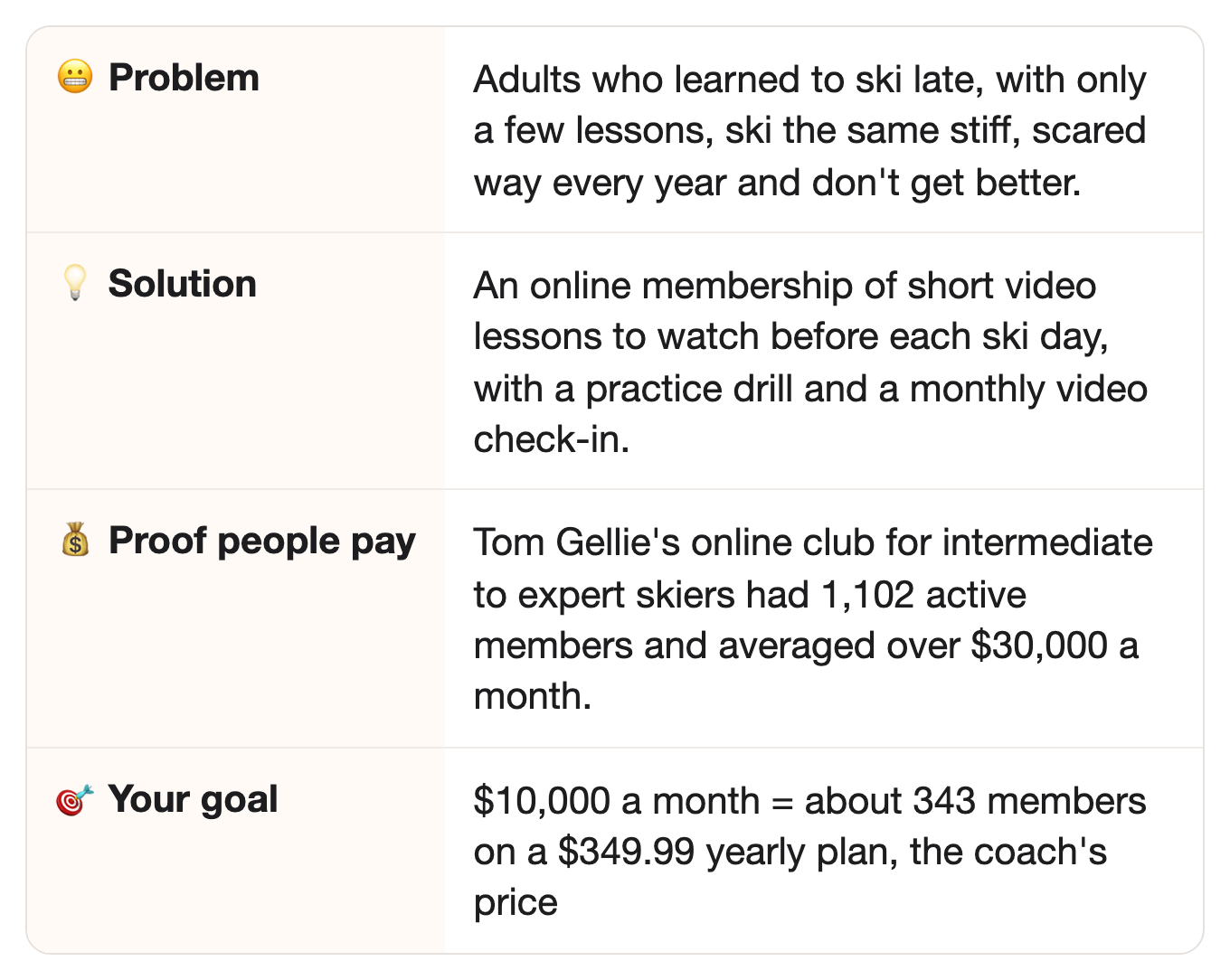
Today’s idea is called The Late-Start Ski Club.
Grab a snack. 🍪
First, a ski coach’s story. Then, the business you could build from it.
⠀
⚡ Quick facts
⠀
📖 How one ski coach built a $30K-a-month club
He spent years following the snow from one side of the world to the other.
Tom Gellie is a ski coach.
For years, he traveled between the Southern Hemisphere and North America, teaching students on snow.
Wait, how does that work?
When it’s summer in the US, it’s ski season in places like New Zealand, so a coach can teach all year.
Then the pandemic hit.
With distancing rules in place, he couldn’t teach in person anymore.
Not great, for a coach who teaches on snow.
Hold on, though: he already had a following on YouTube and Instagram.
⠀So he tried something small.
He sold a few ski videos for a one-time price.
“By the time I’d made about three or four videos, I thought, if people keep buying these videos, I’m going to try the subscription thing,” he said.
A small group was ready to pay monthly, so he tested the idea with them first.
Smart move: test small before you go big.
Then he opened Big Picture Skiing, an online ski school, on Uscreen, a site for selling video memberships.
⠀Here’s how it works: members watch a lesson before they ski, and take one clear plan onto the snow.
When Uscreen wrote up his story, the club had 1,102 active members.
It brought in more than $30,000 a month on average.
And revenue grew by 5.5% a month, on average.
Loopity loop. 🎢
He went from losing his in-person lessons, to a $30,000-a-month club, by teaching skiers through video between their ski days.
⠀
🔗 Same idea, new group
In the story: intermediate to expert skiers paid Tom for video lessons to watch before they ski.
⠀In this idea: adults who took up skiing late and got stuck need lessons made for their level, with one drill at a time.
⠀Why it carries over: both ski only a few weeks a season, so a lesson at home gives each ski day one thing to practice.
⠀
💡 The opportunity
Lots of adults ski. Many of them get stuck, and they get only a few weeks of skiing a year to fix it.
First, who are the buyers?
Adults who took up skiing late, maybe to keep up with a partner or their kids.
They’ve had their first lessons, and they can get down the mountain.
But they’ve stopped getting better, and they don’t know why.
So what’s going on?
Often it’s a nervous habit, like leaning back or skidding every turn, that set in early.
A few weeks of skiing a year isn’t enough to unlearn it alone, so every trip ends the way the last one did.
⠀
Lots of people ski.
US ski areas counted 61.5 million skier visits in the 2024-25 winter.
Wait, what’s a skier visit?
It’s one person skiing for one day, or part of one.
The count comes from the National Ski Areas Association, the US ski-resort trade group.
⠀
Their ski days are few and precious.
Tom’s own site says many members ski only a few weeks a season.
So they want to arrive on the mountain with one clear thing to work on.
⠀
Here’s the fun bit: the planning can happen off the snow.
Tom’s members watch a lesson before skiing, and “have a plan ready to action on snow.”
So each ski day goes to practicing one thing, not working out what to practice.
And the night before a ski day, a short video at home is easy to fit in.
⠀
And some have been stuck for years.
One member writes on Tom’s site that his skiing “was completely stuck for many years,” even after lessons with instructors in the Alps.
Lessons in the Alps, and still stuck.
⠀
👉 The idea: an online membership that coaches adults who took up skiing late.
Members get short lessons to watch before each ski day, a drill plan, and a monthly video check-in.
One safety line comes first: it’s for adults who’ve already had in-person lessons.
A first-time skier needs a real instructor on the snow, not a video.
⠀
🙋 Never coached skiing? You can still build this.
Team up with a ski instructor.
An instructor who teaches at a resort all winter may not have time to build an online membership.
They ski and coach on camera. You plan the lessons, build the site, and find members.
⠀
Be the late starter on camera.
Learn each drill next to the instructor, and keep your wobbles in the video.
Yep, the wobbles stay in.
Members see someone just like them getting it right, one ski day at a time.
⠀
Or use your own skill.
If you’re a strong skier who once had to learn as an adult, you know where late starters get stuck.
Still have an instructor check every lesson before members see it.
⠀
✅ Why this could work
Here’s why people will pay for this.
Others already earn from teaching a sport online.
Nev Lapwood started Snowboard Addiction in 2007, selling videos that teach people to snowboard.
By 2016, he said the business was making just under $1 million in revenue a year.
And it’s not just snow sports.
Performance Golf sells online golf lessons, with a $19 and a $69 monthly plan.
It made $29 million in 2021, its founder told Inc.
⠀
Skiers keep coming back, winter after winter.
The ski areas’ trade group has counted skier visits every season since 1978-79.
And 2024-25 was the second-highest season on record.
⠀
A winter sport can still pay all year.
Uscreen calls Tom’s club a “seasonal niche platform” that “generates year-round income.”
How, when there’s no snow in summer?
His yearly plan is his most popular one, and a yearly plan is paid once and covers the summer, too.
⠀
👉 Curious where these numbers come from? Every source is linked in the last section, “📎 The sources.”
⠀
📊 More proof people want this
Want more? Here you go.
Skiers already pay for online coaching.
Big Picture Skiing had 1,102 active members, Uscreen’s case study says.
It charges $49.99 a month, $199 every six months, or $349.99 a year.
New members get a 7-day free trial.
⠀
Golfers pay for the same kind of help.
Performance Golf says more than 300,000 people have bought its products.
About 250 golfers a day upload a video of their swing, to get a plan back from a golf pro.
And who are those golfers?
Its founder says many are over 50.
⠀
Learners find coaches on YouTube.
Tom’s channel had 75.5K subscribers and 390 videos when we checked.
In Snowboard Addiction’s first five years, YouTube brought in about half of all visits to its website.
⠀
What a stuck skier says.
“My skiing was completely stuck for many years in spite of seeking professional advice from quite a few skiing instructors in the Alps.”
That’s a member’s review on Big Picture Skiing’s site, from Sascha V.
⠀
👉 Millions of ski days happen every winter, and stuck skiers already pay for coaching they can watch at home.
⠀
🔍 Who’s already doing it
Who already coaches skiers, and what they leave out.
Tom’s Big Picture Skiing, from the story above, covers the whole mountain.
It’s built for intermediate to expert skiers, with hundreds of videos on every topic.
Tom’s site says you “don’t need to follow a set order.”
That’s a deep library, and a lot to pick from for a late starter who doesn’t know what to fix first.
⠀
Snowboard Addiction teaches snowboarding, not skiing.
⠀Free ski videos on YouTube are endless.
But they come in no set order, from many coaches, at many levels.
⠀
Ski schools teach in person, on the mountain.
Our guess: between trips, most late starters have nobody to tell them what to work on next.
⠀
Still missing when we checked:
A step-by-step path made only for adults who took up skiing late, from “stuck on blue runs” (the medium-hard trails) to confident.
A one-week plan for people who ski one trip a year, so each day has one focus.
A monthly check-in where members send one clip and get one tip back.
⠀
🔎 Check the market yourself in 2 minutes: run Part 0 of the prompt, under “📋 The prompt” below.
Your AI searches YouTube, course sites, ski coaching memberships, and app stores that day, and tells you: early, growing, or crowded.
Early? Start now.
Crowded? Good news: it means people pay. Pick one narrower kind of late starter (Step 1 of the build plan).
A crowded market is still OK. You win by serving one group better, not by being first.
⠀
👉 You can be the one to fill that gap.
A step-by-step ski club made only for adults who started late, with one clear focus for every ski day.
⠀
🤖 Why AI won’t replace it
Could ChatGPT just coach a stuck skier? Sort of… AI can plan a ski lesson. It can’t ski the drill so a stuck skier can watch it.
🔮 Honest note: a personal AI agent can already find free ski videos and line them up into a plan.
So finding videos isn’t the product.
The product is lessons from a real coach on real snow, in the right order, made for one kind of stuck skier.
⠀
1. A real skier to watch.Skiing is movement, and it’s easier to copy a move you can watch.
Your videos show each drill on real snow, slowly, then at normal speed.
⠀
2. You pick what matters.ChatGPT can write a ski plan in a minute, if someone tells it exactly what the skier does wrong.
But can a stuck skier say what they do wrong?
Usually not, so they can’t give AI the input it needs.
You pick one focus for each ski day, in the order that works for late starters.
⠀
3. Checked twice.Real people will try these drills on a mountain.
Every lesson is checked against safety rules, then by an instructor, before members see it.
⠀
4. Someone who sees their skiing.Once a month in ski season, members send a short clip of themselves skiing.
A coach watches the clip and spots the mistake the skier can’t put into words.
⠀
5. Proof people pay for a coach’s plan, even when the videos are free: Tom’s channel had 75.5K subscribers watching for free in May 2026.Even so, 1,102 members were paying him when Uscreen wrote up his story.
⠀
👉 Free ski videos are everywhere, but a coach who picks your next fix is hard to find.
⠀
💵 How much you can make
Here’s how the numbers add up.
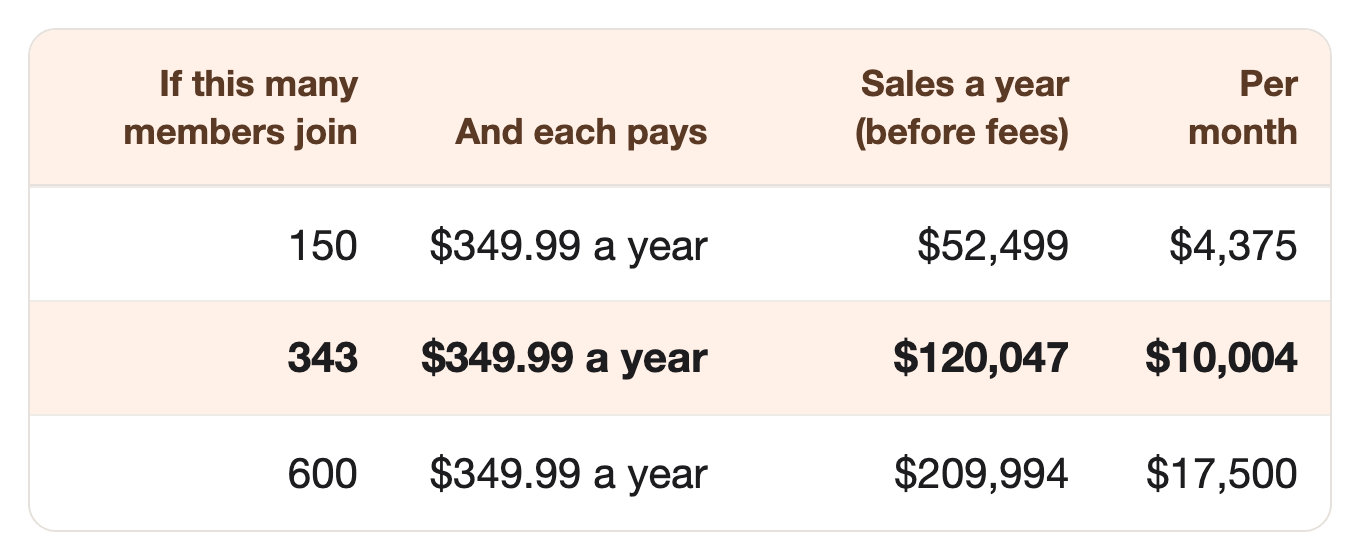
$349.99 a year is Tom’s yearly price, his most popular plan.
⠀343 members is under a third of Tom’s 1,102.
⠀If it doesn’t work out, here’s all you lose:
$0 to post your first free lessons, since a YouTube channel is free to start.
The phone you already own, filming on the snow.
One month’s subscription to an AI app, like ChatGPT or Claude.
One week of your time.
⠀
👉 One idea won’t make a million, but three or four might in 2 to 3 years, and this could be your first.
Want to try this one?
The whole plan, the prompt included, is below. 👇
If it’s not your thing, see you next week with a fresh idea.
That’s it, my fellow contrarians! 🙌
Yours ‘helping you build on what already works’ Vijay Peduru 🦸♂️
⠀
⠀
⠀
🧰 Want to build it? Here’s everything else.
⠀
Step 1: 🎯 Pick one sport and one kind of late starter
One sport, one stuck group, and one clear promise.
This step is the easy one.
Pick one sport.
Skiing, in this issue.
The same shape fits other sports adults often start late, like snowboarding or golf.
Pick one kind of late starter.
Adults who learned after 30 and are stuck on blue runs.
Or parents who learned alongside their kids.
Or people who ski one trip a year, and want every day to count.
Write it in one line, like “skiing for adults who started late and got stuck on blue runs.”
Say who it’s not for. First-time skiers need in-person lessons with a real instructor first.
⠀
Step 2: 🗺️ Map the path
Six stages, from “stuck” to “confident,” with one focus per ski day.
Let your AI draft the path, using Part 1 of the prompt.
Each stage fixes one common habit late starters have, like leaning back or skidding every turn.
Both habits make the skis harder to control, which is why a skier feels stuck and scared on the same runs.
Give each lesson one focus.
One drill, one feeling to look for, and one easy run to practice it on.
Ski the whole path yourself, or with your instructor partner, and fix any step between stages that’s too big.
⠀
Step 3: 🎬 Film on snow
Copy Tom: real snow, real skiers, and a plan they can take up the lift.
The drill, slowly. Shown from behind and from the side, on an easy, groomed run.
A groomed run is a trail a machine smooths flat overnight, the easiest snow to practice a new move on.
The drill at normal speed. The same run, the same angle.
A real late starter trying it. Their first try, then a better one.
A cue card. One short card per lesson, with the key points to read on the chairlift.
Tom attaches a cue card to every video, too.
Off-season? Film at-home lessons: the stance, and what to watch for on the next trip.
⠀
Step 4: 🔍 Check every lesson
Real people will try these drills on a mountain, so the AI checks every lesson twice after writing it, and then an instructor skis it.
Your AI does all three passes for you: it writes in Part 2, and checks in Parts 3 and 4 of the prompt.
🖊️ The AI writer. It writes the focus, the drill steps, the cue card, and the practice plan.
🔍 The AI checker. A second pass checks every lesson against the safety rules, one by one.
🧐 The AI critic. A third pass reads it like a nervous late starter, and like a strict ski instructor.
Then ski it, or have your instructor ski it. If a drill doesn’t work on real snow, fix the lesson.
⠀👉 The prompt already follows six safety rules:
Every lesson says it doesn’t replace in-person lessons, and first-time skiers need a real instructor.
Every drill is done on an easy, groomed run, well inside the skier’s comfort.
No promises about results.
Every lesson says: “Check with your doctor first if you have a health condition or an injury.”
No injury stories, and no scary examples, in any lesson.
Never copy another coach’s lessons or videos.
⠀
Step 5: 🏪 Open the membership
Copy Tom: a monthly price, a yearly price, and a free trial.
Easy one.
Set your prices.
$49.99 a month, $199 every six months, or $349.99 a year, like Tom.
A 7-day free trial, like his.
Pick where to sell. Uscreen, Tom’s platform, or any membership site that takes payments and streams video.
Let AI write your sales page with Part 6 of the prompt, using your first real lesson.
⠀
Step 6: 📣 Get your first members
Get found where stuck skiers search, then where they shop, then on the mountain.
Make one longer YouTube lesson for each thing stuck skiers search for, like “how to stop leaning back skiing, for adults.”
Each lesson is one drill from your path, and links to the club.
Tom built his following on YouTube and Instagram before he opened the club.
Part 7 of the prompt writes these titles from real search words.
Ask one local ski shop or boot fitter to keep your free “first focus” card on the counter.
A boot fitter shapes ski boots to each skier’s feet, so serious skiers visit one in person.
The card gives one free tip to work on next ski day, plus your club’s name.
Send its sale dates to your members in return.
A skier buying new boots is already thinking about skiing better.
Give your five most active members a plan to host a members’ ski day at their local mountain.
A meeting spot, one lesson from the club, and your club’s name on the day.
It’s a day of skiing together, not coaching: everyone skis at their own pace.
⠀
Step 7: 🏃 Eliminate competitors
Copycats will come. Here’s how you stay first.
Give your members a name they’d put in their bio, like “the Late Starters.”
It tells every adult who learned late that this club is theirs.
Sign your instructor partner to a year-long deal.
Name them on every lesson, and feature them in your member emails, so their own following grows with the club.
⠀
Step 8: 🎲 Make it bigger
Add a trip plan, a second sport, then live coaching.
Add a one-week trip pack for people who ski one trip a year: one focus per day, seven days.
Open a second sport adults start late, like snowboarding or golf, with the same short lessons.
Add small-group video feedback later, like the coaching group Tom runs on Zoom.
⠀
🗓️ Your first week
Phew. That was a lot. 😅
A first version of Steps 1 to 6 fits into seven days. 🚀
By day 7, you have a six-stage path, your first lesson on video, a sales page, and your first member kit.
Quick heads-up: the prompt below has a market check (Part 0) and seven Parts, and they’re not the same as the Steps above.
Day 1 (Steps 1 and 2): Run Part 0 of the prompt (it’s below), and pick your kind of late starter.
Then map the path with Part 1.
Days 2–3 (Step 4): Write the first lesson with Part 2, then check it with Parts 3 and 4.
Day 4 (Step 3): Get your filming plan with Part 5, and film the first lesson, on snow or at home.
Day 5 (Step 5): Write your sales page with Part 6, and open the membership.
Days 6–7 (Step 6): Write your YouTube titles, counter card, and members’ ski-day plan with Part 7.
⠀
🏄 How to use the prompt
One prompt does all the AI work, in seven parts, plus a quick market check (Part 0).
Part 1 — Map the path. Plans six stages for your kind of late starter, each fixing one common habit.
Part 2 — Write the lesson. Writes one lesson: the focus, the drill steps, the cue card, and the practice plan.
Part 3 — Check the lesson. Checks it against the safety rules, one by one.
Part 4 — Find the mistakes. Reads it like a nervous late starter, and like a strict ski instructor.
Part 5 — Plan the filming. Writes the shot list and a short script for the lesson’s three videos, plus an at-home version for the off-season.
Part 6 — Write the sales page. Uses your real lesson as the example.
Part 7 — Write the first-member kit. Writes the YouTube titles, the counter card, the members’ ski-day plan, and the welcome emails.
Run it your way:
Part by part (the default): it pauses after each part, and you type “next” to go on.
All at once: say “run all seven parts.”
Just one part: say “only do Part 3,” or any part you need.
The full prompt is just below, under “📋 The prompt.”
🎙️ Talk to your AI sidekick, don’t type.
Turn on voice mode, or use a dictation app like Wispr Flow.
Say it messy. The AI sorts it out.
Turn it into a skill, so you never paste it again.
Paste the prompt into Claude or ChatGPT, and say: “Turn this into a skill I can save.”
Install once, use forever.
⠀
📋 The prompt
The prompt (copy it into Claude or ChatGPT, fill in the INPUTS part, and run it your way)
CONTEXT:
- You're my ski-coaching partner. Together we'll build an online membership that coaches adults who took up skiing late and got stuck.
- This prompt has a market check (Part 0), then seven parts (Part 1 to Part 7), in order.
- If I say "run all seven parts," do Part 1 to Part 7. Run Part 0 only when I ask for it.
- Run it the way I ask:
    - If I say nothing, go one part at a time. After each part, show me the result, then stop and wait. Move on only when I type "next."
    - If I say "run all seven parts," do them all without stopping.
    - If I say "only do Part 3" (or any part), do just that part.
- If a part needs something from me, ask for it before you start that part.
- Real people will try these drills on a mountain. Follow these rules in every part:
    1. Every lesson says: "This doesn't replace in-person lessons. If you've never skied, take lessons with a real instructor first."
    2. Every drill is done on an easy, groomed run, well inside the skier's comfort. Never send anyone onto harder terrain.
    3. Never promise results.
    4. End every lesson with this line: "Check with your doctor first if you have a health condition or an injury."
    5. No injury stories and no scary examples.
    6. Never copy another coach's lessons or videos. Build drills from basic ski technique.
- Never invent a fact or a number. If you're not sure a fact is right, leave it out.
- Keep web search on for the whole prompt (turn on search in ChatGPT or Claude), so you can open any page you need to check.

=============== INPUTS — edit these, or just run as is ===============

The sport:
{e.g. downhill skiing}

The kind of late starter:
{e.g. adults who learned to ski after 30 and are stuck on blue runs}

Who coaches on camera:
{e.g. my partner, a ski instructor with ten winters of teaching}

My prices:
{e.g. $49.99 a month, $199 every six months, $349.99 a year, with a 7-day free trial}

My local mountain and ski shop (for Part 7):
{e.g. a small ski area two hours from my city, and one boot fitter in town}

======================== END OF INPUTS ========================

THE PARTS:

Part 0 — Check the market today.
This part needs web search (turn on search in ChatGPT or Claude). Search for online coaching in my sport for adults and, for each place, give the count, the three biggest with links, and their prices:
1. YouTube channels teaching this sport to adults, with subscriber counts.
2. Courses on Udemy and similar course sites, with student counts and prices.
3. Online coaching memberships for this sport.
4. Coaching apps for this sport in the App Store and Google Play.
Then tell me: early (few sellers), growing, or crowded, and which kind of late starter looks least served (for example: adults over 50, parents learning with their kids, people who ski one trip a year). Give a link for every number. If you can't open a page, say so. Never guess a number.

Part 1 — Map the path.
Plan six stages for my kind of late starter, from "stuck" to "confident." For each stage, give the one habit it fixes, two or three drills, the kind of easy run to practice on, and how the skier knows they're ready for the next stage. Say clearly which choices are your guess.

Part 2 — Write the lesson.
Ask me which stage from Part 1 to write. Then write one lesson for one ski day:
1. The one focus, in one sentence.
2. A short warm-up before the first run.
3. The drill, step by step, and what it should feel like.
4. The three most common mistakes, and the fix for each.
5. A cue card: the key points in five short lines, to read on the chairlift.
6. A plan for the day: how many runs on the drill, and when to stop.
7. The lines from rules 1 and 4 in CONTEXT, at the end.

Part 3 — Check the lesson.
Now act as a separate checker who didn't write this lesson. Check it against each rule in CONTEXT, one by one. Mark each problem, quote the words, and give the fixed version.

Part 4 — Find the mistakes.
Now act as a nervous adult who took up skiing late, then as a strict ski instructor. As the late starter, flag every word or step that would confuse or scare you. As the instructor, flag anything that's wrong, or unsafe for this level. Then give the final lesson, with every fix made.

Part 5 — Plan the filming.
For the lesson in Part 4, write a shot list and a short script for three videos:
1. The drill, slowly, from behind and from the side.
2. The drill at normal speed, on the same run.
3. A late starter's first try, then a better one, with what changed.
For each video, give the camera spot, the length (under 10 minutes), and what to say at the start and the end. Add an at-home version for the off-season: the stance, and what to watch for on the next trip.

Part 6 — Write the sales page.
Ask me for one finished lesson first. Use it as the example. Never invent a result, a review, or a number. Give me:
1. A headline that names my sport and my kind of late starter.
2. What members get: the six-stage path, a lesson for each ski day, cue cards, and the monthly clip check-in.
3. Who it's for, and who it's not for: first-time skiers need in-person lessons first.
4. The prices, shown up front, the free trial, and "Cancel any time."
5. One free lesson, in exchange for an email address.

Part 7 — Write the first-member kit.
1. Ten YouTube lesson titles, each matching words stuck skiers really search for. Use web search to check the words, and give a link for each. Each title teaches one drill from my path.
2. A small counter card for my local ski shop or boot fitter: one free "first focus" tip and the club's name.
3. A one-page plan for a member who wants to host a members' ski day at my local mountain: the meeting spot, one lesson from the club, and a clear note that everyone skis at their own pace, with no coaching.
4. Three welcome emails for new members, each pointing to the first lesson. Never promise results.
⠀
📎 The sources
Every number above, with where it came from.
Tom’s club · Number: “How Big Picture Skiing Drives $30k+ Monthly All-Year-Round”; “1,102 active members, drives $30K+ average monthly revenue, and averages 5.5% monthly revenue growth”; traveled “between the Southern Hemisphere and North America”; “As the pandemic hit… he could no longer conduct in-person sessions”; “Using his following on YouTube and Instagram”; “I’d made a couple of videos that I sold for a one off price”; “By the time I’d made about three or four videos, I thought, if people keep buying these videos”; “So I beta tested it”; “his seasonal niche platform generates year-round income” · Source: Uscreen case study, published July 1, 2025, archived August 12, 2025
Tom’s prices and members · Number: $49.99 monthly; $199.00 bi-annually; $349.99 annually, “Our most popular option”; “The annual plan has become the most popular”; “you don’t need to follow a set order”; “a 7-day free trial”; “an online learning platform for intermediate to expert skiers”; “many members only ski a few weeks per season”; “Watch a lesson before skiing and have a plan ready to action on snow”; “hundreds of videos on every topic imaginable”; “helpful cue cards”; the BPS Academy, with “weekly video feedback and focused Zoom sessions” · Source: Big Picture Skiing home page, archived July 13, 2026
A member’s review · Number: “My skiing was completely stuck for many years in spite of seeking professional advice from quite a few skiing instructors in the Alps” (Sascha V) · Source: Big Picture Skiing home page, archived July 13, 2026
Tom’s YouTube channel · Number: 75.5K subscribers; 390 videos · Source: YouTube, archived May 15, 2026
US skier visits · Number: 61.5 million in 2024-25, the second-highest on record; NSAA “has tracked skier visits since the 1978-79 season” · Source: The Gazette, May 12, 2025
Snowboard Addiction · Number: “started in 2007”; “producing videos that would teach people how to snowboard”; “just under $1 million in revenue”; YouTube “provided about 50% of all the traffic” in the first five-plus years · Source: Shopify Masters interview, December 22, 2016
Performance Golf · Number: “$12 million in revenue in 2020”; “$29 million in 2021”; “$19 per month” and “$69 per month” plans; “more than 300,000 people buy our products”; “Two hundred fifty people upload their swings every day”; “Many of them are over 50” · Source: Inc., Regionals 2022, archived October 14, 2022
The money math · Number: 343 × $349.99 = $120,047 a year, about $10,004 a month · Source: Tom’s yearly price, above