

Hello contrarians,
Today’s idea is called The GLP-1 Protein Log.
Pour yourself a tea. 🍵
First, a teenager’s story. Then, the business you could build from it.
⠀
⚡ Quick facts
⠀
📖 How one teenager turned a food photo into $30 million a year
He just wanted to bulk up, and counting calories got in the way of his life.
Zach Yadegari taught himself to code at age 7.
Yep, seven years old.
Quick story: as a very skinny teenager, he wanted to bulk up.
He learned that most of his progress would come from food, so he counted his calories.
And the most popular calorie app? He called it “an awful experience.”
Counting calories got in the way of his normal life.
He ate pre-weighed meals instead of eating with friends.
He skipped restaurants, because he couldn’t tell the calories.
Not exactly a fun way to be a teenager.
⠀
Then AI tools like ChatGPT and Claude took off… and he decided to build his own app.
In May 2024, he and three co-founders launched Cal AI.
The idea is simple: you snap a photo of your food, and the app estimates the calories.
⠀
So how did they spread the word? TikTok.
“We started making TikToks, we started partnering with influencers, and then we had pretty explosive growth,” he told Fortune.
His price: $29.99 a year.
And by September 2025, Fortune reported that “Cal AI brings in $30 million annually.”
Fortune says it reviewed the app’s financial records.
And Zach? He was 18 when the story ran.
Yahtzee! 🎲
From skipping restaurants with friends… to $30 million a year, by letting a photo do the calorie counting.
⠀
🔗 Same idea, new group
In the story: people counting calories paid $29.99 a year for Cal AI, which estimates the calories from a food photo.
⠀In this idea: people on GLP-1 medicines need the same photo trick for protein, since they can only eat a few bites.
⠀Why it carries over: both groups want to know what’s in a meal, and a photo is far easier than weighing and logging food.
⠀
💡 The opportunity
Lots of people now eat much less because of one kind of medicine, and they still need protein.
First, what’s a GLP-1?
It’s a family of medicines, like Ozempic, Wegovy, and Zepbound.
Doctors prescribe them for weight loss, diabetes, and other conditions.
And many people on them feel full after a few bites.
⠀
There are a lot of them.
About 1 in 8 US adults said they were taking one, in a November 2025 poll by KFF.
Yep, one in eight adults.
Use was highest among people aged 50 to 64: 22%.
⠀
Here’s what’s different: their worry is the opposite of most dieters’ worry.
Most calorie apps help you eat less.
But these people already eat less.
So what’s their worry?
Getting enough protein from a few small meals.
⠀
Health experts agree protein matters here.
Four medical and nutrition groups wrote a joint advisory in May 2025.
It listed eight nutrition priorities for people on these medicines.
One was “adequate protein intake and strength training to preserve lean mass.”
Lean mass?
It means everything in the body except fat, like muscle and bone.
⠀
👉 The idea: build a small snap-a-photo app that helps people on GLP-1 medicines log protein, plus a free weekly newsletter for the same group.
⠀
🧩 What you actually need
Spoiler: less than you might think.
No coding.
AI coding tools like Claude Code or Cursor build the app from screens you describe in plain words.
⠀
No health background.
Users enter the protein goal they set with their doctor or dietitian, so the app never picks one.
That decision stays with their doctor, not you.
⠀
Clear safety lines, everywhere users look.
The app is a food log only: never medical advice, and never doses.
Step 4 of the build plan lists every rule, and the prompt has the exact lines.
⠀
🗣️ What it looks like
Here’s a made-up example of one meal.
Let’s walk through it.
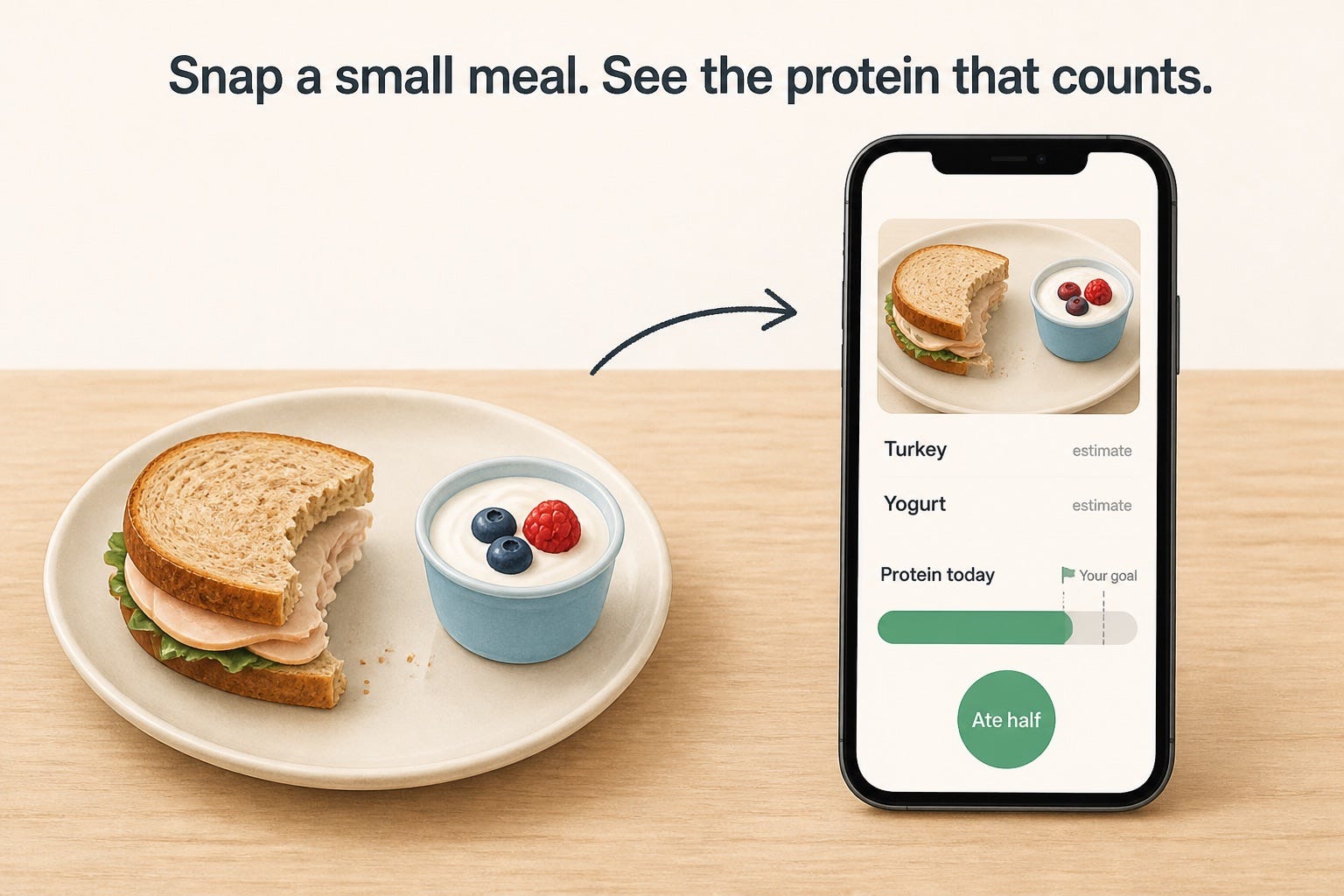
A user snaps a photo of lunch: half a turkey sandwich and a cup of Greek yogurt.
⠀The app answers in two seconds.
It lists the turkey and the yogurt, each with a protein estimate.
It says: “These are estimates. Tap to fix anything I got wrong.”
A bar shows the day’s protein, against the goal they set with their doctor.
⠀
Too full to finish? They tap “ate half,” and the log updates.
And that’s the whole meal logged.
⠀
👉 No typing, no weighing, no long list of nutrients: one photo, and one number, the day’s protein.
⠀
✅ Why this could work
Why this one can work, in three points.
Food apps already make real money, and not just the big one.
Cal AI, from the story: $30 million a year by September 2025.
Then there’s Nutria, a small AI calorie app, built without investor money.
It had $46,238 a month in subscriptions, from 14,969 subscribers, when we checked.
On the App Store, the Nutria app is called Calyra.
And Shotsy is a GLP-1 tracker app its founder built for her own shots.
In February 2025, Shotsy said it was on pace for $1 million a year, and already profitable, eight months in.
⠀
People have logged food in apps for years, and they still do.
MyFitnessPal, a food-logging app, has been on the App Store since December 2009.
It had more than 2.3 million ratings when we checked. 🔁
And GLP-1 use grew: KFF says the share taking one rose over the 18 months before November 2025.
⠀
People search for this every month.
“glp-1 diet” gets 9,900 Google searches a month in the US. 👀
More proof just below.
⠀
👉 Don’t take my word for it. Every number is linked in “📎 The sources,” at the very end.
⠀
📊 More proof people want this
Want more? Here you go.
Lots of people already use apps like this (App Store, when we checked).
Shotsy, the GLP-1 tracker, has 33,864 ratings, with paid plans from $39.99 to $59.99 a year.
MeAgain, another GLP-1 tracker app, has 38,520 ratings.
Cal AI, the calorie app from the story, has 372,125 ratings.
⠀
People watch videos about eating on Ozempic.
“What I Eat in a Day” videos show everything one person eats in a day.
A dietitian’s YouTube review of Ozempic “What I Eat in a Day” videos has more than 408,000 views.
One woman’s own “What I Eat in a Day on OZEMPIC” video has more than 172,000 views.
⠀
People search Google for help.
“what to eat on ozempic” gets 880 searches a month in the US.
“glp-1 tracker” gets 480 more.
⠀
The big picture. 💰
Nearly 1 in 5 US adults had taken a GLP-1 at some point, a November 2025 KFF poll found.
⠀
What they say about eating.
“I can’t eat at all. I have 2 bites and I am full.”
That’s a comment under a popular Ozempic “What I Eat in a Day” video.
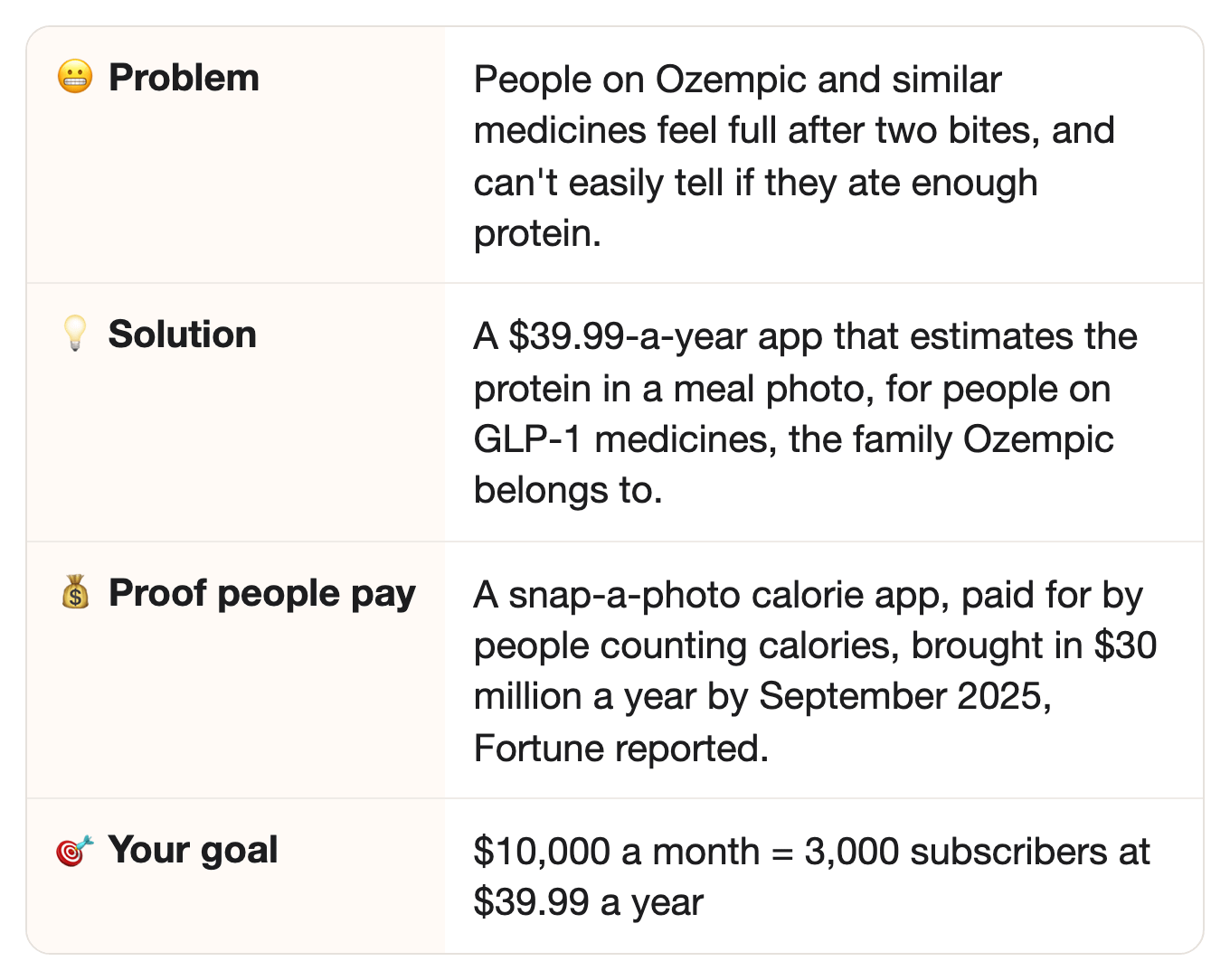
Sound familiar? It’s the problem in the table at the top.
Here it is, in a real person’s words.
⠀
What they say about protein.
“I struggle so much with getting enough protein each day. I never get anywhere near enough 😫”
That’s a comment under the dietitian’s review of Ozempic food videos.
Oof.
⠀
👉 They eat a few bites a day, and they want to know those bites give them enough protein.
⠀
🔍 Who’s already doing it
Big names exist. None is built for one narrow group on these medicines, when we checked.
Cal AI and Nutria count calories for everyone.
Cal AI is the app from the story above, and Nutria is a smaller AI calorie app.
Their whole pitch is helping people eat less.
Building for one small group would mean bending a product built for everyone.
⠀
GLP-1 tracker apps like Shotsy and MeAgain started with the shot.
Both were made to track the shots: dose days, reminders, side effects, and weight.
When we checked, both also logged food by photo and tracked protein.
So a general GLP-1 food log already exists: don’t build another one for everyone.
⠀
What’s missing, when we checked:
A protein log made for one group on these medicines, like people over 50, or vegetarians.
A free weekly newsletter of small, high-protein meals for that same group, leading to the app.
⠀
🔎 Check the market yourself in 2 minutes: run Part 0 of the prompt in the build plan below.
Your AI searches the app stores, newsletters, and YouTube that day, and tells you: early, growing, or crowded.
Early? Start now.
Crowded? Good news: it means people pay. Pick one narrower group (Step 1 of the build plan).
A crowded market is still OK. You win by serving one group better, not by being first.
⠀
👉 That’s the part nobody else offers: a protein log and a weekly meal newsletter, made for one group on these medicines.
⠀
🤖 Why AI won’t replace it
Could a chat app like ChatGPT just do this?
Sort of…
Any AI chat app can guess the protein in a photo. Your app turns it into a habit.
Ready in two seconds.
They snap a photo, and the meal is logged.
No prompt to write, three times a day, even on days the medicine’s stomach side effects kick in.
⠀
Simple: one number that matters.
Sure, ChatGPT can track just protein, if you remind it of your goal at every meal.
Few people keep that up for long.
Your app shows the day’s protein, against the goal they set with their doctor.
⠀
Made for a small appetite.
No “eat less” nudges, which are the wrong advice for them.
Meal ideas that pack protein into a few bites.
⠀
Safe by design.
Every number is labeled an estimate, and the app never talks about doses.
A chat app follows safety rules well once someone writes them in, and yours has them from day one.
⠀
It connects them with people like them. 👥
A weekly newsletter with meals from their own group, and wins they can relate to.
⠀
Proof they pay anyway: Cal AI charged $29.99 a year in September 2025.
Any AI chat app can look at a food photo, and people still pay for Cal AI.
⠀
👉 What they pay for: protein logged from one photo, every meal, with nothing to set up.
⠀
💵 How much you can make
Grab a calculator. Just kidding, here it is.
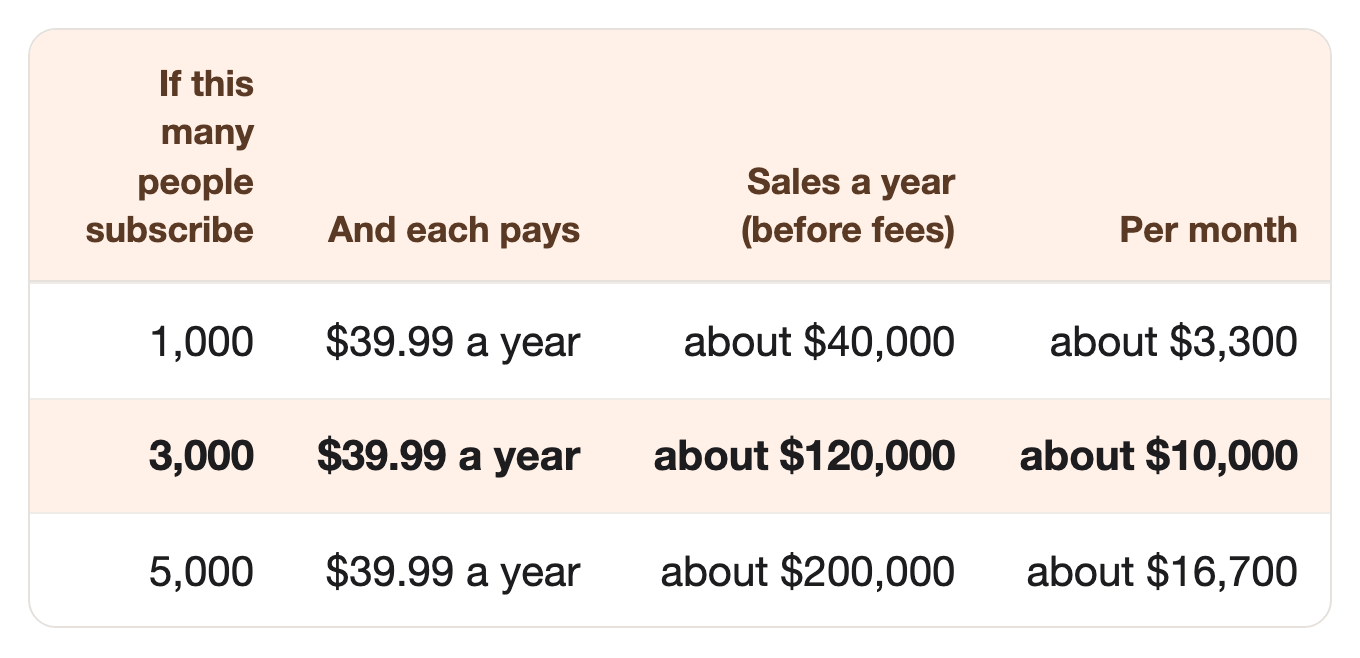
$39.99 a year is Shotsy’s yearly price, when we checked.
⠀3,000 subscribers is about a fifth of Nutria’s 14,969, when we checked.
Remember Nutria?
It’s the small AI calorie app from earlier, built without investor money.
⠀
If it doesn’t work out, here’s all you lose:
$99 for one year of Apple’s developer program, so you can list the app.
One month’s subscription to an AI app, like ChatGPT or Claude.
A newsletter, which is free to start on Substack.
One week of your time.
⠀
👉 Three ideas like this at $10,000 a month each make $360,000 a year, and pass a million in three years.
This app could be your first idea, and a few more like it can add to your yearly income from there.
Is your brain already buzzing? 🐝
Then scroll on. The build plan is below. 👇
Not feeling it? All good. Another idea comes next week.
That’s it, my fellow contrarians! 🙌
Yours ‘turning other people’s wins into your next idea’ Vijay Peduru 🦸♂️
⠀
⠀
⠀
🧰 Want to build it? Here’s everything else.
In every step, AI does most of the work, while you pick the group and keep it safe. 🎙️
⠀
Step 1: 🎯 Pick your group
One group, not everyone on these medicines.
Pick a group you know, or can reach.
People aged 50 to 64, who use these medicines the most.
Vegetarians and vegans.
People who don’t like protein shakes, and want real food.
Read what they say. Comments under GLP-1 food videos show their worries in their own words.
Remember the “2 bites and I am full” comment?
That’s the kind of line you’re looking for.
Pick a name that’s yours. Never use Ozempic, Wegovy, or Zepbound as your app’s name or logo.
⠀
Step 2: 📰 Start the free newsletter
The newsletter finds your users before the app is ready.
One issue a week: three small, high-protein meals for your group.
Let AI draft each issue, with protein numbers from USDA FoodData Central, the government’s free food database.
End every issue the same way: “Snap your next meal in the app. The first week is free.”
Add one line at the bottom: “For general information only. Not medical advice. Follow your doctor.”
⠀
Step 3: 🛠️ Build the app
You don’t need to code. AI coding tools build it, and an AI model reads the photos.
Keep it tiny: three screens.
Snap a photo.
See the protein estimate, and fix anything wrong.
See the day’s log, against the user’s own goal.
That’s the whole app.
Use an AI coding tool, like Claude Code or Cursor, and describe each screen in plain words.
The photo goes to an AI model that names the foods and estimates the protein.
Can’t get it working? Team up with a builder, and you run the newsletter.
⠀
Step 4: 🔍 Keep it safe and check the numbers
It’s a health topic, so the rules are strict.
Please don’t skip this one.
Your AI builds these rules into the app with Parts 2 and 3 of the prompt, and tests the estimates with Part 4.
🛡️ The rules, built into the app:
It’s a food log, not a medical device. Say so on the first screen.
Never give medical advice, and never talk about doses.
The protein goal comes from the user, set with their doctor or dietitian. The app never picks one.
Every AI number says “estimate,” and can be edited.
Never sell anyone’s data.
🔍 Check the estimates. Test 30 meal photos with known protein (from food labels), and fix the instructions where it’s far off.
Optional: pay a registered dietitian once to review the app’s words and your newsletter before launch.
⠀
👉 The prompt already follows these rules: food log only, no doses, estimates labeled, doctor first.
⠀
Step 5: 🏪 Open for subscribers
Copy a price people already pay.
Easy one.
Free to download, with one free week of the full app.
$39.99 a year, like Shotsy’s yearly plan when we checked.
Or $9.99 a month, like Shotsy’s monthly plan.
Let AI write your App Store listing, in the words your group uses.
Put the safety lines in the listing too: food log only, not medical advice.
⠀
Step 6: 📣 Get your first users
Let the app do the spreading, at the moments users feel good.
Show a share card when someone hits their protein goal five days in a row.
The card shows the streak and your app’s name, with a share button right there.
It never shows weight, body numbers, or any health result.
List a small version in the ChatGPT app store, named “protein tracker for small appetites.”
People who ask ChatGPT for help with protein can find it there.
It logs one meal, then points to the full app for the daily log.
Four days into the free week, offer two more free weeks for an honest App Store review.
Ask for an honest review, never a good one.
Honest reviews from people like them help the next user decide.
⠀
Step 7: 🏃 Eliminate competitors
When others copy you, here’s how you stay the one people pick.
Build a ritual: “snap before the first bite.”
Tie the log to something users already do, three times a day: sitting down to eat.
Once the photo comes before the fork, a new app has to break a habit to win them.
Have a “switching from [big tracker]” page ready now.
The day a big tracker starts charging for protein tracking, your page is already live.
It shows how to start in one minute, and what stays free.
⠀
Step 8: 🎲 Make it bigger
Every group has its own foods and its own worries.
Sell a small cookbook of your best newsletter meals.
Open the same app for a second group, like vegetarians after people over 50.
Each one builds on the work you’ve already done. 🎯
⠀
🗓️ Your first week
Phew. That was a lot. 😅
A first version of Steps 1 to 6 fits into seven days. 🚀
By day 7, you have a group, a test app, a newsletter issue, and your share card.
Quick heads-up: the prompt below has seven Parts, and they’re not the same as the Steps above.
Day 1 (Step 1): Run Part 0 and Part 1 of the prompt (it’s below). Pick your group.
Day 2 (Step 3): Plan the app’s three screens with Part 2.
Days 3–4 (Steps 3 and 4): Write the photo instructions with Part 3, then test 30 meals with Part 4.
Day 5 (Step 2): Write your first newsletter issue with Part 5.
Day 6 (Step 5): Write your App Store listing with Part 6.
Day 7 (Step 6): Write your share card, your ChatGPT listing, and your review offer with Part 7.
⠀
🏄 How to use the prompt
One prompt does all the AI work, in seven parts, plus a quick market check (Part 0).
Part 1 — Pick the group. Compares three groups and picks the one easiest to reach.
Part 2 — Plan the app. Writes the three screens and the safety rules, ready for an AI coding tool.
Part 3 — Write the photo instructions. Tells the AI model how to estimate protein, and what it must never say.
Part 4 — Test 30 meals. Compares the app’s estimates with real food labels, and fixes the weak spots.
Part 5 — Write a newsletter issue. Three small, high-protein meals for your group, with sources.
Part 6 — Write the store listing. Your App Store page, with the safety lines.
Part 7 — Write the growth pieces. Your share card, your ChatGPT app listing, and your honest-review offer.
Run it your way:
Part by part (the default): it pauses after each part, and you type “next” to go on.
All at once: say “run all seven parts.”
Just one part: say “only do Part 3,” or any part you need.
The full prompt is just below, under “📋 The prompt.”
🎙️ Talk to your AI sidekick, don’t type.
Turn on voice mode, or use a dictation app like Wispr Flow.
Say it messy. The AI sorts it out.
Turn it into a skill, so you never paste it again.
Paste the prompt into Claude or ChatGPT, and say: “Turn this into a skill I can save.”
Install once, use forever.
⠀
📋 The prompt
The prompt (copy it into Claude or ChatGPT, fill in the INPUTS part, and run it your way)
CONTEXT:
- You're my partner in building a small snap-a-photo protein log for one group of people on GLP-1 medicines (like Ozempic, Wegovy, or Zepbound), plus a free weekly newsletter for the same group.
- This prompt has seven parts, in order.
- Run it the way I ask:
    - If I say nothing, go one part at a time. After each part, show me the result, then stop and wait. Move on only when I type "next."
    - If I say "run all seven parts," do them all without stopping.
    - If I say "only do Part 3" (or any part), do just that part.
- If a part needs something from me, ask for it before you start that part.
- HEALTH RULES. Follow these in every part, and build them into everything you write:
    1. Never give medical advice. Never mention, suggest, or comment on doses, shots, or changing a medicine.
    2. The app is a food log, not a medical device. Say so plainly wherever users will see it.
    3. Never set a protein goal. The user enters their own goal, set with their doctor or dietitian.
    4. Every number the AI makes up from a photo is an estimate. Label it "estimate" every time, and let the user edit it.
    5. Tell users to follow their doctor, and to ask their doctor about side effects, symptoms, or what to eat.
    6. Never use Ozempic, Wegovy, Zepbound, or any drug maker's name or logo as the app's name or logo.
- For food facts, use only official sources, like USDA FoodData Central or the food's own nutrition label. Never invent a number. If you can't find a source, leave it out.
- If you can't open a link I give you, ask me to attach the file instead.
- Keep web search on for the whole prompt (turn on search in ChatGPT or Claude), so you can open any page you need to check.

=============== INPUTS — edit these, or just run as is ===============

The group I want to serve:
{e.g. people over 50 on a GLP-1 medicine who want to keep their strength}

Three groups to compare, if I'm not sure yet:
{e.g. people over 50; vegetarians; people who don't like protein shakes}

My app's name:
{e.g. Small Plate Protein}

My prices:
{e.g. free to download, one free week, then $39.99 a year or $9.99 a month}

My newsletter:
{e.g. a free weekly email on Substack, three small high-protein meals each week}

======================== END OF INPUTS ========================

THE PARTS:

Part 0 — Check the market today.
This part needs web search (turn on search in ChatGPT or Claude). Search for apps and content for people on GLP-1 medicines and, for each place, give the count, the three biggest with links, and their prices:
1. GLP-1 tracker apps on the App Store and Google Play, with their rating counts.
2. AI photo calorie and protein apps, with their rating counts.
3. Newsletters and blogs about eating on GLP-1 medicines.
4. YouTube channels and TikTok accounts about it.
Then tell me: early (few sellers), growing, or crowded, and which group of people on these medicines looks least served (for example: people over 50, vegetarians, people who don't like protein shakes). Give a link for every number. If you can't open a page, say so. Never guess a number.

Part 1 — Pick the group.
Compare the three groups in my INPUTS. For each one, give:
1. Where they gather online (with links).
2. What they say about eating on these medicines, in their own words (with links).
3. What the general apps get wrong for them.
Then pick one, and say why. Say clearly which reasons are your guess.

Part 2 — Plan the app.
Write a plan I can paste into an AI coding tool, like Claude Code or Cursor. Keep it to three screens:
1. Snap: take or upload a photo of a meal.
2. Check: show each food the AI found, its protein estimate, and an "ate half" button. Every number says "estimate" and can be edited.
3. Today: protein so far against the goal the user typed in.
Add a first-run screen that says, word for word: "This app is a food log, not a medical device. It doesn't give medical advice. Follow your doctor." Add where the user enters their own protein goal, with the line: "Use the goal you set with your doctor or dietitian." Add a free week, then my prices. Say what data the app stores, and that it's never sold.

Part 3 — Write the photo instructions.
Write the instructions the app sends to the AI model with each photo. They must say:
1. Name each food and guess the portion. Estimate the protein in grams, using USDA FoodData Central values.
2. Label every number "estimate," and give a short "how sure I am" note: high, medium, or low.
3. If the photo is unclear, ask one short question instead of guessing.
4. Never comment on the user's weight, body, medicine, doses, or side effects. If the user asks about any of these, reply: "That's a question for your doctor."
5. Never tell the user to eat less, skip a meal, or change their goal.
Give the answer back in a fixed format the app can read.

Part 4 — Test 30 meals.
Help me test the instructions from Part 3.
1. Give me a list of 30 small meals typical for my group, each with the protein from its nutrition label or USDA FoodData Central, and a link.
2. Wait while I photograph each meal, run it through my app, and paste the estimates back.
3. Compare each estimate with the real number. Mark it close, off, or way off.
4. List the meals it gets wrong most, and suggest changes to the Part 3 instructions.
5. Check every answer for anything that sounds like medical advice, and flag it.

Part 5 — Write a newsletter issue.
Write one issue of my free weekly newsletter, under 400 words:
1. A short, friendly opening line for my group.
2. Three small meals, each with: the ingredients, the protein (with its USDA FoodData Central or label link), and why it's easy to eat on a small appetite.
3. The closing line, word for word: "Snap your next meal in the app. The first week is free."
4. This line at the very bottom: "For general information only. Not medical advice. Follow your doctor."
Never promise weight loss, muscle, or any health result.

Part 6 — Write the store listing.
Write my App Store and Google Play listing: a title, a subtitle, a short description, and keywords, using the words my group actually searches for. Include, word for word: "This app is a food log, not a medical device. It doesn't give medical advice. Follow your doctor." Never use any drug name or drug maker's name in the app's name or icon. Never promise a health result.

Part 7 — Write the growth pieces.
Write three short pieces:
1. A share card for when a user hits their own protein goal five days in a row: one line of text, the streak, and my app's name. Never show weight, body numbers, doses, or any health result.
2. A listing for a small version of my app in the ChatGPT app store, named "protein tracker for small appetites." It logs one meal and points to the full app. Add, word for word: "This app is a food log, not a medical device. It doesn't give medical advice. Follow your doctor."
3. A message for day 4 of the free week, offering two more free weeks for an honest App Store review. Ask for an honest review, never a good one.
No doses, no medicine advice, no promised results.

When all seven parts are done, ask if I want to repeat Part 5 for next week's issue.
⠀
📎 The sources
Every number above, with where it came from.
Cal AI’s revenue · Number: “Cal AI brings in $30 million annually”; Fortune “reviewed financial records” · Source: Fortune, September 27, 2025
Zach’s story · Number: Coding at 7; “an awful experience”; launched May 2024 with three co-founders; “We started making TikToks…”; $29.99 a year · Source: Same article
GLP-1 use in the US · Number: “About one in eight adults (12%) say that they are currently taking a GLP-1 drug”; 18% ever; 22% of ages 50–64; up from 18 months earlier; poll fielded October 27 – November 2, 2025 · Source: KFF Health Tracking Poll, November 14, 2025
Protein matters on GLP-1s · Number: “(6) adequate protein intake and strength training to preserve lean mass,” one of eight priorities, from ACLM, ASN, OMA, and The Obesity Society · Source: The Obesity Society press release, May 30, 2025
Nutria · Number: $46,238 monthly recurring revenue; 14,969 active subscriptions; founded July 2025; bootstrapped; verified through RevenueCat; its App Store link is “Calyra - AI Calorie Tracker” · Source: TrustMRR
Shotsy’s origin · Number: Began as an app that “serial founder Aja Beckett created for helping her better track her weight loss shots” · Source: Silicon Florist, February 20, 2025
GLP-1 side effects · Number: “these medications can present challenges, including gastrointestinal side effects” · Source: The Obesity Society press release, May 30, 2025
Shotsy’s early revenue (company’s own claim, February 2025) · Number: “revenue run rate of $1 million”; “eight-month-old company is profitable” · Source: Silicon Florist, February 20, 2025
Shotsy on the App Store · Number: 33,864 ratings; $9.99–$14.99 a month; $39.99–$59.99 a year; “Photo Scan: Snap a photo for instant nutrition estimates”; tracks protein · Source: App Store
MeAgain on the App Store · Number: 38,520 ratings; “Log food with photo, barcode and search”; “Track protein, fiber and water” · Source: App Store
Cal AI on the App Store · Number: 372,125 ratings · Source: App Store
MyFitnessPal · Number: On the App Store since December 8, 2009; 2,382,215 ratings · Source: App Store
Google searches · Number: “glp-1 diet” 9,900 a month; “what to eat on ozempic” 880; “glp-1 tracker” 480 · Source: Ubersuggest, US
Dietitian review video · Number: 408,625 views · Source: YouTube: Abbey Sharp
“What I Eat in a Day on OZEMPIC” · Number: 172,576 views · Source: YouTube: Hella Bella
Comment: two bites · Number: “I can’t eat at all. I have 2 bites and I am full.” · Source: YouTube comment, 2024
Comment: protein · Number: “I struggle so much with getting enough protein each day. I never get anywhere near enough 😫” · Source: YouTube comment, 2023
Apple developer fee · Number: $99 a year · Source: Apple Developer Program