

Hello contrarians,
Today’s idea is called The Midlife Strength Letter.
Get comfy. 🛋️
First, a trainer’s story. Then, the business you could build from it.
⠀
⚡ Quick facts
⠀
📖 How one trainer’s PDF became an app a fitness giant bought
It started in her parents’ backyard.
Kayla Itsines was a personal trainer in Adelaide, Australia.
She trained women in her parents’ backyard.
Yep, an actual backyard.
⠀
In 2013, she started posting her clients’ progress photos on Instagram.
⠀Then in 2014, she packed her 12-week program into a PDF, the Bikini Body Training Guide, and sold it online.
Yes, a plain old PDF.
⠀
In November 2015, she and her co-founder, Tobi Pearce, launched an app called Sweat.
By 2018, it cost $19.99 a month.
⠀
Then came the 2020 lockdowns, and they helped Sweat grow.
The company said it had about 450,000 subscribers. 📈
⠀
Brace yourself: in July 2021, she sold Sweat to iFIT, a US fitness equipment giant.
The price was never made public.
But Forbes Australia says the deal was reportedly worth about $150 million, $40 million of it in cash.
Cha-ching! 💰
From her parents’ backyard… to a deal reportedly worth about $150 million, by turning her workouts into a PDF, then an app.
⠀
🔗 Same idea, new group
In the story: younger women paid Kayla Itsines for her workout PDF, and then for her Sweat app.
⠀In this idea: women over 40 get strength plans made for their age, with an easier version of every move.
⠀Why it carries over: both groups want a clear plan to get stronger at home, from a trainer who knows what their bodies need.
⠀
💡 The opportunity
Sweat was built for younger women. Women over 40 need plans made for their age.
Sweat started out aimed at younger women.
When Sweat was sold, Startup Daily, a startup news site, described its original formula as “targeting younger women.”
Its first program was even called the Bikini Body Training Guide.
⠀
Our take: many workout videos aren’t made for her.
Lots of them are fast and jumpy, with a much younger trainer.
Fun for some people.
Less fun if you’re worried about your knees.
⠀
Women over 40 often want something else.
A plan that starts easy.
An easier version of every move.
And a trainer who looks like them.
⠀
Here’s the good news: a new group arrives every year.
About 1.3 million US women go through menopause every year.
So every year, a fresh group of women reaches this stage.
⠀
And most women this age don’t strength-train twice a week, by the government’s own count.
The US guideline for adults is muscle-strengthening activity at least twice a week.
In 2020, only 23.8% of women aged 45 to 64 did that, says the CDC, the US public health agency.
That’s fewer than one in four.
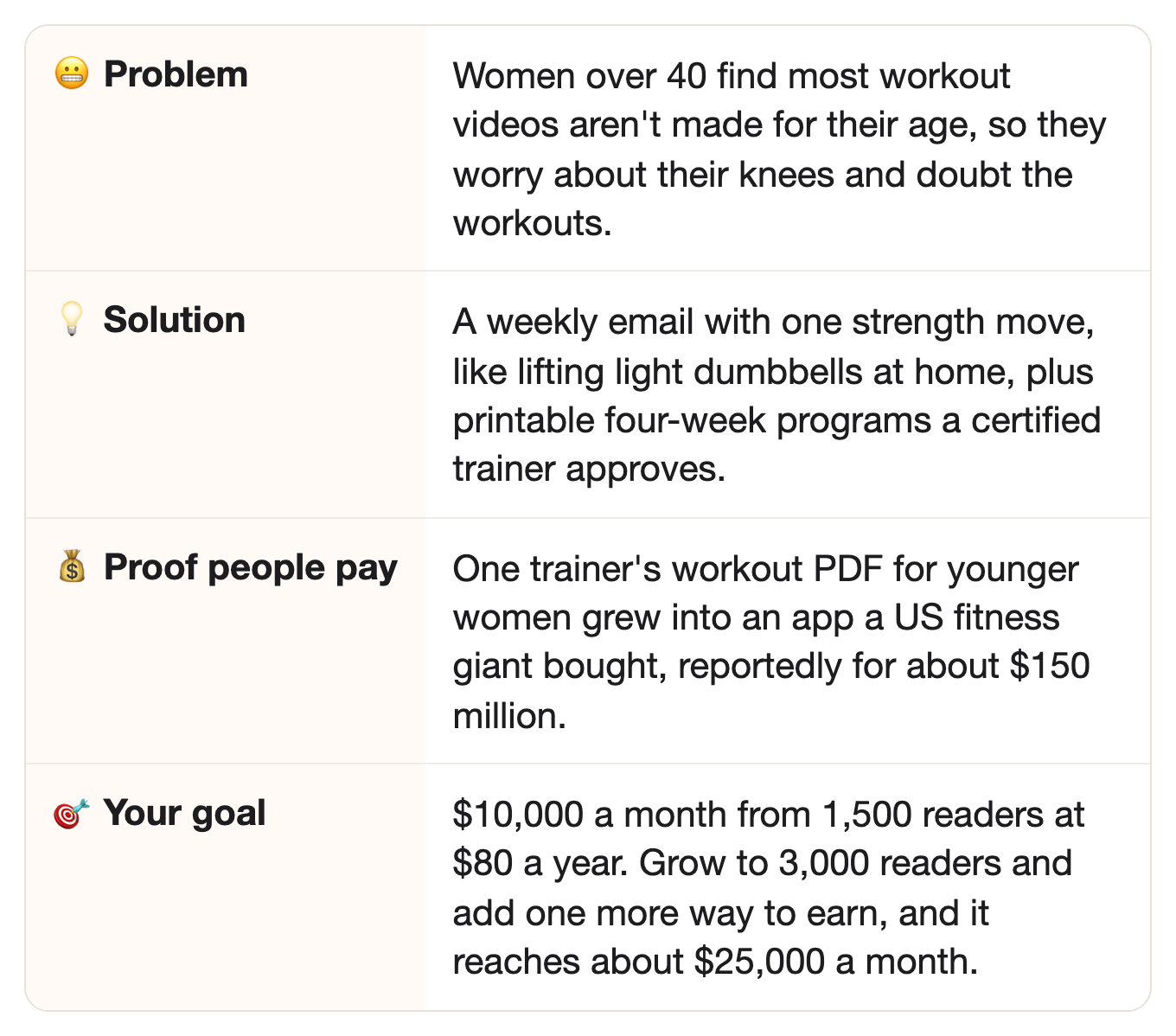
👉 The idea: a weekly newsletter plus simple four-week strength programs, for women over 40.
Each week: one move, shown by a woman her age, with an easier and a harder version.
Paid readers get the full printable program and short demo videos.
Want a narrower group? Pick women over 40 who’ve never lifted, or who train at home with two dumbbells.
The steps are the same.
⠀
🙋 Not a certified trainer? Here’s the plain truth: this one needs one.
This is health, so a certified trainer signs off on every plan.
Good news: that trainer doesn’t have to be you.
Team up with a certified personal trainer who works with women over 40.
They write and approve every plan.
You build the newsletter, the videos, and the list.
⠀
Or get certified yourself before you sell a single program.
⠀Or become the interviewer.
Interview certified trainers and physical therapists, with their permission.
Every interview is also an issue.
Handy, right?
Any plan you sell still gets a certified trainer’s approval first.
⠀
✅ Why this could work
Three reasons this can pay.
Someone already made millions with this model, and others already make money in this exact group.
Kayla’s app sold in a deal reportedly worth about $150 million.
And people in this group already pay.
Patricia Siegel, a sports scientist, started The Menopause Training Blueprint on Substack in February 2026.
When we checked, it showed “hundreds of paid subscribers,” at $8 a month or $80 a year.
Howard Luks, a doctor, writes Notes on Midlife Fitness on Substack.
When we checked, it showed “thousands of paid subscribers,” at $88 a year.
Menovation, an app built for women over 40, charges $28.99 a month.
It had 250 ratings on the App Store when we checked.
⠀
Every year, a new crowd of women starts knowing nothing.
Strong Women Stay Young, a strength book for women, first came out in 1997.
Yep, 1997.
Its series has sold more than one million copies.
And every year, a new group of women reaches midlife.
⠀
You can see the demand in plain numbers.
The book ratings, video views, and comments are in the next section.
⠀
👉 Curious where these numbers come from? Every source is linked in the last section, “📎 The sources.”
⠀
📊 More proof people want this
Want more? Here you go.
People already pay for strength help made for their age.
Next Level, Stacy Sims’ book on training through menopause, has 3,063 Amazon ratings.
Strength Training For Women Over 40: Dumbbell Edition has 133 ratings, at $15.99.
The Sweat app has 43,308 ratings on the App Store.
⠀
One workout video for women over 50 passed 4.1 million views.
It’s called “Weight Training,” and it has 6,009 comments.
It’s by The Fit Mother Project, a YouTube channel for women over 40.
That’s one video.
⠀
Knees come up again and again.
We read the 800 top comments under that video ourselves.
41 of them mention a knee.
So the worry about knees isn’t a guess: real women write about it.
⠀
The big picture: about 1.3 million US women go through menopause every year. 🔁
⠀What women say under that video.
Another comment: “as a 50+ woman, I would have preferred to see a 50+ woman performing these demo exercises.”
⠀And one more: “Where can I find that second weight lifting program?”
From a viewer four weeks into the first one.
In other words: she wants the next plan.
⠀
👉 They don’t want every workout online. They want a plan made for them.
⠀
🔍 Who’s already doing it
Strong sellers, and the group none of them serve.
Sweat, the workout app from the story above, started with younger women.
Its brand grew up around them, and its first program was called the Bikini Body Training Guide.
When we checked, it had added perimenopause (the years leading up to menopause) and menopause programs, inside a big all-ages app.
⠀
Big free YouTube channels teach this age group.
Fabulous50s, run by Shelly, a certified personal trainer, has about 2.3 million subscribers.
Cheryl Coulombe’s channel, “Strength training in midlife,” has about 619,000.
They post one workout at a time, for everyone at once.
Great for a free workout, but it’s not a plan built for one kind of woman.
⠀
The biggest paid midlife newsletter we found is written by a doctor.
That’s Howard Luks’ Notes on Midlife Fitness.
It covers midlife health and exercise science, not a weekly lifting plan.
⠀
Apps for this group are arriving.
We searched the App Store for “menopause strength”.
At least five strength apps launched in 2026 showed up, each with 12 ratings or fewer.
So they’re all brand new.
⠀
Still missing when we checked:
A weekly newsletter with one printable four-week program at a time.
Plans for one kind of woman, like a beginner at home with two dumbbells.
A demo video every week, by a woman her readers’ age.
⠀
🔎 Check the market yourself in 2 minutes: run Part 0 of the prompt in the build plan below.
Your AI searches Substack, YouTube, the App Store, and Amazon that day, and tells you: early, growing, or crowded.
Early? Start now.
Crowded? Good news: it means people pay.
Just pick a narrower group of women (Step 1 of the build plan).
A crowded market is still OK. You win by serving one kind of woman better, not by being first.
⠀
👉 That’s the gap you can fill: a weekly email with a printable strength plan for one kind of woman over 40.
⠀
🤖 Why AI won’t replace it
AI can write a workout. It can’t be the trainer she trusts.
Could ChatGPT just do this?
Partly. Here’s what she’d still pay you for.
Checked by a real trainer.
A certified trainer approves every plan before it goes out.
ChatGPT writes a solid plan, but she can’t tell if it suits her knees, and a trainer’s sign-off settles that.
⠀
You choose which moves she can skip.
A beginner doesn’t know which moves to start with, or what to swap when a move feels wrong.
You give her an easier version of every move, and tell her when to move up.
⠀
Ready to use: one printable page a week.
The moves, the sets, the reps, and the rest time, in order.
ChatGPT can lay out a neat page when asked.
But she’d rather open her inbox and find it done.
⠀
See each move done.
A one-minute demo of each move, by a woman her age. 🎬
Remember the viewer who wanted to see a 50+ woman doing the demo exercises?
This is for her.
⠀
Someone checking in on her.
A weekly email and a monthly live Q&A keep her going.
⠀
Proof people still pay.
Advice on training through menopause is free online.
Stacy Sims’ book on it still has 3,063 Amazon ratings.
⠀
👉 The moves are free. The finished plan she trusts is what she buys.
⠀
💵 How much you can make
Let’s run the numbers.
First stop: $10,000 a month from the newsletter alone
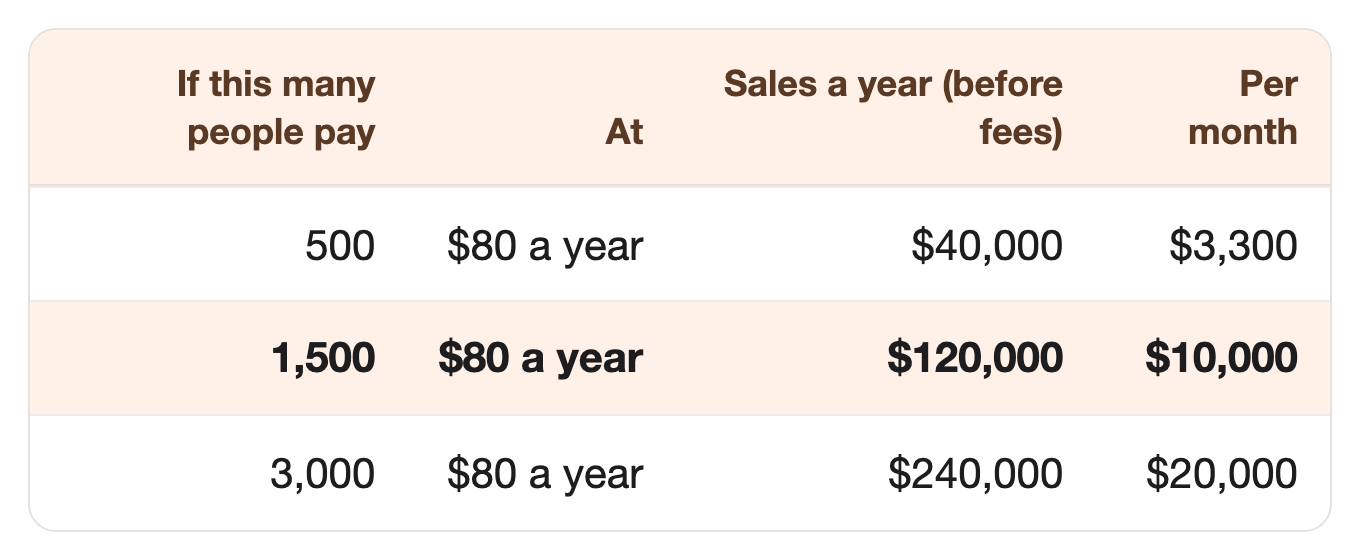
1,500 readers is about 0.1% of the 1.3 million US women who reach menopause every year.
⠀$80 a year is what Patricia charges for The Menopause Training Blueprint.
So the price isn’t a guess.
Next stop: $25,000 a month, with one more way to earn
Some readers will want a coach and a group, not just an email.
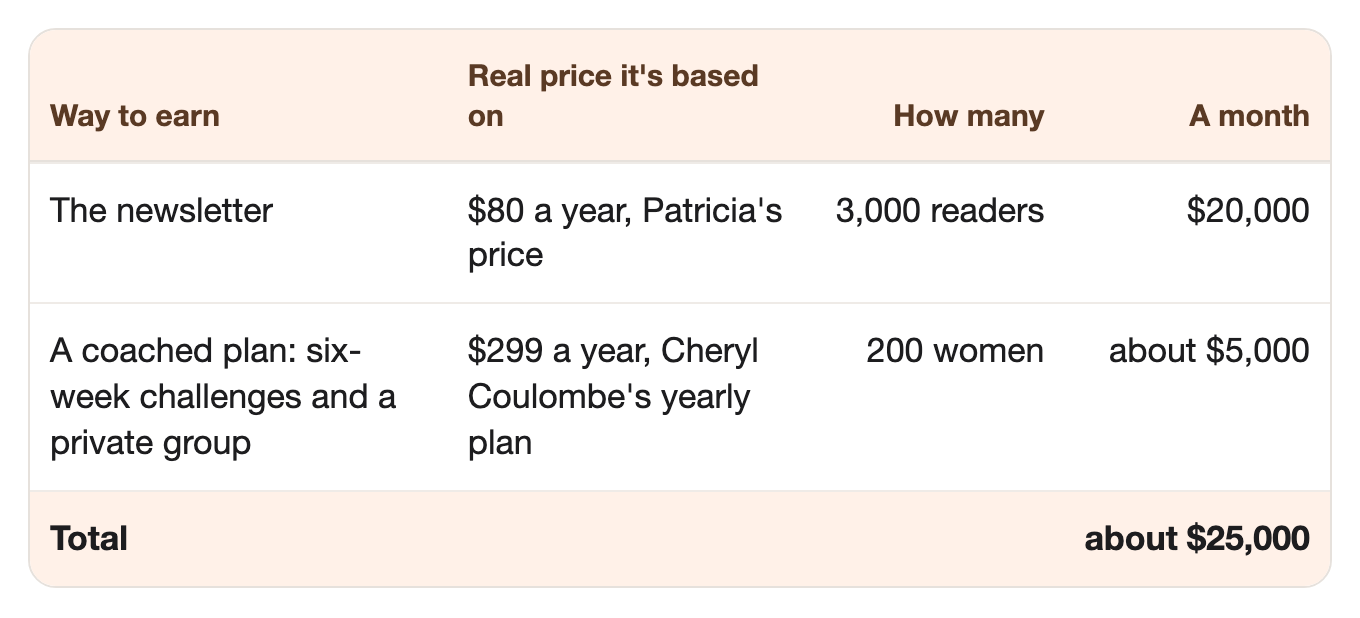
The newsletter still does most of the work.
Grow it from 1,500 to 3,000 readers, and it brings in $20,000 a month.
3,200 women in all is still about a quarter of 1% of the 1.3 million who reach menopause each year.
⠀
Here’s the plain truth: we found only one extra with a real price.
So most of the growth has to come from more readers.
We left out anything we couldn’t price from a real page.
⠀
The coached plan is for women who want to be told what to do each day.
Cheryl’s plan comes with every challenge she runs, a private group, daily coaching posts, and an app.
Yours can start smaller: one six-week challenge, and a private group chat.
Your trainer writes the challenge and answers questions in the group.
⠀
Two hundred women in the group is real work.
So agree on the trainer’s fee up front, and cap the group if it gets too busy.
⠀
Worst case, here’s all you lose:
Nothing for the newsletter itself. Substack is free to start.
One month’s subscription to an AI app, like ChatGPT or Claude.
A pair of dumbbells, and your trainer’s fee if you team up (agree on it up front).
One week of your time.
⠀
👉 So one idea, done well, comes to about $25,000 a month.
Pick two or three ideas from this newsletter, or open this one for a second group. Together, they could add up to a million dollars in two or three years.
For this newsletter, a second group could be women over 60 who walk every day. And this newsletter could be your first idea.
Want to try this one?
The whole plan, the prompt included, is below. 👇
If it’s not your thing, see you next week with a fresh idea.
That’s it, my fellow contrarians! 🙌
Yours ‘digging up proven ideas so you never have to guess’ Vijay Peduru 🦸♂️
⠀
⠀
⠀
🧰 Want to build it? Here’s everything else.
AI does most of the writing in every step, and your trainer has the final say. 🎙️
⠀
Step 1: 🏋️ Pick your group, and your trainer
A narrow group works best. “Fitness” is too big. “Strength for women over 40, at home, with two dumbbells” is a business.
Picky? Yes, and that’s the point.
Pick one kind of woman.
Women over 40 who’ve never lifted.
Or women training at home, or women coming back after years off.
Make sure a certified trainer is behind every plan.
That’s you, if you’re certified.
If not, team up with one who works with women over 40, and agree the deal in writing.
Write down the trainer’s rules.
Which moves to start with, and which to leave out at first.
How to make each move easier.
When to move up to heavier weights.
Everything the AI writes later starts from this list.
⠀
Step 2: 📋 Write the programs
Every program starts from your trainer’s rules, not from the internet.
AI turns the rules into a four-week program.
Two or three short sessions a week, matching the guideline of at least twice a week.
The moves, sets, reps, and rest, in order.
An easier and a harder version of every move.
Start with one program for total beginners.
Put the same lines on every plan:
“Check with your doctor before starting.”
“Stop if anything hurts.”
“For general fitness only. Not medical advice.”
Boring? A little.
But they go on every single plan.
⠀
Step 3: 🔍 Check every plan
This is health, so every plan is checked three times, and a person checks last.
Your AI does the first two passes for you: it writes in Part 2, and checks in Part 3 of the prompt.
🖊️ The AI writer. AI writes each plan from your trainer’s rules only.
🔍 The AI checker. A second pass counts every set and rep.
It makes sure every move has an easier version, and the safety lines are there.
🧐 The trainer. Your certified trainer reads every plan and approves it. This step is never optional.
⠀
👉 The prompt already follows three safety rules: no medical claims, no promised results, and “check with your doctor before starting” on every plan.
⠀
Step 4: 📰 Launch the newsletter
Free every week, with a paid tier for the women who want the full program.
Easy one: copy Patricia’s prices.
Start on Substack. It’s free to start, and it handles payments.
Send one free issue a week: one move, done right, with its easier version.
Set a paid tier at $8 a month, or $80 a year, like Patricia.
The full printable four-week program.
A short demo video for every move.
A monthly live Q&A with the trainer.
Let AI write your welcome email and your paid page.
⠀
Step 5: 📣 Get your first readers
Get found on YouTube, and let each finished program do some sharing for you.
Show a share card when a reader finishes her first four-week program.
Put it in the week-four email: “First four-week program finished,” your newsletter’s name, and a share button.
It never shows weight, body numbers, or any health result.
Make longer YouTube lessons titled like “dumbbell workout for women over 40 beginners.”
One problem per video, in the exact words women search, with the easier version of every move first.
Your trainer checks each one, and every lesson says “Check with your doctor before starting.”
Email readers who drifted off: “You’re still the woman who wanted to carry her own suitcase.”
Add one button that says “That’s still me,” and put any offer at the bottom.
Anyone who clicks gets week one of the plan again, so starting over is easy.
⠀
Step 6: 🏃 Eliminate competitors
Copycats will come. Here’s how you stay first.
Make a pledge: “Real women our age in every photo, no AI bodies.”
Sign it with your name and photo, and put it on your About page and your paid page.
A rival using stock photos or AI images can’t say the same without changing how it works.
Give readers a name they’d put in a bio, like “the Strong at 40 club.”
Use it in every issue’s greeting, and on the week-four share card.
Finishing a program then means joining the club, not just finishing a plan.
⠀
Step 7: 🎲 Make it bigger
Every group of women has the same two things: a plan nobody wrote for them, and new readers every year.
Add the coached plan from “How much you can make,” once you have about 1,000 paid readers.
Start with one six-week challenge and a private group chat.
Price it at $299 a year, like Cheryl’s.
Sell the programs on their own, as printable four-week plans.
Open the same newsletter for another group, like walkers who want to add strength, or women over 60, with your trainer’s approval.
One newsletter at about $25,000 a month is about $300,000 a year, before fees. 🎯
Add two or three more newsletters, or ideas from this newsletter, and a million dollars in total is two or three years away.
⠀
🗓️ Your first week
Phew. That was a lot. 😅
Steps 1 to 5 fit into seven days. 🚀
By day 7, you have a trainer, the first approved week of your program, a newsletter, and your first YouTube lesson.
Quick heads-up: the prompt below has seven Parts, and they’re not the same as the Steps above.
Day 1 (Step 1): Line up your trainer, then run Part 1 of the prompt (it’s below).
Days 2–3 (Step 2): Write the first week of your program with Part 2.
Day 4 (Step 3): Check it with Part 3, then send it to your trainer with Part 4.
Day 5 (Step 4): Set up Substack.
Write your first issue with Part 5, and your welcome email and paid page with Part 7.
Days 6–7 (Step 5): Script your first YouTube lesson with Part 6, film it, and post it.
⠀
🏄 How to use the prompt
One prompt does all the AI work, in seven parts, plus a quick market check (Part 0).
Part 1 — Plan the program. Turns your trainer’s rules into a four-week program outline.
Part 2 — Write one week. Writes one week’s printable plan, with an easier and a harder version of every move.
Part 3 — Check every set and rep. Counts everything again, and checks the safety lines.
Part 4 — Prepare the trainer review. Lists every question your trainer needs to answer before the plan goes out.
Part 5 — Write the weekly issue. Drafts the free weekly issue from the approved plan.
Part 6 — Script the YouTube lesson. Turns one week’s moves into a longer lesson, titled the way women search.
Part 7 — Write the welcome, the paid page, and the share and win-back emails. Writes your welcome email, your paid tier page, the week-four share card email, and the email for readers who drifted off.
Run it your way:
Part by part (the default): it pauses after each part, and you type “next” to go on.
All at once: say “run all seven parts.”
Just one part: say “only do Part 3,” or any part you need.
The full prompt is just below, under “📋 The prompt.”
🎙️ Talk to your AI sidekick, don’t type.
Turn on voice mode, or use a dictation app like Wispr Flow.
Say it messy. The AI sorts it out.
Turn it into a skill, so you never paste it again.
Paste the prompt into Claude or ChatGPT, and say: “Turn this into a skill I can save.”
Install once, use forever.
⠀
📋 The prompt
The prompt (copy it into Claude or ChatGPT, fill in the INPUTS part, and run it your way)
CONTEXT:
- You're my newsletter partner. Together we'll build a weekly newsletter and simple four-week strength programs for one group of women over 40.
- This prompt has seven parts, in order.
- Run it the way I ask:
    - If I say nothing, go one part at a time. After each part, show me the result, then stop and wait. Move on only when I type "next."
    - If I say "run all seven parts," do them all without stopping.
    - If I say "only do Part 3" (or any part), do just that part.
- If a part needs something from me, ask for it before you start that part.
- Use only my trainer's rules. Never invent a move, a number, or a fact. If something is missing, ask me.
- This is health. Never make a medical claim, never promise a result (weight, body shape, symptoms), never write a before-and-after story, and never diagnose pain. Every plan must be approved by a certified trainer before anyone sees it.
- I'll often answer by voice, so expect long, messy answers. Don't ask me to tidy them.
- Keep web search on for the whole prompt (turn on search in ChatGPT or Claude), so you can open any page you need to check.

=============== INPUTS — edit these, or just run as is ===============

My group of women:
{e.g. women over 40 who have never lifted weights, training at home}

My equipment:
{e.g. two pairs of dumbbells, a sturdy chair, a mat}

My certified trainer, and their rules (paste them, or talk them through):
{e.g. Maria, certified personal trainer; start with chair squats, wall push-ups, and dumbbell rows; no jumping in the first program; add weight only after three easy sessions in a row}

My prices:
{e.g. free weekly issue; $8 a month or $80 a year for the full program and demo videos}

======================== END OF INPUTS ========================

THE PARTS:

Part 0 — Check the market today.
This part needs web search (turn on search in ChatGPT or Claude). Search for strength-training help made for my group of women and, for each place, give the count, the three biggest with links, and their prices:
1. Newsletters on Substack and elsewhere, free and paid.
2. Apps on the App Store and Google Play.
3. YouTube channels.
4. Books and printable programs on Amazon and Etsy.
Then tell me: early (few sellers), growing, or crowded, and which narrower group looks least served (for example: total beginners, women training at home, women coming back after years off). Give a link for every number. If you can't open a page, say so. Never guess a number.

Part 1 — Plan the program.
Using only my trainer's rules and my equipment, outline one four-week program: which moves each week, how many sessions a week (at least two), and how it gets a little harder each week. For each move, name an easier version and a harder version. Mark anything my trainer's rules don't cover, as a question for the trainer.

Part 2 — Write one week.
Ask me which week to write. Then write one printable page for a woman in my group:
1. What this week is about, in one sentence.
2. Each session: the moves in order, sets, reps, and rest time.
3. For each move: three short form cues, the easier version, and the harder version.
4. When to move up, using my trainer's rule.
5. These lines at the bottom: "Check with your doctor before starting. Stop if anything hurts. For general fitness only. Not medical advice. Approved by [trainer's name], certified personal trainer."

Part 3 — Check every set and rep.
Now act as a separate checker who didn't write this plan. Count every set, rep, and rest time again, and make sure they match Part 2. Check that every move has an easier version, that nothing breaks my trainer's rules, and that the safety lines are there. Flag any line that sounds like a medical claim or a promised result. Then give a fixed version of the plan.

Part 4 — Prepare the trainer review.
Write a short note to my certified trainer, with the plan attached. List every question they need to answer before it goes out: any move you're unsure about, any rule the plan stretches, and anything a beginner might do wrong. Leave a space for the trainer to write "approved" and their name. Remind me: nothing goes out until the trainer approves it.

Part 5 — Write the weekly issue.
Write this week's free issue from the approved plan:
1. A short opening, in my own words, from this week.
2. One move: what it is, three form cues, and its easier version.
3. One reader question, if I give you one, answered only from my trainer's rules.
4. The line: "The full four-week program is for paid readers."
5. The safety lines from Part 2.

Part 6 — Script the YouTube lesson.
Turn one approved week's moves into a YouTube lesson script, about eight minutes long:
1. A title in the exact words women in my group search, like "dumbbell workout for women over 40 beginners."
2. The first line: the question a woman in my group would ask.
3. For each move: the easier version first, then the move itself, with what I show on camera and one form cue from my trainer.
4. The line: "Check with your doctor before starting."
5. The closing line, word for word: "The full four-week plan is in my newsletter."
Never promise a result. Never mention weight or body numbers.

Part 7 — Write the welcome, the paid page, and the share and win-back emails.
Write:
1. A welcome email for new readers: who it's for, what they'll get each week, the first move to try, and the safety lines.
2. A paid page: what paid readers get (the full printable program, demo videos, and a monthly live Q&A), the prices, shown up front, the trainer's name and certification, and "Cancel any time."
3. The week-four email with a share card: the line "First four-week program finished," my newsletter's name, and a share button. Never show weight, body numbers, or any health result.
4. A short email for readers who drifted off, with this line word for word: "You're still the woman who wanted to carry her own suitcase." Add one button that says "That's still me," which sends week one of the plan again. Put any offer at the bottom.
Never promise a result. Never invent a review, a number, or a before-and-after story.

When all seven parts are done, ask if I want to repeat Parts 2 to 7 for next week.
⠀
📎 The sources
Every number above, with where it came from.
Kayla’s start · Number: Trained women in her “parents’ backyard in Adelaide”; 12-week Bikini Body Training Guide, a PDF, in 2014; 2020 lockdowns “a major boon”; “The company claimed” about 450,000 subscribers · Source: Forbes Australia, February 2024
The sale · Number: Sold to “US-based fitness equipment giant iFIT”; “a deal reportedly worth about US$150 million (US$40 million of which was cash)”. Startup Daily (July 2021): “iFIT did not disclose the financial terms of the deal” · Source: Forbes Australia, February 2024
Instagram posts and the sale to iFIT · Number: Began posting client success pictures in 2013; sold to iFIT, July 2021; original formula “targeting younger women” · Source: Startup Daily, July 2021
Sweat app launch · Number: “The team launched the Sweat app in November 2015”; “$19.99 per month” · Source: TechCrunch, June 2018
Sweat on the App Store · Number: 43,308 ratings; “NEW Peri & Menopause Programs” · Source: App Store
The Menopause Training Blueprint · Number: Patricia Siegel, “a sports scientist”; first post February 17, 2026; “Hundreds of paid subscribers”; $8 a month or $80 a year · Source: Substack and Substack’s public category list
Notes on Midlife Fitness · Number: Howard Luks MD; “Thousands of paid subscribers”; $8 a month or $88 a year · Source: Substack and Substack’s public category list
Notes on Midlife Fitness: topics · Number: “evidence-based writing on longevity, midlife and master’s athlete training, metabolic health, exercise science…”; “A physician” · Source: Substack
Menovation · Number: “Women Fitness 40+”; 250 ratings, 4.9; $28.99 a month · Source: App Store
Strong Women Stay Young · Number: First published 1997 · Source: Open Library
The Strong Women series · Number: “The series has sold more than one million copies” · Source: Wikipedia: Miriam E. Nelson
Menopause each year · Number: “About 1.3 million women per year in the U. S. experience the menopause transition.” · Source: Innovation in Aging, 2025, on PubMed Central
Strength training by age · Number: Women meeting the muscle-strengthening guideline (at least twice a week), 2020: 23.8% aged 45–64; 34.1% aged 18–44 · Source: CDC, MMWR QuickStats, May 2022
Next Level · Number: Stacy Sims, 2022; 3,063 ratings · Source: Amazon
Strength Training For Women Over 40: Dumbbell Edition · Number: 133 ratings; $15.99 · Source: Amazon
The Fit Mother Project video · Number: “Weight Training - Full Body Workout for Women over 50”: 4,190,592 views; 6,009 comments; channel mission: “help women over 40” · Source: YouTube, YouTube Data API
Comments about knees · Number: Our own count: 41 of the 800 top comments (by relevance) mention “knee” or “knees” · Source: YouTube Data API
Fabulous50s · Number: About 2,320,000 subscribers; run by Shelly, “a Certified Personal Trainer” · Source: YouTube, YouTube Data API
Cheryl Coulombe · Number: About 619,000 subscribers; “Strength training in midlife” · Source: YouTube, YouTube Data API
App Store search · Number: “menopause strength”: EvolveHer, Ferrata, StrongDay 40+, Vitalia (0 ratings each) and SecondStrength (12), all launched in 2026 · Source: App Store search
Comment: more routines · Number: “We need more exercise routines for women over 50 so we’re not bored give up and quit.” · Source: YouTube comment, 2020
Comment: a woman her age · Number: “as a 50+ woman, I would have preferred to see a 50+ woman performing these demo exercises.” · Source: YouTube comment, 2023
Comment: the next program · Number: “I’ve been following it for four weeks… Where can I find that second weight lifting program?” · Source: YouTube comment, 2026
Coached plan price · Number: “Lift with Cee Annual,” “$299/year”; includes “Current challenge access,” “Automatic access to every new challenge I launch,” “Private community, daily coaching posts, and weight/rep tracking iPhone and Android app” · Source: Cheryl Coulombe on Solin