


Hello contrarians,
Today’s idea is called The Niche Bedtime Story Show.
Grab a pen. 🖊️
First, a yoga teacher’s story. Then, the business you could build from it.
⠀
⚡ Quick facts
⠀
📖 How a yoga teacher built a bedtime story business
It started with a story where nothing happens.
Kathryn Nicolai is a yoga teacher with her own studio in Michigan.
She opened it at 22.
Yep, 22.
⠀
In April 2018, while still running the studio, she started a podcast called Nothing Much Happens.
⠀Each episode was a gentle bedtime story for grown-ups.
Think a walk home from work in the rain, or a morning with the windows open.
Nothing exciting happens, on purpose, so your mind can let go.
Sounds boring?
That’s the whole idea.
⠀
Cozy fact: listeners loved it.
She reached 10 million downloads within about a year, she says.
And she didn’t spend a dollar on marketing.
Not bad for a podcast about nothing much.
⠀
Later, she added a paid tier, a members-only version of the show.
It costs $40 a year, or $5 a month.
It removes the ads from all three of her shows.
Members also get bonus episodes, and long tracks that run up to 10 hours.
⠀
By July 2026, the show had passed 150 million downloads, her channels say.
⠀By then, the membership had 13,000 to 14,000 subscribers, she says.
The news site IBTimes worked out that the lower count alone brings in about $520,000 a year.
Bingo bango. 🎯
She went from running a small yoga studio to about half a million dollars a year by IBTimes’ math, with stories where nothing much happens.
⠀
🔗 Same idea, new angle
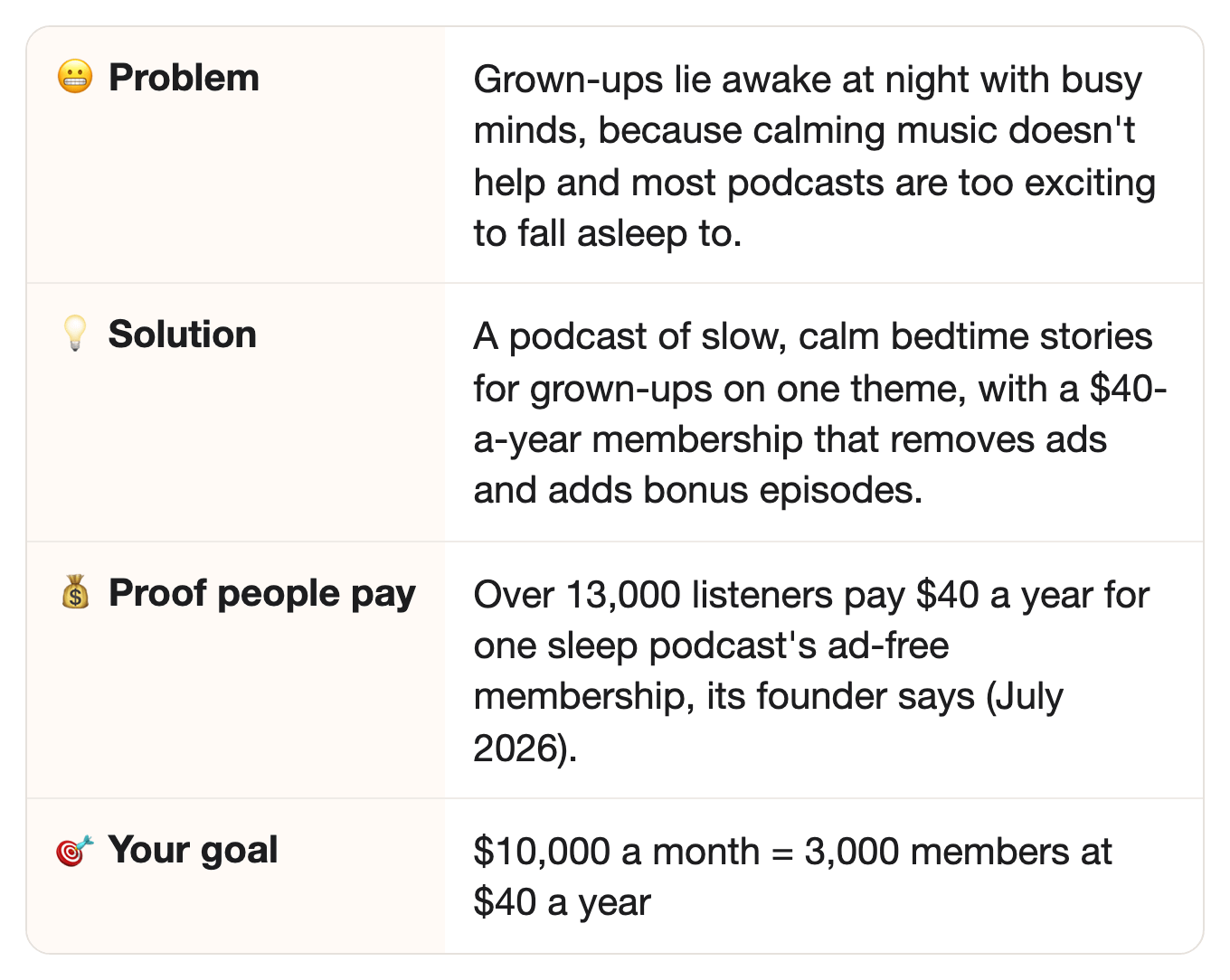
In the story: over 13,000 listeners pay Kathryn $40 a year for ad-free bedtime stories from one cozy world, in English.
⠀In this idea: listeners who love one theme, setting, or language want bedtime stories that sound like their world.
⠀Why it carries over: a slow, calm story does the same job in any niche, and new listeners look for one every night.
⠀
💡 The opportunity
Bedtime stories for grown-ups pay, and every niche can have its own show.
First, what’s a sleep story?
It’s a slow, calm story read aloud at bedtime.
It’s for relaxing, not for treating any sleep problem.
Listeners usually drift off before the end, and that’s the point.
Ha. It’s the one story where falling asleep before the end means it worked.
⠀
Kathryn’s show is one English voice, and one cozy world.
Lovely.
But it’s only one world, in one language.
⠀
Here’s the magic: the same format works in any niche.
One big theme: history, nature, or cozy towns.
One setting inside it: a slow mountain train, a lighthouse, or a quiet garden.
Another language: cozy stories in Spanish, French, or German.
⠀
People in that niche want stories that sound like their world.
A big general show can’t make a second show for every niche.
And that’s where you come in.
⠀
👉 The idea: start a bedtime story podcast for grown-ups in one niche, free with ads, plus a paid ad-free tier.
⠀
🧩 What you actually need
Good news: the list is short.
A love of writing.
AI drafts each story inside your world guide, and you shape it.
Your world guide is one document with your main place, your characters, and your rules, so every story stays the same.
⠀
One calm voice.
Your own, a friend’s, or an AI voice labeled as AI in every episode.
Our guess: Kathryn’s listeners pay partly for her voice, so test whether a human voice sells better.
⠀
One big theme, and one world you can picture.
Like a seaside town, or a quiet garden.
⠀
✅ Why this could work
Three reasons this can pay.
Kathryn isn’t the only one making money from sleep stories.
Calm, the meditation app, reached $150 million in yearly recurring revenue in 2018.
Yearly recurring revenue means subscription sales, counted over a year.
Calm had 2 million paid subscribers by July 2019, and its sleep stories had more than 150 million listens.
Slumber Studios launched its first sleep show, Get Sleepy, in 2019, and added a paid tier in 2021.
Sleep With Me, a podcast started in 2013 by a former librarian, passed 70 million downloads by June 2018, its host said.
⠀
Listeners stay for years.
Between 97% and 98% of Kathryn’s members renew each year, she says.
So almost everyone who joins stays another year.
Bedtime comes every night, so the habit sticks. 🔁
⠀
People already look for these stories, a lot.
How much, exactly?
The numbers come next.
⠀
👉 Want to check these numbers? Each one has a source link in the last section, “📎 The sources.”
⠀
📊 More proof people want this
Want more? Here you go.
People already pay for these stories.
On Apple Podcasts, the paid tier of Nothing Much Happens costs $39.99 a year or $5.99 a month.
The show has 10,224 ratings there.
Kathryn’s book of the stories had 1,784 ratings on Goodreads, a book review site.
Slumber Studios, the maker of Get Sleepy, grew its paid subscribers by 47% from February to April 2022.
⠀
Lots of people watch sleep stories on YouTube.
When we checked, a YouTube search for “sleep stories for adults” found 200 videos, with more than 168 million views.
26 of those videos have over a million views each.
Calm’s sleep story Blue Gold, read by the actor Stephen Fry, has more than 18 million views there.
⠀
People search Google for them.
When we checked, “bedtime stories for adults” got 14,800 searches a month in the US.
“Sleep stories for adults” got 5,400 more.
⠀
The big picture. 💰
80% of Americans aged 12 and older have listened to or watched a podcast.
That’s from Edison Research’s 2026 survey.
⠀
What listeners say about the stories.
“I listen to these stories every night and I don’t remember any of the story.”
That’s a comment under a popular sleep story on YouTube, with more than 1,500 likes.
Ha. For a sleep story, that’s a glowing review.
⠀
What they say about music.
“Sometimes calming music won’t put me to sleep because my mind still keeps thinking so much.”
That’s a comment under the same story.
⠀
👉 At bedtime, people want one calm voice they come back to.
⠀
🔍 Who’s already doing it
A few big shows, and a clear gap next to them.
Kathryn, the podcaster from the story above, serves one world, in English.
Her whole brand is her voice and her cozy world.
A show in another language, or for another group, would need a second Kathryn.
And there’s only one Kathryn.
⠀
Calm and Headspace are big meditation apps, built for everyone.
They sell a whole library, not one small world.
⠀
Get Sleepy and Sleep With Me are big general sleep podcasts.
They aim at every English listener, not one niche.
⠀
People want these stories in their own language, too.
“Historias para dormir” is Spanish for “stories for sleeping.”
When we checked, that search in Apple Podcasts’ Mexico store returned 61 podcasts.
A niche with listeners is a niche you can win with a better show.
⠀
🔎 Check the market yourself in 2 minutes: run Part 0 of the prompt in the build plan below.
Your AI searches Apple Podcasts, Spotify, and YouTube that day, and tells you: early, growing, or crowded.
Early? Start now.
Crowded? Good news: it means people listen. Pick a fresh setting inside your theme (Step 2 of the build plan).
A crowded market is still OK. You win by being the voice one group loves, not by being first.
⠀
👉 That’s the gap you can fill: a bedtime show for one theme, setting, or language, which the big general shows don’t make.
⠀
🤖 Why AI won’t replace it
AI can write a story. You give listeners a calm routine they keep every night.
Could ChatGPT just write a bedtime story?
Sure, it can.
But a story is only part of what listeners come back for.
A voice they trust.
They fall asleep to the same voice every night.
A new AI story every night is a stranger every night.
⠀
One world they come back to.
The same village, the same bakery, the same cat.
Nothing new to follow, so there’s nothing to stay awake for.
⠀
Judgment: you know what keeps a story calm.
No cliffhangers, nothing scary, and no surprise at the end.
ChatGPT keeps a story calm when it’s given these rules, but most people just ask for “a bedtime story.”
⠀
Ready at bedtime.
At 11 p.m., nobody wants to write a prompt.
They just press play.
⠀
Proof people pay even when it’s free: every Nothing Much Happens episode is free with ads.
Free, and people still pay.
13,000+ members were paying $40 a year in July 2026, she says.
⠀
Kathryn writes every story herself.
“We’re not written by AI, produced by AI,” she told IBTimes in July 2026.
So let AI draft, but shape every story yourself.
⠀
👉 They pay for a calm voice and a familiar world every night, not just for a story.
⠀
💵 How much you can make
Let’s run the numbers.
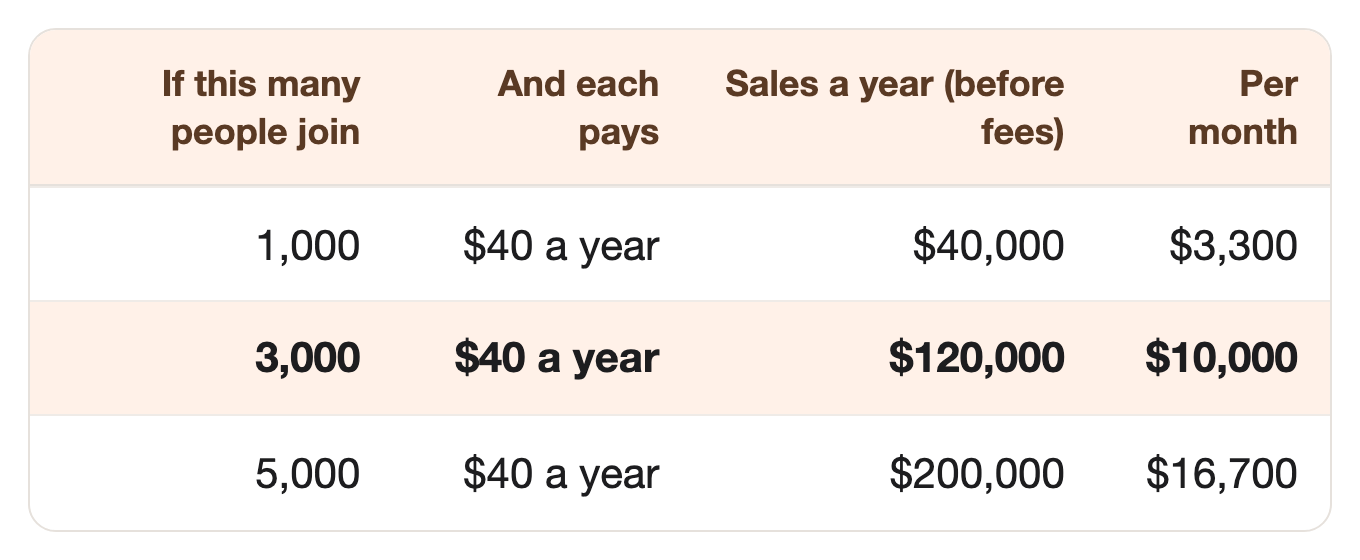
3,000 members is under a quarter of Kathryn’s 13,000.
⠀The $40 is her price, so you’re not guessing what listeners will pay.
⠀If it doesn’t work out, here’s all you lose:
One month’s subscription to an AI app, like ChatGPT or Claude.
A phone to record on, which you already have.
Two weeks of evenings.
⠀
👉 With AI doing most of the work, three or four ideas like this could add up to a million in 2 to 3 years.
A bedtime show could be your first idea, and two or three more like it can build your yearly income from there.
Did this one make you think “wait, I could do that”?
Then keep scrolling. The whole build plan is below. 👇
If not, no worries. See you next week with a new idea.
That’s it, my fellow contrarians! 🙌
Yours ‘helping you spot the gaps the big players ignore’ Vijay Peduru 🦸♂️
⠀
⠀
⠀
🧰 Want to build it? Here’s everything else.
AI does most of the drafting, and you keep every story calm. 🌙
⠀
Step 1: 🎯 Pick your niche
One big theme, like history, nature, or cozy towns. Not a tiny group.
Pick a big theme that lots of people love.
History: an old market town at dusk, or a lighthouse keeper’s evening.
Nature: a quiet garden, or a forest after rain.
Cozy towns: a seaside town or a mountain village.
You need 3,000 paying members, so the theme has to reach far more listeners than that.
Start with what you know. A place or hobby you love makes the stories easier to write.
Check it’s big enough. Part 0 of the prompt searches the podcast apps and YouTube for you.
Pick the one where the stories would feel most like home to the listener.
⠀
Step 2: 🏡 Build your world
Listeners come back to a place, not just a story.
Pick one main place. A village, a train, a garden, a small shop.
Add three or four gentle characters. A baker, a neighbor, a dog who naps in the sun.
Write the rules.
Nothing bad ever happens, not even a burnt loaf of bread.
Every story ends with someone settling down to rest.
Let AI write it all up as one “world guide,” so every story stays the same.
⠀
Step 3: ✍️ Write and check each story
AI drafts. Two more passes keep it calm.
Your AI does the first two passes for you: it writes in Part 4, and calm-checks in Part 5 of the prompt.
🖊️ The AI writer. AI drafts each story inside your world guide, slow and full of small details.
🔍 The AI calm-checker. A second pass removes anything exciting, scary, or gloomy.
🧐 The read-aloud test. You read it aloud once, and cut any line that trips your tongue.
Write a month ahead, like Kathryn does, so a busy week never stops the show.
⠀
👉 The prompt already follows three safety rules: no health or sleep-treatment claims, AI voices labeled as AI, and only your own stories.
⠀
Step 4: 🎙️ Record and publish
Two episodes a week, at the same times every week.
Record in a quiet room, with your phone or a simple mic.
Or use an AI voice, and say so in every episode’s description.
Add soft background sound, like rain or a crackling fire, if it fits your world.
Publish on Apple Podcasts and Spotify through a podcast host (a service that stores your episodes and sends them to the apps).
Put each episode on YouTube too, with one calm still image.
⠀
Step 5: 💳 Open the ad-free tier
Copy Kathryn’s setup: free with ads, or pay to remove them.
Set your prices like hers: $40 a year, or $5 a month.
Give members more:
No ads.
Bonus episodes.
Long tracks of your world’s sounds.
Ads only at the start, never in the middle, so nobody gets woken up.
Say it at the start of every free episode:
“Members hear this without ads. The link is in the notes.”
⠀
Step 6: 📣 Get your first listeners
Go where sleepy listeners already are: other calm shows, AI answers, and sleep groups.
Swap a 30-second mention with another calm podcast on a different theme.
A nature show and a cozy-town show share listeners without competing.
Each of you reads a short line about the other at the start of an episode.
Ask ChatGPT “best bedtime stories for adults about nature,” and publish pages for the shows it misses.
Ask Claude and Gemini the same question, and note which shows they name.
Then write one page for each answer they’re missing, like “calm forest stories to fall asleep to.”
Answer “what do you fall asleep to?” posts in big sleep and insomnia groups on Facebook.
Give a real, kind answer, and put your show’s name in your profile, not in the reply.
Never give medical or sleep-treatment advice.
⠀
Step 7: 🏃 Eliminate competitors
If ten competitors copy you, here’s how yours stays ahead.
Pick one promise, and say it in every episode and listing.
Tie it to your world, like “Every night in [your village], nothing bad ever happens.”
If another show could put its name on the same line, make yours more specific.
Name your listeners, and greet them by that name in each episode.
Pick a name they’d be proud to put in a bio, like “the Night Owls.”
Open every episode the same gentle way: “Good evening, Night Owls.”
⠀
Step 8: 🎲 Make it bigger
One world can grow into a small family of shows.
Open a second show for a second niche, with the same setup.
Sell a book of the stories, like Kathryn did.
Three shows at about 3,000 members each is about $360,000 a year, before fees. 🎯
⠀
🗓️ Your first week
Phew. That was a lot. 😅
Steps 1 to 6 fit into seven days. 🚀
By day 7, you have a show with two episodes, a world guide, and a membership page.
The prompt below has seven Parts plus a Part 0 market check, and they’re not the same as the Steps above.
Day 1 (Step 1): Run Part 0 and Part 1 of the prompt (it’s below). Pick your niche.
Day 2 (Step 2): Build your world with Part 2.
Day 3 (Step 3): Plan 30 episodes with Part 3, then write your first story with Part 4.
Day 4 (Steps 3 and 4): Calm-check it with Part 5, then record it.
Day 5 (Step 4): Write and record a second story, and publish both.
Day 6 (Step 5): Write your show listing and membership page with Part 6.
Day 7 (Step 6): Write your swap mention with Part 7, and send it to one calm podcast.
⠀
🏄 How to use the prompt
One prompt does all the AI work, in seven parts, plus a quick market check (Part 0).
Part 1 — Pick the niche. Compares three niches you suggest, and picks one.
Part 2 — Build the world. Writes your world guide: the place, the characters, and the rules.
Part 3 — Plan the episodes. Lists 30 gentle story ideas inside your world.
Part 4 — Write a story. Drafts one slow, calm story, ready to read aloud.
Part 5 — Calm-check it. Removes anything exciting, scary, or gloomy, and any health claim.
Part 6 — Write the listing. Writes your show description and your membership page.
Part 7 — Find your first listeners. Writes a swap mention for another calm podcast, and kind answers for sleep groups.
Run it your way:
Part by part (the default): it pauses after each part, and you type “next” to go on.
All at once: say “run all seven parts.”
Just one part: say “only do Part 4,” or any part you need.
The full prompt is just below, under “📋 The prompt.”
🎙️ Talk to your AI sidekick, don’t type.
Turn on voice mode, or use a dictation app like Wispr Flow.
Say it messy. The AI sorts it out.
Turn it into a skill, so you never paste it again.
Paste the prompt into Claude or ChatGPT, and say: “Turn this into a skill I can save.”
Install once, use forever.
⠀
📋 The prompt
The prompt (copy it into Claude or ChatGPT, fill in the INPUTS part, and run it your way)
CONTEXT:
- You're my story partner. Together we'll build a bedtime story podcast for grown-ups, in one niche, with a free show and a paid ad-free tier.
- This prompt has seven parts, in order.
- Run it the way I ask:
    - If I say nothing, go one part at a time. After each part, show me the result, then stop and wait. Move on only when I type "next."
    - If I say "run all seven parts," do them all without stopping.
    - If I say "only do Part 4" (or any part), do just that part.
- If a part needs something from me, ask for it before you start that part.
- This show is for relaxing, not treatment. Never claim it treats insomnia, anxiety, or any sleep or health problem.
- Write only original stories. Never copy or retell someone else's book or show.
- If I use an AI voice, every episode description must say it's read by an AI voice.
- Never invent a fact, a number, a show, or a link. If you're not sure, leave it out.
- Keep web search on for the whole prompt (turn on search in ChatGPT or Claude), so you can open any page you need to check.

=============== INPUTS — edit these, or just run as is ===============

Big themes I'm thinking about (up to three):
{e.g. history, like an old market town at dusk; nature, like a quiet garden after rain; cozy towns, like a seaside village}

What I know or love (places, languages, hobbies):
{e.g. I grew up in a small fishing town, and I love gardening}

Who reads the stories:
{e.g. me, in my own voice / a friend with a calm voice / an AI voice, labeled as AI}

My prices:
{e.g. free with ads, or $40 a year / $5 a month with no ads and bonus episodes}

======================== END OF INPUTS ========================

THE PARTS:

Part 0 — Check the market today.
This part needs web search (turn on search in ChatGPT or Claude). For each of my niches, search and give the count, the three biggest with links, and any paid tier with its price:
1. Sleep-story podcasts on Apple Podcasts and Spotify.
2. Sleep-story channels on YouTube.
3. Sleep and story apps that serve this niche.
Then tell me, for each niche: early (few shows), growing, or crowded, and which setting or angle inside it looks least served. Give a link for every number. If you can't open a page, say so. Never guess a number.

Part 1 — Pick the niche.
Compare my niches using Part 0 and what I know. For each: who listens, what their evenings look like, and what would make a story feel like home to them. Pick one and say why. Say clearly which reasons are your guess.

Part 2 — Build the world.
Write a one-page world guide:
1. One main place, with five small sensory details (sounds, smells, textures).
2. Three or four gentle characters, each with one small habit.
3. The rules: nothing bad happens, no cliffhangers, no conflict that isn't solved gently, and every story ends with someone resting.
4. The narrator's voice: slow, warm, plain words.

Part 3 — Plan the episodes.
List 30 story ideas inside my world. Each one is a single small, pleasant task (baking bread, a walk after rain, sorting old letters). Give each a calm title, and mark the ten to write first.

Part 4 — Write a story.
Ask me which idea to write first. Then write it for reading aloud:
1. A short, calm welcome, then a few slow breaths.
2. The story, slow and full of small details, about 2,500 words.
3. Then tell the same story again, more slowly and more briefly, the way a sleep story often repeats.
4. Short sentences, easy to say aloud, nothing sudden.

Part 5 — Calm-check it.
Now act as a separate editor who didn't write this story. Read it as a tired listener at bedtime. Flag:
1. Anything exciting, scary, sad, or surprising.
2. Any line that's hard to say aloud.
3. Anything that breaks the world guide.
4. Any line that could sound like a health or sleep-treatment claim.
Then give the final story, with every fix made.

Part 6 — Write the listing.
Write my show title and description for Apple Podcasts and Spotify, using the words listeners search for, like "bedtime stories for adults," plus my niche. Then write my membership page: what members get, the prices up front, and "Cancel any time." Never promise better sleep or any health result. If an AI voice reads the stories, say so plainly.

Part 7 — Find your first listeners.
Write:
1. A list of five calm podcasts on a different theme from mine, with links, that might swap mentions.
2. A short note to the host of the first one, offering to swap a 30-second mention at the start of an episode.
3. My 30-second mention for their show, under 80 words, in my calm voice.
4. Three kind answers to "what do you fall asleep to?" posts, each under 60 words. Don't name my show in the answer. Never give medical or sleep-treatment advice.

When all seven parts are done, ask if I want to repeat Parts 4 and 5 for the next story.
⠀
📎 The sources
Every number above, with where it came from.
Kathryn’s start and background · Number: Opened her yoga studio at 22; started the podcast in April 2018 while still running the studio in Michigan · Source: IBTimes UK, July 7, 2026
Kathryn on AI · Number: “We’re not written by AI, produced by AI”; she has refused to hand the writing to AI or freelancers · Source: IBTimes UK, July 7, 2026
Yoga teacher · Number: “I am a yoga teacher and own a small studio in Michigan” (her author bio); “eventually becoming a full-time yoga teacher” · Source: Goodreads; The Hustle, November 14, 2025
Early downloads · Number: “10M downloads within roughly a year of launching”; no marketing spend · Source: IBTimes UK, July 7, 2026
Total downloads · Number: “more than 150M downloads, according to her official channels” · Source: Same article
The paid tier · Number: $40 a year or $5 a month; removes ads from all three shows; bonus episodes and tracks up to 10 hours · Source: Same article
Members · Number: “13,000 to 14,000 subscribers,” Nicolai said; about $520,000 a year at the lower count (the paper’s math) · Source: Same article
Renewals · Number: “Between 97% and 98% of members renew each year, she said” · Source: Same article
Ads only at the start · Number: Pre-roll spots only, no mid-roll ads · Source: Same article
Writing a month ahead · Number: Two episodes a week, written a month ahead · Source: Same article
Example stories · Number: “a rambling tale about all the smells and sensations you encounter as you make your way home from work in the rain”; “a morning with the windows open and fresh fall air blowing through” · Source: The Hustle, November 14, 2025
Apple Podcasts listing · Number: $5.99 a month or $39.99 a year after trial; 10,224 ratings · Source: Apple Podcasts
Kathryn’s book · Number: 1,784 ratings · Source: Goodreads
Calm · Number: $150 million ARR in 2018; 2 million paid subscribers and Sleep Stories over 150 million listens, both as of July 2019 · Source: TechCrunch, July 1, 2019
Slumber Studios · Number: First show (Get Sleepy) launched in 2019; premium launched 2021; paid subscribers up 47% from February to April 2022 · Source: Apple Podcasts for Creators
Sleep With Me · Number: Started in 2013 by a former librarian; “downloaded 70 million times,” host Drew Ackerman said in June 2018 · Source: The Ringer, June 13, 2018
YouTube sleep stories · Number: 200 videos found for “sleep stories for adults”; 168,561,710 views; 26 with 1 million+ (re-run; an earlier pull found 187 videos and 165.5 million views) · Source: YouTube Data API
Blue Gold* on YouTube · Number: More than 18.5 million views; title “Calm Sleep Stories \ · Source: Stephen Fry’s ‘Blue Gold’”
Google searches · Number: “bedtime stories for adults” 14,800 a month; “sleep stories for adults” 5,400 a month (monthly average) · Source: Ubersuggest keyword overview, US
Spanish sleep-story shows · Number: 61 podcast results for “historias para dormir” in Apple Podcasts search (Mexico store); not all are calm or in Spanish · Source: Apple search
Podcast reach · Number: 80% of Americans 12+ (230 million) have ever listened to or watched a podcast. Edison Research’s Infinite Dial 2026, as reported by Tubefilter; confirmed in Edison’s own press release · Source: Tubefilter, March 20, 2026; Edison press release on Podnews
Comment: never remember · Number: “I listen to these stories every night and I don’t remember any of the story.” 1,576 likes · Source: YouTube comment, 2024
Comment: busy mind · Number: “Sometimes calming music won’t put me to sleep because my mind still keeps thinking so much.” · Source: YouTube comment, 2023