


Hello contrarians,
Today’s idea is called The One-Job Job Board.
Get comfy. 🛋️
First, an engineer’s story. Then, the business you could build from it.
⠀
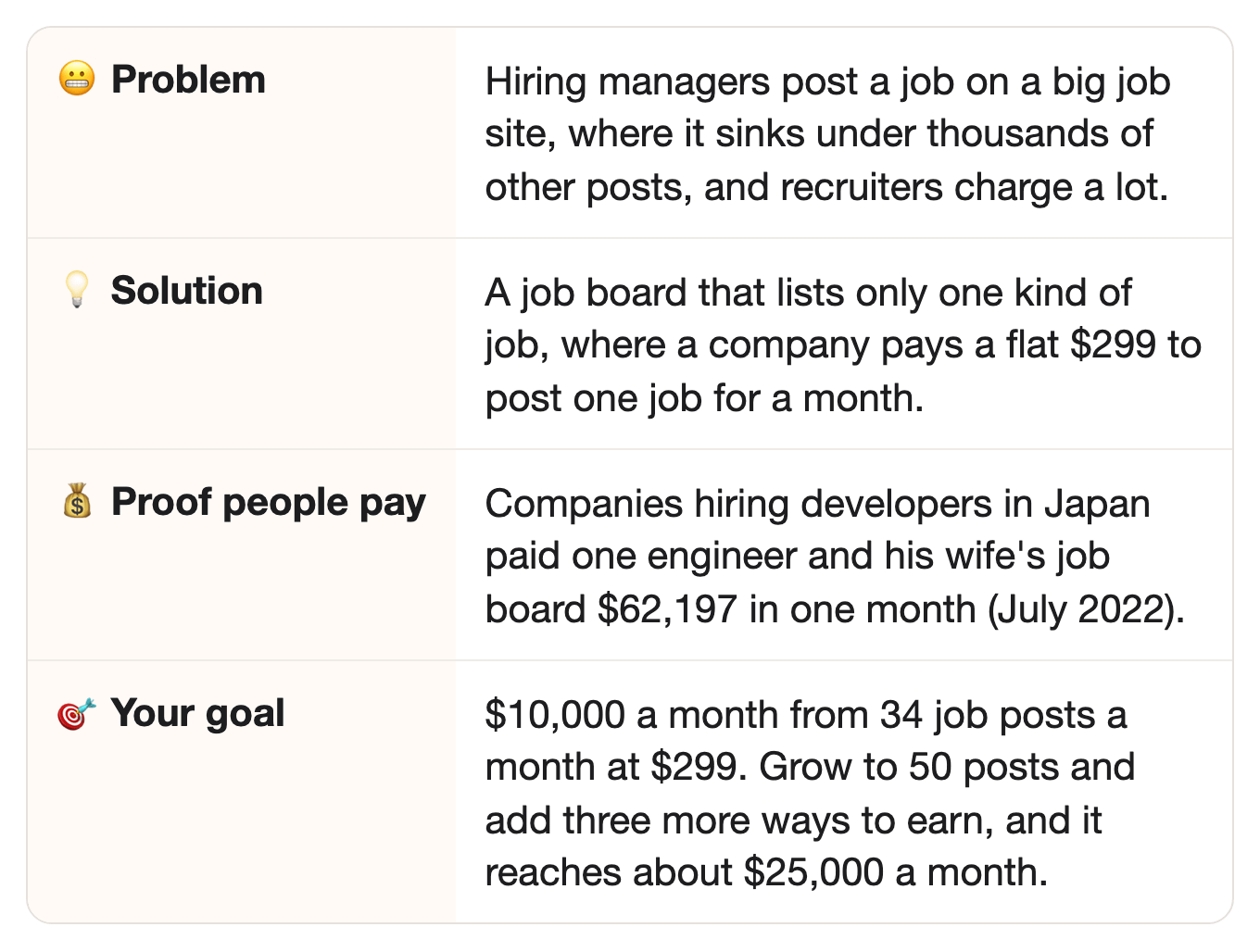
⚡ Quick facts
⠀
📖 How one engineer’s job board made $62,197 in a month
It started with a list he kept for himself.
Back in 2014, Eric Turner was looking for a software job in Tokyo.
So he started a list of good tech companies for foreign developers like him.
And he kept adding to it for years, while working as a developer.
Then in April 2019, he and his wife, Manami, put the list online as a website: Japan Dev.
But every visitor asked the same thing: “How do I actually apply to jobs?”
Fair question.
So they turned it into a job board.
⠀
Real example: his first customer was Mercari, the company he worked for.
He talked to HR, signed a contract, and posted Mercari’s open jobs.
And then came… 12 months with no revenue at all.
Ouch.
Eric called them “12 hellish months.”
Both of them still worked full-time, and ran the board at night.
⠀
In April 2021, the money was steady, and he quit his job.
And in July 2022, the board earned 8.3 million yen, or $62,197.
Still just the two of them, with no outside money.
Holy moly. 😳
He went from a list he kept for himself, to $62,197 in one month, by turning it into a job board for one country.
⠀
🔗 Same idea, new group
In the story: companies hiring foreign developers in Japan paid Eric and Manami’s board a fee each time they hired someone through it.
⠀In this idea: companies hiring one kind of worker, like designers or data analysts, need their post seen by the right people.
⠀Why it carries over: a small board for one group puts each post in front of the right people, instead of burying it.
⠀
💡 The opportunity
Companies want the right people, and the big job boards make that hard.
First, who pays: companies that are hiring.
Usually the hiring manager, or the recruiter at that company.
And the job seekers?
They use the board for free.
⠀
Big job boards list every job, for everyone.
So a post for one kind of worker sinks under thousands of others.
⠀
Recruiters cost a lot.
In Japan, Eric says recruiters often charge 30–35% of a hire’s yearly salary.
That’s a big slice of a whole year’s pay.
⠀
Job seekers in one field want one place to look.
One board, with only their kind of job, and a weekly email of new ones.
⠀
Here’s the surprise: a small, focused board can earn big money.
Japan Dev serves English-speaking tech workers in one country.
It had about 250,000 page views a month in 2022.
For a website, that’s small.
Eric picked one country.
You can pick one job the same way.
⠀
👉 The idea: build a job board for one job, plus a weekly jobs email, and charge companies a flat fee to post.
⠀
🧩 What you actually need
One job you know well, like your own.
Designers, data analysts, or product managers all work.
⠀
Public job posts to fill the board at the start.
You list them free, with a link to apply (Step 2 of the build plan).
That way, your board isn’t empty on day one.
⠀
A weekly jobs email.
It brings job seekers back.
And it shows companies how many people clicked their posts.
⠀
✅ Why this could work
Three reasons there’s real money here.
Others make money the same way, so it’s a pattern, not luck.
Remote OK, a board for remote jobs, was making $101,101 a month in April 2021, says its founder, Pieter Levels.
Remotive, another remote-jobs board, started as an email newsletter about remote work, and earned $125,000 in 2019.
And RailsDevs, a hiring board for Ruby on Rails developers, made about $10,000 a month in 2022, and ran from 2021 to 2025.
Ruby on Rails, by the way, is a popular tool for building websites.
⠀
Hiring never stops.
Remotive has run since 2014, and Remote OK since 2015.
Japan Dev was still listing 282 jobs when we checked.
People quit, retire, and switch jobs, so new openings keep coming. 🔁
⠀
Companies already pay to reach the right people.
The numbers come next.
⠀
👉 Like to check the numbers yourself? The links are all in “📎 The sources,” at the very end.
⠀
📊 More proof people want this
Want more? Here you go.
Companies already pay to post on boards for one kind of job seeker.
Remotive charges $299 to list one job for a month, plus $99 to add a logo and highlight it.
Japan Dev, the board from the story, had contracts with nearly 150 tech companies in 2022.
⠀
Job seekers sign up for job emails.
Remotive’s daily job email reaches more than 273,000 readers, when we checked.
Japan Dev’s newsletter said “Join 52k readers” when we checked.
⠀
Job seekers show up in big numbers.
Remote OK says companies can hire from more than 2.6 million remote workers, when we checked.
⠀
The big picture. 💰
The US government forecasts about 106,100 software developer and tester job openings each year, from 2025 to 2035.
It also forecasts about 24,800 data scientist openings a year.
And data scientist jobs are set to grow 35% from 2025 to 2035.
⠀
What a company that hired this way says.
“We interviewed 10 senior software engineers & hired one, all in the span of 3 weeks.”
That’s Daniel Svona, a startup co-founder, on Remotive’s page for companies.
Three weeks, start to finish.
⠀
👉 Companies pay for one thing: the right people seeing their job, fast.
⠀
🔍 Who’s already doing it
Some big boards, and what they don’t cover.
LinkedIn and Indeed list every job, for everyone.
That’s their strength.
It’s also why a job for one kind of worker gets buried.
⠀
Remote OK, Remotive, and We Work Remotely are job boards for remote jobs.
Companies pay to post jobs there, like Remotive’s fee to list one job for a month.
But they’re built around one setup, working from anywhere, not around your job.
Remotive’s founder said remote work was already a crowded market in 2020.
⠀
Japan Dev, the board from the story above, covers one country.
It serves English-speaking tech workers in Japan, and it’s good at it.
⠀
What the winners have in common, when we checked:
One clear group of job seekers.
A weekly email of new jobs.
Companies that pay to reach that group.
⠀
🔎 Check the market yourself in 2 minutes: run Part 0 of the prompt in the build plan below.
Your AI searches for job boards and job emails for your job that day, and tells you: early, growing, or crowded.
Early? Start now.
Crowded? Good news: it means companies pay. Pick a narrower slice of your job, like one industry or remote roles only (Step 1 of the build plan).
A crowded market is still OK. You win by serving one group better, not by being first.
⠀
👉 That gap is your chance: a job board and a weekly jobs email built around one job, not around remote work or one country.
⠀
🤖 Why AI won’t replace it
AI can find jobs. You give companies the right people.
You have an audience.
Companies pay to reach your readers.
And an AI chat has no list of data engineers who open your email every week.
⠀
Judgment: you know the good employers.
Remember Eric’s list from the story?
It started as a list of companies he’d want to work for.
A job seeker doesn’t know which companies are good, and you do.
⠀
Fresh every week.
New jobs open every day.
Your board checks that each job is still open, and drops the filled ones.
⠀
The jobs come straight to their inbox.
One email, every week, with only their kind of job.
No searching, and no prompt to write.
⠀
Proof companies pay for this: they post every job free on their own websites.
And they still pay Remotive $299 to list one job for a month, in front of the right people.
⠀
👉 Companies pay to reach your readers, not just to get their job listed.
⠀
💵 How much you can make
Here’s the math.
First stop: $10,000 a month from job posts alone
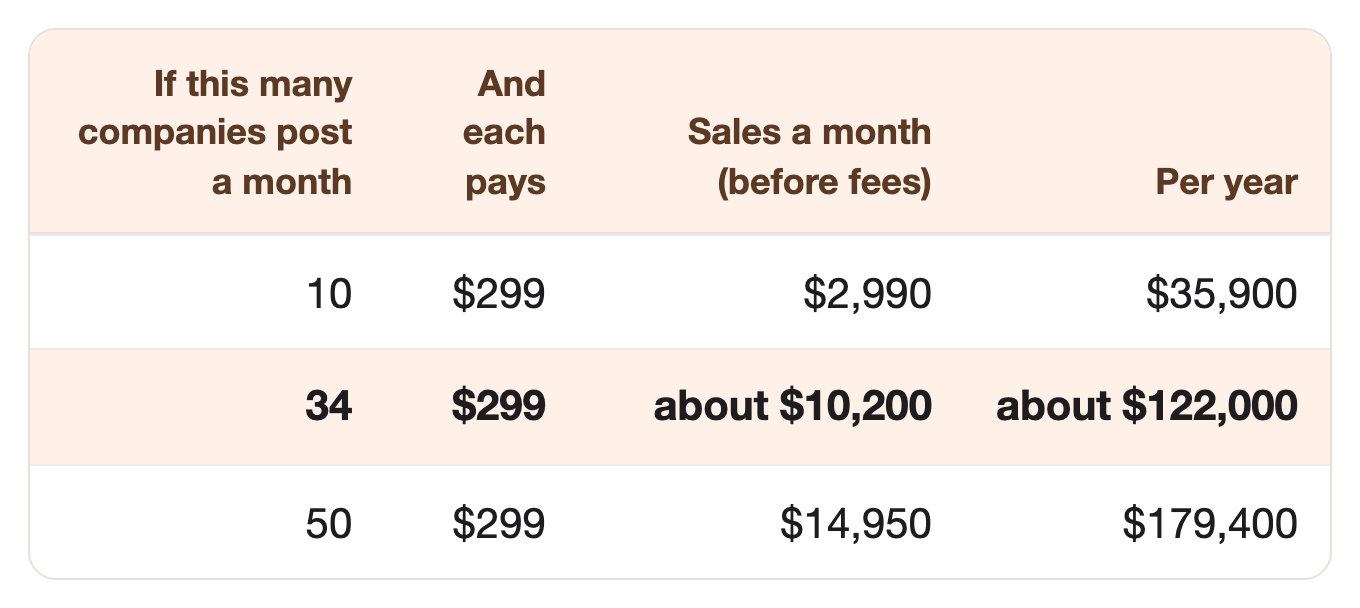
$299 is Remotive’s price to list one job for a month.
⠀Japan Dev earns a different way.
It charges a fee only when a company hires someone.
This math uses the simpler way: a flat $299 per post, like Remotive.
⠀
34 posts a month is a small number of jobs.
For comparison, Japan Dev listed 282 jobs when we checked.
Next stop: $25,000 a month, with three more ways to earn
Once companies get hires from your board, many will pay for more.
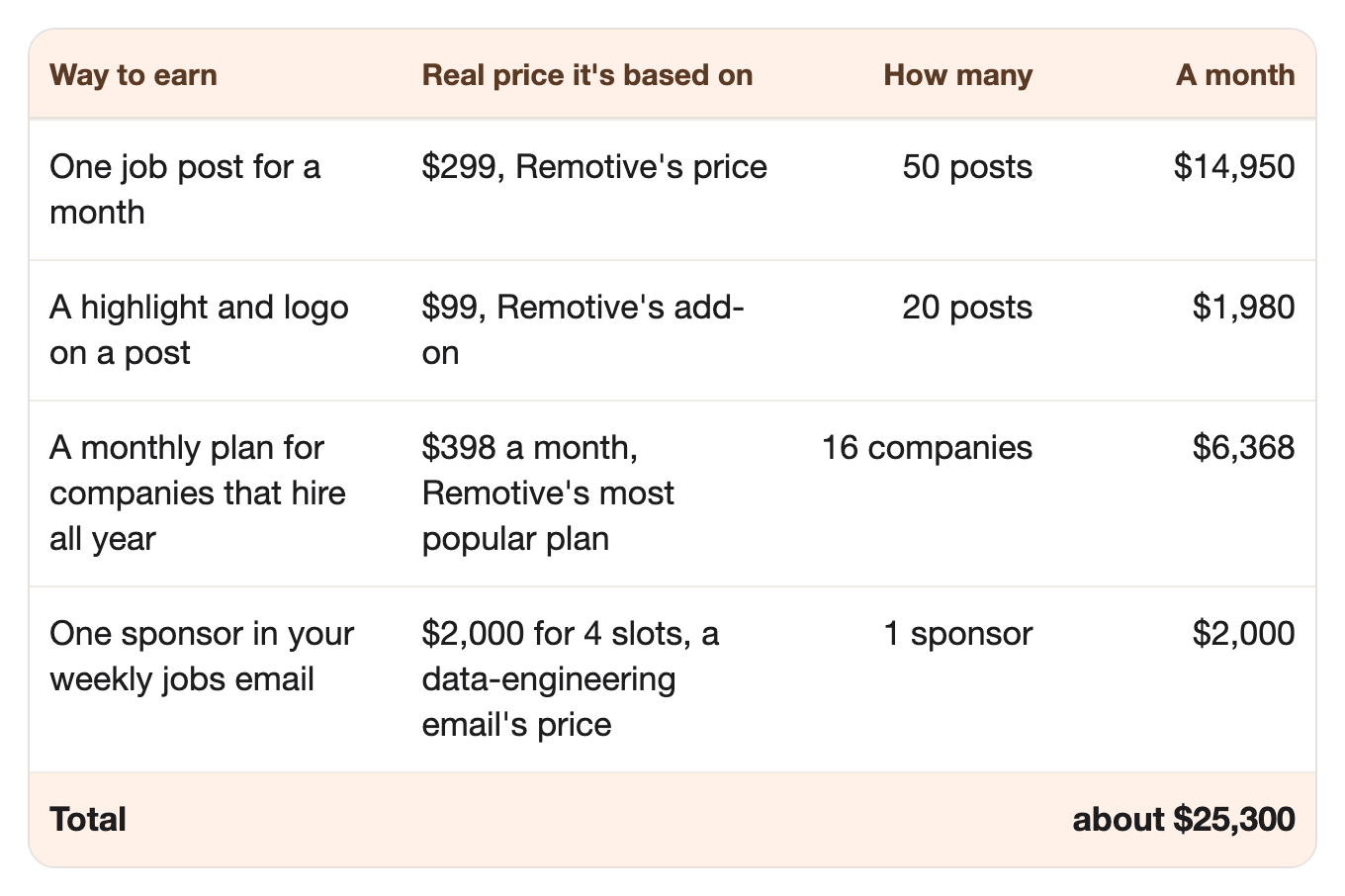
Single posts still do most of the work.
Grow from 34 to 50 posts a month, and they bring in $14,950.
⠀
The highlight is an easy yes.
It puts the company’s logo and brand color on the post, so it stands out.
The goal: about 2 in 5 companies add it.
⠀
The monthly plan is the big jump.
Some companies hire all year, so they’d rather pay once a month than post one job at a time.
Remotive’s plans include a highlight, a logo, and a week pinned at the top of the board.
⠀
The sponsor only works once your weekly email has real readers.
The $2,000 comes from Vutr’s data-engineering email, sent to nearly 20,000 readers.
A smaller email may get less.
⠀
That’s about 66 companies paying in a month.
Japan Dev listed 282 jobs when we checked.
⠀
And if it doesn’t work? Here’s all you lose:
One month of a job board tool, like Job Boardly at $60 a month.
One month’s subscription to an AI app, like ChatGPT or Claude.
One week of your time.
⠀
👉 So one idea, done well, adds up to about $25,000 a month.
The next step is a second idea: another one from this newsletter, or this one for a new group. Three of them could pass a million dollars in total in two or three years.
For this board, a similar niche could be UX designers. And this board could be your first idea.
Thinking “why not me?”
Good question. The answer is right below. 👇
If this one’s not for you, see you next week.
That’s it, my fellow contrarians! 🙌
Yours ‘handing you ideas with the proof attached’ Vijay Peduru 🦸♂️
⠀
⠀
⠀
🧰 Want to build it? Here’s everything else.
AI does most of the work, and you pick the job and the good companies. 🎙️
⠀
Step 1: 🎯 Pick one job, across the whole country
One job is narrow enough. Keep the whole country, so there are plenty of jobs to list.
Easy one: start with what you already know.
Pick a job you know.
Your own job is best: you know the titles, the tools, and the good employers.
For example: data engineers, UX researchers, or product designers.
Cover the whole country, or remote jobs for that job.
For example: data engineers in the US.
Japan Dev covered a whole country, too.
Narrowing to one city is optional, and it can come later.
Check that companies hire for it every week.
Your AI counts open jobs for your pick in Part 1 of the prompt.
⠀
Step 2: 🛠️ Fill the board before anyone pays
An empty board gets no readers, and no readers means no paying companies.
List public job posts for free at the start.
Eric says Remote OK did this: it added jobs from other sites for free, then charged once job seekers came.
Always link to the company’s own job page, so people apply there.
Let AI find the jobs.
It builds a list of companies that hire for your job, with their careers pages.
Then it writes a short, plain summary of each open job.
Use a ready-made job board tool. No code needed.
Job Boardly starts at $60 a month, and can bring in jobs from other sites for you.
⠀
Step 3: 🔍 Check every listing
A board full of dead links loses readers fast. So every job goes through three passes.
Your AI does all three passes for you: it writes in Part 3, and checks in Part 4 of the prompt.
🖊️ The AI writer. It writes each listing only from the company’s own job page.
🔍 The AI checker. A second pass opens every link, and confirms the job is still open.
It also checks the title, the place, and the salary match the company’s page.
🧐 The AI critic. A third pass hunts for anything that looks fake, unclear, or out of date.
Every week, drop the filled jobs.
⠀
👉 The prompt already follows three safety rules: link to the company’s own page, list only real jobs, and drop filled jobs weekly.
⠀
Step 4: 🏪 Open for paid posts
Charge a flat fee per post. It’s simpler than Japan Dev’s model.
Set your price.
$299 to list one job for 30 days, like Remotive.
$99 extra for a highlight and logo, like Remotive.
A monthly plan at $398 for companies that hire all year, like Remotive’s most popular plan.
Skip the hiring fee.
Japan Dev charges when a company hires someone.
That meant a lawyer, a contract in two languages, and tracking every hire and invoice.
That’s a lot of paperwork.
Later, it also got a recruiting license in Japan, mostly because companies kept asking about one.
A flat fee per post is a simple online payment, with no contract to chase.
Rules on job ads and hiring fees differ by country. Check your own country’s rules before you charge for anything hiring-related.
Let AI write your “Post a job” page, with real numbers from your board, like readers and clicks.
⠀
Step 5: 📣 Get your first paying companies
Get found by job seekers, and show each company its job already on your board.
Ask ChatGPT “best job board for data engineers,” and publish pages where your board is missing from its answers.
Ask Claude and Gemini the same question, and note which boards they name.
Then write the pages they seem to be missing, like “remote data engineer jobs with salary ranges.”
Send one hiring manager two lines, plus their own job already listed on your board.
Line one names a real detail from their post, like the team or one tool, so they know you read it.
Line two links to their free listing and offers a featured spot; write each note fresh, never from a template.
Answer “where do I find data engineer jobs?” posts in the biggest data-engineering groups on LinkedIn and Facebook.
Answer the question they asked, and keep your board’s name in your profile, not in the reply.
Every reader who finds you this way adds to the readers and clicks you show companies.
⠀
Step 6: 🏃 Eliminate competitors
Here’s how to stay ahead when the competitors show up.
Publish the salary ranges from your listings every month.
Japan Dev showed salary data that wasn’t well known at the time.
Your monthly record keeps growing, and a new board would start it from zero.
Have a “switching from LinkedIn jobs” page ready now.
When LinkedIn next raises what it charges for job posts, your page is already live.
It shows your flat price, and how to post a job in five minutes.
⠀
Step 7: 🎲 Make it bigger
Every job, and every country, can have its own board.
Add the three extras from “How much you can make,” one at a time.
First the highlight and logo, since every post can take one.
Then the monthly plan, for companies that post again and again.
Then one sponsor, once your weekly email has a few thousand readers.
Open the same board for a second job, or a second country.
One board at about $25,000 a month is about $300,000 a year, before fees. 🎯
Add two or three more boards, or ideas from this newsletter, and a million dollars in total is two or three years away.
⠀
🗓️ Your first week
Phew. That was a lot. 😅
Steps 1 to 5 fit into seven days. 🚀
By day 7, you have a live board with 30 jobs, your first weekly email, and your first notes to hiring managers.
The prompt below has six Parts, and they’re not the same as the Steps above.
Day 1 (Step 1): Run Part 1 of the prompt (it’s below) to pick your job, across the whole country.
Day 2 (Step 2): Build your list of 50 hiring companies with Part 2.
Days 3–4 (Steps 2 and 3): Write 30 listings with Part 3, then check each one with Part 4.
Day 5 (Step 2): Set up your board tool, and add the checked listings.
Day 6 (Step 5): Write your first weekly jobs email with Part 5, and send it.
Day 7 (Step 5): Write your first two-line notes to hiring managers with Part 6.
⠀
🏄 How to use the prompt
One prompt does all the AI work, in six parts, plus a quick market check (Part 0).
Part 1 — Pick the niche. Checks how often companies hire for your job across the country, and keeps a few narrower options for later.
Part 2 — Build the company list. Finds 50 companies that hire for your job, with links to their careers pages.
Part 3 — Write the listings. Turns each open job into a short, plain listing, with a link to apply.
Part 4 — Check every listing. Opens every link, and confirms each job is real, open, and matches.
Part 5 — Write the weekly email. Picks the best new jobs of the week, and writes the email.
Part 6 — Write to companies. Writes two-line notes to hiring managers, and your “Post a job” page.
Run it your way:
Part by part (the default): it pauses after each part, and you type “next” to go on.
All at once: say “run all six parts.”
Just one part: say “only do Part 3,” or any part you need.
The full prompt is just below, under “📋 The prompt.”
🎙️ Talk to your AI sidekick, don’t type.
Turn on voice mode, or use a dictation app like Wispr Flow.
Say it messy. The AI sorts it out.
Turn it into a skill, so you never paste it again.
Paste the prompt into Claude or ChatGPT, and say: “Turn this into a skill I can save.”
Install once, use forever.
⠀
📋 The prompt
The prompt (copy it into Claude or ChatGPT, fill in the INPUTS part, and run it your way)
CONTEXT:
- You're my job-board partner. Together we'll build a job board and a weekly jobs email for one kind of worker.
- Job seekers use it free. Companies pay a flat fee to post a job.
- This prompt has six parts, in order.
- Run it the way I ask:
    - If I say nothing, go one part at a time. After each part, show me the result, then stop and wait. Move on only when I type "next."
    - If I say "run all six parts," do them all without stopping.
    - If I say "only do Part 3" (or any part), do just that part.
- If a part needs something from me, ask for it before you start that part.
- Use only public pages, like a company's own careers page. Never invent a job, a company, a salary, or a number. If you can't find a source, leave it out.
- Every listing links to the company's own job page, so people apply there.
- If you can't open a link, say so, and ask me to paste the page instead.
- Keep web search on for the whole prompt (turn on search in ChatGPT or Claude), so you can open any page you need to check.

=============== INPUTS — edit these, or just run as is ===============

The job:
{e.g. data engineers}

The place (a whole country, or "remote"):
{e.g. the US}

What I know about this job:
{e.g. I've worked as a data engineer for 8 years, at two startups and one bank}

My price:
{e.g. $299 to list one job for 30 days; $99 extra for a logo and highlight}

======================== END OF INPUTS ========================

THE PARTS:

Part 0 — Check the market today.
This part needs web search (turn on search in ChatGPT or Claude). Search for job boards and job emails for my job and place and, for each kind, give the count, the three biggest with links, and their prices for companies:
1. Job boards only for this job, or this job in this place.
2. Weekly job newsletters for it.
3. Communities that post jobs for it (Slack groups, Discord servers, LinkedIn groups).
4. Recruiting firms that focus on it.
Then tell me: early (few boards), growing, or crowded, and which narrower group looks least served (for example: one city, one industry, one language, one level like "first job"). Give a link for every number. If you can't open a page, say so. Never guess a number.

Part 1 — Pick the niche.
Using my job and place, search for open jobs on big job sites and company careers pages. Give me:
1. Roughly how many open jobs you can find this week across my whole place, with links to the searches you used.
2. Three narrower versions of my niche (by industry, level, or city), with a job count for each, to keep for later.
3. Your pick: start with the whole place, unless it has far more jobs than one board can list. Say why.
Say clearly which reasons are your guess.

Part 2 — Build the company list.
Find 50 companies that hire for my niche. For each, give the company name, one line on what it does, the link to its careers page, and how many matching jobs it has open. Mark the ones I should contact first: companies with three or more open jobs.

Part 3 — Write the listings.
Ask me which companies to start with. For each open job, open the company's job page and write a listing:
1. The job title, exactly as the company wrote it.
2. Company, place, and remote or on-site.
3. The salary, only if the company's page states it.
4. Three short lines: what the job is, what they need, and one thing that stands out.
5. The link to apply on the company's own page.
6. The date you checked it.

Part 4 — Check every listing.
Now act as a separate checker who didn't write these listings. Open every link. Check that the title, the place, and the salary match the company's page. Mark each listing: open and matches, doesn't match, or closed or gone. For each problem, show what the page actually says. Then act as a strict critic, and flag anything that looks fake (no company website, a vague job, or a request for money from applicants), unclear, or out of date. Then give the fixed list, with closed and fake jobs removed.

Part 5 — Write the weekly email.
Pick the 10 best new jobs from my checked list. Write the weekly jobs email:
1. A subject line with the number of jobs and one standout company.
2. One short line from me about hiring in this job this week.
3. The 10 jobs: title, company, place, salary if stated, and the link.
4. One line at the bottom for companies: "Hiring? Post your job here."
Never promise anyone a job.

Part 6 — Write to companies.
1. For each company I pick, write a two-line note to the hiring manager. Line one names one real detail from their job post, like the team or a tool. Line two says I listed their job on my board for free, links to it, and offers a featured post at my price. Write each note fresh, never from a template.
2. Write my "Post a job" page: who reads my board, the price shown up front, and what they get. Use only real numbers I give you. Never promise a hire.

When all six parts are done, ask if I want to re-check every live listing with Part 4 and drop the filled jobs, then repeat Parts 3 to 5 for next week's jobs.
⠀
📎 The sources
Every number above, with where it came from.
Japan Dev’s revenue · Number: “In July, it made $62,197 in revenue”; “100% bootstrapped — the only employees are my wife and me”; building since 2019 · Source: Indie Hackers, August 16, 2022 (read via the Web Archive)
Japan Dev’s story · Number: List started in 2014; site launched April 2019; first customer Mercari; “12 hellish months of earning no revenue at all”; quit in April 2021; 8.3 million yen ($62,197) in July 2022 · Source: Japan Dev blog, “How and why I built Japan Dev”
Japan Dev’s founders · Number: Byline “Eric Turner”; “my wife Manami”; “my wife and I were both working full-time, and running Japan Dev at night” · Source: Same blog post
Japan Dev’s model and channels · Number: Fee charged when a company hires; a lawyer and a contract in English and Japanese; invoices and applicant tracking; a recruiting license wasn’t required for the job board, but they got one (November 2021) because companies kept asking; recruiters’ fees “30-35% of a candidate’s yearly salary is typical”; SEO biggest channel, weekly email next; salary-guide lead magnet; early on, unique data “like salary ranges”; Remote OK filled its board by “crawling jobs on other sites and adding them for free” · Source: Same blog post
Japan Dev’s size in 2022 · Number: About 250,000 page views a month; contracts with nearly 150 tech companies · Source: Same blog post
Japan Dev’s site · Number: 282 curated jobs; “Join 52k readers” · Source: Japan Dev
Remote OK’s revenue · Number: “generating $101,101 this month” (posted April 12, 2021) · Source: Pieter Levels, April 12, 2021
Remote OK’s start · Number: Launched in 2015 · Source: Pieter Levels, April 2, 2015
Remote OK’s job seekers · Number: “Hire 2,669,335+ remote workers” · Source: Remote OK
Remotive’s start and revenue · Number: Started in 2014 as “a newsletter on Remote Work”; $125,000 revenue in 2019; newsletter ads $850 to 25,000 readers; “In 2020, remote work is a crowded market”; “Over twenty job boards” in remote work (interview from early 2020) · Source: Indie Hackers interview with Rodolphe Dutel (read via the Web Archive)
Remotive’s prices and readers · Number: $299 for a one-month job listing; $99 for highlight and logo; “273,000+ subscribers on our daily email job digest” · Source: Remotive: post a job
Employer quote · Number: “We interviewed 10 senior software engineers & hired one, all in the span of 3 weeks.” (Daniel Svona, co-founder of Primeflow) · Source: Same page
RailsDevs · Number: A job board for Ruby on Rails developers; “about $10,000 per month, on average” (November 2022); ran from 2021 to 2025 · Source: Starter Story
Software developer openings · Number: About 106,100 a year, on average, projected for 2025–2035 (developers, QA analysts, and testers) · Source: US Bureau of Labor Statistics
Data scientist openings · Number: About 24,800 a year, projected for 2025–2035; 35% growth from 2025 to 2035 · Source: US Bureau of Labor Statistics
Job board tool · Number: Job Boardly Standard, $60 a month, with a job importer · Source: Job Boardly pricing
Highlight and monthly plans · Number: “Highlight & Logo $ 99.00”; “Plus Most popular $ 398/mo” (also Basic $299 a month, Premium $448 a month); plans include a highlight, a logo, and “Pin ad 7 days on top of main page” · Source: Remotive: post a job
Sponsor price · Number: “$600 per slot”; “4 slots for $2,000”; “nearly 19,925 subscribers” (January 29, 2025) · Source: Vutr’s data-engineering newsletter, media kit