


Hello contrarians,
Today’s idea is called The New Healthcare Manager’s Weekly.
Grab a coffee. ☕
First, an engineer’s story. Then, the business you could build from it.
⠀
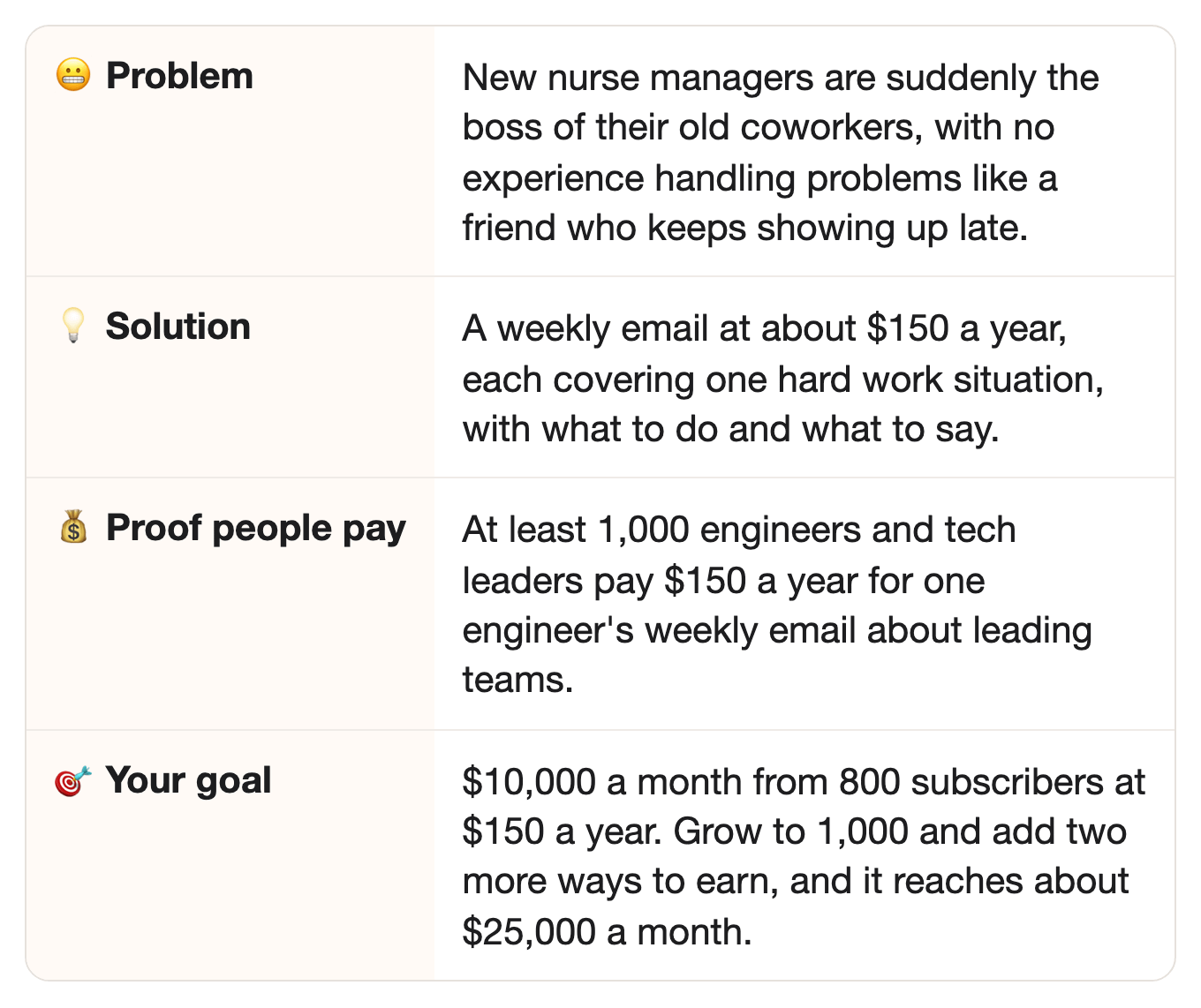
⚡ Quick facts
⠀
📖 How one engineer got thousands of people to pay for a weekly email
He started it while working a full-time job.
Gregor Ojstersek is an engineer who rose all the way to CTO, the head of tech at a company.
On October 3, 2022, he started a newsletter called Engineering Leadership.
At the time, he still had his full-time job, as a Head of Engineering.
Odd but true: his first post wasn’t advice at all.
It was just an announcement that he was starting a newsletter.
Not exactly a big launch.
Then he wrote every week, about leading engineers and teams.
One group he writes for: “Engineering leaders in the engineering leadership role for the first time.”
In plain words: first-time bosses.
Hold that thought.
⠀
Four years later, he had written over 250 articles.
And he never missed a week, not once in four years.
Wow.
He calls his readers “a community of 200k+ engineers and leaders.”
Substack, the site his newsletter runs on, shows a badge on it: “Thousands of paid subscribers.”
We used the smallest number the badge allows: 1,000.
So we’re playing it safe here.
His yearly price is $150.
So 1,000 people at $150 a year is at least $150,000 a year in sales, before fees.
That’s the minimum by our math, from the badge and the price; he hasn’t shared his sales.
Holy cannoli. 🍰
From a side project next to his day job, to at least $150,000 a year in sales, one weekly email at a time.
⠀
🔗 Same idea, new group
In the story: engineers and first-time engineering bosses paid Gregor Ojstersek for one weekly email about leading teams.
⠀In this idea: new nurse and clinic managers get one weekly email about the hard problems in their own job.
⠀Why it carries over: both are first-time bosses who face hard situations every week, and new ones get promoted every year.
⠀
💡 The opportunity
New nurse and clinic managers are first-time bosses too, and they face hard situations every week.
Remember that group Gregor writes for, the first-time engineering leaders?
Healthcare has its own version.
First, who are these managers?
A nurse manager runs one hospital unit, like the intensive care unit, and its nurses.
A clinic manager runs a doctor’s office or clinic: the staff, the schedule, the budget.
And there are plenty of them: the US government counts about 640,400 medical and health services managers (2025).
⠀
Most of them get the job by being good at the old one.
“57% of incoming nurse managers are promoted from within the same department,” says a 2024 report from Laudio and AONL.
AONL is the nurse leaders’ association.
So overnight, they become the boss of their old coworkers.
Picture that first team meeting.
⠀
Their first year is full of hard moments.
The first staff schedule.
A friend who keeps showing up late.
Staff complaints from below, and pressure from above.
⠀
Here’s the honest truth: the training we found comes as one long course, taken once.
But the hard moments come every week.
See the mismatch?
The course happens once, and the problems keep coming.
⠀
👉 The idea: a paid weekly newsletter for new nurse or clinic managers, with one real work problem and what to do about it.
⠀
🙋 Not a healthcare manager yourself? You can still build this.
Become the interviewer.
Each week, interview one experienced nurse manager about one hard moment, with their permission.
Their story becomes that week’s issue.
You ask the questions, and they bring the know-how.
⠀
Team up with one.
An experienced nurse manager brings the know-how and the judgment.
You build the newsletter and find the readers.
⠀
Or use your own job.
First-time managers in any field have the same problem.
The steps to build it are the same.
⠀
✅ Why this could work
Why this one can work, in three points.
Gregor isn’t the only one, so it’s a pattern, not luck.
Refactoring is a paid newsletter by Luca, a former startup CTO.
It has at least 1,000 paid subscribers at $150 a year.
Then there’s Ethan Evans, who retired from Amazon as a Vice President.
He co-writes a leadership newsletter with at least 1,000 paid subscribers, at $144 a year.
And here’s what Evans says of his leadership courses: “I now make far more teaching than I make coaching, and in less time.”
⠀
One honest catch: all three, Gregor’s included, are tech newsletters.
They show that managers pay for weekly help.
They don’t show that nurse managers will.
That’s what Part 0 of the prompt checks for you.
⠀
New nurse managers have needed help for decades, and they still do.
The Nurse Manager’s Survival Guide came out in 1993, “designed to assist nurses recently placed in management positions.”
Yep, 1993.
It’s now in its fourth edition.
And the US government expects about 62,300 healthcare manager jobs to open every year.
⠀
👉 Want to check these numbers? Each one has a source link in the last section, “📎 The sources.”
⠀
📊 More proof people want this
Want more? Here you go.
New nurse managers already pay for courses.
AACN is the critical-care nurses’ association.
It sells an online course for nurses new to leading, at $485 for members and $525 for others.
⠀
And for certificate programs.
Sigma is a nursing honor society.
It sells a Nurse Manager Certificate Program for $450.
⠀
Nurse leaders pay to join their association, too.
AONL, the nurse leaders’ association, says it has 12,500 members, at $249 a year.
Its journal, Nurse Leader, costs $177 a year.
⠀
Books for new nurse managers sell.
The Nurse Leader Coach, a book for nurse leaders, has 377 ratings on Amazon, at $16.22.
From Staff Nurse to Manager has 57 ratings, at $12.99.
⠀
Nurses watch videos about nurse managers.
We searched YouTube for “nurse manager.”
The two most-watched results were comedy sketches about types of nurse managers, with about 328,000 views between them.
Comedy, not how-to (more on that below).
⠀
The big picture: there are a lot of these managers, and they’re well paid. 💰
There are about 640,400 medical and health services manager jobs in the US.
Their median pay, the one in the middle of the pay range, is $123,860 a year (May 2025).
⠀
What a manager says about the job: “I juggle staff complaints while being talked down to by administration every day”
That’s a comment under a YouTube video about nurse managers.
Oof.
⠀
And what a nurse manager asks for: “…it would be great to talk/ interview a nurse manager to understand our perspective”
That’s a nurse manager, commenting under another video.
⠀
👉 New healthcare managers already pay for courses, books, and memberships.
And they want advice from someone who understands their job.
⠀
🔍 Who’s already doing it
Big newsletters for tech, and long courses for healthcare.
Engineering Leadership, Refactoring, and Ethan Evans’s newsletter are written for tech people.
All three are paid newsletters for tech workers; Engineering Leadership is the one from the story above.
Their stories are about engineers, code, and software teams.
A nurse manager’s week is about shifts, staffing, and patients’ families.
Different world.
⠀
Nursing groups sell long courses and journals.
AACN, a nurses’ association, sells a course that gives six months of access.
Sigma, a nursing society, sells a program of 16 courses.
That’s one big course, taken once, not help with the problem in front of them that week.
⠀
Books help, but they’re written once.
A book can’t answer what happened on the unit on Tuesday.
⠀
On YouTube, when we checked, the most-watched “nurse manager” videos were comedy sketches and job-interview tips.
Not many showed how to do the job itself.
⠀
What’s missing, when we checked:
A weekly paid email for new nurse managers or clinic managers.
Written by one named manager they can follow.
At a price like Engineering Leadership’s $150 a year.
⠀
🔎 Check the market yourself in 2 minutes: run Part 0 of the prompt in the build plan below.
Your AI searches for newsletters, courses, and communities for new healthcare managers that day, and tells you: early, growing, or crowded.
Early? Start now.
Crowded? Good news: it means people pay. Pick one narrower group of managers (Step 1 of the build plan).
A crowded market is still OK. You win by serving one group better, not by being first.
⠀
👉 That’s the part nobody else offers: a weekly email for new healthcare managers, from one named manager they can follow.
⠀
🤖 Why AI won’t replace it
AI coaches well when it knows the details. Your email gives new managers advice from someone who’s done the job.
Trust.
They read you every week.
They know your advice comes from people who’ve led a unit or a clinic.
ChatGPT has never had to schedule a holiday shift.
⠀
You choose what’s right for them.
A new manager doesn’t know which problem to fix first.
You say what to handle first, and what can wait.
⠀
A finished issue: one situation, five minutes to read.
What happened, what to do, the words to say, and the mistake to skip.
Sure, ChatGPT gives sharp advice when told the unit, the staff, and the history.
But who’s typing all that after a 12-hour shift?
Nobody.
⠀
Proof people pay for this: ChatGPT is free, and AACN still sells its course for new nurse managers at $485.
⠀
👉 Advice from someone who’s been there: that’s what they’re paying for.
⠀
💵 How much you can make
Grab a calculator. Just kidding, here it is.
First stop: $10,000 a month from the email alone
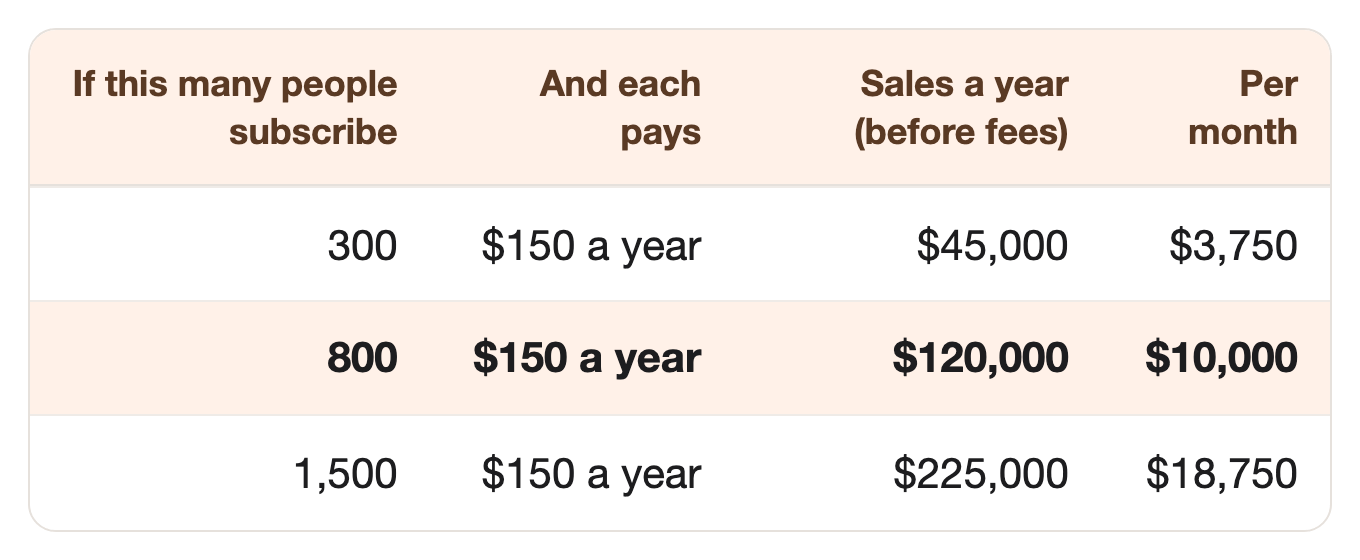
$150 a year is Engineering Leadership’s price.
So you’re not guessing at a price; you’re copying a real one.
⠀
800 subscribers is fewer than the 1,000 or more that Gregor has.
Next stop: $25,000 a month, with two more ways to earn
Once new managers trust your email, hospitals and readers start to buy more.
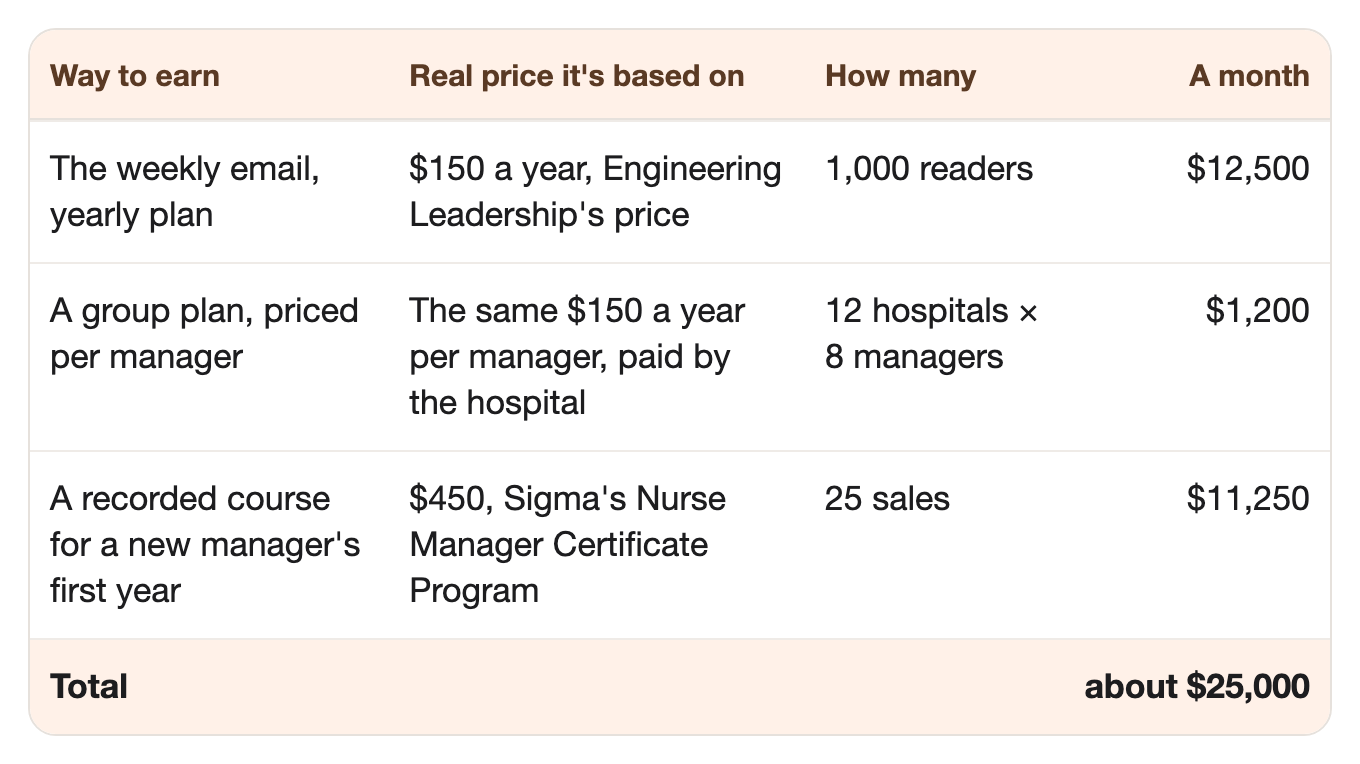
The email is still the base.
Grow it from 800 to 1,000 readers, and it brings in $12,500 a month.
Each “A month” figure for a yearly plan is the price split over 12 months.
⠀
The group plan is one sale for a whole hospital.
Gregor already sells group subscriptions, so a company can buy seats for all its people.
One nursing director signs up, and eight new managers get the email.
⠀
The course is the big jump.
Sigma, a nursing honor society, charges $450 for 16 online courses.
So yours needs to be a full course, not a few short videos, to charge the same.
25 sales a month is about 300 a year, under 1% of the 62,300 healthcare manager openings a year.
⠀
With the 96 group seats, that’s about 1,100 readers in all.
Engineering Leadership’s badge says “thousands,” so at least 1,000 already pay Gregor.
⠀
If it doesn’t work out, here’s all you lose:
Substack’s cut, which comes only from what readers pay: 10%, plus card fees.
One month’s subscription to an AI app, like ChatGPT or Claude.
One week of your time.
⠀
👉 That’s about $25,000 a month, all from one group of new nurse managers.
Run two or three of these, from this newsletter or a niche close to this one. Together, they could pass a million dollars in total in two or three years.
For this email, a niche close by could be new clinic managers. This could be your first idea.
Did this one make you think “wait, I could do that”?
Then keep scrolling. The whole build plan is below. 👇
If not, no worries. See you next week with a new idea.
That’s it, my fellow contrarians! 🙌
Yours ‘turning other people’s wins into your next idea’ Vijay Peduru 🦸♂️
⠀
⠀
⠀
🧰 Want to build it? Here’s everything else.
AI does most of the writing. You, or your partner, bring the know-how. 🎙️
⠀
Step 1: 🎯 Pick one kind of manager
The narrower the reader, the faster they feel it’s written for them.
“New healthcare managers” is still a big crowd, so start smaller.
Pick one group.
For example: nurses in their first year as a unit nurse manager.
Or new managers of small doctors’ offices and clinics.
List the 30 hard moments of their first year.
Leading old coworkers, the first schedule, a staff member who’s always late, the first budget meeting.
Your AI helps you build the list in Part 1 of the prompt.
Stay on management.
People, schedules, meetings, hard talks, their own stress.
Never patient care, and never a ruling on law or HR rules.
⠀
Step 2: 🛠️ Turn one moment a week into an issue
Each issue is one hard moment, handled start to finish.
Get the real story first.
Your own, or one from an interview, with permission.
Change every name and detail, so no patient or staff member can be recognized.
Write it up the same way every week:
The moment, in a new manager’s words.
What to do next, step by step.
The words to say, ready to use.
The mistake to skip.
🎙️ Talk, don’t type. Tell the story out loud, and let AI turn it into the issue.
⠀
Step 3: 🔍 Check every issue
Healthcare is careful work. So every issue gets checked three times.
Good news: AI does the first pass, and you read the flags.
Your AI does all three passes for you: it writes in Part 2, and checks in Parts 3 and 4 of the prompt.
🖊️ The AI writer. Your AI drafts the issue from your story and official sources only.
🔍 The AI checker. A second pass opens every link, and confirms each fact says exactly that.
🧐 The AI critic. A third pass reads it like a careful nurse leader.
It flags anything that sounds like clinical advice (advice on treating patients), or a ruling on law or HR rules.
It flags any detail that could identify a real patient or coworker.
Point them to the right people. For anything about pay, discipline, or firing, say: “Check your hospital’s policy and talk to HR.”
Optional: pay an experienced nurse manager to review your first ten issues.
⠀
👉 The prompt already follows three safety rules: management only, never clinical advice; no legal or HR rulings; and no real names or private details.
⠀
Step 4: 🏪 Open your newsletter
Copy Gregor’s setup.
Two of his tricks are worth copying, in point 4.
Start on Substack. It takes its 10% cut only from what readers pay.
Send free issues first, to build trust and a list.
Then set your prices.
$15 a month, or $150 a year, like Engineering Leadership.
Make it easy to expense.
Gregor gives readers an email template to ask their manager to pay.
He also sells group subscriptions, so a hospital can buy seats for all its new managers.
Price yours the same $150 a year, for each manager in the group.
⠀
Step 5: 📣 Get your first subscribers
Show up where nurse leaders already read, one hard moment at a time.
Write one free issue for a bigger nursing-leadership newsletter or blog.
Give them your best hard moment, like your first week as the boss of your old coworkers.
Add one line about your newsletter at the end.
After each issue, post one Substack Note (a short post inside Substack) with the hard moment and the link.
For two days, reply to every comment, and comment on other nurse leaders’ Notes.
Post a second Note on Friday, and let your AI write both in Part 6 of the prompt.
Leave one useful comment early under the biggest nurse-leadership posts on LinkedIn.
Turn on alerts for five or six big accounts, and comment within ten minutes of each post.
Share one real thing you’ve learned, never a link.
⠀
Step 6: 🏃 Eliminate competitors
If ten competitors copy you, here’s how yours stays ahead.
Make a pledge: “Every story here happened to a real nurse manager. AI never makes one up.”
Sign it with your name and photo, and put it on your welcome page and at the bottom of every issue.
A copycat that lets AI write its stories can’t make the same promise.
Give readers a name they’d put in a bio, like “the First-Year Nurse Leaders.”
Use it in every issue’s greeting: “Hello, First-Year Nurse Leaders.”
A new manager who feels part of a group has a reason to stay when a copycat shows up.
⠀
Step 7: 🎲 Make it bigger
Every kind of healthcare manager has its own first year.
Add the two extras from “How much you can make,” one at a time.
First the group plan, since you already write the email.
Then the course for a new manager’s first year, built from your best year of issues.
Start the same newsletter for a second group: clinic managers, nursing home administrators, or charge nurses (the nurse in charge of a shift).
One newsletter at about $25,000 a month is about $300,000 a year, before fees. 🎯
Add two or three more newsletters, or other ideas from these issues, and a million dollars in total is two or three years away.
⠀
🗓️ Your first week
Phew. That was a lot. 😅
Steps 1 to 5 fit into seven days. 🚀
By day 7, you have a Substack, two checked issues, your first issue sent, and your first Substack Note.
Quick heads-up: the prompt below has six Parts, and they’re not the same as the Steps above.
Day 1 (Step 1): Run Part 1 of the prompt (it’s below), and pick your group and its 30 hard moments.
Days 2–3 (Steps 2 and 3): Draft two issues with Part 2, then check each one with Parts 3 and 4.
Day 4 (Step 4): Set up your Substack, with a short welcome page.
Day 5 (Step 4): Turn your first draft into issue 1 with Part 5, and send it free.
Days 6–7 (Step 5): Write your two Notes with Part 6, and post the first one.
⠀
🏄 How to use the prompt
One prompt does all the AI work, in six parts, plus a quick market check (Part 0).
Part 1 — Plan the moments. Lists the 30 hard moments of your reader’s first year, and picks the first five.
Part 2 — Draft an issue. Turns your story, or an interview, into one issue with a plan and the words to say.
Part 3 — Check every fact. Opens every link and confirms each fact matches the page.
Part 4 — Find the risks. Reads it like a careful nurse leader, and flags clinical advice, legal or HR rulings, and private details.
Part 5 — Write the issue. Turns the checked draft into the weekly email.
Part 6 — Write the Notes. Turns the issue into two short Substack Notes that point to your newsletter.
Run it your way:
Part by part (the default): it pauses after each part, and you type “next” to go on.
All at once: say “run all six parts.”
Just one part: say “only do Part 3,” or any part you need.
The full prompt is just below, under “📋 The prompt.”
🎙️ Talk to your AI sidekick, don’t type.
Turn on voice mode, or use a dictation app like Wispr Flow.
Say it messy. The AI sorts it out.
Turn it into a skill, so you never paste it again.
Paste the prompt into Claude or ChatGPT, and say: “Turn this into a skill I can save.”
Install once, use forever.
⠀
📋 The prompt
The prompt (copy it into Claude or ChatGPT, fill in the INPUTS part, and run it your way)
CONTEXT:
- You're my newsletter partner. Together we'll build a paid weekly newsletter for new healthcare managers, with one real management situation a week.
- This prompt has six parts, in order.
- Run it the way I ask:
    - If I say nothing, go one part at a time. After each part, show me the result, then stop and wait. Move on only when I type "next."
    - If I say "run all six parts," do them all without stopping.
    - If I say "only do Part 3" (or any part), do just that part.
- If a part needs something from me, ask for it before you start that part.
- We teach management and people skills only. Never give clinical, patient-care, or medication advice.
- Never rule on law, labor contracts, or HR rules. For pay, discipline, firing, or complaints, tell the reader to check their hospital's policy and talk to HR.
- Never use a real patient's or coworker's name or any detail that could identify them. Change names and details, and say so.
- Never invent a fact, a number, a study, or a quote. If you can't find a source, leave it out. If you can't open a link, say so, and ask me to paste the page instead.
- I'll often answer by voice, so expect long, messy answers. Don't ask me to tidy them.
- Keep web search on for the whole prompt (turn on search in ChatGPT or Claude), so you can open any page you need to check.

=============== INPUTS — edit these, or just run as is ===============

Who I write for:
{e.g. nurses in their first year as a hospital unit nurse manager}

What I know about this job:
{e.g. I was a nurse for 8 years, then a unit nurse manager for 5, or: I'm teaming up with a nurse manager with 10 years in the job}

How I'll get the stories:
{e.g. my own first-year stories, plus one interview a week with an experienced nurse manager, with their permission}

My prices:
{e.g. $15 a month, or $150 a year}

======================== END OF INPUTS ========================

THE PARTS:

Part 0 — Check the market today.
This part needs web search (turn on search in ChatGPT or Claude). Search for paid help for new managers in my group and, for each place, give the count, the three biggest with links, and their prices:
1. Paid newsletters for new nurse managers or clinic managers (for example on Substack).
2. Courses and certificate programs for them.
3. Books for them on Amazon, with their rating counts.
4. Communities, associations, and the biggest free YouTube channels and podcasts for them.
Then tell me: early (few sellers), growing, or crowded, and which group of new healthcare managers looks least served (for example: clinic managers, night-shift managers, managers of their old coworkers). Give a link for every number. If you can't open a page, say so. Never guess a number.

Part 1 — Plan the moments.
List the 30 hard moments of my reader's first year as a manager. For each moment, give:
1. The moment, in the words a new manager would use.
2. When it usually happens (first week, first month, first year).
3. Whether it's management (people, schedules, meetings, budgets, their own stress) or something to send elsewhere (clinical care, law, HR rules). Drop anything that isn't management.
Then pick the first five moments to write about, and say why. Say clearly which reasons are your guess.

Part 2 — Draft an issue.
Ask me which moment to write first. Then ask me for the real story: mine, or an interview I did with permission. Ask one question at a time, and when an answer is vague, ask "What did you actually do?" Then write one issue:
1. The moment, in one sentence, in the reader's words.
2. The story, short, with every name and identifying detail changed. Say that names and details are changed.
3. What to do this week, as numbered steps.
4. The words to say, ready to use, for the hardest conversation in it.
5. The mistake to skip, and why.
6. This line at the bottom: "This is management advice, not clinical, legal, or HR advice. Check your hospital's policy and talk to HR."

Part 3 — Check every fact.
Now act as a separate fact-checker who didn't write this issue. Open every link. Mark each fact: matches the source, doesn't match, or has no source. For each problem, show what the source actually says. Then give a fixed version of the issue.

Part 4 — Find the risks.
Now act as a careful nurse leader reading this before any reader sees it. Flag:
1. Anything that sounds like clinical, patient-care, or medication advice.
2. Anything that rules on law, labor contracts, or HR rules, or tells the reader what they're allowed to do to an employee.
3. Any name or detail that could identify a real patient or coworker.
4. Any step a brand-new manager would find confusing.
Then give the final issue, with every fix made.

Part 5 — Write the issue.
Turn the final draft into this week's email:
1. A subject line that names the moment.
2. A short free part: the moment, and why it's hard.
3. The paid part: the steps, the words to say, and the mistake to skip.
4. The "not clinical, legal, or HR advice" line at the bottom.
Never promise a result, a promotion, or lower turnover.

Part 6 — Write the Notes.
Turn the issue into two Substack Notes, each under 60 words:
1. Note one, for the day the issue goes out: the moment, in a new manager's words, one thing to do, and the link to the issue.
2. Note two, for Friday: a different line from the issue, like one line of the words to say, and the link.
3. No patient details, and no real names.

When all six parts are done, ask if I want to repeat Parts 2 to 6 for the next moment.
⠀
📎 The sources
Every number above, with where it came from.
Engineering Leadership’s paid subscribers and price · Number: “Thousands of paid subscribers” (Substack’s badge; at least 1,000); $15 a month or $150 a year · Source: Substack Technology leaderboard
Gregor’s story · Number: First article October 3, 2022; “I also worked full-time as Head of Engineering at that time”; “over 250 articles in the span of 4 years, and never missed a week”; “a community of 200k+ engineers and leaders” · Source: Engineering Leadership, “Lessons From 4 Years of Writing,” October 5, 2026
Gregor’s career and readers · Number: “grew in his career from engineer all the way to CTO”; goal includes “Engineering leaders in the engineering leadership role for the first time”; expense email template; group subscriptions · Source: Engineering Leadership: about
Refactoring · Number: “Thousands of paid subscribers”; yearly $150; first article September 20, 2020 (welcome post July 6, 2020); Luca, “10+ years as a startup CTO” · Source: Substack Technology leaderboard and Refactoring: about
Ethan Evans’s newsletter · Number: “Thousands of paid subscribers”; yearly $144; “I retired from Amazon as a Vice President in September 2020” · Source: Substack Technology leaderboard and its about page
Ethan Evans quote · Number: “I now make far more teaching than I make coaching, and in less time.” · Source: Maven case study
Healthcare managers in the US · Number: About 640,400 jobs in 2025; about 62,300 openings projected each year, on average, over the decade; median pay $123,860 (May 2025); clinical managers “oversee a department, such as intensive care” · Source: US Bureau of Labor Statistics
Promoted from within · Number: “57% of incoming nurse managers are promoted from within the same department” (from the Laudio and AONL report “Trends and Innovations in Nurse Manager Retention,” Fall 2024) · Source: Laudio Insights, January 2, 2025
The 1993 survival guide · Number: The Nurse Manager’s Survival Guide, Mosby, February 1, 1993: “designed to assist nurses recently placed in management positions” · Source: Amazon
Its fourth edition · Number: “New 4th Edition!”, $39.95 on sale · Source: Marrelli and Associates
AACN course · Number: Fundamental Skills for Nurse Managers: $485 member, $525 nonmember; 6-month subscription; “for nurses who are new to their leadership role” · Source: AACN store
Sigma program · Number: Nurse Manager Certificate Program, “$450.00”; “16 courses,” 76.75 contact hours; “New Program Additions for 2026” · Source: Sigma Marketplace
Group subscriptions · Number: “You can get unlimited seats for your people here”; “For a bigger number of seats, I am happy to give a discount” · Source: Engineering Leadership: about
Books on Amazon · Number: The Nurse Leader Coach (Rose O. Sherman): 377 ratings, $16.22 · From Staff Nurse to Manager: 57 ratings, $12.99 · Source: Amazon search “nurse manager book,” read in a browser
AONL · Number: “you’ll join 12,500 of the best and brightest people working in health care today”; full membership $249 a year · Source: AONL: join
Nurse Leader* journal · Number: “Official Journal of the American Organization for Nursing Leadership”; $177 a year for US individuals · Source: Elsevier
YouTube comedy sketches · Number: Nurse Blake, “TYPES OF NURSE MANAGERS” 191,912 views and “Types of Nurse Managers” 135,700 views (about 328,000 combined); the next most-watched was a job-interview tips video · Source: YouTube Data API, search words “nurse manager,” top 100 results by relevance (US, English), then sorted by views; hand-filtered to titles with “manager” or “leader” (79 of 100)
Comment: the juggle · Number: “Try doing my job as a manager. I juggle staff complaints while being talked down to by administration every day” (quoted from “I juggle”) · Source: YouTube comment, June 2021
Comment: our perspective · Number: “I’m a Nurse Manager and the video is funny but it would be great to talk/ interview a nurse manager to understand our perspective” (quoted from “it would”) · Source: YouTube comment, August 2019
Substack’s fee · Number: “Writers keep 90% of their revenue minus credit card fees” · Source: Substack: going paid