


Hello contrarians,
Today’s idea is called The Specialty Membership for Engineers.
Grab a coffee. ☕
First, an engineer’s story. Then, the business you could build from it.
⠀
⚡ Quick facts
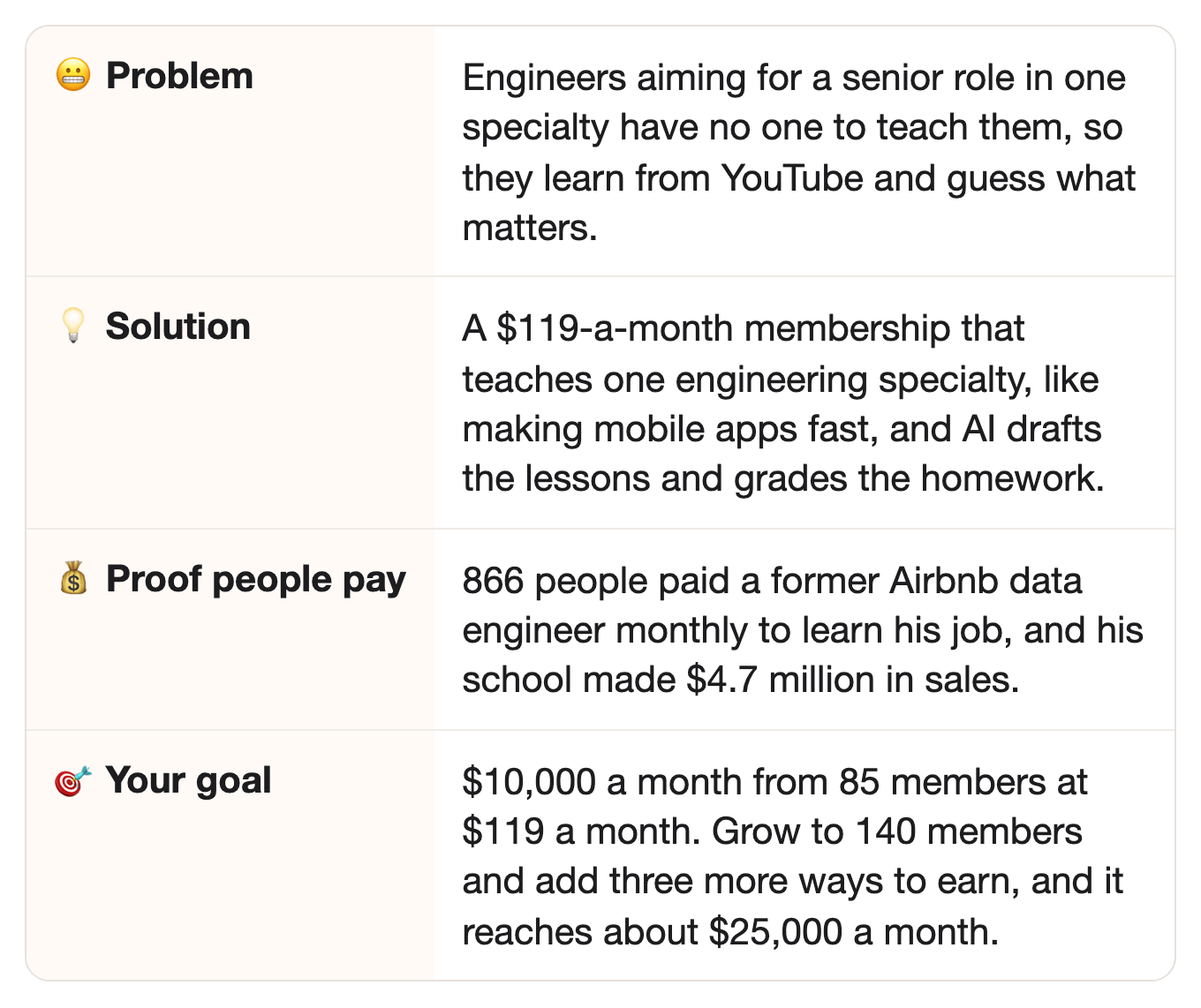
⠀
📖 How one engineer turned his day job into $4.7 million
It started with what he already did at work.
Meet Zach Wilson, a data engineer.
Quick translation: data engineers build the pipes that move a company’s data, so everyone else can use it.
And where has he worked?
He says he “led teams of data engineers and software engineers at Airbnb, Facebook, and Netflix.”
Then he starts posting what he knows online, and people follow.
In March 2023, he starts DataExpert.io, a school for data engineers.
⠀In November 2023, he writes a post with a bold title.
“How I quit my $600k data engineering job at Airbnb and made $600k in 7 months from content creation and teaching.”
Yep, that’s the real title.
His prices are simple.
$119 a month for the membership.
$4,500 for a 10-week live boot camp, with weekly Q&As and a community.
Here’s the thing: he gives a whole boot camp away free on YouTube, and it points viewers to the paid one.
Some of it is free, and some of it is paid.
⠀
So how’s it going?
When we checked, 866 people paid him every month, and the business had made $4.7 million in sales.
TrustMRR is a site that shows a business’s sales, pulled straight from its payment account.
His numbers there are public.
Cha-ching! 💰
He went from a data engineering job at Airbnb, to $4.7 million in sales, by teaching other engineers the job he used to do.
⠀
🔗 Same idea, new group
In the story: data engineers paid Zach Wilson $119 a month to learn the job he did at Airbnb.
⠀In this idea: engineers in another specialty, like keeping big systems running or making mobile apps fast, need a teacher who has done their job.
⠀Why it carries over: in every specialty, companies rarely teach it, so engineers will pay someone who has done the job.
⠀
💡 The opportunity
Every tech specialty needs a teacher who’s done the job, like Zach is for data engineering.
First, what’s a specialty?
It’s one deep corner of engineering, like data engineering or making mobile apps fast.
Another is site reliability engineering (SRE), which keeps big systems running.
Another is analytics engineering.
⠀
The buyers are engineers who want to move up in one specialty.
Some are two to five years in, and want the senior job.
Some want to switch into the specialty from another team.
⠀
Spoiler: their company rarely teaches it.
Our guess: their manager is busy, and the senior engineers don’t have time.
Free videos teach one tool at a time, not the whole path.
And a live boot camp? It can cost $4,500.
⠀
So they learn it alone, bit by bit.
They watch YouTube, and guess what matters.
⠀
👉 The idea: teach your one specialty to other engineers, as a monthly membership with a community.
⠀
🙋 No years in a specialty? You can still build this.
Team up with one.
A senior engineer brings the know-how and the face.
You build the lessons with AI, and find the members.
⠀
Or use your own specialty.
Product management, design, data analysis: the steps are the same.
⠀
✅ Why this could work
Three reasons this can pay.
Someone already makes tens of thousands a month with this model, and others have done it too.
Zach makes $55,200 a month from 866 members.
And he’s not the only one.
Josh Comeau, a staff engineer (a senior engineering role), left his job to teach CSS to JavaScript developers.
CSS is the code that controls how a web page looks.
He sold almost 5,000 copies of his course, about $550,000, in one week of pre-orders (March 2021).
Jeffrey Way teaches Laravel, one framework (a ready-made toolkit for building websites), on his site Laracasts.
He was running it by 2014, and it still charges $25 a month.
⠀
People have paid to learn tech skills online for about 20 years.
Pluralsight started in 2004 as classroom training for developers, then moved to online video.
In December 2020, it agreed to be bought for $3.5 billion. 🔁
Yes, billion, with a b.
⠀
Engineers already look for this, a lot.
Zach’s YouTube channel has about 265,000 subscribers. 👀
There’s more proof in the next section.
⠀
👉 Don’t take my word for it. Every number is linked in “📎 The sources,” at the very end.
⠀
📊 More proof people want this
Want more? Here you go.
People already pay for this kind of teaching.
DataExpert, Zach’s $119-a-month membership, has 669 reviews on Trustpilot, a review site, rated 4.9 out of 5.
⠀
Big tool courses sell too.
Apache Spark is a tool for crunching huge amounts of data.
One Apache Spark course on Udemy, a big course site, has 18,340 ratings, listed at $139.99.
⠀
Zach’s free videos draw a crowd.
His free boot camp launch video on YouTube has more than 411,000 views.
His channel has more than 8 million views in all.
⠀
Engineers search Google for it every month.
“data engineering course” gets 1,900 searches a month in the US.
“data engineering bootcamp” gets 720 more.
⠀
The big picture: the US has about 1.9 million software developer and tester jobs. 💰
What his viewers say.
“I just landed my first data engineering opportunity because of you zach, you are amazing!”
That’s a comment under one of Zach’s YouTube videos.
⠀
And another viewer.
“I applied some of these concepts in my job and it actually made a difference.”
That one is under one of his free boot camp lectures.
⠀
👉 Engineers want someone who’s done the job to show them the path, not just more videos.
⠀
🔍 Who’s already doing it
One big name in data, and other specialties where we found no one like him.
Zach, from the story above, teaches data engineering.
His whole brand is data.
Mobile engineers make apps fast, and site reliability engineers keep big systems from going down.
Those are different jobs.
⠀
The big course sites teach tools, from thousands of teachers.
Udemy and Pluralsight sell one course at a time.
There’s no single engineer walking members through a path, week by week.
⠀
Other specialties have courses, but no one like Zach, when we checked.
A quick search found courses and one-day workshops for mobile app speed and for site reliability engineering (SRE).
We didn’t find a big-tech engineer running a monthly membership with a community for them, like Zach’s.
⠀
Still missing when we checked:
One experienced engineer, teaching one specialty.
A monthly price, with graded homework, a weekly live Q&A, and a community.
A free boot camp (a short, intense course) on YouTube that leads to the paid one.
⠀
🔎 Check the market yourself in 2 minutes: run Part 0 of the prompt in the build plan below.
Your AI searches courses, boot camps, and memberships for your specialty that day, and tells you: early, growing, or crowded.
Early? Start now.
Crowded? Good news: it means engineers pay. Pick a narrower level or group (Step 1 of the build plan).
A crowded market is still OK. You win by being the one engineer they trust for one specialty, not by being first.
⠀
👉 That’s the gap you can fill: a monthly membership where one experienced engineer teaches one specialty other than data, like SRE or mobile app speed.
⠀
🤖 Why AI won’t replace it
AI can explain a tool. You show them how it’s done at a real company.
You’ve worked on real systems, at real scale.
One of Zach’s most-watched videos is about handling 2,000 terabytes of data a day at Netflix.
AI has read about systems like that. You’ve kept one running.
⠀
You pick what matters.
A mid-level engineer doesn’t know what to learn first.
You pick the five things that matter, and say what to skip.
⠀
You give them a path, with homework someone checks.
Could ChatGPT just lay out a study plan?
Sure, but it only knows what to focus on once someone who’s done the job tells it.
Your membership gives them a six-week plan, labs, graded homework, and a final project.
⠀
They learn next to other engineers. 👥
A community to ask, compare notes with, and stay on track with.
⠀
They get a face to follow.
You’re there for the big moves: the interview, the promotion, the switch to a new team.
⠀
Proof people pay for this: Zach posts free boot camp lectures on YouTube, some almost four hours long.
And 866 members still paid him $55,200 a month when we checked.
⠀
👉 They pay for the path and the people, not just the facts.
⠀
💵 How much you can make
Let’s run the numbers.
First stop: $10,000 a month from the membership alone
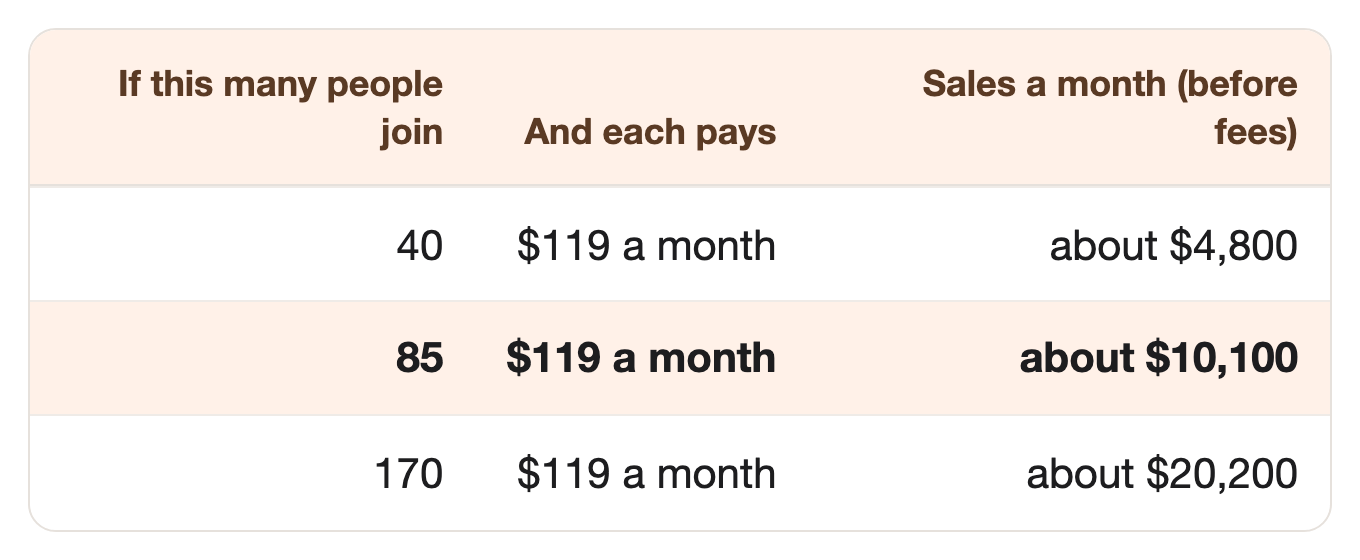
85 members is about a tenth of Zach’s 866.
Next stop: $25,000 a month, with three more ways to earn
Once engineers trust your lessons, their companies and the keenest members buy more.
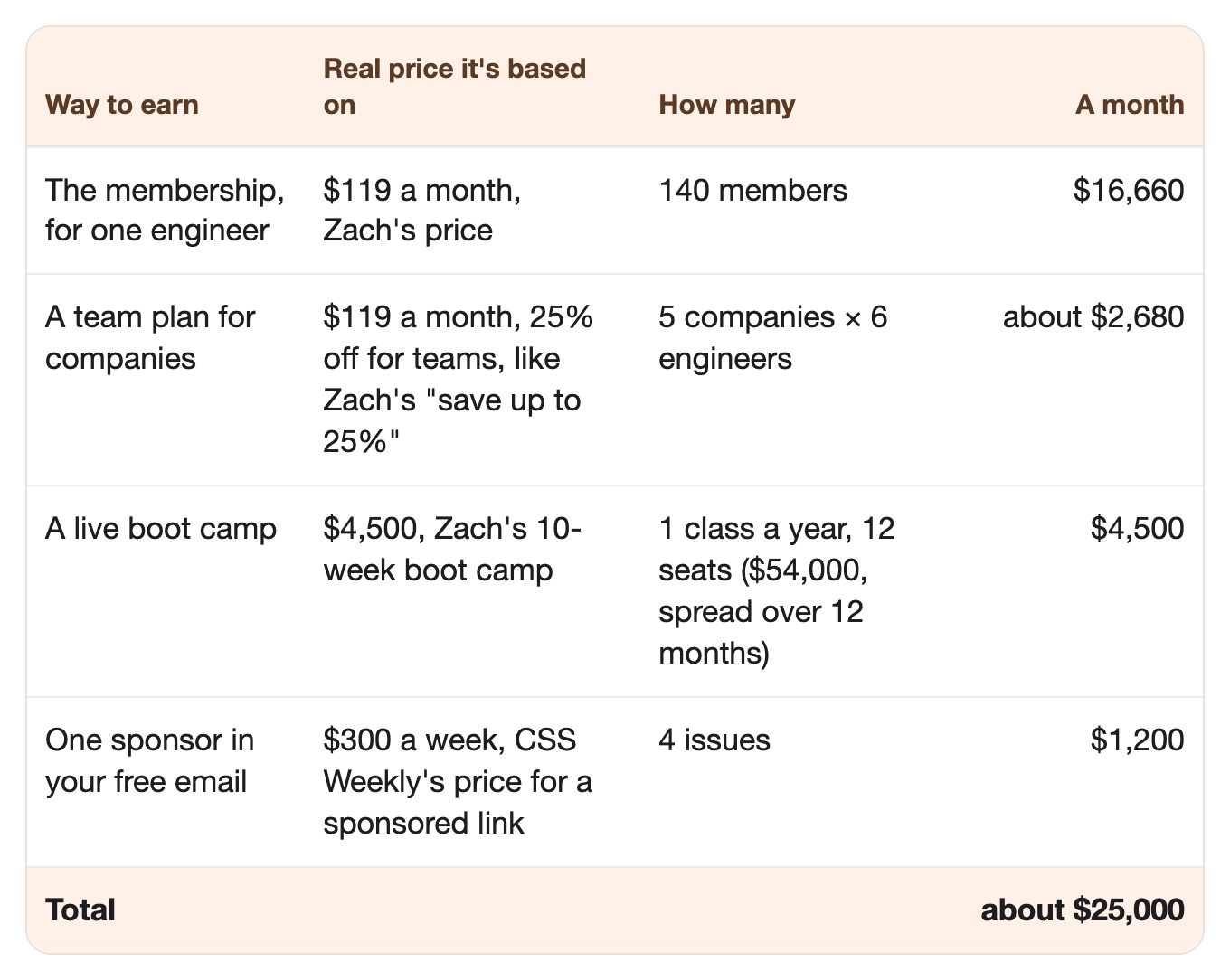
The membership still does most of the work.
Grow it from 85 to 140 members, and it brings in $16,660 a month.
That’s still about a sixth of Zach’s 866.
⠀
The boot camp is the big jump.
Run one 10-week class a year, with 12 seats.
That’s 12 of your 140 members, so it’s the hardest sale here.
Spread over the year, that’s about $4,500 a month.
⠀
The team plan sells to companies that want to train a whole team.
One manager signs up, and six engineers get in at $89.25 a month each.
⠀
The sponsor is small, but it takes almost no time.
The sponsor only works once your free email reaches a few thousand engineers.
CSS Weekly, a free weekly email for website builders, says it has 43,000 subscribers, so a smaller email may get less.
⠀
That’s 170 members, plus 12 boot camp seats a year.
Zach’s school had 866 paying members when we checked.
⠀
And if it doesn’t work, here’s everything you lose:
One month’s subscription to an AI app, like ChatGPT or Claude.
A Discord server for your community, which is free to start.
One week of your time.
⠀
👉 One idea, four ways to earn: about $25,000 a month.
Run two or three of these, from this newsletter or a niche close to this one. Together, they could pass a million dollars in total in two or three years.
For this membership, a niche close to this one could be site reliability engineering. And this membership could be your first idea.
Is your brain already buzzing? 🐝
Then scroll on. The build plan is below. 👇
Not feeling it? All good. Another idea comes next week.
That’s it, my fellow contrarians! 🙌
Yours ‘helping you spot the gaps the big players ignore’ Vijay Peduru 🦸♂️
⠀
⠀
⠀
🧰 Want to build it? Here’s everything else.
In every step, AI does most of the work. You mostly talk. 🎙️
⠀
Step 1: 🧠 Pick your specialty and get it out of your head
Good news: you don’t need to write a textbook. AI interviews you, then turns it into a plan.
Pick one specialty and one level, not a whole field.
For example: “data engineering for analysts moving up,” not “data.”
Or “making Android apps start fast,” not “mobile.”
Let AI interview you.
The problems you solved, the mistakes you made, and what you’d teach a new hire first.
Use only your own know-how, never your company’s private code, data, or names.
🎙️ Talk, don’t type.
Use voice mode in the ChatGPT or Claude app, or a dictation app like Wispr Flow.
Ramble like you’re teaching a new teammate at a whiteboard. The AI cleans it up.
⠀
Step 2: 🛠️ Build the lessons
Six weeks, one skill a week, each with a lab and homework.
Turn your interview into a six-week plan.
Each week has one skill, a short lesson, a hands-on lab, and homework.
Week six ends with a final project they can show in a job interview.
Let AI draft each lesson from your interview, in your words.
Record yourself teaching it. Your face and your stories are what they pay for.
Nervous on camera? That’s fine. Nobody needs a perfect first take.
⠀
Step 3: 🔍 Check every lesson
Engineers will spot a wrong command in seconds, so every lesson gets two checks after it’s written.
Your AI does all three passes for you: it writes in Part 3, and checks in Part 4 of the prompt.
🖊️ The AI writer. It drafts each lesson from your interview and the tool’s official docs.
🔍 The AI checker. A second pass opens every docs link, and runs every code example.
🧐 The AI critic. A third pass reads it like a tough senior engineer, and flags anything outdated or vague.
Optional: ask one senior engineer friend to review the first two weeks before launch.
⠀
👉 The prompt already follows three safety rules: no employer secrets, every code example tested, and no promised job or raise.
⠀
Step 4: 🏪 Open the membership
Easy one: copy Zach’s monthly price, and make it easy for a company to pay.
Set your prices.
$119 a month, like Zach.
Two free weeks, so engineers can try it first.
Later, a live boot camp, like Zach’s $4,500 one.
A team plan for companies, up to 25% off, like Zach’s.
Add a weekly live Q&A and a Discord community for members.
Let AI write your sales page, using real lessons as examples.
Make it easy to expense. Send a proper receipt, so members can ask their company to pay.
⠀
Step 5: 📣 Get your first members
Teach where engineers in your specialty already read, and let them watch you build it.
Write one free deep-dive for a bigger engineering newsletter in your specialty.
Pick your strongest work story, like “how we cut our data bill in half,” and teach the whole fix.
End with one line about your membership and its two free weeks.
Leave one useful answer early under the top LinkedIn posts in your specialty every day.
Turn on alerts for the five biggest accounts, and add a real fix or a missing step within minutes.
Keep the membership link in your profile, not in the reply.
Start a free weekly email with one fix from your specialty.
Engineers who aren’t ready to pay still hear from you every week.
Later, this is where your sponsor goes.
Post a 90-day member goal, and a weekly “what didn’t work” note.
Share the live member count, the lesson that didn’t work, and what you changed.
Engineers trust a builder who shows the bugs, not just the wins.
⠀
Step 6: 🏃 Eliminate competitors
When others copy you, here’s how you stay the one people pick.
Show “Member since [month]” in the community.
Put the date next to each member’s name, so each one sees a streak worth keeping.
A copycat can match your lessons, but not a member’s two years with you.
Let your first 30 members vote on which module you build next.
Put them in one channel, and post three module ideas each month.
The path then fits their real jobs, and a rival is left guessing.
⠀
Step 7: 🎲 Make it bigger
Every specialty you know can be its own membership.
Add the three extras from “How much you can make,” one at a time.
First the team plan, since your lessons are already built.
Then a live boot camp for members who want more, like Zach’s 10-week one.
Then one sponsor, once your free email has a few thousand engineers.
Bring in partner teachers for other specialties, and split the money.
One membership at about $25,000 a month is about $300,000 a year, before fees. 🎯
Add two or three more memberships, or ideas from this newsletter, and a million dollars in total is two or three years away.
⠀
🗓️ Your first week
Phew. That was a lot. 😅
Here’s a first version of Steps 1 to 5, in seven days. 🚀
By day 7, you have a six-week plan, your first lesson, a sales page, and a guest deep-dive.
Quick heads-up: the prompt below has seven Parts, and they’re not the same as the Steps above.
Day 1 (Step 1): Let AI interview you with Part 1 of the prompt (it’s below).
Day 2 (Step 2): Build your six-week plan with Part 2.
Day 3 (Step 2): Write your first lesson with Part 3, and record it.
Day 4 (Step 3): Check the lesson with Part 4.
Day 5 (Step 2): Make the homework and its grading guide with Part 5.
Day 6 (Step 4): Write your sales page with Part 6.
Day 7 (Step 5): Draft your guest deep-dive with Part 7, and send the pitch.
⠀
🏄 How to use the prompt
One prompt does all the AI work, in seven parts, plus a quick market check (Part 0).
Part 1 — Interview me. Pulls your know-how out of your head, one question at a time.
Part 2 — Plan the six weeks. Turns the interview into a six-week path, one skill a week.
Part 3 — Write a lesson. Drafts one week’s lesson and lab, in your words.
Part 4 — Check the lesson. Opens every docs link, runs every code example, and flags anything outdated.
Part 5 — Make the homework. Writes the homework and a grading guide, then grades a member’s answer.
Part 6 — Write the sales page. Uses your real lessons as examples.
Part 7 — Write the guest deep-dive. Turns one real work story into a free piece for a bigger newsletter.
Run it your way:
Part by part (the default): it pauses after each part, and you type “next” to go on.
All at once: say “run all seven parts.”
Just one part: say “only do Part 4,” or any part you need.
The full prompt is just below, under “📋 The prompt.”
🎙️ Talk to your AI sidekick, don’t type.
Turn on voice mode, or use a dictation app like Wispr Flow.
Say it messy. The AI sorts it out.
Turn it into a skill, so you never paste it again.
Paste the prompt into Claude or ChatGPT, and say: “Turn this into a skill I can save.”
Install once, use forever.
⠀
📋 The prompt
The prompt (copy it into Claude or ChatGPT, fill in the INPUTS part, and run it your way)
CONTEXT:
- You're my partner in building a paid membership that teaches my one engineering specialty to other engineers.
- This prompt has seven parts, in order.
- Run it the way I ask:
    - If I say nothing, go one part at a time. After each part, show me the result, then stop and wait. Move on only when I type "next."
    - If I say "run all seven parts," do them all without stopping.
    - If I say "only do Part 4" (or any part), do just that part.
- If a part needs something from me, ask for it before you start that part.
- Use only what I tell you and the official docs of the tools we teach. Never invent a fact, a command, or a number.
- Skip anything that looks like my company's private code, data, or names, and tell me what you skipped.
- Never promise a job, a raise, or a promotion, in any part.
- I'll often answer by voice, so expect long, messy answers. Don't ask me to tidy them.
- Keep web search on for the whole prompt (turn on search in ChatGPT or Claude), so you can open any page you need to check.

=============== INPUTS — edit these, or just run as is ===============

My specialty and the level I teach:
{e.g. data engineering, for data analysts moving up to their first data engineering job}

Where I learned it:
{e.g. six years building data pipelines at a large online store}

Who it's for:
{e.g. engineers two to five years in, who want the senior job}

My prices:
{e.g. $119 a month with two free weeks, and later a 10-week live boot camp}

======================== END OF INPUTS ========================

THE PARTS:

Part 0 — Check the market today.
This part needs web search (turn on search in ChatGPT or Claude). Search for paid help for my specialty and level and, for each place, give the count, the three biggest with links, and their prices:
1. Memberships and communities taught by one engineer.
2. Live boot camps and cohort courses (for example on Maven).
3. Courses on Udemy, Pluralsight, and similar sites.
4. The biggest free YouTube channels, newsletters, and podcasts for it.
Then tell me: early (few sellers), growing, or crowded, and which narrower level or group looks least served (for example: career switchers, mobile engineers at startups, engineers at small companies). Give a link for every number. If you can't open a page, say so. Never guess a number.

Part 1 — Interview me.
Interview me about my specialty. Ask one question at a time, and ask for a real story each time, not general advice. Cover:
1. The problems I solved, and how.
2. The mistakes I made, and what I'd do now.
3. What I'd teach a new teammate in their first month.
4. What most people learn too early, or never learn.
When an answer is vague, ask "What did you actually do?" After each answer, give a two-line summary. At the end, list my ten strongest stories.

Part 2 — Plan the six weeks.
Turn the interview into a six-week path for the people in my INPUTS. For each week:
1. The one skill, in plain words.
2. Why it comes in this order.
3. A hands-on lab they can do on a free or low-cost tool.
4. The homework, and what "done" looks like.
End week six with a final project they can show in a job interview. Mark any week where you're guessing what matters, so I can fix it.

Part 3 — Write a lesson.
Ask me which week to write first. Then write the lesson in my words, using my stories from Part 1:
1. The skill in one sentence.
2. Why it matters at work, with one of my real stories.
3. The steps, with code examples, each linked to the tool's official docs.
4. The lab, step by step.
5. Three questions to check they understood, with the answers at the bottom.

Part 4 — Check the lesson.
Now act as a separate checker who didn't write this lesson. Open every docs link and confirm each step matches. Run or trace every code example, and mark it: works, broken, or can't test. Flag anything outdated, anything vague, and anything that looks like private company information. Then act as a tough senior engineer and list what a beginner would get stuck on. Give the fixed lesson.

Part 5 — Make the homework.
Write the homework for this week, plus a grading guide with what a pass, a near-miss, and a fail look like. Then ask me to paste a member's answer, and grade it against the guide, with two things done well and two to fix. Never give the full answer away.

Part 6 — Write the sales page.
Ask me for my best lesson and my strongest work story first. Never invent a result, a review, or a number. Give me:
1. A headline that names the specialty and the next step, not the whole field.
2. Who it's for, and who it's not for.
3. The six-week path, week by week.
4. What they get: the lessons, the homework, the weekly live Q&A, the community.
5. The prices, shown up front, and "Cancel in one click."
6. A short note they can send their manager to get it expensed.
Never promise a job, a raise, or a promotion.

Part 7 — Write the guest deep-dive.
Ask me which work story from Part 1 to use, and which bigger newsletter in my specialty I'm pitching. Then give me:
1. A three-line pitch to that newsletter's writer: the problem, what readers will learn, and why I'm the one to teach it.
2. The deep-dive itself, 800 to 1,200 words, in my words: the problem, what I did, the steps, and the lesson they can use this week.
3. One closing line about my membership and its two free weeks, never a hard sell.
Never use my company's private code, data, or names. Then give me five more stories from my interview that would make good deep-dives.
⠀
📎 The sources
Every number above, with where it came from.
DataExpert’s sales · Number: $4,744,943 all-time; $55,200 a month from 866 active subscriptions; $119 a month; founded March 2023; checked through Stripe · Source: TrustMRR
Zach’s background · Number: “I have led teams of data engineers and software engineers at Airbnb, Facebook, and Netflix.” · Source: DataExpert.io, About
Zach’s post · Number: “How I quit my $600k data engineering job at Airbnb and made $600k in 7 months from content creation and teaching,” November 12, 2023 · Source: DataExpert.io Newsletter
The live boot camp · Number: $4,500 one-time; 10 weeks; weekly Q&As with Zach; a learning community · Source: DataExpert.io
Zach’s YouTube channel · Number: About 265,000 subscribers; about 8.0 million views; free boot camp launch video 411,793 views; Netflix video 445,525 views · Source: YouTube Data API (channel, launch video, Netflix video, an almost four-hour free boot camp lecture)
Josh Comeau’s launch · Number: “sold almost 5000 copies”; “about $550k in that one week”; $129 Early Access, March 2021; staff software engineer at Gatsby · Source: Failory interview, August 31, 2021
Laracasts · Number: Run alone for about six months by June 2014; Way was “the head of web development courses at Tuts+” · Source: Laravel News, June 13, 2014
Laracasts price · Number: $25 a month · Source: Laracasts
Pluralsight’s start · Number: Founded in 2004 as a classroom training company; online video by 2007 · Source: Wikipedia
Pluralsight’s sale · Number: “Acquired by Vista Equity Partners for $3.5 Billion,” agreement of December 13, 2020 · Source: Pluralsight press release
Team discount · Number: “Buy for Team,” “Save up to 25%” · Source: DataExpert.io
Sponsor price · Number: “Sponsored Link $300,” one sponsor a week; “Email Subscribers 43,000” · Source: CSS Weekly
DataExpert reviews · Number: 669 reviews, rated 4.9 · Source: Trustpilot
Udemy Spark course · Number: 18,340 ratings; list price $139.99 (price read in a browser) · Source: Udemy: Taming Big Data with Apache Spark 4 and Python
Google searches · Number: “data engineering course” 1,900 a month; “data engineering bootcamp” 720 a month · Source: Ubersuggest, US
Software developer jobs in the US · Number: 1,905,400 software developer, QA analyst, and tester jobs in 2025; about 106,100 openings a year, on average, 2025–35 · Source: US Bureau of Labor Statistics
Comment: the new job · Number: “I just landed my first data engineering opportunity because of you zach, you are amazing!” · Source: YouTube comment, November 2024
Comment: at work · Number: “I applied some of these concepts in my job and it actually made a difference” · Source: YouTube comment, December 2024
Competition check · Number: Courses and one-day workshops for mobile app speed and SRE; no big-tech engineer’s monthly membership found · Source: Web search