


Hello contrarians,
Today’s idea is called The Insurance Explainer.
Grab a snack. 🍪
First, a hedge fund manager’s story. Then, the business you could build from it.
⠀
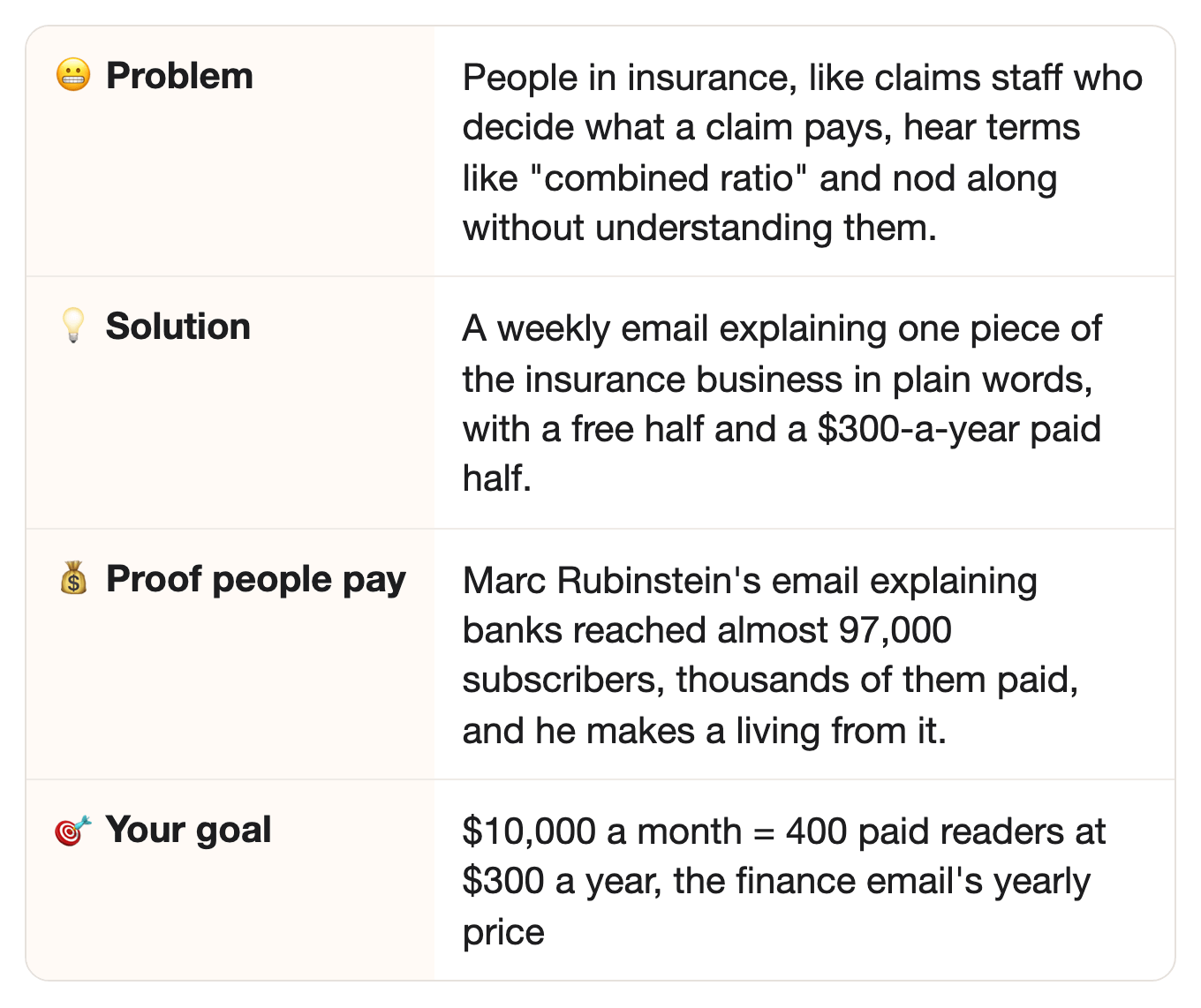
⚡ Quick facts
⠀
📖 How one hedge fund manager made a living from a weekly email
He spent more than 20 years judging banks for a living. And then his fund closed.
Marc Rubinstein graduated from Oxford in 1994 and soon went to work in the City of London, the UK’s money district.
His very first job: studying bank stocks at BZW, which was Barclays’ investment bank at the time.
Later, he ran the European bank research team at Credit Suisse for more than six years.
Then, in 2006, he joined Lansdowne, one of Europe’s biggest hedge funds.
A hedge fund invests money for wealthy people and big institutions.
He was a partner there, running a fund that bought shares in banks and other financial companies.
It also bet that some of those shares would fall.
He did that for almost ten years.
But after the 2008 crash, the opportunities shrank.
After 2011, he said, it was “really a single trade around two things, interest rates and regulation.”
And in 2016, the fund closed.
Ouch.
⠀
So what did he do next?
He went back to school, for an MBA at London Business School.
Then, in 2020, he wrote that he had decided to publicly share what he’d learned investing in financial companies.
His first weekly email went out in May 2020.
He called it Net Interest.
Each week, it takes one trending finance topic and explains it “in an easy-to-read style.”
Insider tip: he gives away half of every issue.
Paid subscribers unlock “the most valuable half,” behind a paywall.
The price: $30 a month, or $300 a year.
By December 2025, Net Interest had almost 97,000 subscribers.
And he said he makes a living from it.
By May 2026, Substack’s badge on his page said “Thousands of paid subscribers.”
Holy smokes. 🔥
Our rough math: “thousands” means at least 1,000 paid readers, and 1,000 readers at $300 a year is $300,000 a year.
The badge only gives a range, and some readers pay monthly instead, so that’s our estimate, not a number he has shared.
From shutting down his hedge fund… to making a living from one weekly email, by explaining banks in plain words.
⠀
🔗 Same idea, new group
In the story: finance readers paid Marc $300 a year for a weekly email that explains banks in plain words.
⠀In this idea: people who work in insurance, like underwriters, claims staff, and new hires, need the same plain explainer for their own industry.
⠀Why it carries over: both industries speak in insider jargon, and even Marc says insurance is harder to understand from the outside than banking.
⠀
💡 The opportunity
Insurance is even harder to understand than banking, and the people who work in it have to learn it on the job.
Wait, who are the buyers here?
People who work at insurance companies, but don’t sell the policies.
Underwriters decide whether to insure something, and at what price.
Claims adjusters decide what a claim pays, like how much the company pays when your car gets hit.
Add analysts, operations people, and new hires in every department.
⠀
There are a lot of them.
About 2.9 million people worked at insurance companies and related businesses in May 2026.
Across all US employers, there were 127,000 underwriters and 365,300 claims jobs, in 2024.
⠀
And new ones start every year. 🔁
About 8,200 underwriter openings and 21,600 claims openings are expected each year (government projections).
Our guess: many go to people new to the job, learning the words from zero.
⠀
Here’s the hidden part: the words are written by insiders, for insiders.
Here’s how one insurance glossary starts its definition of combined ratio: “the sum of two ratios, one calculated by dividing incurred losses plus loss adjustment expense (LAE) by earned premiums.”
Not exactly plain English, is it?
In plain words: out of every dollar customers pay, how many cents go out in claims and costs.
Under 100% means the company made money from insurance itself, not counting what it earns by investing customers’ money.
⠀
Even a finance expert says insurance is hard to understand from the outside.
Remember Marc Rubinstein, the bank guy from the story?
He told Institutional Investor that you don’t really know what’s going on inside a bank.
Then he added: “Insurance is even more opaque.”
And that’s from someone who judged banks for more than 20 years.
⠀
And these numbers make the news.
In January 2026, a forecast came out for US home, car, and business insurers.
It said 2025 was on track for their best combined ratio in over a decade.
That’s the kind of news that ends up on a slide at an all-staff meeting.
⠀
👉 The idea: a weekly email that explains one piece of the insurance business in plain words, for the people who work in it.
The free half explains the term or the news.
The paid half says what it means for claims and underwriting work, at $300 a year, like Net Interest.
⠀
🙋 Never worked in insurance? You can still build this.
Team up with someone who has.
An underwriter or claims pro with ten years in brings the inside view, and checks every issue.
You write it, run it, and grow it.
⠀
Let your AI read what insiders already say.
Claims and underwriting staff already post their first-year questions on LinkedIn and in industry forums.
Your AI reads those posts and turns the most common questions into topics.
⠀
Or use your own industry.
Does your industry have its own words?
Then the same weekly explainer works there too, like it would for shipping, drug companies, or energy.
⠀
Already in insurance? Your years inside are the whole qualification.
Just one rule: use only public sources, never your employer’s private information.
⠀
✅ Why this could work
Why this one can work, in three points.
Net Interest isn’t a one-off.
Out-Of-Pocket does the same thing for healthcare.
It says it’s making the business of healthcare easy to understand, for 31K+ readers.
It also sells a Healthcare 101 crash course for $1,200.
And the course page says it has seen a lot of interest from new hires at companies new to healthcare.
New hires, a lot like the readers this idea is for.
⠀
Insurance already has paid insider reading.
P&C Insurance Executive Intelligence is a paid newsletter about insurance strategy.
It charges $30 a month, or $200 a year, and it’s written for leaders and executives.
P&C means property and casualty: home, car, and business insurance.
And insurance people have read their own trade news for over 125 years.
AM Best, an insurance rating agency that also publishes news, was founded in 1899.
A rating agency grades whether an insurer has enough money to pay its claims.
⠀
Every year, a new crowd starts knowing nothing.
Those ~29,800 yearly openings mean a fresh set of readers every year.
So you don’t run out of people who need the basics.
After all, none of them was born knowing what “loss adjustment expense” means.
It’s what the company spends to handle a claim, like the adjuster’s time and lawyers, on top of the payout itself.
⠀
👉 Like to check the numbers yourself? The links are all in “📎 The sources,” at the very end.
⠀
📊 More proof people want this
Want more? Here you go.
Companies buy courses for groups of staff, readers keep paying for old issues, and these jobs pay well.
Crash courses for new staff are sold to whole groups.
Out-Of-Pocket’s $1,200 course offers group discounts, so a company can buy it for several employees at once.
The people it lists include employees who know one slice of the industry and want to learn the rest.
⠀
Readers inside the industry say why they read it.
A vice president at a healthcare tech company, on Out-Of-Pocket’s homepage: “A how things work newsletter about our most convoluted - and important - industry.”
Note who calls it “convoluted”: someone who works in it.
⠀
Old issues keep their value.
Net Interest’s paid readers get a searchable archive of over 250 evergreen issues.
Evergreen means they’re still useful years later.
It says it’s read by over 95,000 people.
⠀
The pay in these jobs is solid. 💰
The median underwriter, the one in the middle of the pay range, earned $79,880 in 2024.
The median claims adjuster or examiner earned $76,790.
So $300 a year is a small cost to get better at their own job.
⠀
👉 Investors already pay to understand banks.
Healthcare staff already pay to understand their own industry, too.
Insurance staff hear the same kind of jargon every day, in an industry that’s even harder to understand.
⠀
🔍 Who’s already doing it
Four kinds of sellers already exist, and none of them write for claims staff, underwriters, and new hires.
Insurance news sites report what happened.
AM Best and other trade news sites cover deals, ratings, and results.
Trade news means news written for people in one industry. It has nothing to do with stock trading.
Your issue is different: it explains what the words mean, and why the news matters to someone in claims or underwriting.
⠀
P&C Insurance Executive Intelligence is for leaders.
It’s written for strategy, product, and executive leaders.
⠀
Net Interest is about finance, for investors.
It covers banks and fintech, and sometimes insurance, from an investor’s side.
Fintech means finance apps and startups, like online banks and payment apps.
⠀
Out-Of-Pocket is only about healthcare.
⠀Still missing when we checked:
A plain-English weekly built for claims staff, underwriters, and new hires in one kind of insurance.
At a price one person can pay, without a company budget, plus a team price for managers.
⠀
🔎 Check the market yourself in 2 minutes: run Part 0 of the prompt in the build plan below.
Your AI searches Substack, LinkedIn newsletters, trade sites, and course sites that day.
Then it tells you: early, growing, or crowded.
Early? Start now.
Crowded? Good news: it means people pay. Pick one narrower reader (Step 1 of the build plan).
A crowded market is still OK. You win by serving one kind of reader better, not by being first.
⠀
👉 That’s the part nobody else offers.
A weekly, plain-English explainer for the people inside one kind of insurance.
⠀
🤖 Why AI won’t replace it
Could ChatGPT just do this? Sort of, if someone gives it the right reports, the right context, and checks the answer. Your issue does that work every week.
🔮 Honest note: AI agents can already read a company’s report and sum it up on their own.
So the summary isn’t the product.
The product is picking the one thing that matters each week for a claims or underwriting person, and explaining it from the inside.
⠀
1. You pick what matters.Every week brings dozens of reports, rate filings, and news stories.
A rate filing is an insurer asking the state to approve a price change.
A busy adjuster doesn’t know which one touches her job, so she doesn’t know what to ask.
⠀
2. Checked twice.Every number goes back to its public source, then a second pass reads it like a veteran underwriter.
Picture repeating a wrong number in front of your coworkers.
Yikes.
So readers trust the writer who never gets one wrong.
⠀
3. Sounds like a coworker.A writer who did the job, or works with a partner who did, sounds like a coworker, not a textbook.
⠀
4. Ready to use.One idea, one email, ten minutes, with no prompt to write.
⠀
5. Proof people pay for the finished issue: thousands pay for Net Interest, even though the reports it explains are free to read.
⠀
👉 The facts are free. People pay for the finished, checked issue.
⠀
💵 How much you can make
Grab a calculator. Just kidding, here it is.
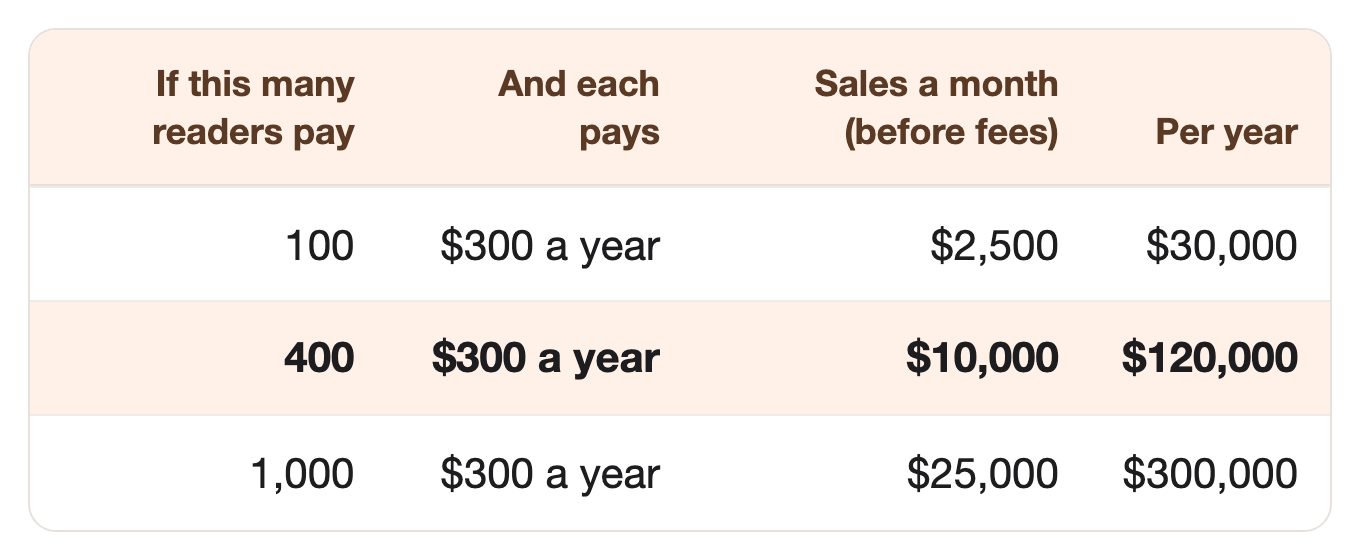
At $300 a year, Net Interest’s yearly price, 400 paid readers bring in $10,000 a month.
⠀400 readers is under 2% of one year’s openings for underwriters and claims staff.
That’s 8,200 plus 21,600, or about 29,800 openings a year.
⠀
And if it doesn’t work? Here’s all you lose:
Nothing for Substack, which is free to start and takes a share of sales only once you charge.
One month’s subscription to an AI app, like ChatGPT or Claude.
One week of your time.
⠀
👉 Add three more ideas at $10,000 a month each, and the yearly total gets close to half a million.
Itching to build this one?
The step-by-step plan is right below. 👇
Just browsing? All good. A new idea comes next week.
That’s it, my fellow contrarians! 🙌
Yours ‘helping you skip the guesswork and start with proof’ Vijay Peduru 🦸♂️
⠀
⠀
⠀
🧰 Want to build it? Here’s everything else.
⠀
Step 1: 🎯 Pick one reader and one kind of insurance
“Insurance” is too big. Pick one reader and one kind of insurance.
Good news: you only need to explain one small corner of it.
Pick one reader.
Claims staff, underwriters, analysts, or people in their first two years at an insurer.
Pick one kind of insurance.
Home, car, and business insurance (property and casualty).
Or life insurance and annuities, or health insurance.
An annuity is a deal where you pay an insurer now, and it pays you a steady income later, often in retirement.
List the first 12 topics.
The terms and numbers your reader hears but nobody explains.
Your AI turns your notes, or the questions insurance staff already post on LinkedIn, into the list.
If you work in insurance, check your employer’s policy on outside work and public writing first.
Boring, but it matters.
⠀
Step 2: 🛠️ Make the first three issues
One issue is one idea: a term, a number, or a news story.
Gather the public sources.
Company reports and earnings calls, regulator pages, and published news.
Never your employer’s private information, or anyone else’s.
Write the free half.
What the term or news means, in plain words, with one simple example.
Write the paid half.
What it means for claims or underwriting work, the one number to watch, and what to ask at the next team meeting.
Keep each issue to about a ten-minute read.
⠀
Step 3: 🔍 Check every issue
Your readers will repeat these numbers at work, so every issue gets written once and checked twice.
The prompt below does all three passes for you: Part 3 writes the issue, and Parts 4 and 5 check it.
🖊️ The AI writer. It writes only from the sources you gathered in Part 2.
🔍 The AI fact checker. A second pass matches every number and quote to its source link, and flags anything without one.
🧐 The AI critic. A third pass reads it like a veteran underwriter, and then like a first-month claims hire.
Optional: pay an experienced insurance pro once, to review your first three issues.
⠀👉 The prompt already follows four safety rules:
Public sources only, never an employer’s private information.
No investment advice: no buy or sell calls on insurance company stocks.
No legal or coverage advice on anyone’s real claim or policy.
Every issue ends with a line saying it’s general education, not advice.
⠀
Step 4: 🏪 Open for paid readers
Copy Net Interest: a free half, a paid half, and one simple price.
The model is already right there to copy.
Set your prices.
$300 a year, like Net Interest.
$30 a month, also like theirs.
A team price for a manager who wants to buy for the whole claims or underwriting team.
Start on Substack. It’s free to start, takes a share of sales only once you charge, and handles the paywall.
Send every issue on the same day each week.
Let AI write your sales page and welcome email, using your first three issues as examples.
⠀
Step 5: 📣 Get your first readers
Go where insurance people already read, and let them bring their coworkers.
Record yourself for 30 minutes a week, answering three questions about one insurance term.
For example: “What does loss adjustment expense mean for a claims team?”
Turn the transcript into three LinkedIn posts, with the issue’s link in the post itself.
Swap Substack recommendations with two newsletters that insurance people read on a different topic.
Like an insurance-tech newsletter, or a career newsletter for people in finance jobs.
You recommend them, and they recommend you.
Open a waitlist before your first paid issue, where people move up the line for each coworker they bring.
Coworkers sit through the same all-staff meetings, so one reader can bring a whole team.
⠀
Step 6: 🏃 Eliminate competitors
Here’s how to stay ahead when the competitors show up.
Show your headline to your AI, and tell it to read as a claims hire in her first year.
Ask it who the newsletter is for, what it fixes, and why it beats reading the trade news.
Narrow the headline until it can answer all three, like “for claims staff in their first two years.”
Show each reader how long they’ve been with you.
Every year on their join date, send a short note: “Reader since [month],” with the three issues readers liked most that year.
Staying feels like a streak worth keeping.
⠀
Step 7: 🎲 Make it bigger
Every industry with its own words has the same three things: insiders, jargon, and new hires every year.
Sell team plans to managers who onboard new claims or underwriting staff.
Turn your best issues into an “Insurance 101” crash course for new hires, like Out-Of-Pocket’s course for healthcare.
Open a second edition for another kind of insurance, or another industry you know.
⠀
🗓️ Your first week
Phew. That was a lot. 😅
A first version of Steps 1 to 5 fits into seven days. 🚀
By day 7, you have three issues, a sales page, and your first LinkedIn posts.
Quick heads-up: the prompt below has seven Parts, and they’re not the same as the Steps above.
Day 1 (Step 1): Run Part 0 of the prompt (it’s below), then pick your reader and your 12 topics with Part 1.
Days 2–3 (Step 2): Gather each issue’s sources with Part 2, then write three issues with Part 3.
Day 4 (Step 3): Check the facts with Part 4, then find the mistakes with Part 5.
Day 5 (Step 4): Write your sales page and welcome email with Part 6, and set up Substack.
Days 6–7 (Step 5): Record your first self-interview, then turn it into posts, swap notes, and a waitlist message with Part 7.
⠀
🏄 How to use the prompt
One prompt does all the AI work, in seven parts, plus a quick market check (Part 0).
Part 1 — Pick the reader and the topics. Helps you pick one reader and one kind of insurance, and lists the first 12 topics.
Part 2 — Gather the sources. Finds and lists the public sources for one topic, with a link for every fact.
Part 3 — Write the issue. Writes the free half and the paid half, from those sources only.
Part 4 — Check the facts. Matches every number and quote to its source, and flags anything that breaks the safety rules.
Part 5 — Find the mistakes. Reads it like a veteran underwriter, and then like a first-month claims hire.
Part 6 — Write the sales page and welcome email. Uses your real issues as examples.
Part 7 — Write the first-reader messages. Turns your self-interview into three LinkedIn posts, and writes a recommendation-swap note and a waitlist message.
Run it your way:
Part by part (the default): it pauses after each part, and you type “next” to keep going.
All at once: say “run all seven parts.”
Just one part: say “only do Part 3,” or any part you need.
The full prompt is just below, under “📋 The prompt.”
🎙️ Talk to your AI sidekick, don’t type.
Turn on voice mode, or use a dictation app like Wispr Flow.
Say it messy. The AI sorts it out.
Turn it into a skill, so you never paste it again.
Paste the prompt into Claude or ChatGPT, and say: “Turn this into a skill I can save.”
Install once, use forever.
⠀
📋 The prompt
The prompt (copy it into Claude or ChatGPT, fill in the INPUTS part, and run it your way)
CONTEXT:
- You're my writing partner. Together we'll build a paid weekly newsletter that explains the insurance business, in plain words, to the people who work in it.
- This prompt has a market check (Part 0), then seven parts, in order. "Run all seven parts" means Parts 1 to 7; run Part 0 only when I ask.
- Run it the way I ask:
    - If I say nothing, go one part at a time. After each part, show me the result, then stop and wait. Move on only when I type "next."
    - If I say "run all seven parts," do them all without stopping.
    - If I say "only do Part 3" (or any part), do just that part.
- If a part needs something from me, ask for it before you start that part.
- Follow these rules in every part:
    1. Use only public sources: company reports, earnings calls, regulator pages, and published news. Never use private or confidential information from my employer or anyone else's.
    2. Never give investment advice. No buy, sell, or hold calls on any company's stock.
    3. Never give legal or coverage advice about a real claim or policy. Teach general ideas only.
    4. Never invent a fact, a number, or a quote. Every number gets a link to its source. If you're not sure a fact is right, leave it out.
    5. Name a company only to state a public fact about it, with its link. No rumors.
- End every issue with this line: "This is general education, not investment, legal, or coverage advice. Follow your own company's policies."
- Keep web search on for the whole prompt (turn on search in ChatGPT or Claude), so you can open any page you need to check.

=============== INPUTS — edit these, or just run as is ===============

Who the newsletter is for:
{e.g. claims staff in their first two years at a home and car insurer}

The kind of insurance:
{e.g. property and casualty: home, car, and business insurance}

What I know from my own work (or leave blank):
{e.g. 8 years as a claims adjuster, then 3 in claims operations}

This week's topic (a term, a number, or a news story):
{e.g. "What does combined ratio mean, and why did the CFO smile?"}

My prices:
{e.g. $300 a year, $30 a month, a team price for managers}

======================== END OF INPUTS ========================

THE PARTS:

Part 0 — Check the market today.
This part needs web search (turn on search in ChatGPT or Claude). Search for newsletters, podcasts, and courses that explain the insurance business to people who work in it. For each place, give the count, the three biggest with links, and their prices:
1. Substack and LinkedIn newsletters about how insurance works.
2. Paid trade newsletters and news sites for insurance staff.
3. Courses and crash courses for new insurance hires.
4. The biggest social accounts explaining insurance to insiders.
Then tell me: early (few sellers), growing, or crowded, and which reader looks least served (for example: claims staff, underwriters, new hires, life insurance staff). Give a link for every number. If you can't open a page, say so. Never guess a number.

Part 1 — Pick the reader and the topics.
Using my INPUTS, Part 0, and any interview notes I paste, suggest the one reader and one kind of insurance to start with, and say why in two lines. Then list 12 topics this reader hears at work but rarely gets explained: terms, numbers, and kinds of news. For each, give one line on why this reader would care. Say clearly which reasons are your guess.

Part 2 — Gather the sources.
For this week's topic from my INPUTS, search for public sources: company reports and earnings calls, regulator and industry-body pages, and published news. List each fact you'll use, with its link and the date on the page. Ask me to paste anything you can't open. Leave out any fact you can't link.

Part 3 — Write the issue.
Write one issue from the Part 2 facts only, for someone with no finance background:
1. A free half: what the term or news means, in plain words, with one everyday example. Explain every insurance word the first time you use it.
2. A paid half: what it means for this reader's daily work, the one number to watch, and two questions they could ask at their next team meeting.
3. A subject line under 60 characters.
Keep it to about a ten-minute read, and follow every rule in CONTEXT.

Part 4 — Check the facts.
Now act as a separate fact checker who didn't write this issue. Check every number, date, name, and quote against its link from Part 2, one by one. Mark each: correct, needs a fix, or cut it. Flag anything that breaks a rule in CONTEXT, like a stock tip, advice on a real claim, or information that isn't public. Then give the fixed issue.

Part 5 — Find the mistakes.
Now read the fixed issue as a veteran underwriter with 20 years in, then as a first-month claims hire. As the veteran, flag anything that's wrong, too simple to be true, or missing the real reason. As the new hire, flag any word or step that would lose them. Then give the final issue, with every fix made and the line from CONTEXT at the end.

Part 6 — Write the sales page and welcome email.
Ask me for my three best finished issues first. Use them as examples. Never invent a result, a review, or a number. Give me:
1. A headline that names the reader, not "insurance professionals."
2. What they get each week: the free half, the paid half, and the archive.
3. How every issue is checked, and that it uses public sources only.
4. The prices, shown up front, and "Cancel any time."
5. A short welcome email for new readers that links the three best issues.

Part 7 — Write the first-reader messages.
1. Ask me to paste the transcript of my 30-minute self-interview about one insurance term. Turn it into three short LinkedIn posts, each with one idea and the issue's link in the post itself. Never promise a raise, a promotion, or results.
2. Write a short note to another newsletter that insurance people read on a different topic, offering to recommend each other on Substack.
3. Write a waitlist message for my first paid issue: people move up the line for each coworker they bring.
⠀
📎 The sources
Every number above, with where it came from.
Net Interest today · Number: “Thousands of paid subscribers” (Substack’s badge); $30 a month or $300 a year; “the most valuable half of each newsletter” behind the paywall; “over 250 evergreen issues”; “Enjoyed by over 95,000 people”; explains finance “in an easy-to-read style”; first post May 15, 2020 (page data) · Source: Net Interest About page, Wayback copy of May 1, 2026
Marc Rubinstein’s career · Number: Oxford, 1994; BZW, then Credit Suisse for more than six years; Lansdowne from 2006, almost ten years; “Post-2011, it was really a single trade around two things, interest rates and regulation”; fund wound down in 2016 · Source: Institutional Investor, December 16, 2025
Net Interest’s readers and money · Number: “almost 97,000 subscribers”; “$300 per year”; “Rubinstein says he makes a living from it”; “Insurance is even more opaque.” · Source: Same Institutional Investor article
His MBA · Number: “going back to school to obtain his MBA from LBS” · Source: Alt Goes Mainstream, May 10, 2024
Why he started · Number: “decided to publicly share some of the things I have learned investing in financial companies” · Source: Product Hunt, Net Interest launch, 2020
People in insurance · Number: 2,947.9 thousand employees in insurance carriers and related activities, May 2026 · Source: US Bureau of Labor Statistics, Industries at a Glance, Wayback copy of June 12, 2026
Underwriters (all US employers) · Number: 127,000 jobs in 2024; about 8,200 openings projected each year, 2024–34, all from replacing workers who leave; median pay $79,880 (2024) · Source: US Bureau of Labor Statistics, Wayback copy of June 12, 2026
Claims jobs · Number: 365,300 jobs in 2024; about 21,600 openings projected each year, 2024–34; median pay $76,790 (2024) · Source: US Bureau of Labor Statistics, Wayback copy of June 12, 2026
Combined ratio definition · Number: “the sum of two ratios…”; “a combined ratio below 100 percent is indicative of an underwriting profit” · Source: IRMI glossary, Wayback copy of May 11, 2026
Best in a decade · Number: US property and casualty insurers “forecast to have its lowest net combined ratio (NCR) in over a decade for the full year 2025” (Triple-I and Milliman) · Source: Reinsurance News, January 23, 2026
Out-Of-Pocket · Number: “making the business of healthcare easy to understand”; “join 31K+ others”; “A how things work newsletter about our most convoluted - and important - industry” (Phil Weiss, VP of Customer Success, CipherHealth) · Source: Out-Of-Pocket homepage, Wayback copy of July 15, 2026
Healthcare 101 course · Number: $1,200; “New hires to companies that are new to healthcare”; “Employees who have been in one specific role or slice of the industry”; “Ask us about group discounts and bundles!” · Source: Out-Of-Pocket Healthcare 101, Wayback copy of July 12, 2026
Insurance leaders’ newsletter · Number: P&C Insurance Executive Intelligence: plans of $30 a month and $200 a year (page data: monthly30usd, yearly200usd); “Premium intelligence service”; “for strategy, product, and executive leaders” · Source: P&C Insurance Executive Intelligence About page, Wayback copy of May 1, 2026
Substack’s cut · Number: “Writers keep 90% of their revenue minus credit card fees” · Source: Substack: Going paid, Wayback copy of May 29, 2026
AM Best · Number: “Founded in 1899”; “a global credit rating agency, news publisher and data analytics provider” · Source: AM Best About Us, Wayback copy of July 27, 2026