


Hello contrarians,
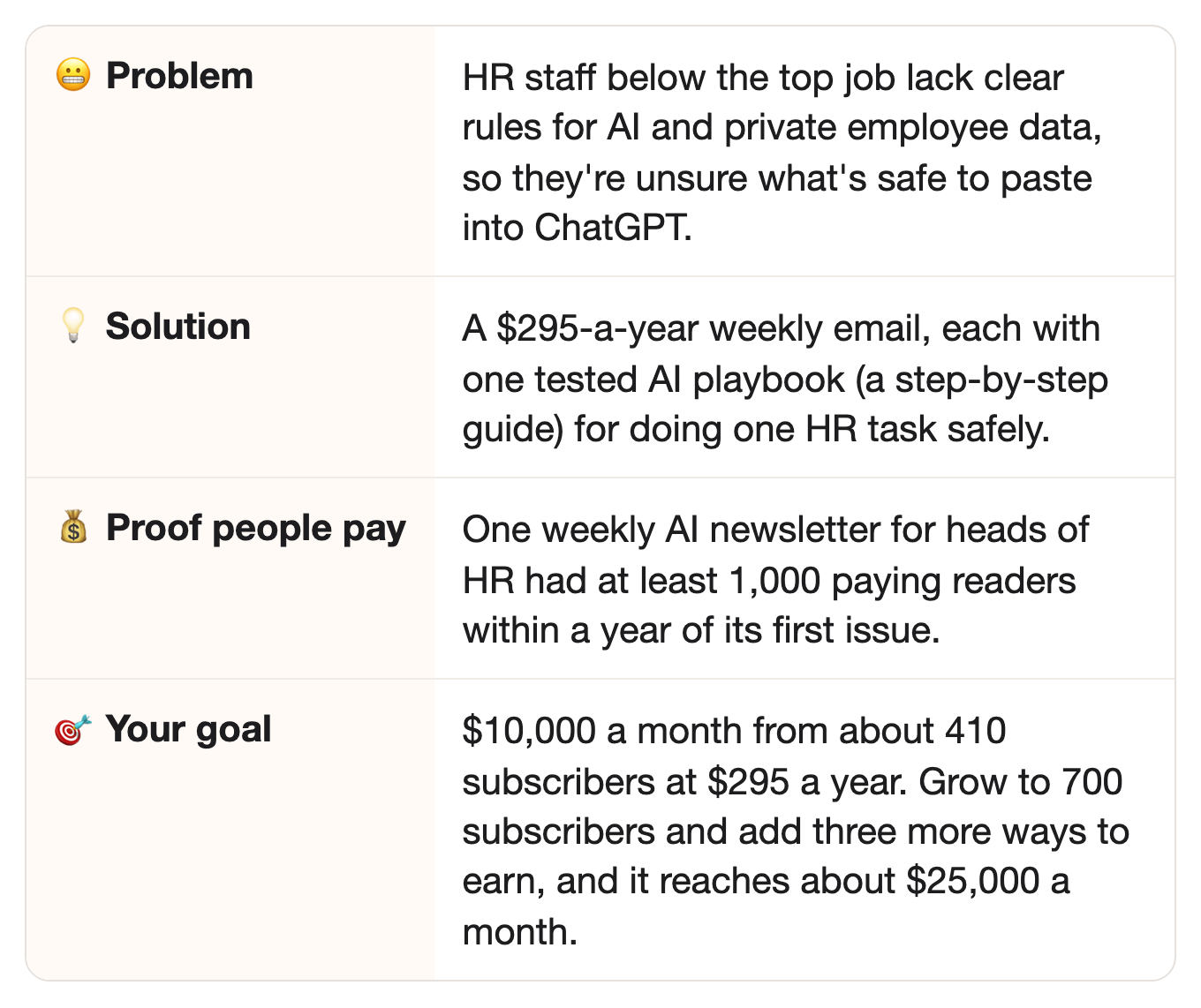
Today’s idea is called The Weekly AI Playbook for HR.
Pour yourself a tea. 🍵
First, a newsletter’s story. Then, the business you could build from it.
⠀
⚡ Quick facts
⠀
📖 How one HR newsletter won 1,000+ paying readers in a year
It started with one playbook a week.
On October 23, 2025, a brand-new newsletter called The CHRO Office sent its first issue.
Quick decoder: CHRO means chief human resources officer, the head of HR at a company.
⠀
Its promise was simple: “Every Thursday, I send one playbook to your inbox.”
A playbook here is a step-by-step guide to one HR task, done with AI.
⠀
For about four months, every post was free.
One early post: “3 ChatGPT HR Prompts every HR must try.”
⠀
Then, in February 2026, most posts went behind a paywall.
From then on, only paying readers could read them.
⠀
And the paid posts were hands-on.
“How to build a job description drafter with Claude Opus 5.5.”
“I built an onboarding HR Agent with Claude.”
“I just built an Exit Interview Analysis Agent with Claude in 15 minutes.”
⠀
Little-known fact: its about page doesn’t name the writer.
The posts are just signed “The CHRO Office.”
So there’s no famous name on it, just one useful playbook every Thursday.
⠀
Fast-forward to October 2026: it said “23,000+ HR leaders have joined us,” free and paid.
⠀And Substack, the site it runs on, shows a badge: “Thousands of paid subscribers.”
The badge only gives a range, and its low end is 1,000.
⠀
Until October 11, 2026, the yearly price was $200.
So 1,000 people at $200 a year would be at least $200,000 a year.
Quick note: that’s our lowest estimate, from the badge and the old price.
The newsletter hasn’t shared its numbers.
Then the yearly price went up to $295.
Boom! 💥
By our math, at least $200,000 a year, from one weekly email, within a year of the first issue.
From a free Thursday email, to at least 1,000 paying readers, by teaching one HR task with AI each week.
⠀
🔗 Same idea, new group
In the story: HR leaders paid The CHRO Office for one AI playbook a week, written for the head of HR.
⠀In this idea: recruiters and one-person HR teams, who do most of the daily work, get playbooks written for their own role.
⠀Why it carries over: every HR role has the same AI questions about private employee data, and AI tools keep changing.
⠀
💡 The opportunity
Every HR person has the same AI questions, and most of them aren’t the head of HR.
First, who are HR people?
They hire, onboard new staff, run pay and benefits, and help managers with hard conversations.
And how many are there?
The US government counts about 939,700 HR specialists (2025).
⠀
Their week is full of writing and sorting.
Job descriptions, onboarding plans, policy updates.
Exit interview notes too, from talks with people who are leaving.
And these are the tasks The CHRO Office’s paid posts teach with AI.
⠀
Two things make it risky.
First, employee data is private, and readers worry about pasting it into AI (one reader’s words are below).
Second, AI hiring tools can be biased, and some places have laws about them.
For example, New York City bars employers from using an automated hiring tool unless it had a bias audit within the past year.
A bias audit is an outside check that the tool treats all groups fairly.
⠀
Here’s the key point: The CHRO Office writes for the head of HR.
Our reading: recruiters, HR generalists (who handle a bit of everything), and one-person HR teams do most of the daily work.
So the people doing the work get advice written for their boss’s boss.
⠀
👉 The idea: a paid weekly newsletter for one HR role, with one HR task a week, done with AI, safely.
⠀
🙋 Never worked in HR? You can still build this.
Become the interviewer.
Each week, interview one HR person about an AI workflow that works for them, with their permission.
Their workflow becomes the playbook, and you test it yourself.
⠀
Team up with an HR person.
They bring the know-how and the judgment.
You build the newsletter and find the readers.
⠀
Or use your own job.
There’s already a paid newsletter called AI CFO Office that does the same thing for finance leaders.
Same steps, any job.
⠀
✅ Why this could work
Three reasons there’s real money here.
Others make money the same way, so it’s a pattern, not luck.
AI CFO Office, by investor Wouter Born, writes AI playbooks for finance leaders.
It started in January 2025.
And it has at least 1,000 paid subscribers, at $220 a year.
⠀
The need comes back every year, as new HR people arrive.
About 73,700 HR specialist jobs open every year in the US, so new people keep arriving.
And there are a lot of them: SHRM, a big HR association, has nearly 340,000 members in 180 countries.
⠀
HR people already pay for AI help.
How much do they pay?
$295 a year for one newsletter, and $1,125 a year for AIHR’s certificate programs.
The details are in the next section. 👀
⠀
👉 Want to check these numbers? Each one has a source link in the last section, “📎 The sources.”
⠀
📊 More proof people want this
HR people already pay a newsletter for AI help.
The CHRO Office charges $29 a month or $295 a year.
Its top tier, with live AI trainings, is $595 a year.
⠀
They pay for AI courses too.
AIHR is an online HR academy.
It charges $1,125 a year for its 16 certificate programs, and “Artificial Intelligence for HR” is one of them.
And in September 2026, AIHR opened a whole AI for HR Academy.
⠀
They sign up in big numbers.
Remember that “23,000+ HR leaders” line from the story?
The CHRO Office said it in October 2026, counting free and paid readers.
⠀
The big picture: about 939,700 HR specialist jobs in the US in 2025. 💰
Their median pay is $75,940 a year (May 2025).
Median just means the middle: half earn more, half earn less.
⠀
What a reader says.
“These suggestions are actionable steps in my new role…”
That’s a reader comment under The CHRO Office’s first issue.
⠀
And what another reader worries about.
“these prompts are alarming with uploading proprietary documents and sensitive employee information to an AI tool.”
That’s a reader comment under its post of ChatGPT prompts for HR.
Fair worry.
⠀
👉 HR people want AI help they can trust with private employee data.
⠀
🔍 Who’s already doing it
Who’s already doing it, and what they miss.
The CHRO Office, the newsletter from the story above, writes for the head of HR.
Its own words: “The #1 newsletter for CHROs,” the chief HR officers who run HR at a company.
Its posts cover board briefings, the first 90 days as a CHRO, and leading with AI.
Boss-level topics, in other words.
⠀
AIHR, an online HR academy, sells AI training as courses.
It’s a yearly set of certificate programs at $1,125, not a short weekly playbook.
⠀
When we checked, The CHRO Office was the only HR newsletter in Substack’s top 100 paid Business newsletters.
That’s proof HR people pay, and only one HR newsletter made that list.
⠀
Here’s what we didn’t see in that top 100, when we checked:
A weekly AI playbook for one HR role below the top, like recruiters or a one-person HR team.
Written by a named HR person they can follow.
At a price like The CHRO Office’s.
⠀
🔎 Check the market yourself in 2 minutes: run Part 0 of the prompt in the build plan below.
Your AI searches for AI newsletters, courses, and communities for your HR role that day.
Then it tells you: early, growing, or crowded.
Early? Start now.
Crowded? Good news: it means people pay. Just pick one narrower HR role (Step 1 of the build plan).
A crowded market is still OK. You win by serving one group better, not by being first.
⠀
👉 That gap is your chance: a weekly AI playbook for one HR role below the top, from a named HR person.
⠀
🤖 Why AI won’t replace it
AI gives HR people a chat box. You give them a workflow that’s safe to use.
Could ChatGPT just do this?
Sort of, once someone writes and tests the prompt, and decides what’s safe to paste in.
That’s the part you do for them.
Safe with private data.
Every playbook says what never goes into an AI tool.
A plain ChatGPT chat won’t stop them from pasting in an employee’s file.
⠀
You choose which tasks stay with a person.
Firing, investigations, and final hiring decisions stay with people.
You show which tasks AI can draft, and which it shouldn’t touch.
⠀
Ready to use: one task, one tested prompt.
A before-and-after, the time it saved, and a prompt they can copy.
ChatGPT does the task well once the prompt is written and tested, and you’ve already done that part.
⠀
Tested every week.
AI tools keep changing.
You try the new ones on real HR tasks, so they don’t have to.
⠀
Proof people pay for this.
ChatGPT is free.
And HR people still pay The CHRO Office $295 a year.
⠀
👉 The prompts are free. People pay for the finished, tested workflow.
⠀
💵 How much you can make
Here’s the math. 🧮
First stop: $10,000 a month from the newsletter alone
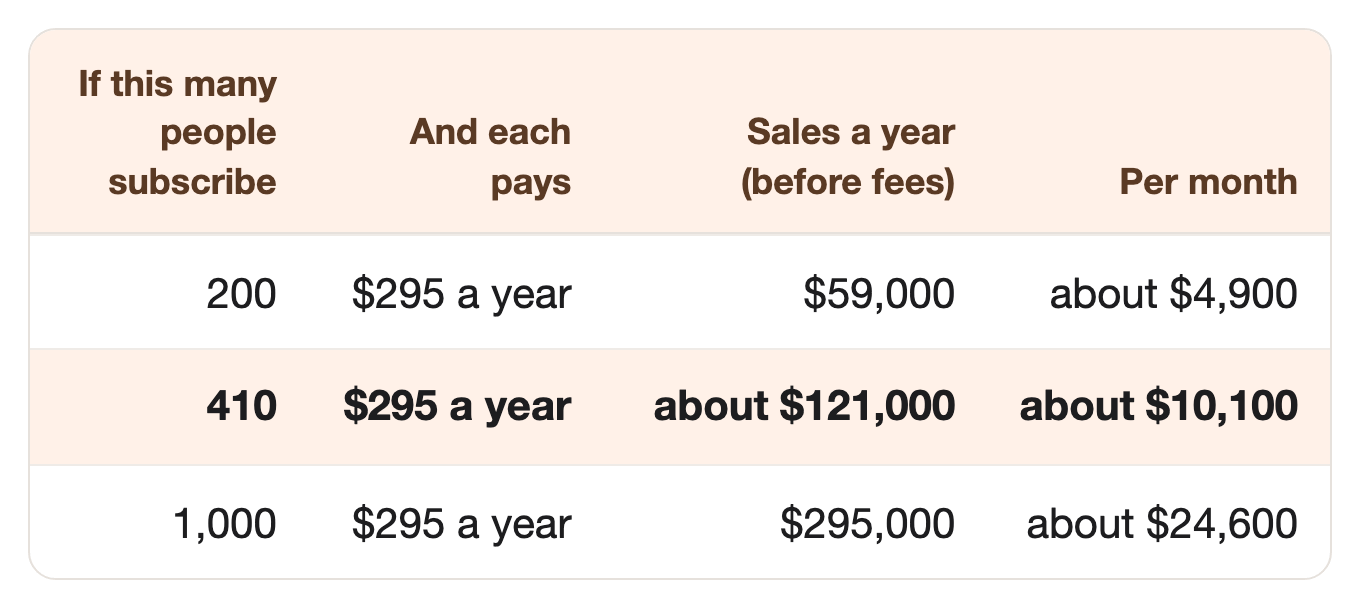
$295 a year is The CHRO Office’s price.
⠀410 subscribers is less than half of the 1,000 or more that The CHRO Office has.
Next stop: $25,000 a month, with three more ways to earn
Once HR readers trust your playbooks, some want more, and some bosses pay for the whole team.
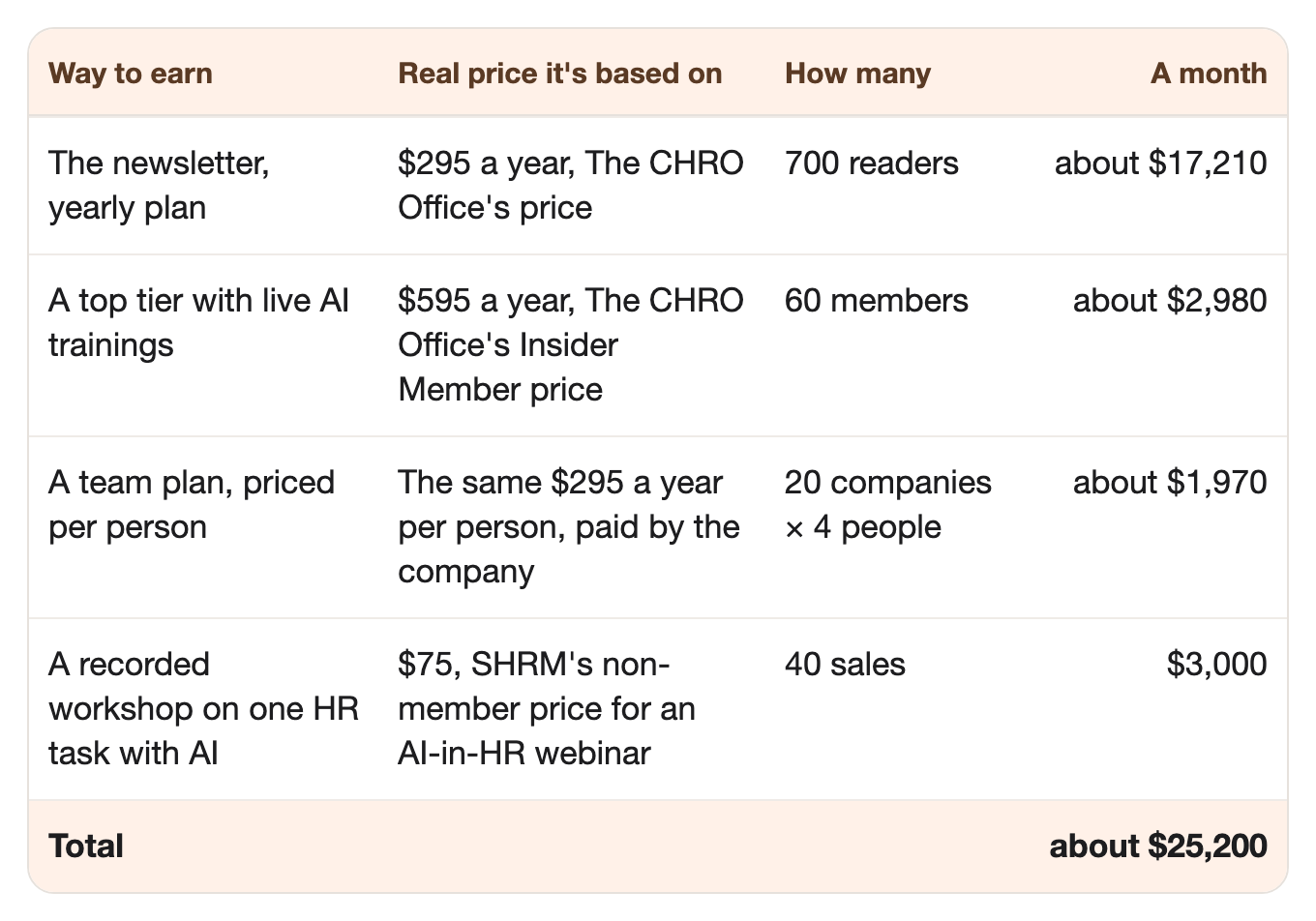
The newsletter still does most of the work.
Grow it from 410 to 700 readers, and it brings in about $17,210 a month.
The three yearly plans are split over 12 months.
⠀
The top tier is for readers who want to learn live.
The CHRO Office already sells a $595 top tier with live AI trainings.
60 members is less than one reader in ten.
⠀
The team plan is one sale for a whole HR team.
One HR manager signs up, and four people get the playbooks.
Add a short note they can send their boss, so the company pays.
⠀
The workshop sells to HR people who aren’t ready to subscribe.
SHRM charges non-members $75 for a live AI webinar.
Record the live session from Step 5 of the build plan, with made-up data.
About 40 sales a month is the goal.
⠀
That’s about 840 paying subscribers, plus the workshop buyers.
Still fewer than the 1,000 or more The CHRO Office has.
⠀
If it doesn’t work out, here’s all you lose:
Substack’s cut, which comes only from what readers pay: 10%, plus card fees.
One month’s subscription to an AI app, like ChatGPT or Claude.
One week of your time.
⠀
👉 So one weekly email, done well, adds up to about $25,000 a month.
One idea is the start. Add a second and a third, from this newsletter or a niche next door, and a million in total is two or three years out.
For this newsletter, a niche next door could be payroll teams. And this one could be your first idea.
Already picturing your first sale?
Keep going. The how-to is just below. 👇
Not this one? Next week brings a new one.
That’s it, my fellow contrarians! 🙌
Yours ‘showing you how many ways there are to make money’ Vijay Peduru 🦸♂️
⠀
⠀
⠀
🧰 Want to build it? Here’s everything else.
AI does most of the work. You bring the HR judgment. 🎙️
⠀
Step 1: 🎯 Pick one HR role
The narrower the reader, the faster they feel it’s written for them.
Pick one HR role you know.
For example: the one-person HR team at a company of 50 to 500 people.
Or recruiters, or HR business partners (HR people who advise one part of the company).
List the 20 tasks that fill their week.
Writing job descriptions, onboarding plans, policy updates, exit interview summaries.
Your AI helps you build the list in Part 1 of the prompt.
Mark the ones that are risky.
Anything with private employee data, or anything that decides who gets hired or fired.
These get extra care in Step 3.
⠀
Step 2: 🛠️ Turn one task a week into a playbook
Each issue is one HR task, done with AI, start to finish.
Test the task yourself with AI.
Use made-up or stripped-down data, never a real employee’s details.
Write it up the same way every week:
The task, and the time it takes by hand.
The prompt, ready to copy.
A before-and-after example.
What never goes into the AI, and what a person must check.
🎙️ Talk, don’t type. Describe how you’d do the task, out loud, and let AI turn it into steps.
⠀
Step 3: 🔍 Check every playbook
HR mistakes hurt real people. So every playbook gets checked three times.
Your AI does all three passes for you: it writes in Part 2, and checks in Parts 3 and 4 of the prompt.
🖊️ The AI writer. Your AI drafts the playbook from your notes and official sources only.
🔍 The AI checker. A second pass opens every link, and confirms each fact says exactly that.
🧐 The AI critic. A third pass reads it like a cautious HR lead.
It flags anything that sounds like legal advice, or that puts private data at risk.
AI hiring tools get extra care.
They can be biased against some groups of people, and some places have laws about them.
Say so plainly in every hiring playbook, and tell readers to check their local rules with an employment lawyer.
Optional: pay an employment lawyer once to review your safety rules before you launch.
⠀
👉 The prompt already follows three safety rules: workflows only, never legal advice; no real employee data; and a warning on every hiring tool.
⠀
Step 4: 🏪 Open your newsletter
Copy The CHRO Office’s setup: free first, then paid.
Start on Substack. It takes its 10% cut only from what readers pay.
Send free issues first.
The CHRO Office was free for about four months before most posts went paid.
Then set your prices.
$29 a month, or $295 a year, like The CHRO Office.
A team plan: the same $295 a year, for each person on the team.
Make it easy to expense.
Add a short note readers can send their manager, so the company pays.
⠀
Step 5: 📣 Get your first subscribers
Teach one task live, praise the people who do it well, and send each reader their own playbooks.
Co-host a free live session with your local SHRM chapter: “One HR task with AI, with no employee data.”
SHRM is the big US association for HR people, and it has local chapters.
Teach one real task from start to finish with made-up data, and both of you keep the signup list.
Publish “20 HR people using AI safely” on LinkedIn, and tag each one.
Pick people who share how they use AI without putting private employee data in.
Each person you tag can share the list with their own HR followers.
At signup, ask “What’s your HR role?” and send the three playbooks for that role.
Offer a few choices, like recruiter, one-person HR team, or HR generalist.
Anyone who skips gets your three most-read playbooks, and the skip button says so.
⠀
Step 6: 🏃 Eliminate competitors
If ten competitors copy you, here’s how yours stays ahead.
Publicly invite any AI-for-HR newsletter to show one task, start to finish, with no real employee data.
You already do this every week.
Post your own playbook next to the invite, with the made-up data in plain view.
A rival either joins in, stays quiet, or looks careless about private data.
Title each playbook with a phrase HR readers sent you, like “I’m a team of one.”
Save the exact words from replies and comments.
Readers see their own problem in the title, in their own words.
⠀
Step 7: 🎲 Make it bigger
Every job has the same AI questions, and its own weekly tasks.
Add the three extras from “How much you can make,” one at a time.
First the team plan, since you already write the playbooks.
Then the recorded workshop, from your first live session.
Then a top tier with live AI trainings, priced like The CHRO Office’s $595 top tier.
Start the same newsletter for a second role: recruiters, payroll, or office managers.
One newsletter at about $25,000 a month is about $300,000 a year, before fees. 🎯
Add a second and third role, or other ideas from these issues, and a million dollars in total is two or three years away.
⠀
🗓️ Your first week
Phew. That was a lot. 😅
Steps 1 to 5 fit into seven days. 🚀
By day 7, you have a Substack, two checked playbooks, your first issue sent, and your praise-list post.
Quick heads-up: the prompt below has six Parts, and they’re not the same as the Steps above.
Day 1 (Step 1): Run Part 1 of the prompt (it’s below), and pick your HR role and its 20 tasks.
Days 2–3 (Steps 2 and 3): Build two playbooks with Part 2, then check each one with Parts 3 and 4.
Day 4 (Step 4): Set up your Substack, with a short welcome page.
Day 5 (Step 4): Turn your first playbook into issue 1 with Part 5, and send it free.
Days 6–7 (Step 5): Write your praise list, signup question, and SHRM note with Part 6, and post the list.
⠀
🏄 How to use the prompt
One prompt does all the AI work, in six parts, plus a quick market check (Part 0).
Part 1 — Pick the role and the tasks. Lists the 20 tasks that fill your reader’s week, and marks the risky ones.
Part 2 — Build a playbook. Turns one task into a step-by-step AI workflow, with a prompt and a before-and-after.
Part 3 — Check every fact. Opens every link and confirms each fact matches the page.
Part 4 — Find the risks. Reads it like a cautious HR lead, and flags legal advice, private data, and bias.
Part 5 — Write the issue. Turns the checked playbook into the weekly email.
Part 6 — Find your first subscribers. Writes your “20 HR people” post, your signup question, and a note to your SHRM chapter.
Run it your way:
Part by part (the default): it pauses after each part, and you type “next” to go on.
All at once: say “run all six parts.”
Just one part: say “only do Part 3,” or any part you need.
The full prompt is just below, under “📋 The prompt.”
🎙️ Talk to your AI sidekick, don’t type.
Turn on voice mode, or use a dictation app like Wispr Flow.
Say it messy. The AI sorts it out.
Turn it into a skill, so you never paste it again.
Paste the prompt into Claude or ChatGPT, and say: “Turn this into a skill I can save.”
Install once, use forever.
⠀
📋 The prompt
The prompt (copy it into Claude or ChatGPT, fill in the INPUTS part, and run it your way)
CONTEXT:
- You're my newsletter partner. Together we'll build a paid weekly newsletter that teaches one kind of HR person to do one HR task a week with AI, safely.
- This prompt has six parts, in order.
- Run it the way I ask:
    - If I say nothing, go one part at a time. After each part, show me the result, then stop and wait. Move on only when I type "next."
    - If I say "run all six parts," do them all without stopping.
    - If I say "only do Part 3" (or any part), do just that part.
- If a part needs something from me, ask for it before you start that part.
- We teach workflows, never legal advice. Never tell a reader what the law requires them to do. Point them to an employment lawyer instead.
- Never use real employee data. Use made-up examples, and say they're made up.
- Any playbook about hiring tools must say plainly that AI hiring tools can be biased, and that some places have laws about them.
- Never invent a fact, a number, or a law. If you can't find a source, leave it out. If you can't open a link, say so, and ask me to paste the page instead.
- Keep web search on for the whole prompt (turn on search in ChatGPT or Claude), so you can open any page you need to check.

=============== INPUTS — edit these, or just run as is ===============

The HR role I write for:
{e.g. the one-person HR team at a company of 50 to 500 people}

What I know about this role:
{e.g. I've worked in HR for 9 years, the last 3 as the only HR person at a 120-person software company}

The AI tools my readers can use:
{e.g. ChatGPT or Claude, with company rules against uploading employee files}

My prices:
{e.g. $29 a month, or $295 a year}

======================== END OF INPUTS ========================

THE PARTS:

Part 0 — Check the market today.
This part needs web search (turn on search in ChatGPT or Claude). Search for paid AI help for my HR role and, for each place, give the count, the three biggest with links, and their prices:
1. Paid newsletters about AI for HR (for example on Substack's leaderboards).
2. Courses and certificates about AI for HR.
3. Communities and live trainings about AI for HR.
4. The biggest free newsletters, YouTube channels, and podcasts about it.
Then tell me: early (few sellers), growing, or crowded, and which HR role looks least served (for example: recruiters, HR teams of one, HR business partners). Give a link for every number. If you can't open a page, say so. Never guess a number.

Part 1 — Pick the role and the tasks.
If my INPUTS don't name a role yet, suggest three HR roles from Part 0, say which is easiest for me to reach, and help me pick one. Then list the 20 tasks that fill my reader's week. For each task, give:
1. The task, in the words an HR person would use.
2. How often they do it.
3. What AI could draft or sort.
4. Risk: low, medium, or high. High means private employee data, or a decision about who gets hired, promoted, or let go.
Then pick the first five tasks to write about, and say why. Say clearly which reasons are your guess.

Part 2 — Build a playbook.
Ask me which task to write first, and ask me to describe how I do it by hand. Then write one playbook:
1. The task in one sentence, and the time it takes by hand (use my number, or say it's missing).
2. The steps, numbered, with what the AI does and what the person does.
3. The prompt, ready to copy, using only made-up or stripped-down data.
4. A before-and-after example, labeled as made up.
5. "Never put this into an AI tool:" a short list for this task.
6. "A person must check:" a short list for this task.
7. This line at the bottom: "This is a workflow, not legal advice. Check your local rules with an employment lawyer."

Part 3 — Check every fact.
Now act as a separate fact-checker who didn't write this playbook. Open every link. Mark each fact: matches the source, doesn't match, or has no source. For each problem, show what the source actually says. Then give a fixed version of the playbook.

Part 4 — Find the risks.
Now act as a cautious HR lead reading this before any reader sees it. Flag:
1. Anything that sounds like legal advice, or tells the reader what the law requires.
2. Anything that would put private employee data into an AI tool.
3. Anything where AI makes or shapes a hiring, firing, or pay decision. Add a plain warning that AI hiring tools can be biased and that some places have laws about them.
4. Any step a beginner would find confusing.
Then give the final playbook, with every fix made.

Part 5 — Write the issue.
Turn the final playbook into this week's email:
1. A subject line that names the task and the time it saves.
2. A short free part: the task, why it matters, and the before-and-after.
3. The paid part: the full steps, the prompt, and the two safety lists.
4. The "not legal advice" line at the bottom.
Never promise a result, a saving, or a promotion.

Part 6 — Find your first subscribers.
Write:
1. A LinkedIn post called "20 HR people using AI safely." I'll give you the names and a link to one post from each. Write one line per person on what they share. Say nothing about anyone that their linked post doesn't show.
2. One signup question, "What's your HR role?", with three or four choices and the three playbooks I send for each. Add a skip button line that says skippers get my three most-read playbooks.
3. A short email to my local SHRM chapter, offering to co-host a free live session: "One HR task with AI, with no employee data." Keep it under 120 words.

When all six parts are done, ask if I want to repeat Parts 2 to 5 for the next task.
⠀
📎 The sources
Every number above, with where it came from.
The CHRO Office’s paid subscribers · Number: “Thousands of paid subscribers” (Substack’s badge; at least 1,000); yearly plan $295; first post October 23, 2025 · Source: Substack Business leaderboard
The CHRO Office’s description · Number: “The HR playbook is broken. We’re rewriting it for AI. The #1 newsletter for CHROs…”; no writer named · Source: The CHRO Office: about
The first issue · Number: October 23, 2025; “Every Thursday, I send one playbook to your inbox.” · Source: The CHRO Office, “The Modern HR Playbook”
Free, then paid · Number: All posts free from October 2025 to January 2026; first paid-only post February 12, 2026; paid post titles quoted above · Source: The CHRO Office archive
Readers and prices · Number: “23,000+ HR leaders have joined us”; monthly $25 → $29; annual $200 → $295; Insider $400 → $595 a year; prices went up October 11, 2026 · Source: The CHRO Office, October 11, 2026
Comment: actionable steps · Number: “These suggestions are actionable steps in my new role within the PE space” (quoted up to “role”) · Source: Reader comment, October 23, 2025
Comment: the worry · Number: “these prompts are alarming with uploading proprietary documents and sensitive employee information to an AI tool” · Source: Reader comment, December 5, 2025
Top 100 check · Number: The CHRO Office was the only HR newsletter in the top 100 paid Business newsletters · Source: Substack Business leaderboard, pages 1–4
AI CFO Office · Number: “Thousands of paid subscribers”; yearly plan $220; first post January 19, 2025; “I’m Wouter Born, an investor, CFOTech expert” · Source: Substack Business leaderboard and AI CFO Office: about
HR specialists in the US · Number: About 939,700 jobs in 2025; about 73,700 openings a year, on average, over the decade; median pay $75,940 (May 2025) · Source: US Bureau of Labor Statistics
SHRM · Number: “nearly 340,000 members in 180 countries”; roots in the American Society for Personnel Administration, founded November 21, 1948 · Source: SHRM: about
AIHR prices · Number: Certificate Program $1,125 a year, “across all 16 programs,” including Artificial Intelligence for HR · Source: AIHR pricing
AIHR’s AI academy · Number: AI for HR Academy, announced September 14, 2026 · Source: AIHR news
New York City’s hiring-tool law · Number: A bias audit “within one year of the use of the tool,” a public summary, and notice to candidates; enforced from July 5, 2023 · Source: NYC Department of Consumer and Worker Protection
Substack’s fee · Number: “Writers keep 90% of their revenue minus credit card fees” · Source: Substack: going paid
Top tier price · Number: Founding plan “Insider Member,” $595 a year (59500 cents); yearly plan “$295 a year” · Source: Substack Business leaderboard
Workshop price · Number: “Non-Member Registration - Only $75!”; “Member Registration - FREE”; webinar on April 1, 2026 · Source: SHRM, “The State of AI in HR in 2026”