


Hello contrarians,
Today’s idea is called The Pricing Course for Freelance Editors.
Find a comfy chair. 🪑
First, a programmer’s story. Then, the business you could build from it.
⠀
⚡ Quick facts
⠀
📖 How one programmer turned “charge more” into a 7-figure business
He learned what to charge by losing money.
In 2008, Brennan Dunn was a programmer, with his first baby on the way.
Then a move to Virginia forced him to quit a $105,000-a-year job and start freelancing.
Not exactly calm timing.
His freelance work grew fast, and soon he had a team of 11.
By then his freelance work had become an agency, a small company that does work for clients.
Money truth: he later figured that charging too little, and selling without a plan, had cost his agency well over $1 million in lost revenue.
Oof.
So he fixed how he priced, how he wrote quotes, and how he talked to clients.
⠀In 2012, he wrote down what he’d learned.
He called it a “short little ebook,” and said he wrote it against his own better judgment.
Its name: Double Your Freelancing Rate.
He launched it in September 2012, and it brought in $33,024 that year.
In 2013, he turned the ebook into a much bigger online course.
He also raised the price of his live consulting class, from $1,199 to $1,799.
And his total revenue for 2013? It came to $324,073.
⠀
By the end of 2016, he wrote: “my business is doing 7-figures annually.”
7 figures means at least $1,000,000 a year in sales.
He also wrote that it was “10,000+ customers strong,” with more than 200 local groups meeting each month.
And in July 2026, the rate course was still on sale, for $297.
Holy guacamole. 🥑
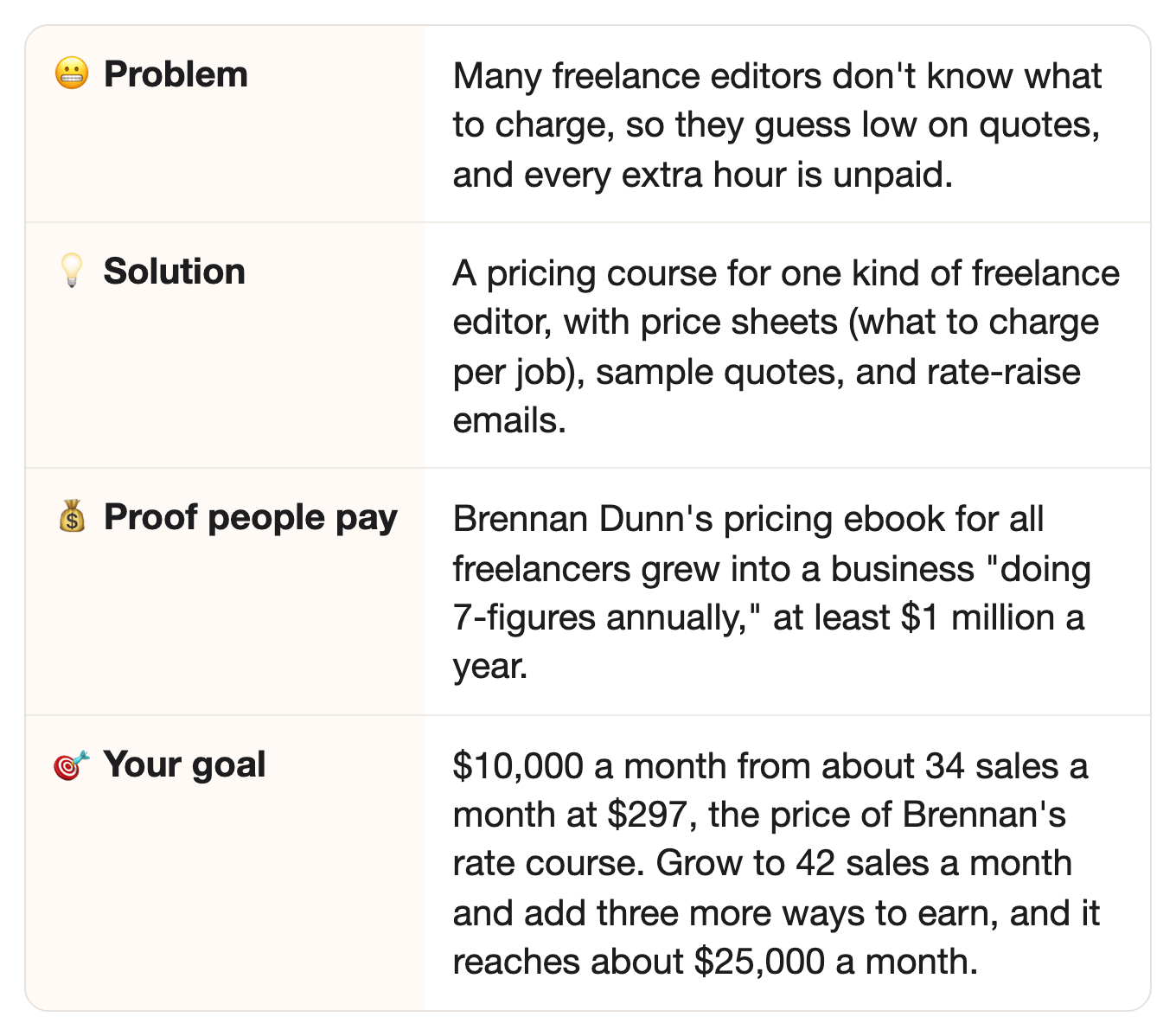
He went from undercharging his own clients… to a 7-figure business, by teaching other freelancers what to charge.
⠀
🔗 Same idea, new group
In the story: freelancers of all kinds paid Brennan to learn how to price, quote, and raise their rates.
⠀In this idea: freelance editors need the same lessons, with price sheets and emails made for editing jobs.
⠀Why it carries over: every freelancer names a price for each job, and a weak quote loses the job or locks in a low price.
⠀
💡 The opportunity
Brennan taught all freelancers. A course for just one kind of freelancer, taught well, can be a business on its own.
First, who are freelance editors?
They fix other people’s writing: novels, academic papers, business reports, websites.
Freelance editors work for themselves.
So every new job starts with the same question: “what would you charge?”
⠀
There are a lot of editors.
Editors held about 105,000 jobs in 2025, and 9% were self-employed.
And about 7,900 editor job openings are expected each year (a government projection).
⠀
Many editors aren’t sure what to charge.
The Editorial Freelancers Association (EFA) is a group for freelance editors, founded in 1970.
Its director of communications and marketing said it plainly: “As more people become part-time or full-time freelancers, they often don’t know how to price their work.”
That’s from the EFA’s 2026 rate chart announcement.
⠀
The EFA’s rate chart gives price ranges, not the words to put in a quote.
The EFA says its rates are “for guidance only and are not mandated or recommended rates.”
So a chart tells an editor what others charge.
But it doesn’t write the quote, explain a fixed price, or say what to send when raising a rate.
A fixed price is one number for the whole job, instead of a rate per hour or per word.
Clients like it, because they know the cost up front.
But if the editor guesses too low, every extra hour is unpaid.
⠀
Here’s the brave part: raising a rate is hard because it feels scary, not because the math is hard.
Our guess: most editors know they should charge more.
What they need is the exact email to send, and proof it worked for someone like them.
⠀
👉 The idea: a pricing course for one kind of freelance editor, with real price sheets, sample quotes, and the emails for raising a rate.
⠀
🙋 Never edited for money? You can still build this.
Become the researcher.
Good news: editors already post what they charge, in editor forums and groups.
And the EFA publishes a rate chart.
The prompt reads hundreds of those posts, and pulls out real rates, quotes, and the emails editors sent when they raised their rate.
⠀
Team up with one.
An experienced freelance editor brings the real quotes and checks every lesson.
You build the course and find the buyers.
⠀
Or use your own field.
Did you freelance on the side, as a developer, designer, or writer?
Then you already have real quotes.
The same course works for any freelancer who has to name a price.
⠀
✅ Why this could work
Three reasons this can pay.
A course for one kind of freelancer can be big.
Caitlin Pyle teaches people to work from home as proofreaders.
Those are the people who catch the last typos before a text goes out.
She said her course business, Proofread Anywhere, had “a $2 million a year turn over” (Course Method, 2022).
Turnover is British English for total sales in a year, before costs.
⠀
Pricing guides for one profession last for decades.
The Graphic Artists Guild is a group for illustrators and designers.
It began as a 20-page pamphlet, and grew into a 400-page book.
That’s a lot of pricing advice.
⠀
New editors need this every year.
About 7,900 editor job openings are expected each year.
Most of those openings are salaried jobs, but 9% of editors work for themselves.
And every new freelance editor faces the “what do I charge?” question on day one.
⠀
👉 Like to check the numbers yourself? The links are all in “📎 The sources,” at the very end.
⠀
📊 More proof people want this
A few more signs, quickly.
Freelancers already pay to learn pricing.
Remember Brennan’s rate ebook?
It brought in $33,024 in its first four months, in 2012.
His live consulting class sold at $1,199, then $1,799, in 2013.
⠀
The rate course lasted.
Brennan’s Double Your Freelancing Rate course was listed at $297 on a July 2026 copy of its page.
That’s 42 video lessons, with scripts and templates, and a 30-day money-back promise.
⠀
Tens of millions of Americans freelance. 💼
Upwork is a site where companies hire freelancers.
It runs a yearly study of American freelancers.
Its 2023 study found 64 million Americans freelanced in 2023, 38% of the US workforce.
Nearly 30 million of them, 47%, did knowledge work like programming, marketing, and consulting.
⠀
Editors want rate data.
Over 1,100 people filled out the EFA’s 2026 rate survey.
That’s the most since the survey began in 1991.
⠀
The money in this job is real. 💰
The median salaried editor, the one right in the middle of the pay range, earned $77,920 a year (May 2025).
So a $297 course pays for itself the first time one quote goes up by $300.
⠀
👉 Editors are told what others charge, but nobody hands them the quote to send.
⠀
🔍 Who’s already doing it
The players, and what they leave out.
Double Your Freelancing, Brennan’s business from the story, is for freelancers in general.
Its rate course is for anyone who is “starting or run[s] a freelancing business.”
⠀
The EFA publishes a rate chart.
It shows ranges, “for guidance only.”
But it doesn’t walk one editor from a range to a quote they can send.
⠀
Proofread Anywhere teaches the skill itself.
Its courses teach people how to proofread, for example legal transcripts for court reporters.
A court reporter types a word-for-word record of everything said in court.
⠀
Still missing when we checked:
A pricing course built for one kind of editor, like academic editors who fix research papers for scientists.
Real price sheets, sample quotes, and fixed-price examples for that one kind of work.
⠀
🔎 Check the market yourself in 2 minutes: run Part 0 of the prompt in the build plan below.
Your AI searches course sites, Gumroad, Udemy, and editor groups that day.
Gumroad and Udemy are websites where people sell digital products and online courses.
Then it tells you: early, growing, or crowded.
Early? Start now.
Crowded? Good news: it means editors pay. Pick one narrower kind of editor (Step 1 of the build plan).
A crowded market is still OK. You win by serving one kind of editor better, not by being first.
⠀
👉 That’s the gap you can fill.
A pricing course for one kind of editor, with the real quotes and emails a general course can’t give.
⠀
🤖 Why AI won’t replace it
Could ChatGPT just write the quote? Sure, if someone first gives it real rates, the real size of each job, and real examples. Your course gives it all of that.
🔮 Honest note: AI can already draft a proposal or a “my rates are going up” email in seconds.
So a blank template alone isn’t the product.
The product is the real numbers and examples, gathered from editors who do this work.
⠀
1. You know what matters.You know what academic editors charge per word, and what fiction editors charge per manuscript.
A busy editor doesn’t know which numbers to give AI, so the quote comes out generic.
⠀
2. Ready to use.Your course hands them a price sheet, three sample quotes, and the raise email, already filled in.
No digging through forums, and no writing a long prompt.
⠀
3. Checked twice.Every rate range points to a real source, like the EFA chart, and gets a fact check and a critic’s read before it ships.
⠀
4. Trust.Raising a rate feels scary.
So editors trust real emails that other editors sent without losing the client.
⠀
5. Proof people pay for the finished version: Brennan’s rate course was on sale at $297 in July 2026, though ChatGPT has a free plan.
⠀
👉 AI gives free answers. Your course gives a quote that’s ready to send.
⠀
💵 How much you can make
Okay, let’s run the numbers. 🧮
First stop: $10,000 a month from the course alone
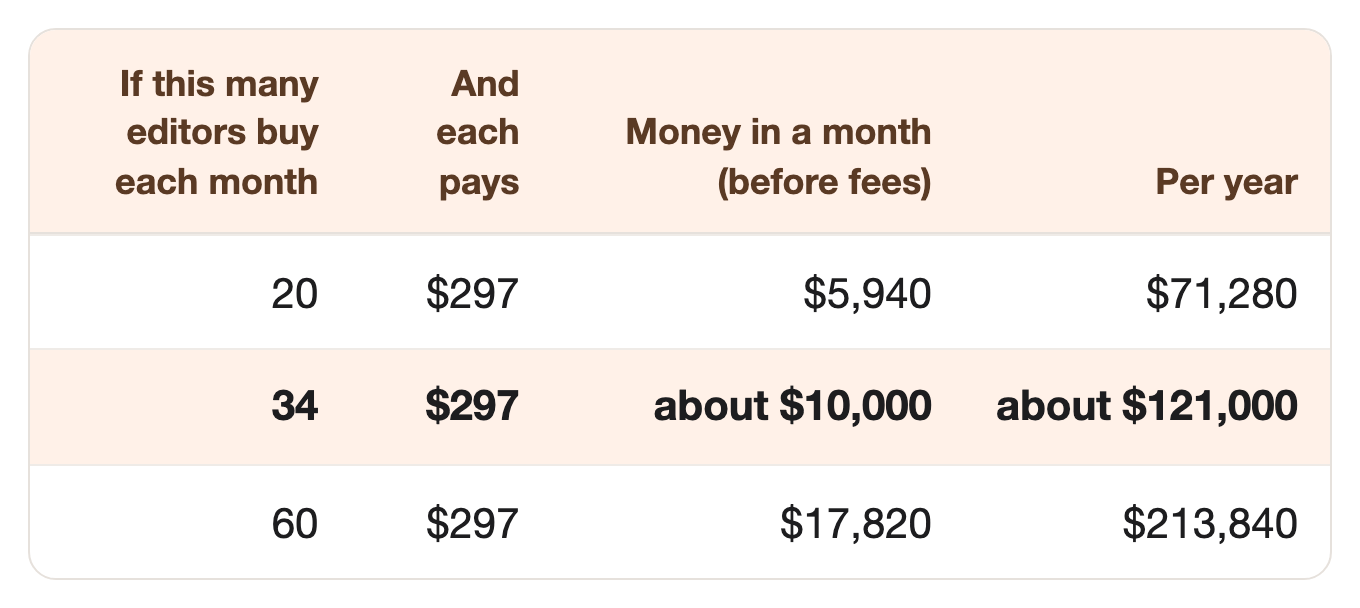
At $297, the price of Brennan’s rate course, 34 sales a month bring in about $10,000.
⠀34 sales a month is 408 a year, about 5% of one year’s editor job openings.
Your buyers are the editors who work for themselves, new or not, who still guess at prices.
Next stop: $25,000 a month, with three more ways to earn
Brennan sells more than one thing to the same freelancers, and so can you.
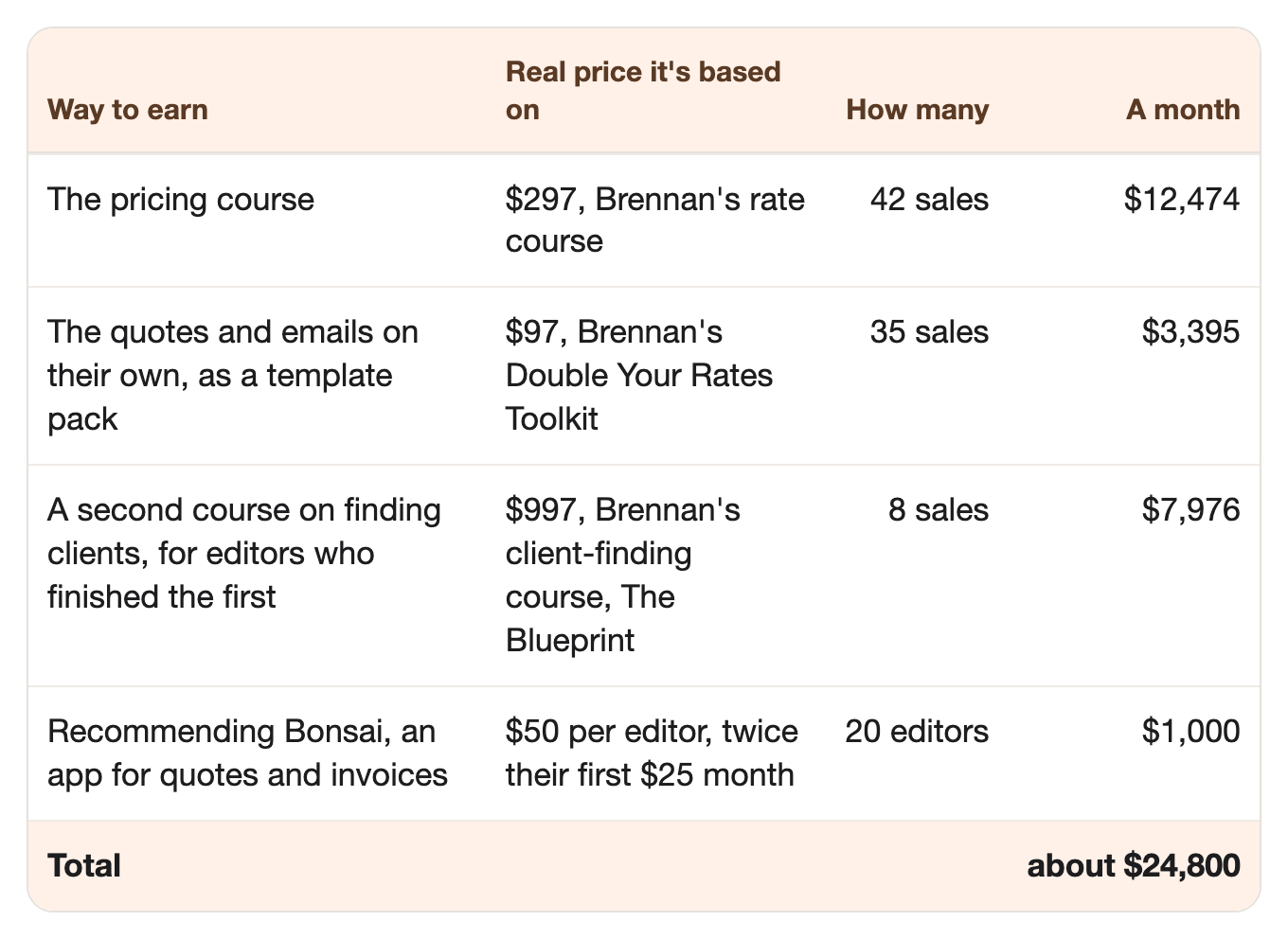
The course still does most of the work.
Grow it from 34 to 42 sales a month, and it brings in $12,474 a month.
⠀
The template pack sells to editors who aren’t ready for a course.
It’s the quotes and raise emails, with no lessons.
Some of them come back for the course later.
⠀
The second course is the big jump.
Editors who raised their rates next want more clients at the new rate.
Eight sales a month means about one in five course buyers moves up.
⠀
The Bonsai link is small, but it takes almost no time.
Bonsai pays twice the first month’s payment, so $50 for each editor on its $25 plan.
Only recommend it if you’d use it yourself.
⠀
That’s about 77 new editors a month, or about 920 a year.
That’s about 12% of one year’s editor job openings, so it’s a big share.
It’s a rough yardstick, since most openings are salaried jobs.
Many freelance editors edit on the side and aren’t in that count, but treat this as a stretch.
⠀
And if it doesn’t work? Here’s everything you lose:
Nothing for the course site, if you start on a free plan.
One month’s subscription to an AI app, like ChatGPT or Claude.
One week of your time.
⠀
👉 So one course, done well, adds up to about $25,000 a month.
Most million-dollar totals come from a few ideas, not one. Take two or three from this newsletter, or one idea across a few niches, and give it two or three years.
For this course, a similar niche could be freelance translators. And this course could be your first idea.
Itching to build this one?
Good. The step-by-step plan is right below. 👇
Just browsing? All good. A new idea comes next week.
That’s it, my fellow contrarians! 🙌
Yours ‘hoping one of these sparks an idea of your own’ Vijay Peduru 🦸♂️
⠀
⠀
⠀
🧰 Want to build it? Here’s everything else.
⠀
Step 1: 🎯 Pick one kind of editor
You don’t need to be an editor. You need to know exactly who you’re teaching.
Pick one group, not all editors.
Academic editors, who fix research papers for scientists and students.
Fiction editors, who work on novels for self-published authors.
Business editors, who polish reports and websites for companies.
Collect real quotes, without asking anyone.
Editors in that group already post what they charge and how they quote, in editor forums and groups.
Your AI reads those posts, plus the EFA rate chart, and finds what editors say when a client argues about the price.
Then it turns them into a list of the pricing problems they share.
⠀
Step 2: 🛠️ Build the course
Five short modules, each ending with something the editor can send, plus two extras.
Find your lowest price. The lowest rate that covers their bills, taxes, and unpaid hours.
From hourly to a fixed price. How to quote a whole project instead of an hourly rate.
The quote. A sample proposal, filled in for one real-looking job.
Raising your rate. The email to old clients, and the price for new ones.
The hard replies. What to say to “that’s too expensive” and “can you do it cheaper?”
Add the extras: a price sheet for their kind of editing, and three sample quotes.
⠀
Step 3: 🔍 Check every lesson
Editors will put these numbers in front of real clients, so every lesson gets two checks after it’s written.
Your AI does all three passes for you: it writes in Part 3, and checks in Parts 4 and 5 of the prompt.
🖊️ The AI writer. It writes the price sheet, quotes, and emails from your research notes and rate sources.
🔍 The AI fact checker. A second pass checks every number against its source, and flags any number with no source.
🧐 The AI critic. A third pass reads it like an experienced editor, and then like a nervous new one.
Optional: pay an experienced editor in your group once, to review the price sheet and the first module.
⠀👉 The prompt already follows four safety rules:
No promised income, raises, or “you’ll double your rate.”
Every rate is shown as a range from a named source, never as “the rate you must charge.”
No copying the EFA chart or anyone’s paid course. Link to them instead.
Every lesson tells editors to adjust for their own experience, clients, and taxes.
⠀
Step 4: 🏪 Open for sales
Copy Brennan: one clear price and a money-back promise.
Set your price.
$297, like Brennan’s rate course.
A 30-day money-back promise, like his.
Pick where to sell. Gumroad, Teachable, or Kajabi all host courses and take payments.
Give one module away free, in exchange for an email address, so editors can try before buying.
Let AI write your sales page, using one real sample quote from the course as the example.
⠀
Step 5: 📣 Get your first students
Go where editors already read and ask each other for help.
Write one free guest post for a blog or newsletter that editors in your group read.
Make it your single best lesson, like “How to quote a 300-page academic book.”
Add one line about your course at the end.
Give the fastest useful answer in editor groups.
Join the Slack, Discord, or forum groups where editors ask “what should I charge for this?”
Answer with a real range and its source, and keep your course’s name in your profile, not in the reply.
Ask for a review the day a student writes “I raised my rate.”
Reply with thanks, then ask for a short review on your course page while the feeling is fresh.
Never ask for a good review, just an honest one.
⠀
Step 6: 🏃 Eliminate competitors
Here’s how to stay ahead when the competitors show up.
Let your first 30 students pick what you build next.
Put them in one small group, and ask which job they most want a sample quote for.
Their votes decide the next price sheet and module, so the course keeps fitting them better than a general one.
Own one claim: “Real rates for academic editors, each one with its source.”
Swap in your kind of editor, then put the line on your sales page, every price sheet, and your group profile.
A general freelance pricing course can’t say it, so keep saying it until editors repeat it back.
⠀
Step 7: 🎲 Make it bigger
Every freelancer who has to name a price has the same problem.
Add the three extras from “How much you can make,” one at a time.
First the template pack, since the quotes and emails are already in the course.
Then a second course on finding clients, once your first students have raised their rates.
Then one quotes-and-invoices app you’d recommend anyway, like Bonsai.
Open the same course for other freelancers: translators, technical writers, or illustrators.
One course at about $25,000 a month is about $300,000 a year, before fees. 🎯
Add two or three more courses, or ideas from this newsletter, and a million dollars in total is two or three years away.
⠀
🗓️ Your first week
Phew. That was a lot. 😅
A first version of Steps 1 to 5 fits into seven days. 🚀
By day 7, you have a free first module, a sales page, and one guest post pitch sent.
Quick heads-up: the prompt below has eight Parts (Part 0 to Part 7), and they’re not the same as the Steps above.
Day 1 (Step 1): Run Part 0 of the prompt (it’s below), and pick your kind of editor.
Then gather real rates and quotes with Part 1.
Day 2 (Step 2): Plan the course with Part 2.
Days 3–4 (Steps 2 and 3): Write the price sheet, quotes, and emails with Part 3, then check them with Parts 4 and 5.
Day 5 (Step 4): Write your sales page with Part 6, and open for sales.
Days 6–7 (Step 5): Write your guest post pitch and group answers with Part 7, and send the pitch.
⠀
🏄 How to use the prompt
One prompt does all the AI work, in seven parts, plus a quick market check (Part 0).
Part 1 — Gather real rates. Reads what editors in your group already post about pricing, then sorts it into shared pricing problems.
Part 2 — Plan the course. Turns those problems into five modules, each ending with something to send.
Part 3 — Write the price sheet, quotes, and emails. Writes them from your notes and rate sources, with a source for every number.
Part 4 — Check the facts. Checks every number against its source, and flags any without one.
Part 5 — Find the mistakes. Reads it like an experienced editor, then like a nervous new one.
Part 6 — Write the sales page. Uses one real sample quote as the example.
Part 7 — Write the first-students kit. Writes a guest post pitch and draft, group answers, and the review-ask message.
Run it your way:
Part by part (the default): it pauses after each part, and you type “next” to keep going.
All at once: say “run all parts.”
Just one part: say “only do Part 3,” or any part you need.
The full prompt is just below, under “📋 The prompt.”
🎙️ Talk to your AI sidekick, don’t type.
Turn on voice mode, or use a dictation app like Wispr Flow.
Say it messy. The AI sorts it out.
Turn it into a skill, so you never paste it again.
Paste the prompt into Claude or ChatGPT, and say: “Turn this into a skill I can save.”
Install once, use forever.
⠀
📋 The prompt
The prompt (copy it into Claude or ChatGPT, fill in the INPUTS part, and run it your way)
CONTEXT:
- You're my course partner. Together we'll build an online pricing course for one kind of freelance editor (or the freelancer I name below).
- This prompt has eight parts, Part 0 to Part 7, in order.
- Run it the way I ask:
    - If I say nothing, go one part at a time. After each part, show me the result, then stop and wait. Move on only when I type "next."
    - If I say "run all parts," do them all, Part 0 to Part 7, without stopping.
    - If I say "only do Part 3" (or any part), do just that part.
- If a part needs something from me, ask for it before you start that part.
- Follow these rules in every part:
    1. Never promise income, a raise, more clients, or "you'll double your rate."
    2. Show every rate as a range with a named source (my research notes, or a page you opened with its link). Never as "the rate you must charge."
    3. Never copy a rate chart, a paid course, or anyone's writing. Summarize in your own words and link to it.
    4. Never invent a quote, a review, a student result, or a story. Use only what's in my notes or a page you opened.
    5. Never use a real client's or editor's name.
    6. Add this line to every lesson: "Adjust these numbers for your own experience, clients, and taxes."
- Never invent a fact or a number. If you're not sure a fact is right, leave it out.
- Keep web search on for the whole prompt (turn on search in ChatGPT or Claude), so you can open any page you need to check.

=============== INPUTS — edit these, or just run as is ===============

Who the course is for:
{e.g. freelance academic editors who edit research papers for scientists}

My research notes (leave blank; Part 1 fills them in):
{e.g. "An editor posted that she charges per word for papers, and lost two clients when she switched to per-hour"}

Rate sources I trust (links):
{e.g. the Editorial Freelancers Association's latest rate chart}

My price:
{e.g. $297, with a 30-day money-back promise}

======================== END OF INPUTS ========================

THE PARTS:

Part 0 — Check the market today.
This part needs web search (turn on search in ChatGPT or Claude). Search for pricing courses and guides for my kind of freelancer and, for each place, give the count, the three biggest with links, and their prices:
1. Courses on Udemy, Teachable, Gumroad, and similar sites about pricing for this kind of freelancer.
2. General freelancing courses that cover pricing.
3. Free rate charts and guides from associations and groups.
4. The biggest newsletters, blogs, or social accounts teaching this group about rates.
Then tell me: early (few sellers), growing, or crowded, and which kind of editor (or freelancer) looks least served. Give a link for every number. If you can't open a page, say so. Never guess a number.

Part 1 — Gather real rates.
This part needs web search. Find the forums, groups, blogs, and rate charts where my kind of editor talks about pricing, and read as many posts as you can open, aiming for a few hundred. Find: what they charge and how (per word, per hour, per project), how they write a quote, what they sent when they raised a rate, and what they say when a client pushes back. Give a link for every point. Then sort what you found into the five pricing problems that came up most, with how many of the posts you read named each. If you can't open a page, say so. Never guess a count. These are my research notes for the rest of the prompt.

Part 2 — Plan the course.
Turn the problems from Part 1 into five modules, in this order: find your floor rate, from hourly to a fixed price, the quote, raising your rate, the hard replies. For each module give the goal, three to five short lessons, and the one thing the editor can send or use at the end. Say clearly which parts are your guess.

Part 3 — Write the price sheet, quotes, and emails.
Write:
1. A price sheet for my kind of editor: each common job, a rate range, and its source.
2. Three sample quotes for realistic jobs, each with scope, price, timeline, and what's not included.
3. A "my rate is going up" email to an old client, and a reply to "that's too expensive."
Use only my notes and the rate sources I gave or you opened. Follow every rule in CONTEXT.

Part 4 — Check the facts.
Now act as a separate fact checker who didn't write Part 3. Open every source. For each number, mark it: matches the source, doesn't match, or has no source. Quote the source line for each match. Remove or fix anything that doesn't match, and list what you changed.

Part 5 — Find the mistakes.
Now act as an editor with 15 years of freelance work, then as a nervous editor in their first year. As the experienced editor, flag anything that's unrealistic, risky, or missing. As the new editor, flag anything confusing or too scary to send. Then give the final price sheet, quotes, and emails, with every fix made.

Part 6 — Write the sales page.
Ask me for one finished sample quote from the course first. Use it as the example. Never invent a result, a review, or a number. Give me:
1. A headline that names my kind of editor, not "freelancers."
2. What's inside: the five modules, the price sheet, the sample quotes, and the emails.
3. How every number is sourced and checked.
4. The price, shown up front, and the money-back promise.
5. A free first module, in exchange for an email address.

Part 7 — Write the first-students kit.
1. Write a short pitch to a blog or newsletter my kind of editor reads, offering a free guest post. Then draft that post from my strongest lesson, with one line about my course at the end.
2. Write five short answers to "what should I charge for this?" for editor groups. Each gives a real range with its source. Never link to my course in the answer.
3. Write a short thank-you message for a student who says they raised their rate, asking for an honest review on my course page.
⠀
📎 The sources
Every number above, with where it came from.
Brennan’s business · Number: “Now, 4 years later, my business is doing 7-figures annually”; “we’re now 10,000+ customers strong”; “more than 200 groups that meet monthly around the world” · Source: Double Your Freelancing, 2016 Year In Review (Dec 19, 2016)
Brennan’s start · Number: 2008: “Forced to quit my $105k/year job and start freelancing”; 2012: “wrote a short little ebook, Double Your Freelancing Rate” (against his better judgment, he says); 2013: turned it into “a much bigger and better online course” · Source: Same 2016 page
The ebook’s first revenue · Number: Double Your Freelancing Rate, “Launched: September, 2012,” “2012 Revenue: $33,024” · Source: Double Your Freelancing, 2013 review (Dec 16, 2013)
His 2013 revenue and class price · Number: “The net total revenue in 2013 year clocks in at” $324,073 (the updated figure on the page); Consultancy Masterclass price raised “from $1,199 to $1,799” · Source: Same 2013 page
Undercharging cost, team, course price · Number: “undercharging and having a haphazard sales process resulted in my agency losing out on well over $1 million in revenue”; “My team grew to 11 employees”; “42 Video Lessons Across 9 Modules”; “30-day, 100% Satisfaction Money-Back Guarantee”; “Price: $297” · Source: Double Your Freelancing Rate page, Wayback copy of July 28, 2026
Editor jobs · Number: About 105,000 jobs in 2025; 9% self-employed; about 7,900 openings projected each year, on average, over the decade; median wage $77,920 (May 2025) · Source: US Bureau of Labor Statistics, Editors (Aug 27, 2026; figures matched on the Wayback copy of Sep 1, 2026)
EFA rate chart · Number: “Founded in 1970”; “they often don’t know how to price their work”; “for guidance only and are not mandated or recommended rates”; “Over 1,100 individuals filled out the survey – the most respondents since it was first distributed in 1991” · Source: Editorial Freelancers Association, 2026 rate chart announcement (Mar 24, 2026)
Proofread Anywhere · Number: “we have a $2 million a year turn over on Proofread Anywhere”; courses teach proofreading legal transcripts for court reporters · Source: Course Method interview with Caitlin Pyle (last updated Mar 9, 2022)
Graphic Artists Guild pricing guide · Number: First edition of Pricing & Ethical Guidelines in 1973; “began as a 20-page pamphlet and has grown into a 400-page book” · Source: Wikipedia, Graphic Artists Guild (revision of Apr 19, 2026)
US freelancers · Number: 64 million Americans freelanced in 2023, 38% of the US workforce; 47%, or nearly 30 million, provided knowledge services · Source: Upwork press release, Dec 12, 2023 (Wayback copy of Apr 2, 2024)
Template pack price · Number: Double Your Rates Toolkit: “Yes, Give Me Access For $97 30-day money-back guarantee” · Source: Double Your Freelancing, Rates Toolkit page
Second course price · Number: “When you enroll in The Blueprint, you’re getting lifetime access to the course for $997.” · Source: Double Your Freelancing, The Blueprint page
Bonsai affiliate rate · Number: “you’ll earn 200% of the referral’s first monthly payment and 30% for any yearly plan” · Source: Bonsai affiliate page
Bonsai price · Number: Essentials “$25 /user/month” (monthly billing); includes “Proposals & Contracts” · Source: Bonsai pricing page
The $25,000 math · Number: 42 × $297 = $12,474; 35 × $97 = $3,395; 8 × $997 = $7,976; 20 × (200% of $25) = $1,000; total $24,845; 77 × 12 = 924 a year, about 12% of 7,900 openings · Source: Our math