


Hello contrarians,
Today’s idea is called The One-Collection Tracker.
Get comfy. 🛋️
First, four founders’ story. Then, the business you could build from it.
⠀
⚡ Quick facts
⠀
📖 How four founders turned a Pokémon habit into an eight-figure app
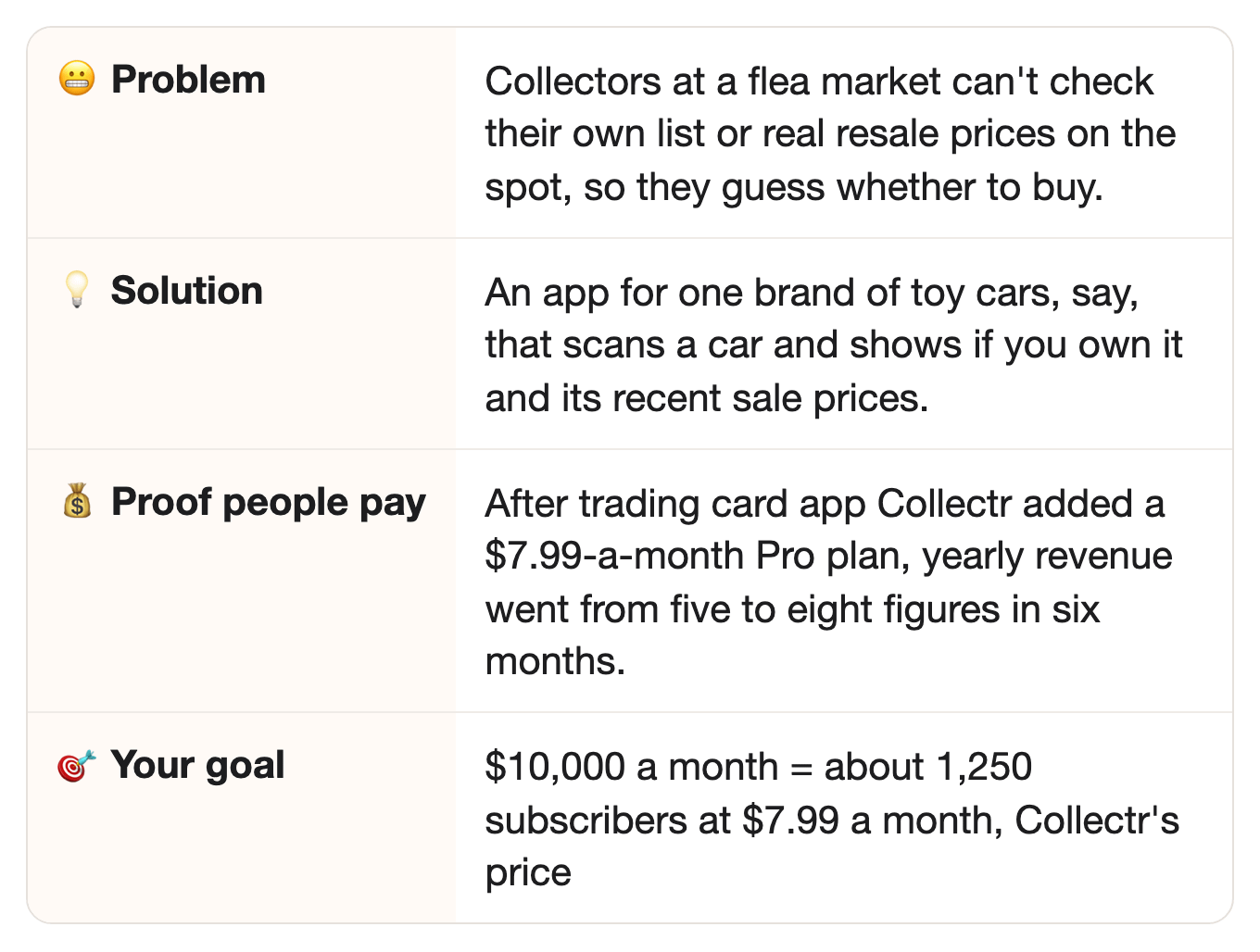
Pokémon cards? They started buying them to cope with the stress of their first startup.
Adam Hijleh and two co-founders ran a home-loan tech startup in Toronto called Doorr.
And money got tight: they had quit their jobs without savings, and the company came close to running out of money.
So, to relax, they went to a local game store every week to buy Pokémon card packs.
Then, in 2019, Adam Hijleh opened a three-dollar pack and pulled the hottest card of the year.
Packs are sealed and the cards inside are random, so “pulled” means he found it when he opened the pack.
“I remember the store going wild,” he told BetaKit.
The card was worth about $150 at the time.
Not bad for a three-dollar pack.
⠀
In 2020, they sold Doorr to Finastra, a big finance software company.
But their card collections kept growing, and so did one question.
“How much is this [card] worth?” Hijleh called it “the million-dollar question.”
They tracked it all in spreadsheets, and got sick of it.
So in December 2021, they built an app to track their cards’ value, like a stock portfolio.
A fourth partner, an old colleague from a past job, joined the founding team.
⠀
They posted about it on hobby forums, and say they added 5,000 users in 24 hours.
And they never spent a cent on ads.
Wild, right?
For most of its life, though, the app made five figures a year.
That money came from links to card marketplaces, which pay a small cut of each sale.
⠀
Then they launched a Pro plan at $7.99 a month.
It gave unlimited scans, price history, and a profit-and-loss view.
And within six months, yearly revenue went from five figures to eight figures.
Eight figures a year means at least $10 million.
By August 2025, Collectr had more than four million users… and a team of five.
“We’re an eight-figure ARR company that is doing this with five people,” co-founder Muhammad Rashid said.
ARR means yearly subscription revenue.
Yep, five people.
Great Scott! ⚡
From spreadsheets of their own Pokémon cards… to an eight-figure business, by building the app they wanted for themselves.
⠀
🔗 Same idea, new group
In the story: trading card collectors paid Collectr $7.99 a month to see what their cards are worth.
⠀In this idea: collectors of one other thing, like die-cast cars, need an app that knows every item and version in their hobby.
⠀Why it carries over: every collector asks if they own it and what it’s worth, but each collection needs its own catalog.
⠀
💡 The opportunity
Every collector asks the same two questions: do I own this, and what’s it worth? But each collection needs its own list of items to answer them.
First, what’s a collection tracker?
It’s an app that lists everything you own in one hobby, and what it’s worth.
You add an item by pointing your phone camera at it.
⠀
Collectr is built around trading cards.
It covers card games like Pokémon, Magic: The Gathering, and Yu-Gi-Oh!, BetaKit wrote.
It also tracks Funko Pops, which are small vinyl figures.
So mostly cards, plus Funko Pops.
That’s what it is built for.
⠀
Other collections need different facts.
Die-cast cars, LEGO sets, coins, and records each have their own list of every item and version.
That list is called a catalog.
A version is the same item made slightly differently, like a toy car in a rarer color or with different wheels.
The app needs the exact version before it can say “you own this” or show a price.
And each has its own places where the real sales happen.
⠀
Take die-cast cars.
Hot Wheels has been made since 1968.
Mattel, its maker, billed stores $1.75 billion for Hot Wheels in 2025, up 11% from 2024.
Its yearly report says the brand is for “kids, adults, and collectors.”
Notice who’s on that list?
Collectors, right there in the maker’s own report.
⠀
One collection is enough to reach $10,000 a month.
At Collectr’s $7.99 a month, about 1,250 subscribers bring in $10,000 a month.
⠀
👉 The idea: one app for one slice, like one brand: scan an item, see if you own it, and see what it sells for.
⠀
🙋 Not a developer? You can still build this.
Let AI write the code.
AI coding tools, like Claude Code or Cursor, build an app from screens you describe in plain words.
You talk, it builds.
⠀
Team up with a developer.
You bring the collection and the buyers, and they build and fix the app.
⠀
Pick a collection you know, or team up with a collector.
The catalog is the hard part, and a collector knows which small details matter.
⠀
🗣️ What it looks like
Here’s a made-up example from a swap meet.
Picture a collector at a swap meet, holding a tiny die-cast car.
Here’s how it could go for her.
She points her phone at the car.
The app names it: the model, the year, the series, and the color.
⠀
It answers her two questions.
“Not in your collection.”
The last few sold prices, each with its date.
⠀
She buys it and taps “Add.”
Her collection’s total updates, and the car comes off her wishlist.
No spreadsheet at home needed.
⠀
👉 One scan at the seller’s table, and she knows if she owns it and what it really sells for.
⠀
✅ Why this could work
Three reasons there’s real money here.
Others grew apps like this.
Card Ladder tracks sports card prices, and started in 2020 as a tool built “quick and dirty” for a friend.
A company called Collectors, which owns the card grading firm PSA, bought it after reaching out in November 2021.
Grading means an expert scores a card’s condition, and the grade can change what the card sells for.
Ha. Quick and dirty, and it still got bought.
LUDEX, a card-scanning app from a former stock trader, had over a half-million subscribers by December 2023, its founder said, without saying how many pay.
CollX, a card scanner started by a dad whose son collected, had more than 600,000 users in February 2023.
⠀
People have needed this for 47 years, and they still do.
The first Beckett card price guide went on sale for $6.95 in 1979.
Printed on paper, back then.
A monthly price guide followed in November 1984.
And Collectr passed four million users in 2025.
⠀
Even Mattel built an app for collectors.
Hot Wheels Showcase, Mattel’s own collection app, came out in October 2025.
So even the toy’s own maker thinks collectors want to track what they own.
⠀
👉 Like to check the numbers yourself? The links are all in “📎 The sources,” at the very end.
⠀
📊 More proof people want this
Want more? Here you go.
Collectors already pay.
Collectr’s Pro plan costs $7.99 a month, in US or Canadian dollars.
⠀
One brand is a big business on its own. 💰
Mattel billed stores $1.75 billion for Hot Wheels in 2025.
That’s up from $1.58 billion in 2024.
⠀
Collections are huge.
Collectr users had logged over 600 million products worth over $1.5 billion, BetaKit reported in August 2025.
That’s a lot of stuff to keep track of.
⠀
What collectors asked for under a review of Mattel’s app.
“I wish we had the option to catalogue cars by scanning the barcode/QR code from the back of the card.”
That’s a comment from October 2025, under a YouTube walkthrough of the app.
In other words: let me scan it, please.
⠀
And what they missed.
“Why no listing for matchbox?”
Matchbox is another die-cast car brand, also made by Mattel.
That’s a comment from October 2025, under another video about the app.
⠀
👉 Collectors pay to know what they own and what it’s worth, and they openly ask for the features they’re missing.
⠀
🔍 Who’s already doing it
Who’s in the space, and what they skip.
Collectr is built for trading cards.
In 2025, it covered more than 25 card games, plus Funko Pops.
Its prices come from marketplaces like eBay and TCGplayer, a trading card marketplace.
⠀
Mattel’s own app tracks Hot Wheels, without prices.
Hot Wheels Showcase offers search, a collection list, and a wishlist.
Its App Store listing mentioned no prices, when we checked.
So it answers “do I own this?”… but not “what’s it worth?”
⠀
Small die-cast apps came out fast.
Die Carz came out in July 2025, Hunt64 in January 2026, and Carlect in March 2026.
Several already pitch scanning and prices in their App Store names, like “Diecast Price Scanner” and “Diecast Scan & Value.”
So yes, die-cast cars are getting crowded.
Our guess: so many new apps also means collectors want them.
⠀
Still missing when we checked:
An app that goes deepest on one slice of a collection, like one brand or one series.
Every version listed, real sold prices with dates, and that slice’s collectors in one place.
⠀
🔎 Check the market yourself in 2 minutes: run Part 0 of the prompt, under “📋 The prompt” below.
Your AI searches the app stores, collector sites, and YouTube that day, and tells you: early, growing, or crowded.
Early? Start now.
Crowded? Good news: it means collectors pay. Pick one narrower slice (Step 1 below).
A crowded market is still OK. You win by serving one slice better, not by being first.
⠀
👉 That gap is your chance: an app that goes deepest on one slice.
⠀
🤖 Why AI won’t replace it
AI can recognize a toy car in a photo. Naming the exact version and its price takes a catalog someone built.
🔮 Honest note: an AI agent can look up one item’s price for its owner.
So a single lookup isn’t the product.
The product is a checked catalog, a price history that grows, and a whole collection kept in one place.
Could ChatGPT just do this?
Partly… but not the things below.
Every version, checked.
Small details can change the price a lot.
BetaKit’s example: a plain Pikachu card is worth cents to a few dollars, but special editions are worth far more.
Same Pikachu, very different price.
Your catalog lists every version, and each scan gets checked against it.
⠀
Real sold prices, with dates.
A sold price is what a buyer actually paid, not what a seller is asking.
Collectors resell on marketplaces like eBay, and that’s where the sold prices are.
Your app reads them through a marketplace’s official data program, or users log what they paid.
You set this up once, and every user gets the prices.
⠀
Ready at the swap meet.
One scan, no prompt to write, while the seller waits.
Nobody wants to type a prompt with the seller watching.
⠀
The whole collection, in one place.
A chat app can track a list, if you paste it in every time.
Few collectors will do that for hundreds of cars.
Your app keeps the total, the duplicates, and the wishlist.
⠀
Proof they pay anyway: Collectr’s $7.99 Pro plan took it to eight figures a year within six months.
AI chat apps can look at a photo, and collectors still pay for the finished app.
⠀
👉 Collectors won’t build a checked catalog and a price history themselves, so they pay for an app that already has both.
⠀
💵 How much you can make
Here’s the math. 🧮
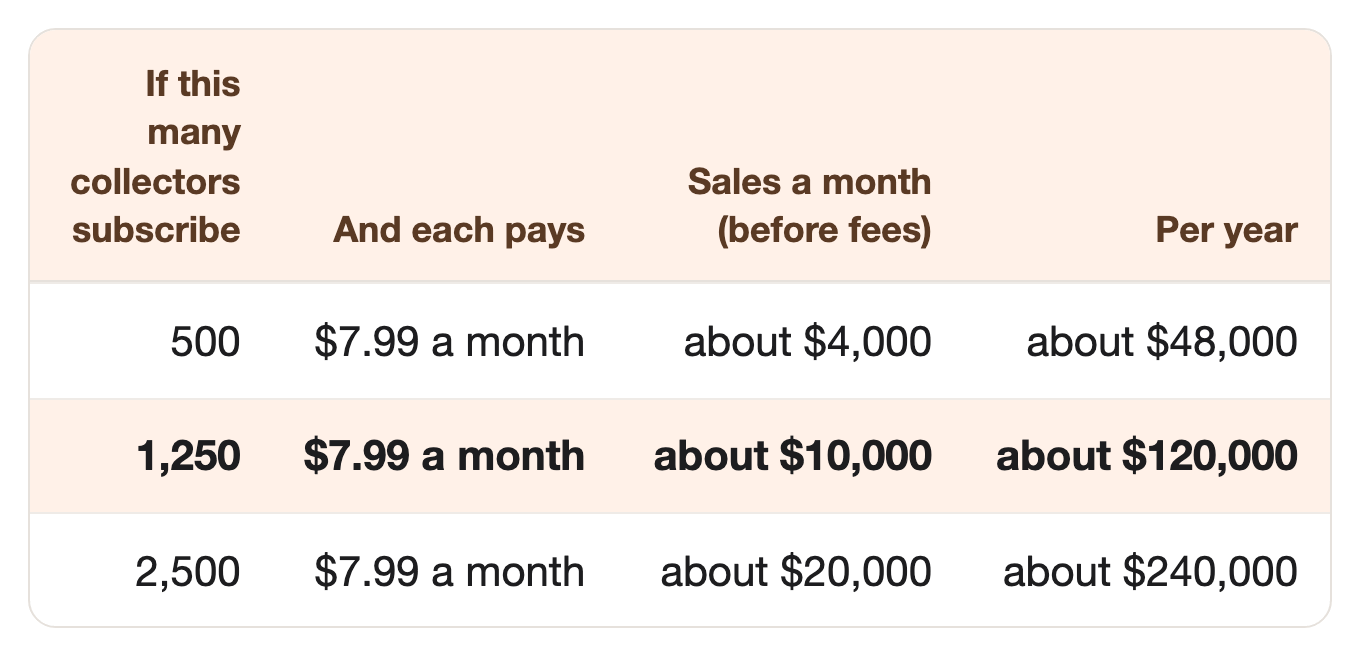
$7.99 a month is the price of Collectr’s Pro plan.
⠀1,250 subscribers is a tiny slice of Collectr’s four million users.
Tiny, right?
⠀
If it doesn’t work out, here’s all you lose:
$99 for one year of Apple’s developer program, so you can list the app.
One month’s subscription to an AI app, like ChatGPT or Claude.
One week of your time.
⠀
👉 Add three more ideas at $10,000 a month each, and the yearly total gets close to half a million.
Itching to build this one?
The step-by-step plan is right below. 👇
Just browsing? All good. A new idea comes next week.
That’s it, my fellow contrarians! 🙌
Yours ‘handing you ideas with the proof attached’ Vijay Peduru 🦸♂️
⠀
⠀
⠀
🧰 Want to build it? Here’s everything else.
In every step, AI does most of the work, while you pick the collection and check the facts. 🎙️
⠀
Step 1: 🎯 Pick one collection, and one slice
One slice, not every collectible.
Think small here.
Pick a collection you know, or can reach.
Die-cast cars, LEGO sets, coins, records, or retro video games.
Then pick one slice inside it.
One brand, one series, or one era, like Matchbox cars, or LEGO sets from one theme.
Find where its collectors meet. Clubs, swap meets, hobby shops, and YouTube channels about that slice.
Pick a name that’s yours. Never put a toy brand’s name or logo in your app’s name or icon.
⠀
Step 2: 📚 Build the catalog
The catalog is the real product: every item and every version, checked.
Remember, this is the hard part.
List what a collector needs for each item: name, year, series, color, and the small details that mark a version.
Use sources you’re allowed to use.
Makers’ own lists, collector guides, and your own collection.
Take your own photos, or let users add theirs. Never copy other sites’ photos.
Plan your prices.
Use a marketplace’s official data tools, or its affiliate program, which pays you a small cut of each sale you send it.
Collectr’s prices come from marketplaces like eBay and TCGplayer.
Or let users enter what they paid.
Never scrape a site whose rules forbid it.
Start with 200 items, then grow the catalog each week.
⠀
Step 3: 🛠️ Build the app
You don’t need to code. AI coding tools build it, and an AI model reads the photos.
Keep it tiny: three screens.
Scan an item.
See the match, “you own this” or “not yet,” and recent sold prices with dates.
See the collection: the total, the duplicates, and the wishlist.
Use an AI coding tool, like Claude Code or Cursor, and describe each screen in plain words.
The photo goes to an AI model that matches it against your catalog.
⠀
Step 4: 🔍 Check every match and price
Collectors notice one wrong version, so every scan and price gets checked.
Remember the plain Pikachu worth cents to a few dollars, and the special editions worth far more?
That’s why.
Your AI writes the scan rules in Part 4 of the prompt, and tests them in Part 5.
🛡️ The rules, built into the app:
Every price is an estimate, with the date and the number of sales behind it.
Never call a price an appraisal, or promise what an item will sell for.
An appraisal is a formal value from a qualified expert, and your app’s prices come from recent sales, not an expert.
If the scan isn’t sure, show the closest two or three matches, and let the user pick.
Never sell anyone’s data.
🔍 Test 50 items you own. Compare each scan with the real item, and fix the rules where it’s wrong.
Optional: ask a longtime collector of your slice to check your first 200 catalog entries.
⠀
👉 The prompt already follows these rules: prices labeled as estimates, no appraisals, no brand names in your app’s name, no copied photos.
⠀
Step 5: 🏪 Open for subscribers
Copy a price collectors already pay.
Easy one.
Free to download and scan, so collectors try it on the spot.
Pro at $7.99 a month, like Collectr’s Pro plan.
Pro adds prices, price history, the collection’s total value, and unlimited scans.
Let AI write your App Store listing, in the words your collectors use.
Put the rules in the listing too: prices are estimates, never appraisals.
⠀
Step 6: 📣 Get your first collectors
Go where collectors of your slice already meet in person and online.
Here’s where you meet your first real users.
Give a 20-minute talk at a collector club meeting.
Show how to tell three look-alike versions apart, live on the screen.
Hand out a card with a free sign-up code at the end.
Ask a hobby or toy shop to keep a small card on its counter.
The card offers a free month of Pro to the shop’s customers.
Offer to mention the shop in your app, in return.
Publish one price report for your slice, every quarter, under the same name.
The ten most-wanted items, and how their sold prices moved, from your own price history.
Collectors quote it, and link back to you.
⠀
Step 7: 🏃 Eliminate competitors
Here’s how to stay ahead when the competitors show up. Two things a newer app can’t copy on its first day.
Let your price history grow every month.
Every sale you log makes your history longer.
A new app starts that history from zero.
Keep a “switching from” page ready.
Write a page now for collectors leaving a bigger app, showing how to bring their list over.
If a bigger app raises its price or drops a feature, the page is live that day.
⠀
Step 8: 🎲 Make it bigger
Every collection needs its own catalog, and its collectors all ask: do I own this, and what’s it worth?
Add a second slice of the same collection, on the same app.
Then open a second app for another collection you know, using the same code.
Each new app reuses the code, the scan rules, and the price setup from your first one. 🎯
⠀
🗓️ Your first week
Phew. That was a lot. 😅
A first version of Steps 1 to 6 fits into seven days. 🚀
By day 7, you have a slice, a starter catalog, a test app, and a club talk, a counter card, and a price report.
Quick heads-up: the prompt below has eight Parts, Part 0 to Part 7, and they’re not the same as the Steps above.
Day 1 (Step 1): Run Part 0 and Part 1 of the prompt (it’s below), and pick your collection and slice.
Day 2 (Step 2): Plan the catalog with Part 2, and start your first entries.
Day 3 (Step 3): Plan the app’s three screens with Part 3.
Days 4–5 (Step 4): Write the scan rules with Part 4, then test 50 items with Part 5.
Day 6 (Step 5): Write your App Store listing and Pro page with Part 6.
Day 7 (Step 6): Write your club talk, counter card, and price report with Part 7.
⠀
🏄 How to use the prompt
One prompt does all the AI work, in seven parts, plus a quick market check (Part 0).
Part 1 — Pick the collection and slice. Compares three slices and picks the one easiest to reach.
Part 2 — Plan the catalog. Lists the details for each item, where to get them, and how to get prices legally, then lays out a spreadsheet with 10 sample rows.
Part 3 — Plan the app. Writes the three screens and the rules, ready for an AI coding tool.
Part 4 — Write the scan rules. Tells the AI model how to match a photo to your catalog, and what to say when it isn’t sure.
Part 5 — Test 50 items. Gives you a photo checklist, compares the app’s matches with your real items, and suggests fixes for the weak spots.
Part 6 — Write the store listing and Pro page. Your App Store page and what Pro adds, with the rules.
Part 7 — Write the growth pieces. Your club talk, your shop counter card, and your quarterly price report.
Run it your way:
Part by part (the default): it pauses after each part, and you type “next” to go on.
All at once: say “run all parts.”
Just one part: say “only do Part 3,” or any part you need.
The full prompt is just below, under “📋 The prompt.”
🎙️ Talk to your AI sidekick, don’t type.
Turn on voice mode, or use a dictation app like Wispr Flow.
Say it messy. The AI sorts it out.
Turn it into a skill, so you never paste it again.
Paste the prompt into Claude or ChatGPT, and say: “Turn this into a skill I can save.”
Install once, use forever.
⠀
📋 The prompt
The prompt (copy it into Claude or ChatGPT, fill in the INPUTS part, and run it your way)
CONTEXT:
- You're my partner in building a small collection-tracker app for one collection (or one slice of it). Users scan an item, see if they own it, and see what it sold for.
- This prompt has eight parts, Part 0 to Part 7, in order.
- Run it the way I ask:
    - If I say nothing, go one part at a time. After each part, show me the result, then stop and wait. Move on only when I type "next."
    - If I say "run all parts," do Part 0 to Part 7 without stopping.
    - If I say "only do Part 3" (or any part), do just that part.
- If a part needs something from me, ask for it before you start that part.
- RULES. Follow these in every part, and build them into everything you write:
    1. Every price is an estimate. Show it with the date and the number of sales behind it.
    2. Never call a price an appraisal, and never promise what an item will sell for or that it will go up in value.
    3. Never put a toy maker's or brand's name or logo in my app's name or icon. Brand names may appear only to describe items.
    4. Never copy photos or text from other sites. Use my own photos, users' photos, or plain facts in my own words.
    5. Get prices only from official data tools, affiliate programs, or prices users enter. Never suggest scraping a site whose rules forbid it.
    6. Never sell or share user data.
- Never invent a fact or a number. If you're not sure a fact is right, leave it out and tell me.
- Keep web search on for the whole prompt (turn on search in ChatGPT or Claude), so you can open any page you need to check.

=============== INPUTS — edit these, or just run as is ===============

The collection:
{e.g. die-cast cars}

Slices I'm thinking about (or leave blank):
{e.g. Matchbox cars, premium 1:64 brands, Hot Wheels from the 1970s}

What I know about it:
{e.g. I've collected Matchbox for 10 years and own about 600 cars}

Items I own that I can photograph for testing:
{e.g. 50 Matchbox cars from different years}

My prices:
{e.g. free to scan; Pro at $7.99 a month}

======================== END OF INPUTS ========================

THE PARTS:

Part 0 — Check the market.
This part needs web search (turn on search in ChatGPT or Claude). For my collection and each slice I listed, search and give the count, the three biggest with links, and their prices:
1. Collection apps on the App Store and Google Play.
2. Websites and price guides for this collection.
3. The biggest YouTube channels and collector groups for it.
Then tell me: early (few apps), growing, or crowded, and which slice looks least served. Give a link for every number. If you can't open a page, say so. Never guess a number.

Part 1 — Pick the collection and slice.
Compare three slices of my collection, using Part 0 and what I know. For each: how many items it has, where its collectors meet, where its sales happen, and how well the apps in Part 0 cover it. Then pick one, and say why. Say clearly which reasons are your guess.

Part 2 — Plan the catalog.
For my slice:
1. List the details a collector needs for each item, including the small details that mark a different version.
2. List sources I'm allowed to use for these details, with links, and say what each one's rules allow.
3. List legal ways to get sold prices: official data tools, affiliate programs, or prices users enter. Say what each one allows, with links.
4. Give me a spreadsheet layout, and fill in 10 sample rows from sources you can link. Mark anything you couldn't confirm.

Part 3 — Plan the app.
Write a plan I can paste into an AI coding tool, like Claude Code or Cursor. Keep it to three screens:
1. Scan: take a photo of an item.
2. Match: show the item, "in your collection" or "not yet," and recent sold prices, each with its date and the number of sales. If the match isn't sure, show the closest three and let the user pick.
3. Collection: the total value, the duplicates, and the wishlist.
Add a free tier (scans and the collection list) and a Pro tier at my price (prices, price history, total value, unlimited scans). Add a line on every price screen: "Prices are estimates from recent sales, not an appraisal." Say what data the app stores, and that it's never sold.

Part 4 — Write the scan rules.
Write the instructions the app sends to the AI model with each photo. They must say:
1. Match the photo only to items in my catalog, and return the catalog ID.
2. Give a "how sure I am" note: high, medium, or low.
3. If it's low, return the closest three matches instead of one.
4. Never invent an item, a version, or a price.
5. Never say what an item will sell for, or that it's a good investment.
Give the answer back in a fixed format the app can read.

Part 5 — Test 50 items.
Help me test the rules from Part 4.
1. Give me a checklist for photographing my 50 test items, mixing easy ones and look-alike versions.
2. Wait while I run each photo through my app, and paste the results back.
3. Compare each result with the real item. Mark it right, close, or wrong.
4. List the items it gets wrong most, and suggest changes to the Part 4 rules or the catalog.

Part 6 — Write the store listing and Pro page.
Write my App Store and Google Play listing: a title, a subtitle, a short description, and keywords, using the words my slice's collectors actually search for. Then write a short Pro page: what Pro adds, the price, and "Cancel any time." Include, word for word: "Prices are estimates from recent sales, not an appraisal." Never promise that items will go up in value. Follow the brand-name rule in RULES.

Part 7 — Write the growth pieces.
Write three things:
1. An outline for a 20-minute talk at a collector club meeting: how to tell three look-alike versions apart, then a short app demo, then a free sign-up code.
2. A small counter card for a hobby or toy shop: one line about the app, a free month of Pro for the shop's customers, and a spot for the shop's name.
3. A template for a quarterly price report for my slice: the ten most-wanted items and how their sold prices moved, using only my app's own price history. Label every price an estimate, with dates.
Never promise results, and never invent a price.
⠀
📎 The sources
Every number above, with where it came from.
Collectr’s story · Number: Doorr founders Adam Hijleh, Muhammad Rashid, and Abbas Ali (”Doorr co-founder”); weekly trips to 401 Games for Pokémon packs; a “three dollar” pack in 2019; “I remember the store going wild”; card worth about $150 USD; “the million-dollar question everybody goes to is ‘How much is this [card] worth?’”; “Sick of using spreadsheets, in December 2021…”; Mark Hopson, “an old colleague from Flipp,” on the founding team; 5,000 users “Within 24 hours”; “without spending a cent on advertising” · Source: BetaKit, August 13, 2025
Collectr’s revenue and price · Number: “The $7.99-per-month subscription (in both USD and CAD) boosted the company from five-figure to eight-figure ARR within six months”; five-figure ARR from affiliate listings on eBay and TCGplayer “for most of its lifetime”; “more than four million users”; “eight-figure ARR company… with five people” · Source: Same article
Collectr’s size · Number: Covers Pokémon, Magic: The Gathering, Yu-Gi-Oh, “other collectibles, like Funko Pops”; “tracking over 600 million products worth over $1.5 billion”; Pikachu “worth anywhere from a few cents to a few dollars” · Source: Same article
Collectr’s launch · Number: “Launched in February 2022”; “more than 25 trading card games”; Doorr sold to Finastra in 2020; “from five-figure annual recurring revenue (ARR) to eight figures in just six months” · Source: Fintech.ca, May 22, 2025
Card Ladder · Number: Launched in 2020; “quick and dirty” first tool; Collectors, PSA’s parent, reached out in November 2021 and bought it · Source: Sports Collectors Digest, December 18, 2023
LUDEX · Number: Founder spent nearly 25 years in stock trading; launched November 2022; “Ludden isn’t at liberty to divulge how many subscribers his company has, but it’s over a half-million” (free or paid not stated) · Source: Same article
CollX · Number: “more than 600,000 users”; started after CEO Ted Mann’s son began collecting cards · Source: TechCrunch, February 27, 2023
Beckett price guides · Number: “went on sale for $6.95 in 1979”; monthly price guide from November 1984 · Source: Fox Sports, October 30, 2014
Hot Wheels sales · Number: Gross billings $1,749.7 million in 2025, $1,575.0 million in 2024, up 11%; “since 1968”; “kids, adults, and collectors” · Source: Mattel Form 10-K for 2025, filed February 2026
Mattel’s app · Number: Hot Wheels Showcase, released October 1, 2025 (App Store release date); search, “Track Your Collection,” “Create a Wishlist”; no prices in its description · Source: App Store; Wayback copy, June 7, 2026
Small die-cast apps · Number: Release dates: Die Carz, July 2025; Hunt64, January 2026; Carlect, March 2026; HW Price Guide, April 2026 · Source: Die Carz, Hunt64, Carlect, HW Price Guide on the App Store
Barcode comment · Number: “I wish we had the option to catalogue cars by scanning the barcode/QR code from the back of the card.” October 2025 (video posted October 14, 2025; comment shown as “1 year ago”) · Source: YouTube comment
Matchbox comment · Number: “Why no listing for matchbox?” October 2025 (video posted October 15, 2025; comment shown as “1 year ago”) · Source: YouTube comment
Apple developer fee · Number: “$99 annual membership” · Source: Apple Developer Program; Wayback copy, June 1, 2026