


Hello contrarians,
Today’s idea is called The Reactive Dog Walk Coach.
Grab a coffee. ☕
First, a marketer’s story. Then, the business you could build from it.
⠀
⚡ Quick facts
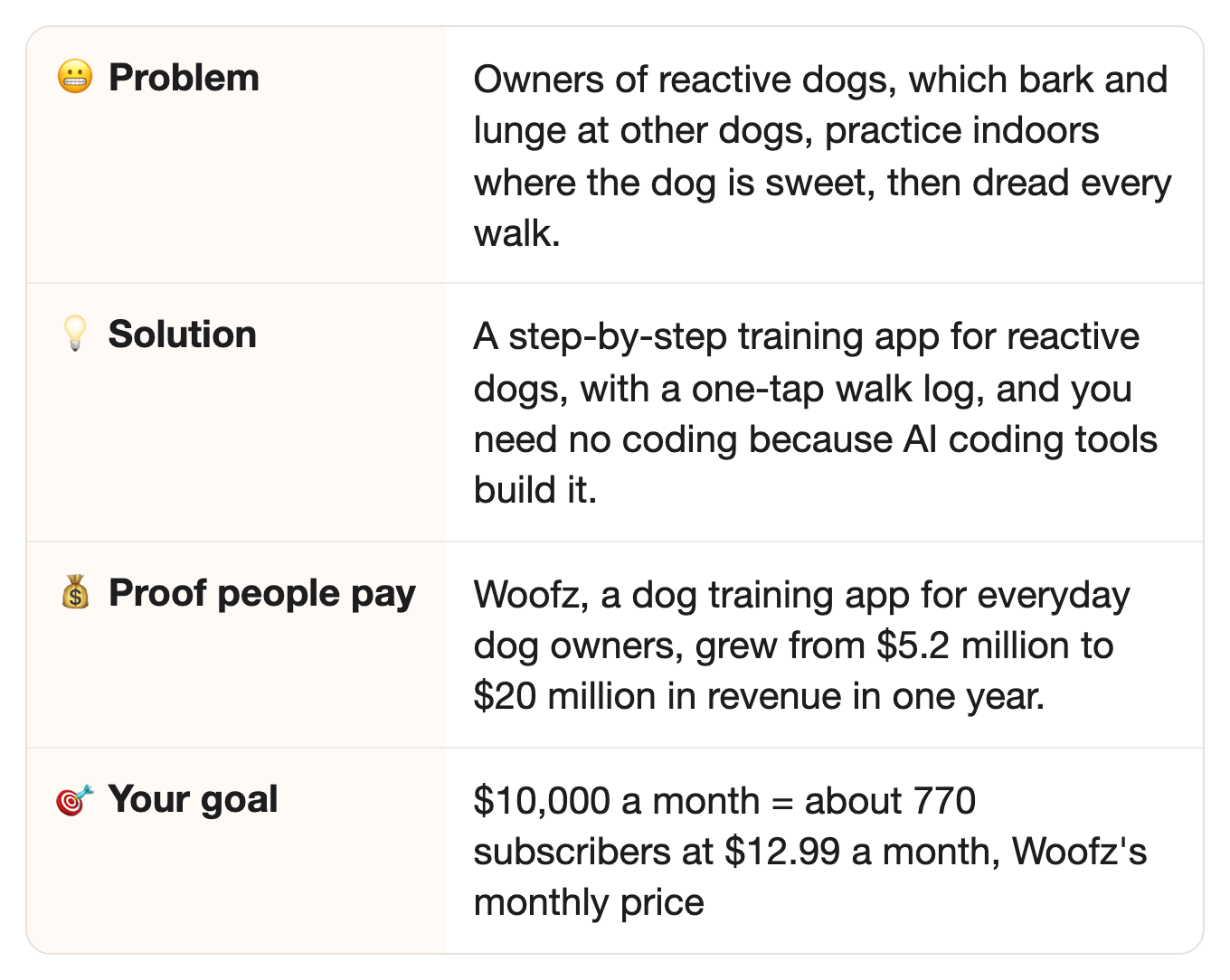
⠀
📖 How one marketer’s first dog led her to a $20M app
She went looking for good dog training help, and couldn’t find any.
Natalia Shahmetova has loved dogs since she was a kid, starting with her family’s Cocker Spaniel.
She spent years in marketing at Gismart, a company that makes phone apps.
Her job there?
Building subscription apps, the kind you pay for monthly.
Then she got her first dog, and went looking for help training her.
“I hit a wall,” she told Pulse 2.0, a business news site.
She found generic apps, random YouTube videos, and blogs she couldn’t trust.
And she realized many other dog owners felt the same.
⠀So in 2020, during the COVID lockdowns, her company started building a dog training app.
Dog ownership was booming, and there was one competitor.
Just one.
Here’s the surprise: the team was just 10 people.
“Not many people believed in the niche,” she told Tech.eu, a European tech news site.
They launched Woofz in December 2020.
By 2025, it gave owners personal daily lessons, made with input from certified dog trainers.
⠀
In early 2024, the Woofz team split off from Gismart as its own company, nove8.
She became its marketing chief, and later its CEO.
It took no venture capital money, and it made a profit from 2024 on.
Then it grew from $5.2 million to $20 million in revenue in one year.
Yes, in a single year.
By 2025, it had more than 21 million downloads and 120,000 active subscribers.
About 70% of its users were in the US.
Hot diggity dog. 🌭
From finding no good help for her first dog… to a $20 million app, by turning dog training into a clear daily plan.
⠀
🔗 Same idea, new group
In the story: everyday dog owners paid Woofz $12.99 a month for personal daily training lessons on their phone.
⠀In this idea: owners of reactive dogs need a slower plan that moves in small steps, week by week, based on each walk.
⠀Why it carries over: both groups want a clear daily plan they can trust, instead of random YouTube videos and blogs.
⠀
💡 The opportunity
Woofz is built for everyday dog owners. Owners of reactive dogs need a plan that moves in small steps, week by week.
First, what’s a reactive dog?
It’s a dog that barks, lunges, or growls at other dogs or people, often on a leash.
And often, the dog is scared, not mean.
At home?
They can be the sweetest dog you know.
⠀
It’s common.
In a study of 13,700 pet dogs in Finland, 17% were afraid of other dogs.
And the US had about 89.7 million dogs in 2024, the American Veterinary Medical Association found.
That’s a lot of dogs.
⠀
The big app is built for every dog, not for dogs that bark and lunge.
Woofz’s App Store page offers a behavior program for “barking, chewing, biting, and more.”
And one owner’s review there, from May 2025, says the app “assumes you just brought home a puppy.”
Ouch.
⠀
Here’s the bright side: reactive dog training is a slow plan of small steps, and an app is great at tracking them.
The owner keeps the dog far enough away from what sets it off that it stays calm.
Trainers call that thing a trigger: another dog, a bike, a stranger.
Why does the distance matter?
A dog that gets too close is too scared to learn anything.
Then, week by week, they close the distance a little.
That only works if someone tracks every walk, and an app does it in one tap.
A trainer sees the dog for an hour, maybe once a week.
But the walks happen every day, with nobody there to track them.
The app covers the days in between.
⠀
One rule this app never breaks.
It gives training plans, not medical advice.
If a dog has bitten, or seems close to it, the right step is to see a vet or a certified behavior professional.
That’s a trainer certified in dog behavior, or a vet who specializes in behavior.
⠀
👉 The idea: an app for one kind of reactive dog, with a step-by-step plan, a one-tap walk log, and a weekly check-in.
⠀
🙋 Never trained a reactive dog? You can still build this.
Team up with a certified trainer.
They write or check the training program, and you build the app and find the owners.
Pay them, or give them a share of the subscriptions.
⠀
Let AI read what owners already wrote.
Owners of reactive dogs already post what sets their dogs off and what helped, in YouTube comments and dog forums.
Ask your AI to read a few hundred of them and sum up what comes up most.
⠀
Or start from your own dog’s problem.
Is your own dog scared of noises, or of being left alone?
Then you can build the same kind of app for that problem.
⠀
🗣️ What it looks like
Here’s a made-up example from one week.
Monday morning, the app shows one short drill.
“Today: five minutes of ‘look at me’ in your driveway.”
In that drill, the dog learns to look up at its owner for a treat.
So on the walk, it can look at her instead of at the other dog.
⠀
On the walk, a dog appears across the street.
Uh-oh.
She taps “Saw a dog,” then picks how far away it was and whether her dog stayed calm.
⠀
On Sunday, the check-in reads the week’s log.
“He stayed calm at 30 feet four times out of five. Next week, try 25 feet.”
Five feet closer, and that’s the whole step for the week.
⠀
👉 Each walk gets one tap, and next week’s plan comes from what really happened.
⠀
✅ Why this could work
Three signs the money is real.
Other dog training apps grew big, including one built just for puppies.
Dogo was built by a married couple, a software developer and a vet, inspired by their own rescue dog.
By 2022, it was used by over 4 million dog parents, and raised $3 million.
Then there’s Zigzag, which calls itself “the UK’s number one app solely dedicated to puppy training.”
In 2023, Purina, the pet food maker, teamed up with Zigzag to bring it to the US.
⠀
Owners of reactive dogs have needed help for decades, and they still do.
Feisty Fido is a short book for owners of dogs that react on a leash, by two animal behavior experts.
Its second edition came out in 2009, and it was still on sale when we checked.
And Whole Dog Journal, a paid magazine with training tips that use rewards, not force, has helped dog owners since 1998.
⠀
New owners arrive every year. 🔁
About 2 million dogs were adopted from US shelters and rescues in 2025 alone.
Each one goes home with an owner who has never trained that dog.
⠀
👉 Don’t take my word for it. Every number is linked in “📎 The sources,” at the very end.
⠀
📊 More proof people want this
Want more? Here you go.
Owners already pay for a dog training app.
Woofz charged $12.99 a month, or $29.99 to $59.99 a year.
It had 120,000 active subscribers in 2025.
⠀
Dogs are everywhere. 💰
About 45.5% of US households had a dog in 2024, the American Veterinary Medical Association found.
That’s close to half of all US homes.
⠀
What owners say, late at night.
“Its 10pm im training him in living room and watching this dreading tomorrow when he goes crazy outside again.”
That’s a comment from March 2025, under a popular YouTube lesson on reactive dogs.
So this owner practices indoors at night, and dreads the next walk outside.
The same owner adds: “Some days no issues other days nothing works i cant figure him out.”
⠀
What owners say after a bad walk.
“I’m so embarrassed and tired of that situation.”
That’s a comment from September 2025, under the same video.
⠀
And after adopting a dog.
“Every walk is a trigger storm and not very enjoyable.”
That’s another September 2025 comment, from an owner who adopted a small terrier mix a few weeks before.
A trigger storm.
That’s a whole walk of things that set the dog off.
⠀
👉 Owners already pay for dog training apps, and owners of reactive dogs openly say that they can’t work out what helps.
⠀
🔍 Who’s already doing it
The apps already out there, and what none of them does.
Woofz is built for “everyday dog owners.”
That’s how Tech.eu described it in 2025.
Its behavior program covers barking, chewing, biting, and more, not one specific problem.
⠀
Zigzag is built for puppies.
It’s made for the first months, not for a grown dog that lunges on a leash.
⠀
Small reactive-dog apps came out fast.
Then BauBau in May 2026, Mellow in June 2026, and TriggerPath in July 2026.
So more apps now compete for these owners.
Our guess: that many new apps means owners want one.
⠀
What nobody was selling, when we checked:
An app for one kind of reactive dog, like small dogs that bark at big dogs, or adult dogs just adopted.
A program a certified trainer checked, and a weekly plan built from the owner’s own walk log.
⠀
🔎 Check the market yourself in 2 minutes: run Part 0 of the prompt, under “📋 The prompt” below.
Your AI searches the app stores, online courses, and YouTube that day, and tells you: early, growing, or crowded.
Early? Start now.
Crowded? Good news: it means owners pay. Pick one narrower kind of reactive dog (Step 1 below).
A crowded market is still OK. You win by serving one kind of dog better, not by being first.
⠀
👉 That missing part can be your business: an app for one kind of reactive dog, with a trainer-checked plan that learns from every walk.
⠀
🤖 Why AI won’t replace it
Could ChatGPT just do this? Sort of, if someone gives it the dog’s triggers, distances, and every walk. Your app collects all of that for the owner.
🔮 Honest note: an AI agent can already write a reactive dog training plan for one owner.
So a plan on its own isn’t the product.
The product is the walk log, a program a certified trainer checked, and safety rules built in.
⠀
1. The inputs, every day.A good plan needs what set the dog off, how far away it was, and how the dog did.
But a stressed owner on a sidewalk won’t type that into a chat.
Your app gets it in one tap, on every walk.
⠀
2. Checked twice.Your program is checked by a certified trainer before launch.
Every weekly change is checked against your safety rules, like sending the owner to a vet after a bite.
⠀
3. Ready on the walk.The day’s drill is on the screen, with no prompt to write.
⠀
4. A record of every walk.After a month, the owner can see the calm walks adding up.
And on the bad days, that record keeps them going.
⠀
5. Proof they pay anyway: Woofz had 120,000 active subscribers in 2025.AI chat apps are free to try, and owners still paid for a finished training plan.
⠀
👉 A plan from an AI chat is free, but people pay for a plan that remembers every walk.
⠀
💵 How much you can make
Quick math time. 🧮
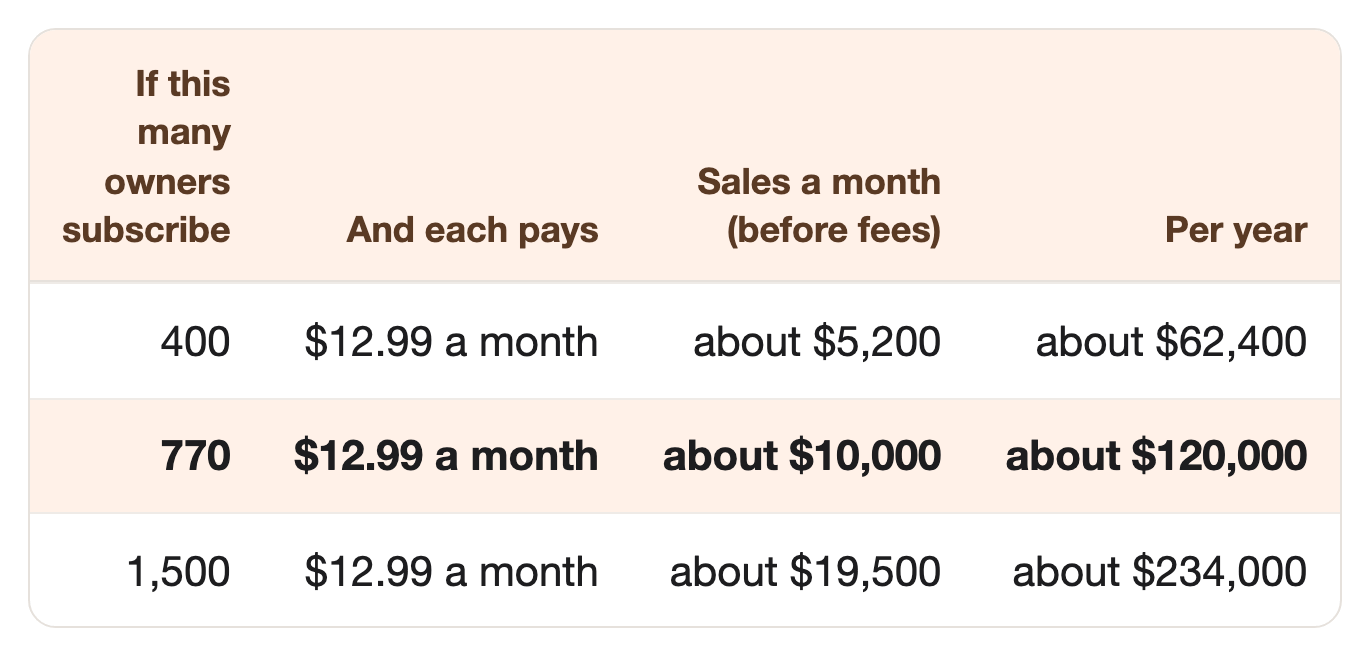
$12.99 a month is Woofz’s monthly price.
⠀770 subscribers is under 1% of Woofz’s 120,000 active subscribers.
⠀If it doesn’t work out, here’s all you lose:
$99 for one year of Apple’s developer program, so you can list the app.
One month’s subscription to an AI app, like ChatGPT or Claude.
One week of your time.
⠀
👉 With AI doing most of the work, three or four ideas like this could add up to a million in 2 to 3 years.
Did this one make you think “wait, I could do that”?
Then keep scrolling. The whole build plan is below. 👇
If not, no worries. See you next week with a new idea.
That’s it, my fellow contrarians! 🙌
Yours ‘showing you where the money already is’ Vijay Peduru 🦸♂️
⠀
⠀
⠀
🧰 Want to build it? Here’s everything else.
In every step, AI does most of the work, while you pick which kind of dog to serve, and a certified trainer checks the program. 🎙️
⠀
Step 1: 🎯 Pick one kind of reactive dog
One kind of dog, not every dog with a problem.
Good news: one kind of dog means one program to build.
Pick one group of dogs and owners.
Small dogs that bark at big dogs.
Adult dogs in their first three months after adoption.
City dogs that meet other dogs on every block.
Find where those owners already ask for help. Part 1 of the prompt lists them, like YouTube channels, trainers’ classes, and shelter follow-ups.
Pick a name that’s yours, and never use another app’s name or logo.
⠀
Step 2: 📚 Build the program with a certified trainer
The program is the heart of the app: small steps, in order, that a certified trainer has checked.
Find a certified trainer or behavior consultant who works with reactive dogs.
Pay them to write or review the program, or give them a share of the subscriptions.
Your AI drafts the program in Part 2 of the prompt, for the trainer to check.
Stages, from calm at a long distance to calm at a short one.
One short drill a day, with plain steps.
Red flags that stop the plan and send the owner to a vet or a certified behavior professional.
Use reward-based steps only. No tools or steps that cause pain or fear.
Reward-based means the dog gets a treat or praise for staying calm.
No choke or shock collars: pain makes a scared dog more scared, which is the very problem the app fixes.
⠀
Step 3: 🛠️ Build the app
You don’t need to code. AI coding tools build it, and an AI model writes the weekly check-in.
Keep it tiny: three screens.
Drill of the day: one drill, with a short video or picture.
Walk log: one tap for “saw a trigger,” then the distance and how the dog did.
Weekly plan: the plan, and a chart of calm walks.
Use an AI coding tool, like Claude Code or Cursor, and describe each screen in plain words.
Once a week, the log goes to an AI model that adjusts the plan inside your program’s rules.
⠀
Step 4: 🔍 Check every plan
Owners trust the app on hard walks, so the app checks every weekly plan against your safety rules before the owner sees it.
Your AI writes the check-in rules in Part 4 of the prompt, and tests them in Part 5.
🛡️ The rules, built into the app:
Training plans only. Never medical advice, and never anything about medicine for the dog.
If the owner logs a bite, or a near-bite, stop the plan and point them to a vet or a certified behavior professional.
Never move the dog closer by more than one small step a week.
Reward-based steps only, and never promise a cure or a date.
🔍 Test 10 made-up weeks of walk logs, including bad weeks and a near-bite, and check what the app says.
Ask your certified trainer to check the program and the test results before launch.
⠀
👉 The prompt already follows these rules: training plans only, red flags sent to a vet or behavior professional, small reward-based steps, and no promised results.
⠀
Step 5: 🏪 Open for subscribers
Copy a price owners already pay.
Easy one: Woofz already shows the price.
Free to download, with the first week’s drills free.
$12.99 a month, or a yearly plan, like Woofz.
Let AI write your App Store listing, in the words owners use, like “my dog barks at other dogs on walks.”
Put the safety line in the listing too: training plans, not medical advice.
⠀
Step 6: 📣 Get your first owners
Owners of reactive dogs search late at night, and they trust trainers. So reach them in search, and through trainers.
Show a share card the first time the dog walks calmly past another dog.
When the log shows the first walk where the dog stayed calm past another dog, show a card: “First calm pass! 🐾”
Add a share button, and your app’s name on the card.
Give certified trainers a share of each subscriber they send.
Trainers see owners once a week; your app covers the other six days.
Each trainer gets a code, and a share of each subscription that uses it.
Write one page per question owners search.
Like “why does my dog bark at other dogs on walks” or “how to walk a reactive dog.”
Each page answers the question, and offers the first week free.
⠀
Step 7: 🏃 Eliminate competitors
When others copy you, here’s how you stay the one people pick.
Make every walk start the same way.
When the owner picks up the leash, they open the app first.
It shows a quick checklist: treats in the pocket, how far to stay from other dogs, and the day’s drill.
Once the app is part of every walk, a new app has to break that habit first.
Have a “switching from a general dog app” page ready.
Build it now: what your app does for a reactive dog that a general training app doesn’t, and how to start in two minutes.
Keep it live, so it’s ready the day a big dog training app raises its price or drops a feature owners like.
⠀
Step 8: 🎲 Make it bigger
Every hard-to-train dog needs its own step-by-step plan, and every owner needs the walk log.
Add a second kind of reactive dog to the same app.
Then open a second app for another hard kind of dog, like dogs scared of noises or of being left alone.
Each new app reuses the code, the log, and the check-in rules from your first one. 🎯
⠀
🗓️ Your first week
Phew. That was a lot. 😅
Here’s a first version of Steps 1 to 6, in seven days. 🚀
By day 7, you have your chosen kind of dog, a draft program, and a test app.
You also have a share card, a trainer note, and your first help page.
Quick heads-up: the prompt below has eight Parts, Part 0 to Part 7, and they’re not the same as the Steps above.
Day 1 (Step 1): Run Part 0 and Part 1 of the prompt (it’s below), and pick your kind of dog.
Day 2 (Step 2): Draft the program with Part 2, and send it to a certified trainer.
Day 3 (Step 3): Plan the app’s three screens with Part 3.
Days 4–5 (Step 4): Write the check-in rules with Part 4, then test 10 made-up weeks with Part 5.
Day 6 (Step 5): Write your App Store listing, and a page on what the paid plan adds, with Part 6.
Day 7 (Step 6): Write your share card, trainer note, and first help page with Part 7.
⠀
🏄 How to use the prompt
One prompt does all the AI work, in seven parts, plus a quick market check (Part 0).
Part 1 — Pick the kind of dog. Compares three kinds of reactive dog, and picks one with the reasons.
Part 2 — Draft the program. Writes the stages, one drill a day, and the red flags, for a certified trainer to check.
Part 3 — Plan the app. Writes the three screens and the safety lines, ready for an AI coding tool.
Part 4 — Write the check-in rules. Tells the AI model how to read a week’s log and adjust the plan, and when to stop and send the owner to a vet.
Part 5 — Test 10 weeks. Writes 10 made-up weeks of logs, runs the rules on them, then checks the results as a strict behavior professional and as a worried owner.
Part 6 — Write the store listing and paid-plan page. Your App Store page and what the subscription adds, with the safety line.
Part 7 — Write the growth pieces. Your share card, your note to certified trainers, and your first help page.
Run it your way:
Part by part (the default): it pauses after each part, and you type “next” to go on.
All at once: say “run all eight parts.”
Just one part: say “only do Part 3,” or any part you need.
The full prompt is just below, under “📋 The prompt.”
🎙️ Talk to your AI sidekick, don’t type.
Turn on voice mode, or use a dictation app like Wispr Flow.
Say it messy. The AI sorts it out.
Turn it into a skill, so you never paste it again.
Paste the prompt into Claude or ChatGPT, and say: “Turn this into a skill I can save.”
Install once, use forever.
⠀
📋 The prompt
The prompt (copy it into Claude or ChatGPT, fill in the INPUTS part, and run it your way)
CONTEXT:
- You're my partner in building a small training app for owners of one kind of reactive dog (a dog that barks, lunges, or growls at other dogs or people, often on a leash). The app gives a slow step-by-step plan, a one-tap walk log, and a weekly check-in that adjusts the plan.
- This prompt has eight parts, Part 0 to Part 7, in order.
- Run it the way I ask:
    - If I say nothing, go one part at a time. After each part, show me the result, then stop and wait. Move on only when I type "next."
    - If I say "run all eight parts," do Part 0 to Part 7 without stopping.
    - If I say "only do Part 3" (or any part), do just that part.
- If a part needs something from me, ask for it before you start that part.
- RULES. Follow these in every part, and build them into everything you write:
    1. Training plans only. Never give medical or veterinary advice, never diagnose, and never mention medicine for the dog.
    2. If an owner reports a bite, a near-bite, or a dog that seems close to biting, stop the plan and tell them to see a vet or a certified behavior professional first.
    3. Reward-based steps only. Never suggest tools or steps that cause pain or fear.
    4. Never move the dog closer to its trigger by more than one small step a week, and step back after a bad week.
    5. Never promise a cure, a result, or a date.
    6. Never copy another trainer's or app's lessons, words, or videos. Write everything in my own words.
    7. Never sell or share owners' data.
- Never invent a fact or a number. If you're not sure a fact is right, leave it out and tell me.
- Keep web search on for the whole prompt (turn on search in ChatGPT or Claude), so you can open any page you need to check.

=============== INPUTS — edit these, or just run as is ===============

Kinds of reactive dog I'm thinking about (or leave blank):
{e.g. small dogs that bark at big dogs, adult dogs just adopted, city dogs}

What I know about it:
{e.g. my own terrier mix barked at every dog for two years, and a trainer helped us}

My certified trainer (or leave blank):
{e.g. a certified trainer in my town who runs reactive dog classes}

My prices:
{e.g. first week free; $12.99 a month or $59.99 a year}

======================== END OF INPUTS ========================

THE PARTS:

Part 0 — Check the market.
This part needs web search (turn on search in ChatGPT or Claude). For each kind of reactive dog I listed, search and give the count, the three biggest with links, and their prices:
1. Reactive dog apps on the App Store and Google Play.
2. Online courses and memberships for reactive dogs.
3. The biggest YouTube channels teaching owners of reactive dogs.
Then tell me: early (few apps), growing, or crowded, and which kind of reactive dog looks least served. Give a link for every number. If you can't open a page, say so. Never guess a number.

Part 1 — Pick the kind of dog.
Compare three kinds of reactive dog, using Part 0 and what I know. For each: what sets these dogs off, where their owners ask for help, and how well the apps in Part 0 cover them. Then pick one, and say why. Say clearly which reasons are your guess.

Part 2 — Draft the program.
Draft a training program for my kind of dog, for a certified trainer to check:
1. Four to six stages, from calm at a long distance from the trigger to calm at a short one. Say what "ready for the next stage" looks like.
2. One short drill a day for each stage, under five minutes, with plain steps an owner can follow.
3. A list of red flags that stop the plan and send the owner to a vet or a certified behavior professional.
Mark the program "DRAFT: to be checked by a certified trainer." Follow every rule in RULES.

Part 3 — Plan the app.
Write a plan I can paste into an AI coding tool, like Claude Code or Cursor. Keep it to three screens:
1. Drill of the day: the same short before-the-walk check each time (treats in the pocket, the distance for this walk), then one drill, with steps and a spot for a short video or picture.
2. Walk log: one tap for "saw a trigger," then pick the trigger, the distance, and calm, alert, or reacted.
3. Weekly plan: the plan, and a chart of calm walks.
Add a free tier (the first week's drills and the log) and a paid tier at my price (the full program and the weekly check-in). Add a line on every plan screen: "Training plans, not medical advice. If your dog has bitten, see a vet or a certified behavior professional." Say what data the app stores, and that it's never sold.

Part 4 — Write the check-in rules.
Write the instructions the app sends to the AI model each week, with the week's log. They must say:
1. Read the log, and give the owner a short summary in plain words.
2. Pick next week's stage only from the program in Part 2: step forward one small step, stay, or step back.
3. If the log shows a bite, a near-bite, or a dog getting worse two weeks in a row, stop the plan and send the owner to a vet or a certified behavior professional.
4. Never invent a drill outside the program, and never give medical advice.
Give the answer back in a fixed format the app can read.

Part 5 — Test 10 weeks.
1. Write 10 made-up weeks of walk logs for my kind of dog: good weeks, bad weeks, a week with a near-bite, and a messy log.
2. Run the Part 4 rules on each week, and show what the app would say.
3. Now act as a strict certified behavior professional. Flag any answer that is unsafe, moves too fast, or sounds like medical advice.
4. Then act as a worried owner. Flag anything confusing or scary.
5. List what to change in the Part 4 rules or the Part 2 program.

Part 6 — Write the store listing and Pro page.
Write my App Store and Google Play listing: a title, a subtitle, a short description, and keywords, using the words owners actually search for, like "my dog barks at other dogs on walks." Then write a short page on what the paid tier adds, the price, and "Cancel any time." Include, word for word: "Training plans, not medical advice. If your dog has bitten, see a vet or a certified behavior professional." Never promise a cure or a result.

Part 7 — Write the growth pieces.
Write three things:
1. A share card for the first calm pass (the first logged walk where the dog stayed calm past a trigger): a short line, my app's name, and no promise of results.
2. A short note to a certified trainer: my app covers the six days between classes, each trainer gets a code, and a share of each subscription that uses it. Ask me what share to offer before you write it.
3. One help page for the question "why does my dog bark at other dogs on walks": a plain answer, the red flags that need a vet or a certified behavior professional, and an offer of the first week free.
Never promise results, and never invent a number.
⠀
📎 The sources
Every number above, with where it came from.
Woofz’s revenue and story · Number: “It successfully scaled from $5.2 million to $20 million in revenue in one year”; “There was one competitor at the time”; “We noticed a boom in dog ownership”; “We were just 10 people then, and honestly, not many people believed in the niche”; “in early 2024, we spun off as our own company”; “profitable since last year”; “over 21 million downloads”; “About 70 per cent of Woofz users are in the US”; “everyday dog owners”; “personalised daily lessons” made “with input from certified trainers”; Shahmetova’s marketing background at Gismart; “transitioned from her marketing leadership role at Gismart to become CMO — and later CEO — at nove8, which spun off”; “we don’t have any VC behind us, just private equity” · Source: Tech.eu, August 1, 2025
Shahmetova’s first dog · Number: “my childhood Cocker Spaniel”; “It all started when I got my first dog”; “I hit a wall: there were plenty of generic apps, random YouTube videos, and unreliable blogs”; “Woofz founder and CEO Natalia Shahmetova”; building subscription apps; “since launching Woofz in December 2020”; “120,000 active subscribers”; “$20 million in 2024” · Source: Pulse 2.0, June 5, 2025
Woofz’s prices and behavior program · Number: “monthly at $ 12.99”; “yearly at $ 29.99”; “yearly at $ 49.99”; “yearly at $ 59.99”; “Behavior program — Help with barking, chewing, biting, and more”; a review dated 05/27/2025 says the app “automatically assumes you just brought home a puppy” · Source: Wayback copy of Woofz’s US App Store page, August 2, 2026
Fear of other dogs · Number: Study of 13,700 Finnish pet dogs (Scientific Reports); “fear of other dogs (17%)” · Source: Phys.org, March 5, 2020
US dogs · Number: American Veterinary Medical Association’s 2024 Pet Ownership and Demographic report, as reported by Global Pet Industry: “The US dog population rebounded to 89.7 million in 2024”; “45.5% of US households now own dogs” · Source: Global Pet Industry, October 28, 2024
Shelter adoptions · Number: “2 million dogs” adopted from shelters and rescues in 2025 · Source: Shelter Animals Count, 2025 report (Wayback copy, March 2, 2026), released February 4, 2026 (ASPCA)
Dogo · Number: Built by “a married tandem,” “developer Tadas and veterinarian Rasa,” inspired by “their own rescue dog, Udra”; “used by over 4 million dog parents”; “closing a $3 million funding round” · Source: The Suburban, February 1, 2022
Zigzag · Number: “the UK’s number one app solely dedicated to puppy training”; launched March 2021; Purina teams up to launch it in the US · Source: Purina, August 23, 2023
Feisty Fido · Number: “Help for The Leash Reactive Dog, 2nd Edition,” by Patricia McConnell and Karen London, 2009 · Source: Dogwise; on sale in a Wayback copy, May 14, 2026
Whole Dog Journal · Number: “has helped dog owners and their dogs since 1998”; “no-force training tips”; subscription · Source: Whole Dog Journal, About
Owner comments · Number: “Its 10pm im training him in living room…” and “Some days no issues other days nothing works i cant figure him out” (March 29, 2025); “I’m so embarrassed and tired of that situation” (September 12, 2025); “every walk is a trigger storm and not very enjoyable” from an owner who adopted a chihuahua terrier mix “a few weels ago” (September 29, 2025) · Source: YouTube comments under Ethan Steinberg’s “REACTIVE DOG TUTORIAL: Stop Barking and Lunging at Other Dogs”: 1, 2, 3
Small reactive-dog apps · Number: App Store release dates: Reacpaw, August 2023; NoBark, July 2025; BauBau, May 2026; Mellow, June 2026; TriggerPath, July 2026 (TriggerPath’s page shows no version history; its July 16, 2026 release date is from Apple’s lookup,
itunes.apple.com/lookup?id=6789711403) · Source: Reacpaw, NoBark, BauBau, Mellow, TriggerPath on the App StoreApple developer fee · Number: “$99 annual membership” · Source: Apple Developer Program; Wayback copy, June 1, 2026