


Hello contrarians,
Today’s idea is called The School-Break Flight List.
Grab a snack. 🍪
First, a cheap-flight hunter’s story. Then, the business you could build from it.
⠀
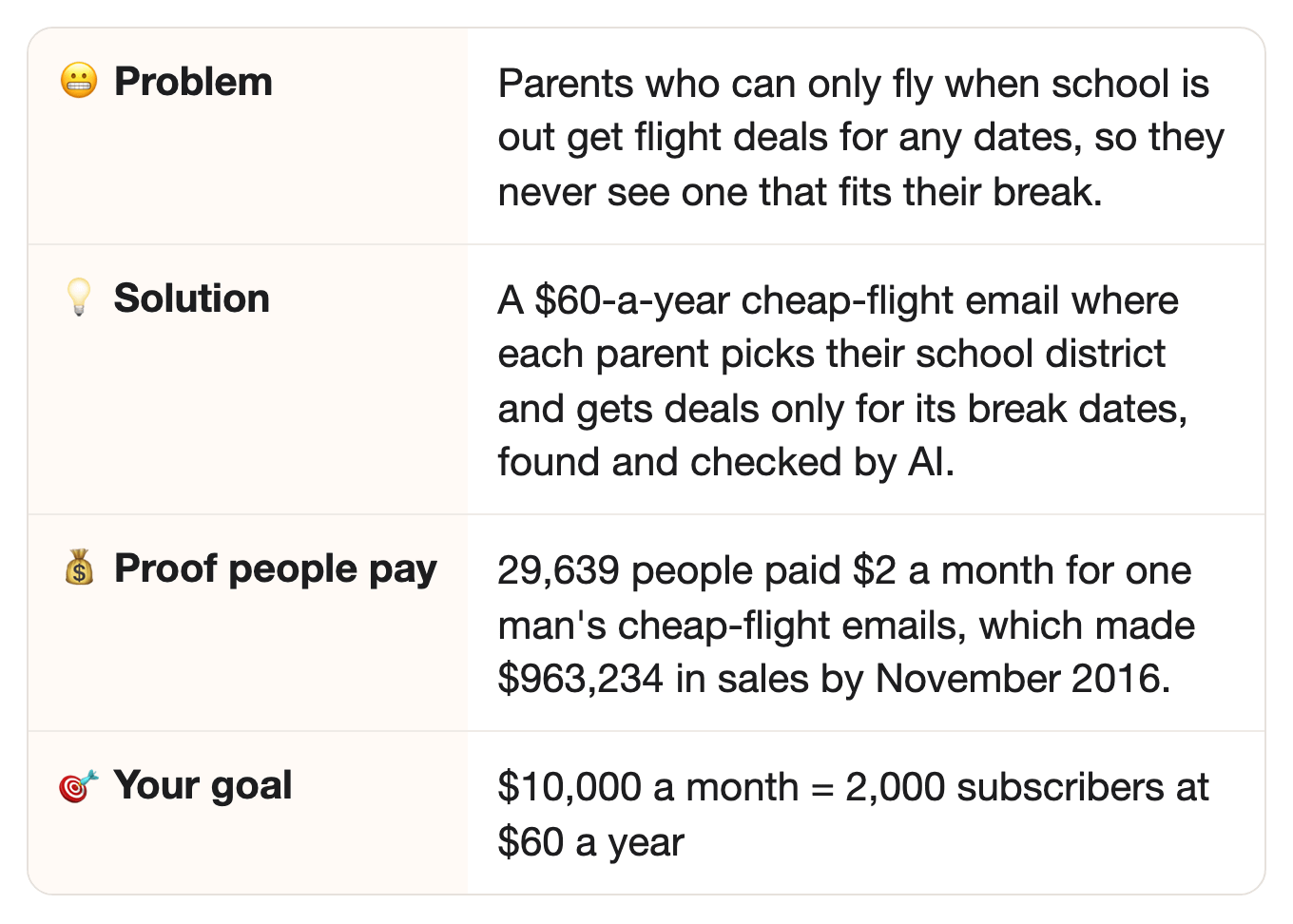
⚡ Quick facts
⠀
📖 How one man’s cheap-flight emails made almost $1 million
It started with one deal he couldn’t stop talking about.
It’s 2013, and a guy named Scott Keyes finds a nonstop round-trip ticket from New York to Milan, for $130.
When he gets back, his friends all want to know the same thing.
How do you find deals like that?
So he sets up an email list, and sends them every deal he finds.
Then, in April 2015, a Business Insider reporter writes about his list.
And nearly overnight, it jumps from 300 people to 3,000. 📈
⠀
Now his email tool costs money, so in August 2015 he starts charging.
Some deals stay free.
Getting all the deals costs $2 a month.
He isn’t even sure he’ll get 30 paying subscribers.
That’s how many he needs to cover his costs.
Wait for it… by November 2016, 29,639 people are paying.
His list has made $963,234.48 in sales.
And he has spent less than $500 on marketing.
Wowza. 🤩
He went from emailing cheap flights to his friends, to almost $1 million in sales, by charging $2 a month for every deal he found.
⠀
🔗 Same idea, new group
In the story: travelers paid Scott Keyes $2 a month for every cheap flight he found, for any dates.
⠀In this idea: parents need cheap flights only for the one week their kids’ school is out.
⠀Why it carries over: both groups want cheap flights without searching themselves, and will pay a small fee for a list that does it.
⠀
💡 The opportunity
Big deal lists find cheap flights for any dates. A parent can only fly the week school is out.
Picture a parent in Chicago, with two kids in public school.
They don’t want “anywhere cheap, any time.”
They need March 22 to 26, 2027, Chicago’s spring break, for four people.
And a parent in New York City has a whole different week.
Theirs is April 22 to 30, 2027.
⠀
But the big lists send whatever is cheap that day.
Going is Scott’s company, the list from the story.
It sells its Premium plan with the line “Go anywhere in the world”.
So one deal goes to Paris, and the next one to Tokyo.
Great if you can fly any week.
Not so great if the school calendar picks your week.
⠀
Here’s a fun one: a big deal list said so itself.
Thrifty Traveler, one of the big deal lists, wrote this line itself in 2025.
“The deck is stacked against travelers tied to the school calendar.”
Their words, not ours.
⠀
And the week school is out costs more.
Hopper is a travel-booking site.
In 2025, it found domestic fares 33% higher for the week of Easter than for the first two weekends of March.
That’s the week many schools close for spring break.
Ouch.
⠀
👉 The idea: a paid flight-deal newsletter for parents who can only travel when school is out, where each parent picks their own district.
⠀
🧩 What you actually need
Good news: it’s a short list.
A sign-up form where each parent picks their school district.
That way, any family in the US can join, not just families in one city.
⠀
A fare-search tool, like Google Flights.
It’s free, and it shows past prices.
⠀
A daily check.
AI searches fares for the break dates each day.
You pick the deals worth sending.
⠀
✅ Why this could work
Here’s why people will pay for this.
Someone made almost $1 million this way.
Remember Scott’s little list for his friends?
Scott’s list became Going.
When we checked, it was a team of more than 50 people, serving more than 2 million travelers.
⠀
Others keep making money from deal emails too.
Jack’s Flight Club, another paid flight-deal list, started in London in 2016.
In 2020, Travelzoo, a big travel-deal company, bought most of it.
In just three months of 2025 (April to June), Jack’s Flight Club brought in $1.4 million.
Thrifty Traveler started in 2015 as one man’s travel tips, and when we checked, it was a team of 30-plus.
⠀
Deal emails have been popular since 2000, and they still are.
Travelzoo emailed its first weekly deal list, the Top 20, to one million US members in September 2000.
FlyerTalk, a forum for people obsessed with flights, was founded in 1998.
Even during the 2020 lockdowns, Scott’s company says it had its biggest sales month ever, in October 2020.
Yes, during the lockdowns.
And every school year brings new break dates, and a new set of trips to plan. 🔁
⠀
The searches, and the buyers, are already there.
The numbers are coming up in the next section.
⠀
👉 Like to check the numbers yourself? The links are all in “📎 The sources,” at the very end.
⠀
📊 More proof people want this
Want more? Here you go.
People already pay for flight deals.
Going Premium, from Scott’s company, costs $49 a year.
Going Elite, with business-class deals, costs $199 a year.
Thrifty Traveler Premium costs $129.99 a year.
Jack’s Flight Club costs $60 a year.
⠀
And more people keep paying.
In the year to August 2022, Jack’s Flight Club’s paying members in the US grew 413%.
⠀
In the UK, deal lists already sell school-break alerts.
Bob’s Flight Alerts puts “every school holiday and half term fare alert” in its £29-a-year plan (about $40).
Half term is a short UK school break.
SchoolHolidays.deals asks for your school, finds its break dates, and emails fares for them.
Its Plus plan is £39 a year (about $53).
⠀
One honest caveat about SchoolHolidays.deals.
It looks new, with a “founding” price.
So it proves the model exists, not that it has paying customers.
⠀
People want to learn how to find cheap flights (YouTube).
The top 99 videos for “how to find cheap flights” have more than 29 million views.
36 of those videos have over 100,000 views each.
⠀
The big picture: 49.6 million kids went to US public schools in fall 2022. 💰
The US had 13,318 regular public school districts that school year (2022–23).
19.4 million of them had only school-age kids, 6 to 17.
⠀
What a parent said.
“Everything said, ‘Don’t buy now. We expect better prices,’ including Google. And so I kept waiting.”
That’s an Idaho teacher and mother of three, on her family’s spring break flights to Orlando, to CNBC in 2022.
CNBC reported that those prices never came down.
⠀
👉 Millions of families are tied to the same few school weeks, and people already pay for help finding cheap flights.
⠀
🔍 Who’s already doing it
Who’s in the space, and what they skip.
Going, Scott’s company from the story above, sends deals to anywhere in the world.
When we checked, its $49 Premium plan included custom alerts for places you pick.
So it can watch a beach town for you.
Handy.
But its plans are built around places, not around the week your school is out.
⠀
Thrifty Traveler, another big deal list, sends deals from your home airport.
It has a big focus on points and miles (airline reward points).
Its deals come with wide travel windows, like “February - June.”
It even wrote a guide for families on the school calendar.
But its paid alerts are built around your airport, not your school’s dates.
⠀
In the UK, two flight-deal email lists already match fares to school holidays.
They’re SchoolHolidays.deals and Bob’s Flight Alerts.
Close, but both are built for UK schools and UK airports.
⠀
What nobody was selling, when we checked:
A paid US deal list that starts from each reader’s own school break dates.
Deals priced for the whole family, not one seat.
Plain notes on which day to leave.
Hopper, the travel-booking site, found leaving on a Tuesday or Wednesday could save up to 39% per domestic ticket on a week-long spring trip (2025).
⠀
🔎 Check the market yourself in 2 minutes: run Part 0 of the prompt in the build plan below.
Your AI searches Substack (a site for paid newsletters), deal sites, school-break tools, and YouTube that day, and tells you: early, growing, or crowded.
Early? Start now.
Crowded? Good news: it means people pay. Pick one narrower group, like one district or families with toddlers (Step 1 of the build plan).
A crowded market is still OK. You win by serving one district better, not by being first.
⠀
👉 You can be the one to fill that gap: a US flight-deal list that starts from each family’s own school break dates.
⠀
🤖 Why AI won’t replace it
AI can search fares. You know which deal is worth booking.
🔮 Honest note: AI tools can already watch fares and book flights.
So the search itself isn’t the product.
The product is knowing each district’s breaks, and saying “book this one” with confidence.
⠀
1. You know what a family needs.A cheap fare with a 6 a.m. connection isn’t a deal for a parent with two small kids.
You know when the break starts and ends, and which airports the district’s families can reach.
⠀
2. You’re fast on mistake fares.Scott calls them “fat-finger” fares, like a $590 ticket priced at $59 by accident.
Oops for the airline, nice for your readers.
When one shows up during a school break, your readers hear about it first.
⠀
3. Readers can trust your picks.You take no money from airlines for a pick, just as Scott’s company says it doesn’t.
A travel site’s spring break page wants to sell a package. Yours doesn’t.
⠀
4. You’re ready when they book.Your “when to book” planner covers every break on the district’s calendar.
It tells them when to start watching fares, and when to buy.
⠀
5. Proof people pay for picked deals: Google Flights is free, and Going still charges $49 a year.Scott called finding deals “more of an art than a science,” in an online Q&A that CNBC quoted.
⠀
👉 Free fare searches are everywhere, but a checked deal for your break week is hard to find.
⠀
💵 How much you can make
Here’s how the numbers add up.
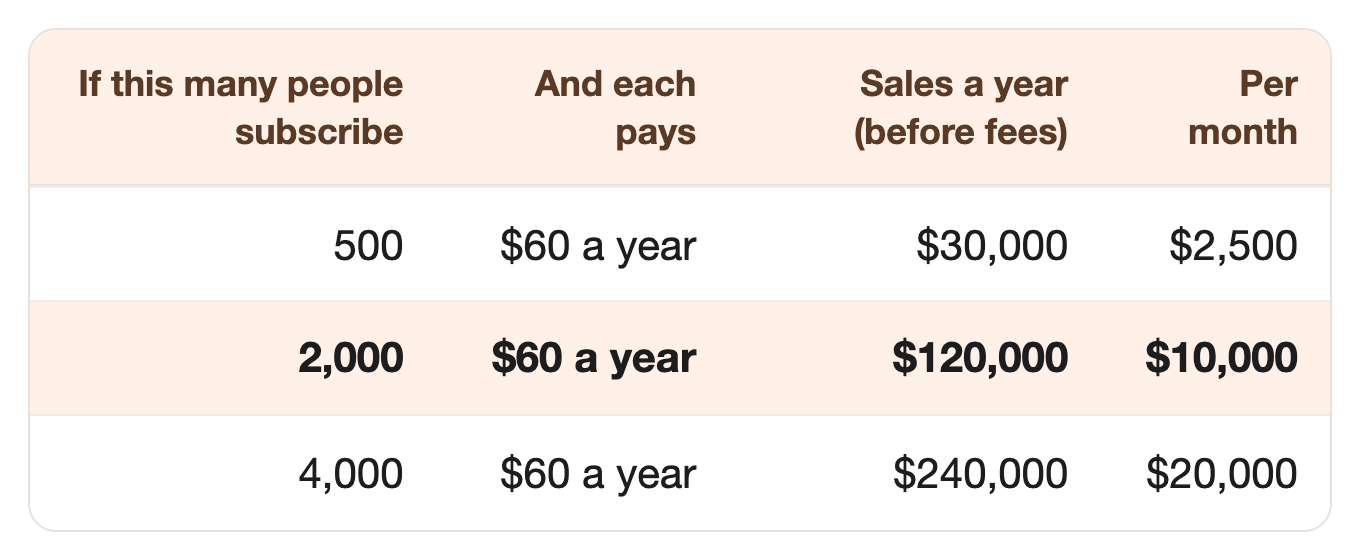
$60 a year is what Jack’s Flight Club charges.
⠀2,000 subscribers is about 1 in 9,700 of the 19.4 million US families with kids 6 to 17, and none younger (2024).
Remember Scott’s 29,639 paying subscribers?
He had them about 15 months after he started charging.
⠀
Substack says writers keep 90% of their revenue, minus credit card fees.
⠀And if it doesn’t work, here’s everything you lose:
Nothing to open a Substack. It only takes a cut when people pay.
One month’s subscription to an AI app, like ChatGPT or Claude.
One week of your time.
⠀
👉 One idea won’t make a million, but three or four might in 2 to 3 years, and this could be your first.
This list could be your first idea, and two or three more ideas like it can grow your yearly income from there.
Thinking “why not me?”
Good question. The answer is right below. 👇
If this one’s not for you, see you next week.
That’s it, my fellow contrarians! 🙌
Yours ‘proving you don’t need an original idea, just a proven one’ Vijay Peduru 🦸♂️
⠀
⠀
⠀
🧰 Want to build it? Here’s everything else.
⠀
Step 1: 🗺️ Map your first city’s breaks
You don’t need to work for an airline. You need to know your first city’s breaks better than anyone.
Pick your first city.
Start with the districts around one big airport, like Chicago.
Any parent can sign up from any district, but you market here first.
Copy the break dates from the district’s own calendar page.
Chicago’s spring break in 2027 is March 22 to 26.
Write down every break like that.
List the places the district’s families fly for breaks, like Florida, the beaches in Mexico, or a ski town.
Write down what a normal fare looks like, the weeks before and after each break.
Google Flights shows past prices for a route, for free.
A deal is a break-week fare well below what break weeks usually cost.
Let AI build the table. 🎙️
Tell it what you know, out loud.
It fills in the rest from the district’s and the airlines’ own pages.
⠀
Step 2: 🔍 Find and check every deal
Your name is on every deal, so every fare gets checked twice before it goes out.
Your AI does all three passes for you: it finds the deals in Part 2, and checks in Parts 3 and 4 of the prompt.
🖊️ The AI finder. It searches your break dates every day, and lists fares below normal, with a link and the time it checked.
🔍 The AI fact-checker. A second pass opens every link, and confirms the price, the dates, the bags, and the layovers.
🧐 The AI critic. A third pass reads each deal like a parent flying with two small kids, and flags anything that would hurt.
When AI can’t open a fare page, you check it by hand on Google Flights, then paste it in.
⠀
👉 The prompt already follows three safety rules: every fare is dated, every affiliate link is disclosed, and no airline pays for a pick.
Wait, what’s an affiliate link?
It’s a link that pays you a small fee when a reader books through it.
⠀
Step 3: 🏪 Open your newsletter
Copy Jack’s Flight Club’s price, and give every reader a free taste.
Open a Substack. It handles the emails and the payments for you.
Send one free deal a week to everyone.
For example: “This week’s best spring break fare, from Chicago.”
Add a paid tier at $60 a year, like Jack’s Flight Club.
Paid readers get every deal for every break.
They get instant alerts for mistake fares.
And they get a “when to book for each break” planner.
Let AI write your welcome page, using one of your real, checked deals as the example.
⠀
Step 4: 📣 Get your first readers
Scott’s list took off when a reporter wrote about it. Give parents, and reporters, something to pass on.
Give each paying parent one free year to gift to a parent at the same school.
Send the gift link after their first booked trip, as a thank-you, not as a cash reward.
Parents at one school share the same break dates, so the gift fits on day one.
Publish a “Chicago School-Break Fare Index” every quarter, under the same name each time.
One number from your own tracking, like what a family of four paid for the coming break versus a normal week.
Send it to one local reporter.
Remember, one Business Insider story took Scott from 300 people to 3,000.
When an airline announces a sale, post the next day which break dates it covers.
Say plainly which routes fit Chicago’s spring break, and which ones end before school is out.
Put the post on your Substack, and share it in the school parent groups that allow it.
⠀
Step 5: 🏃 Eliminate competitors
Here’s how to stay ahead when the competitors show up.
Compete on “fits your kids’ break,” not “cheapest flight anywhere.”
The big deal lists win on the lowest fare to anywhere, on any date.
Your list wins on dates parents can actually use.
Serve families on school calendars, the ones the big deal lists ignore.
The big lists are built for travelers who can fly any week.
You check every deal against one district’s breaks, and answer parents’ replies yourself.
⠀
Step 6: 🎲 Make it bigger
Every district has the same problem: fixed break dates, and nobody watching fares for them.
Add a business-class tier, like Going’s $199-a-year Elite plan.
Market in the next cities: Houston, Los Angeles, Miami, New York City.
Three lists at about $10,000 a month each is about $360,000 a year, before fees. 🎯
⠀
🗓️ Your first week
Phew. That was a lot. 😅
Steps 1 to 4 fit into seven days. 🚀
By day 7, you have a newsletter, three checked deals, and your first fare index.
Quick heads-up: the prompt below has six Parts, and they’re not the same as the Steps above.
Day 1 (Step 1): Run Part 1 of the prompt (it’s below), and map your first city’s breaks.
Days 2–3 (Step 2): Find deals with Part 2, then check each one with Parts 3 and 4.
Day 4 (Step 3): Write your first issue and welcome page with Part 5, then open your Substack.
Days 5–7 (Step 4): Write your first fare index with Part 6, and send it to one local reporter.
⠀
🏄 How to use the prompt
One prompt does all the AI work, in six parts, plus a quick market check (Part 0).
Part 1 — Map the breaks. Lists the break dates, the airports, the places families go, and what a normal fare looks like around each break.
Part 2 — Find deals. Searches your break dates and lists fares below normal, with links and times.
Part 3 — Check every deal. Opens every link and confirms the price, dates, bags, and layovers.
Part 4 — The family test. Reads each deal like a parent flying with kids, and flags anything that would hurt.
Part 5 — Write the issue. Writes your weekly issue and your Substack welcome page.
Part 6 — Write the fare index and the sale post. Turns your checked fares into one quotable number, or a next-day post on an airline sale.
Run it your way:
Part by part (the default): it pauses after each part, and you type “next” to go on.
All at once: say “run all six parts.”
Just one part: say “only do Part 3,” or any part you need.
The full prompt is just below, under “📋 The prompt.”
🎙️ Talk to your AI sidekick, don’t type.
Turn on voice mode, or use a dictation app like Wispr Flow.
Say it messy. The AI sorts it out.
Turn it into a skill, so you never paste it again.
Paste the prompt into Claude or ChatGPT, and say: “Turn this into a skill I can save.”
Install once, use forever.
⠀
📋 The prompt
The prompt (copy it into Claude or ChatGPT, fill in the INPUTS part, and run it your way)
CONTEXT:
- You're my flight-deal partner. Together we'll build a weekly newsletter of cheap flights for parents who can only travel when school is out, where each reader picks their school district. We market in one city first.
- This prompt has six parts, in order.
- Run it the way I ask:
    - If I say nothing, go one part at a time. After each part, show me the result, then stop and wait. Move on only when I type "next."
    - If I say "run all six parts," do them all without stopping.
    - If I say "only do Part 3" (or any part), do just that part.
- If a part needs something from me, ask for it before you start that part.
- Use only airline websites, Google Flights, and well-known booking sites for fares. Use only the district's own calendar page for break dates. Never invent a fare, a date, or a bag rule. If you can't open a page, say so, and I'll check it by hand and paste it in.
- Give every fare the date and time you saw it. Fares change fast.
- The picks are mine. You find and explain the options, but I decide what goes out.
- I'll often answer by voice, so expect long, messy answers. Don't ask me to tidy them.
- Keep web search on for the whole prompt (turn on search in ChatGPT or Claude), so you can open any page you need to check.

=============== INPUTS — edit these, or just run as is ===============

The city (and its school districts) I'm marketing in first:
{e.g. Chicago, starting with Chicago Public Schools}

The airports my readers fly from:
{e.g. Chicago O'Hare and Midway}

The narrower group I want to win:
{e.g. families flying with kids under five}

The places these families like to go on breaks:
{e.g. Florida, beaches in Mexico, ski towns in Colorado}

What I know about flying on school breaks (say it out loud, messy is fine):
{e.g. Saturday flights cost the most; we always need four seats together; two kids means we avoid early connections}

My prices:
{e.g. one free deal a week; $60 a year for every deal and instant alerts}

======================== END OF INPUTS ========================

THE PARTS:

Part 0 — Check the market today.
This part needs web search (turn on search in ChatGPT or Claude). Search for flight-deal help for parents tied to the school calendar in my area and, for each place, give the count, the three biggest with links, and their prices:
1. Paid flight-deal newsletters and alert services (for example Going, Thrifty Traveler, Jack's Flight Club), and whether they let you pick deals by school break dates.
2. Newsletters, Substacks, or tools that match fares to a school's own break dates (for example SchoolHolidays.deals in the UK), and whether any cover my district or my country.
3. Travel sites and agents selling spring break and holiday trips from my airports.
4. YouTube channels and social accounts posting school-break flight deals for my area.
5. Parent groups on Facebook or WhatsApp in my district where people share fares, if you can find them.
Then tell me: early (few sellers), growing, or crowded, and which narrower group looks least served (for example: one district, families with toddlers, teachers, one break like Thanksgiving). Give a link for every number. If you can't open a page, say so. Never guess a number.

Part 1 — Map the breaks.
Using my district and my airports, list:
1. Every school break for the coming school year, with start and end dates, from the district's own calendar page, with the link.
2. The airlines that fly from my airports to the places families like to go, with links to each airline's route page.
3. What a normal round-trip economy fare looks like the week before, the week of, and the week after each break, from Google Flights price history or airline pages, with the date you checked.
4. The bag rules for each airline, from the airline's own page.
5. How far ahead people usually need to book for each break. Say clearly which parts are your guess.
Then ask me what I'd add from my own trips, and keep my notes in my words.

Part 2 — Find deals.
Search round-trip fares that leave and return inside each break (or the weekend around it), well below the normal fares from Part 1. For each one, give: the route, the dates, which break it fits, the airline, the price for one seat and for a family of four, the connection and layover time, the checked bags included, the link, and the date and time you saw it. Rank them from best to worst for a family in my narrower group from INPUTS. If you find fewer than three real deals, say so. Never pad the list.

Part 3 — Check every deal.
Now act as a separate fact-checker who didn't find these deals. Open every link. Mark each deal: matches the source, doesn't match, or can't open. Check the dates against the district's calendar too. For each problem, show what the page actually says. List the deals I need to check by hand. Then give a fixed list.

Part 4 — The family test.
Now act as a parent flying with two small kids. For each checked deal, flag anything that would hurt: early-morning or overnight flights, long layovers, a change of airport, missing bags, tight connections, seats that can't be booked together, a return after school starts again. Drop any deal that fails. Then give the final list, with one plain line on who each deal is good for.

Part 5 — Write the issue.
Using the final list, write:
1. This week's issue: a short hello, the best deal first, then the others, each with the price, the dates, which break it fits, who it's good for, and the link.
2. This line at the bottom: "Fares checked on [date and time]. Prices change fast; book on the airline or the booking site directly. Some links may be affiliate links; no airline pays for a pick."
3. My Substack welcome page: who it's for, what free readers get, what paid readers get, and my prices. Use one real, checked deal from the final list as the example.
Never promise a fare will still be there, and never invent a saving.

Part 6 — Write the fare index and the sale post.
Ask me which one I need this week.
1. The fare index: from every fare you checked for the coming break, give one number, like the average round-trip price for a family of four, next to a normal week's price. Name it "[City] School-Break Fare Index, [quarter and year]." Show how you got it, with the links and dates. Then write a three-line note I can send a local reporter.
2. The sale post: ask me for the airline's sale page. List which of my city's break dates the sale covers, which routes fit, and which end before school is out. Give the link and the time you checked.
Never promise a fare will still be there, and never invent a number.

When all six parts are done, ask if I want to repeat Parts 2 to 6 next week.
⠀
📎 The sources
Every number above, with where it came from.
The Milan deal · Number: Nonstop round trip, New York to Milan, $130, in 2013 · Source: CNBC, November 2016
The news story · Number: Business Insider, April 2015; the list went from 300 to 3,000 “nearly overnight” · Source: Same article
Starting to charge · Number: Premium list launched August 23, 2015, at $2 a month; he wasn’t sure he’d reach “the 30 subscribers necessary to cover my costs” · Source: Same article
Scott’s sales · Number: 29,639 premium subscribers; $963,234.48 in sales; less than $500 spent on marketing · Source: Same article, November 29, 2016
Mistake fares, and the art · Number: “fat-finger discounts (someone priced it at $59 instead of $590)”; “more of an art than a science” (said in an online Q&A, quoted by CNBC) · Source: Same article
Going’s team · Number: More than 50 people, serving more than 2 million travelers · Source: Going: About
Going’s prices · Number: Limited $0; Premium $49 a year, with custom destination alerts; Elite $199 a year; “Go anywhere in the world” · Source: Going: Premium
Going in 2020 · Number: Says it had its biggest sales month in October 2020; doesn’t take commissions or kickbacks · Source: Fortune, April 2021
Jack’s Flight Club start · Number: Founded in London, September 2016; £48 / $60 a year for paid · Source: Wikipedia: Jack’s Flight Club
Jack’s Flight Club’s price · Number: Takeoff plan $60 (First Class $199) · Source: Jack’s Flight Club
Travelzoo’s stake · Number: Majority stake bought January 13, 2020 · Source: Travelzoo Q4 2019 results, SEC
Jack’s Flight Club revenue · Number: $1.4 million in Q2 2025 (April to June), up 33% · Source: Travelzoo Q2 2025 results
Jack’s Flight Club US growth · Number: US premium members grew 413% from August 31, 2021 to August 31, 2022 · Source: Travelzoo press release, September 2022
Thrifty Traveler · Number: Started in 2015 by Jared Kamrowski, as “a way to pass on all his tips and tricks”; “30-plus” team · Source: Thrifty Traveler: About
Thrifty Traveler’s price and alerts · Number: Premium $129.99 a year; Premium+ $189.99 a year; “Set your home airport(s)”; past deals shown with windows like “February - June” · Source: Thrifty Traveler: Premium
“The deck is stacked” · Number: “The deck is stacked against travelers tied to the school calendar”; during spring break week “you might see airfare that is four-or-five times higher than the week before or after” (Gunnar Olson, April 21, 2025) · Source: Thrifty Traveler: Travel on the school calendar
Spring break fares · Number: Week of April 14, 2025 (Easter and Passover, “when many schools are closed for spring break”): domestic airfare 33% higher than the first two weekends of March; leaving a week-long trip on Tuesday or Wednesday saves “as much as 39% or $172 per domestic ticket” (Hopper, February 12, 2025) · Source: Hopper: 2025 Spring Break Travel Outlook
Chicago’s spring break · Number: Schools closed March 22 to March 26, 2027 · Source: Chicago Public Schools: 2026–27 family calendar
New York City’s spring break · Number: Spring Recess, schools closed April 22 to April 30, 2027 · Source: NYC Public Schools: 2026–27 calendar
Bob’s Flight Alerts · Number: Premium: “Every school holiday and half term fare alert we find”; £29 a year or £3.50 a month · Source: Bob’s Flight Alerts: Premium
SchoolHolidays.deals · Number: “Pick your school. We find its dates and email you the best fares for them”; Plus £39 a year (£19 founding first year); covers 28,369 UK schools · Source: SchoolHolidays.deals: Home and Pricing
Pounds to dollars · Number: £1 = $1.3656 on August 21, 2026 (this issue’s date); £29 ≈ $40; £39 ≈ $53 · Source: Frankfurter (European Central Bank rates)
Travelzoo’s first Top 20 · Number: Emailed to one million US members, September 2000 · Source: Wikipedia: Travelzoo
FlyerTalk · Number: Founded in 1998 (launched February 1999) · Source: Wikipedia: FlyerTalk
Families with kids · Number: 2024: 32,695,000 families with own children under 18; 19,358,000 with own children 6 to 17, none younger (the table also shows 2025, an 11-month average: 32,895,000 and 19,473,000) · Source: US Bureau of Labor Statistics: Employment Characteristics of Families, Table 4
Public school students · Number: About 49.6 million in fall 2022 · Source: NCES Fast Facts: Back to school statistics
School districts · Number: 13,318 regular public school districts, 2022–23 · Source: NCES Digest, Table 214.10
1 in 9,700 · Number: 19,358,000 divided by 2,000 is 9,679 · Source: Math on the BLS figure above
YouTube · Number: 99 videos for “how to find cheap flights”; 29,880,531 views; 36 with 100,000+ views (from a re-run; an earlier pull showed about 43.5 million, as search results shift day to day) · Source: YouTube Data API, YouTube search “how to find cheap flights”, top 99 results
Quote: the parent · Number: “Everything said, ‘Don’t buy now. We expect better prices,’ including Google. And so I kept waiting.” (Elizabeth Smith, Idaho teacher and mother of three; spring break flights Spokane to Orlando; “those prices never came down”) · Source: CNBC, March 2022
Substack’s cut · Number: “Writers keep 90% of their revenue minus credit card fees” · Source: Substack: Going paid