


Hello contrarians,
Today’s idea is called The Money Behind Board Games.
Find a comfy chair. 🪑
First, a sports fan’s story. Then, the business you could build from it.
⠀
⚡ Quick facts
⠀
📖 How one sports fan turned 5 AM emails into a paid newsletter
His dream job in sports never happened, so he wrote about sports instead.
Joe Pompliano has loved sports for as long as he can remember.
His first plan? To be a sports agent.
He spends time at Octagon, a sports agency, and applies for more than 100 jobs in sports.
Yep, more than 100 applications.
It doesn’t work out.
Ouch.
So he takes a job on Wall Street, and ends up at JP Morgan.
⠀Then, in July 2020, he sends the first email of Huddle Up, about the business and money behind sports.
Who knew: the first version was just links.
Articles he found interesting, each with a short note on why people should care.
That’s it, nothing fancy.
In those early days, he wakes up at 5 AM to write it, before work.
Yes, 5 AM, before his day job.
He ends the first day with 50 subscribers.
⠀
And less than a year in? He has just short of 40,000 subscribers.
The newsletter is still free, paid for by sponsors’ ads.
In June 2021, he tells Business of Business the newsletter makes “well into the six figures.”
⠀
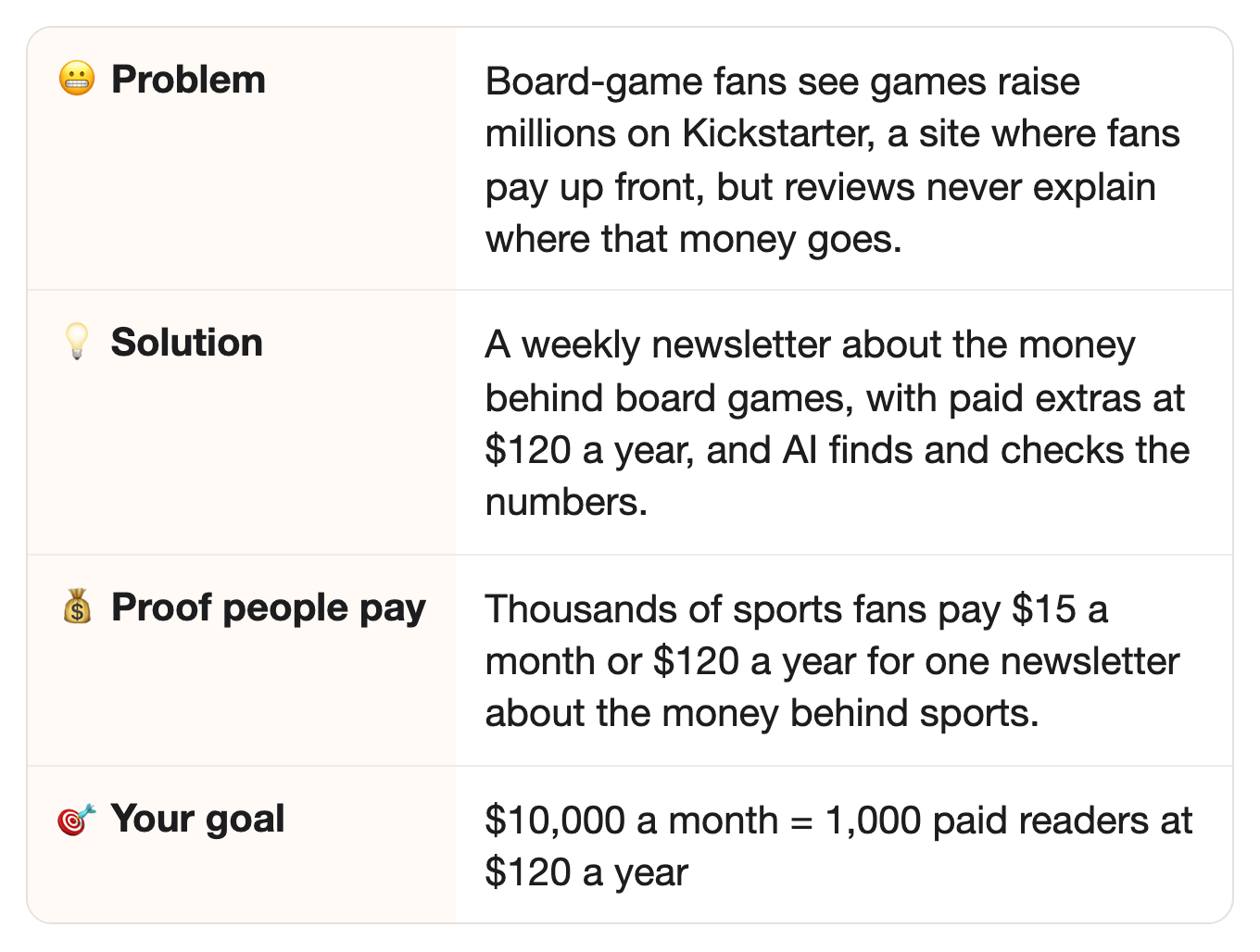
Later, he adds a paid tier, extra issues only paying readers get: $15 a month, or $120 a year.
⠀When we checked, Huddle Up had over 135,000 subscribers.
Substack, the newsletter platform he uses, shows its badge: “Thousands of paid subscribers.”
The badge only gives a range, and its low end is 1,000.
So what does that low end add up to?
⠀
At least 1,000 readers at $120 a year is at least $120,000 a year, from the paid tier alone.
Yahtzee! 🎲
He went from 50 subscribers on day one, to thousands of paying readers, by explaining the money behind sports.
⠀
🔗 Same idea, new group
In the story: sports fans paid Joe Pompliano to explain the business and money behind sports.
⠀In this idea: board-game fans want the same money stories about the games they love.
⠀Why it carries over: both groups love a hobby full of big numbers that the usual coverage never explains.
⠀
💡 The opportunity
Every hobby has a money story, and most fans never hear it.
Take board games.
Fans back new games on Kickstarter, a website where fans pay up front so a product gets made.
⠀
Some of those games raise huge sums.
In 2024, one game expansion, Root: The Homeland Expansion, raised over $2.4 million from 27,549 backers.
An expansion is an add-on box for a game fans already own.
27,549 fans backed one add-on box.
⠀
So fans start wondering.
How does a small studio raise that much?
Why does a box of cardboard cost so much?
Who actually makes the money?
All fair questions.
⠀
Here’s the fun part: the big fan channels review the games.
They tell you which game to buy, not where the money goes.
Super useful, just not the money part.
⠀
Sports fans have Huddle Up to explain the money behind their sport.
So what about board-game fans?
When we checked, we couldn’t find one for board-game fans.
⠀
👉 The idea: a weekly newsletter that explains the money behind board games, for fans.
⠀
🧩 What you actually need
Good news: the list is short.
A love for one hobby, like board games.
The one you’d read about anyway.
⠀
Public money numbers to dig into.
Like Kickstarter totals, with every number linked.
⠀
A weekly habit of writing one money story.
AI finds the numbers and checks them.
That’s the whole list.
⠀
🗣️ What it looks like
Here’s a made-up example of one week.
The free weekly story: “What a game designer earns from one copy of a game.”
Five minutes to read, every number linked.
Short enough for a coffee break.
⠀
The paid monthly deep dive: “Where the money from one big Kickstarter really goes.”
Printing, shipping, the platform’s fee, the designer, the publisher.
Basically, the stuff the reviews skip.
⠀
The paid tracker: a running list of the hobby’s biggest Kickstarters, with what each raised.
⠀
👉 Reviews tell fans which game to buy.
Your newsletter tells them where the hobby’s money goes.
⠀
✅ Why this could work
Why this one can work, in three points.
People already pay to read about the money behind games and sports.
Huddle Up, for sports: thousands of paid readers, at $120 a year.
Game File, the business and culture of video games: thousands of paid readers, at $100 a year.
GameDiscoverCo, the business of video games: thousands of paid readers, at $190 a year.
One catch: GameDiscoverCo is written for people who make games, not for fans.
But Huddle Up says fans read it too.
For each badge, the low end of the range is 1,000 paid readers.
⠀
People have paid to read about the business of entertainment for more than 100 years.
Variety started in 1905, reporting on theater and vaudeville (old-time stage variety shows).
And yes, it’s still published, written for people who work in show business, not for fans.
And board games keep making new money stories: 6,646 tabletop games launched on Kickstarter in 2024 alone. 🔁
That’s a lot of stories to tell.
⠀
People watch videos about why games cost so much.
One video on why championship chess sets are so expensive has more than 14 million views. 👀
Yes, chess sets.
More proof is just below.
⠀
👉 Curious where these numbers come from? Every source is linked in the last section, “📎 The sources.”
⠀
📊 More proof people want this
Want more? Here you go.
Board-game fans already pay for content they could watch for free.
Shut Up & Sit Down is a board-game review channel on YouTube.
It has 1,328 paid members on Patreon, a site where fans pay creators monthly.
It says it’s “almost entirely audience-supported.”
⠀
Big YouTube audiences for board games.
Shut Up & Sit Down has about 462,000 subscribers.
The Dice Tower, another board-game review channel, has about 363,000.
⠀
One video about board-game business drew a big crowd.
It’s “Board Games are in Trouble, and it’s NOT Why You Think,” by the YouTube channel Extra Credits.
That’s a lot of people talking about one business video.
⠀
A games-business newsletter grew from small to big.
GameDiscoverCo began in 2019 as a side hustle, written for people in the video-game business.
It had about 1,500 free subscribers in 2020.
It has over 46,000 subscribers.
⠀
The big picture: in 2024, backers pledged $220 million to tabletop games that got funded on Kickstarter. 💰
That’s board games, card games, and role-playing games.
5,314 of those projects got funded that year.
⠀
What one viewer says:
“This series should dive into how much the final price is split between the intermediaries and the primary producers.”
In plain words: who gets what share of the price?
That’s the kind of question your newsletter answers.
⠀
And another, about a popular board game called Spirit Island:
“i can definitely appreciate why spirit island cost me so much.”
Ha. Spoken like a true fan.
⠀
👉 Fans want more than the game: they want to know where the money goes.
⠀
🔍 Who’s already doing it
Here’s who already writes about this, and the fans none of them serve.
Huddle Up, Joe’s newsletter from the story above, covers sports only.
Joe’s network and brand are all sports.
⠀
BoardGameWire, an email newsletter, covers board-game business news, mostly for insiders.
It calls itself news and analysis “for board game professionals.”
That means designers, publishers, shops, and marketers, more than fans.
⠀
The big fan channels review games.
Shut Up & Sit Down and The Dice Tower, two big YouTube channels, tell fans what to play.
Explaining the money isn’t their job.
⠀
Here’s what we couldn’t find, when we checked:
A weekly newsletter that explains board-game money to fans.
A paid tier with a monthly deep dive and a Kickstarter tracker.
A price like Huddle Up’s.
⠀
🔎 Check the market yourself in 2 minutes: run Part 0 of the prompt in the build plan below.
Your AI searches Substack (a site for paid newsletters), YouTube, and podcasts that day, and tells you: early, growing, or crowded.
Early? Start now.
Crowded? Good news: it means fans pay. Pick one narrower kind of fan (Step 1 of the build plan).
A crowded market is still OK. You win by being the fan other fans trust, not by being first.
⠀
👉 That’s the part nobody else offers: a weekly newsletter that explains board-game money to fans.
⠀
🤖 Why AI won’t replace it
AI can answer a question. You pick the story fans are talking about.
Could ChatGPT just do this?
Sort of, if someone tells it which story to chase and asks it to link and check every number.
Most fans won’t take the time to do that.
You know what’s worth telling.
A fan doesn’t know what to ask an AI.
You know which Kickstarter everyone is arguing about, and why it matters.
⠀
Fresh information.
When a designer tells you what they earned, that’s not in any AI.
You only get that by asking.
⠀
Every number is checked twice.
Every number is linked, then checked again.
ChatGPT gets totals right when it’s told to link and check each number, and most fans just ask once.
⠀
Ready to listen: one story, five minutes.
AI can turn numbers into a story with a twist and one chart, once someone picks the story, and that’s you.
You give them a story with a beginning, a twist, and one clear chart.
⠀
A fan they trust.
Fans follow someone who loves the hobby as much as they do.
⠀
Proof people pay for the person: Shut Up & Sit Down’s reviews are free on YouTube.
1,328 fans still pay them on Patreon.
Remember those 1,328 Patreon members from the “More proof” section?
Same channel, same fans.
⠀
👉 The money facts are out there for free.
What fans pay for is the finished story, picked and explained by a fan they trust.
⠀
💵 How much you can make
Grab a calculator. Just kidding, here it is.
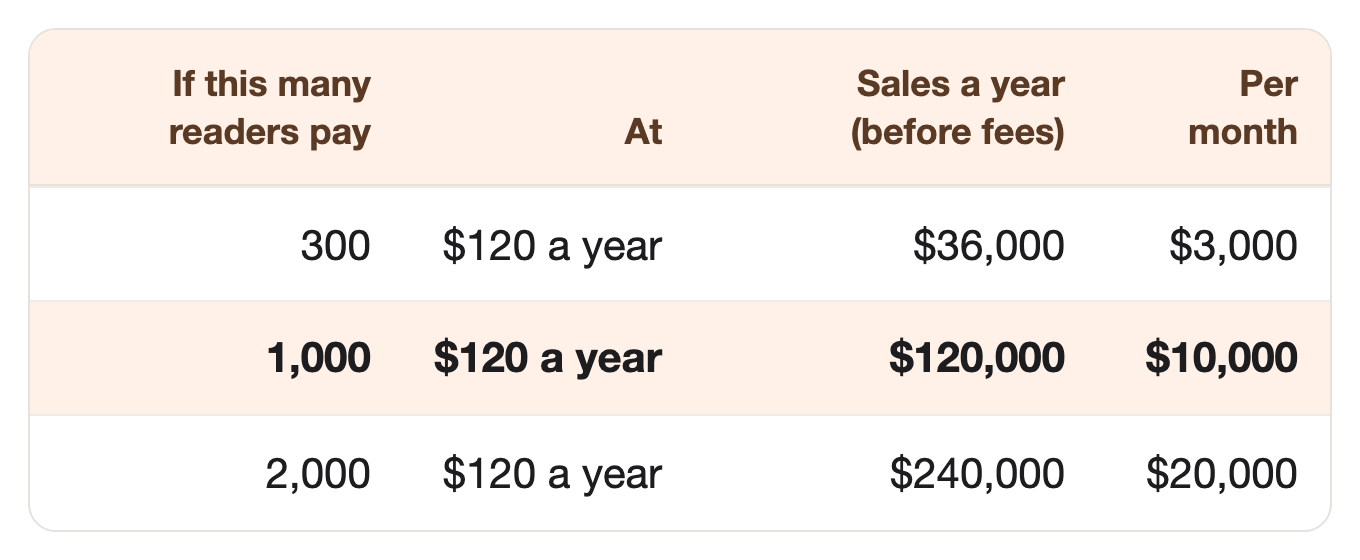
1,000 paid readers is the minimum Huddle Up’s badge shows.
⠀The $120 is Huddle Up’s yearly price.
Monthly readers pay more: $15 a month is $180 a year.
⠀
Sponsors come on top.
Joe was “well into the six figures” from sponsors before he had a paid tier.
⠀
And if it doesn’t work, here’s everything you lose:
Publishing costs nothing: Substack is free while your newsletter is free.
Substack takes 10% only once readers pay.
One month’s subscription to an AI app, like ChatGPT or Claude.
A few weekends of your time.
⠀
👉 Add three more ideas at $10,000 a month each, and the yearly total gets close to half a million.
This newsletter could be your first idea, and the ones you add after it can grow your yearly income from there.
Want to try this one?
The whole plan, the prompt included, is below. 👇
If it’s not your thing, see you next week with a fresh idea.
That’s it, my fellow contrarians! 🙌
Yours ‘helping you build on what already works’ Vijay Peduru 🦸♂️
⠀
⠀
⠀
🧰 Want to build it? Here’s everything else.
In every step, AI does most of the research. You pick the stories. 🎙️
⠀
Step 1: 🎯 Pick your hobby and your fans
Pick the hobby you’d read about anyway.
Good news: this is the fun step.
Board games are the example here. Any hobby with money moving through it works.
Check the fans are there.
Big fan channels on YouTube.
Busy forums and Discord servers (online chat groups).
Big Kickstarters or big companies in the hobby.
Run Part 0 of the prompt to see who already covers it.
⠀
Step 2: 🔎 Find the money stories
You don’t need inside sources to start. Most of the numbers are public.
Kickstarter pages show what each game raised, and from how many backers.
Yearly reports from public toy and game companies, like Hasbro.
Interviews and podcasts where designers and publishers talk about money.
Industry news, like BoardGameWire, written for insiders. You turn it into a story for fans.
Let AI list the 20 biggest money stories in your hobby, with a link for each (Part 1).
⠀
Step 3: 🔍 Check every number
Your name is on every issue, so every number gets checked twice.
Your AI does all three passes for you: it gathers the numbers in Part 2, and checks in Parts 3 and 4 of the prompt.
🖊️ The AI gatherer. AI collects the numbers for one story, with a link for each one.
🔍 The AI fact-checker. A second pass opens every link, and confirms the number is on that page.
🧐 The AI critic. A third pass reads it like a strict editor and a bored fan.
It flags anything wrong, unclear, or boring.
⠀
👉 The prompt already follows three safety rules: every number gets a link, guesses are labeled as guesses, and news stays separate from opinion.
⠀
Step 4: 🏪 Open your newsletter
Copy Huddle Up’s setup.
No need to reinvent it.
Open your newsletter on Substack. It costs nothing until readers pay.
Send one free money story a week.
Add a paid tier.
$15 a month, or $120 a year, like Huddle Up.
Paid readers get one long deep dive a month, plus your Kickstarter tracker.
Let AI write your welcome page and paid pitch (Part 6).
⠀
Step 5: 📣 Get your first readers
Give fans one number worth quoting, and a reason to pass it on.
Publish a “Board Game Kickstarter Money Index” every quarter, under the same name every time.
Pick one surprising number from your tracker, like how much the top ten games raised.
The same name each quarter makes it easy for fans and game sites to quote you.
Publish “20 designers who share their real numbers,” and tag each one.
Pick designers who post their sales or Kickstarter costs in public.
Tagging them lets each one share the list with their own fans.
After each issue, post one Substack Note with one number and the link.
For the next two days, reply to every comment and comment on other board-game Notes.
Post a second Note on Friday, with a different number from the same issue.
⠀
Step 6: 🏃 Eliminate competitors
Copycats will come. Here’s how you stay first.
Keep your own tracker of every big board-game Kickstarter.
Add each one with what it raised, the date, and the link.
It grows every month, and a new rival would have to start from zero.
Sign a pledge on your welcome page, with your name and photo.
Say it plainly: “AI helps me find and check the numbers. I pick every story, and I read every issue myself.”
A copycat run by AI alone can’t honestly sign it.
⠀
Step 7: 🎲 Make it bigger
Every hobby with money moving through it can have its own newsletter.
Add sponsors from inside the hobby, like game publishers and stores.
Joe ran four to five sponsors at a time.
Start a second newsletter for another hobby, with the same weekly format.
Three newsletters at about $10,000 a month each is about $360,000 a year, before fees. 🎯
⠀
🗓️ Your first week
Phew. That was a lot. 😅
Steps 1 to 5 fit into seven days. 🚀
By day 7, you have a newsletter, your first issue, and your first readers.
Quick heads-up: the prompt below has six Parts, and they’re not the same as the Steps above.
Day 1 (Steps 1 and 2): Run Parts 0 and 1 of the prompt (it’s below).
Pick your first two stories.
Days 2–3 (Steps 2 and 3): Gather the numbers with Part 2, then check them with Parts 3 and 4.
Day 4 (Step 4): Write your first issue with Part 5, and open your newsletter on Substack.
Days 5–7 (Step 5): Write your welcome page and first Notes with Part 6, publish issue one, and post your first Note.
⠀
🏄 How to use the prompt
One prompt does all the AI work, in six parts, plus a quick market check (Part 0).
Part 1 — Find the stories. Lists the 20 biggest money stories in your hobby, with a link for each.
Part 2 — Gather the numbers. Pulls every number for one story, with its source.
Part 3 — Check every number. Opens every link and confirms each number is on that page.
Part 4 — Find the mistakes. Reads it like a strict editor and a bored fan.
Part 5 — Write the issue. Turns the checked numbers into a five-minute story a fan would enjoy.
Part 6 — Write the pitch and Notes. Writes your welcome page, your paid pitch, and two short Substack Notes for each issue.
Run it your way:
Part by part (the default): it pauses after each part, and you type “next” to go on.
All at once: say “run all six parts.”
Just one part: say “only do Part 3,” or any part you need.
The full prompt is just below, under “📋 The prompt.”
🎙️ Talk to your AI sidekick, don’t type.
Turn on voice mode, or use a dictation app like Wispr Flow.
Say it messy. The AI sorts it out.
Turn it into a skill, so you never paste it again.
Paste the prompt into Claude or ChatGPT, and say: “Turn this into a skill I can save.”
Install once, use forever.
⠀
📋 The prompt
The prompt (copy it into Claude or ChatGPT, fill in the INPUTS part, and run it your way)
CONTEXT:
- You're my research partner. Together we'll run a weekly newsletter that explains the money behind one hobby, for fans of that hobby.
- This prompt has six parts, in order.
- Run it the way I ask:
    - If I say nothing, go one part at a time. After each part, show me the result, then stop and wait. Move on only when I type "next."
    - If I say "run all six parts," do them all without stopping.
    - If I say "only do Part 3" (or any part), do just that part.
- If a part needs something from me, ask for it before you start that part.
- Never invent a number. Every number needs a link to the page it came from. If you can't find a source, leave the number out.
- Label every guess as a guess. Keep news and opinion separate.
- If you can't open a link, say so, and ask me to paste the page instead.
- Keep web search on for the whole prompt (turn on search in ChatGPT or Claude), so you can open any page you need to check.

=============== INPUTS — edit these, or just run as is ===============

My hobby:
{e.g. board games}

The kind of fan I write for:
{e.g. fans who back board games on Kickstarter}

Where the money shows up in this hobby:
{e.g. Kickstarter pages, yearly reports from public toy and game companies, designer interviews and podcasts}

My prices:
{e.g. free weekly story; paid tier at $15 a month or $120 a year}

======================== END OF INPUTS ========================

THE PARTS:

Part 0 — Check the market today.
This part needs web search (turn on search in ChatGPT or Claude). Search for anyone explaining the money behind my hobby and, for each place, give the count, the three biggest with links, and their prices:
1. Newsletters on Substack, Beehiiv, and elsewhere.
2. YouTube channels and videos about the business of this hobby.
3. Podcasts about it.
4. Industry news sites, and whether they write for fans or for insiders.
Then tell me: early (few doing it), growing, or crowded, and which kind of fan looks least served. Give a link for every number. If you can't open a page, say so. Never guess a number.

Part 1 — Find the stories.
List the 20 biggest money stories in my hobby: big raises, big failures, price jumps, companies bought or closed, people who earned a lot. For each: one line on what happened, one line on why fans would care, and a link. Pick the two best for my first two issues, and say why. Say clearly which reasons are your guess.

Part 2 — Gather the numbers.
Ask me which story to start with. Then collect every number for it: amounts, dates, backers, prices, people. Put them in a table with the number, what it means, and the exact link. Quote the sentence each number comes from.

Part 3 — Check every number.
Now act as a separate fact-checker who didn't gather these numbers. Open every link. Mark each number: matches the page, doesn't match, or has no source. For each problem, show what the page actually says. Then give a fixed table, with every unsourced number removed.

Part 4 — Find the mistakes.
Now act as a strict editor and a bored fan, reading together. Flag anything wrong, unclear, or boring. Check every sum and percentage again from scratch. Flag any guess that reads like a fact, and any opinion that reads like news. Then list the fixes.

Part 5 — Write the issue.
Write the issue for a fan who knows the hobby but not the business, using only the checked numbers:
1. A headline with one real number in it.
2. The story in short, plain steps: what happened, then the money twist.
3. One simple chart or table idea, with the numbers to put in it.
4. "Why it matters to you": two lines for the fan.
5. Every number linked. Under 700 words.

Part 6 — Write the pitch and Notes.
Write:
1. My welcome page: who it's for, what they get each week, in five short lines.
2. My paid pitch: what paid readers get (a monthly deep dive and a tracker of the hobby's biggest Kickstarters), and the prices, shown up front. Never promise a result.
3. Two short Substack Notes for this issue, one for publish day and one for Friday. Each shares one different number from the issue, with the link in the Note itself.
Never use another company's name or logo as my newsletter's name.

When all six parts are done, ask if I want to repeat Parts 2 to 5 for the next story from Part 1's list.
⠀
📎 The sources
Every number above, with where it came from.
Huddle Up today · Number: “Thousands of paid subscribers”; over 135,000 subscribers; $15 a month or $120 a year; “the business and money behind sports”; read by “industry executives, professional athletes, investors, and fans” · Source: Huddle Up on Substack
Joe’s start · Number: “At first, I wanted to be a sports agent”; first email July 2020; first version “simply links to articles”; “I would wake up at 5 AM each morning to write the newsletter before work” (the early days); 50 subscribers on day one; Octagon, 100+ applications, Wall Street; loved sports “for as long as I can remember” · Source: Huddle Up, January 2, 2023
His first year · Number: “about 10 months in,” “just short of 40,000 subscribers”; “well into the six figures”; “a free newsletter” paid for by ads; sponsors, four to five at a time; a smaller firm first, then JP Morgan · Source: Business of Business, June 7, 2021
Game File · Number: “Thousands of paid subscribers”; over 29,000 subscribers; $10 a month or $100 a year · Source: Game File on Substack
GameDiscoverCo · Number: “Thousands of paid subscribers”; over 46,000 subscribers; $19 a month or $190 a year; aimed at “anyone in the games industry” · Source: GameDiscoverCo on Substack
GameDiscoverCo’s start · Number: Launched in 2019, a side hustle at first; about 1,500 free subscribers in 2020 · Source: Simon Owens, October 31, 2023
Variety · Number: Founded in 1905, reporting on theater and vaudeville; a trade magazine, for people in the business; still published: “It is the only remaining Variety print publication and is published weekly” · Source: Wikipedia
Tabletop games on Kickstarter, 2024 · Number: $220 million pledged to successful campaigns; 6,646 launched; 5,314 funded · Source: Kickstarter, February 2025
Root: The Homeland Expansion · Number: Raised $2.4 million+ from 27,549 backers · Source: Same page
Shut Up & Sit Down on Patreon · Number: 1,328 paid members; “almost entirely audience-supported” · Source: Patreon. The page shows 3,950 members, free ones included; the 1,328 paid count is in the page’s own data (its “paid_member_count” field), not printed on the page.
Shut Up & Sit Down on YouTube · Number: About 462,000 subscribers · Source: YouTube, YouTube Data API
The Dice Tower on YouTube · Number: About 363,000 subscribers · Source: YouTube, YouTube Data API
Chess-set video · Number: More than 14.2 million views · Source: Business Insider on YouTube, YouTube Data API
Extra Credits video · Number: More than 163,000 views; 892 comments · Source: YouTube, YouTube Data API
BoardGameWire · Number: “industry news and analysis for board game professionals”; written for “designers, publishers, retailers and marketers,” plus investors and some consumers · Source: BoardGameWire on Buttondown (it moved from Substack)
Comment: the price split · Number: “This series should dive into how much the final price is split between the intermediaries and the primary producers.” · Source: YouTube comment, 2021
Comment: Spirit Island · Number: “i can definitely appreciate why spirit island cost me so much.” · Source: YouTube comment, 2025
Substack’s fees · Number: Free if your content is free; 10% platform fee on paid subscriptions, plus card fees · Source: Substack FAQ