


Hello contrarians,
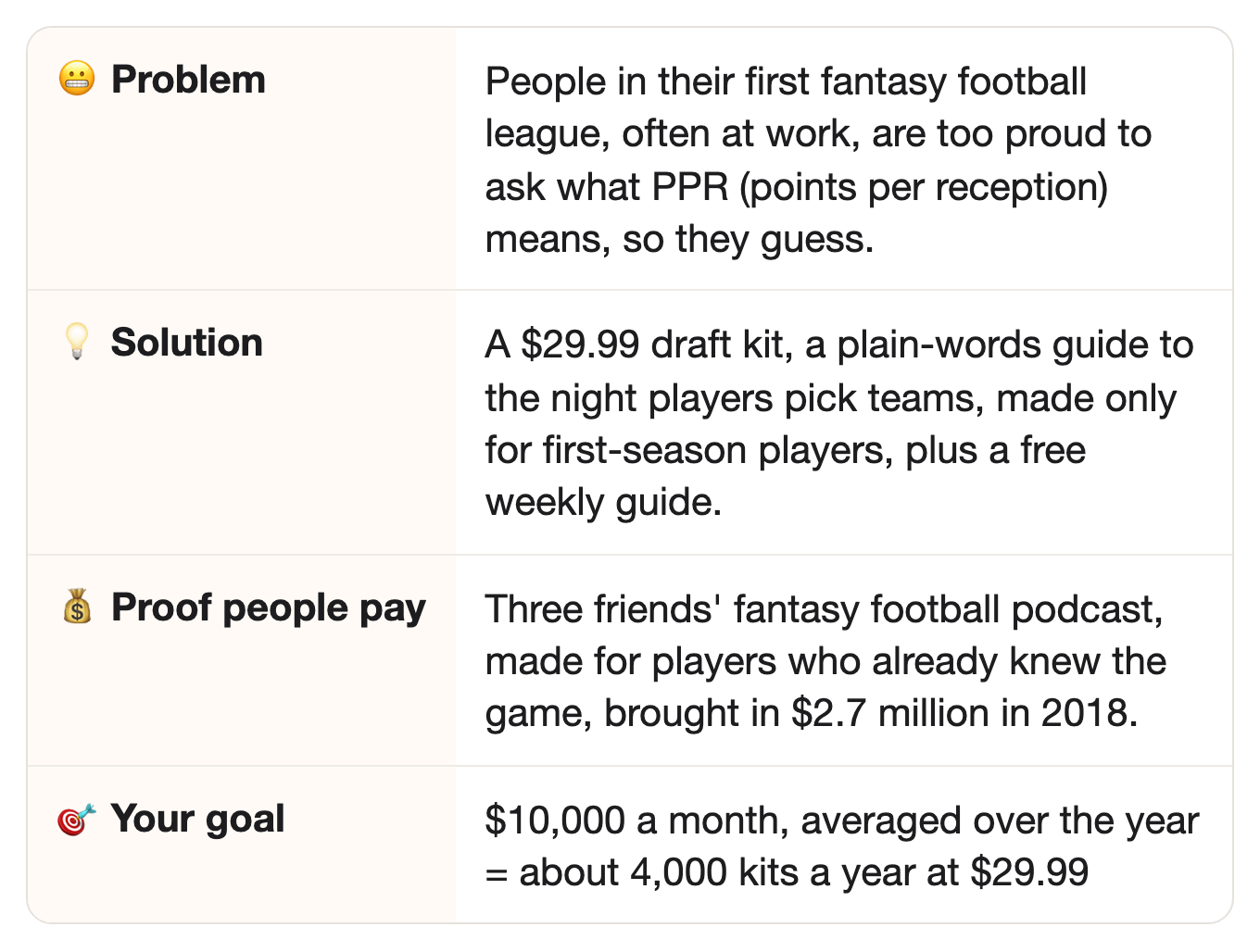
Today’s idea is called The First-League Fantasy Kit.
Find a comfy chair. 🪑
First, three friends’ story. Then, the business you could build from it.
⠀
⚡ Quick facts
⠀
📖 How three friends turned league chatter into a $2.7M business
It started as a podcast for one league of friends.
It’s 2014, and Andy Holloway and Mike Wright are doing what office friends do.
They’re talking about their fantasy football teams instead of working.
Fair warning: this is a business story that starts with two guys not working.
Then they turn on a microphone.
Their first show was just for their own league, to tease friends and talk about trades.
Andy put it simply: “Mike and I actually started a podcast for our league.”
It was made for one league of friends.
⠀
They launched in February, after the football season ended.
Then they spent the off-season building a following of listeners.
A longtime friend, Jason Moore, became the third host.
Andy’s reason it worked: “We felt like there were a lot of people who were a lot like us.”
Hold on to that line. It comes back in a minute.
⠀
The show is called The Fantasy Footballers, and the money grew fast.
$750,000 in 2016.
$1.6 million in 2017.
$2.7 million in 2018.
Not bad for a show that started for one league.
They sell a draft guide called the Ultimate Draft Kit, and a paid membership called FootClan.
In 2018 alone, the podcast had over 100 million downloads.
And they did it with no outside investors and no debt.
Yahtzee! 🎲
They went from teasing their own league, to $2.7 million a year, by talking to people just like them.
Remember Andy’s line about “a lot of people who were a lot like us”?
Their listeners were players like them, who already knew the game.
So who gets left out?
The player in her very first league.
That’s who today’s idea is for.
⠀
🔗 Same idea, new group
In the story: fantasy football players who already knew the game paid The Fantasy Footballers for a draft kit and a membership.
⠀In this idea: players in their very first league need the same kind of draft kit, written in plain words.
⠀Why it carries over: every player faces the same draft night, and new players join leagues every season.
⠀
💡 The opportunity
Every season, a new group of players joins a league and feels lost.
First, how does fantasy football work?
A league is a group of friends or coworkers.
Each one drafts a team of real NFL players before the season.
Every week, your players’ real games earn your team points.
Simple on paper.
⠀
A lot of people play.
19% of American adults play fantasy sports, says the Fantasy Sports & Gaming Association.
And 79% of those players play fantasy football.
So football is the big one.
⠀
And the crowd has grown. 🔁
The same group says the share was 13% in 2014.
So each season, new players draft a team for the first time.
Remember 2014?
That’s the same year Andy and Mike started their show.
⠀
Here’s the bonus: many of these players look a lot like you.
In the group’s 2023 survey, 84% of fantasy players have a college degree or higher.
And 65% make more than $50,000 a year.
⠀
But a first league is full of words nobody explains.
“PPR” means points per reception: a point every time a player catches a pass.
The “waiver wire” is the pool of players nobody picked, which you can claim during the season.
And every league sets its own scoring rules, so general rankings don’t fit every league.
Rankings are lists from fantasy experts that put every player in order, from best pick to worst.
Confusing, right?
Now picture hearing all of it in your first week.
⠀
👉 The idea: a draft kit and a weekly plain-words guide made only for first-season players, from draft night to the final game.
⠀
🙋 Never played fantasy football? You can still build this.
Learn as you play your first season.
Join a league, and write down every word and rule that confused you.
Your reader is one season behind you, and one season ahead is enough.
Every word that trips you up is a word for your kit.
⠀
Team up with a league veteran.
Someone who has played for years checks your draft plan and your weekly picks.
You build the kit, write the newsletter, and find the buyers.
⠀
Or use a game you already know.
Fantasy basketball, fantasy baseball, and fantasy soccer all have new players every season too.
⠀
✅ Why this could work
Why this one can work, in three points.
Others already sell fantasy help, and beginners already buy guides made just for them.
The Footballers aren’t the only big seller.
Footballguys is another fantasy football site.
Its own page says it has over 50,000 paid subscribers.
So the Footballers aren’t the only ones getting paid.
⠀
Beginners already buy guides made just for them.
Wiley, the publisher of the “For Dummies” books, sells Fantasy Football For Dummies.
Yep, there’s a For Dummies book for this.
Its second edition came out in November 2022, and the publisher calls it “perfect for beginners.”
⠀
Every season, a new crowd starts knowing nothing.
When people change jobs, a new office league may ask them to join.
Each new player needs a first draft plan.
⠀
👉 Curious where these numbers come from? Every source is linked in the last section, “📎 The sources.”
⠀
📊 More proof people want this
Want more? Here you go.
Fans already pay the Footballers every month.
Their Patreon page, where fans pay creators monthly, showed 9,964 paid members in February 2026.
The cheapest level is $5 a month.
If every member paid just that, it’s about $49,800 a month, our math, before Patreon’s fees.
And that’s if every member picked the cheapest level.
⠀
Players pay for a draft kit, too.
The Ultimate Draft Kit cost $29.99 in 2019.
Its App Store page listed the 2026 kit at $29.99, and a bigger version at $49.99.
Same price, years later.
⠀
Fantasy fans read every day.
Footballguys says its daily newsletter has 600,000+ subscribers.
And yes, daily means daily.
It goes out seven days a week, from the NFL Draft in spring to the Super Bowl.
The NFL Draft is when pro teams pick new players from college, months before any fantasy draft.
⠀
The money in this crowd is real. 💰
65% of fantasy players make more than $50,000 a year, the same 2023 survey says.
So $29.99 for a season is a small cost for them.
⠀
👉 Fans already pay for draft kits and weekly advice.
But nobody we found sells one made only for players in their very first season.
⠀
🔍 Who’s already doing it
Strong sellers, and none of them is made only for first-season players.
The Fantasy Footballers, the show from the story, serve every kind of player.
Their site has free “Fantasy Football 101” articles for beginners.
Their paid kit says it’s for everyone, from brand new players to experts, so it isn’t made just for beginners.
They also sell a pass for dynasty leagues, where you keep your players for years.
⠀
Footballguys serves serious players.
Deep rankings and tools, plus a contest with free entry for yearly subscribers.
Great if you already know the game.
⠀
Fantasy Football For Dummies is a book.
Its second edition came out in November 2022, and a book stays the same all season.
It can’t know your league’s scoring rules, or the latest injury news.
⠀
Still missing when we checked:
A kit made only for first-season players, in plain words, not a kit for every level.
A weekly guide through their first season that says who to start, and why, without the jargon.
Each week you pick which of your players score for you: you “start” them.
The rest sit on your bench and score nothing that week.
⠀
🔎 Check the market yourself in 2 minutes: run Part 0 of the prompt at the bottom of this issue.
Your AI searches Etsy, Gumroad, YouTube, and newsletters that day, and tells you: early, growing, or crowded.
Etsy and Gumroad are websites where small shops sell digital files.
Early? Start now.
Crowded? Good news: it means players pay. Pick one narrower kind of league (Step 1, below).
A crowded market is still OK. You win by serving one kind of player better, not by being first.
⠀
👉 That’s the part nobody else offers: a $29.99 kit and a free weekly guide made only for first-season players, in plain words.
⠀
🤖 Why AI won’t replace it
AI can build a great draft plan, if you know what to ask. A first-season player doesn’t know the words to ask with.
🔮 Honest note: AI tools can already read the news and rank players.
So rankings alone aren’t the product.
The product is a plain-words guide made only for first-season players, every week of that season, checked before it goes out.
⠀
1. You write for the first season only.A beginner doesn’t know what PPR means, or that scoring rules change who to draft.
Your kit explains every word the first time, and skips what only experts need.
⠀
2. Every fact is checked.Player news changes every day, and an old injury report can lose you that week’s game.
Ouch.
Every fact in your guide is checked against a dated link before it goes out.
⠀
3. You pick what matters.Fantasy sites publish more articles each week than a beginner could ever read.
A beginner needs the five things that matter in the coming week, and permission to skip the rest.
⠀
4. Ready to use.One page on draft night, with the plan for each round.
No prompt to write while the clock is ticking.
Could a new player just ask ChatGPT on draft night?
Sure, if she knew the words to ask with.
⠀
5. Proof people pay for a finished kit: the Ultimate Draft Kit sells at $29.99, even though rankings are free all over the web.
⠀
👉 They pay for a plan they can follow on draft night, not for the facts.
⠀
💵 How much you can make
Grab a calculator. Just kidding, here it is.
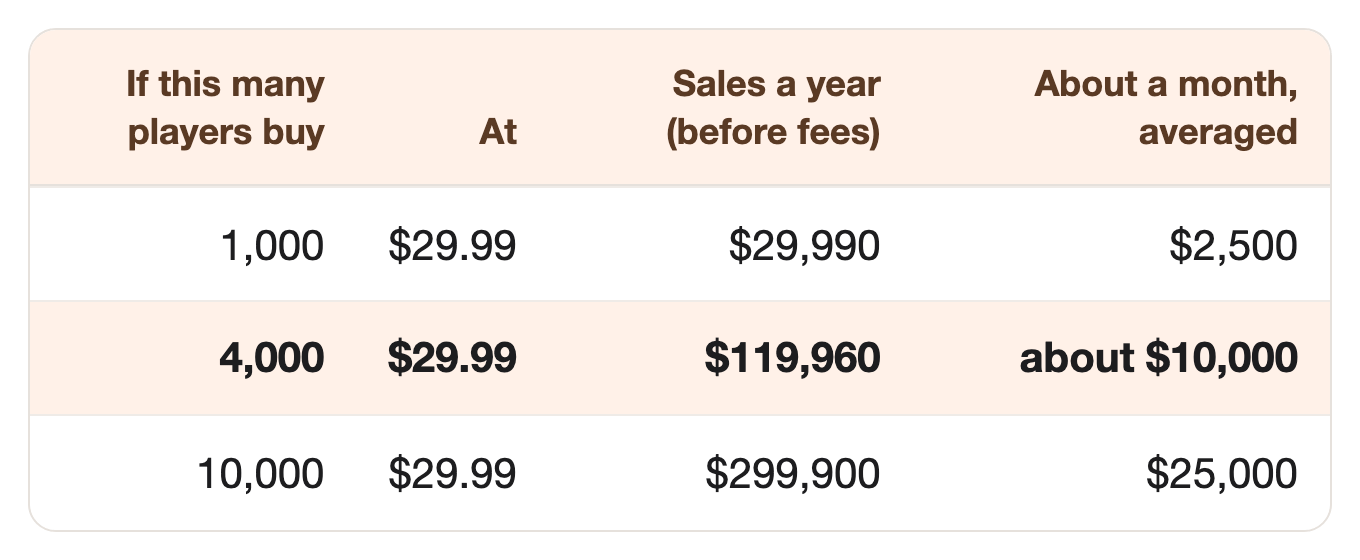
At $29.99, the Ultimate Draft Kit’s price, 4,000 kits a year bring in about $10,000 a month, averaged.
⠀4,000 is under half of the 9,964 people who paid the Footballers on Patreon.
So you’d need fewer buyers than one podcast’s Patreon page.
⠀
Our guess: most sales happen in late summer, in the weeks before the drafts.
The free weekly newsletter keeps readers through the season, so next summer they tell the new players in their league about you.
⠀
And if it doesn’t work, here’s everything you lose:
Nothing for a free newsletter.
One month’s subscription to an AI app, like ChatGPT or Claude.
One week of your time.
⠀
👉 One idea won’t make a million, but three or four might in 2 to 3 years, and this could be your first.
Want to try this one?
The whole plan, the prompt included, is below. 👇
If it’s not your thing, see you next week with a fresh idea.
That’s it, my fellow contrarians! 🙌
Yours ‘helping you skip the guesswork and start with proof’ Vijay Peduru 🦸♂️
⠀
⠀
⠀
🧰 Want to build it? Here’s everything else.
⠀
Step 1: 🎯 Pick one kind of league
Pick the player you’re writing for before you write a word.
Start with first-season players.
Office leagues, where coworkers play together.
Family leagues, where a parent and a teenager play together.
Or a league of friends where one person has never played.
Pick one for now.
Learn what confused them.
New players already post their questions every August, on fantasy football forums.
Part 1 of the prompt searches those posts and turns the most common questions into your jargon page.
Their questions are your research, already written down.
⠀
Step 2: 🛠️ Make the kit
The $29.99 kit is a jargon page and a draft plan. The weekly guide is free, in your newsletter.
The jargon page. 30 words a new player hears in the first week, each in plain words.
The draft plan. A round-by-round plan, with a version for each of the three common scoring setups: standard, half-PPR, and PPR.
A round is one full turn: everyone in the league picks once, then the next round starts.
Standard gives no points for catches, half-PPR gives half a point, and PPR gives a full point.
The weekly guide. A one-page sheet each week of the season: who to start, who to sit, and one move to make.
Your rankings. You rank the players yourself.
Start from the free rankings on the big fantasy sites.
Write down the one rule you use to adjust them, so you rank the same way every week.
⠀
Step 3: 🔍 Check every fact
Player news changes daily, so every fact gets checked after it’s written.
Your AI writes the plan in Part 2, and checks it in Part 3 of the prompt.
🖊️ The AI writer. It builds the plan from the rankings and the league settings you give it.
🔍 The AI fact checker. It opens a dated page for every player fact, and flags anything out of date.
🧐 The AI critic. It reads the plan like a confused first-time player, and flags every word they’d stop at.
If a beginner would stop and squint, it gets fixed.
Optional: if you teamed up with a league veteran, have them read your first kit once before you sell it.
⠀👉 The prompt already follows four safety rules:
No betting picks, odds, or links to paid contests.
No promise that the kit wins a league.
No NFL or team logos.
Never invent a stat or an injury; every player fact needs a dated link.
⠀
Step 4: 🏪 Open your shop
Price it like the Ultimate Draft Kit: one price for the season.
Set your price.
$29.99 for the season, like the Ultimate Draft Kit.
A league price, for the person who runs the league to buy a kit for everyone.
Pick where to sell. Gumroad, Stan (a creator storefront app), or your own website all sell digital files.
Start a free weekly newsletter on Substack, for the season’s guide.
Let AI write your sales page, using one real page from your kit as the example.
⠀
Step 5: 📣 Get your first buyers
New players search for help in the weeks before their draft.
Before and during draft season, reply to reporter requests about fantasy football.
Check reporter request sites like Qwoted and Featured each day, and reply within the hour.
On these sites, reporters post questions they need an expert to answer for an article.
Send three short sentences a reporter can quote, with no pitch, and your kit’s name in your sign-off.
Ask one question at signup: “What’s your league’s scoring: standard, half-PPR, or PPR?”
Then send the free cheat sheet for that exact setup.
Give each buyer one free kit to pass to someone else in their league.
New players often join in pairs, so one buyer can pass the free kit to the other new player.
⠀
Step 6: 🏃 Eliminate competitors
Copycats will come. Here’s how you stay first.
Title every guide with the words new players use.
“What does PPR even mean?” works better than “Scoring formats explained.”
New players hear words like PPR in the group chat from day one.
That’s the kind of question a new player is too proud to ask out loud.
Keep a list of every question readers send you, in their own words.
When you add features, raise the price openly and say what’s new.
Tell buyers what you added, and why the price went up.
Never strip pages out of the kit people already bought.
⠀
Step 7: 🎲 Make it bigger
Players new to other kinds of leagues need a first-season kit too.
Make the same kit for dynasty leagues, where you keep your players for years, and for other fantasy games.
Three kits at about $10,000 a month each is about $360,000 a year, before fees. 🎯
⠀
🗓️ Your first week
Phew. That was a lot. 😅
Good news: a first version of Steps 1 to 5 fits into seven days. 🚀
By day 7, you have a jargon page, a draft plan, a sales page, and your first reporter replies.
Quick heads-up: the prompt below has six Parts, and they’re not the same as the Steps above.
Day 1 (Step 1): Run Part 0 of the prompt (it’s below), and pick your kind of league.
Then make the jargon page with Part 1.
Days 2–3 (Steps 2 and 3): Build the draft plan with Part 2, then check it with Part 3.
Day 4 (Step 2): Make your first weekly guide with Part 4.
Day 5 (Step 4): Write your sales page with Part 5, and open your shop.
Days 6–7 (Step 5): Write your reporter replies, signup email, and pass-it-on note with Part 6.
⠀
🏄 How to use the prompt
One prompt does all the AI work, in six parts, plus a quick market check (Part 0).
Part 1 — Make the jargon page. Explains 30 words a new player hears, in plain words.
Part 2 — Build the draft plan. Turns your league settings and your rankings into a round-by-round plan, plus a short version for standard, half-PPR, and PPR.
Part 3 — Check every fact. Opens a dated page for each player fact, and reads the plan like a confused beginner.
Part 4 — Write the weekly guide. Turns the week’s news into a one-page start-and-sit sheet, with every fact checked.
Part 5 — Write the sales page. Uses one real page from your kit as the example.
Part 6 — Write the first-buyer pieces. Writes three reporter replies, the signup emails, and the pass-it-on note.
Run it your way:
Part by part (the default): it pauses after each part, and you type “next” to go on.
All at once: say “run all six parts.”
Just one part: say “only do Part 3,” or any part you need.
The full prompt is just below, under “📋 The prompt.”
🎙️ Talk to your AI sidekick, don’t type.
Turn on voice mode, or use a dictation app like Wispr Flow.
Say it messy. The AI sorts it out.
Turn it into a skill, so you never paste it again.
Paste the prompt into Claude or ChatGPT, and say: “Turn this into a skill I can save.”
Install once, use forever.
⠀
📋 The prompt
The prompt (copy it into Claude or ChatGPT, fill in the INPUTS part, and run it your way)
CONTEXT:
- You're my content partner. Together we'll build a fantasy football kit for people playing in their first league (or the group I name below).
- This prompt has six parts, plus a market check (Part 0), in order.
- Run it the way I ask:
    - If I say nothing, go one part at a time. After each part, show me the result, then stop and wait. Move on only when I type "next."
    - If I say "run all six parts," do them all without stopping.
    - If I say "only do Part 3" (or any part), do just that part.
- If a part needs something from me, ask for it before you start that part.
- Follow these rules in every part:
    1. This is season-long fantasy football with friends. No betting picks, no odds, and no links to paid contests or betting apps.
    2. Never promise that the kit wins a league or a week.
    3. No NFL or team logos, and no copied articles. Write everything in your own words.
    4. Never invent a stat, an injury, or a news item. Every player fact needs a link to a page with its date.
    5. Write for someone who has never played. Explain every fantasy word the first time you use it.
- Never invent a fact or a number. If you're not sure a fact is right, leave it out.
- Keep web search on for the whole prompt (turn on search in ChatGPT or Claude), so you can open any page you need to check.

=============== INPUTS — edit these, or just run as is ===============

Who the kit is for:
{e.g. first-time players in an office league}

Their league settings:
{e.g. 10 teams, half-PPR scoring, 1 QB, 2 RB, 2 WR, 1 TE, 1 flex, 6 bench spots}

My rankings (paste your own list, or name the method you use):
{e.g. my top 150 players, ranked with the same three questions every week}

What confused new players (paste questions you've seen, or leave blank and Part 1 will search beginner posts on fantasy football forums):
{e.g. "What's a flex spot?", "When do I pick a kicker?"}

My price:
{e.g. $29.99 for the season, plus a league price}

======================== END OF INPUTS ========================

THE PARTS:

Part 0 — Check the market that day.
This part needs web search. Search for help made for first-time fantasy football players and, for each place, give the count, the three biggest with links, and their prices:
1. Etsy and Gumroad shops selling beginner draft kits or cheat sheets.
2. Paid newsletters and memberships for new players.
3. YouTube channels and videos made for first-time players.
4. Free beginner guides from the big fantasy sites.
Then tell me: early (few sellers), growing, or crowded, and which kind of new player looks least served (for example: office leagues, family leagues, dynasty beginners). Give a link for every number. If you can't open a page, say so. Never guess a number.

Part 1 — Make the jargon page.
Search fantasy football forums and beginner guides for questions first-time players posted before their draft. List the 30 words a new player hears in the first week of a league, starting with the ones in my INPUTS, then the ones asked most often in those posts, with a link for each source. For each one, give a plain explanation under 20 words and one short example. Group them: draft day, scoring, and during the season.

Part 2 — Build the draft plan.
Use my league settings and my rankings from INPUTS. If the rankings are missing, ask me for them; never make your own list of players. Give:
1. What the scoring rules mean for who to draft, in three plain sentences.
2. A round-by-round plan: which position to look for in each round, and why.
3. Five draft-night rules for a beginner, like when to pick a kicker.
4. Then give a short version of the plan for each of the three common scoring setups: standard, half-PPR, and PPR.
5. Name a player only if they're in my rankings, and give a dated link for any fact you add about them.

Part 3 — Check every fact.
Now act as a separate fact checker who didn't write the plan. Open a dated page for every player fact in Part 2: team, position, injury, role. Mark each one: checked, out of date, or can't confirm. Remove anything you can't confirm. Then read the whole plan as a confused first-time player, and list every word or step they'd stop at, with a fix. Give the final plan with every fix made.

Part 4 — Write the weekly guide.
Ask me which week of the season it is. Pick the 10 players drafted in most leagues that week. Search for that week's injury and news reports, and give a link with a date for each one. Then write one page:
1. Who to start, and who to sit, each with one plain reason.
2. One waiver-wire move: a player nobody picked who could help, and why. Explain the waiver wire in one line.
3. One thing to ignore this week.
Before you finish, check every player fact again against its dated link, and drop any that's older than three days.

Part 5 — Write the sales page.
Ask me for one finished page from my kit first, and use it as the example. Never invent a result, a review, or a number. Give me:
1. A headline that names the kind of league, not "fantasy players."
2. What's in the kit: the jargon page, the draft plan, and the free weekly guide.
3. How every fact is checked before it goes out.
4. The price, shown up front.
5. A free cheat sheet in exchange for an email address.

Part 6 — Write the first-buyer pieces.
1. Ask me to paste up to three reporter requests from Qwoted or Featured. If I have none, use three common ones, like "tips for your first fantasy draft." For each, write three short sentences a reporter could quote. No pitch, no promise the kit wins, and my kit's name only in the sign-off.
2. Write a signup email that asks one question: "What's your league's scoring: standard, half-PPR, or PPR?" Then write the three follow-up emails, one for each answer, each with the matching free cheat sheet described.
3. Write a short note buyers can send with a free kit to one other person in their league.
⠀
📎 The sources
Every number above, with where it came from.
The Fantasy Footballers’ revenue · Number: “$2.7 million in revenue in 2018, up 68.8% from $1.6 million in 2017”; “$750,000 in 2016”; “no outside investors and no debt” · Source: Front Office Sports, August 30, 2019
How it started · Number: 2014; “Mike and I actually started a podcast for our league”; to “make fun of people, talk about trades”; launched in February; “We felt like there were a lot of people who were a lot like us” · Source: Same article
What they sell, and downloads · Number: “The Ultimate Draft Kit”; “a premium #FootClan membership”; “over 100 million downloads in 2018”; Jason Moore, “longtime friend” · Source: Same article
Fantasy players · Number: 19% of Americans 18+ play fantasy sports, up from 13% in 2014; 79% of players play fantasy football; from “our 2023 survey”: 84% have a college degree or higher, 65% make more than $50,000 · Source: Fantasy Sports & Gaming Association, Industry Demographics (archived copy, January 24, 2026)
FootClan on Patreon · Number: 9,964 paid members; lowest paid level, “FootClan Member,” $5 a month (the page data lists it at 500 US cents; the archived copy shows CA$7.50 because it was saved from Canada) · Source: Patreon (archived copy, February 6, 2026)
Footballguys · Number: “over 50,000 paid subscribers”; “$35k Subscriber Contest: Free entry with annual subscription”; Daily Update “600,000+ opted-in subscribers,” sent 7 days a week “from the NFL Draft to the Super Bowl” · Source: Footballguys, Advertise With Us (archived copy, May 4, 2026)
Ultimate Draft Kit, 2019 · Number: “For just $29.99 you can dominate your draft.” · Source: FanSided, August 13, 2019
Ultimate Draft Kit, 2026 · Number: In-app purchases: “2026 UDK” $29.99; “2026 UDK+” $49.99; “This draft kit is for everyone, from brand new players looking to get off to a hot start to the most avid fantasy experts” · Source: Apple App Store, Fantasy Football Draft Kit UDK (archived copy, April 22, 2026)
Fantasy Football For Dummies · Number: 2nd edition, November 2022; “perfect for beginners interested in joining a league and learning the basics” · Source: Wiley-VCH
The Footballers’ beginner and dynasty pages · Number: Site menu lists “Fantasy Football 101” and a “Dynasty Pass” · Source: The Fantasy Footballers, FootClan page (archived copy, July 18, 2024)