


Hello contrarians,
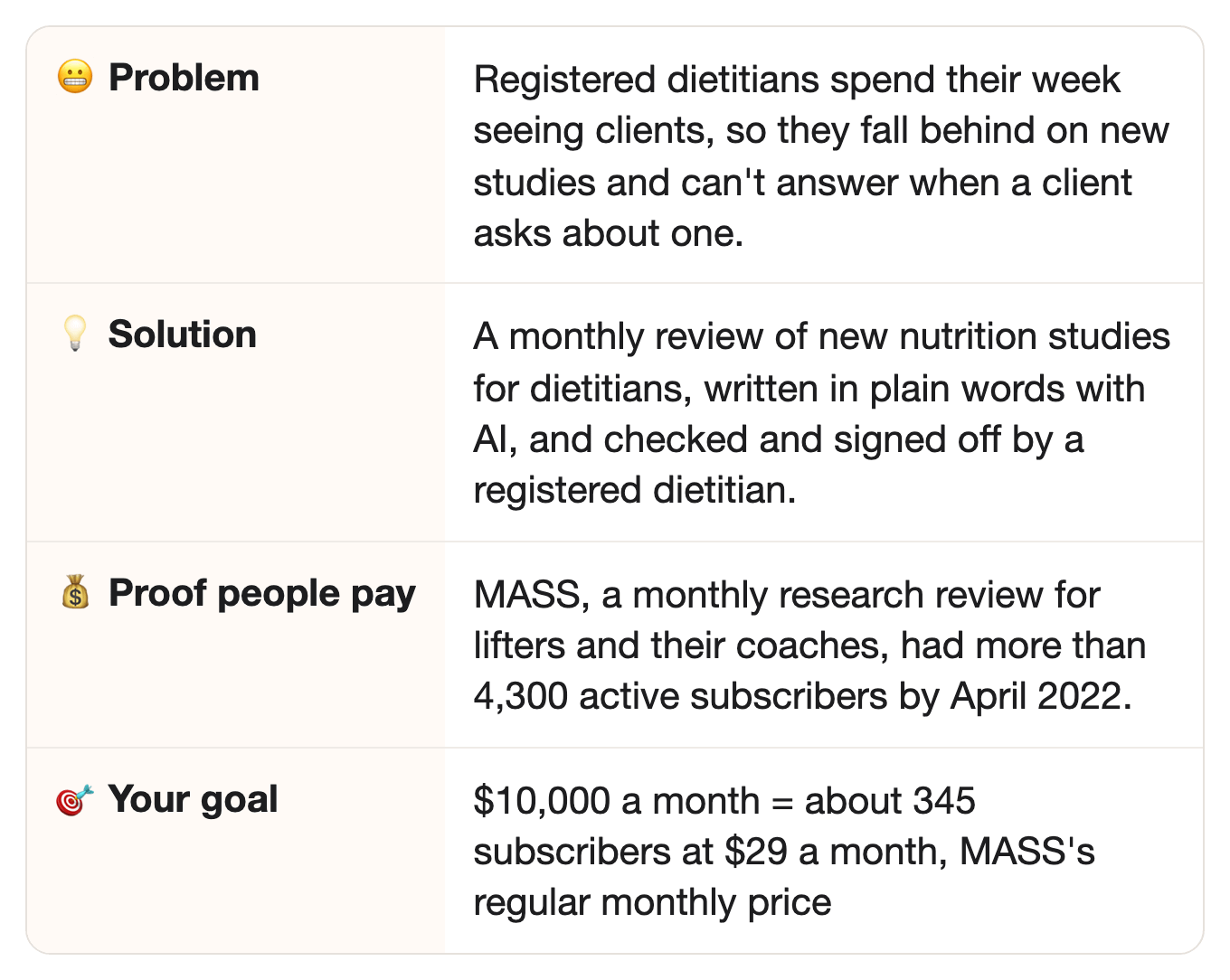
Today’s idea is called The Monthly Research Review for Dietitians.
Pour yourself a tea. 🍵
First, three weightlifters’ story. Then, the business you could build from it.
⠀
⚡ Quick facts
⠀
📖 How three lifters turned reading research into a business
One of them spent 40 to 50 hours a month just reading studies.
Greg Nuckols is a powerlifter who has held three all-time world records in his weight classes.
He also has a master’s degree in exercise and sport science, and he has trained hundreds of athletes.
To coach well, he kept up with the research on muscle and strength.
And that meant 50 to 60 journals putting out more than 1,000 articles a month.
A journal here is a science publication where researchers print their studies, and each article is one study.
Reading them took him 40 to 50 hours a month, by his own count.
Phew.
⠀
And after all that reading, how many new studies changed how coaches should work?
Fewer than 10 a month, he found.
He also saw a problem with how studies got explained.
Most people only read the abstract, the short summary at the top of a study.
He called abstracts “generally incomplete or misleading.”
Ouch.
So in 2017, he teamed up with two other coaches who also lift, Eric Helms and Mike Zourdos.
Together, they launched MASS, short for Monthly Applications in Strength Sport.
Every month, they read the new studies and explain the ones that matter, in plain words and short videos.
⠀
Nerdy fact: when asked if his team was geekier than the nerds in an old movie, Greg said they’re “nerdier.”
Ha.
They kept it narrow on purpose.
Greg said MASS is “not for people focused on general health.”
It’s only for people who lift, and the coaches who train them.
⠀
By 2019, the regular price was $29 a month or $299 a year.
For its second birthday, it ran a sale: $21 a month, $209 a year, or $699 once for life.
One coach wrote that he hates reading research… and he still called MASS one of his favorite research reviews.
By April 2022, MASS had 60 issues out and more than 4,300 active subscribers.
Bingo bango. 🎯
Rough math: 4,300 subscribers at the $209 sale price for a year is about $900,000 a year, or about $75,000 a month.
That’s our estimate, not a number they shared, and some subscribers paid less on a one-time plan.
They went from going through 1,000+ articles a month for themselves, to thousands of subscribers, by doing that reading for everyone else.
⠀
🔗 Same idea, new group
In the story: lifters and their coaches paid MASS to read more than 1,000 studies a month and explain the few that matter.
⠀In this idea: dietitians need the same monthly reading done for them, for new nutrition studies.
⠀Why it carries over: both groups must keep up with research, and neither has 40 to 50 hours a month to read it.
⠀
💡 The opportunity
Dietitians have the same reading problem, and their clients bring the headlines to them.
Wait, who are registered dietitians, exactly?
They’re nutrition experts with a master’s degree and supervised training.
Many states require them to be licensed.
They work in hospitals, clinics, nursing homes, and their own private practices.
⠀
There are a lot of them.
There were about 90,900 dietitian and nutritionist jobs in the US in 2024.
About 6,200 openings are expected each year, on average, over the decade (a government projection).
The Academy of Nutrition and Dietetics, the US group that calls itself the biggest for food and nutrition professionals, has over 112,000 members.
⠀
Here’s the useful part: keeping up with research is part of their job description.
Yep, it’s written down.
The US government’s job guide says dietitians “must keep up with food and nutrition research.”
It also says they should be able to turn studies into “practical guidance.”
And to keep their RDN credential (registered dietitian nutritionist, their official title), they must earn continuing-education credits within a set number of years.
A credit is a point they earn for taking an approved course.
Your review won’t earn credits at first, but it does the reading part of the job they already have to do.
Adding credits later, as MASS did, is Step 7.
⠀
But new studies never stop.
Every new diet study can turn into a headline a client brings to their next visit.
Remember Greg’s 40 to 50 hours a month of reading?
A dietitian with a full week of clients doesn’t have 40 spare hours a month to read studies, the way Greg did.
⠀
👉 The idea: every month, send dietitians a short review of the new studies that matter for their work.
Each summary is checked and signed off by a registered dietitian.
⠀
🙋 Not a dietitian? You can still build this.
Team up with one. This part isn’t optional.
A registered dietitian checks and signs off on every summary before it goes out.
And you? You run the system: finding studies, drafting with AI, the layout, the emails, and the sales.
MASS works the same way: it’s written by coaches who read the research and lift.
⠀
Become the interviewer.
Talk to 10 dietitians, with their permission, on a podcast or newsletter.
Ask which studies their clients ask about, and which journals they wish they had time to read.
⠀
Or use your own field.
Does your job need a license and ask you to keep up with research?
Then this works for you too, the way it would for nurses, pharmacists, or physical therapists.
Same rule: someone with the license signs off on every summary.
⠀
✅ Why this could work
Three reasons this can pay.
MASS isn’t the only one. Another fitness review has been selling since 2008.
Alan Aragon launched a monthly research review for the fitness world in January 2008.
It covers nutrition, training, and supplement studies, for $10 a month or $99 a year.
⠀
Speech therapists have one built just for them.
The Informed SLP sums up research for speech therapists (SLPs), and says it’s trusted by 40,000+ SLPs.
Its paid plan starts at $12 a month, with continuing-education credits included.
⠀
People have needed this for 18 years, and they still do.
Alan Aragon’s review started in January 2008, and it was still selling in May 2026.
MASS had been running for five years by April 2022.
⠀
👉 Don’t take my word for it. Every number is linked in “📎 The sources,” at the very end.
⠀
📊 More proof people want this
Want more? Here you go.
The job itself asks for it.
The government job guide lists “keep up with or contribute to the latest food and nutritional science research” as part of the work.
⠀
People who hate reading research still pay for a review.
Tony Gentilcore is a well-known strength coach.
He wrote that he hates reading research.
But he still called MASS one of his favorite research reviews and sent his readers to it.
⠀
Busy clinicians say a review saves them time.
A speech therapist quoted on The Informed SLP’s site says it “saves me time with research so I can actually do my job.”
That’s the whole pitch, in one line.
⠀
Credits make a review worth more.
By 2022, MASS offered continuing-education credits for several fitness groups.
These are the groups that certify personal trainers and coaches, and their members need credits to stay certified.
The Informed SLP includes them in its paid plan.
Dietitians need credits too, so this is a natural next step later.
⠀
And the money in this job is real. 💰
The median dietitian or nutritionist, the one right in the middle of the pay range, earned $73,850 a year (May 2024).
So $29 a month is a small cost on that pay, and it saves hours of reading every month.
⠀
👉 Dietitians are told to keep up with research, and other jobs already pay for someone to do the reading.
So a review made just for dietitians can sell too.
⠀
🔍 Who’s already doing it
Yes, big names exist. But none is built for dietitians.
MASS is for lifters and the coaches who train them.
Greg himself said it’s “not for people focused on general health.”
A dietitian’s clients with kidney disease or diabetes aren’t in its pages.
⠀
Alan Aragon’s review is made for the fitness world.
It’s aimed at the fitness audience, and it covers nutrition, training, and supplements.
It isn’t built around the clients a kidney or diabetes dietitian sees.
⠀
The Informed SLP shows the model, but only for speech therapists.
It’s made for SLPs, the speech therapists who use it to keep up with research.
⠀
A magazine for dietitians sells continuing-education courses.
In June 2026, its publisher’s site still offered courses for dietitians.
In 2021, its CPE Monthly courses were articles that earned credit, one course at a time.
CPE stands for continuing professional education, the dietitian name for continuing-education credits.
⠀
What’s missing, when we checked:
A monthly review of new studies for one kind of dietitian, like kidney dietitians or dietitians in private practice.
Every summary signed by a registered dietitian, with a plain line on how strong the study is.
⠀
🔎 Check the market yourself in 2 minutes: run Part 0 of the prompt in the build plan below.
Your AI searches research reviews, newsletters, and continuing-education sellers that day, and tells you: early, growing, or crowded.
Early? Start now.
Crowded? Good news: it means dietitians pay. Pick one narrower kind of dietitian (Step 1 of the build plan).
A crowded market is still OK. You win by serving one kind of dietitian better, not by being first.
⠀
👉 That’s the gap you can fill.
A monthly study review made for one kind of dietitian, signed off by a registered dietitian.
⠀
🤖 Why AI won’t replace it
Could ChatGPT just do this? Sort of, if someone tells it which journals to search and checks every claim against the paper. Your review does that work.
🔮 Honest note: the summary alone isn’t the product.
The product is the right studies, checked against the full paper, with a dietitian’s name on it.
⠀
1. You pick what matters.Remember Greg’s reading pile?
He found fewer than 10 studies a month that mattered, out of more than 1,000.
Choosing those few is the work, and it takes someone who knows the clients.
⠀
2. Checked three times.An abstract can say more than the study shows.
Your review checks each summary against the full paper, reads it again like a strict reviewer, and then a dietitian checks it a third time.
⠀
3. Trust.A dietitian can’t tell a client “an AI said so.”
A review signed by a registered dietitian is something they can rely on.
⠀
4. Ready to use.Each summary ends with what it means for their work, in a line they can use with a client.
⠀
👉 AI can write a summary, but it can’t pick the studies or sign them.
The few studies that matter, with a dietitian’s name on them: that’s what they pay for.
⠀
💵 How much you can make
Let’s run the numbers.
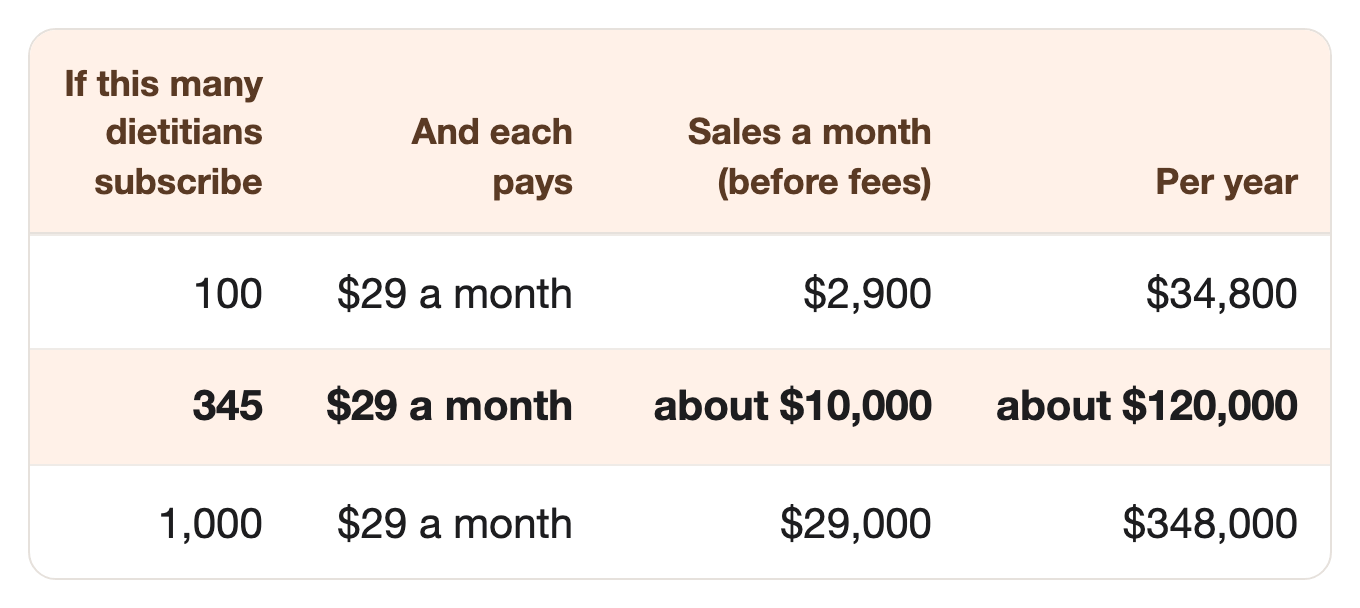
At $29 a month, MASS’s regular price, 345 dietitians bring in about $10,000 a month.
⠀And 345 is under half of 1% of the 90,900 dietitian and nutritionist jobs in 2024.
⠀Your partner gets paid out of this.
Agree on a monthly fee or a share of sales up front (Step 1).
Either way, the table above is sales before your partner’s pay and Substack’s fees.
⠀
And if it doesn’t work? Here’s all you lose:
Nothing for Substack, which is free to start on.
One month’s subscription to an AI app, like ChatGPT or Claude.
What you pay your dietitian partner to review the first issue.
One week of your time.
⠀
👉 Run three of these well for three years, and the total could pass a million: no promises, just the numbers.
That’s three reviews like this one at about $10,000 a month each.
Together, that’s about $360,000 a year, and more than a million over three years.
Is your brain already buzzing? 🐝
Then scroll on. The build plan is below. 👇
Not feeling it? All good. Another idea comes next week.
That’s it, my fellow contrarians! 🙌
Yours ‘hoping one of these sparks an idea of your own’ Vijay Peduru 🦸♂️
⠀
⠀
⠀
🧰 Want to build it? Here’s everything else.
⠀
Step 1: 🎯 Pick one kind of dietitian, and your partner
A review for “all dietitians” covers so many topics that each reader skips most of it.
A review just for kidney dietitians is about their clients on every page, so it’s the one they pick.
Pick one group.
Dietitians in private practice.
Kidney dietitians, who work with dialysis patients.
Dialysis is a machine that cleans the blood when a person’s kidneys stop working.
These patients must follow strict rules on foods like salt and potassium, so their dietitians need research on exactly that.
Sports dietitians, who work with athletes.
Diabetes educators, or dietitians who work with children.
Find your registered dietitian partner.
They check and sign off on every summary before it goes out.
Agree up front on pay, the time each issue takes, and how their name appears.
Learn what their clients ask.
Ask your dietitian partner which studies their clients bring in, and which journals they wish they had time to read.
Then have your AI read dietitian forums online for the diet headlines clients ask about most.
⠀
Step 2: 🛠️ Make the first issue
One issue is 5 to 8 study summaries, plus a short “in the news” section.
Find the month’s studies. Your AI searches PubMed (the free US database of medical studies) and the main journals for your group.
Pick the few that matter. Your partner picks from the AI’s shortlist.
Get the full papers. Many are free; for the rest, use your partner’s journal access.
Many journals charge to read a full study.
Dietitians often can read them for free through their hospital, university, or professional group.
Write each summary. What they tested, on whom, what they found, how strong the evidence is, and what it means for their work with clients.
Add “in the news.” One headline clients are asking about, and what the study behind it really showed.
⠀
Step 3: 🔍 Check every summary
Dietitians will use these with clients, so every summary gets checked three times.
Your AI writes each summary, then does the first two checks.
It writes in Part 2 of the prompt, and checks in Parts 3 and 4.
Your dietitian partner does the third check.
🖊️ The AI writer. It writes each summary only from the paper you paste in.
🔍 The AI fact checker. A second pass checks every number and claim against the paper, and flags anything the paper doesn’t say.
🧐 The AI critic. A third pass reads it like a strict dietitian reviewer, and like a busy dietitian skimming between clients.
Then your dietitian partner signs off. Nothing goes out without their name on it.
⠀👉 The prompt already follows five safety rules:
No study, number, author, or link that isn’t in the paper or a page it opened.
Every summary says the study type, who was studied, and how many.
No advice to any one client or reader; the review is for professionals.
No claims about continuing-education credit.
Every issue ends with: “For health professionals. Not medical advice. Reviewed by a registered dietitian.”
⠀
Step 4: 🏪 Open for subscribers
Copy MASS: one monthly price, one yearly price, and nothing else.
Easy one.
Set your prices.
$29 a month, like MASS’s regular price.
$299 a year, like MASS’s regular yearly price.
Sell on Substack. It’s free to start, and it takes monthly and yearly payments.
Send one free sample issue, so dietitians can see the work before they pay.
Let AI write your sales page, using two real summaries from your first issue as examples.
⠀
Step 5: 📣 Get your first subscribers
Go where dietitians already read about new studies.
When a diet study is in the news, post about it on LinkedIn the next day.
Say what the study really tested, how strong the evidence is, and what dietitians might hear from clients.
Keep it for professionals, with no advice to the public.
Record a 30-minute self-interview each week, and turn it into three LinkedIn posts.
Answer three questions, like “Which study surprised me this month?”
Put the link to your review in the post itself, not in the comments.
Swap Substack recommendations with two or three newsletters dietitians read.
Pick ones on a different topic, like private-practice business or recipes for clients.
Recommend them back.
⠀
Step 6: 🏃 Eliminate competitors
When others copy you, here’s how you stay the one people pick.
Show your proof in public, in a way copycats can’t match.
Invite any other review to show, for every summary, the paper’s link and the name of the dietitian who checked it, as you do.
Either they match it, or readers notice they can’t.
Sign your dietitian partner to a long deal.
Sign a year-long deal, and feature them by name in every issue.
A copycat can copy the format, but not the trusted name on it.
⠀
Step 7: 🎲 Make it bigger
Every licensed job that must keep up with research has the same setup.
Look into offering continuing-education credit.
MASS and The Informed SLP both include credits.
Check the current rules for becoming an approved provider before you promise any.
An approved provider is a company the dietitian credentialing body has signed off to award credits.
Open a second review for another kind of dietitian, or for nurses, pharmacists, or physical therapists, each with its own licensed partner.
Three reviews at about $10,000 a month each is about $360,000 a year, before fees. 🎯
⠀
🗓️ Your first week
Phew. That was a lot. 😅
A first version of Steps 1 to 5 fits into seven days. 🚀
By day 7, you have a sample issue, a sales page, and your first posts.
Quick heads-up: the prompt below has seven Parts, and they’re not the same as the Steps above.
Day 1 (Steps 1 and 2): Run Part 0 of the prompt (it’s below), pick your kind of dietitian, and line up your dietitian partner.
Then find the month’s studies with Part 1.
Days 2–3 (Steps 2 and 3): Write the summaries with Part 2, then check them with Parts 3 and 4.
Day 4 (Steps 2 and 3): Build the issue with Part 5, and send it to your dietitian partner to sign off.
Day 5 (Step 4): Write your sales page with Part 6, and open for subscribers.
Days 6–7 (Step 5): Write your first news post, LinkedIn posts, and recommendation notes with Part 7.
⠀
🏄 How to use the prompt
One prompt does all the AI work, in seven parts, plus a quick market check (Part 0).
Part 1 — Find the month’s studies. Searches for new studies for your kind of dietitian, and gives you a shortlist with links.
Part 2 — Write the summaries. Writes one plain summary per paper you paste in, with how strong the evidence is and what it means for practice.
Part 3 — Check the facts. Checks every number and claim against the paper, and flags anything the paper doesn’t say.
Part 4 — Find the mistakes. Reads it like a strict dietitian reviewer, and like a busy dietitian.
Part 5 — Build the issue. Puts it in order, adds “in the news,” and makes a sign-off sheet for your dietitian partner.
Part 6 — Write the sales page. Uses your real summaries as examples.
Part 7 — Write your first posts. A next-day news post, three LinkedIn posts from your self-interview, and a recommendation-swap note.
Run it your way:
Part by part (the default): it pauses after each part, and you type “next” to keep going.
All at once: say “run all seven parts.”
Just one part: say “only do Part 3,” or any part you need.
The full prompt is just below, under “📋 The prompt.”
🎙️ Talk to your AI sidekick, don’t type.
Turn on voice mode, or use a dictation app like Wispr Flow.
Say it messy. The AI sorts it out.
Turn it into a skill, so you never paste it again.
Paste the prompt into Claude or ChatGPT, and say: “Turn this into a skill I can save.”
Install once, use forever.
⠀
📋 The prompt
The prompt (copy it into Claude or ChatGPT, fill in the INPUTS part, and run it your way)
CONTEXT:
- You're my research partner. Together we'll build a monthly research review for registered dietitians (or the group I name below).
- This prompt has a quick market check (Part 0), then seven parts, in order. "Run all seven parts" means Parts 1 to 7.
- Run it the way I ask:
    - If I say nothing, go one part at a time. After each part, show me the result, then stop and wait. Move on only when I type "next."
    - If I say "run all seven parts," do them all without stopping.
    - If I say "only do Part 3" (or any part), do just that part.
- If a part needs something from me, ask for it before you start that part.
- This review is for health professionals, and a registered dietitian signs off on every summary. Follow these rules in every part:
    1. Never invent a study, a number, an author, a journal, or a link. Use only the papers I paste in and pages you actually open.
    2. For every study, say the study type (for example, randomized trial, observational study, review), who was studied (people or animals), and how many.
    3. Never say a study "proves" something. Say what it found, and how strong the evidence is.
    4. Never give advice to one client, a patient, or the reader. Write for dietitians, about what the study means for their practice.
    5. If the paper says who funded it or lists conflicts of interest, include them.
    6. Never claim the review earns continuing-education credit.
- End every issue with this line: "For health professionals. Not medical advice. Reviewed by a registered dietitian."
- If you're not sure a fact is right, leave it out and tell me.
- Keep web search on for the whole prompt (turn on search in ChatGPT or Claude), so you can open any page you need to check.

=============== INPUTS — edit these, or just run as is ===============

Who the review is for:
{e.g. registered dietitians in private practice who work with kidney disease}

The month:
{e.g. March}

What their clients ask most (paste what your partner hears, or questions you found posted online, or leave blank):
{e.g. "I saw a study on the news, should I change what I eat?", "Is this new supplement worth it?"}

My dietitian partner's name and credential:
{e.g. Jane Doe, RDN}

My prices:
{e.g. $29 a month, $299 a year}

======================== END OF INPUTS ========================

THE PARTS:

Part 0 — Check the market today.
This part needs web search (turn on search in ChatGPT or Claude). Search for research reviews and study summaries made for my kind of dietitian and, for each place, give the count, the three biggest with links, and their prices:
1. Paid research reviews and newsletters that sum up nutrition studies.
2. Continuing-education sellers that cover new research.
3. Free summaries from dietitian groups, journals, or companies.
4. The biggest social accounts explaining new nutrition studies to dietitians.
Then tell me: early (few sellers), growing, or crowded, and which kind of dietitian looks least served (for example: kidney, private practice, pediatric). Give a link for every number. If you can't open a page, say so. Never guess a number.

Part 1 — Find the month's studies.
Search PubMed and the main journals for my kind of dietitian for studies published in the month in my INPUTS. Give me a shortlist of 12 to 15. For each: the title, journal, date, study type, who was studied and how many, and the link. Mark the 5 to 8 that matter most for practice (use what their clients ask most, from my INPUTS, if I gave it), and say why in one line. Say clearly which reasons are your guess. Then tell me which ones have free full text, so I can paste them in.

Part 2 — Write the summaries.
Ask me to paste the full text (or at least the methods and results) of each study I picked. Write one summary per study, for a busy dietitian:
1. A plain headline that says what was found, with no hype.
2. What they tested, on whom, and how many.
3. What they found, with the main numbers from the paper.
4. How strong it is: the study type, its size, and its biggest limit.
5. What it means for practice, in one or two lines.
Keep each summary under 250 words, and follow every rule in CONTEXT.

Part 3 — Check the facts.
Now act as a separate fact checker who didn't write these summaries. Check every number, claim, and study detail against the paper I pasted. Mark each summary: correct, needs a fix, or drop it. For each problem, quote the words and say what the paper actually says. Then give a fixed version of every summary that needs one.

Part 4 — Find the mistakes.
Now act as a strict registered dietitian reviewer, then as a busy dietitian reading between clients. As the reviewer, flag anything that overstates the evidence, reads like advice to one person, or leaves out a big limit. As the busy reader, flag any word or line that's unclear. Then give the final summaries, with every fix made.

Part 5 — Build the issue.
Put the final summaries in order, most useful first. Add:
1. A short opening note, under 100 words.
2. An "in the news" section: ask me for one headline clients are asking about, then say what the study behind it tested and found, following the rules in CONTEXT.
3. A sign-off sheet for my dietitian partner: one line per summary, with the paper's link and a box marked "Checked and approved by: ____".
4. The closing line from CONTEXT.

Part 6 — Write the sales page.
Ask me for two of my best finished summaries first. Use them as examples. Never invent a result, a review, or a number. Give me:
1. A headline that names my kind of dietitian, not "dietitians."
2. What they get each month: the number of summaries, the "in the news" section, and the links to every paper.
3. How every summary is checked, and the name of the dietitian who signs off.
4. The prices, shown up front, and "Cancel any time."
5. A free sample issue, in exchange for an email address.

Part 7 — Write your first posts.
1. Ask me for one diet study that's in the news. Write a next-day post for dietitians: what it tested, on whom, how strong it is, and what clients may ask. No advice to the public, and no promises.
2. Ask me for the transcript of my 30-minute self-interview. Turn it into three LinkedIn posts, with the link to my review in each post.
3. Write a short note to a newsletter that dietitians read, on a different topic from mine, offering to recommend each other on Substack.
⠀
📎 The sources
Every number above, with where it came from.
MASS subscribers and issues · Number: “As of April 2022, we have more than 4,300 active subscribers”; “Since we started in April 2017, we’ve published 60 issues”; offers credits “for NSCA and NASM” and “for ACSM and ACE” · Source: Stronger By Science, The Best of MASS 2021–2022 (April 2022)
Greg Nuckols’ records and degree · Number: “held three all-time world records in powerlifting”; M.A. in exercise and sport science · Source: Same April 2022 PDF
Why MASS started · Number: “at least 50-60 journals”; “1000+ articles per month”; “40-50 hours per month”; “fewer than 10 new studies”; abstracts “generally incomplete or misleading”; “not for people focused on general health”; “we’re nerdier”; with Eric Helms and Mike Zourdos · Source: Tony Gentilcore, interview with Greg Nuckols, May 1, 2017
MASS prices · Number: “$21 monthly subscription (normally $29)”; “$209 yearly subscription (normally $299)”; “$699 lifetime subscription (normally $999)”; Tony writes that he hates reading research and calls MASS “one of my favorite research reviews” · Source: Tony Gentilcore, April 25, 2019
MASS rough math · Number: 4,300 × $209 = $898,700 a year, about $74,900 a month; our estimate, not a number MASS shared · Source: Math from the two MASS sources above
Dietitian jobs · Number: About 90,900 jobs in 2024; about 6,200 openings projected each year, on average, over the decade; median pay $73,850 (May 2024); “must keep up with food and nutrition research”; “Keep up with or contribute to the latest food and nutritional science research”; “translate nutrition science into practical guidance”; RDN needs a master’s degree, supervised training, and continuing-education credits; many states require a license · Source: US Bureau of Labor Statistics, Wayback copy, July 23, 2026
Academy of Nutrition and Dietetics · Number: “over 112,000 members”; “the largest organization of food and nutrition professionals” (the association’s own claim) · Source: Wikipedia, Wayback copy, June 29, 2026
Alan Aragon’s Research Review · Number: “In January, 2008… I launched the first-ever monthly research review”; “$10 USD a month”; “$99 USD/year”; “targeted toward the fitness audience” · Source: AlanAragon.com, Wayback copy, May 14, 2026
The Informed SLP · Number: “Trusted By 40000 + SLPs”; “as little as $12 per month for unlimited CEUs”; “saves me time with research so I can actually do my job” · Source: The Informed SLP, Wayback copy, April 22, 2026
A magazine for dietitians (ce.todaysdietitian.com) · Number: Sells “CPE Monthly Courses” and other continuing-education courses for dietitians · Source: Its continuing-education site, Wayback copy, March 5, 2021
The magazine’s publisher offered CE for dietitians (June 2026) · Number: Its publisher’s CE site lists “CPD for Dietitians” and “Today’s Dietitian” among its continuing-education brands · Source: Great Valley Publishing CE site, Wayback copy, June 12, 2026
Our money math · Number: 345 × $29 = $10,005 a month; 345 is about 0.38% of 90,900 · Source: Math from the sources above